4804. Bank of Edwardsville (Edwardsville, IL)

Bank Information

Episode Type
Run → Suspension → Unsure
Bank Type
state
Start Date
August 21, 1821
Location
Edwardsville, Illinois (38.811, -89.953)

Metadata

Model
gpt-5-mini
Short Digest
507fe165

Response Measures

Accommodated withdrawals, Partial suspension

Description

August 1821: a brief run occurred after the failure of the Bank of Missouri (depositors from St. Louis/St. Charles). On Sept 3, 1821 the bank's board announced a temporary and partial suspension of specie payments (small notes under $10 still redeemed). No clear article states a full resumption of general specie payments, so reopening is uncertain.

Events (2)

1. August 21, 1821 Run
Cause
Local Banks
Cause Details
News of the failure of the Bank of Missouri caused depositors from St. Louis and St. Charles to redeem Edwardsville notes.
Measures
Bank opened early, kept doors open several hours past usual closing; redeemed notes in specie and afforded facilities to obtain specie; continued redemption of small denominations.
Newspaper Excerpt
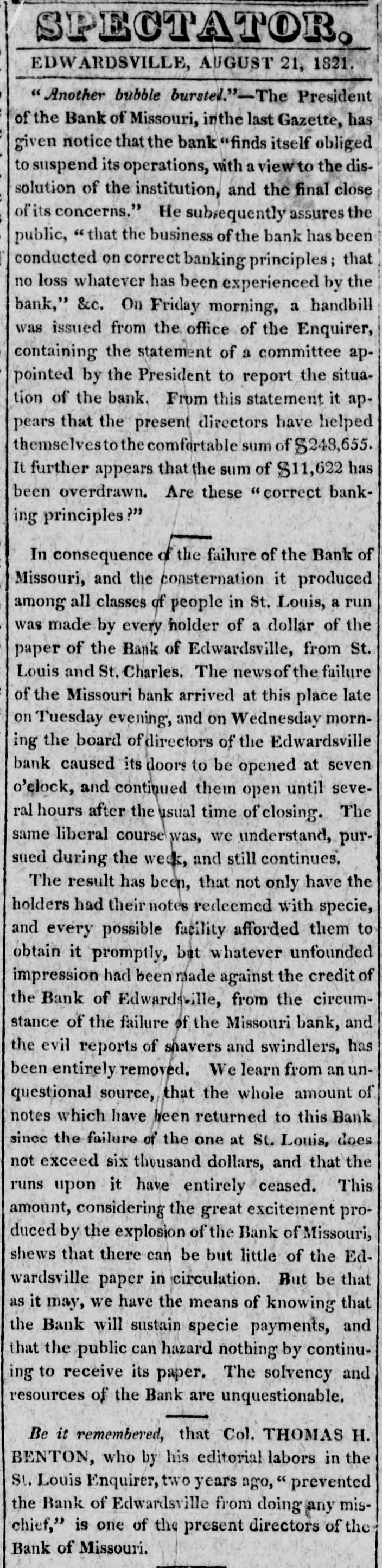
a run was made by every holder of a dollar of the paper of the Bank of Edwardsville, from St. Louis and St. Charles.
Source
newspapers
2. September 3, 1821 Suspension
Cause Details
Board cited large and incessant drains of specie (exportation to remote points) and self-preservation as reasons for temporary partial suspension.
Newspaper Excerpt
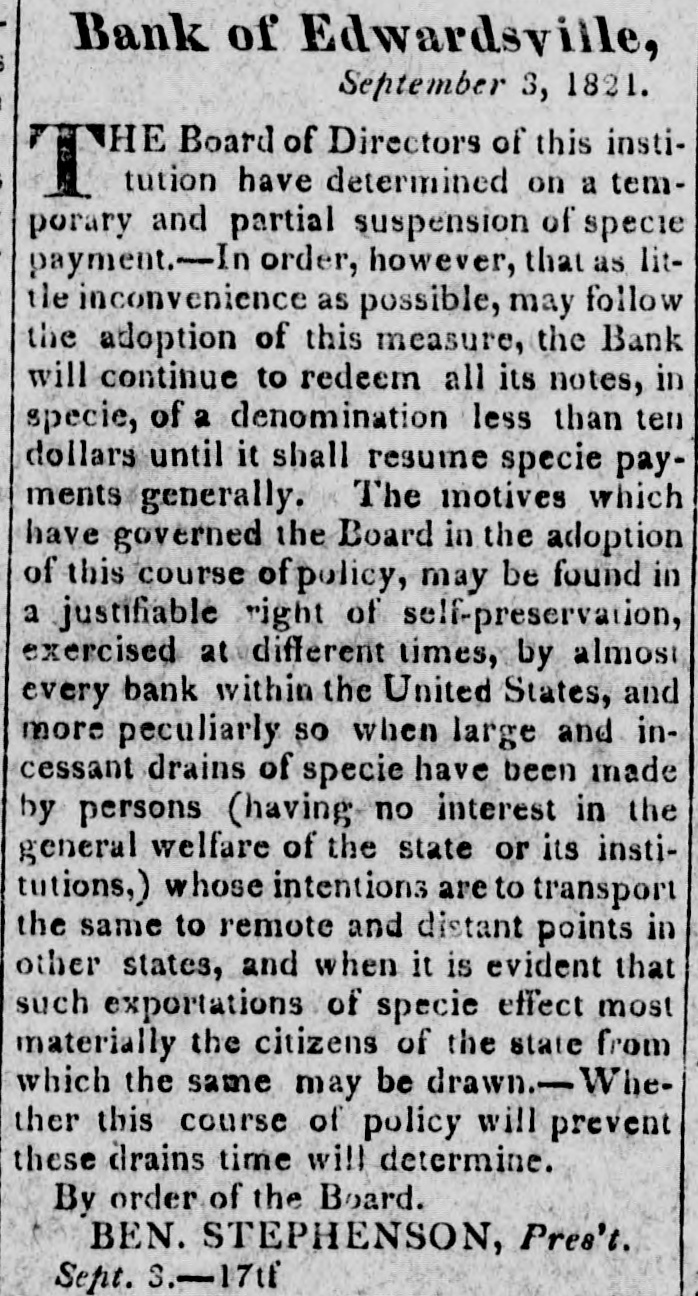
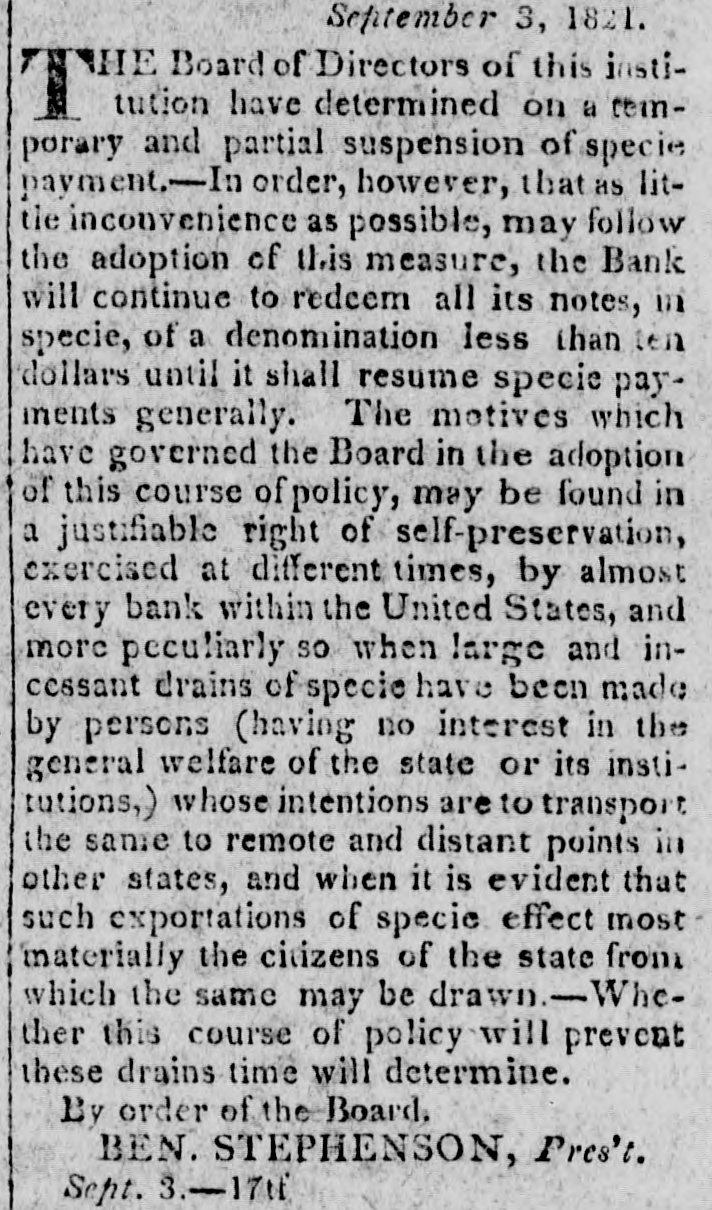
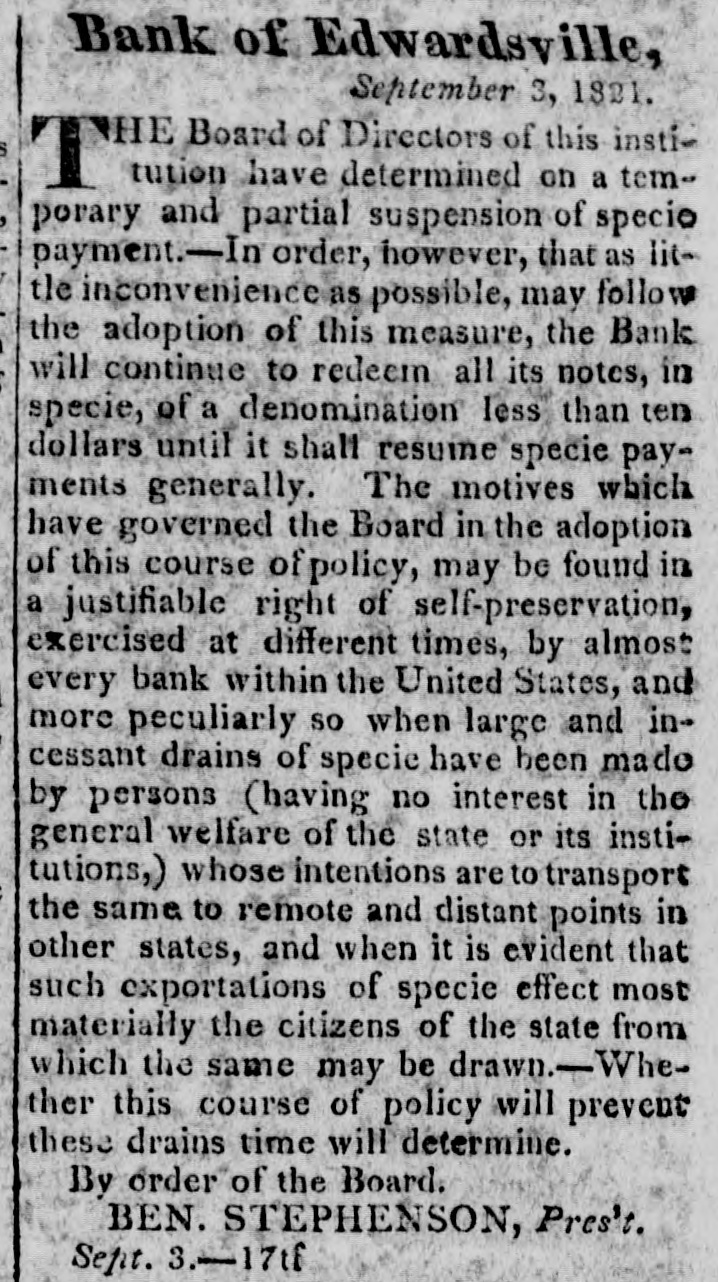
THE Board of Directors of this institution have determined on a temporary and partial suspension of specie payment...the Bank will continue to redeem all its notes, in specie, of a denomination less than ten dollars until it shall resume specie payments generally.
Source
newspapers

Newspaper Articles (6)

Article from Edwardsville Spectator, August 21, 1821

Click image to open full size in new tab

Article Text

SPECTATOR EDWARDSVILLE, AUGUST 21, 1821. Another bubble bursted."-The President of the Bank of Missouri, inthe last Gazette, has given notice that the bank "finds itself obliged to suspend its operations, with a view to the dissolution of the institution, and the final close of its concerns." He subsequently assures the public, " that the business of the bank has been conducted on correct banking principles; that no loss whatever has been experienced by the bank," &c. On Friday morning, a handbill was issued from the office of the Enquirer, containing the statement of a committee appointed by the President to report the situation of the bank. From this statement it appears that the present directors have helped themselves to the comfortable sum of $248,655. It further appears that the sum of $11,622 has been overdrawn. Are these "correct banking principles?" In consequence of the failure of the Bank of Missouri, and the consternation it produced among all classes of people in St. Louis, a run was made by every holder of a dollar of the paper of the Bank of Edwardsville, from St. Louis and St. Charles. The news of the failure of the Missouri bank arrived at this place late on Tuesday evening, and on Wednesday morning the board of directors of the Edwardsville bank caused its doors to be opened at seven o'clock, and continued them open until several hours after the usual time of closing. The same liberal course was, we understand, pursued during the week, and still continues. The result has been, that not only have the holders had their notes redeemed with specie, and every possible facility afforded them to obtain it promptly, but whatever unfounded impression had been made against the credit of the Bank of Edwardsville, from the circumstance of the failure of the Missouri bank, and the evil reports of shavers and swindlers, has been entirely removed. We learn from an unquestional source, that the whole amount of notes which have been returned to this Bank since the failure of the one at St. Louis, does not exceed six thousand dollars, and that the runs upon it have entirely ceased. This amount, considering the great excitement produced by the explosion of the Bank of Missouri, shews that there can be but little of the Edwardsville paper in circulation. But be that as it may, we have the means of knowing that the Bank will sustain specie payments, and that the public can hazard nothing by continuing to receive its paper. The solvency and resources of the Bank are unquestionable. Be it remembered, that Col. THOMAS H. BENTON, who by his editorial labors in the St. Louis Enquirer, two years ago, prevented the Bank of Edwardsville from doing any mischief," is one of the present directors of the Bank of Missouri.


Article from Edwardsville Spectator, September 4, 1821

Click image to open full size in new tab

Article Text

Bank of Edwardsville, September 3, 1821. HE Board of Directors of this institution have determined on a tem1 porary and partial suspension of specie payment.-In order, however, that as littie inconvenience as possible, may follow the adoption of this measure, the Bank will continue to redeem all its notes, in specie, of 2 denomination less than ten dollars until it shall resume specie payments generally. The motives which have governed the Board in the adoption of this course of policy, may be found in a justifiable right of self-preservation, exercised at different times, by almost every bank within the United States, and more peculiarly so when large and incessant drains of specie have been made by persons (having no interest in the general welfare of the state or its institutions,) whose intentions are to transport the same to remote and distant points in other states, and when it is evident that such exportations of specie effect most materially the citizens of the state from which the same may be drawn.-Whether this course of policy will prevent these drains time will determine. By order of the Board. BEN. STEPHENSON, Pres't. Sept. 3.-17tf


Article from Edwardsville Spectator, September 11, 1821

Click image to open full size in new tab

Article Text

September 3, 1821. THE Board of Directors of this institution have determined on a temporary and partial suspension of specie payment. In order, however, that as little inconvenience as possible, may follow the adoption of this measure, the Bank will continue to redeem all its notes, in specie, of a denomination less than ten dollars until it shall resume specie payments generally. The motives which have governed the Board in the adoption of this course of policy, may be found in a justifiable right of self-preservation, exercised at different times, by almost every bank within the United States, and more peculiarly so when large and incessant drains of specie have been made by persons (having no interest in the general welfare of the state or its institutions,) whose intentions are to transport the same to remote and distant points in other states, and when it is evident that such exportations of specie effect most materially the citizens of the state from which the same may be drawn.-Whether this course of policy will prevent these drains time will determine. By order of the Board. BEN. STEPHENSON, Pres't. Sept. 3.-17th


Article from Edwardsville Spectator, September 18, 1821

Click image to open full size in new tab

Article Text

Bank of Edwardsville, September 3, 1821. HE Board of Directors of this instiT tution have determined on a temporary and partial suspension of specio payment.-In order, however, that as little inconvenience as possible, may follow the adoption of this measure, the Bank will continue to redeem all its notes, in specie, of a denomination less than ten dollars until it shall resuine specie payments generally. The motives which have governed the Board in the adoption of this course of policy, may be found in a justifiable right of self-preservation, exercised at different times, by almost every bank within the United States, and more peculiarly so when large and incessant drains of specie have been mado by persons (having no interest in the general welfare of the state or its institutions,) whose intentions are to transport the same to remote and distant points in other states, and when it is evident that such exportations of specie effect most materially the citizens of the state from which the same may be drawn.-Whether this course of policy will prevent these drains time will determine. By order of the Board. BEN. STEPHENSON, Pres't. Sept. 3.-17tf


Article from Constitutional Whig, July 13, 1824

Click image to open full size in new tab

Article Text

of danger in continuing the deposites. It must be evident, therefore, either that the silence of this Receiver, as to my publication, is no evidence against its existence, or that it contained something "to conceal," or, at least, to render the propriety of continuing the deposites somewhat questionable. The truth, however, is, that I have no where contended that the Receiver's letter rendered it Mr. Crawford's duty to discontinue the deposites, and the avowal of such an opinion is most erroneously imputed to me, in direct opposition to the explanation I have given, and my declared objects in referring to that letter. Neither in my publication of 1819, avowing my intention of retiring from the bank, nor in my correspondence with him in February, 1823, nor in my late communication to the House of Representatives, of the 6th April last, is any such idea suggested. In fact, owing to the responsibility, which I thought I had imposed upon myself, by recommending the bank as a depository of public money, I did not think myself at liberty to retire from it, until I had seen it through all the difficulties, and embarrassments, with which I found it struggling on my return from Congress, shortly after it had been authorized to receive the public money. These difficulties having been overcome, and the time arrived when I thought I could, with propriety, announce my intention of resigning, I made the publication which has been submitted to the committee; in which, after explicitly stating that "I was convinced if [the bank] could have nothing to fear from a comparison of its situation [as to solvency] with that of any other bank in the United States," I add, "notwithstanding I do verily believe, that neither the Government nor any individual is in danger of being intentionally imposed upon by the bank, so long as it continues under the control of its present directors, yet, intending to be absent from the state, and considering the disastrous pressure of the present times, the hostility which the bank has to encounter; and, particularly, the opposition of gentlemen in this state, high in office, who have been extremely anxious to get other banks into operation, with the aid of "foreign capital," as it is termed, I have determined to resign my seat in the directory, and to withdraw from all future responsibility, of any kind whatever, in relation to this, or any other bank, without making any further unsupported effort to retain any portion of the public deposites in this state; leaving it to the directors to maintain their credit by their own good conduct, and to the Secretary of the Treasury to judge for himself, upon the returns he requires, how far it may be prudent to trust them." Although I believed at the time, that one of the papers in which my publication appeared was regularly sent to Mr. Crawford, yet, I enclosed to him a paper containing it; and that he might have as perfect control over the subject as possible. I prevailed upon Col. Benjamin Stephenson, the Receiver, and the President of the bank, who apprehended that ill consequences would result from my withdrawing from it, to write to the Secretary of the Treasury on the subject, and enclose to him one of my publications also: and I advised him, (the Receiver) in the mean time to withhold the deposites, until he could receive further orders from the Secretary. In my correspondence with Mr. Crawford, in February, 1822, which is exhibited by himself, referring to my publication, and the situation of the bank at that time, I say in one of my letters, "this publication was contained in the St. Louis Enquirer, which I supposed you took at the time; it was also contained in a paper which I forwarded to you myself, and it was enclosed, referred to, and commented upon, in a letter of the President of the bank to you." In the other letter I say, "that I was the cause of the deposite being made there, in the first instance, I freely admit; but, that I unequivocally declared, that I would not be held responsible for that, or any other bank, in any way whatever, after the fall of 1819; that you were notified thereof in due time; that the deposites have not been continued there, in consequence of my recommendation, since that period; and that the bank was then in a good situation, I may, I think, according to my present impressions, fairly insist on. In my oath, before the select committee, on the 13th Feb. 1823, which Mr. Crawford has thought proper to impeach, after having testified to Col. Stephenson's having written the letter in question, and enclosed my publication, &c. I add, "The bank continued to pay specie, notwithstanding the pressure, and in the Fall of that year, I expect, was in as good a situation as any bank in which the public money was then deposited. In my late communication to the House of Representatives, of the 6th April last, I not only re-assert the same facts substantially, in regard to the situation of the bank, but, by its monthly return for Nov. 1819, have, unquestionably, proved them true to the fullest extent. And I expressly state in that communication, that, even "at the time of its failure, its resources were, I am well satisfied, more than amply sufficient to have secured its debt to the Government." It is, therefore, inconceivable to me, upon what ground it has been assumed that, in referring to the Receiver's letter, my object was "to charge the Secretary with continuing the deposites, after he ought to have been alarmed for their safety," especially, while it is admitted that I spoke "in the most decided terms of the solvency and safety of the bank," at the time the letter was written. It is true, I cannot consider it very prudent management in Mr. Crawford, to have continued it a depository of public money, after he had, as he says himself, "reason to apprehend a want of punctuality, or good faith on its part," especially, without enforcing a compliance with its stipulation to make those returns, which he considered necessary to ensure the fidelity of all the banks that were made depositories of the public money. The former is acknowledged in his communication to the committee, page 18; the latter appears by his letter to the President of the Bank of Edwardsville, of the 10th Nov. 1821; in which he states, that "no statement of the accounts between the Bank of Edwardsville, and the Treasurer of the United States, has been rendered to this Department, since that of the 31st January last." [See document 140, part 2, page 439.] But, whatever may be my opinion of his sub-

Article from Edwardsville Spectator, August 31, 1824

Click image to open full size in new tab

Article Text

terms of the solvency and safety of the bank," at the time the letter was written. It is true, I cannot consider it very prudent management in Mr. Crawford, to have continued it a depository of public money, after he had, as he said himself, "reason to apprehend a want of punctuality, or good faith on its part," especially, without enforcing a compliance with its stipulation to make those returns, which he considered necessary to ensure the fidelity of all the banks that were made depositories of the public moneys. The former is acknowledged in his communication to the committee, page 18; the latter appears by his letter to the President of the Bank of Edwardsville, of the 10th November, 1821; in which he states, that "no statement of the accounts between the Bank of Edwardsville, and the Treasurer of the United States, has been rendered to this Department, since that of the 31st January last." [See document 140, part 2, page 439.] But, whatever may be my opinion of his subsequent careless management in regard to this as well as other Western banks, I certainly never intended to refer to the letter in question for the purpose of showing that there existed, at that time, any such a state of things, as rendered it necessary to withdraw the deposites from that bank. But, as my having been a director thereof, at the time it was authorized to receive the public money, might have had its influence with Mr. Crawford, in selecting it for that purpose, I deemed it important to give him timely notice of my intention to resign, and to afford him a fair opportunity of adopting such a course as he might think expedient under the circumstances of the case. The Receiver, who was also President of the Bank, and who was more afraid of jeopardizing the former, than anxious to retain the latter office, (for which he was not then allowed a cent of compensation) fearing that the credit of the Bank might be impaired, and that other ill consequences might result from my withdrawing from it, and being, also, bound by the Secretary's instructions "to communicate any circumstance affecting the character of the Bank," was very easily prevailed on to write the letter in question, to enclose my publication, and to withhold the deposites, for the purpose of lessening the additional weight of responsibility which he thought—and truly thought—the circumstances mentioned in his letter had devolved upon him. My objects in referring to my publication and to this letter, were twofold. 1. To shew the course of conduct I had pursued in relation to my withdrawal from the Bank. 2. To shew that Mr. Crawford was well informed and duly notified thereof. Both were rendered necessary by the ungenerous and disingenuous attempts to subject me to unjust censure, which are adverted to in my correspondence with him, in February, 1822. It is remarkable that, with a pertinacity the most extraordinary, he still perseveres in his efforts to implicate me in the transactions of that Bank, well knowing that my connection with it has long since ceased. And hence is his labored effort, in his late communication to the Committee, to prove that I continued to be a Director thereof, after the fall of 1819. In doing this, he must have attempted to impose upon others what he himself could not have believe.l. With all the information which he must have had at the time of writing his late communication, what could be less justifiable than the implications to which he has thus so recently endeavored to subject me? Whatever else, he may think of me, you cannot believe that he thinks me so great a fool, as to have so repeatedly and publicly asserted, and finally sworn to, the fact of my having withdrawn from the Directorship of that Bank, if it had not been true; since, in that case, it would have been so easy to have convicted me of falsehood and perjury. What, then can be thought of ir's candor, in insisting, even at this late period, that I continued to be a Director of the Bank, after the fall of 1819? Let us, however, see how he endeavors to establish this fact. Referring to that part of my oath before the Committee, in February, 1833, in which I had sworn that though I had once been elected a Director, since the fall of 1819, I had refused to accept the appointment, and had had nothing to do with the management of the Bank, since that time, "Yet," says he, "in the following winter, Mr. Edwards is found presenting himself to the Secretary, not only in the character of a Director of the Bank, but of a Director specially delegated and authorized by the Bank to conclude an important arrangement with the Secretary, in respect to the terms on which the Bank was to continue a depository of public money. By the printed papers accompanying the Secretary's report to the House, of the 27th April, 1822, it appears that, on the 16th February, 1820, Mr Edwards, then in Washington, transmitted to the Secretary a letter from the Bank to the Secretary, signed by this very Receiver, as President of the Bank, containing a list of Directors for the year 1820, in which Mr. Edwards' name is included; that, at the same time a letter from the Bank, addressed to himself, signed also by Mr. Stephenson, stating to him, at large, the changes desired by the Bank, and the reasons therefor." Contrasting all this parade of circumstances, with all that I did, in regard to the authority thus conferred upon me "to suggest certain modifications of the contract;" and to my "special delegation to conclude the important arrangement," it would seem that Mr. Crawford could not have desired a stronger confirmation of the truth of the very statement which he now affects to question. What did I do? Nothing more than write to him a short note, in the following words, viz: "I have the honor, herewith, to transmit to you certain communications, which I have recently received from the Bank of Edwardsville, the object of which is fully explained by the communications themselves." Is it presumable that any member of the Senate, (not excepting my colleague, who was opposed to the bank) would not w