First National Bank (Pittsburg, PA)

Episode Information

Episode Type
Suspension โ†’ Reopening
Start Date
November 29, 1903
Location
Pittsburg, Pennsylvania (40.441, -79.996)
Registered Place
Pittsburgh
Bank Type
national
Charter Number
48

Metadata

Events (4)

1. August 5, 1863 Chartered
Source
historical_nic
2. November 29, 1903 Suspension
Cause
Macro News
Cause Details
Collapse/retrenchment of large trusts and broader industrial contraction leading to bank closure or suspension
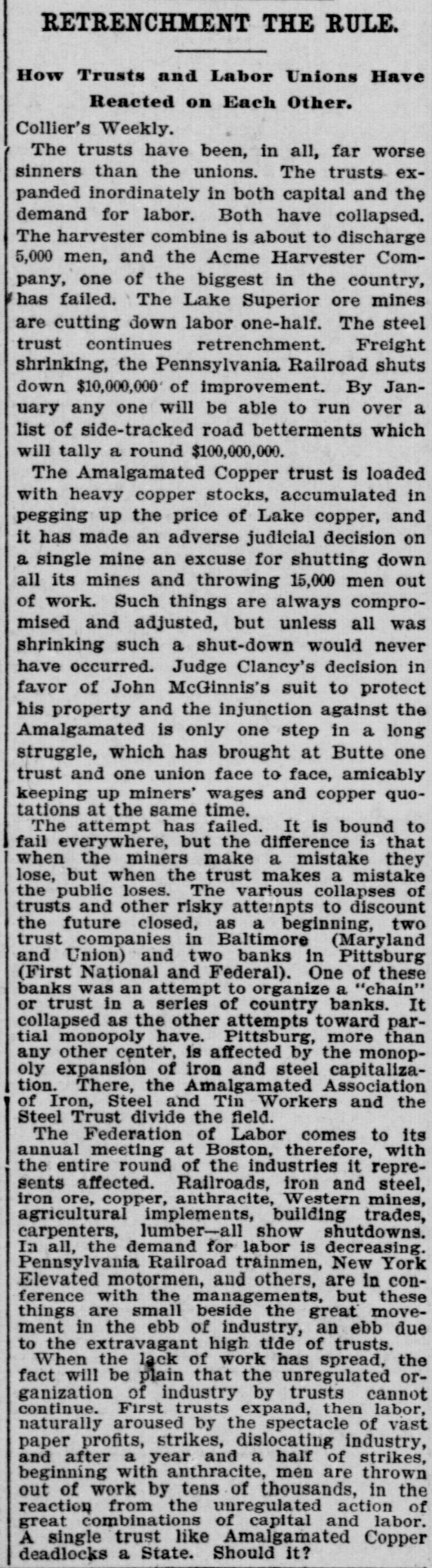
Newspaper Excerpt
two banks in Pittsburg (First National and Federal)
Source
newspapers
3. December 7, 1903 Reopening
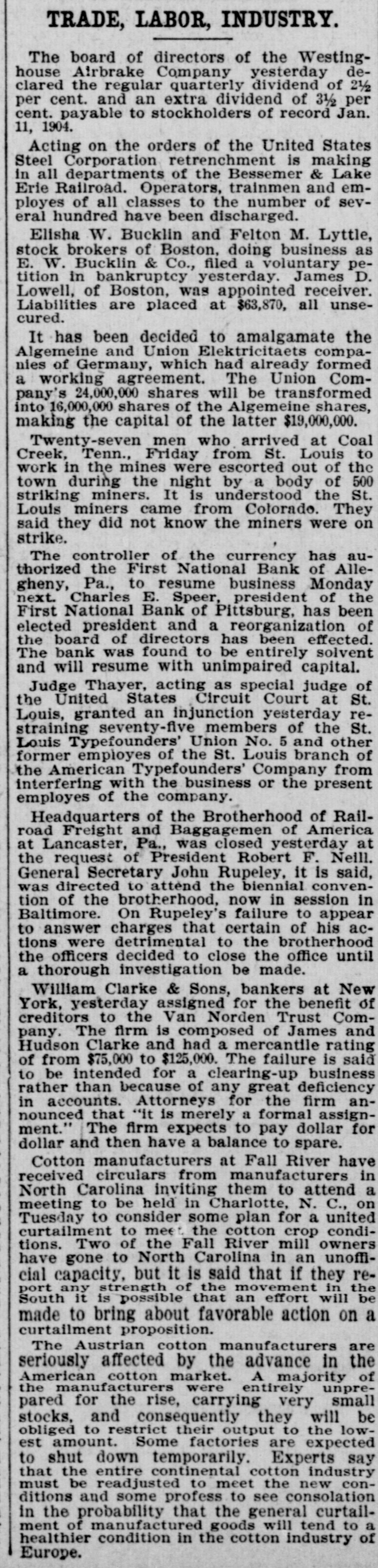
Newspaper Excerpt
Charles E. Speer, president of the First National Bank of Pittsburg, has been elected president and a reorganization of the board of directors has been effected. The bank was found to be entirely solvent and will resume with unimpaired capital. The controller of the currency has authorized the First National Bank of Allegheny, Pa., to resume business Monday next.
Source
newspapers
4. April 19, 1913 Voluntary Liquidation
Source
historical_nic

Newspaper Articles (2)

Article from The Indianapolis Journal, November 29, 1903

Click image to open full size in new tab

Article Text

RETRENCHMENT THE RULE

How Trusts and Labor Unions Have Reacted on Each Other. Collier's Weekly. The trusts have been, in all, far worse sinners than the unions. The trusts expanded inordinately in both capital and the demand for labor. Both have collapsed. The harvester combine is about to discharge 5,000 men, and the Acme Harvester Company, one of the biggest in the country, has failed. The Lake Superior ore mines are cutting down labor one-half. The steel trust continues retrenchment. Freight shrinking, the Pennsylvania Railroad shuts down $10,000,000 of improvement. By January any one will be able to run over a list of side-tracked road betterments which will tally a round $100,000,000. The Amalgamated Copper trust is loaded with heavy copper stocks, accumulated in pegging up the price of Lake copper, and it has made an adverse judicial decision on a single mine an excuse for shutting down all its mines and throwing 15,000 men out of work. Such things are always compromised and adjusted, but unless all was shrinking such a shut-down would never have occurred. Judge Clancy's decision in favor of John McGinnis's suit to protect his property and the injunction against the Amalgamated is only one step in a long struggle, which has brought at Butte one trust and one union face to face, amicably keeping up miners' wages and copper quotations at the same time. The attempt has failed. It is bound to fail everywhere, but the difference is that when the miners make a mistake they lose, but when the trust makes a mistake the public loses. The various collapses of trusts and other risky attempts to discount the future closed, as a beginning, two trust companies in Baltimore (Maryland and Union) and two banks in Pittsburg (First National and Federal). One of these banks was an attempt to organize a "chain" or trust in a series of country banks. It collapsed as the other attempts toward partial monopoly have. Pittsburg, more than any other center, is affected by the monopoly expansion of iron and steel capitalization. There, the Amalgamated Association of Iron, Steel and Tin Workers and the Steel Trust divide the field. The Federation of Labor comes to its annual meeting at Boston, therefore, with the entire round of the industries it represents affected. Railroads, iron and steel, iron ore, copper, anthracite, Western mines, agricultural implements, building trades, carpenters, lumber-all show shutdowns. In all, the demand for labor is decreasing. Pennsylvania Railroad trainmen, New York Elevated motormen, and others, are in conference with the managements, but these things are small beside the great movement in the ebb of industry, an ebb due to the extravagant high tide of trusts. When the lack of work has spread, the fact will be plain that the unregulated organization of industry by trusts cannot continue. First trusts expand, then labor, naturally aroused by the spectacle of vast paper profits, strikes, dislocating industry, and after a year and a half of strikes, beginning with anthracite, men are thrown out of work by tens of thousands, in the reaction from the unregulated action of great combinations of capital and labor. A single trust like Amalgamated Copper deadlocks a State. Should it?

Article from The Indianapolis Journal, December 6, 1903

Click image to open full size in new tab

Article Text

TRADE, LABOR, INDUSTRY. The board of directors of the Westinghouse Airbrake Company yesterday declared the regular quarterly dividend of 2ยฝ per cent. and an extra dividend of 3ยฝ per cent. payable to stockholders of record Jan. 11, 1904. Acting on the orders of the United States Steel Corporation retrenchment is making in all departments of the Bessemer & Lake Erie Railroad. Operators, trainmen and employes of all classes to the number of several hundred have been discharged. Elisha W. Bucklin and Felton M. Lyttle, stock brokers of Boston, doing business as E. W. Bucklin & Co., filed a voluntary petition in bankruptcy yesterday. James D. Lowell, of Boston, was appointed receiver. Liabilities are placed at $63,870, all unsecured. It has been decided to amalgamate the Algemeine and Union Elektricitaets companies of Germany, which had already formed a working agreement. The Union Company's 24,000,000 shares will be transformed into 16,000,000 shares of the Algemeine shares, making the capital of the latter $19,000,000. Twenty-seven men who arrived at Coal Creek, Tenn., Friday from St. Louis to work in the mines were escorted out of the town during the night by a body of 500 striking miners. It is understood the St. Louis miners came from Colorado. They said they did not know the miners were on strike. The controller of the currency has authorized the First National Bank of Allegheny, Pa., to resume business Monday next. Charles E. Speer, president of the First National Bank of Pittsburg, has been elected president and a reorganization of the board of directors has been effected. The bank was found to be entirely solvent and will resume with unimpaired capital. Judge Thayer, acting as special judge of the United States Circuit Court at St. Louis, granted an injunction yesterday restraining seventy-five members of the St. Louis Typefounders' Union No. 5 and other former employes of the St. Louis branch of the American Typefounders' Company from interfering with the business or the present employes of the company. Headquarters of the Brotherhood of Railroad Freight and Baggagemen of America at Lancaster, Pa., was closed yesterday at the request of President Robert F. Neill. General Secretary John Rupeley, it is said, was directed to attend the biennial convention of the brotherhood, now in session in Baltimore. On Rupeley's failure to appear to answer charges that certain of his actions were detrimental to the brotherhood the officers decided to close the office until a thorough investigation be made. William Clarke & Sons, bankers at New York, yesterday assigned for the benefit of creditors to the Van Norden Trust Company. The firm is composed of James and Hudson Clarke and had a mercantile rating of from $75,000 to $125,000. The failure is said to be intended for a clearing-up business rather than because of any great deficiency in accounts. Attorneys for the firm announced that "it is merely a formal assignment." The firm expects to pay dollar for dollar and then have a balance to spare. Cotton manufacturers at Fall River have received circulars from manufacturers in North Carolina inviting them to attend a meeting to be held in Charlotte, N. C., on Tuesday to consider some plan for a united curtailment to meet the cotton crop conditions. Two of the Fall River mill owners have gone to North Carolina in an unofficial capacity, but it is said that if they report any strength of the movement in the South it is possible that an effort will be made to bring about favorable action on a curtailment proposition. The Austrian cotton manufacturers are seriously affected by the advance in the American cotton market. A majority of the manufacturers were entirely unprepared for the rise, carrying very small stocks, and consequently they will be obliged to restrict their output to the lowest amount. Some factories are expected to shut down temporarily. Experts say that the entire continental cotton industry must be readjusted to meet the new conditions and some profess to see consolation in the probability that the general curtailment of manufactured goods will tend to a healthier condition in the cotton industry of Europe.