First National Bank (Pittsburg, PA)

Episode Information

Episode UID
4801246
Episode Type
Run โ†’ Suspension โ†’ Reopening
Bank Type
national
Bank ID
480 national
Charter Number
48
Start Date
October 21, 1903
Location
Pittsburg, Pennsylvania (40.441, -79.996)

Metadata

Model
gpt-5-mini (chosen from majority vote of a three-model LLM ensemble)
Short Digest
301bba78413116d9

Response Measures

Capital injected, Full suspension, Books examined

Clearinghouse involved: Yes (loan, examination, or other measures)

Events (7)

1. August 5, 1863 Chartered
Source
historical_nic
2. June 30, 1882 Chartered
Source
historical_nic
3. October 21, 1903 Run
Cause
Local Banks
Cause Details
Rumors/reported connection with the suspension of the Federal National Bank of Pittsburg triggered heavy withdrawals
Measures
Directors decided to place the bank in voluntary liquidation and to apply to the Comptroller of the Currency
Newspaper Excerpt
its supposed connection with the Federal National bank of Pittsburg has created wide distrust and caused a run on this bank
Source
newspapers
4. October 22, 1903 Suspension
Cause
Voluntary Liquidation
Cause Details
Directors resolved to enter voluntary liquidation because the run and reputational connection made operations impractical
Newspaper Excerpt
the First National bank of Allegheny failed to open its doors for business and ... has gone into voluntary liquidation
Source
newspapers
5. October 23, 1903 Receivership
Newspaper Excerpt
Bank Examiner E. J. Vaughan has been appointed receiver for the bank by the comptroller of the currency.
Source
newspapers
6. December 1, 1903 Reopening
Newspaper Excerpt
The First National Bank of Allegheny ... to reopen on Thursday; ... authorized ... to resume business next Monday, it being found solvent despite the terrific run which caused the doors to close.
Source
newspapers
7. April 19, 1913 Voluntary Liquidation
Source
historical_nic

Newspaper Articles (21)

Article from Santa Fe New Mexican, October 22, 1903

Click image to open full size in new tab

Article Text

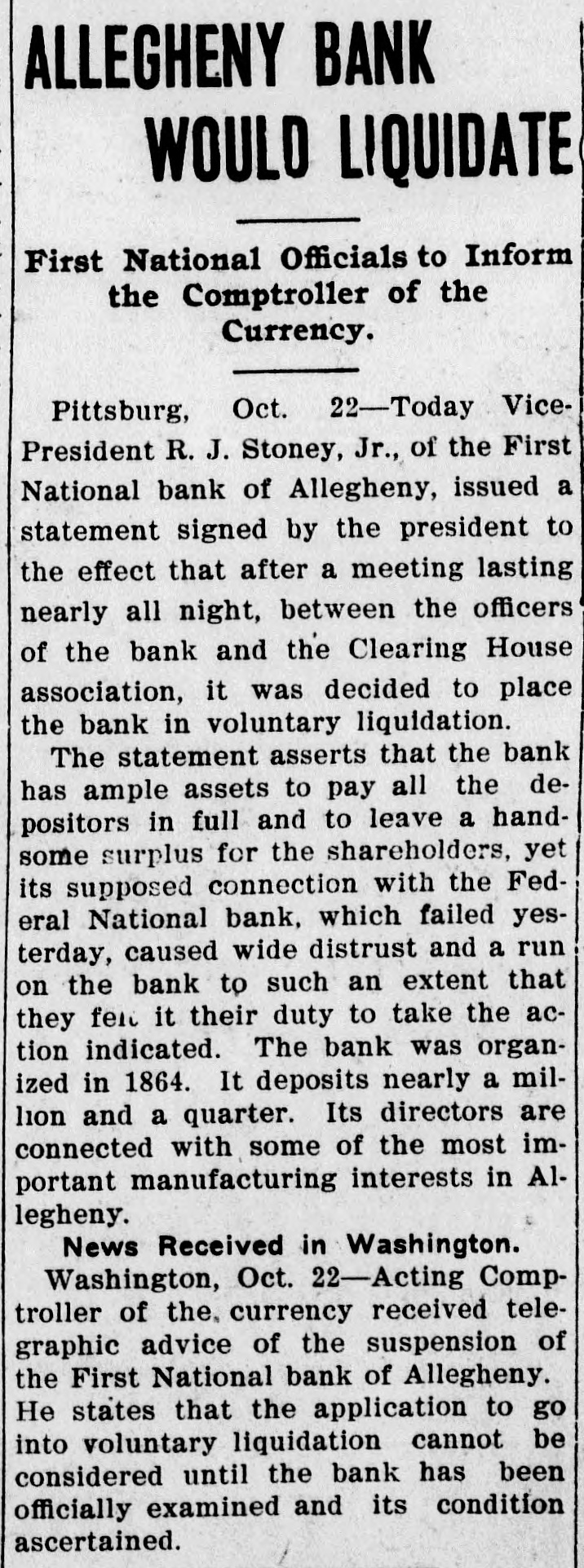
ALLEGHENY BANK WOULD LIQUIDATE First National Officials to Inform the Comptroller of the Currency. Pittsburg, Oct. 22-Today VicePresident R. J. Stoney, Jr., of the First National bank of Allegheny, issued a statement signed by the president to the effect that after a meeting lasting nearly all night, between the officers of the bank and the Clearing House association, it was decided to place the bank in voluntary liquidation. The statement asserts that the bank has ample assets to pay all the depositors in full and to leave a handsome surplus for the shareholders, yet its supposed connection with the Federal National bank, which failed yesterday, caused wide distrust and a run on the bank to such an extent that they felt it their duty to take the action indicated. The bank was organized in 1864. It deposits nearly a million and a quarter. Its directors are connected with some of the most important manufacturing interests in Allegheny. News Received in Washington. Washington, Oct. 22-Acting Comptroller of the, currency received telegraphic advice of the suspension of the First National bank of Allegheny. He states that the application to go into voluntary liquidation cannot be considered until the bank has been officially examined and its condition ascertained.


Article from The Evening Statesman, October 22, 1903

Click image to open full size in new tab

Article Text

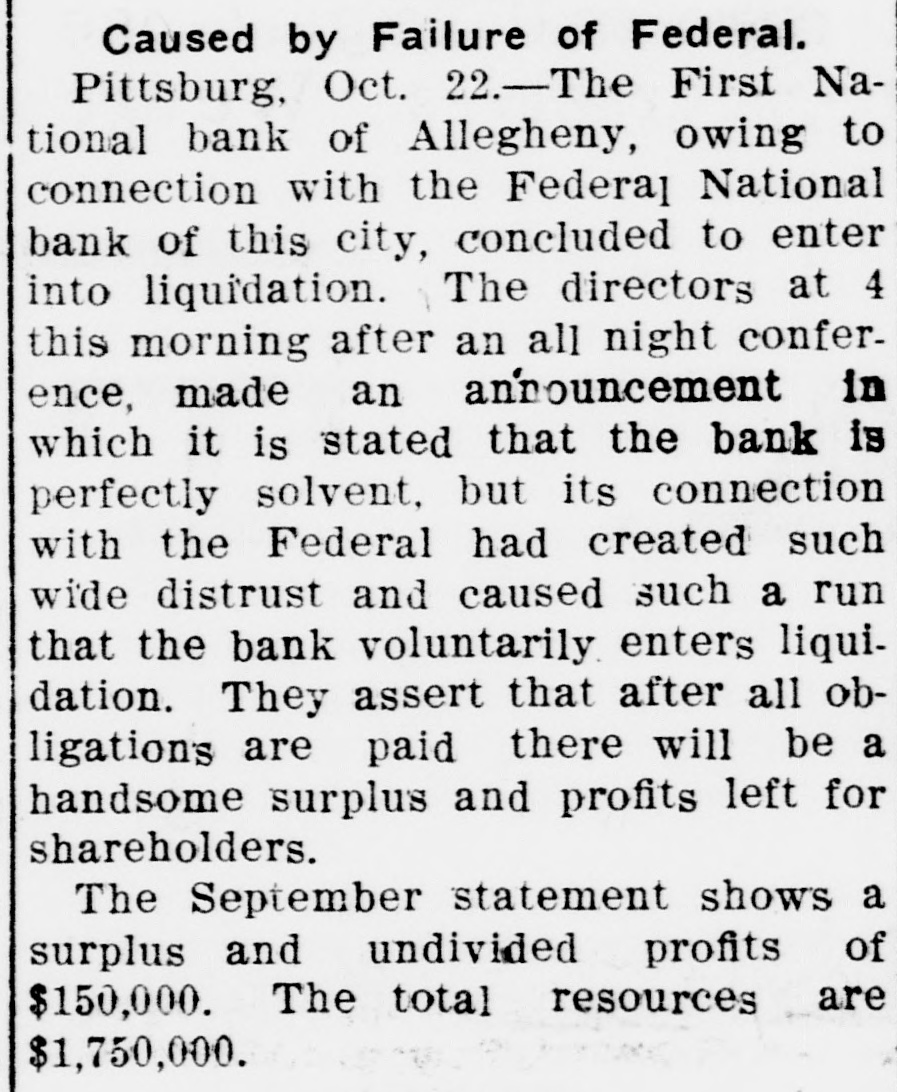
Caused by Failure of Federal. Pittsburg, Oct. 22.-The First National bank of Allegheny, owing to connection with the Federal National bank of this city, concluded to enter into liquidation. The directors at 4 this morning after an all night conference, made an announcement in which it is stated that the bank is perfectly solvent, but its connection with the Federal had created such wide distrust and caused such a run that the bank voluntarily enters liquidation. They assert that after all obligations are paid there will be a handsome surplus and profits left for shareholders. The September statement shows a surplus and undivided profits of $150,000. The total resources are $1,750,000.


Article from Rock Island Argus, October 22, 1903

Click image to open full size in new tab

Article Text

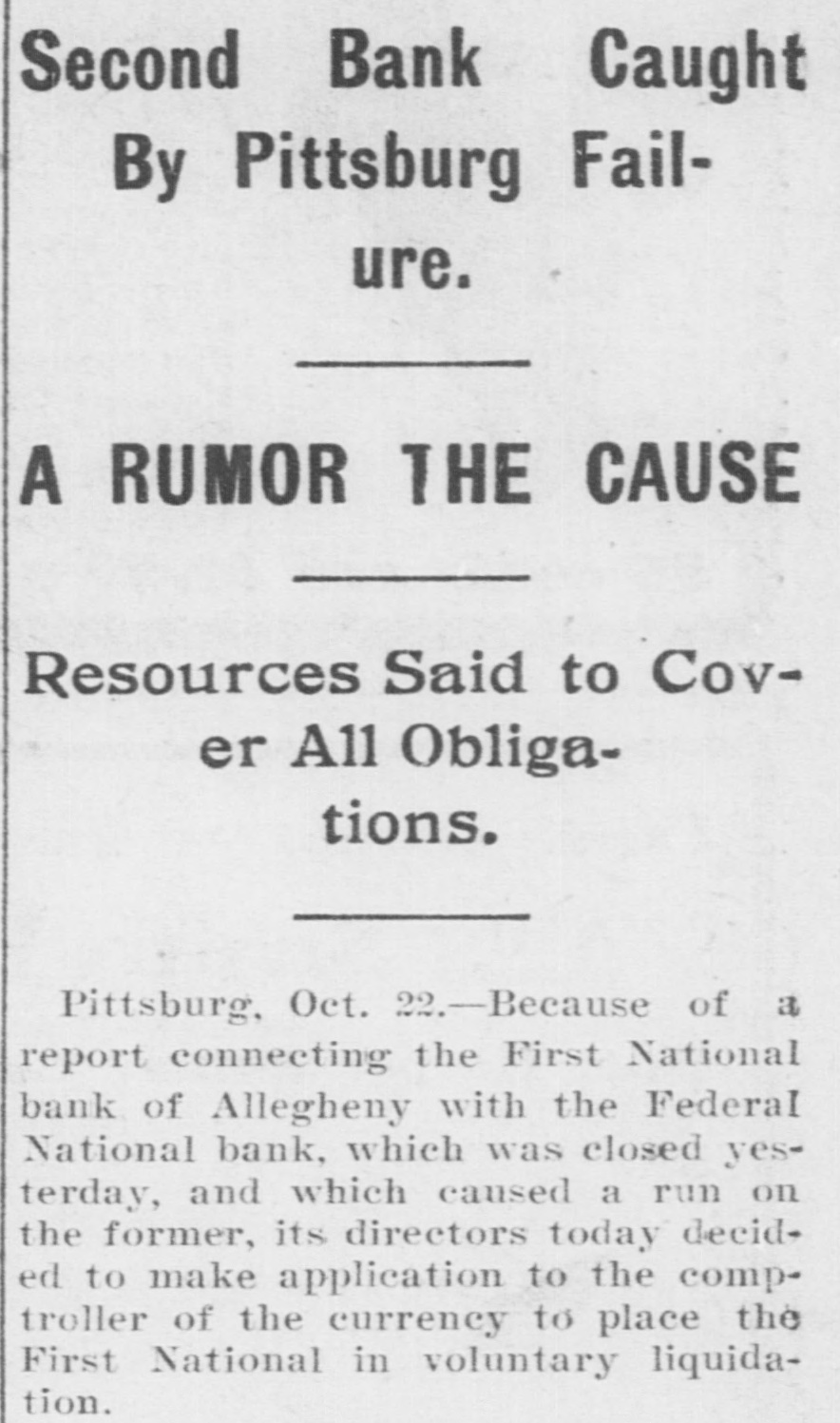
Second Bank Caught By Pittsburg Failure. A RUMOR THE CAUSE Resources Said to Cover All Obligations. Pittsburg, Oct. 22.-Because of a report connecting the First National bank of Allegheny with the Federal National bank, which was closed yesterday, and which caused a run on the former, its directors today decided to make application to the comptroller of the currency to place the First National in voluntary liquidation.


Article from Waterbury Evening Democrat, October 22, 1903

Click image to open full size in new tab

Article Text

First National of Allegheny Closed Its Doors. PITTSBURG BANK THE CAUSE. President Thompson Issued a State ment Giving Reasons for Closing--Bank Has Ample Assets-The Acting Comptroller Gives His Views on Going Into Voluntary Liquidation. Pittsburg, Oct 22.-At 3:30 o'clock morning Vice President R. J. Stoof the First of ney, this jr, National bank stateAllegheny, issued the following ment after a meeting of the officers and directors with the clearing house committee of the Pittsburg Clearing House association. which lasted from 8 o'clock last evening until 3:20 o' clock this morning: "Allegheny, Pa, Oct 21, 1903. "At a meeting of the board of directors of the First National bank of Allegheny. held this evening, it was resolved that. although the bank has ample assets to pay all of its depositors in full and leave a handsome surplus for the shareholders, yet its supposed connection with the Federal National bank of Pittsburg has created wide distrust and caused a run on this bank to such an extent that we feel It to be our duty to place the bank in voluntary liquidation. and the officers of the bank and directors have decided to make application to the comptroller of the currency to take necessary steps to accomplish this purpose. "JOHN THOMPSON. President." The First National bank of Allegheny was organized in January, 1864, and has a capital stock of $850,000. a surplus of $100.000, and undivided profits of $34,871.80. The officers are as follows: President. John Thompson; vice president. R. J. Stoney, jr: cashier, E. R. Kramer: assistant cashier, John D. Kramer. The First National is one of the oldest banking institutions in Allegheny. The directors of the bank are connected with some of the most important manufacturing interests in Allegheny. Many rumors during the past few days have connected the bank with the Federal National and for two days people have demanded their deposits after learning of the condition of the Pittsburg institution. The clearing house committee bankers have a very sanguine opinion of the general institution, but the two banks so unfortunate at this time were found to be beyond the immediate reach of aid. although both are declared to be solvent and in good condition. The correspondents of the bank are New York. National Park bank: Philadelphia. First National bank: Chicago, First National bank. According to a report of the condition of the bank at the close of business September 9 the liabilities were $1.785.476; amount due depositors. $1.052.128: cash on hand. $113.113. Other resources were given to bring the total to $1,735,476. Washington, Oct 22.--The acting controller of the currency last night received the following telegram from John Thompson, president of the First National bank of Allegheny, Pa: "At a meeting of the directors of the bank. held this evening, it was resolved on account of the adverse rumors in connection with the failure of the Federal National bank of Pittsburg and inability to realize quickly on assets to go into voluntary liquidation." The acting controller states, in this connection. that an application to go into voluntary liquidation cannot be considered until the bank has been officially examined and its condition as. certained.


Article from The Washington Times, October 22, 1903

Click image to open full size in new tab

Article Text

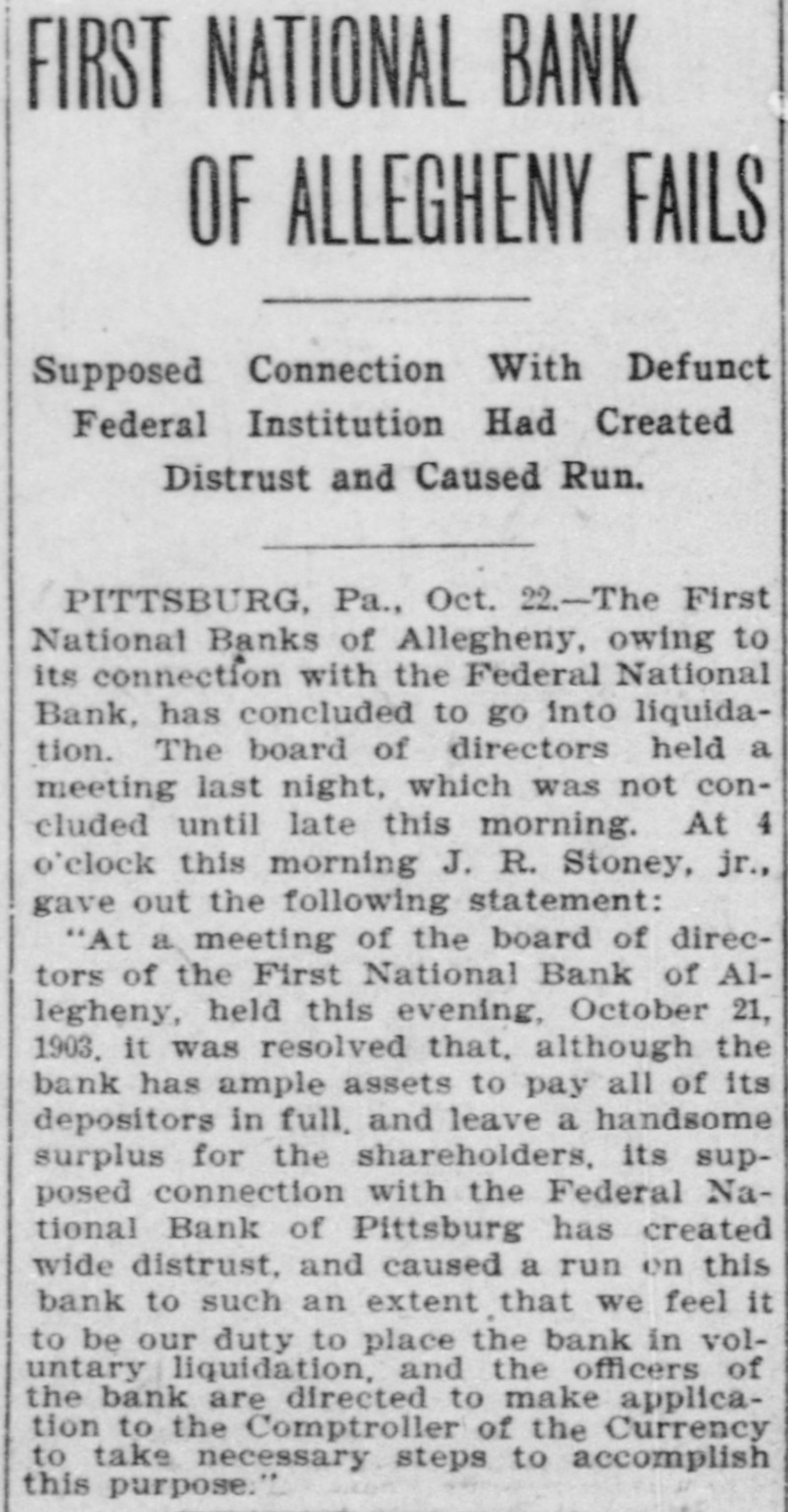
FIRST NATIONAL BANK OF ALLEGHENY FAILS Supposed Connection With Defunct Federal Institution Had Created Distrust and Caused Run. PITTSBURG, Pa., Oct. 22.-The First National Banks of Allegheny, owing to its connection with the Federal National Bank, has concluded to go into liquidation. The board of directors held a meeting last night, which was not concluded until late this morning. At 4 o'clock this morning J. R. Stoney, jr., gave out the following statement: "At a meeting of the board of directors of the First National Bank of Allegheny, held this evening, October 21, 1903. it was resolved that, although the bank has ample assets to pay all of its depositors in full, and leave a handsome surplus for the shareholders, its supposed connection with the Federal National Bank of Pittsburg has created wide distrust, and caused a run on this bank to such an extent that we feel it to be our duty to place the bank in voluntary liquidation, and the officers of the bank are directed to make application to the Comptroller of the Currency to take necessary steps to accomplish this purpose.'


Article from The Sun, October 23, 1903

Click image to open full size in new tab

Article Text

FINANCIAL AND COMMERCIAL THURSDAY, Oct. 22. The dominant feature of the stock market to-day was the demand for the investment issues. Evidences of a growing interest in securities of this grade have not been wanting of late and have been duly emphasized in this column. But to-day the dealings in bonds quite overshadowed operations in the stock market proper. All the established railway bonds were dealt in in good volume and at advancing prices, and, indeed, the prices of these bonds have already risen SO that the choice of bargains among them is by no means what it was even two weeks since. There is a natural order in operations of this kind which is almost invariably followed. The demand converges, at first, on issues of the very best character, first mortgage bonds of the well known railway lines yielding only a small return, but furnishing the very highest security, whose prices under almost all conditions fluctuate but little. It is obvious that a very small advance, comparatively, in the prices of bonds of this kind brings them to a point where their interest yield becomes sensibly diminished and where the prospective investor is inclined to turn from them to consideration of bonds which, although not quite SO well secured, are still thoroughly safe and afford a greater interest return. In time the supply of good bonds at suitable prices becomes exhausted and the buying spreads to preferred stocks, and so through the entire security list. Whether the investment of capital will proceed steadily along this path in the coming months cannot, of course, be said to be a settled question. It has, however, started on the journey after its accustomed fashion, and in the past its footsteps have rarely wavered from the beaten way. The combined strength and dulness of the stock market are, too, just what would naturally be expected under these circumstances. Bearish operators have discovered that there is no further liquidation by the general public upon the receipt of unfavorable news, a fact which usually indicates that these unfavorable developments were long ago foreseen and duly prepared for. Hence, while a "bull market" is by no means in order yet, and while any attempt of speculators to inaugurate such an affair would undoubtedly meet with disaster, prices of stocks stubbornly resist artificial attempts to depress them and in their own good time may be expected to display the effects of the general market convalescence. It seems to be clear that a very sharp line is now being drawn by all careful students and dispassionate observers of financial affairs between such events as the collapse of overboomed local enterprises in various cities, dragging down with them trust companies and other money lending institutions which have advanced funds upon forms of security for which there is little market, and the general business life of the whole country, especially that in the Western and Southwestern agricultural sections. It would be very singular if we had seen the last of suspensions, temporary or otherwise, of institutions of this character because of reasons like the foregoing. The important point for investors and speculators alike to remember is that such disasters as these-many of them of only small importance at best-are not of such a character as to involve sales of securities in Wall Street. While of course, they have a perceptibly greater bearing upon the general situation than the bursting of such incorporation bubbles in the industrial world as prevailed SO notably in 1899, the two phenomena are really kith and kin, and the wealth and prosperity of the country are such that far less harm to the business life of the country. as a whole, will be done by them than many people might suppose. Prices of stocks to-day closed very irregularly, most of the active issues, however, showing small advances. Among the railroad issues the Rock Island shares were especially strong, while in the industrial list a sharp break in Republic Iron and Steel preferred followed the announcement that a-number of the employees of the Republic Iron and Steel Company in Minnesota had been laid off. The decision of a local court in Montana awarding possession of the Minnie Healy mine to the Amalgamated Copper Company's chief antagonist, and restraining the Boston and Montana company from paying any dividends to the Amalgamated Company, but refusing to put the Boston and Montana company in the hands of a receiver, was really more favorable to the Amalgamated company than had been expected. Litigation over these matters, is of course merely in its preliminary stage and must pass through the higher courts before a final adjustment is reached. As the Amaigamated company has not been in receipt of the Boston and Montana dividends for some time, the preliminary decision to-day does not change the status of affairs in the least. The decision of the First National Bank of Allegheny, Pa., to go into voluntary liquidation, as a result of the suspension of the Federal National Bank of Pittsburg. with which it was allied, was considered as of little importance in Wall Street, because the solvent condition of the bank was perfectly realized. The one other important new development of the day was the declaration of an extra dividend of


Article from Bismarck Daily Tribune, October 23, 1903

Click image to open full size in new tab

Article Text

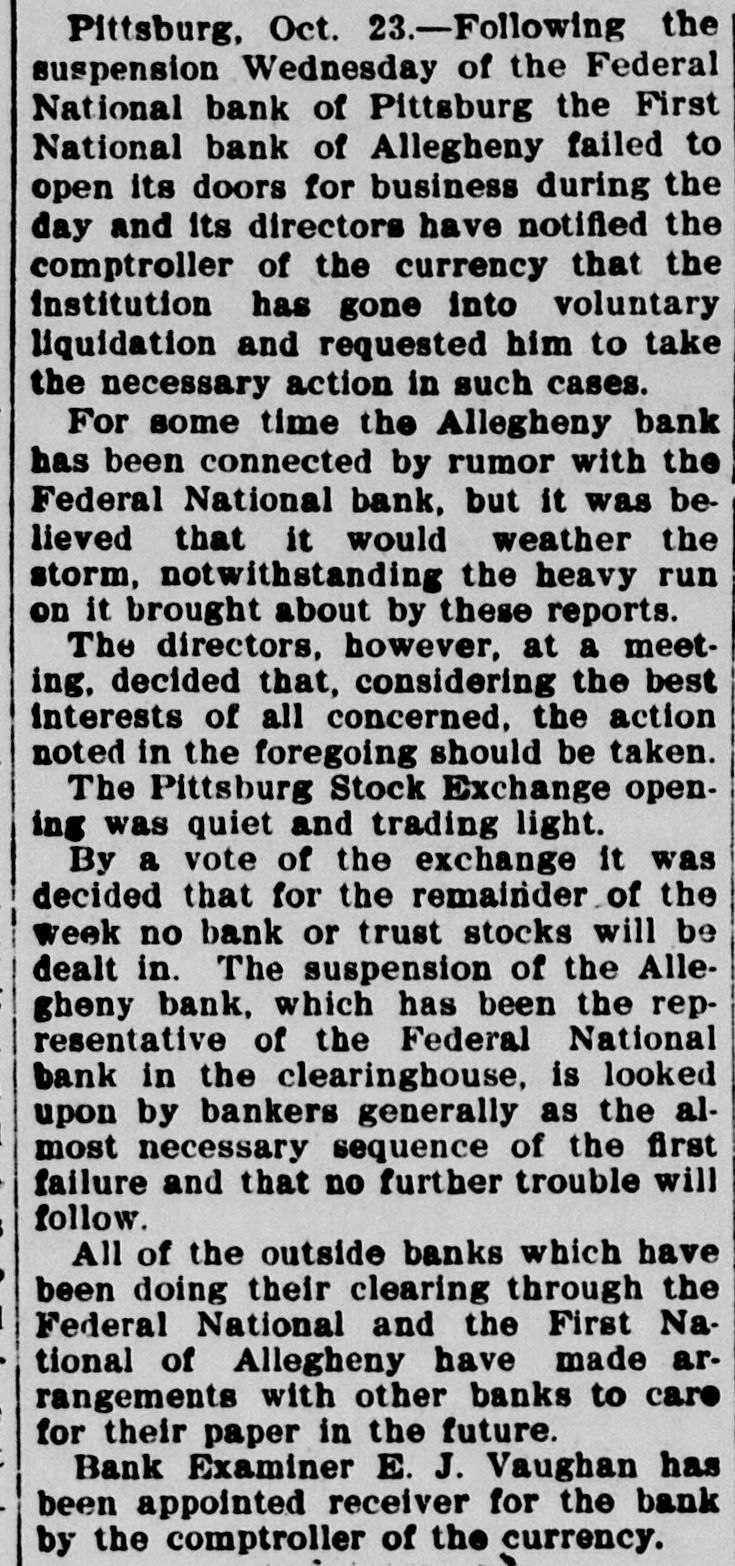
Pittsburg, Oct. 23.-Following the suspension Wednesday of the Federal National bank of Pittsburg the First National bank of Allegheny failed to open its doors for business during the day and its directors have notified the comptroller of the currency that the institution has gone into voluntary liquidation and requested him to take the necessary action in such cases. For some time the Allegheny bank has been connected by rumor with the Federal National bank, but it was believed that it would weather the storm, notwithstanding the heavy run on it brought about by these reports. The directors, however, at a meeting, decided that, considering the best interests of all concerned, the action noted in the foregoing should be taken. The Pittsburg Stock Exchange opening was quiet and trading light. By a vote of the exchange it was decided that for the remainder of the week no bank or trust stocks will be dealt in. The suspension of the Allegheny bank, which has been the representative of the Federal National bank in the clearinghouse, is looked upon by bankers generally as the almost necessary sequence of the first failure and that no further trouble will follow. All of the outside banks which have been doing their clearing through the Federal National and the First National of Allegheny have made arrangements with other banks to care for their paper in the future. Bank Examiner E. J. Vaughan has been appointed receiver for the bank by the comptroller of the currency.


Article from The Barre Daily Times, October 23, 1903

Click image to open full size in new tab

Article Text

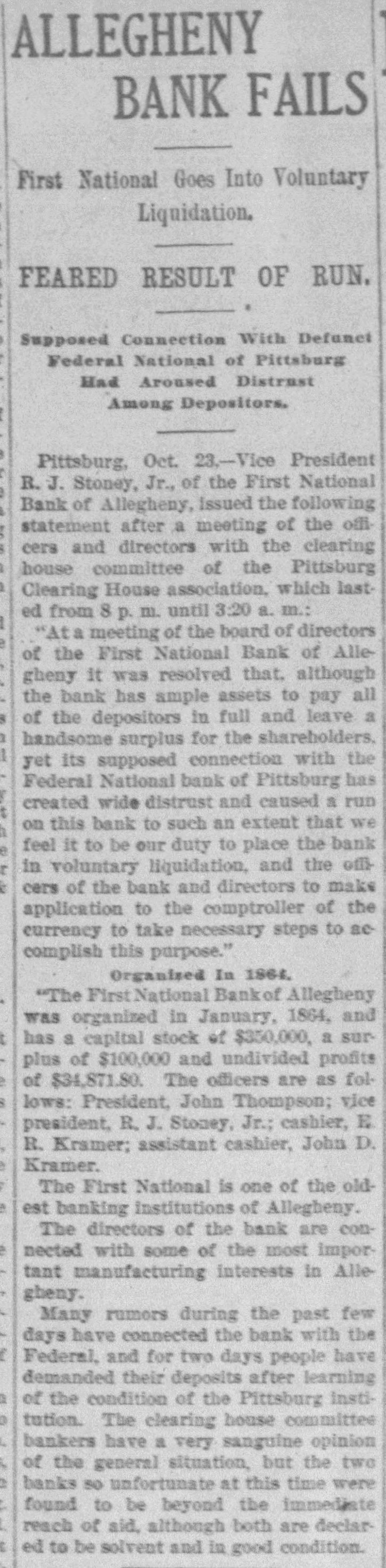
ALLEGHENY BANK FAILS First National Goes Into Voluntary Liquidation. FEARED RESULT OF RUN. Supposed Connection With Defunct Federal National of Pittsburg Had Aroused Distrust Among Depositors. Pittsburg, Oct. 23,-Vice President R.J. Stoney, Jr., of the First National Bank of Allegheny, Issued the following statement after a meeting of the officers and directors with the clearing house committee of the Pittsburg Clearing House association, which lasted from 8 p. m. until 3:20 a. m.: "At a meeting of the board of directors of the First National Bank of Allegheny it was resolved that. although the bank has ample assets to pay all of the depositors in full and leave a handsome surplus for the shareholders. yet its supposed connection with the Federal National bank of Pittsburg has created wide distrust and caused a run on this bank to such an extent that we feel it to be our duty to place the bank in voluntary liquidation, and the officers of the bank and directors to make application to the comptroller of the currency to take necessary steps to aecomplish this purpose." Organized In 1864, "The First National Bankof Allegheny was organized in January, 1864, and has a capital stock of $350,000, a surplus of $100,000 and undivided profits of $34,871.80. The officers are as follows: President, John Thompson; vice president, R, J. Stoney, Jr.; cashier, E R. Kramer; assistant cashier, John D. Kramer. The First National is one of the oldest banking institutions of Allegheny. The directors of the bank are connected with some of the most important manufacturing interests in Allegheny. Many rumors during the past few days have connected the bank with the Federal, and for two days people have demanded their deposits after learning of the condition of the Pittsburg Institution. The clearing house committee bankers have a very sanguine opinion of the general situation, but the two banks so unfortunate at this time were found to be beyond the immediate reach of aid, although both are declared to be solvent and in good condition.


Article from The Seattle Star, October 23, 1903

Click image to open full size in new tab

Article Text

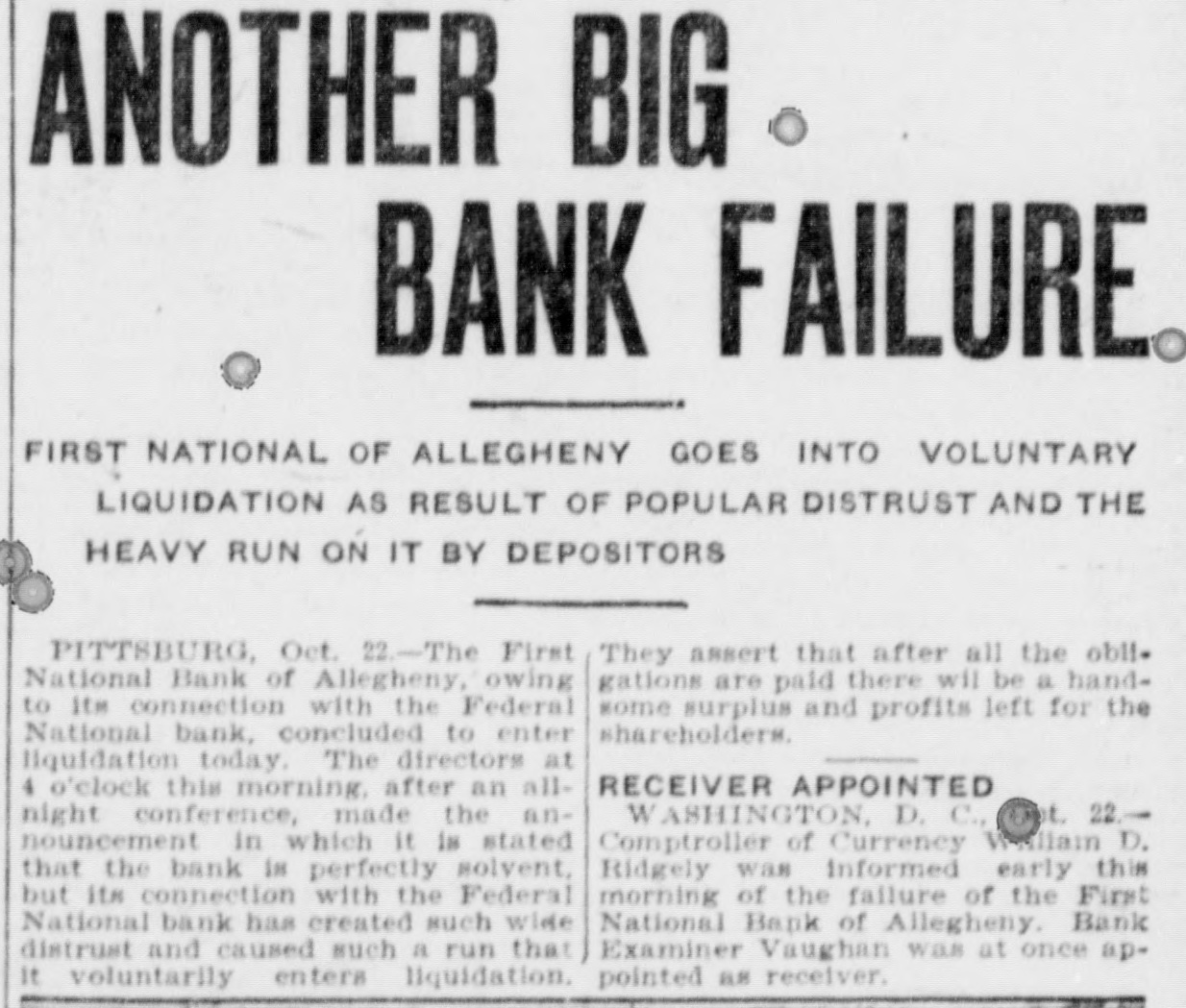
ANOTHER BIG BANK FAILURE FIRST NATIONAL OF ALLEGHENY GOES INTO VOLUNTARY LIQUIDATION AS RESULT OF POPULAR DISTRUST AND THE HEAVY RUN ON IT BY DEPOSITORS PITTSBURG, Oct. 22-The First They assert that after all the obilNational Bank of Allegheny, owing gations are paid there will be a handto Its connection with the Federal some surplus and profits left for the National bank, concluded to enter shareholders. liquidation today. The directors at RECEIVER APPOINTED 4 o'clock this morning, after an allnight conference, made the anWASHINGTON, D. C., Opt. t. 22.nouncement in which it is stated Comptroller of Currency William D. that the bank in perfectly solvent, Ridgely was informed early this but its connection with the Federal morning of the failure of the First National bank has created such wide National Bank of Allegheny. Bank distrust and caused such a run that Examiner Vaughan was at once apIt voluntarily enters liquidation. pointed BB receiver.


Article from The Salt Lake Herald, October 23, 1903

Click image to open full size in new tab

Article Text

CARRIED DOWN BY THE FEDERAL First National Bank of Allegheny Goes Under. CREDITORS WILL NOT LOSE ACME HARVESTER COMPANY STRIKES A SNAG. ITTSBURG, Pa., Oct. 22.-Following the suspension yesterday of P the Federal National bank of Pittsburg, the First National bank of Allegheny failed to open for business today, and its directors have notified the comptroller of the currency that the institution has gone into voluntary liquidation, and requested him to take the necessary action in such cases. For sometime the Allegheny has been connected by rumor with the Federal National bank, but it was believed up to late yesterday that it would weather the storm notwithstanding the heavy run made on it brought about by these reports. The directors, however, at a meeting last night decided that considering the best interests of all concerned the action noted above should be taken. Bankers Were Prepared. The Pittsburg stock exchange opening this morning was quiet and trading light. By a vote of the exchange it was decided that for the balance of the week no bank or trust stocks will be dealt in. The suspension of the Allegheny bank, which has been the representative of the Federal National in the clearing house. is looked upon by bankers generally as an almost necessary sequence of the failure yesterday, and they believe that no further trouble will follow. Robert Lyons, deputy comptroller of the currency of Washington, D. C., is in charge of the Allegheny bank. J. D. Kramer, the assistant cashier, stated that as soon as the assets were realized the depositors would be paid off dollar for dollar. Early today Vice President R. J. Stoney, jr., issued the following statement: "Allegheny, Pa., Oct. 21, 1903.-Aat a meeting of the board of directors of the First National bank of Allegheny, held this evening, Oct. 21, 1903, it was resolved that, although the bank has ample assets to pay all of its depositors in full and leave a handsome surplus for the shareholders, yet its supposed connection with the Federal National bank of Pittsburg has created wide distrust and caused a run on this bank to such an extent that we feel it to be our duty to place the bank in voluntary liquidation, and the officers of the bank and directors have decided to make application to the comptroller of the currency to take the necessary steps to accomplish this purpose. (Signed) "JOHN THOMPSON. "President."


Article from The Montgomery Advertiser, October 23, 1903

Click image to open full size in new tab

Article Text

ANOTHER BANK CLOSES AN ALLEGHENY INSTITUTION FORCED TO SUSPEND. Has Ample Assets to Connection Paj All Debts, But Its Supposed With Pittsburg Federal Causes Run. ViceOct. 22-Early today of the First Pittsburg. R. J. Stoney, Jr., issued the National President Bank of Allegheny, a meeting of following statement directors after with the House clearthe house owners of and the Pittsburg Clearing from 8 o'clock ing Association. which lasted morning: last night until Allegheny, this Board Oct. of Directors 21, 1903. "At "meeting National of the Bank of 1903, Allegheny, it was of the dthis First evening, October 21, bank has amhel that, although the its depositors assets to pay all surplus full ple resolved and leave a handsome of its supposed Bank con- for in has the shareholders, Federal yet National distrust nection with the created wide to such and that we feel caused a run on it to be our of an extent Pittsburg the bank in voluntary bank this bank and liquidation directors duty the to place officers of the application to and have the decided to make Currency to take nec(Signed) Comptroller essary steps of to the accomplish this Thompson. purpose. "John "President. The First National January, Bank 1864, of Allegheny and has of organized in $350,000; a surplus $34,871. was a capital stock undivided of profits of The $100,000. officers are as Thompson; follows: and John Cashier, Vice-Presi- E.R. D. President, Jr.: John dent, Cramer; R. J. Assistant Stoney, Cashier, of the Cramer. The First National Institutions Bank in is Allegheny. one connected oldest The directors banking of the most bank important are manuMany the bank with facturing some rumors plants of the during in Allegheny. the with past few the days Fed- dehave have connected for two days after people learning of manded eral, and their deposits Pittsburg institution. a very condition of the committee has situation. so the house general this their The clearing opinion of the unfortunate at imsanguine but the two found banks to be beyond though both are mediate time were aid to be or solvent reach, and in good con- as declared dition. The correspondents of the Bank; bank are Philaof follows: New York, First Park National; National Chicago, the First First National. delphia., of the condition at the close The report Bank of 9, 1903, is of National business on September Allegheny discounts, unsecured. $1,240,- as follows: Resources-Iron and to secure overdrafts, States on United 980.01; $3,012.56; United $100,000 :premiums securities, bonds, $6,000; house estate $60,350; other banks etc., States circulation, $114,862.30 banking national stocks, real furniture State own- (not and fixtures, $5,972.30; due from $9,271.71; due from from ap ed, agents). $4,158.55 due checks banks reserve $834.82; cash items, $27,026.30; reserve proved and other and bankers, agents, $89,610.52; exchanges fractional notes of clearing banks, cents, nickles viz.: for national house, $2,311; and bank, $128.12; Speother currency reserve in $47,183: tolawful paper money legal tender reserve notes, in bank, United $113, cie, $65,935; lawful money fund with of circula113.03; tal Treasurer redemption (5 from per cent United redemp- States States $5,000; due than 5 per cent $350, Treasurer. tion), $2,850; other total, $1,735,476.19. paid in, and tion fund. Capital stock undivided pro- $53. 630.89: Liabilities surplus expenses funds, $100,000; notes taxes, utstanding, paid, less bank subject cashier's $1,735,476.19 $100,000; 000; check. fits, national $1,052,128.38: Individual $76,456.75; demand total, deposits certificates checks opening out- of to deposits, standing. Pittsburg $3,205.47 Stock quiet Exchange and trading it was light. deBy a for the will be vote of the balance of dealt in. this The morning that was stock exchange Bank, the week which The no cided bank or trust of the Allegheny of the Federal looked suspension representation esentative house, an is almost in the failure upon by sequence for no further necessary National has been bankers the believe clearing generally who as have trouble been yesterday, will follow. of the clearing outside banks through of the Allegheny Federal other to care doing All their and First National with in the crowd National have made arrangements for their paper of defuture. morning a in front of There of among banks positors This gathered Bank Allegheny. excitement small the restless First ap- the the National to be little several were to depositors, peared though to gain admission busy on and wished the bank were Robert clerks of entire of the The books the comptroller in charge of bank. their deputy was morning. currency assistant the Cramer, this the morning. were at J. D. at the bank as the assets paid cashier, was that as soon would be did the said banks of and bank. stated depositors he Alle- not off gheny think any would be realized dollar for dollar. of the affected. other
Article from Evening Journal, October 24, 1903

Click image to open full size in new tab

Article Text

Bank Failure Caused Cashier's Death. Pittsburg, Pa., Oct. 24.-Edward R. Kramer, cashier of the First Naional Bank of Allegheny, which suspended Thursday, died at his home in Sewickley, aged 56 years. Death was caused by apoplexy, followed by paralysis. The severe nervous strain through which he has passed during the last few days is thought to have hastened the attack. Mr. Kramer had been cashier of the bank for 15 years, having succeeded his father, Colonel J. P. Kramer, who had acted in the same capacity for 15 years prior to his death


Article from The Savannah Morning News, October 24, 1903

Click image to open full size in new tab

Article Text

THE PITTSBURG BANK FAILURES. It was stated that the cause of the failure of the Federal National Bank at Pittsburg. Pa., on Wednesday was the circulation of unfounded rumors respecting the bank's solvency, thus causing a run on it, and it is alleged that the cause of the failure of the First National Bank of Allegheny, Pa., announced in our dispatches yesterday, was its connection with the Federal National Bank of Pittsburg. The real cause of the failure of these banks will not be generally known probably until there is a careful examination of their affairs. The chances are that they had loaned a great deal of money on securities which had for the time being become practically unsalable. The fall in the prices of securities within the last few months has been very great, so great and rapid, in fact, that banks which have loaned heavily upon them have been large losers. It may be asked why the banks did not sell them before their market value became less than the amount of the loan for which they were pledged. Perhaps they tried to do so, but in many cases were unable to find any market at all, or at least a market that would save them from heavy loss. Doubtless in many instances securities have been retained by banks with the hope that the market would improve. In the Northern cities the banks do a very large business in lending to brokers on securities which are put up as margins in speculative ventures. One of the reasons why there has been such a decline in the prices of securities is the actions of the banks in selling them, the owners no longer being able to increase their margins. It is to be hoped that the bottom has been reached in the matter of the prices of stocks and bonds. It was thought it had been reached many weeks ago, but that opinion, it seems, was an erroneous one. Notwithstanding the downward movement of the market for stocks and bonds, however, there seems to be a feeling that the period of prosperity which the country has been enjoying so long, is going to continue. In his address before the American Bankers' Association at San Francisco, reported in our dispatches yesterday, Controller of the Currency Ridgely, speaking of the prosperity which the country is enjoying, said: "It isn't going to disappear or vanish in a day because of a slump in stocks or the collapse of a few underwriting syndicates. It may be necessary to pause a little to get our breath after the pace we have been going, but if there is any serious check it will only be because we have lost our nerve and courage. The course of business today depends very largely on the bankers. If the banks continue to act wisely and conservatively, as they have, they can avert anything like serious trouble and keep the country in shape for a continuance of very prosperous times." No one understands better than the Controller of the Currency the importance of conservative management of the banks. If the banks refuse to encourage speculation there is not_ much danger of hard times in the near future. With the banks healthy confidence will remain firm, and with confidence unimpaired there will be plenty of money in circulation, and with plenty of money for business purposes prosperity will continue.


Article from New-York Tribune, October 25, 1903

Click image to open full size in new tab

Article Text

ALLEGHENY BANK WANTS TO RESUME. Acting Controller Says, Give the Institution Every Facility. Washington, Oct. 24-The Acting Controller ot the Currency has received a letter from Examiner John P. Cunningham stating that the directors of the First National Bank. of Allegheny. of which Mr. Cunningham now is receiver, contemplate placIng the affairs of the bank in such condition as will permit of its resumption of business. The acting controller has instructed Mr. Cunningham that If the directors or stockholders contemplate any action with a view to the rehabilitation of the bank by providing means for the payment of 114 liabilities to give them every encouragement and assistance not inconsistent with his duties as receiver.


Article from Twice-A-Week Plain Dealer, October 27, 1903

Click image to open full size in new tab

Article Text

MAY RESUME BUSINESS. Directors of Closed Allegheny, Pa., Institution Contemplating Such Action. Washington, Oct. 26.-The acting comptroller of the currency has received a letter from Examiner John P. Cunningham, stating that the directors of the First national bank of Allegheny, of which he is now receiver, contemplate placing the affairs of the bank in such condition as will permit of its resuming business. The acting comptroller has instructed Mr. Cunningham that if the directors or stockholders contemplate any action with a view to the rehabilitation of the bank by providing means for the payment of its liabilities to give them every encouragement and assistance not inconsistent with his duties as receiver.


Article from Cameron County Press, October 29, 1903

Click image to open full size in new tab

Article Text

Friday. Samuel E. Morse, editor of the Indianapolis Sentinel, was killed by falling from a window of his office. With Charles M. Schwab and Max Pam in attendance at the inquiry, Lewis Nixon told in detail of his deeds as head of the collapsed shipyard trust. Following the suspension Wednesday of the Federal National bank at Pittsburg the First National bank at Allegheny failed to open its doors Thursday. Two division superintendents and two clerks in the postoffice department were dismissed as a result of the report on the investigation of the postal scandals. Edward Mullen, one of the two students who were burned Wednesday morning by the explosion of an alcohol lamp at Niagara university, died at the Sisters' hospital, Buffalo.


Article from The Herald-Advance, November 6, 1903

Click image to open full size in new tab

Article Text

People Talked About. Joseph Monroe, a descendant of President James Monroe, died at Peoria, III., aged ninety-eight. Prof. Robert H. Thurston, director of the Sibley College of Engineering. Cornell university, died from heart disease. Mrs. Van Rensselaer Cruger has just finished the writing of a novel which she will call "The Diplomat's Diary,' and which chronicles the adventures of a young American girl abroad. Edward R. Kramer, cashier of the First National Bank of Allegheny, Pa., which suspended Thursday, died at his home, aged fifty-six years. Death was caused by apoplexy, followed by paralysis. The will of the late Archbishop John J. Kain was filed for probate at St. Louis. It provides that all of the ate archbishop's property, both of a personal and real character, shall be turned over to the diocese. Prof. Irwin Rautenstrauch of Washington university, who formerly lived in Sedalia, Kan., has asked the courts to change his name. Nobody in this country has ever been able to pronounce it right, and the professor has got tired of being called "Rottenstraw," which was conferred upon him In his school days.


Article from New-York Tribune, December 2, 1903

Click image to open full size in new tab

Article Text

PITTSBURG BANKS TO RESUME. Pittsburg, Dec. 1.-Judge M. W. Acheson, in the United States Circuit Court, has issued an order authorizing Receiver John B. Cunningham, of the Federal National Bank, to sell and transfer to a syndicate formed here 1,550 shares of stock in the First National Bank of Allegheny, which were owned by the Federal National Bank when the Federal bank closed its doors. The First National Bank of Allegheny was compelled to suspend payment on account of the close connections between the two concerns. It is now proposed by the syndicate to sever all relations of the Allegheny bank with the Federal institution, and reopen on Thursday. The Federal bank is also preparing for resumption, and will probably reopen for business next week. Nothing definite has as yet been decided upon. The principal difficulty seems to be in the selection of new officers.


Article from The Evening Statesman, December 5, 1903

Click image to open full size in new tab

Article Text

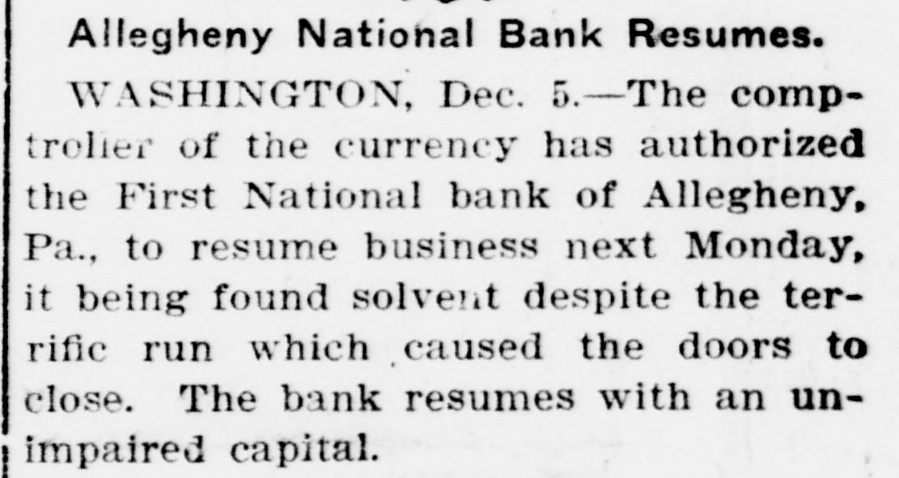
Allegheny National Bank Resumes. WASHINGTON, Dec. 5.-The comptrolier of the currency has authorized the First National bank of Allegheny, Pa., to resume business next Monday, it being found solvent despite the terrific run which caused the doors to close. The bank resumes with an unimpaired capital.


Article from The St. Louis Republic, December 8, 1903

Click image to open full size in new tab

Article Text

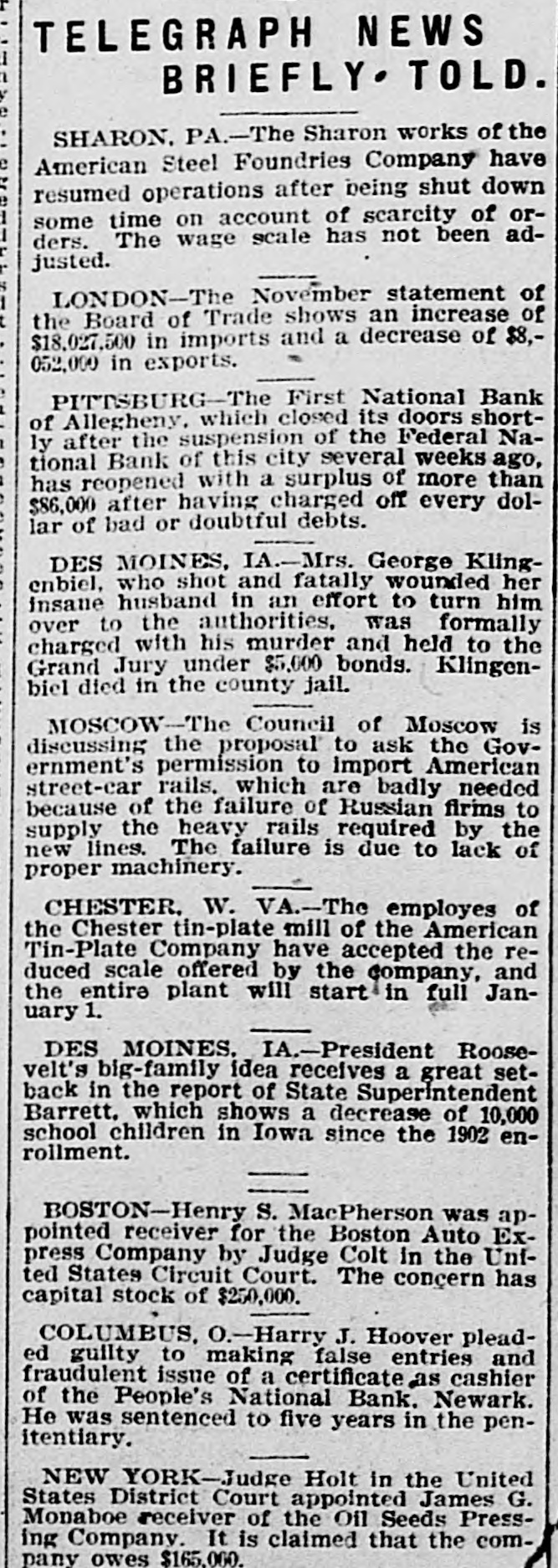
TELEGRAPH NEWS BRIEFLY TOLD. SHARON. PA.-The Sharon works of the American Steel Foundries Company have resumed operations after being shut down some time on account of scarcity of orders. The wage scale has not been adjusted. LONDON-The November statement of the Board of Trade shows an increase of $18,027,500 in imports and a decrease of $8,052,000 in exports. PITTSBURG-The First National Bank of Allegheny. which closed its doors shortly after the suspension of the Federal National Bank of this city several weeks ago, has reopened with a surplus of more than $86,000 after having charged off every dollar of bad or doubtful debts. DES MOINES, IA.-Mrs. George Klingenbiel, who shot and fatally wounded her insane husband in an effort to turn him over to the authorities, was formally charged with his murder and held to the Grand Jury under $5,000 bonds. Klingenbiel died in the county jail. MOSCOW--The Council of Moscow is discussing the proposal to ask the Government's permission to import American street-car rails. which are badly needed because of the failure of Russian firms to supply the heavy rails required by the new lines. The failure is due to lack of proper machinery. CHESTER. W. VA.-The employes of the Chester tin-plate mill of the American Tin-Plate Company have accepted the reduced scale offered by the company, and the entire plant will start i full January 1. DES MOINES. IA.-President Roosevelt's big-family idea receives a great setback in the report of State SuperIntendent Barrett. which shows a decrease of 10,000 school children in Iowa since the 1902 enrollment. BOSTON-Henry S. MacPherson was appointed receiver for the Boston Auto Express Company by Judge Colt in the Unfted States Circuit Court. The concern has capital stock of $250,000. COLUMBUS, O.-Harry J. Hoover pleaded guilty to making false entries and fraudulent issue of a certificate as cashier of the People's National Bank. Newark. He was sentenced to five years in the penitentiary. NEW YORK-Judge Holt in the United States District Court appointed James G. Monaboe receiver of the Oil Seeds Pressing Company. It is claimed that the company owes $165,000.


Article from Daily Kennebec Journal, December 8, 1903

Click image to open full size in new tab

Article Text

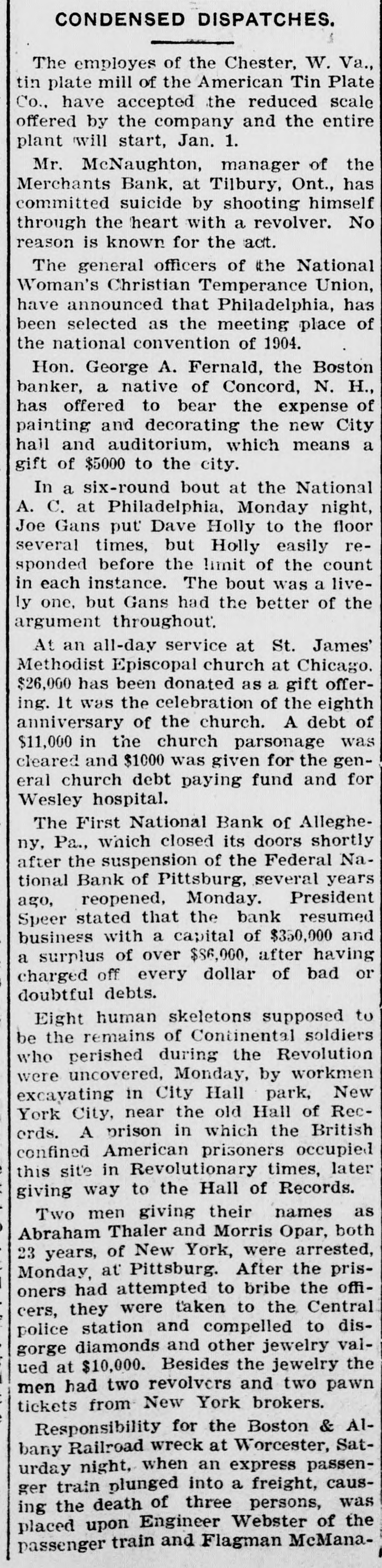
CONDENSED DISPATCHES. The employes of the Chester, W. Va., tin plate mill of the American Tin Plate Co., have accepted the reduced scale offered by the company and the entire plant will start, Jan. 1. Mr. McNaughton, manager of the Merchants Bank, at Tilbury, Ont., has committed suicide by shooting himself through the heart with a revolver. No reason is known for the act. The general officers of the National Woman's Christian Temperance Union, have announced that Philadelphia, has been selected as the meeting place of the national convention of 1904. Hon. George A. Fernald, the Boston banker, a native of Concord, N. H., has offered to bear the expense of painting and decorating the new City hall and auditorium, which means a gift of $5000 to the city. In a six-round bout at the National A. C. at Philadelphia, Monday night, Joe Gans put' Dave Holly to the floor several times, but Holly easily responded before the limit of the count in each instance. The bout was a lively one, but Gans had the better of the argument throughout. At an all-day service at St. James' Methodist Episcopal church at Chicago. $26,000 has been donated as a gift offering. It was the celebration of the eighth anniversary of the church. A debt of $11,000 in the church parsonage was cleared and $1000 was given for the general church debt paying fund and for Wesley hospital. The First National Bank of Allegheny, Pa., which closed its doors shortly after the suspension of the Federal National Bank of Pittsburg, several years ago, reopened, Monday. President Speer stated that the bank resumed business with a capital of $350,000 and a surplus of over $86,000, after having charged off every dollar of bad or doubtful debts. Eight human skeletons supposed to be the remains of Continental soldiers who perished during the Revolution were uncovered, Monday, by workmen excavating in City Hall park, New York City, near the old Hall of Records. A prison in which the British confined American prisoners occupied this site in Revolutionary times, later giving way to the Hall of Records. Two men giving their names as Abraham Thaler and Morris Opar, both 23 years, of New York, were arrested, Monday, at Pittsburg. After the prisoners had attempted to bribe the officers, they were taken to the Central police station and compelled to disgorge diamonds and other jewelry valued at $10,000. Besides the jewelry the men had two revolvers and two pawn tickets from New York brokers. Responsibility for the Boston & Albany Railroad wreck at Worcester, Saturday night. when an express passenger train plunged into a freight, causing the death of three persons, was placed upon Engineer Webster of the passenger train and Flagman McMana-