4766. Beech Grove State Bank (Beech Grove, IN)

Bank Information

Episode Type
Suspension โ†’ Closure
Bank Type
state
Start Date
January 1, 1921*
Location
Beech Grove, Indiana (39.715, -86.087)

Metadata

Model
gpt-5-mini
Short Digest
7125aba82b351bd6

Response Measures

None

Description

Articles state the Beech Grove State Bank collapsed in 1921, a receiver was appointed April 20, 1922, and the receivership continued through final dividends paid in 1932 and final reports in early 1933. No bank run is described in the articles. Therefore this is a suspension (failure/closure) followed by receivership and liquidation (permanent closure).

Events (4)

1. January 1, 1921* Suspension
Cause Details
Bank 'collapsed in 1921' per article; specific trigger for collapse not described in the texts provided.
Newspaper Excerpt
the institution closed its doors.
Source
newspapers
2. April 20, 1922 Receivership
Newspaper Excerpt
began with Jewett's appointment, April 20, 1922, five months after the institution closed its doors.
Source
newspapers
3. December 14, 1932 Other
Newspaper Excerpt
The fourth and last payment of $5,250 to depositors was ordered Dec. 14, 1932.
Source
newspapers
4. February 15, 1933 Other
Newspaper Excerpt
Receiver Charles W. Jewett will file his final report with Circuit Judge Earl R. Cox about Feb. 15.
Source
newspapers

Newspaper Articles (3)

Article from The Indianapolis Times, February 4, 1933

Click image to open full size in new tab

Article Text

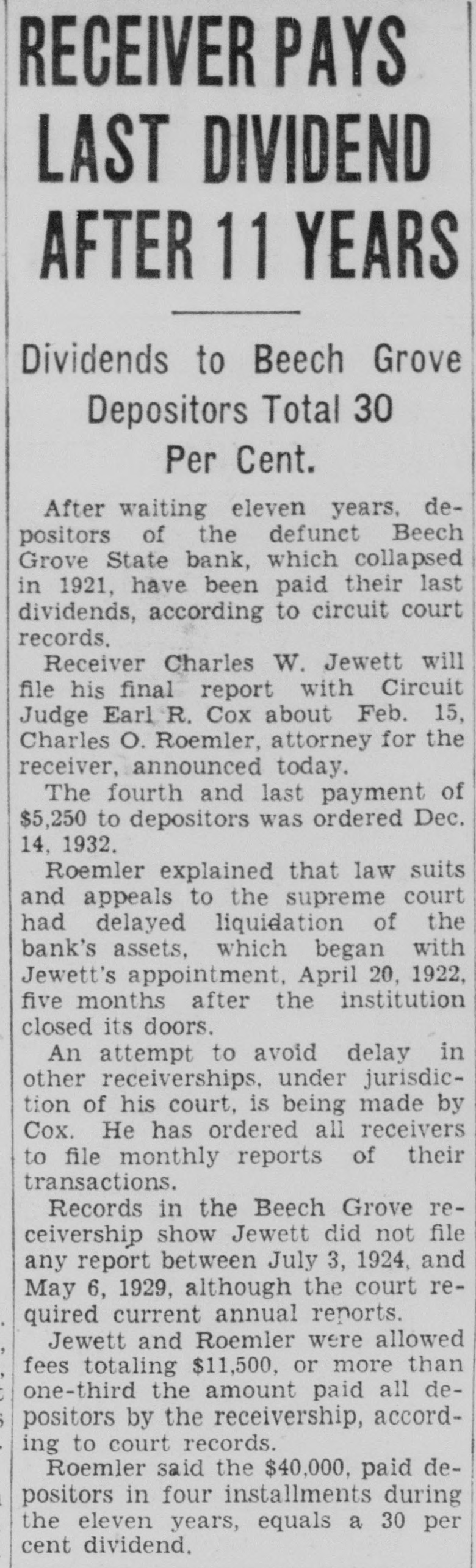
RECEIVER PAYS LAST DIVIDEND AFTER 11 YEARS Dividends to Beech Grove Depositors Total 30 Per Cent. After waiting eleven years, depositors of the defunct Beech Grove State bank, which collapsed in 1921, have been paid their last dividends, according to circuit court records. Receiver Charles W. Jewett will file his final report with Circuit Judge Earl R. Cox about Feb. 15, Charles O. Roemler, attorney for the receiver, announced today. The fourth and last payment of $5,250 to depositors was ordered Dec. 14, 1932. Roemler explained that law suits and appeals to the supreme court had delayed liquidation of the bank's assets, which began with Jewett's appointment, April 20, 1922, five months after the institution closed its doors. An attempt to avoid delay in other receiverships, under jurisdiction of his court, is being made by Cox. He has ordered all receivers to file monthly reports of their transactions. Records in the Beech Grove receivership show Jewett did not file any report between July 3, 1924, and May 6, 1929, although the court required current annual reports. Jewett and Roemler were allowed fees totaling $11,500, or more than one-third the amount paid all depositors by the receivership, according to court records. Roemler said the $40,000, paid depositors in four installments during the eleven years, equals a 30 per cent dividend.

Article from The Indianapolis Times, February 18, 1933

Click image to open full size in new tab

Article Text

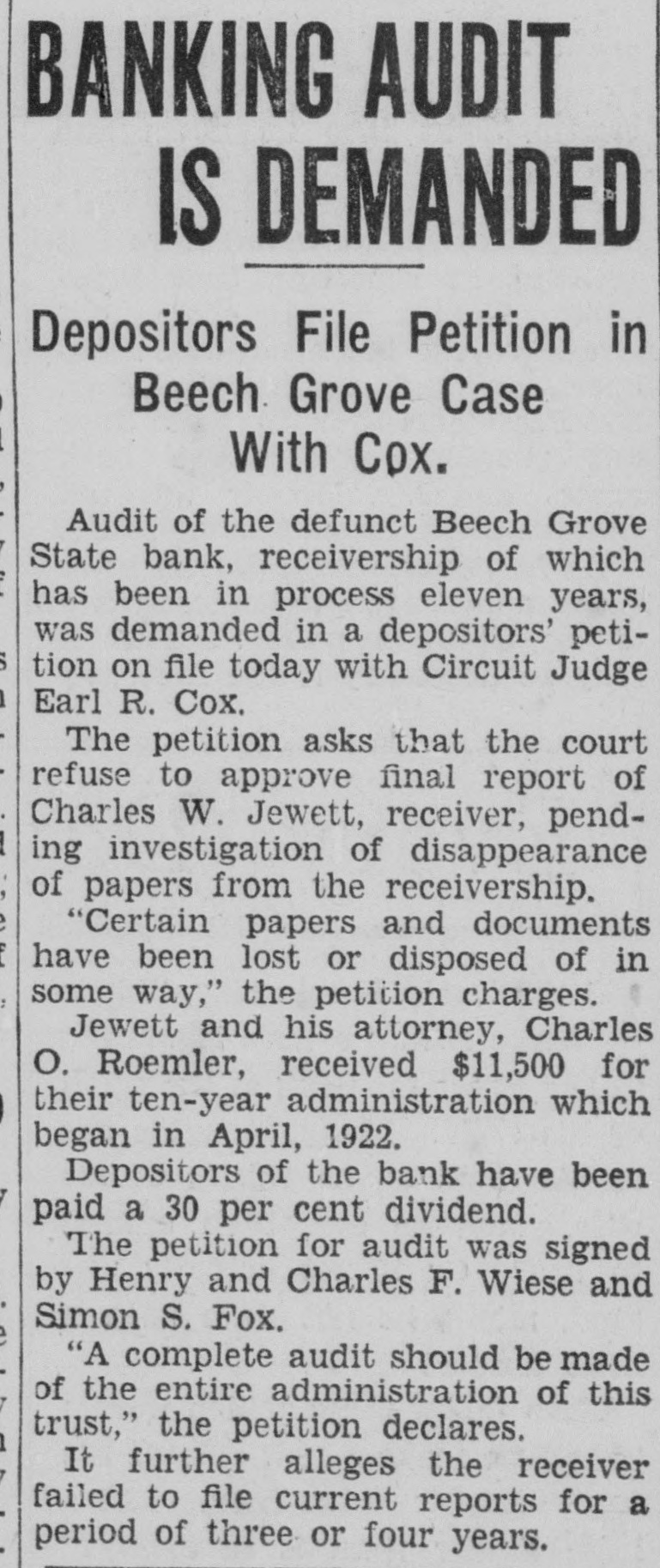
BANKING AUDIT IS DEMANDED Depositors File Petition in Beech Grove Case With Cox. Audit of the defunct Beech Grove State bank, receivership of which has been in process eleven years, was demanded in a depositors' petition on file today with Circuit Judge Earl R. Cox. The petition asks that the court refuse to approve final report of Charles W. Jewett, receiver, pending investigation of disappearance of papers from the receivership. "Certain papers and documents have been lost or disposed of in some way," the petition charges. Jewett and his attorney, Charles O. Roemler, received $11,500 for their ten-year administration which began in April, 1922. Depositors of the bank have been paid a 30 per cent dividend. The petition for audit was signed by Henry and Charles F. Wiese and Simon S. Fox. "A complete audit should be made of the entire administration of this trust," the petition declares. It further alleges the receiver failed to file current reports for a period of three or four years.


Article from The Indianapolis Star, February 26, 1933

Click image to open full size in new tab

Article Text

RESIGNS Action Taken After Judge Cox Orders 4 Employes of Officer Dismissed. Resignation of Curtis H. Rottger, receiver for the City Trust Company, filed in Circuit court yesterday. The came after Judge Earl R. Cox, after examination of payroll vouchers, had issued order discharging four of the ceiver's employes. This examination disclosed that all of the persons ordered discharged were former officers and employes of the defunct bank. Judge Cox announced that he would not formally accept Mr. Rottpending detailed audit of the receivership. Second Receiver to Resign. Mr. Rottger was the second ceiver of major bank to resign. Eben H. Wolcott, receiver for State Savings and Trust Company, submitted his resignation to Judge Cox Feb. Both resignations came while the judge in the midst of an investigation of the receiverships of Marion banks pending in his county court. In addition the City Trust Company and the State Savings and Trust Company they are the Washington Bank Trust Company and the Beech Grove State bank. Brandt C. Downey receiver for the Washington bank and Charles W. Jewett receiver for the Beech Grove bank. In submitting his resignation, Mr. Rottger, served receiver without compensation, declared in letter addressed to Judge Cox that operation of the could not continue if the four discharged, ordered Judge Cox. Paid $210 Week. The men discharged by the court were Dwight Murphy, former president of the City Trust Company: Halford Justin Forsythe Walter H. Hurd. They being paid total of $210 for their services and had been drawing high $855 month until few months ago, according to court Murphy ceiving $75 week. He had been getting $128 week until about year when the amount duced $100 His salary was cut $75 week reductions were made the pay the other three On the basis, the aries totaled year, Judge Cox pointed out. The judge declared that the could erated until liquidated by the ceiver and stenographer. Says Liquidation Slow. strange feature about the statement of the receiver that could not operate without these ployes that the not an operating receivership at all, but liquidating receivership and portion its assets should CONTINUED ON PAGE