Merchants Trust Company (New York, NY)

Episode Information

Episode Type
Suspension → Closure
Start Date
May 23, 1905
Location
New York, New York (40.714, -74.006)
Bank Type
trust

Metadata

Notes

Suspension was by state superintendent with receivers appointed; bank did not resume as independent institution.

Events (3)

1. May 23, 1905 Suspension
Cause
Government Action
Cause Details
Closed by order of State Superintendent of Banks F. D. Kilburn due to inability to realize on illiquid collateral and to prevent a run.
Newspaper Excerpt
The Merchants' Trust Company ... closed its doors this morning ... the usual hour for opening the bank ... posted on its doors the following notice: The Merchants' Trust Company is closed by order of F. D. Kilburn, state superintendent of banks.
Source
newspapers
2. May 24, 1905 Receivership
Newspaper Excerpt
Upon the application of the state attorney general, Douglas Robinson ... was appointed one of the receivers of the company.
Source
newspapers
3. August 28, 1905 Other
Newspaper Excerpt
Interest ... have agreed to purchase all the unsold assets of the defunct Merchants' Trust Company ... The receivers ... will make a payment to depositors on Sept. 15, probably of 25 per cent. Depositors have already received 40 per cent.
Source
newspapers

Newspaper Articles (23)

Article from Evening Star, May 23, 1905

Click image to open full size in new tab

Article Text

BUSINESS SUSPENDED Merchants' Trust Company of New York Closes Doors. STATEMENT ISSUED UNABLE TO TURN SECURITIES INTO CASH QUICKLY. President Phillips Exonerated From All Blame in the MuddleReceiver Shortly. Special Dispatch to The Star. NEW YORK, May 23.-The Merchants' Trust Company, which has its main office at 346 Broadway, and a branch at 300 West 59th street, closed its dors this morning. Shortly before 10 o'clock, the usual hour for opening the bank, Samuel Untermeyer, counsel for the company, emerged from a meeting of directors and announced that upon his advice the officers had decided to suspend the business. By 10 o'clock there were a dozen persons in line, as usual, waiting to draw out money, and a similar number ready to make deposits, but the tellers' wickets were not open. Bank Examiner A. C. Judson was behind the counter, and about ten minutes after the time the bank should have opened he posted on its doors the following notice: "The Merchants' Trust Company is closed by order of F. D. Kilburn. state superintendent of banks." While Mr. Judson was posting up his notice, Mr. Untermeyer was preparing the following statement, which he issued shortly thereafter: "In view of the publicity that has been given to the efforts of the company to increase Its cash resources and to the unmarketable character of certain of the securities, which it holds as collateral for large loans, I have advised the president to recommend the suspension of business so as to prevent a run on the institution. "Mr. Philips has been president for only a few months. The loans that have crippled the cash resources were not made under his administration and he has no responsibility for them. Ever since Mr. Phillips assumed office his efforts have been directed toward inducing those under whose administration these loans were made to take them out of the institution. This has not yet been done, but it may be done. The president will probably make a statement later." President Jacob L. Phillips said at the time Mr. Untermeyer issued the foregoing statement that the directors were still in session and that as soon as they concluded their meeting a statement would be issued by the president, probably early in the afternoon. Until the issuance of his statement he said that he did not care to discuss the company's troubles. Receiver Shortly. Bank Examiner Judson said that a receiver would probably be appointed shortly upon application to the attorney general. Mr. Judson added that it would probably be a week or ten days before the state banking department completed its present examination of the books, and that until that time he was not at liberty to discuss the affairs of the bank. As the bank counters transacted no business this morning there were no new deposits accepted and no money paid out. The number of patrons at the trust company's offices this morning, as It closed, was normal. None manifested any anxiety. If anyone present suspected that the company was in serious trouble he did not show it. Not until the news of the company's suspension spread rapidly through the dry goods and the financial districts was there any commotion at 346 Broadway. The Present Officers. The present officers of the Merchants' Trust Company are as follows: President, Jacob L. Phillips; vice president, Cassius M. Wicker; secretary-treasurer, Frederick P. Davis; asistant treasurer, Jacob J. Coyne. Directors: George C. Batcheller, Ronald K. Brown, John Cantlege, George C. Clarke, Frederick P. Davis, Thomas L. Feitner, Charles J. Follmer, Edwin Langdon, John P. Munn, Jacob L. Phillips, James E. Reynolds, Henry Sampson, David S. Walton and Cassius M. Wicker. The company has been in operation about six years. Its statement at the close of business December 31, 1904. showed that It had a capital stock of $500,000, a surplus of $1,000,000, undivided profits of $198.737 and deposits amounting to $3,367,617. It had loans amounting to $2,074,000, cash on hand in banks of $1,481,608, and it had $507,500 worth of New York city bonds and about $980,000 worth of other stocks, bonds and investments. A person familiar with the affairs of the company said today that the principal cause of the suspension was the inability of the company to realize rapidly upon large loans it had made upon bonds of the Hudson Valley railroad and some Rutland property. This financier said: "The Merchants' Trust Company has as collateral $1,200.000 worth of bonds of the Hudson Valley railroad, a system of trolley companies operating between Albany and Saratoga, and it loaned about $700,000 worth upon some Rutland property. Meeting of Directors. "When the directors met this morning about 9:30 o'clock, there was a disposition on the part of those present to make heroic efforts to weather the financial gale which they expected would follow the rumors in circulation about the Merchants' Trust Company ever since late

Article from The Times Dispatch, May 24, 1905

Click image to open full size in new tab

Article Text

TRUST COMPANY DRIVEN TO WALL

(Continued from First Page.)

ness men. The Fifty-ninth Street branch had on deposit about $700,000. "No other institution is involved by the closing. "It is certain the assets would cover all liabilities to the extent of paying the depositors and stockholders in full if the assets can be marketed at par. Several months will be required for the receiver or receivers to get the affairs of the company in shape approaching a more or less final state of preparation for settlement." State Bank Superintendent F. D. Kilburn gave out the following statement: "An examination of the Merchants Trust Company made something over two years ago disclosed the fact that its management had loaned upon the purchased securities to the amount of about $4,000,000, which had no ready market value, besides guaranteeing loans made in the interest of the Richmond (Va.) company to the extent of $750,000. About $2,360,000 of these loans and investments were upon securities of Richmond companies. About $$50,000 were invested in securities of and loaned to the Hudson Valley Railway Company and nearly $400,000 to the Rutland (Vt.) Street Railway Company and to the Chittenden Development Company, the latter being a holding company of the stock of lighting, power and railway companies located in Rutland. "I was convinced that to put the trust company in the hands of a receiver at that time would necessarily result in throwing these securities on the market and in an enormous loss to the trust company and it was my judgment, which subsequent events have justified, that it would be better to try to relieve the trust company of these securities. "This task was at once undertaken and has thus far resulted in the payment by the Richmond companies of $2,267,000 or the entire debt, less $150,000. The trust company has also been relieved from its said guarantee of $750,000. "In the meantime, a syndicate had been formed by those interested in the Hudson Valley Railway property by which it was agreed to advance $970,000 for the purpose of putting that property in better shape. This amount was paid in by this syndicate of which the trust company paid eleven-twentieths. Out of this, however, there was paid to the trust company $100,000 upon its indebtedness."

Stock and Investments.

The officers of the trust company are as follows: President, Jacob L. Phillips; Vice-President, Cassius M. Wycker! Secretary and Treasurer, Frederic P. Davis; Assistant Secretary and Assistant Treasurer, Jacob C. Coyne. One of the directors was Dr. John P. Munn, physician to the Gould family. On January 1st, the company's stock and bond investments amounted to $1,471,312, including the following: Hudson Valley Railway syndicate participation, $533,500; United States Cotton Duck stock, $100,000; $101,000 Virginia Passenger and Power Company, first bonds; $200,000 of the Chittenden Development Company, first bonds, and $500,000 of the bonds of the city of New York. State Bank Examiner Judson said the loans believed to be responsible for the banks' trouble were made under the administration of Edwin Langdon, who was president of the company until 1902, and that Edwin Hawley and Mr. Phillips were not responsible for them.


Article from Evening Journal, May 24, 1905

Click image to open full size in new tab

Article Text

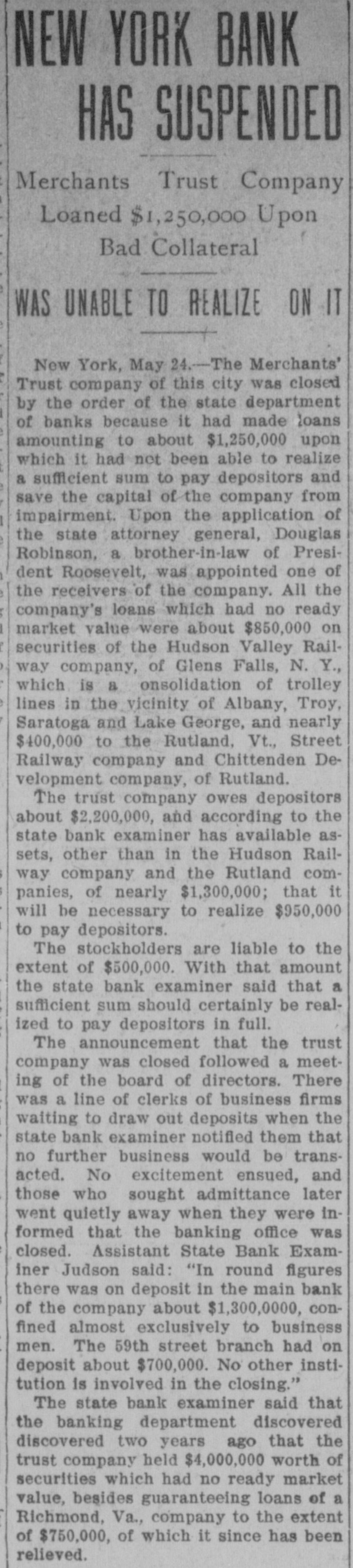
NEW YORK BANK HAS SUSPENDED Merchants Trust Company Loaned $1,250,000 Upon Bad Collateral WAS UNABLE TO REALIZE ON IT New York, May 24.-The Merchants' Trust company of this city was closed by the order of the state department of banks because it had made loans amounting to about $1,250,000 upon which it had not been able to realize a sufficient sum to pay depositors and save the capital of the company from impairment. Upon the application of the state attorney general, Douglas Robinson, a brother-in-law of President Roosevelt, was appointed one of the receivers of the company. All the company's loans which had no ready market value were about $850,000 on securities of the Hudson Valley Railway company, of Glens Falls, N. Y., which is a consolidation of trolley lines in the vicinity of Albany, Troy, Saratoga and Lake George, and nearly $400,000 to the Rutland, Vt., Street Railway company and Chittenden Development company, of Rutland. The trust company owes depositors about $2,200,000, and according to the state bank examiner has available assets, other than in the Hudson Railway company and the Rutland companies, of nearly $1,300,000; that it will be necessary to realize $950,000 to pay depositors. The stockholders are liable to the extent of $500,000. With that amount the state bank examiner said that a sufficient sum should certainly be realized to pay depositors in full. The announcement that the trust company was closed followed a meeting of the board of directors. There was a line of clerks of business firms waiting to draw out deposits when the state bank examiner notified them that no further business would be transacted. No excitement ensued, and those who sought admittance later went quietly away when they were informed that the banking office was closed. Assistant State Bank Examiner Judson said: "In round figures there was on deposit in the main bank of the company about $1,300,0000, confined almost exclusively to business men. The 59th street branch had on deposit about $700,000. No other institution is involved in the closing." The state bank examiner said that the banking department discovered discovered two years ago that the trust company held $4,000,000 worth of securities which had no ready market value, besides guaranteeing loans of a Richmond, Va., company to the extent of $750,000, of which it since has been relieved.


Article from The Hawaiian Star, May 24, 1905

Click image to open full size in new tab

Article Text

ONE OF THE FAMILY

NEW YORK, May 24-Douglas Robinson, brother-in-law of President Roosevelt, has been made receiver of the Merchants' Trust Co.


Article from The Daily Morning Journal and Courier, May 24, 1905

Click image to open full size in new tab

Article Text

MARKET STOCK FEATURES THEN PRICES RALLY BRISKLY, DROP OFF. Buying-T Investment Considerable Covering by Shorts-Som DisintegratCo.Trust Weather Merchants' evidences ed Crop Report Slightly Unfavorable. of shorts there were and a continuation after While yesterday the market about of covering investment brisk rally slumped buying, again to again. the a opening selling prices. was in evidence is going to do are is Just Bear what the market "the little fellows" will something to that determine. that there not able was said yesterday regarding na- the It an announcement affairs of a satisfactory be likely to be Equitable next week, which sentiment will on this 20,than improve ture Wall general street situation. phase of the firms dealt in less sales slightly exceeding 000 Arbitrage shares purchases in this market, and being scatterthat began ing. The good class of Monday buying was and carried eventhe last yesterday's hour market, the market. but over in into its impress for on stocks, to This tually made was no bidding they were offered. short which covering, to they There condition were taken led, as in the the bulk end, of the adto due was vance was due. attack on prices of the closThe early announcementhants Trust to ing the of expected the doors Stocks, of the news however, came out. began specula- The company. rise as soon this as the was that early some formation was reason had of on Monday impending failure. share list tors of the bank's reaction in the to a material for The in late a great the measure morning buying and a due subsidence of and short account London by net of both the long of position with the 40,000 result to from sudden a buyer shifting sales on to balance seller, of about the interpret by shares. Those who sought of the stock Steel market shares with probable course States the ease watching United perplexetter by being bid up. ocwere much they ran off, recessions which it was which the sharp the late trading more or less of an apparentificial curred From during that there character was to the early the from learned rally. as could hand, be the company suspension was So far details at 'Trust s lending those on meagre of the Merchants instance of reckless similar Exchange to another enterprises the Produce the winter con- of were Trust +inside brought which company facts to were grief that such in the difficulties and to that of the a 1899. vince of every The a special one falled character, bank was an isosomewhat or not Trust the lated There case case. is doubtless doubt as left than to whether the it, have Mer"boom uncomton other ortable small may concerns not, times,' like affecting and the to Leather altogethepare been chants' using too the liberal for similar laws reckon- and deChicago the them, United States directors on their clared ing. The Sugar, and regular Northwest was the Perhaps and Minued contini speculative To an this extent, stocks. the least rise in rise was unon the which governmental reported and cotton cotton. doubtedl crop based bulletining the agricultural wheat growth, though injure it. is in the weekly kind belts, of weatherd that it may not distinctly recorn delay Further and Ohio, from Indiana ported in is the and much planting in as as necessary and states first named and Iowa Nebraska. wheat Winter generally continues of rust although complaints promising, are refrom straw portions and short celved. cona More conditions weather favorable the the have week part latter during rapidwheat spring improve caused is this ly, satisnow crop and making on in factory North where Dakota damaged by and fields some flooding Scattered in are Dathin of the South satiskota. wheat advancink in and heavy though in vallow some Factorical frosts rein will the damage leys well. Washington cover, and is by was Dick This Brothadvice given by & to Co. ers their vesterday: customers is "In the our becomand while ing prices we not go would of may at the time. After sales advise of the few days past violent declines is side the There short dangerous. be furany from rally sharp to be are there seriunless shoudrives and unfaments unforeseen unway." ous ther vorable development in a THE FRIENDLESS FOR


Article from New-York Tribune, May 25, 1905

Click image to open full size in new tab

Article Text

DELAY SAVES DEPOSITORS so INSISTS MR. KILBURN. Says Merchants' Trust Company Will Pay in Full. Otto T. Bannard, president of the New-York Trust Company. one of the receivers of the Merchants' Trust Company. expressed yesterday the belief that the customers of the falled institution would receive the full amount of their deposits, although probably not for a considerable time. In addition to the assets, in realizing on some of which there might be necessary a good deal of delay. there was the stockholders' 100 per cent liability. amounting to $500,000. The loans on the Hudson Valley Railway and Rutland Street Railway properties are regarded by competent judges as good, although slow. W. B. Ellison, counsel for the Merchants' Trust Company, declined yesterday to make any statement as to the alleged conspiracy among the directors, but it is understood that the situation is about as follows: The Merchants' Trust Company was Interested to the extent of $1,250,000 in the Hudson Valley Railway Company and was in receipt of a standing offer for its interest of $750,000. The directors were. however, convinced that they would within six months be in a position to get $1,300,000 for this collateral. and therefore determined to hold on. The trolley company, it is declared. is in a flourishing condition. and the reason its accounts do not make a better showing is that certain expenditures that might have been charged to capital were met out of income. HUDSON VALLEY COMPANY MAY BE SOLD. It is thought to be not unlikely too, that the Hudson Valley Railway Company, the line of which crosses the Delaware and Hudson's tracks at five different points, may be taken over by that company, just as the New-York Central. the NewHaven and other important steam railways have acquired trolley systems paralleling and competing with them. Two weeks ago, it is alleged. the whole condition of the Merchants' Trust Company was laid before Superintendent Kilburn. with the request for authorization of the increase of the capital stock from $500.000 to $1,000,000. Mr. Kilburn assented. it is said, on condition that the interests of the depositors should be protected. Two of the directors of the trust company are. however, said to have gone into Wall Street last week. trying to raise heavy loans, a step which gave rise to rumors which resulted in the suspension of the company. It is asserted that if the additional capital had been secured there would have been no reason to close the doors of the trust company. The New-York Trust Company yesterday. as receiver, took possession of the Merchants' Trust Company, William V. King. third vice-president of the former company. being assigned to take charge of the main office of the concern. and A. S. Webb. jr., second vice-president. to the branch office at Broadway and 59th-st. A conference of directors of the Merchants' Trust Company was held yesterday morning at the main office, but it was said afterward that no action had been taken. Ex-President Langdon held conferences with some of these directors, but subsequently refused to make any statement. State Bank Examiner Judson was asked yesterday afternoon about a statement made by a lawyer that proceedings might be brought against certain of the directors under a section of the banking act, which provides that no corporation of like kind, or the employes of such corporation, shall loan more than 25 per cent of its capital stock and surplus to any one person or corporation. In reply Mr. Judson said: This section does not apply to any loan made by the Merchants' Trust Company. It refers to loans made without collateral. Moreover, many of the loans of the Merchants' Trust Company were underwritings, to which twenty or thirty names were appended. and in no case has more than the legal sum been loaned to any one person. I do not think that the law has been violated in any way. When asked about the action of the State Superintendent of Banks in allowing the Merchants' Trust Company to continue for two years after he had discovered its condition was unsatisfactory, Mr. Judson said: By SO doing the Superintendent has saved the interests of the depositors. If the trust company had been thrown into the hands of a receiver two years ago the depositors would not have realized 30 cents on the dollar. The securities would have been slaughtered. as securities always are when they are thrown on the market. Now, I think the depositors will realize 100 cents on the dollar. "Has the letter of the law been complied with?" Mr. Judson was asked. cannot criticise Mr. Kilburn. He has been indorsed by three Governors, and that means that he is a pretty good man. He acted solely in the interest of the depositors. and his reason for acting now was simply to prevent a run on the trust company. which was already just beginning when I took charge yesterday.' MR. KILBURN'S STATEMENT Albany, May 24 (Special).-F. D. Kilburn, State Superintendent of Banks, to-day discussed the affairs of the Merchants' Trust Company, and declared that his'firm belief was that the depositors would be paid in full. Mr. Kilburn said: When I discovered the condition of the company about two years ago, I exercised my best judgment, and. instead of closing the company. thought it best to relieve it of securities which, if forced to a sale at that time would in all probability have netted the company less than was finally raised upon them. For example, $2,267.000 invested pronerties was.collected and in ad-


Article from The Free Lance, May 25, 1905

Click image to open full size in new tab

Article Text

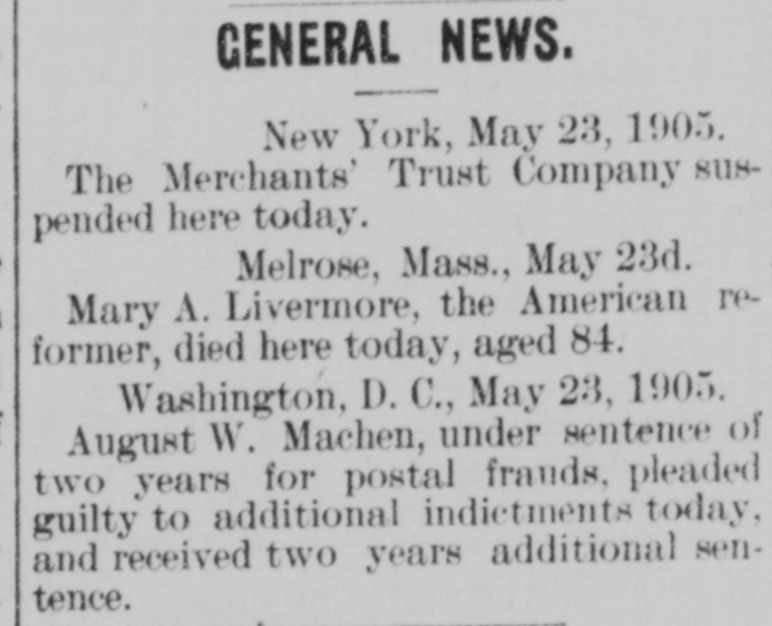
GENERAL NEWS

New York, May 23, 1905. The Merchants' Trust Company suspended here today. Melrose, Mass., May 23d. Mary A. Livermore, the American reformer, died here today, aged 84. Washington, D.C., May 23, 1905. August W. Machen, under sentence of two years for postal frauds, pleaded guilty to additional indictments today, and received two years additional sentence.


Article from The Minneapolis Journal, May 26, 1905

Click image to open full size in new tab

Article Text

BOSTON BANKERS IN HUGE FAILURE Nearly Two Millions Liabilities with Less Than $200,000 Assets. Boston, May 26.-Seventy-one banks and trust companies, most of them in Massachusetts, but several located in various parts of the country, are among the creditors of the banking firm of Burnett, Cummings & Co., this city, which has filed a voluntary petition in bankruptcy, with liabilities placed at $1,714,348. The assets are stated to be uncertain. The creditors have been given to understand that they will not exceed $200,000, if, indeed, they prove to be of any value whatsoever. The bankruptcy petition is the heaviest ever filed in this district. Explains the Cause. J. T. Auebach, counsel for the bankrupt firm, said that the cause of the failure was the building and financing of the Concord & Boston Street Railway company, the Middleboro, Wareham & Buzzards Bay Street Railway company, the Lowell & Boston Street railway and the Bristol County Railway company. These roads were in thinly settled districts and were unable to make suitable connections with roads running to Boston. The four companies were placed in the hands of receivers and their notes became valueless. Auebach said also that the bank's financial crisis was hastened by the buying of the Hampden Trust company of Springfield and of the Taunton Safe Deposit & Trust company of Easton, both of which, unknown to the firm, were in serious financial straits and were placed in the hands of receivers. The refusal of extension of credits then made a continuance of business impossible. Banks as Creditors. The secured creditors number eightyseven and the unsecured eighty-one. There are thirty-two Massachusetts savings banks in the list of creditors and thirteen Massachusetts national banks. One of the heaviest creditors is the Worcester Five Cents Savings bank, with a claim of $80,600, Other banking-institution creditors are the Danvers Savings bank of Danvers for $26,700, the Millbury Savings bank of Millbury for $26,600, and the International Trust company of Boston for $44,495. All these claims are in the secured list. Among the western institutions affected are the Chicago Savings bank, Chicago, $30,390; the State Savings bank, Ann Arbor, Mich., $20,314; the Western Trust & Savings bank, Chicago, $11,896; Fort Dearborn National bank, Chicago, $7,866, and the State Bank of Chicago, Chicago, $10,425. Helen Gould a Loser. New York, May 26.-Chief among the developments from the failure of the Merchants' Trust company is the statement that Miss Helen Gould and her brother Frank were induced by fraudulent practices to invest in the securities of the Virginia Passenger & Power company of Richmond, Va., on the securities of which the trust company made heavy loans, and that they have charged George E. Fisher with taking $2,000,000 to which he is not entitled. Their charge is in answer to his suit for a receivership for the Virginia Passenger & Power company, of which he was a promoter. befine AMILS of Mineral City Bank Closed. Canton, May 26.-The People's Deposit Bank of Mineral City, Ohio, closed. its doors today. The president of the institution says loans of about $50,000 have been made by the bank to W. L. Davis of Canton, whose heavy loans are said to have caused the suspension of the Canton State bank yesterday. Directors of the Mineral City bank say it will resume business in a day or two. Failure in Cincinnati. Cincinnati, May 26.-Holzman & Co, bankers and brokers in the Union Trust building and members of the New York Stock exchange, assigned to. day to Lepman & Levi. Alfred Holzman, a member of the firm, says their assets and liabilities are about equal, at $100,000. He attributes their embarrassment to the rumors concerning the loss of $55,000 from the reserve fund of the German National bank and to the recent run on the Union Trust company bank. Now Another Ohio Bank. Washington, May 26.-The First National Bank of Barberton, Ohio, has been ordered closed by the controller of the currency on the ground that the bank is insolvent. The capital stock is $50,000. snn VIVDL


Article from The San Francisco Call, May 26, 1905

Click image to open full size in new tab

Article Text

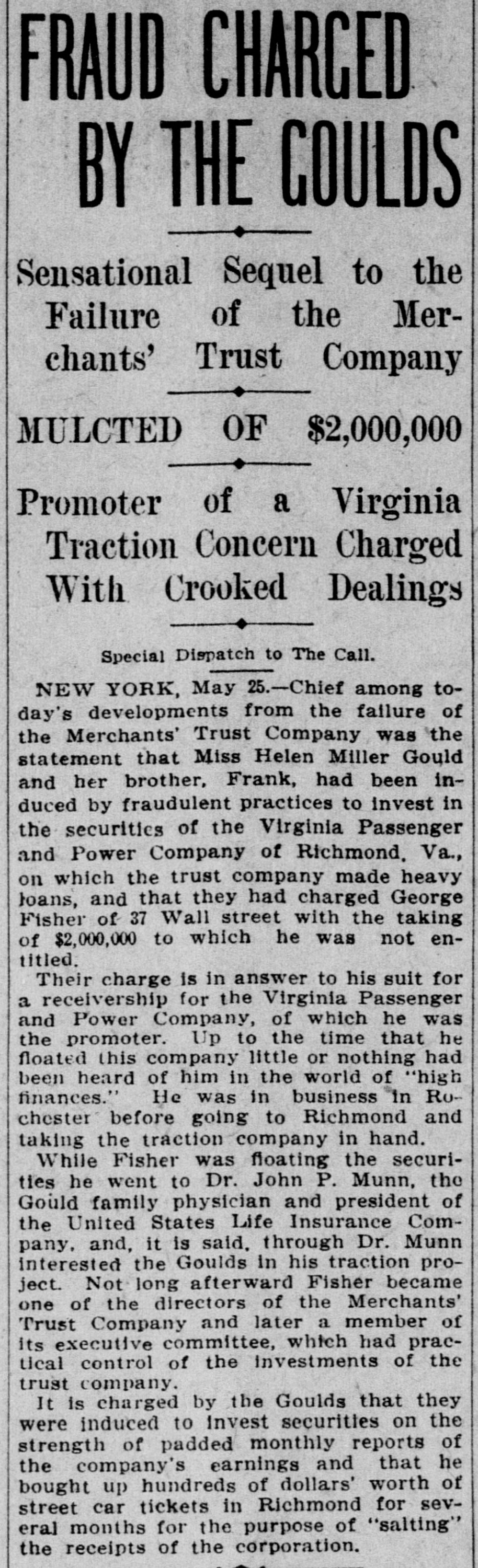
FRAUD CHARGED BY THE GOULDS Sensational Sequel to the of the MerFailure chants' Trust Company MULCTED OF $2,000,000 Promoter of a Virginia Traction Concern Charged With Crooked Dealings Special Dispatch to The Call. NEW YORK, May 25.-Chief among today's developments from the failure of the Merchants' Trust Company was the statement that Miss Helen Miller Gould and her brother, Frank, had been induced by fraudulent practices to invest in the securities of the Virginia Passenger and Power Company of Richmond, Va., on which the trust company made heavy loans, and that they had charged George Fisher of 37 Wall street with the taking of $2,000,000 to which he was not entitled. Their charge is in answer to his suit for a receivership for the Virginia Passenger and Power Company, of which he was the promoter. Up to the time that he floated this company little or nothing had been heard of him in the world of "high finances." He was in business in Rochester before going to Richmond and taking the traction company in hand. While Fisher was floating the securities he went to Dr. John P. Munn, the Gould family physician and president of the United States Life Insurance Company, and, it is said, through Dr. Munn interested the Goulds in his traction project. Not long afterward Fisher became one of the directors of the Merchants' Trust Company and later a member of its executive committee, which had practical control of the investments of the trust company. It is charged by the Goulds that they were induced to invest securities on the strength of padded monthly reports of the company's earnings and that he bought up hundreds of dollars' worth of street car tickets in Richmond for several months for the purpose of "salting" the receipts of the corporation.


Article from The Stark County Democrat, May 26, 1905

Click image to open full size in new tab

Article Text

#

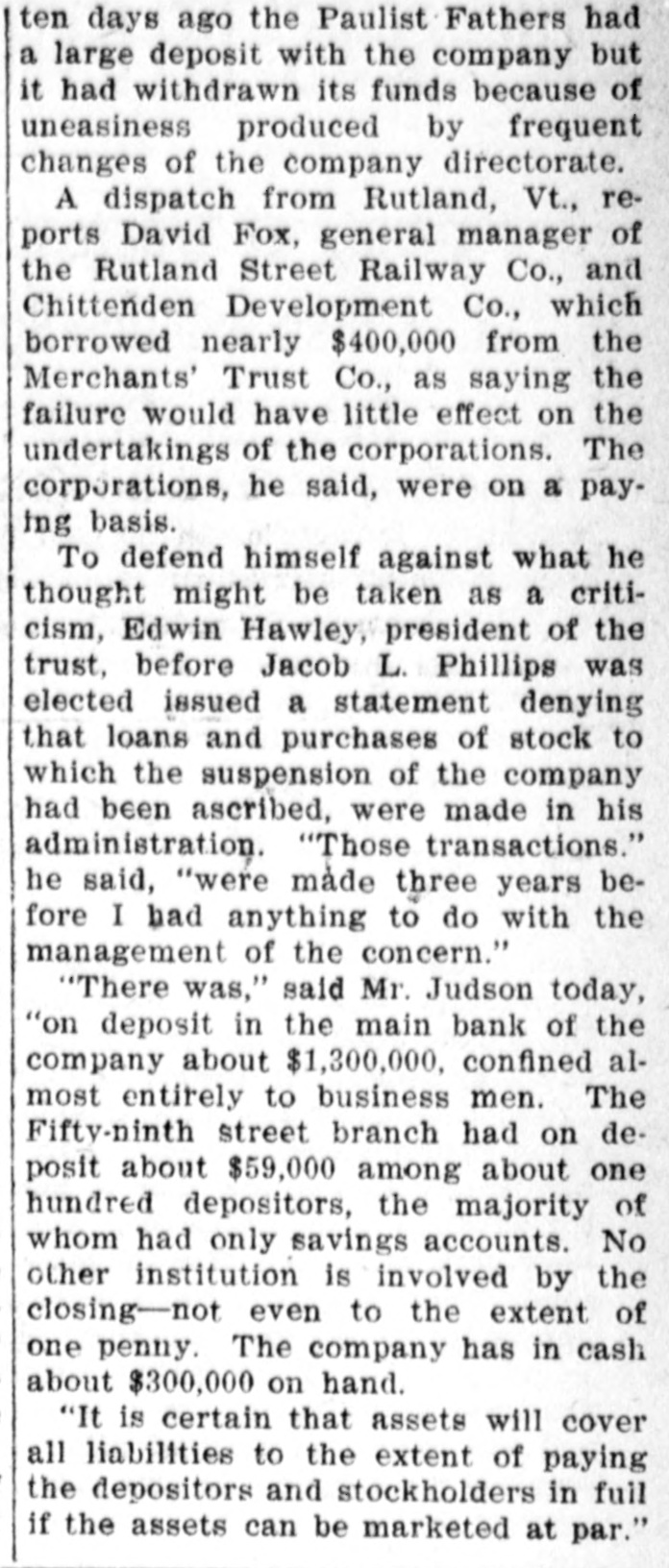
ten days ago the Paulist Fathers had a large deposit with the company but it had withdrawn its funds because of uneasiness produced by frequent changes of the company directorate.

A dispatch from Rutland, Vt., reports David Fox, general manager of the Rutland Street Railway Co., and Chittenden Development Co., which borrowed nearly $400,000 from the Merchants' Trust Co., as saying the failure would have little effect on the undertakings of the corporations. The corporations, he said, were on a paying basis.

To defend himself against what he thought might be taken as a criticism, Edwin Hawley, president of the trust, before Jacob L. Phillips was elected issued a statement denying that loans and purchases of stock to which the suspension of the company had been ascribed, were made in his administration. "Those transactions," he said, "were made three years before I had anything to do with the management of the concern."

"There was," said Mr. Judson today, "on deposit in the main bank of the company about $1,300,000, confined almost entirely to business men. The Fifty-ninth street branch had on deposit about $59,000 among about one hundred depositors, the majority of whom had only savings accounts. No other institution is involved by the closing-not even to the extent of one penny. The company has in cash about $300,000 on hand.

"It is certain that assets will cover all liabilities to the extent of paying the depositors and stockholders in full if the assets can be marketed at par."


Article from The Irish Standard, May 27, 1905

Click image to open full size in new tab

Article Text

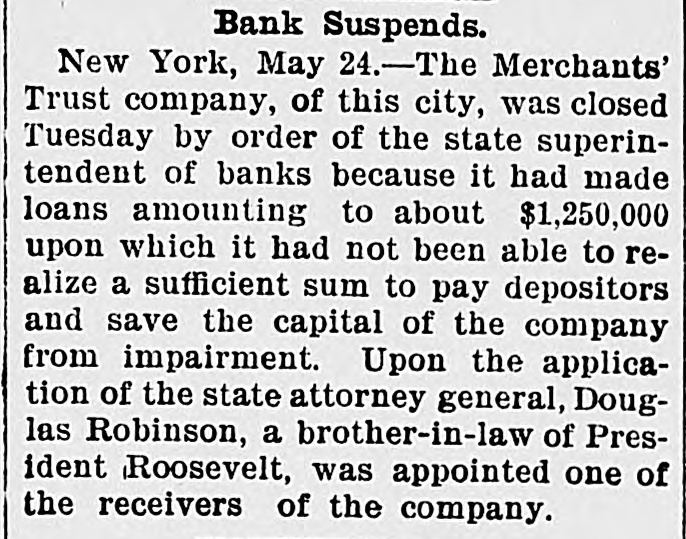
Bank Suspends

New York, May 24.-The Merchants' Trust company, of this city, was closed Tuesday by order of the state superintendent of banks because it had made loans amounting to about $1,250,000 upon which it had not been able to realize a sufficient sum to pay depositors and save the capital of the company from impairment. Upon the application of the state attorney general, Douglas Robinson, a brother-in-law of President Roosevelt, was appointed one of the receivers of the company.


Article from The Labor World, May 27, 1905

Click image to open full size in new tab

Article Text

DEPOSITORS WILL GET THEIR MONEY NEW YORK, May 24.-The depositors of the closed Merchants' Trust company eventually will be paid in full, was the opinion expressed today by President Otto T. Bannard, of the New York Trust company, one of the receivers for the suspended company. He said that an assessment may have to be levied upon the stockholders. The receiver took full charge of the company today.


Article from Chicago Eagle, May 27, 1905

Click image to open full size in new tab

Article Text

Loans Wreck Bank.

Its money frittered away on the securities of almost worthless companies organized by its officers, the Merchants' Trust Company passed into the hands of a receiver in New York. The receivers are Douglas Robinson, brother-in-law of President Roosevelt, and the New York Trust Company.


Article from New-York Tribune, June 1, 1905

Click image to open full size in new tab

Article Text

TO CARE FOR SECURITIES

MERCHANTS' TRUST PLAN. Special Meeting To-morrow-Past and Present Directors Invited. A special meeting, to include both past and present directors of the Merchants' Trust Company. it was learned by The Tribune yesterday, has been called for to-morrow to consider the question of underwriting the Hudson Valley and Rutland securities, on which the company lent upward of $2,000,000. At the meeting, it is said, the directors will be told that these securities cannot at present be disposed of, at least for anything above a fraction of the amount of the loans. Should they agree to "take care" of these securities, the directors, it is said. will be told that an assessment of the stock will be entirely unnecessary. The proposed taking care of the securities will be part of a plan to be formulated at the meeting for the rehabilitation and the reorganization of the company. Every living director who at any time has served on the board has been invited to attend. and a lively session is looked for. The call was sent out yesterday. W. B. Ellison, the counsel of the company, when seen at his home by a Tribune reporter last night, said he would not admit that any call had been sent out, and declined to discuss the matter in any shape or form. Should the plan to be formulated meet with success an application may be made to prevent/the appointment of a permanent receiver. It had been expected that this appointment would be made on Satfurday. Louis E. Spencer, secretary of George E. Fisher. promoter, of No. 37 Wall-st., expressed indignation yesterday at the introduction of his name into the failure of the company by counsel for Frank J. and Helen M. Gould. Mr. Spencer said: I deny that I have made any statement that I have had any dealings with the Merchants' Trust Company. I never borrowed a dollar from that company, nor do I owe the company a dollar. I wish to be left out of this controversy entirely. Said Mr. Fisher: I wish to state that nearly every statement made by the Gould lawyers is a misstatement. Mr. Battie states that $1,000,000 was lost in the Merchants' Trust stock. That is not so. Mr. Gould made $20,000 by the sale of 500 shares of stock, and his net loss, as I understand it. was only $110,000. I never mentioned Miss Helen Gould's name in this case. I bought some bonds from Frank J. Gould, and I gave him a check for $50,000, which is one-half of the money invested. Mr. Gardiner's statement of a loss of $130,000 is incorrect because he fails to subtract therefrom the $20,000 profit made by Mr. Gould. In the syndicate formed in April, 1900. there were 200.000 shares of stock subscribed, 100,000 of the Richmond Passenger Power Company, of which Charles A. Gardiner was the chairman. He received for that $80,000 in consolidated bonds and $200,000 in preferred stocks, and a bonus of $100,000 in common stock. I may say here that my personal attorney was Charles A. Gardiner. Suits have been brought in Virginia against Mr. Gould. and judgments have been secured there against him. He has never been able to win a case in Virginia. George Gordon Battle told the reporter that he never remembered having said that $1,000,000 was lost in the stock. "As to the suits in Virginia," Mr. Battle added, "I am not personally familiar with them. but it is my belief that the judgments went just the other way." The report that a banking house seeks to buy the Hudson Valley securities, to obtain control of the railway company, could not be confirmed from any authoritative source.


Article from The Star, June 7, 1905

Click image to open full size in new tab

Article Text

GOULDS FIGURE IN FAILURE

Helen and Frank Charge Fisher With Taking $2,000,000.

Chief among developments from the failure of the Merchants Trust Company of New York was the statement that Miss Helen Gould and her brother, Frank, has been induced by fraudulent practices to invest in the securities of the Virginia Passenger & Power Company of Richmond, Va., on the securities of which the trust company made heavy loans, and that they have charged George E. Fisher with taking $2,000,000 to which he was not entitled. Their charge is in answer to his suit for a receivership for the Virginia Passenger & Power Company, of which he was promoter.


Article from La Democracia, June 9, 1905

Click image to open full size in new tab

Article Text

UNA GRAN QUIEBRA Ha suspendido sus pagos la Merchants Trust Co, de New York, y de orden del Inspector Gereral de Bancos del Estado, se han encargado de liquidar sus negocios los síndicos nombrados al efecto. El investigador ba declarado inútiles, sin ningún valor, documentos en cartera que por valor de dos millones de resos se habían dado á la Compa ñía como garantías colaterales á prés tamos hechos Mr. Sanson ha calificado a los directores de la Merchants Trust como «financieros frenéticos.» Helen Gould, quesalvó en circunstancias análogas, tiempo hace, a esta institución, se niega a volverle a prestar auxilio.


Article from Evening Star, June 20, 1905

Click image to open full size in new tab

Article Text

Money Raised to Pay Depositors

The directors of the suspended Merchants' Trust Company in New York yesterday voted to accept the offer of $850,000 made by a syndicate for the Hudson Valley Railway Company stock which is held by the trust company. If the court permits the sale, the $850,000 thus obtained, added to $300,000 in cash on hand, $500,000 in New York city bonds held by the company and $300,000 promised by certain of the directors to be advanced for the purpose, will enable the depositors to be paid off immediately.


Article from The Providence News, July 20, 1905

Click image to open full size in new tab

Article Text

RECEIVER APPOINTED FOR
RUTLAND STREET RAILWAY

Burlington, Vt., July 20. -The appoint- ment of David Fox as received for the Rutland Street Railway company of Rut- land, was made today in this city, by Judge Hoyt T. Wheeler of the United States circuit court.

Mr. Fox is general manager of the street railway company. The appointment was made as the result of the petition filed with the court here yesterday by Douglas Robinson of New York, receiver of the Merchants Trust company of New York, asking for the naming of a receiver.


Article from New-York Tribune, August 6, 1905

Click image to open full size in new tab

Article Text

WANT NEW RECEIVER

Merchants' Trust Depositors Expected to Ask for Change. It is expected that at a meeting to be held tomorrow night by the members of the Merchants' Trust Company Depositors Protective Association it will be voted to petition the Supreme Court at Albany for the removal of Douglas Robinson and the New-York Trust Company as receivers of the defunct Merchants' Trust Company. There are two branches of the depositors' association, with a membership of 500. They express deep dissatisfaction with the manner in which the affairs of the company are being conducted by the receivers. A committee was appointed. consisting of Isaac Pennamacoor, president: James I. Moore, secretary; Gustave Keese and W. T. Irwin, for the purpose of presenting to Douglas Robinson and Otto T. Bannard, president of the New-York Trust Company, a list of questions. the answers to which they think will be of interest to the depositors. Mr. Robinson and Mr. Bannard, the committee was informed, were out of town, so a letter was addressed to them. asking when they could meet the committee. Some of the questions refer to sales of some of the Merchants' Trust Company's assets for much below their market value. and in some instances for even less than was offered. One instance of which the depositors complain is the sale of four hundred shares of Tefft-Weller Company stock at 56, though 65 had been offered and the stock was quoted on the market at 70. Another cause for complaint was the sale by the receivers of the lease, furniture and fixtures of the uptown branch of the Merchants' Trust Company for $6,200. though $8,000 was offered and a certified check for that amount was tendered by the person who made the offer. These same chattels had been disposed of at a previous sale for $6,100. which sale the depositors had set aside by the Supreme Court. The depositors' committee also asks if it is not true that E. Clarence Jones & Co. bid $2,200,000 for all the assets. Vice-President King of the New-York Trust Company said yesterday regarding the offer of E. Clarence Jones & Co. for the entire assets: "Mr. Jones has not made any offer of any kind to the receivers." Benjamin Franklin, counsel for the depositors' association. said to a Tribune reporter yesterday that with a proper handling of the assets of the Merchants' Trust Company the depositors and other creditors ought to receive dollar for dollar.


Article from Evening Star, August 8, 1905

Click image to open full size in new tab

Article Text

Want Jerome to Probe Trust Affairs.

Following charges of fraud in connection with the affairs of the Merchants' Trust Company, the depositors of the institution at New York last night appointed a committee of three to meet and confer with District Attorney Jerome. This committee, it is understood, will lay before Mr. Jerome evidence of alleged wrong-doing in its possession. Charges were made at the meeting that the receivers of the trust company had refused bids for the assets of the corporation, which would have enabled the depositors to have received their money in full. A committee appointed at the last meeting of the depositors reported that it had had a consultation with Vice President Haynes of the New York Trust Company and Edward Lauterbach, the receiver's attorney. Mr. King, it was said at this meeting, denied that the receivers had received a bona fide bid of $2,300,000 for the entire assets of the Merchants' Trust Company.


Article from The Birmingham Age-Herald, August 13, 1905

Click image to open full size in new tab

Article Text

that the commercial countries are in danger of calamities due to over inflation they laugh and say there can be no danger of getting too much money, inasmuch as it is acknowledged to be the "best money ever known." The financial fabric of every nation is grounded on gold itself and what can be better than that? Whoever heard of having too much of a good thing? This conclusion is hard to answer, and is usually passed up, even by the wisest, who recognize that the time is not yet ripe for an educational campaign of safety.

Vain it is to talk of remote calamity in the face of present amazing prosperity, evidences of which are everywhere about us. An operator of the multi-millionaire class who has been in the street for forty years and who has beaten the market nine times out of ten, said to me the other day: "I have about discovered most of my old theories and principles of market play. Time was when I had to think and study and plan deeply. Now one has only to shut his eyes and buy blindly. Seemingly prices are never too high. Values grow up to almost any plane of quotations that may be established. I find it profitable to forget most that I was forty years learning, and to throw doubt and distrust to the winds, buying almost without considering everything that suggests itself to my fancy. That may seem nonsensical but nevertheless, it pays. I suppose some day I will get a jolt, but what's the use of borrowing trouble. I can run as fast as anybody and when calamity hits the market I will not be found among the hindmost." That's the trouble with the market today. The majority of traders are committed blindly to the bull side of the market and each trader is confident of his ability to get out from under when the walls begin to crumble. if they should crumble. Technically this it a dangerous situation, but the skies are bright and no where along the whole horizon can the faintest sign of danger be seen. The army of speculators is in hascheesh dream and its pipe has not yet gone out. It plays the market from day to day and the tape from minute to minute-ever and ever making money.

The holders of the Southern Pacific common do not appear to be greatly disturbed by the annual report which shows a deficit of $650,000 for the year. That is to say the net earnings fell that much short of fixed charges and dividends on the $40,000,000 7 per cent preferred stock issued less than a year ago. During the period under review there has been a very large increase of the bonded indebtedness in addition to the $40,000,000 stock put out. Union Pacific is being made the beneficiary of every phase of the Harriman financiering and Southern is the "goat." Upon that fated system is saddled every kind of burden and indebtedness that can be devised. Every move to increase the load is widely heralded as boundlessly benefitting the common stock, yet every move puts further into the limbo of hopelessness the possibility of dividends. The holder of Southern Pacific common who believes he will ultimately get dividends is quite as optimistic as the impecunious party who put a tooth pick over his ear in order to be prepared for that invitation to lunch which he said he hoped some stranger might extend to him.

Bankers are almost without exception in receipt of encouraging trade reports from their correspondents in every part of the country. Inspired by faith in bounteous crops and healthy conditions, merchants and retailers from one end of the country to the other are buying liberally. Being in touch with the elemental purchasers they fell justified in extending themselves to meet demands for the coming fall and winter. Eastern banks will not be drawn upon more than usual to move the crops and indications point to a fairly easy money market until the end of the year. At the same time, bankers, as a rule, are dead set against giving undue encouragement to speculative enthusiasm on the bull side. They are in deadly fear of over speculation, knowing the consequences of unbridled stock gambling.

Creditors and stockholders of the insolvent Merchants Trust company are building a fire under the receivers. They have even gone to the states attorney, Mr. Jerome, with charges of criminal failure to protect the interests of those to whom money is due and who are legally and morally entitled to whatever can be realized from the assets. It appears that E. Clarence Jones, a millionaire capitalist, has a standing offer to take over the assets of the company, pay off all indebtedness with enough besides to meet incidental fees in connection with the settlement. The offer was calmly ignored, although nothing as good is in sight. Creditors marveled at first and then loudly protested. Wall street has


Article from The Birmingham Age-Herald, August 13, 1905

Click image to open full size in new tab

Article Text

said to have been conveyed to Mr. Jones that if he would abandon his position in Seaboard Air Line and come into the Blair-Ryan camp he would find the ma- chinery greased to his satisfaction in the neighborhood of the Merchants Trust company. He decided, however, to stand pat and to not only stick to Mr. Williams but to protect his interests in the Trust company to the very best of his ability. It is shrewdly surmised that persons friendly to the Jones combination are supplying the fuel for the fire which is driving the Blair-Ryan receivers out into the open. From what can be seen it is clear that the receivers have been doing some very clumsy work and by their acts have given the opposition plenty of ammunition for a vigorous cam- paign. If the Merchants Trust company insolvency does not yet yield a first class financial scandal there will be disappoint- ment in Wall street.

Once more the columns of the financial pages of the newspapers are full of wise talk about the west and the south "bor- rowing" enormous sums of money from the New York banks with which to move the crops. The south will do considerable borrowing in this center, it is true, but the west will be only drawing down its balances here which are heavier now than ever before, according to most estimates. The rest of the country is becoming more independent of New York year by year and when it draws funds for local or sec- tional use it is merely employing its own cash resources the same as an individual depositor might do. The country at large is in very little need of coming to New York for "help."

There is a close communication between the great international banking inter- ests of the old world and the new, and it may be said with full knowledge of the facts that this mighty influence is strongly for a restoration of peace be- tween Russia and Japan. The financial powers of both hemispheres have gone about as far as they care to in extend- ing credit to the battling nations. From the broader viewpoint there is more money in peace than can be made in milking the treasuries of Russia and Japan. The whole world is in a health- ful and satisfactory trade and industrial position. A colossal war however remote the acting scene may be from the great currents of commercial activity, is nev- ertheless a distributing element and the weight of money is against further con- tinuation of the struggle.

### Not So Green,

"Your father has reached a green old age, hasn't he?" "It's old age, all right, but if you think it's green just try to sell him a gold brick."


Article from The Sun, August 29, 1905

Click image to open full size in new tab

Article Text

MERCHANTS' TRUST ASSETS SOLD.

Hudson Valley Railway Interests to Take Them—Another Slice for Depositors.

GLENS FALLS, N. Y., Aug. 28.—Interest headed by former State Treasurer Addison B. Colvin and John W. Herbert, the president and the general manager and vice-president, respectively, of the Hudson Valley Railroad Company, have agreed to purchase all the unsold assets of the defunct Merchants' Trust Company of New York; which include 11,000 shares of Hudson Valley stock, par value $1,100,000; demand notes of the Hudson Valley Railway, $746,861.70, secured by Hudson Valley bonds, par value $861,000; 275 of the bonds, $275,000; 110 North River Railway bonds, $110,000; 1,100 North River Railway shares, guaranteed by the Hudson Valley Railway, $110,000; supplemental notes given by Hudson Valley Syndicate, $115,500; car trust notes given by same syndicate, $16,500, and accrued interest on above securities, about $50,000.

Mr. Colvin declined to name the terms of the purchase inasmuch as the papers have not yet been executed. This will be done at a conference to be held in New York Wednesday. He said that the agreement was mutually satisfactory to all interested. It has, Mr. Colvin said, been approved by Attorney General Mayer, who was present for a part of the time at the conference held in Albany Saturday when the agreement was reached.

The receivers of the Merchants' Trust Company in pursuance of the court order will make a payment to depositors on Sept. 15, probably of 25 per cent Depositors have already received 40 per cent.