4733. Whisky Trust (Chicago, IL)

Bank Information

Episode Type
Suspension → Reopening
Bank Type
state
Start Date
February 2, 1895
Location
Chicago, Illinois (41.850, -87.650)

Metadata

Model
gpt-5-mini
Short Digest
b520993c

Response Measures

None

Description

The articles describe the Whisky Trust being placed in the hands of court-appointed receivers (a legal suspension/receivership) in early February 1895, subsequent receiver actions (borrowing authority, litigation), and stockholders' plans to reorganize and take the concern out of receivers' hands (Feb 17, 1895 report). There is no mention of depositor runs or heavy withdrawals; the main event is a receivership (court action) with plans for reorganization, so classified as a suspension (receivership) with an eventual reorganization/reopening plan. Dates are taken from newspaper publication dates and internal date references. OCR errors in names/dates were corrected (e.g., Greenhut for president Greenhut; receiver McNulta/McFulta appears with OCR variants).

Events (6)

1. February 2, 1895 Suspension
Cause
Government Action
Cause Details
Court-appointed receivers were put in charge of the Whisky Trust by the U.S. circuit court (receivership filed and appointment in early February 1895).
Newspaper Excerpt
CHICAGO, Feb. 2.-Proceedings ... whisky trust litigation in united States courts opened ... the receivers had been appointed.
Source
newspapers
2. February 13, 1895 Other
Newspaper Excerpt
Judge Grosscup today issued an order authorizing the receivers of the Whisky Trust to borrow $50,000 for ninety days.
Source
newspapers
3. February 17, 1895 Reopening
Newspaper Excerpt
To Be Reorganized, Taken Out of the Receivers' Hands and Greenhut's Services Dispensed With. ... plans for getting the Whisky Trust on its feet have been practically agreed on by the stockholders' reorganization committee.
Source
newspapers
4. May 17, 1895 Other
Newspaper Excerpt
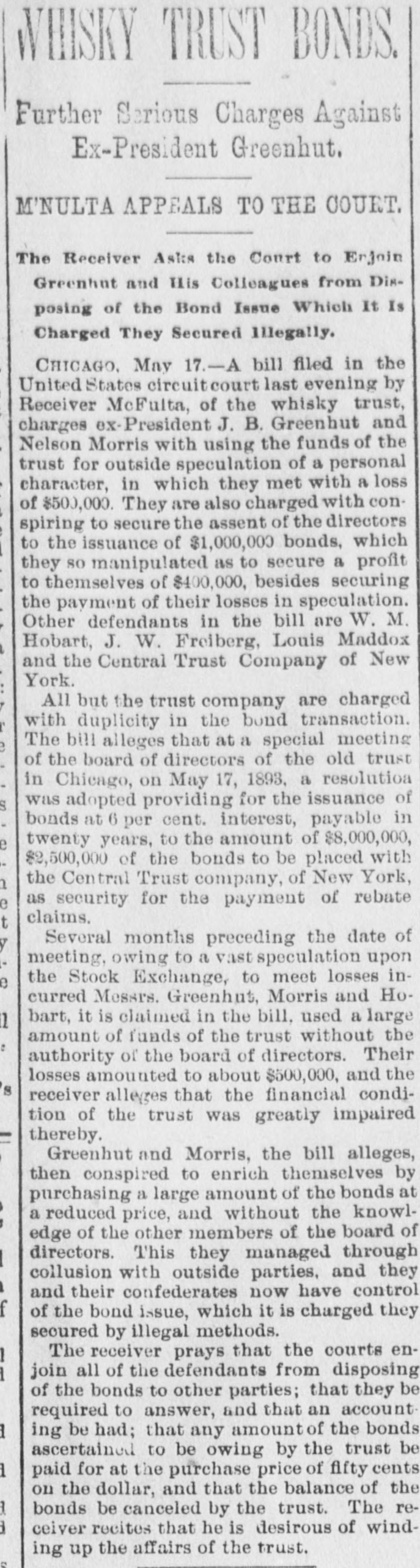
A bill filed in the United States circuit court last evening by Receiver McFulta ... charges ex-President J. B. Greenbut and Nelson Morris with using the funds of the trust for outside speculation ... the receiver prays that the courts enjoin ... and that an accounting be had.
Source
newspapers
5. May 23, 1895 Suspension
Cause
Government Action
Cause Details
Bondholders (Central Trust Co.) filed suit to foreclose mortgage and sought a receiver under the bill; additional receivership-related litigation in May 1895.
Newspaper Excerpt
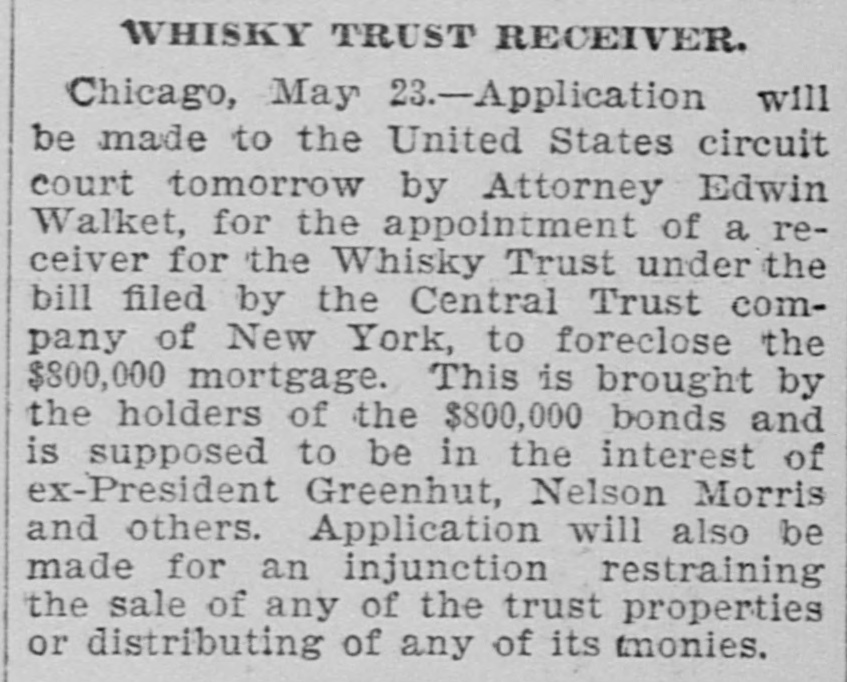
Application will be made ... for the appointment of a receiver for the Whisky Trust under the bill filed by the Central Trust company of New York, to foreclose the $800,000 mortgage.
Source
newspapers
6. June 3, 1895 Other
Newspaper Excerpt
Judge Showalter today refused the injunction of the Central Loan & Trust company against the receiver of the Whisky Trust.
Source
newspapers

Newspaper Articles (10)

Article from St. Paul Daily Globe, February 3, 1895

Click image to open full size in new tab

Article Text

USTING OF GREENHU UDGE GROSSCUP HEARS VOISE JSAHL ANSHA ntis Claim to Represent Practi cally the Entire Number of Shares-Decision Monday. CHICAGO, Feb. 2.-Proceedings e whisky trust litigation in nited States courts opened with omise of a sharp battle today. Judg rosseup took the initiative. He ently intended to find what foundation ere was for rumors that the receiver d not been acting in the interests e trust. President Greenhut lled to the stand as soon as ened. Judge Grosseup said he nded to ask a few questions before guments for the removal of the ivers began. "Did you deal in any Whisky Trus ock Monday or Tuesday?" he e witness. "Yes," replied Mr. Greenhut. "Tues y I bought between three and ousand shares on the New York t. I did not sell and have the ought there." Receiver Lawrence, Mr. Greenhut' sociate, said he neither bought Id any stock. Attorney Levi Mayer then began guinent of the motion to oust the ivers. In the court there were presen rge numbers of persons interested e proceedings. Among the director attendance were Messrs. Greenhut eggs, Hobart, Green and Hennessy elson Morris was present, and ented by counsel. The main claim ade were that not over 15,000 share ere represented in the petition for ceivership, while the antis ented over 300,000 shares. The trust bt in any need of receivers, havin 50,000 in bank and not owing '000' Mr. Burry then opened the argumen r the receivers. He read an affidavi gned by Directors Hobart, Beggs reene, Freiberg and Hennessy, hich they reviewed the financial ry of the trust, and asserted the 1 a receiver. and requested the court tain Mr. Greenhut, because of his mate knowledge of the affairs of impany. The affidavit attributed ilure to secure funds to pay the : spirits last September when the ease of 20 cents a gallon went feet the cause of crippling the finan al condition of the company. urry concluded his presentatio / reading a copy of the resolutio lopted by the stockholders at the


Article from The Times, February 10, 1895

Click image to open full size in new tab

Article Text

WHISKY TRUST CASE. SOMERATHER SENSA TIONAL DEVELOPMENTS BROUGHT OUT. Jud, Gie n 3 ade a Sca h ng Speech, in Wh He Characterized President Greenhut as is Robber. CHICAGO, ILL., Feb. 9.-Attorney Julian Mack this morning presented to Judge Grosscup the affidavits procured from New York in the Whisky Trust case, in behalf of his clients, Charles J. Heinsheimer and S. L. Wormser. Both made additional affidavits, saying the use of their names as petitioners for a receivership for the Whisky Trust was not authorized. A telegram to Runnells & Burry, counsel for Mr. Greenhut, demanding that their names be withdrawn from the petition, was cited. The denial was absolute and complete. Neither Heinsheimer nor Wormser had had any connection with President Greenhut in regard to signing their names. Wormser had never owned any stock at any time. Albert E. Goodhart, a member of the firm of P. J. Goodhart & Co., of New York, made an affidavit to the effect that on Tuesday, after the receivers had been appointed, he had a conversation with Mr. Greenhut by telephone. Mr. Greenhut asked him if there were any persons in his office who held any stock in the Whisky Trust. Mr. Goodhart replied there were not. Mr. Greenhut then asked him to send somebody to the Central Trust Company and see If he could find two stockholders of record there, as he wished to use their names on a mere matter of form. He then told about the Whisky Trust being in the hands of a receiver, and said Mr. Edward M. Lawrence had been appointed receiver, but did not mention himself. The first Intimation Mr. Goodhart had of the names of Heinsheimer and Wormser being used to get a receivership for the Whisky Trust was when he read it in the morning papers. DKM ED TH" NAMES WISHDRAWN He immediately called up Mr. Greenhut and demanded that the names be withdrawn. Mr. Greenhut attempted to argue the case, but he definitely insisted peremptorily that Heinsheimer, his nephew, and Wormser, a favorite clerk, be relieved from the cdium attached to the use of their names, and to this the Whisky Trust's president reluctantly consented. This affidavit was corroborated by others from Philip J. Goodhart and from Nathaniel Myers, attorney for the firm. Mr. Myers told Mr. Greenhut, by tele-


Article from The Herald, February 14, 1895

Click image to open full size in new tab

Article Text

THE POOR WHISKY TRUST Receivers Authorized to Borrow Money From a Bank How the Concern Is Handicapped-A Bank Turns Down a Note and Puts the Trust in a Hole Chicago, Feb. 13.-Judge Grosscup today issued an order authorizing the receivers of the whisky trust to borrow $59,000 for ninety days. The receivers in asking for the anthority said that a bank holding funds of the trust had charged $45,000 against its depositors on account of a note that had fallen due. The result was to cripple the financial operations of the receivers. It was reported that the receivers and the judge were in consultation over the business of the trust which was represented by the receivers to be a losing instead of a paying one, as announced at the time of their appointment. Concerning the conference on that point Judge Grosscup would neither deny nor affirm the report.


Article from The Indianapolis Journal, February 14, 1895

Click image to open full size in new tab

Article Text

Whisky Trust May Borrow $50,000. CHICAGO, Feb. 13.-Judge Grosscup today issued an order authorizing the receivers of the Whisky Trust to borrow $50,000 for ninety days. The receivers, in asking for the authority, said that a bank holding funds of the trust had charged $45,000 against its deposits on account of a note that had fallen due. The result was to cripple the. financial operations of the receivers. It was reported that the receivers and the Judge were in consultation over the business of the trust, which was represented by the receivers to be a losing instead of a paying one, as announced at the time of their appointment. Concerning the conference on that point Judge Grosscup would neither deny nor affirm the report.


Article from The Indianapolis Journal, February 18, 1895

Click image to open full size in new tab

Article Text

FAR FROM BANKRUPT WHISKY TRUST AFFAIRS NOT SO BAD AS FIRST REPORTED. To Be Reorganized, Taken Out of the Receivers' Hands and Greenhut's Services Dispensed With. CHICAGO, Feb. 17.-It is stated here that plans for getting the Whisky Trust on its feet have been practically agreed on by the stockholders' reorganization committee. Every effort is being made to keep the terms secret until an address to the shareholders can be prepared. Three members of the reorganization committee-R. D. Hartshorne and S. D. Rice, of New York, and W. D. Hutton, of Cincinnati,-are in conference with receivers McNulta, Mitchell and Lawrence. It is said the concern is in excellent condition, and no difficulty will be experienced in raising the money necessary to get it out of the hands of receivers. Instead of a pressing indebtedness of $1,000,000 or more, as Judge Grosscup was led to believe existed, the receivers discovered that the company owed only little more than $600,000 in the form of rebate vouchers, and $140,000 of those have been forfeited. The remaining $460,000 is not due in a lump sum, but matures in small amounts from day to day and can readily be met without sacrificing any of the assets of the company. It was discovered that the trust had almost $200,000 cash in the bank, which could be used for the payment of debts. The business, however, requires reserve capital of that amount, for, in lively times, from $8,000 to $10,000 a day is paid to the internal revenue collectors in getting spirits out of bond. The trust owed only a small amount, as the managers had paid cash for all supplies bought. The plan which, it is said, will 1 obably be adopted is to force a judicial sale of the property and buy it in. It is thought that stockholders favor the plan because it would get the company away from the receivers and restore it to managers friendly to those holding its securities. One feature of the plan is said to be to dispense with Mr. Greenhut. Mr. Hartshorne would not talk about the intentions of the committee further than to say that any plan that might be adopted would include the retirement of $1,000,000 in bonds now outstanding. These were sold at 50 cents on the dollar. It is said to-night that whatever the result of the case now pending before the Illinois State Supreme Court, the stockholders will decide to surrender the present charter. They will then immediately apply for a charter under the laws of New Jersey. This granted, the company will proceed to reorganize under its provisions, leaving President Greenhut and his fellowofficers stranded, the managers of a corporation which has ceased to have a corporate existence. It is reported that the application for the new charter in New Jersey is likely to be made within the week. The stockholders' committee will hold a final consultation with the receivers Wednesday next.


Article from The Evening Herald, May 17, 1895

Click image to open full size in new tab

Article Text

WHISKY TRUST BONDS. Further Serious Charges Against Ex-President Greenhut. M'NULTA APPEALS TO THE COURT. The Receiver Asks the Court to Enjoin Greenhut and His Colleagues from Disposing of the Bond Issue Which It Is Charged They Secured Illegally. CHICAGO, May 17.-A bill filed in the United States circuitcourt last evening by Receiver McFulta, of the whisky trust, charges ex-President J. B. Greenbut and Nelson Morris with using the funds of the trust for outside speculation of a personal character, in which they met with a loss of $500,000. They are also charged with conspiring to secure the assent of the directors to the issuance of $1,000,000 bonds, which they so manipulated as to secure a profit to themselves of $400,000, besides securing the payment of their losses in speculation. Other defendants in the bill are W. M. Hobart, J. W. Freiberg, Louis Maddox and the Central Trust Company of New York. All but the trust company are charged with duplicity in the bond transaction. The bill alleges that at a special meeting of the board of directors of the old trust in Chicago, on May 17, 1893, a resolutioa was adopted providing for the issuance of bonds at 6 per cent. interest, payable in twenty years, to the amount of $8,000,000, $2,500,000 of the bonds to be placed with the Central Trust company, of New York, as security for the payment of rebate claims. Several months preceding the date of meeting, owing to a vast speculation upon the Stock Exchange, to meet losses incurred Messrs. Greenhut, Morris and Hobart, it is claimed in the bill, used a large amount of funds of the trust without the authority of the board of directors. Their losses amounted to about $500,000, and the S receiver alleges that the financial condition of the trust was greatly impaired thereby. Greenhut and Morris, the bill alleges, then conspired to enrich themselves by purchasing a large amount of the bonds at a reduced price, and without the knowledge of the other members of the board of directors. This they managed through collusion with outside parties, and they and their confederates now have control of the bond issue, which it is charged they secured by illegal methods. The receiver prays that the courts enjoin all of the defendants from disposing of the bonds to other parties; that they be required to answer, and that an account ing be had; that any amount of the bonds ascertained to be owing by the trust be paid for at the purchase price of fifty cents on the dollar, and that the balance of the bonds be canceled by the trust. The receiver recites that he is desirous of winding up the affairs of the trust.


Article from The Salt Lake Herald, May 24, 1895

Click image to open full size in new tab

Article Text

WHISKY TRUST RECEIVER. Chicago, May 23.-Application will be made to the United States circuit court tomorrow by Attorney Edwin Walket, for the appointment of a receiver for the Whisky Trust under the bill filed by the Central Trust company of New York, to foreclose the $800,000 mortgage. This is brought by the holders of the $800,000 bonds and is supposed to be in the interest of ex-President Greenhut, Nelson Morris and others. Application will also be made for an injunction restraining the sale of any of the trust properties or distributing of any of its tmonies.


Article from San Antonio Daily Light, June 3, 1895

Click image to open full size in new tab

Article Text

Injunction Refused. CHICAGO, June 3.-Judge Showalter today refused the injunction of the Central Loan & Trust company against the receiver of the Whisky Trust.


Article from The Morning News, June 4, 1895

Click image to open full size in new tab

Article Text

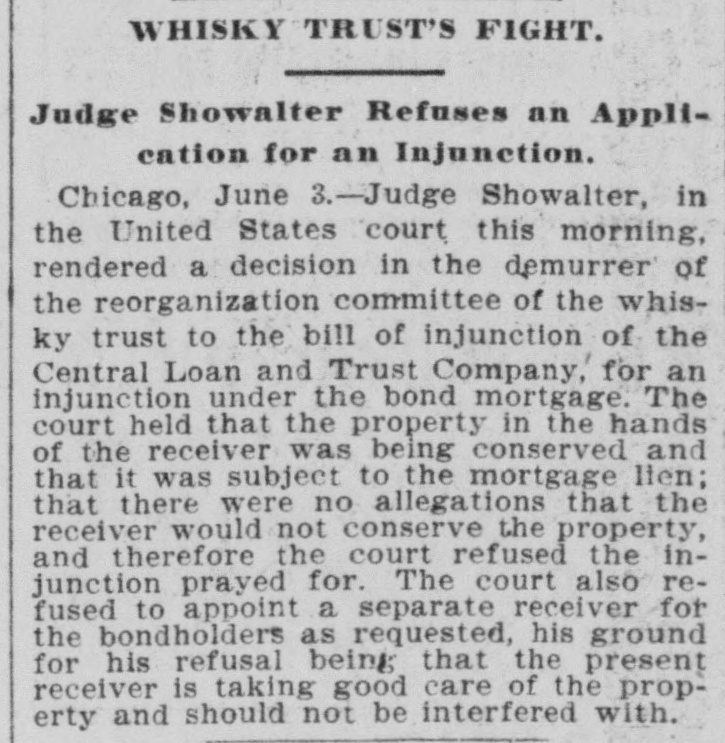
WHISKY TRUST'S FIGHT. Judge Showalter Refuses an Application for an Injunction. Chicago, June 3.-Judge Showalter, in the United States court this morning, rendered a decision in the demurrer of the reorganization committee of the whisky trust to the bill of injunction of the Central Loan and Trust Company, for an injunction under the bond mortgage. The court held that the property in the hands of the receiver was being conserved and that it was subject to the mortgage lien; that there were no allegations that the receiver would not conserve the property, and therefore the court refused the injunction prayed for. The court also refused to appoint a separate receiver for the bondholders as requested, his ground for his refusal being that the present receiver is taking good care of the property and should not be interfered with.


Article from The Abbeville Press and Banner, July 10, 1895

Click image to open full size in new tab

Article Text

Domestic. RECORD OF THE LEAGUE CLUBS. Per Per Clubs. Won. Lost. et. Clubs. Won. Lost. et. 28 15 Boston .651 New York.24 23 .522 Pittsburg 29 19 .604 Brooklyn 23 22 .511 Baltimore 17 .585 Cincinnati. 22 .511 Cleveland 27 20 .574 Wash'ng'n. 20 24 .455 28 21 .571 Chicago. St. Louis. .16 32 .333 Philadel. 24 21 .533 Louisville. 7 38 .156 Police Inspector William W. McLaughlin. of New York City, was sentenced to State Prison for two years and six months by Judge Barrett. Judge William J. Gaynor. in Newburg, N. Y.. ordered the District Attorney to show cause why a certificate of reasonable doubt should not be granted. William Henry, the accused son of the murdered miser. was acquitted by the Coroner's jury in Brooklyn. At Colorado Springs, Col., four men tried to loot the Exchange National Bank. The Sheriff got information of the affair through the confession of a member of the band and arrested the desperadoes at the muzzle of his gun. The Park Commissioners have decided to make a palm garden in Central Park, New York City, after the model of those existing in Europe. Several wealthy New Yorkers subscribed the necessary $250,000 for the establishment of a botanical garden in Bronx Park, modelled after the gardens in Kew, England. The convention of the Republican National League met in Cleveland, Ohio. A fight over the silver issue was sprung at once. "Will" Chandler, a colored man, of Alabama, met Miss Hohns, a young white girl on the railroad near Abbeville, Miss.. knocked her down and assaulted her. He fled, but was captured and acknowledged his guilt. He was taken to a telegraph pole and shot to death. Frank Peterson and William Smith were killed and four persons badly injured by a boiler explosion at the home of Charles Peterson, Attica, Ind. W. W. Taylor, the defaulting ex-Treasurer of South Dakota, reached Pierre. He arranged to turn over his property to the State. and to be sentenced to as short a term of imprisonment as the law would permit. The famous case of William R. Laidlaw to recover $50,000 from Sage for injuries in the Norcross dynamite bomb explosion ended before Justice Ingraham. of the Supreme Court, New York City, in a verdict of $40,000 for Laidlaw. Governor Altgeld issued a call for an extra session of the Illinois Legislature. On the streets of Trenton, N. J., Miss Hattie Cooms. the pretty eighteen-year-old daughter of a contractor, was murdered by Frederick C. Floyd, a farmhand. aged thirtyfive years. Floyd placed the revolver within a few inches of her face and fired two shots in rapid succession. He then turned the revolver to his own head and blew out his brains. Three men are under arrest in Greenville, Ohio. charged with starting a fire that resulted in $250,000 damage to the town. There were threats of lynching. The challenges from Oxford and Cambridge to Yale and Harvard Athletic Clubs were made public. A cyclone struck Hartford, Kan.. and swept everything from it path, which was clean-cut and about 100 feet in width. No one was killed outright. It did great damage at Creston, Iowa; Hampton, Neb., and Wallace. Neb. Two boat loads of armed men attacked the Shufeldt distillery, Chicago, III., which was guarded by Deputy United States Marshals, acting under orders of Receiver McNulta, of the Whisky Trust. Many shots were exchanged. Arthur Gaulin killed his wife at Rollington, Ky., and mortally wounded her college boy lover, "Tom" Murphy. Patrick Spain, who was an inmate of the Utica Asylum, shot his son William three times at Albany, N. Y., killing him instantly. Grasshoppers aresweeping over Oklahoma Territory in such numbers that they are destroying the corncrop. The farmers are unable to cope with them. Jacob's Third Avenue Theatre, New York City., was gutted by a fire. Loss, $300,000. Grasshoppers appeared in clouds at Eckhart, Ind., and came down upon fields of grain, corn, and grass in such numbers that everything seemed to be alive with them. They ate everything green and left the fields bare and crops ruined. The Silver Convention at Memphis, Tenn., passed resolutions advocating the free and unlimited coinage of both silver and gold and then adjourned. The New Jersey Legislature adjourned sine die after passing several bills over the Governor's veto. The Supreme Court of Illinois handed down its decision declaring the Whisky Trust an illegal corporation. George Andrews, the colored wife murderer, was hanged in the Warren County Jail in Belvidere, N. J. Mrs. Harriet Beecher Stowe celebrated her eighty-fourth birthday at her home in Hartford, Conn. She is in excellent physical health. Eight prisoners, including one charged with murder, escaped through the roof of the New Brunswick (N. J.) County Jail.