Article Text
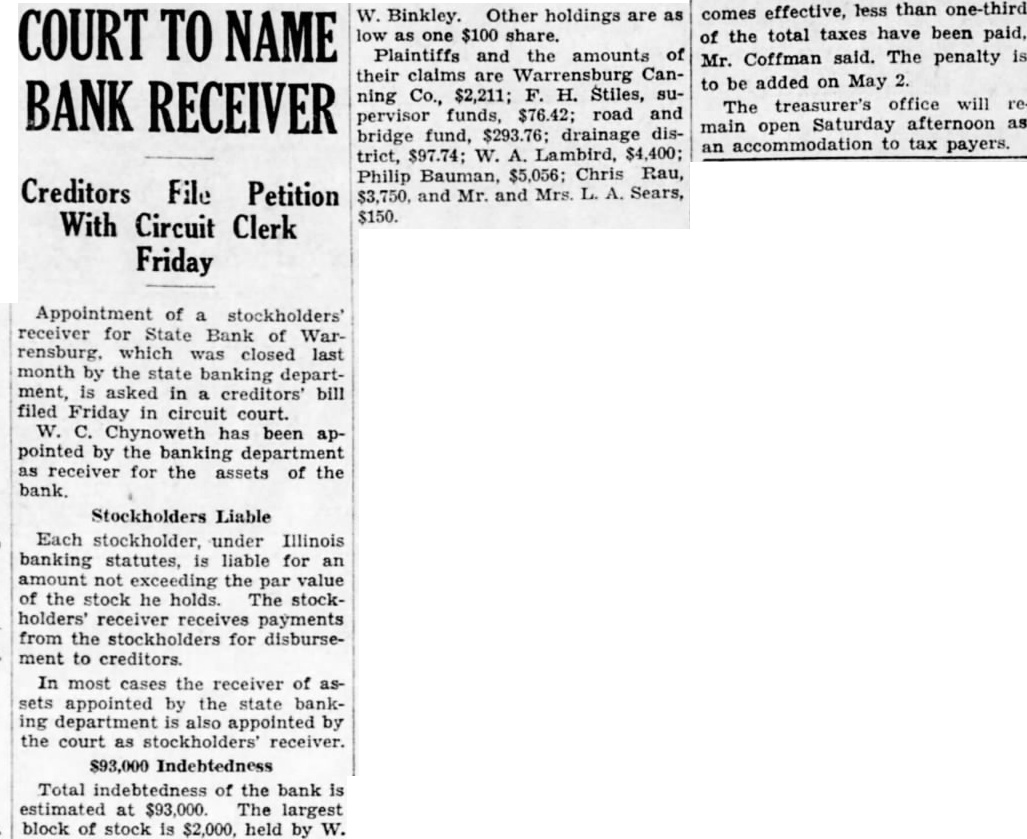
COURT TO NAME BANK RECEIVER Creditors File Petition With Circuit Clerk Friday Appointment of stockholders' receiver for State Bank of Warrensburg. which was closed last month by the state banking department, is asked in a creditors' bill filed Friday in circuit court. W. C. Chynoweth has been appointed by the banking department as receiver for the assets of the bank. Stockholders Liable Each stockholder, under Illinois banking statutes, is liable for an amount not exceeding the par value of the stock he holds. The stockholders' receiver receives payments from the stockholders for disbursement to creditors. In most cases the receiver of assets appointed by the state banking department is also appointed by the court as stockholders' receiver. $93,000 Indebtedness Total indebtedness of the bank is estimated at $93,000. The largest block of stock is $2,000, held by W. W. Binkley. Other holdings are as low as one $100 share. Plaintiffs and the amounts of their claims are Warrensburg Canning Co., $2,211; F. H. Stiles, supervisor funds, $76.42; road and bridge fund, $293.76; drainage district, $97.74; W. A. Lambird, $4,400; Philip Bauman, $5,056; Chris Rau, $3,750. and Mr. and Mrs. L. A. Sears, $150. comes effective, less than one-third of the total taxes have been paid, Mr. Coffman said. The penalty is to be added on May 2. The treasurer's office will remain open Saturday afternoon as an accommodation to tax payers.