Mechanics National Bank (Chicago, IL)

Episode Information

Episode UID
46600889
Episode Type
Suspension β†’ Closure
Bank Type
national
Bank ID
4660 national
Charter Number
466
Start Date
January 21, 1874
Location
Chicago, Illinois (41.850, -87.650)

Metadata

Model
gpt-5-mini (chosen from majority vote of a three-model LLM ensemble)
Short Digest
516d194e20b31227

Response Measures

None

Description

Bank voluntarily liquidated; no evidence of a depositor-driven run specific to this bank.

Events (4)

1. June 28, 1864 Chartered
Source
historical_nic
2. January 21, 1874 Other
Newspaper Excerpt
The Executive Committee of the Chicago Clearing-House Association yesterday invited the Mechanics National Bank of this city to withdraw from its membership, to-morrow, Jan. 21. This is only polite modo of expulsion, and eventual it will probably result in the winding no of the bank.
Source
newspapers
3. December 30, 1874 Voluntary Liquidation
Source
historical_nic
4. January 1, 1875 Suspension
Cause
Voluntary Liquidation
Cause Details
Stockholders resolved to go into voluntary liquidation and the bank suspended operations; officers announced suspension and liquidation.
Newspaper Excerpt
The officers of the Mechanics' National Bank, of this city, informed the members of the Clearing-House Association yesterday that they should make no clearings, and that they had suspended business.
Source
newspapers

Newspaper Articles (24)

Article from The Daily Dispatch, October 18, 1871

Click image to open full size in new tab

Article Text

LATEST FROM WASHINGTON. JUDGE CHASE-ANOTHER PAYMASTER IN TROUBLE, &C. ASHINGTON, October 7.-Judge Chase is presiding at the Supreme Court, which commenced a special term yesterday. General Bullock, paymaster of the Freedmen's Bureau, has been suspended for irregularities. His arrest had been ordered, but it is withheld for explanations. Rumors of a defalcation are rife, and a run is progressing on the Freedman's Bank in consequence. The Attorney-General has a dispatch from North Mississippi that five kuklux, with disguises complete, have been captured. Seven hundred and filty thousand dollars in revenue stamps were found safe in the Government vault at Chicago. Secretary Boutwell has received the following dispatch from Chicago: "The Chicago banks are saved and are paying every dollar on demand. A good feeling prevails." [Signed] H. R. Hurlbut, comptroller of currency." THE WEIT OF HABEAS CORPUS SUSPENDED IN SOUTH CAROLINA. ASHINGTON, October 17.-The President to day, after reciting the causes, and quoting the laws under which he acts, issued a proclamation in which he suspends the writ of habeas corpus in Spartansburg, York, Marion, Chester, Laurens, Newberry, Fairfield, Lancaster, and Chesterfield counties, of South Carolina. The suspension extends to the arrest by the United States marshal, his deputies, any military officer of the United States, or any soldier or citizen acting under the order of said marshal, deputy, or such military officer within said counties, of persons charged with any violation of the kuklux act of Congress during the continuance of the "rebellion" in said counties. WEATHER PROBABILITIES. WASHINGTON, October 17. - -Rising barometer, with clear and pleasant weather, is probable for Wednesday from the lower lakes to Texas and northwestward. Cloudy and clearing weather in New England and on the South Atlantic coast. Fresh northerly winds on the gulf coast. Light winds on the Atlantic, and fresh westerly wind on the lakes.


Article from Chicago Daily Tribune, September 16, 1873

Click image to open full size in new tab

Article Text

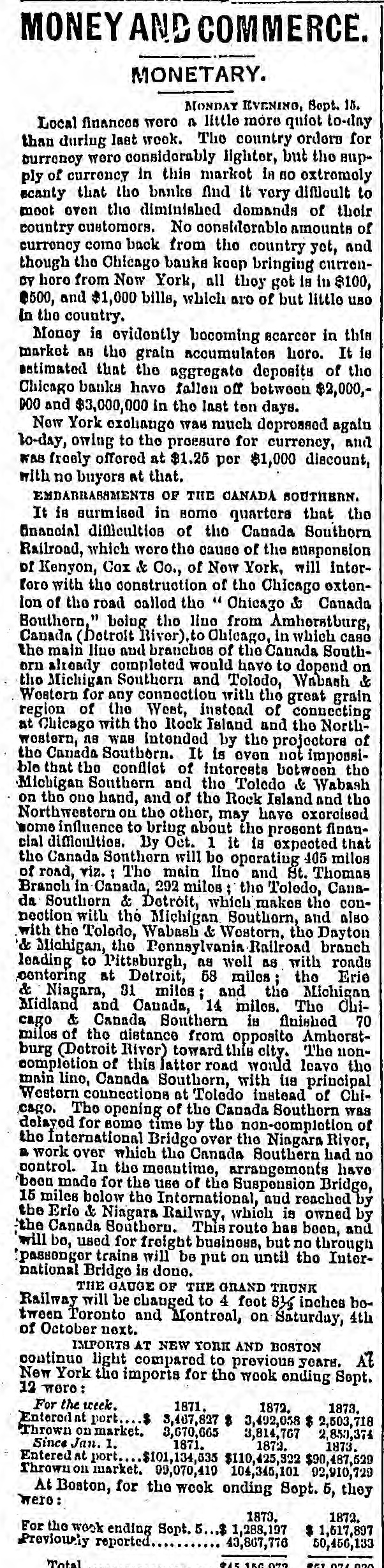
MONETARY. MONDAY EVENING, Sept. 15. Local finances word n little more quiet to-day than during last week. The country orders for burrency were considerably lighter, but the supply of currency in this markot in BO extremely scanty that the banks find it very difficult to moot oven the diminished domanda of their country customors. No considerable amounts of currency coino back from the country yet, and though the Chicago banks keep bringing currenby hore from Now York, all thoy get la in $100, 0500, and $1,000 bills, which are of but little uso In the country. Money is evidently becoming scarcer in this market AB the grain accumulates horo. It le estimated that the aggregate deposits of the Chicago banks havo fallen off between $2,000,000 and $3,000,000 in the last ten days. Now York exchange was much depressed again 10-day, owing to the pressure for currency, and was freely offored at $1.25 por $1,000 discount, with no buyers at that. EMBABRABSMENTS OF THE CANADA SOUTHERN. It is surmised in some quarters that the financial difficultion of the Canada Southorn Railroad, which were the cause of the susponsion of Kenyon, Cox & Co., of Now York, will intorforo with the construction of the Chicago oxtonlon of the road called the Chicago & Canada Bouthern." boing the line from Amherstburg, Canada (Detroit Rivor) to Chicago, in which case the main line and branches of the Canada Southorn already completed would have to dopend on the Michigan Southern and Tolodo, Wabash & Wostern for any connection with the great grain region of the West, instead of connecting at Chicago with the Rook Island and the Northwestern, as was intended by the projectors of the Canada Southern. It is oven not impossiblo that the confliot of intercete between the Michigan Southern and the Tolodo & Wabash on the one hand, and of the Rock Island and the Northwestern on the other, may have exercised wome influence to bring about the present financial difficulties. By Oct. 1 it is expected that the Canada Sonthorn will be operating 405 milos of road, viz. : The main lino and St. Thomas Branch in Canada, 292 miles; the Toledo, Canada Southorn & Detroit, which makes the connection with the Michigan Southorn, and also with the Tolodo, Wabash & Westorn, the Dayton & Michigan, the Pennsylvania Railroad branch leading to Pittsburgh, as well as with roads centering at Detroit, 58 miles; the Erie & Niagara, 31 miles: and the Michigan Midland and Canada, 14 miles. The Chicago & Canada Southern is finished 70 milos of the distance from opposite Amboratburg (Dotroit Rivor) toward this city. The noncompletion of this latter road would leave the main lino, Canada Southorn, with us principal Western connections at Tolodo instead of Chlcago. The opening of the Canada Southorn was delayed for some time by the non-completion of the International Bridgo over the Niagara River, a work over which tho Canada Southern had no control. In the menutime, arrangements have been made for the use of the Suspension Bridge, 15 miles bolow the International, and reached by the Erio & Niagara Railway, which is owned by the Canada Southorn. This routo has been, and will bo, used for freight business, but no through passenger trains will be put on until tho International Bridge is done. THE GAUGE OF THE GRAND TRUNK Railway will be changed to 4 foot 81/4 inches botween Toronto and Montreal, on Saturday, 4th of October next. IMPORTS AT NEW YORK AND BOSTON continuo light compared to previous years. At New York the imports for the wook ending Sept. 12 were: For the week. 1871. 1872. 1873, Entered at port $ 3,467,827 $ 3,492,058 $ 2,503,718 Thrown on market. 3,670,665 3,814,767 2,853,374 Since Jan. 1. 1871. 1873. 1873. Entered At port $101,134,535 $110,425,322 $90,487,529 Thrownon market. 99,070,410 104,345,101 92,910,729 At Boston, for the week ending Sept. 5, they were: 1873, 1872. $ 1,617,897 For the week ending Sept. 5 $ 1,288,197 Previously reported 43,867,776 50,456,133 845 156 079 Total
Article from Memphis Daily Appeal, September 22, 1873

Click image to open full size in new tab

Article Text

NEWS OF THE DAY. The Wisconsin State fair begins at Milwaukee to-day. The Texas editorial excursionists left Cincinnati last night for Louisville. The financial panic is reported to have seriously affected the narrow-gauge interests in Utah. The Chicago banks have taken advantage of the sixty-day privilege on their depositors. McClure's military academy, at Oakland, California, was entirely destroyed by fire Saturday night. Immediately after the cortes adjourns the Spanish government at Madrid will declare Spain in a state of seige. Thomas Tarwater, a brakeman, was run over and killed by a freight-train at Columbia, Tennessee, on the nineteenth instant. Pat Garnley, an insane man, set fire to a building in Jeffersonville, Indiana, yesterday, remained in it and was burned to death. Business generally will be suspended in Cincinnati to-day. it being proclaimed by the mayor. a holiday in the interest of the exposition. A strange and fatal disease at Kelter, in Utah, is very prevalent, producing great consternation. The patients die in a few hours. It resembles fever. Satisfactory arrangements have bee n perfected with the Ute and other tribes of Indians, hitherto in discontent, so that they will be settled upon their reservations. A Milwaukee dispatch says the financial panic of New York produces no disturbance there as yet, but the banks are preparing for any emergency that may occur the coming week. At Carbondale, Illinois, yesterday two negroes, Bill Smith and Frank Collins, remembered the Sabbath by playing cards, "fell out," resulting in the latter shooting the former through the heart. He's dead.


Article from The Daily Dispatch, September 23, 1873

Click image to open full size in new tab

Article Text

senior partner, has disappeared, causing great anxiety to his famile and friends. Search has been made in fall directions. CHICAGO. CHICAGO, September 20.-The Franklin Bank, a private banking institution, closed its doors to-day, being unable to settle at the clearing-house. The amount short was only $9,000. The vice-president of the concern says the embarros-ment is only temporary. CHICAGO, September - There is considerable of a run upon some of the banks here to-day, but they are adhering to the resolution adopted yesterday to fall back on the thirty and sixty-day rule, and are only paying sums of less than 8100. The latest reports, public and private, from New York appear to have had the effect to lessen the anxiety. BALTIMORE. BALTIMORE, September 21.-While the excitement in the New York market is watched with interest, and the brokers' offices have been visited by crowds to observe the sway and wreck of stock prices, everything has gone on calmly, and business is done at our banks in the usual way. Money continues at 10 to 12 per cent. for best paper on the street, though negotiations are limited, and are for strictly business en. gagements. IOWA. BURLINGTON, IOWA, September 20.-The Orchard City Savings Bank suspended at 12:20. PITTSBURGH. PITTSBURGH, PA., September James T. Brady & Co., bankers, and the Security Trust Company. of this city, suspended today. THE FEELING IN ENGLAND. The London Times says: " In view of the extraordinary prosperity of the United States and the high price of Government bonds the present must be regarded as a simple effort of the financial system to get rid of its dishonest element." The Daily Telegraph says stick local trouble as suspensions in New York seems to be merely the rank outgrowth of exuberant prosperity, ond accessories to progress which does not for a moment halt. LONDON, September 22.-5 P. M.-Much anxiety is manifested on all sides to hear further news from New York. Jay Cooke and McCultoch & Co. continue to pay cash in the usual manner over their counter. Among the rumors current in the Stock Exchange is one that the Bank of England holds $300,000 of Jay Cooke & Co.'s acceptances, and that the Roth-childs have $1,000,000 of. the same paper. LONDON, September 22.-4:30 P.M.10-40's are quoted at 904; new 58,911; Eries, 45. 5:30 P. M.-A dispatch announcing the closing of the New York Gold Exchange has just been bulletined. The news is accepted as an indiction of the gravity of the financial situation. and the market for American securities is again depressed.


Article from The New York Herald, September 23, 1873

Click image to open full size in new tab

Article Text

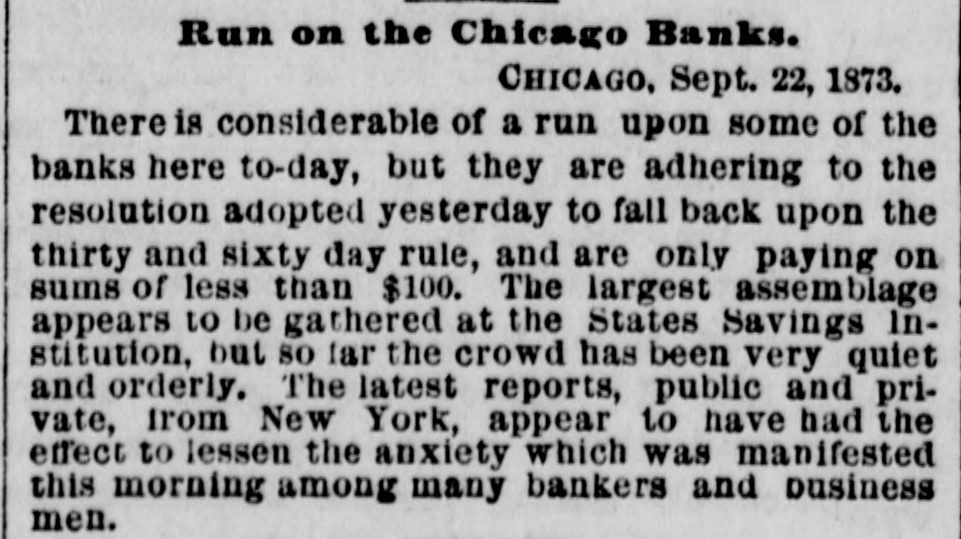
Run on the Chicago Banks. CHICAGO, Sept. 22, 1873. There is considerable of a run upon some of the banks here to-day, but they are adhering to the resolution adopted yesterday to fall back upon the thirty and sixty day rule, and are only paying on sums of less than $100. The largest assemblage appears to be gathered at the States Savings Institution, but so far the crowd has been very quiet and orderly. The latest reports, public and private, from New York, appear to have had the effect to lessen the anxiety which was manifested this morning among many bankers and business men.


Article from Knoxville Weekly Chronicle, September 24, 1873

Click image to open full size in new tab

Article Text

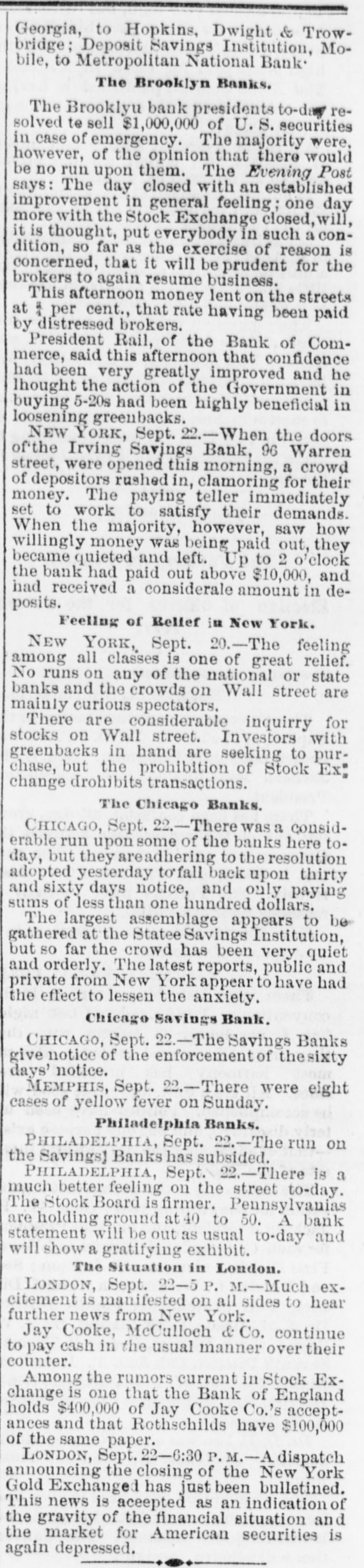
Georgia, to Hopkins, Dwight & Trowbridge; Deposit Savings Institution, Mobile, to Metropolitan National Bank The Brooklyn Banks. The Brooklyu bank presidents to resolved te sell $1,000,000 of U. S. securities in case of emergency. The majority were, however, of the opinion that there would be no run upon them. The Evening Post says: The day closed with an established improvement in general feeling; one day more with the Stock Exchange closed, will, it is thought, put everybody in such a condition, SO far as the exercise of reason is concerned, that it will be prudent for the brokers to again resume business. This afternoon money lent on the streets at : per cent., that rate having been paid by distressed brokers. President Rail, of the Bank of Commerce, said this afternoon that confidence had been very greatly improved and he Thought the action of the Government in buying 5-20s had been highly beneficial in loosening greenbacks. NEW York, Sept. 22.-When the doors of the Irving Savings Bank, 96 Warren street, were opened this morning, a crowd of depositors rushed in, clamoring for their money. The paying teller immediately set to work to satisfy their demands. When the majority, however, saw how willingly money was being paid out, they became quieted and left. Up to 2 o' clock the bank had paid out above $10,000, and had received a considerale amount in deposits. Feeling of Relief in New York. NEW YORK, Sept. 20.-The feeling among all classes is one of great relief. No runs on any of the national or state banks and the crowds on Wall street are mainly curious spectators. There are considerable inquirry for stocks on Wall street. Investors with greenbacks in hand are seeking to purchase, but the prohibition of Stock Ex: change drohibits transactions. The Chicago Banks. CHICAGO, Sept. 22.-There was a considerable run upon some of the banks here today, but they areadhering to the resolution adopted yesterday to fall back upon thirty and sixty days notice, and only paying sums of less than one hundred dollars. The largest assemblage appears to be gathered at the Statee Savings Institution, but so far the crowd has been very quiet and orderly. The latest reports, public and private from New York appear to have had the effect to lessen the anxiety. Chicago Savings Bank. CHICAGO, Sept. 22.-The Savings Banks give notice of the enforcement of thesixty days' notice. MEMPHIS, Sept. 22.-There were eight cases of yellow fever on Sunday. Philadelphia Banks. PHILADELPHIA, Sept. 22.-The run on the Savings] Banks has subsided. PHILADELPHIA, Sept. 2.-There is a much better feeling on the street to-day. The Stock Board is firmer. Pennsylvanias are holding ground at 40 to 50. A bank statement wili be out as usual to-day and will show a gratifying exhibit. The Situation in London. LONDON, Sept. 22-5 P. M.-Much excitement is manifested on all sides to hear further news from New York. Jay Cooke, McCulloch & Co. continue to pay cash in the usual manner over their counter. Among the rumors current in Stock Exchange is one that the Bank of England holds $400,000 of Jay Cooke Co.'s acceptances and that Rothschilds have $100,000 of the same paper. LONDON, Sept. 22-6:30 P. M. - dispatch announcing the closing of the New York Gold Exchanged has just been bulletined. This news is aceepted as an indication of the gravity of the financial situation and the market for American securities is again depressed.


Article from The Rock Island Daily Argus, September 25, 1873

Click image to open full size in new tab

Article Text

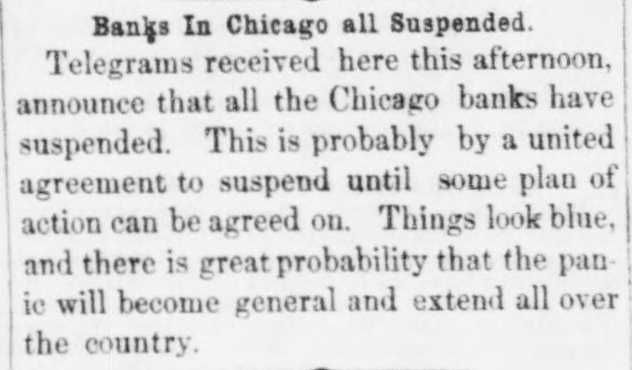
# Banks In Chicago all Suspended. Telegrams received here this afternoon, announce that all the Chicago banks have suspended. This is probably by a united agreement to suspend until some plan of action can be agreed on. Things look blue, and there is great probability that the panic will become general and extend all over the country.


Article from The Richmond Palladium, September 27, 1873

Click image to open full size in new tab

Article Text

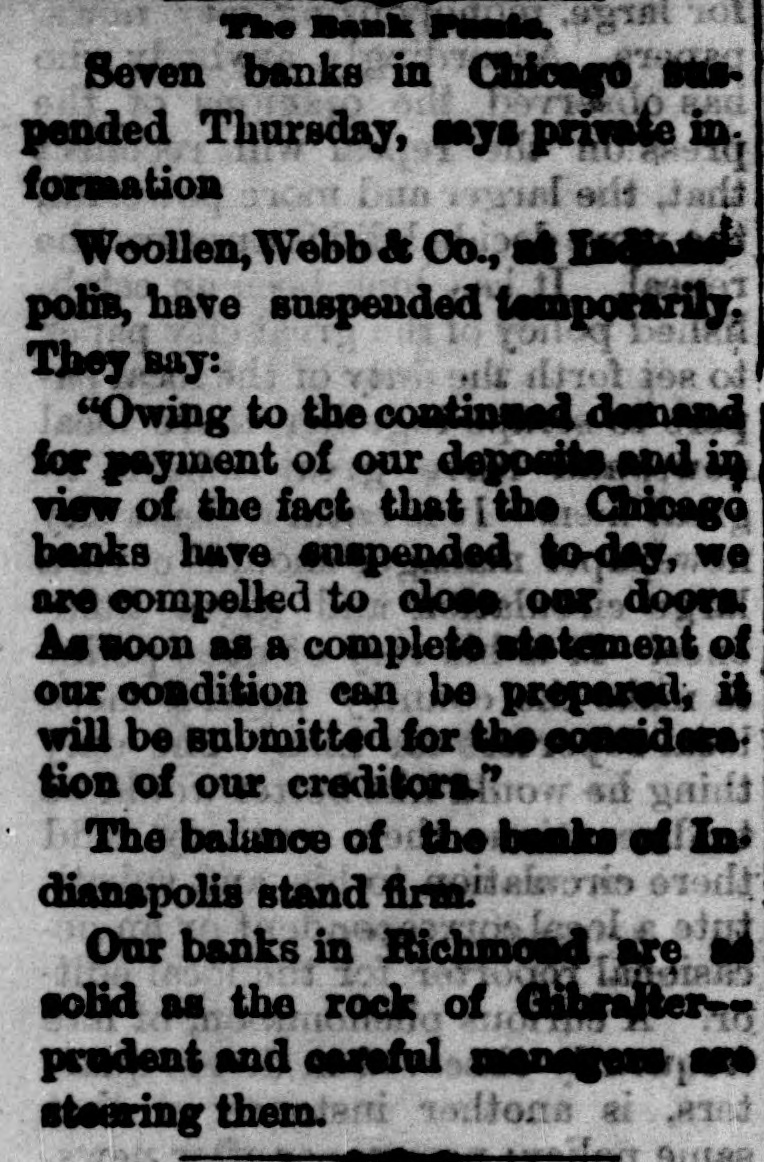
The Bank Seven banks in Chicago pended Thursday, says private formation exit Woollen, Webb & Co., at polis, have suspended temporarily They say: of "Owing to the continued demand for payment of our deposite and in view of the fact that i the Chicago banks have enspended to-day, we are compelled to close our doors. As moon as a complete statement of our condition can be prepared, it will be submitted for the considers tion of our sd The balance of the banks of In: dianapolis stand firm. aferonia Our banks in Richmond are solid as the rock of Gabralterprudent and careful managers 81 steering them. addens


Article from The Portland Daily Press, September 27, 1873

Click image to open full size in new tab

Article Text

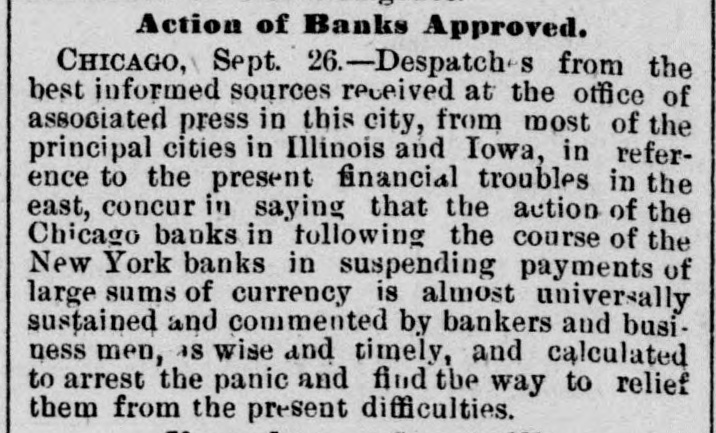
Action of Banks Approved. CHICAGO, Sept. 26.-Despatch-s from the best informed sources received at the office of associated press in this city, from most of the principal cities in Illinois and Iowa, in reference to the present financial troubles in the east, concur in saying that the action of the Chicago banks in following the course of the New York banks in suspending payments of large sums of currency is almost universally sustained and commented by bankers and business men, as wise and timely, and calculated to arrest the panic and find tbe way to relief them from the present difficulties.


Article from Chicago Daily Tribune, September 27, 1873

Click image to open full size in new tab

Article Text

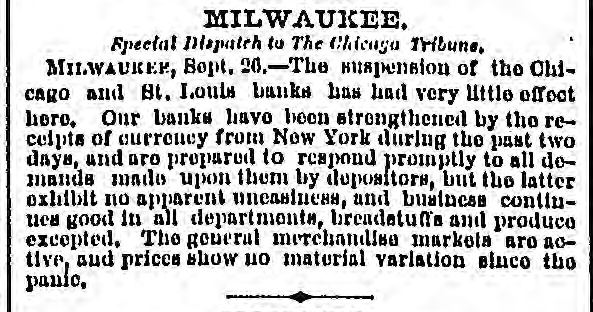
MILWAUKEE. Special Dispatch to The Chicago Tribune. MILWAUKER, Bopt. 26,-The suspension of the Ohicago and St. Louis banks has had very little effect here. Our banks have been strengthened by the receipts of currency from Now York during the past two days, and are prepared to respond promptly to all domands made upon them by depositors, but the latter exhibit no apparent uneastricas, and business continuce good in all departments, breadetuffa and produce excepted. The general merchandise markets are aotive, and prices show uo material variation sinco the panic,


Article from Chicago Daily Tribune, September 30, 1873

Click image to open full size in new tab

Article Text

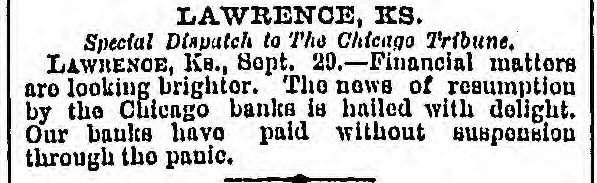
LAWRENCE, KS. Special Dispatch to The Chicago Tribune. LAWRENCE, Ks., Sept. 20.-Financial matters are looking brighter. The news of resumption by the Chicago banks is hailed with delight. Our banks have paid without suspension through the panic.


Article from Chicago Daily Tribune, September 30, 1873

Click image to open full size in new tab

Article Text

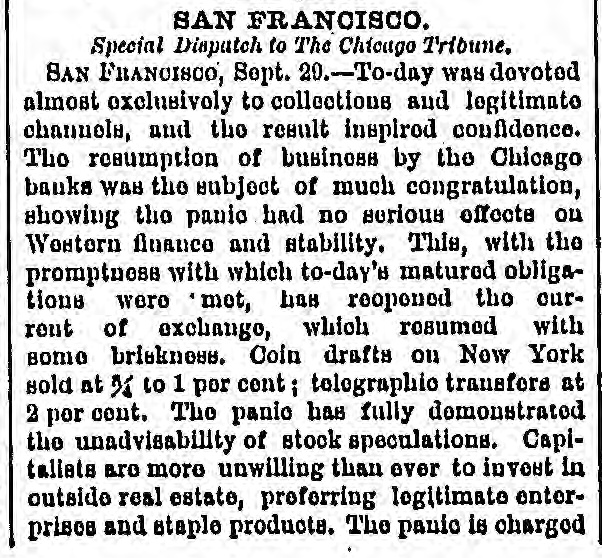
SAN FRANCISCO. Special Dispatch to The Chicago Tribune. SAN FRANCISCO, Sept. 20.-To-day was devoted almost exclusively to collections and legitimate channels, and the result inspirod confidence. Tho resumption of business by the Chicago banks was the subject of much congratulation, showing the panic had no serious effects on Western finance and stability. This, with the promptness with which to-day's matured obliga- tions were mot, has reopened the current of exchange, which resumed with some briskness. Coin drafts on New York sold at ΒΎ to 1 por cent; telegraphic transfers at 2 por cent. The panic has fully demonstrated the unadvisability of stock speculations. Capitalists are more unwilling than ever to invest in outside real estate, preferring legitimate enter- prises and staple products. The panic is charged


Article from The Saline County Journal, October 2, 1873

Click image to open full size in new tab

Article Text

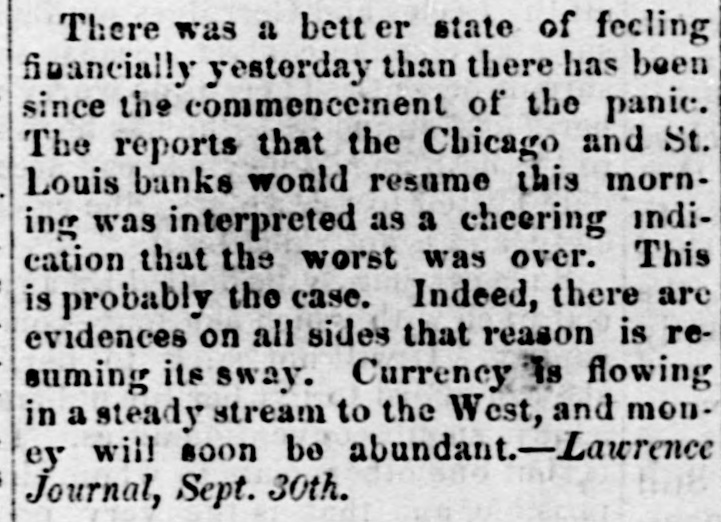
There was a bett er state of feeling financially yesterday than there has been since the commencement of the panic. The reports that the Chicago and St. Louis banks would resume this morning was interpreted as a cheering indication that the worst was over. This is probably the case. Indeed, there are evidences on all sides that reason is resuming its sway. Currency is flowing in a steady stream to the West, and mon. ey will soon be abundant.-Lawrence Journal, Sept. 30th.


Article from Ottumwa Weekly Courier, October 2, 1873

Click image to open full size in new tab

Article Text

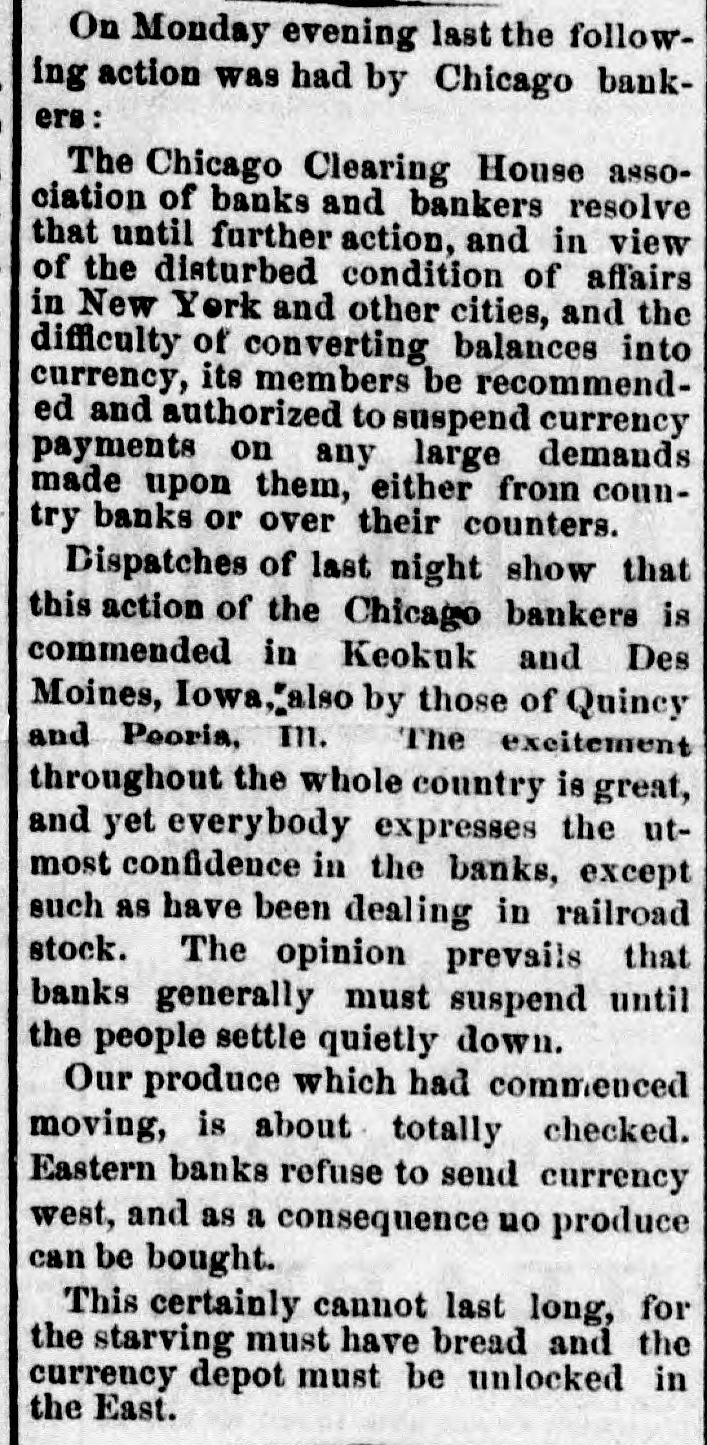
On Monday evening last the following action was had by Chicago bankers : The Chicago Clearing House association of banks and bankers resolve that until further action, and in view of the disturbed condition of affairs in New York and other cities, and the difficulty of converting balances into currency, its members be recommended and authorized to suspend currency payments on any large demands made upon them, either from country banks or over their counters. Dispatches of last night show that this action of the Chicago bankers is commended in Keokuk and Des Moines, Iowa,"also by those of Quincy and Peoria, III. The excitement throughout the whole country is great, and yet everybody expresses the utmost confidence in the banks, except such as have been dealing in railroad stock. The opinion prevails that banks generally must suspend until the people settle quietly down. Our produce which had commenced moving, is about totally checked. Eastern banks refuse to send currency west, and as a consequence no produce can be bought. This certainly cannot last long, for the starving must have bread and the currency depot must be unlocked in the East.


Article from Burlington Weekly Free Press, October 3, 1873

Click image to open full size in new tab

Article Text

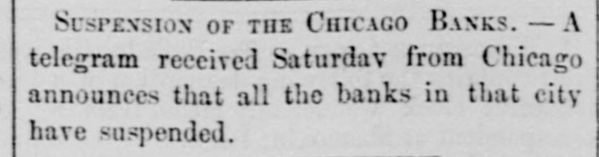
SUSPENSION OF THE CHICAGO BANKS. - A A telegram received Saturday from Chicago announces that all the banks in that city have suspended.


Article from Iowa Voter, October 9, 1873

Click image to open full size in new tab

Article Text

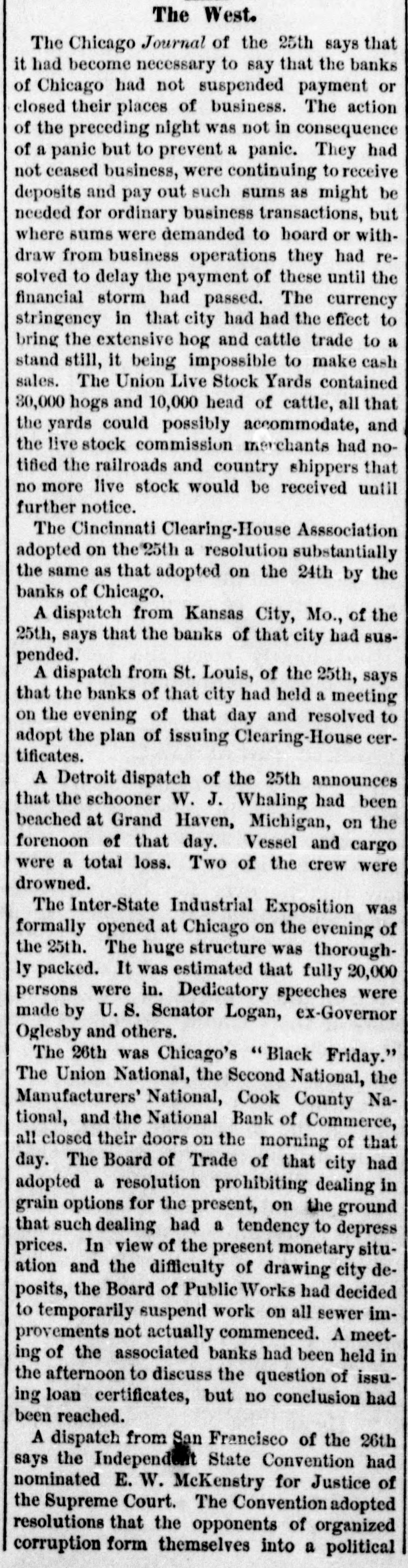
The West. The Chicago Journal of the 25th says that it had become necessary to say that the banks of Chicago had not suspended payment or closed their places of business. The action of the preceding night was not in consequence of a panic but to prevent a panic. They had not ceased business, were continuing to receive deposits and pay out such sums as might be needed for ordinary business transactions, but where sums were demanded to board or withdraw from business operations they had resolved to delay the payment of these until the financial storm had passed. The currency stringency in that city had had the effect to bring the extensive hog and cattle trade to a stand still, it being impossible to make cash sales. The Union Live Stock Yards contained 30,000 hogs and 10,000 head of cattle, all that the yards could possibly accommodate, and the live stock commission merchants had notified the railroads and country shippers that no more live stock would be received until further notice. The Cincinnati Clearing-House Association adopted on the 25th a resolution substantially the same as that adopted on the 24th by the banks of Chicago. A dispatch from Kansas City, Mo., of the 25th, says that the banks of that city had suspended. A dispatch from St. Louis, of the 25th, says that the banks of that city had held a meeting on the evening of that day and resolved to adopt the plan of issuing Clearing-House certificates. A Detroit dispatch of the 25th announces that the schooner W. J. Whaling had been beached at Grand Haven, Michigan, on the forenoon of that day. Vessel and cargo were a total loss. Two of the crew were drowned. The Inter-State Industrial Exposition was formally opened at Chicago on the evening of the 25th. The huge structure was thoroughly packed. It was estimated that fully 20,000 persons were in. Dedicatory speeches were made by U.S. Senator Logan, ex-Governor Oglesby and others. The 26th was Chicago's "Black Friday." The Union National, the Second National, the Manufacturers' National, Cook County National, and the National Bank of Commerce, all closed their doors on the morning of that day. The Board of Trade of that city had adopted a resolution prohibiting dealing in grain options for the present, on the ground that such dealing had a tendency to depress prices. In view of the present monetary situation and the difficulty of drawing city deposits, the Board of Public Works had decided to temporarily suspend work on all sewer improvements not actually commenced. A meeting of the associated banks had been held in the afternoon to discuss the question of issuing loan certificates, but no conclusion had been reached. A dispatch from San Francisco of the 26th says the Independent State Convention had nominated E. W. McKenstry for Justice of the Supreme Court. The Convention adopted resolutions that the opponents of organized corruption form themselves into a political


Article from Chicago Daily Tribune, October 14, 1873

Click image to open full size in new tab

Article Text

ovor proceding days. While thero was gront con- fidence in the solvency of our banks, thoro was much intorost folt to see what developments would be made during the carlior hours of the oponing-day. At the usual hour this morning overy bank and banker in the Olearing-Houso Association, twonty-ono in number, commenced full and unequivocal resumption. # THERE WAS NO Ξ•Ξ§ΞŸΞ™Ξ€Ξ•MENT, thero was nothing about the appearance of the bank that indicated a run; the business of the day commenced and continued to the close with a degroo of quiet that was remarkable. So far as is known, there was not an anxions depositor presented himself at the banks. The amount drawn by depositora was probably less than usual on Monday. Cortainly it did not ex- coed the usual demands of the average busi- noss day of the week. While this was true, the deposits of currency were liboral and boyond the expectation of the banks. Tho largost number of the bankers report that they recoived more currency than they paid out. Ono of the National Banks received in currency $100,- 000 more than they were called on to pay. The entisfactory results of the forenoon put # A NEW FACE ON THE MEROHANTS who assembled on 'Change. The attendance was larger than it had been for days, and overy per- son seemed to be encouraged. The gen- eral markots woro improved in tone, and the impression prevailed that we had en- torod fully upon the work of recuperation, and that restoration would proceed with rapidity. At the close of banking bours all acknowlodged that the success of the first day of curronoy ro- sumption had been comploto. # THE LOAN-CERTIFICATES. Of $462,000 in Clearing-House certificates, $165,000 wero canceled to-day, leaving less than $300,000 of cortificates unredeemed. Of the lattor amount, under the ac- tion of the Clearing-House, 25 por cont will be redeemed to-morrow. and 25 per cent each week thereafter, for the purpose of equitably distributing the cortificatos. It was decided on Saturday that the banks should hold them until retirement in proportion to the business done by them respectively within a definite period theroin named.


Article from The Lambertville Record, October 22, 1873

Click image to open full size in new tab

Article Text

There has been a gradual but decided improvement in financial matters during the last week. On Saturday, in New York and Philadelphia, confidence had-been largely restored and business was moving with almost its accustomed activity. It now appears that the worst effects of the panic have been limited to banking and speculative interests, and to those branches of manufactures that depend upon railroad enterprises for most of their work. These have had a pretty hard time, and many fortunes have been lost or greatly impaired. But the dealers in produce and general merchandise seem to have lost little of their trade, and as currency gets into circulation again they resume their usual business. The agricultural interests of the country have suffered little or nothing. The panic of course could not effect the amount of their products, and it has not perceptibly changed the market rates. Prices are certainly not tending downward, nor are they likely to do so. Thus the farmer, who apparently makes money slowly, is shown to be engaged in the safest of all occupations. The New York and Philadelphia banks have not yet fully resumed the payment of currency to their depositors. Those in Chicago and Cincinnati have done so, while the banks of Pittsburg never suspended. As soon as the eastern instituti ons redeem their obligations, as they must do at an early day, the usual current of affairs will be promptly resumed.


Article from Chicago Daily Tribune, January 21, 1874

Click image to open full size in new tab

Article Text

MONEY AND COMMERCE. MONETARY TUESDAY EVENING, Jan. 20, There has not been much relaxation in the money market yot, but the tendonoy in that direction, the cause boing an increase in the suj ply of exchange mhilo against shipments of grain, and some iuflux of nuouoy from the country in the way of merchants collections, and of amounts sout in by country banks to loan ou collaterals or invest in commercial paper in the open market But It cannot be expected that there will be any very great increase of loanablo Yunde in this market until the rk-packers and )spoculators ship off and sell part of the several million dollare worth of pork and out meats now being hold here by them. The banks are accommodating all their regular customers at 10 por cont, but are taking very little outside paper. In the open market money is to be had at 12 per cont on primo col gaterale, though 15 por cent is paid in many instances. Now York exchange was little firmer to-day than yesterday, and sold between banks at 25 cente per $1,000 discount. THE MEOHANICS' NATIONAL BANK. The Executive Committee of the Chicago Clearing-House Association yosterday invited the Mechanics National Bank of this city to withdraw from its mom borship, to-morrow, Jan. 21. This is only polito modo of expulsion, and eventua it will probably result in the winding no of the bank. The bank was believed to be in a very unsatisfactory condition before the papic thoug not sufficiently 60 to warrant eithor the Bank Examinor or the Clearing- House Committee in making any decided move against its continu inco in business. The panic, of course, only made its condition worse, but the other bauksin the city have been disposed, until now, to at least lend the Mechanics' National their countenance by allowing it to remain in the Clearing House, partly because they wore afraid turb the recovery of public confidence from the effects of the panic, and partly because they were in hopes that its condition might improve with the gonoral improvement of affairs In the last two months. No improvemont however, in its condition appears to have been made since the panio. According to Site recently published statement the bank has only about percent of its deposit in cash lte Acaus are understood to bo now just about where they woro two months or more ago. It is alloged the bank has been unablo to reduce them, bo cause great portion of them are suspended paper which is past due and cannot be collected without great delay As the Executive Committeo of the Clearing House did not examine the dotails of the condition of the Mechanics National Bank yesterday. it is not positively known what the $178,000 of bills payable' in the published statement of the bank represents, but whatover olso it ie. is an evidence that the bank has increased its liabilities in some other way than the of logitimate one of an increase deposits, and only shows the more necessity that it should be put into the hauds of a ReDelver and wound up BANKRUPT FUND DEPOSITORIES. But if the condition of the Mechanics Nationbl Bank is disgrace to the city, it is not 80 of treat an outrage on the public as the order in the Bankrupt Court that all bankrupt funds the hands of Assignees should be deposited in the Dichanics National This order WAS, we believe, subsequent ly modified, 80 as to include the National Bank of Illinois, but, even with this modification, the keeping of bankrupt funds is a disgraceful monopoly managed by a littlo ring for their own benefit. The Assignees it in Bankruptcy are a part of it. and seems now to be an acknowledged fact that none but 8 few bangers on of the Register in Bankruptcy can be appointed to those offices. One of the results of this ringmanagement is that large amount of bankrupt funds have boon locked up, for nobody knows how long, in the Mechanic National Several bankrupt concerns, whose affairs have beon to a great extent adjudicated would have paid dividende to their creditors long ago, only that the Mechanics' National has not been able to pay This farce of settling up bankrupt estates through bank that cau DAY is played out. As far as the National Bank of Illinois is concerned of courso, nobody has any objection to its condition. It is, we believe, sound, well-mauaged bank, but has no right to any monopoly of the baukrupt faude in the hands of Assiguees. BANK. CHEQUE A new kind of financial institution line been started in Eugland called a cheque bank the effect of which is to makd a larger circula tion of bank checks in place of 0010, thus in one sense making au increasing supply of currency, and econom the use of coin for all emall payments. To the small tradesmen, artienne and other persons whose accounts are too small to be very desirable to the larger commercial banks, its conveniences are very great. Ite peouliarity is that, instead of being a competi tor of other banks, it in fact co-operates with them, so that all the ther motropolita: banks are practically made branches of the cheque bank. Chambers' Journal gives the following details of its operation When money is deposited, the only receipt given is at check-book containing chocks for the amount lodged. Tho largest amount for which any one check can be drawn is Β£10. If we deposit Β£100 we receive a check book containing ten checks for Β£10 we may, howev have twenty checks for Β£5. or 100 check for $1 Now, we can draw only to the amount of our doposit, and no further. for. in the corner of each check, its value is perforated in words, time boing indelibly fixed. In this way it is shoor impossibility for us to overdraw our account, for, though we may make out & chock for any less amount than that specified on it, we cannot for greater. This is great advantage, as there can never be any check re. turned to the payee with No funds inscribed on it, as too often is the case with the old eyea tem. If, then, we make out some checks for less amount than that specified. there must be balance standing at our credit when the checkbook is finished. This we may have carried on towards new book, or we like. may draw on surrondering the counterfoils of the old check-book. All checks are made ble to ordor, and are crossed besides: 80 that, before recoiving payment, the check must have been indorsed This puts such an effectual barrier to unfair dealing, that the risk run by the Oheque Bank is comparatively insignificant Each book of checks contains ten, for which the uniform price is onesbilling teuponce boing for Government stamps, and the odd twopence boing divided between the expense of the paper and bank commission The way in which the book is kept is poculiar. and SAVER an enormous amount of time and trouble Instead of each check being entered in the books some half dozen times, the total amount only of all the checks paid out is placed in the books. And to avoid all risk, the check are 80 caref indoxed and put past, that ton years linese chool cashed now will be found quite roadily also, their checks are cleared dail thus avoiding the necessity of passing through the bankers ClearHouse The leading peculiaritie of this norv instit tion are: 1. N interest is allowed on doposite 2. It does not keep its own cash. 9. It transacts no financial business whatever. 4. Beiug intended only for small accounts (ne no intorest given), it essentially a bank for the million 5. It discounts no bills. The sources of profit to the stockholders are 1. The interest on the Β£100.000 reserve fund in vested in government consols. Largo returus cannot be looked for here, as the be at security and not a high percentage issought. 2. The divi dends arising from the investment of the doposita terest the


Article from Chicago Daily Tribune, January 23, 1874

Click image to open full size in new tab

Article Text

part of the citv and south of the city limits, and also in Hydo Park, but all unproductive. THE EFFECT. If the Mechanics' National shall be thrown into the hands of = Receiver and the Marine Company shall be forced to close its doors altogether, the effect on the banking interests of Chicago will not be serious, since the situation has been well understood for two months, and the banks have taken steps to protect themselves. The principal inconvenience will fall upon those who are waiting for the distribution of bankrupt -funds, and those who have deposited in the savings department of the Mariue Company. The bulk of Mr. Scammon's personal debts are amply secured by mortgage on his property, and it is to be hoped that it will not be necessary to sacritice the property at a forced sale. To the credit of Mr. Scammon it must be said that he bas b.n 0 his trials thus far in a very philosophical and becoming spirit.


Article from Chicago Daily Tribune, January 1, 1875

Click image to open full size in new tab

Article Text

MONEY AND COMMERCE. FINANCIAL. The ossential features of the financial rituation remain the same as they have been reported every day of the week. The demand for loans is at its minimum from regular mercantile sources. Business men are occupying themselves in taking stock and settling the accounts of the year, and have no occasion to use funds in any extension of their operations. Some merchants are borrowing to moot engagements due on the 1st. and Board of Trade men are borrowing to carry property after settlement dav. There are very fow outside borrowers that can command the attention of the banks. Rates of discount remain nominally at 10 per cent, and that rato is charged to regular customare who borrow the year round. It in readily shaded for independent borrowers with good colInterals. Street rates are 86/18 per cent; real estate loans are 8(a/10 per cent. The clearings were $3,000,000. Rates of exchange were weaker. Sales were made between banks at war to 25 cents premium for $1,000. The supply is liberal. The movement of currency III and out is too inconsiderable to note. The Third National Bank has declared a dividend of 5 per cent, payable Jan. 1, 1875. TUE MECHANICS' NATIONAL BANK. The officers of the Mechanics' National Bank, of this city, informed the members of the Clearing-House Association yesterday that they should make no clearings, and that they had suspended business. Inquiry shows that the bank has at length sucembed to the burdens placed upon it during the management of Mr. J. Y. Scammon. and of which it has valuly songht to rid itself under the Prosidency of Mr. E. B. MeCarg. At a meeting night before last, the stockholders resolved to go into voluntary liquidation, in accordance with the provisions of the National Banking not. Mr. E. B. McCagg resigned the post of President, and his place was filled by the election of Mr. Leitner, of Peoria, one of the largest stockholders, who will superintend the liquidation. There WILL no pressure brought to bear upon the bank from without, its officers state. They base their decision to go into voluntary liquidation simply on the conviction that such was the best course to protect the interests of all concerned. Mr. Leitner states that the assets of the bank are sufficient to pay the depositors in full; the note-holders (the circulation has been reduced to $45.000) are protected by the bonds on deposit in Washington. The sale of these will leave a considerable markin, which, with the 5 per cont redemption fond at Washington, will go with other assets towards the watisfaction of the claims of depositors. The condition of the Mechanics' National Bank, according to its statement, Oct. 24 last, was as follows: RESOURCES.


Article from New-York Tribune, January 26, 1875

Click image to open full size in new tab

Article Text

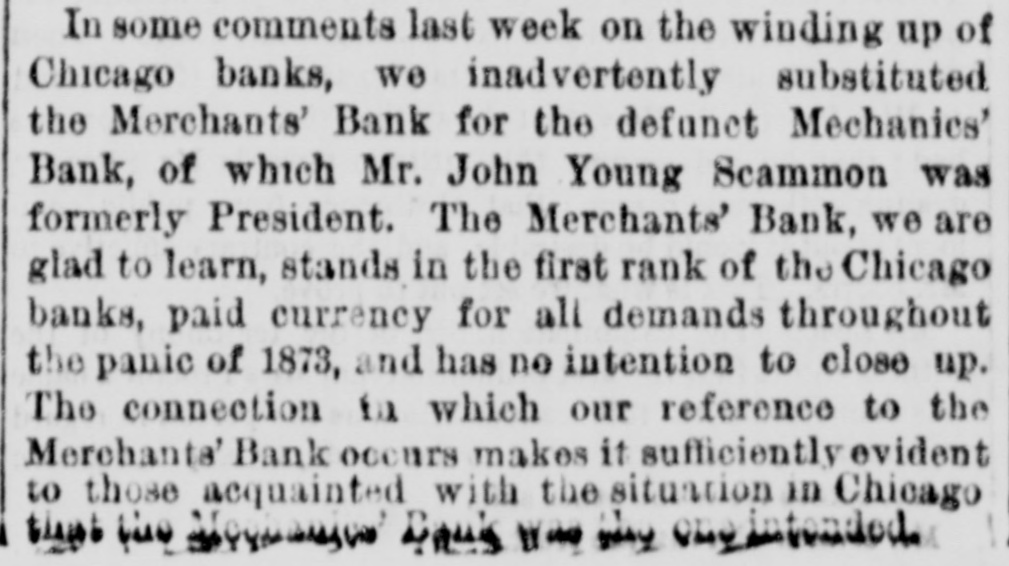
In some comments last week on the winding up of Chicago banks, we inadvertently substituted the Merchants' Bank for the defunct Mechanics' Bank, of which Mr. John Young Scammon was formerly President. The Merchants' Bank, we are glad to learn, stands in the first rank of the Chicago banks, paid currency for all demands throughout the panic of 1873, and has no intention to close up. The connection in which our reference to the Merchanta' Bank occurs : makes it sufficiently evident to those acquainted with the situation in Chicago tines


Article from The Star, May 18, 1875

Click image to open full size in new tab

Article Text

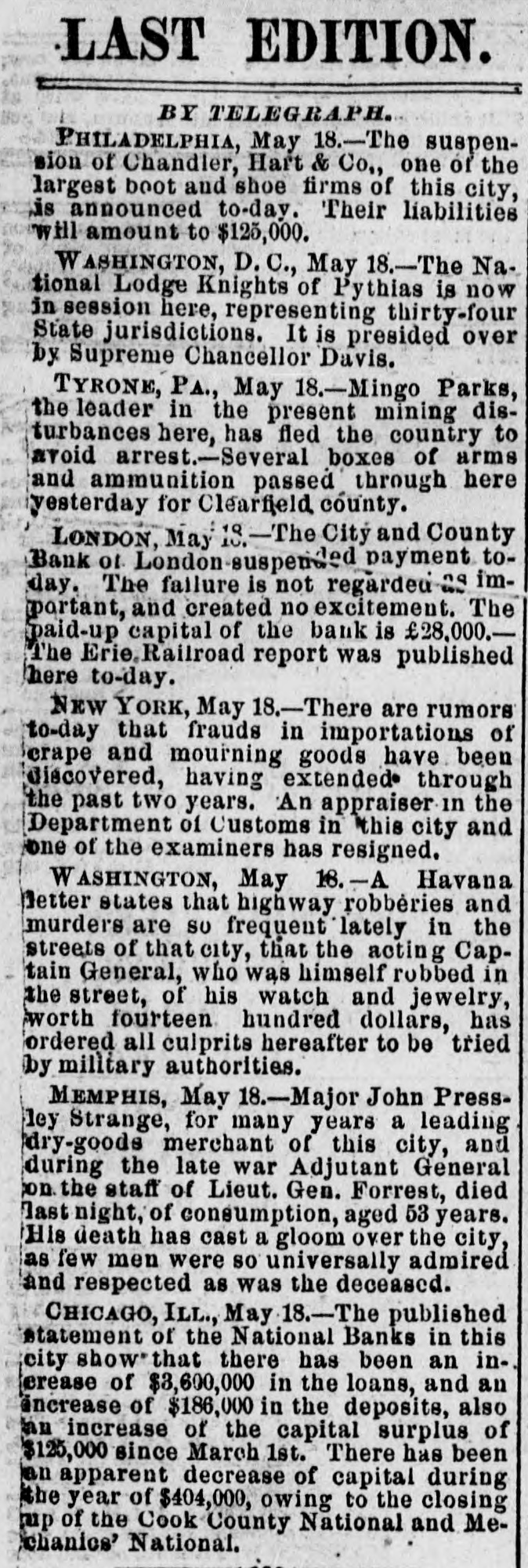
LAST EDITION. BY TELEGRAPH. Philadelphia, May 18.-The suspension of Chandler, Hart & Co,, one of the largest boot and shoe firms of this city, is announced to-day. Their liabilities will amount to $125,000. WASHINGTON, D.C., May 18.-The National Lodge Knights of Pythias is now in session here, representing thirty-four State jurisdictions. It is presided over by Supreme Chancellor Davis. TYRONE, PA., May 18.-Mingo Parks, the leader in the present mining disturbances here, has fled the country to avoid arrest.-Several boxes of arms and ammunition passed through here yesterday for Clearfield county. LONDON, May 18-The City and County Bank of London suspended payment today. The failure is not regarded na important, and created no excitement. The paid-up capital of the bank is £28,000.The Erie. Railroad report was published here to-day. NEW YORK, May 18.-There are rumors to-day that frauds in importations of crape and mourning goods have been discovered, having extended. through the past two years. An appraiser in the Department of Customs in this city and one of the examiners has resigned. WASHINGTON, May 18.-A Havana letter states that highway robbèries and murders are S0 frequent lately in the streets of that city, that the acting Captain General, who was himself robbed in the street, of his watch and jewelry, worth fourteen hundred dollars, has ordered all culprits hereafter to be tried by military authorities. MEMPHIS, May 18.-Major John Pressley Strange, for many years a leading dry-goods merchant of this city, and during the late war Adjutant General on the staff of Lieut. Gen. Forrest, died last night, of consumption, aged 53 years. His death has cast a gloom over the city, as few men were so universally admired and respected as was the deceased. CHICAGO, ILL., May 18.-The published statement of the National Banks in this city show' that there has been an increase of $3,600,000 in the loans, and an increase of $186,000 in the deposits, also an increase of the capital surplus of $125,000 since March 1st. There has been an apparent decrease of capital during the year of $404,000, owing to the closing up of the Cook County National and Mechanics' National.


Article from Chicago Daily Tribune, September 23, 1877

Click image to open full size in new tab

Article Text

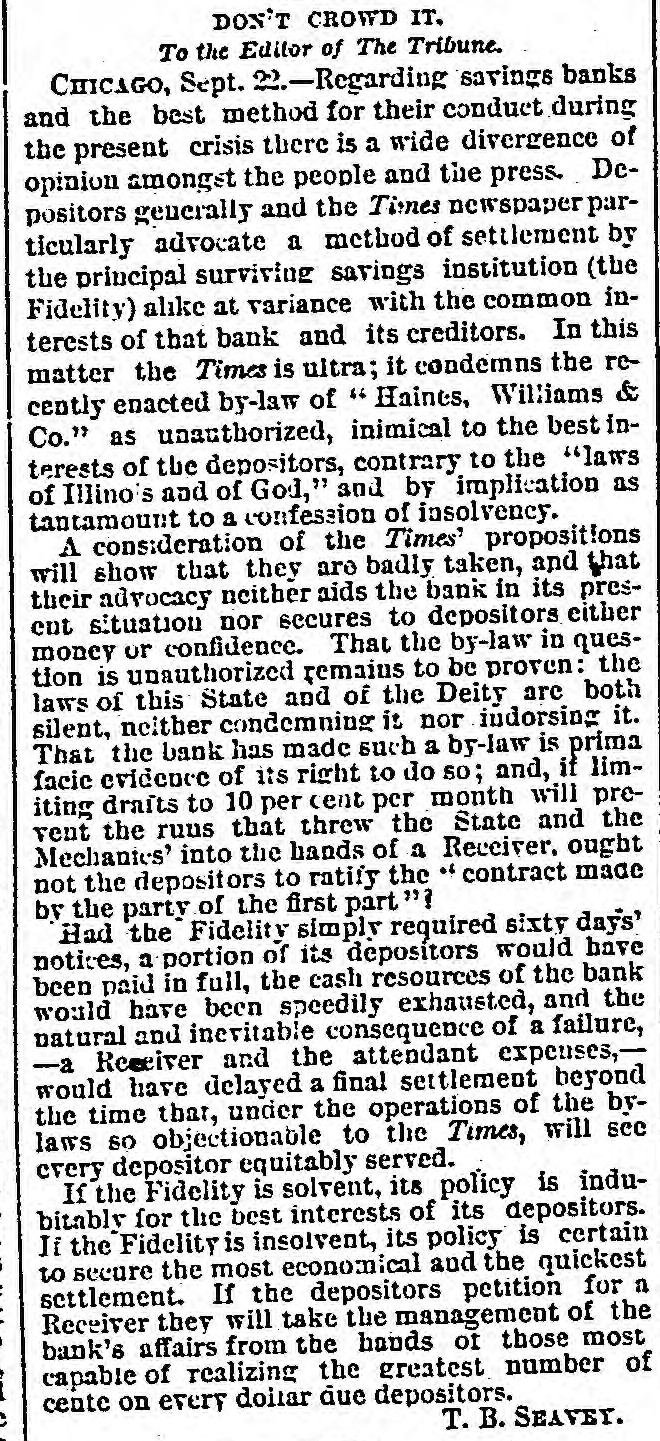
DON'T CROWD IT. To the Editor of The Tribune. CHICAGO, Sept. 22.-Regarding savings banks and the best method for their conduct during the present crisis there is a wide divergence of opinion amongst the people and the press. Depositors generally and the Times newspaper particularly advocate a method of settlement by the principal surviving savings institution (the Fidelity) alike at variance with the common interests of that bank and its creditors. In this matter the Times is ultra; it condemns the recently enacted by-law of " Haines, Williams & Co." as unauthorized, inimical to the best interests of the depositors, contrary to the "laws of Illino's and of God," and by implication as tantamount to a confession of insolvency. A consideration of the Times' propositions will show that they are badly taken, and that their advocacy neither aids the bank in its present situation nor secures to depositors either money or confidence. That the by-law in question is unauthorized remains to be proven: the laws of this State and of the Deity are both silent, neither condemning is nor indorsing it. That the bank has made such a by-law is prima facie evidence of its right to do so; and, if limiting draits to 10 per cent per month will prevent the runs that threw the State and the Mechanics' into the hands of a Receiver. ought not the depositors to ratify the of contract made by the party of the first part Had the Fidelity simply required sixty days' notices, a portion of its depositors would have been paid in full, the cash resources of the bank would have been speedily exhausted, and the natural and inevitable consequence of a failure, -a Receiver and the attendant expenses,would have delayed a final settlement beyond the time that, under the operations of the bylaws so objectionable to the Times, will see every depositor equitably served. If the Fidelity is solvent, its policy is indubitably for the best interests of its depositors. If the Fidelity is insolvent, its policy is certain to secure the most economical and the quickest settlement. If the depositors petition for a Receiver they will take the management of the bank's affairs from the hands of those most capable of realizing the greatest number of cente on every dollar due depositors. T. B. SEAVEY.