First National Bank (Poughkeepsie, NY)

Episode Information

Episode UID
46500885
Episode Type
Suspension β†’ Reopening
Bank Type
national
Bank ID
4650 national
Charter Number
465
Start Date
September 24, 1873
Location
Poughkeepsie, New York

Metadata

Model
gpt-5-mini (chosen from majority vote of a three-model LLM ensemble)
Short Digest
98b930d3cd5a1882

Response Measures

None

Description

Articles discuss statewide/new‑York bank suspensions in the 1873 panic but do not name the Poughkeepsie bank directly; additional local articles could confirm reopening.

Events (2)

1. June 25, 1864 Chartered
Source
historical_nic
2. September 24, 1873 Suspension
Cause
Macro News
Cause Details
Financial crash and panic in late September 1873 leading New York banks to suspend payments.
Newspaper Excerpt
The New York banks suspended on Thursday, the 24th inst., and their fourteen days' limit under the act will terminate on the 8th of October.
Source
newspapers

Newspaper Articles (2)

Article from National Republican, October 4, 1873

Click image to open full size in new tab

Article Text

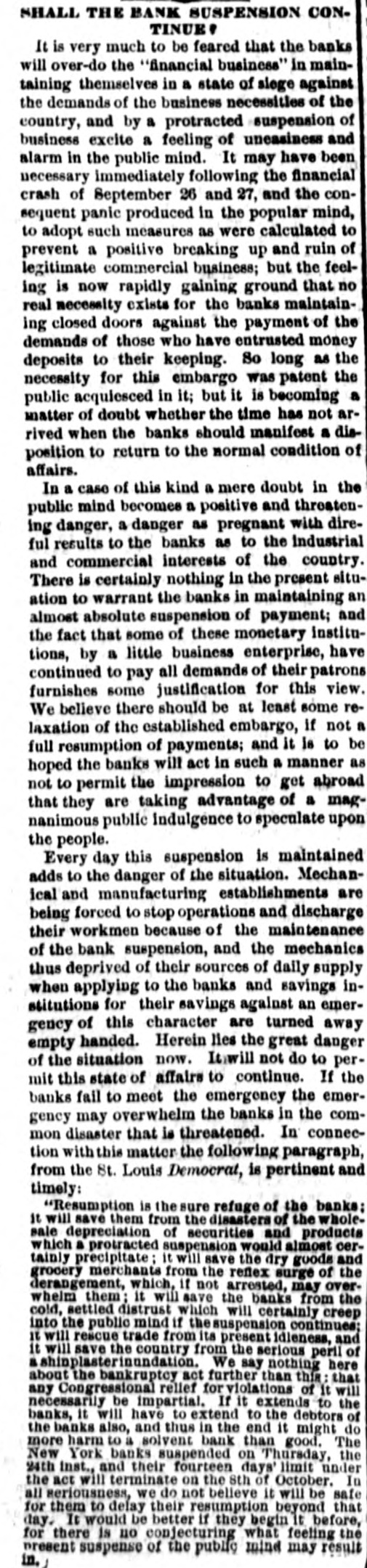
# SHALL THE BANK SUSPENSION CONTINUE It is very much to be feared that the banks will over-do the "financial business" in main-taining themselves in a state of slege against the demands of the business necessities of the country, and by a protracted suspension of business excite a feeling of uneasiness and alarm in the public mind. It may have been necessary immediately following the financial crash of September 26 and 27, and the con-sequent panic produced in the popular mind, to adopt such measures as were calculated to prevent a positive breaking up and ruin of legitimate commercial business; but the feel-ing is now rapidly gaining ground that no real necessity exists for the banks maintain-ing closed doors against the payment of the demands of those who have entrusted money deposits to their keeping. So long as the necessity for this embargo was patent the public acquiesced in it; but it is becoming a matter of doubt whether the time has not ar-rived when the banks should manifest a dis-position to return to the normal condition of affairs. In a case of this kind a mere doubt in the public mind becomes a positive and threaten-ing danger, a danger as pregnant with dire-ful results to the banks as to the industrial and commercial interests of the country. There is certainly nothing in the present situ-ation to warrant the banks in maintaining an almost absolute suspension of payment; and the fact that some of these monetary institu-tions, by a little business enterprise, have continued to pay all demands of their patrons furnishes some justification for this view. We believe there should be at least some re-laxation of the established embargo, if not a full resumption of payments; and it is to be hoped the banks will act in such a manner as not to permit the impression to get abroad that they are taking advantage of a mag-nanimous public indulgence to speculate upon the people. Every day this suspension is maintained adds to the danger of the situation. Mechan-ical and manufacturing establishments are being forced to stop operations and discharge their workmen because of the maintenance of the bank suspension, and the mechanics thus deprived of their sources of daily supply when applying to the banks and savings in-stitutions for their savings against an emer-gency of this character are turned away empty handed. Herein lies the great danger of the situation now. It will not do to per-mit this state of affairs to continue. If the banks fail to meet the emergency the emer-gency may overwhelm the banks in the com-mon disaster that is threatened. In connec-tion with this matter the following paragraph, from the St. Louis Democrat, is pertinent and timely: "Resumption is the sure refuge of the banks; it will save them from the disasters of the whole-sale depreciation of securities and products which a protracted suspension would almost cer-tainly precipitate; it will save the dry goods and grocery merchants from the reflex surge of the derangement, which, if not arrested, may over-whelm them; it will save the banks from the cold, settled distrust which will certainly creep into the public mind if the suspension continues; it will rescue trade from its present idleness, and it will save the country from the serious peril of a shinplasterinundation. We say nothing here about the bankruptcy act further than this: that any Congressional relief for violations of it will necessarily be impartial. If it extends to the banks, it will have to extend to the debtors of the banks also, and thus in the end it might do more harm to a solvent bank than good. The New York banks suspended on Thursday, the 24th inst., and their fourteen days' limit under the act will terminate on the 8th of October. In all seriousness, we do not believe it will be safe for them to delay their resumption beyond that day. It would be better if they begin it before, for there is no conjecturing what feeling the present suspense of the public mind may result in."


Article from The Birmingham Age-Herald, March 12, 1908

Click image to open full size in new tab

Article Text

FINANCIAL BILL HOTLY DENOUNCED Senator Clarke of Arkansas Hits Several Fierce Blows ALDRICH ATTEMPTS REPLY Investigation of Causes of the Panic Is Demanded by Senator Clarke, Who Also Denounces New York Stock Exchange. Washington, March 11.-Senator Clarke of Arkansas denounced the pending currency bill in a speech in the Senate today, declaring that no currency legislation should be enacted until an investigation is held as to the causes of the panic. "No such legislation is necessary now, said Mr. Clarke. "It is not only not necesI sary, but it may become dangerous. am not disposed to tolerate the idea of giving any support to the committee bill, nor the substitute proposed by the minority members of the Senate." If emergency currency is to be provided, Mr. Clarke said, the benefits should be extended all persons whose legitimate business demands cause them to need it. Mr. Clarke denounced the operations of stock exchanges and said the American people would not be satisfied with the proposed currency legislation without a complete knowledge of causes of the panic. "The time has arrived," he said, "when the affairs of the New .York stock exchange and other stock exchanges must be looked into." Mr. Clarke's reference to the stoppage of the payments by the New York banks called Mr. Aldrich to his feet with the remark that he did not believe the people would permit that course again to be pursued. "I trust the senator from Rhode Island as a historian," retorted Mr. Clarke, "but I do not trust him as a prophet." Mr. Clarke expressed the opinion that the majority would not pass the bill allowing the emergency circulation to be retired without limitation. Mr. Clarke said he would not only require a restriction of reserves, but he would deny to a national bank the right to pay interest on checking accounts. Senator Nelson suggested that the national banks should pay interest on the $250,000,000 of government deposits. Mr. Aldrich said that five years ago he had introduced a bill providing for the payment of interest on such deposits at the rate of 1 1/2 per cent, but, he added, senators had opposed that bill on the ground that it changed the nature of the loan. Former Senator Spooner and the late Senator Morgan, he said, opposed the bill. If that objection could be overcome he declared his willingness to again bring in such a measure. He did not know any reason unless it should be a legal one, of the kind suggested, why interest should not be charged on these deposits. Mr. Culberson, he said, had introduced a bill to require payment of interest on government deposits and it was now before the committee on finance. Mr. Bailey spoke at some length suggesting that the main purpose of his substitute was to favor the principle of government money instead of bank money He explained that he had provided for a distribution of the emergency currency in accordance with population, although he realized that business necessity was a greater measure of the amount they should have. But it was not possible to make sure of the business needs of the several sections and it was a simple matter to ascertain the population. An extended argument was made by Mr. Newlands of Nevada in favor of his view that the sending of a check from one state to another makes the business of banking interstate commerce.