Townsend Savings Bank (New Haven, CT)

Episode Information

Episode UID
462560590998
Episode Type
Suspension โ†’ Closure
Bank Type
savings
Bank ID
46256059 hash
Start Date
February 28, 1883
Location
New Haven, Connecticut (41.308, -72.928)

Metadata

Model
gpt-5-mini (chosen from majority vote of a three-model LLM ensemble)
Short Digest
e6032bb581ddb430

Response Measures

None

Description

Receivers appointed and the bank wound up over several years; no run or reopening reported.

Events (3)

1. February 28, 1883 Receivership
Newspaper Excerpt
Receiver Doolittle, of the bankrupt Townsend Savings Bank, received the following communication...
Source
newspapers
2. January 28, 1886 Other
Newspaper Excerpt
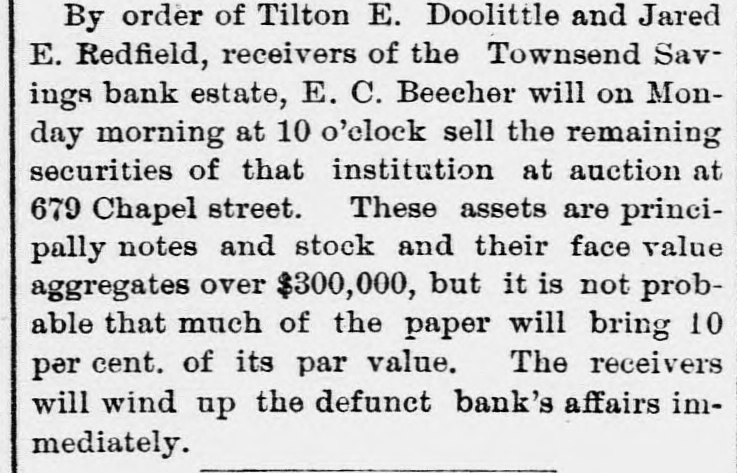
By order of Tilton E. Doolittle and Jared E. Redfield, receivers of the Townsend Savings bank estate, E. C. Beecher will ... sell the remaining securities of that institution at auction
Source
newspapers
3. May 3, 1886 Other
Newspaper Excerpt
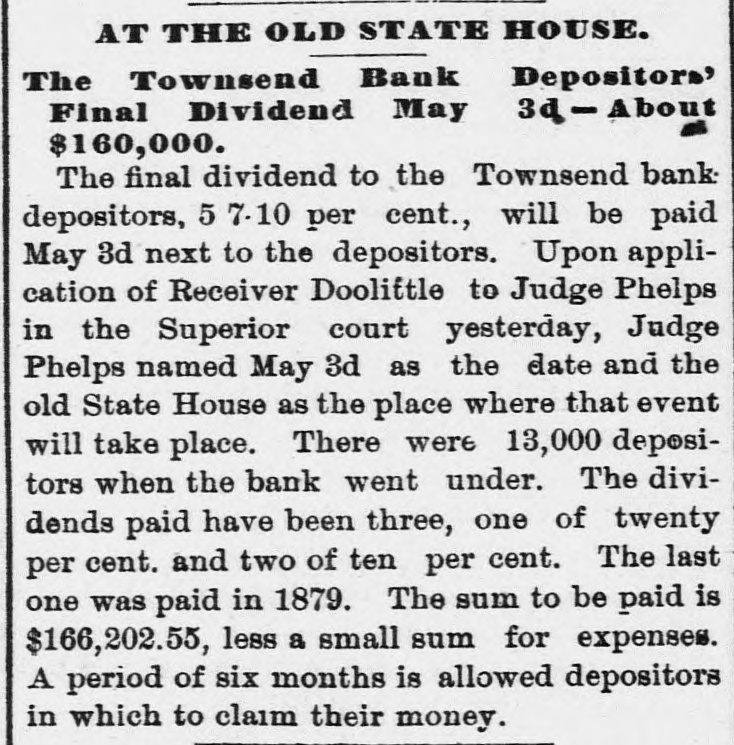
The final dividend to the Townsend bank depositors, 57.10 per cent., will be paid May 3d next to the depositors.
Source
newspapers

Newspaper Articles (11)

Article from Morning Journal and Courier, February 27, 1883

Click image to open full size in new tab

Article Text

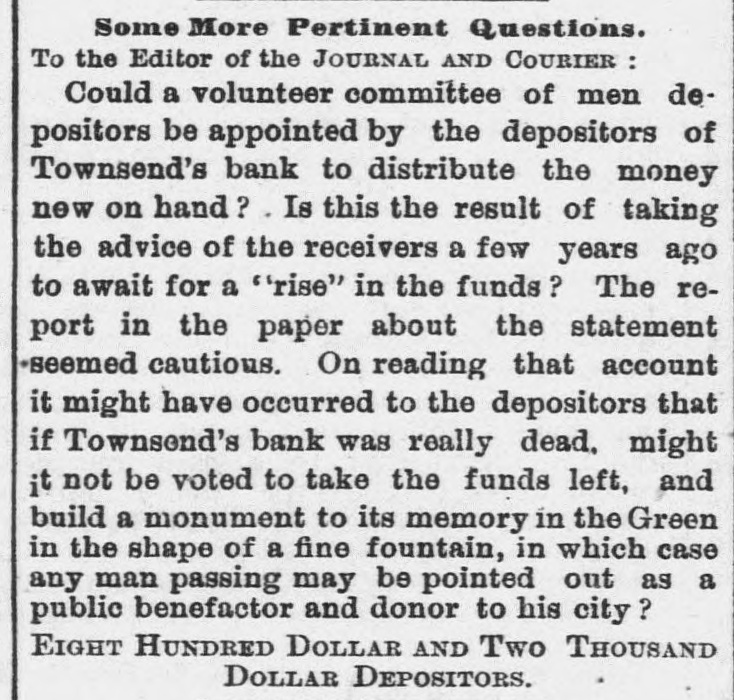
Some More Pertinent Questions. To the Editor of the JOURNAL AND COURIER : Could a volunteer committee of men depositors be appointed by the depositors of Townsend's bank to distribute the money new on hand ? Is this the result of taking the advice of the receivers a few years ago to await for a "rise" in the funds ? The report in the paper about the statement seemed cautious. On reading that account it might have occurred to the depositors that if Townsend's bank was really dead. might it not be voted to take the funds left, and build a monument to its memory in the Green in the shape of a fine fountain, in which case any man passing may be pointed out as a public benefactor and donor to his city ? EIGHT HUNDRED DOLLAR AND Two THOUSAND DOLLAR DEPOSITORS.


Article from Daily Globe, March 1, 1883

Click image to open full size in new tab

Article Text

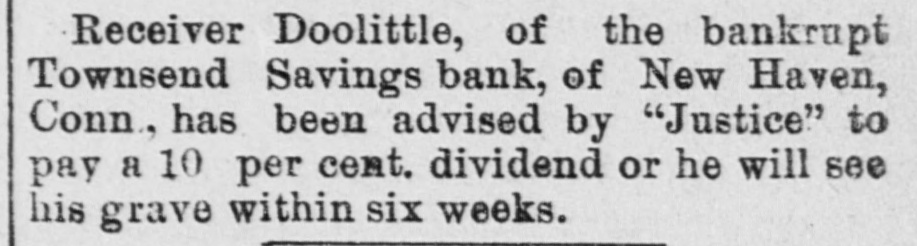
Receiver Doolittle, of the bankrupt Townsend Savings bank, of New Haven, Conn, has been advised by "Justice" to pay a 10 per cent. dividend or he will see his grave within six weeks.


Article from New-York Tribune, March 1, 1883

Click image to open full size in new tab

Article Text

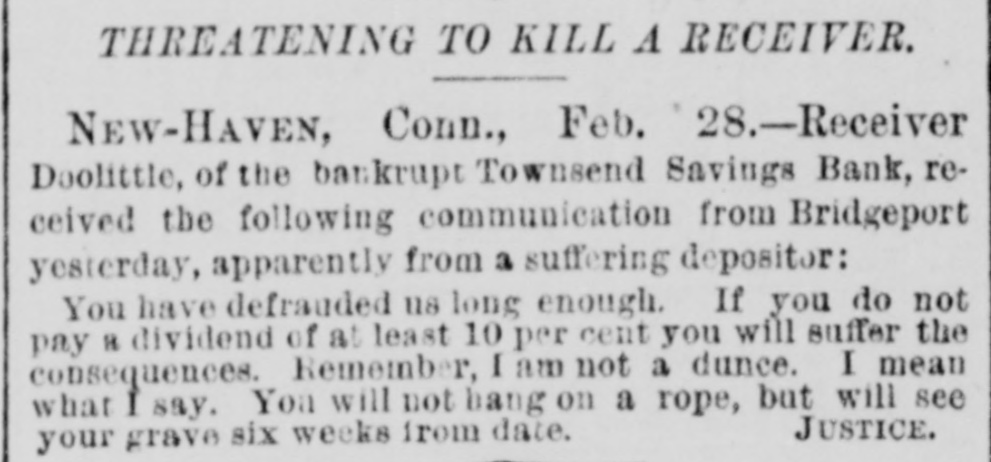
THREATENING TO KILL A RECEIVER. NEW-HAVEN, Conn., Feb. 28.-Receiver Doolittle, of the bankrupt Townsend Savings Bank, received the following communication from Bridgeport yesterday, apparently from a suffering depositor: You have defrauded us long enough. If you do not pay a dividend of at least 10 per cent you will suffer the consequences. Remember, I am not a dunce. I mean what I say. Yoa will not bang on a rope, but will see JUSTICE. your grave six weeks from date.


Article from Morning Journal and Courier, May 8, 1883

Click image to open full size in new tab

Article Text

The Townsend Savings Bank. Just before the adjournment of the General Assembly last Thursday Governor Waller affixed his signature of approval to the resolution requiring Jared Redfield, of Hartford, and Tilton E. Doolittle, of New Haven, receivers of the Townsend Savings. bank of New Haven, to wind up the affairs of the institution before the meeting of the next Legislature.


Article from The Portland Daily Press, September 5, 1883

Click image to open full size in new tab

Article Text

# Credit Mobilier Gets $2,000,000. NEW HAVEN, Sept. 3. -State Attorney Doolittle, receiver for the Townsend Savings Bank, has received a telegram stating that the action of the Credit Mobilier vs. the Union Pacific Railroad Company, on a note of $2,000,000, has been decided in the Supreme Judicial Court of Massachusetts in favor of the Credit Mobilier.


Article from New-York Tribune, September 5, 1883

Click image to open full size in new tab

Article Text

THE CREDIT MOBILIER SUCCESSFUL. New-HAVEN, Conn., Sept. 4.-State Attorney Doolittle, receiver for the Townsend Sa vinga Bank, has received a telegram stating that the action of the Credit Mobilier vs. the Union Pacific Railroad Company on a note of $2,000,000, has been decided 10 the Supreme Judicial Court of Massachusetts, in favor of the Credit Mobilier. Mr. Doofittle caused the case to be instituted in the interest of the Townsend Savings Bank, and it has been argued four times before the Supreme Judicial Court.


Article from Morning Journal and Courier, December 2, 1884

Click image to open full size in new tab

Article Text

Commission of Enquiry. The commission of enquiry concerning the Townsend Savings bank of New Haven consisting of Senator Edwin L. Schofield of Stamford, Representative George P. McLean of Simsbury and William C. Durand of Milford will meet at the Capitol building tomorrow at noon for conference in regard to the work to be done under the resolution authorizing an enquiry concerning the receivership and the transaction of the bank's affairs.


Article from Morning Journal and Courier, December 4, 1884

Click image to open full size in new tab

Article Text

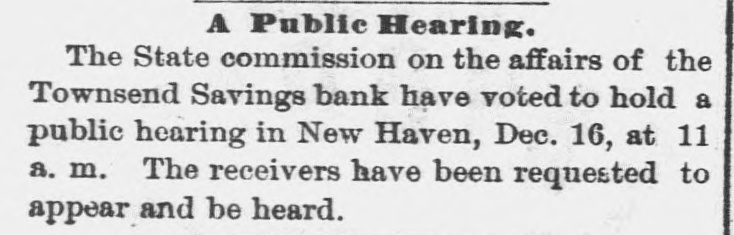
A Public Hearing. The State commission on the affairs of the Townsend Savings bank have voted to hold a public hearing in New Haven, Dec. 16, at 11 a. m. The receivers have been requested to appear and be heard.


Article from Morning Journal and Courier, January 28, 1886

Click image to open full size in new tab

Article Text

By order of Tilton E. Doolittle and Jared E. Redfield, receivers of the Townsend Savings bank estate, E. C. Beecher will on Monday morning at 10 o'clock sell the remaining securities of that institution at auction at 679 Chapel street. These assets are principally notes and stock and their face value aggregates over $300,000, but it is not probable that much of the paper will bring 10 per cent. of its par value. The receivers will wind up the defunct bank's affairs immediately.


Article from New-York Tribune, February 2, 1886

Click image to open full size in new tab

Article Text

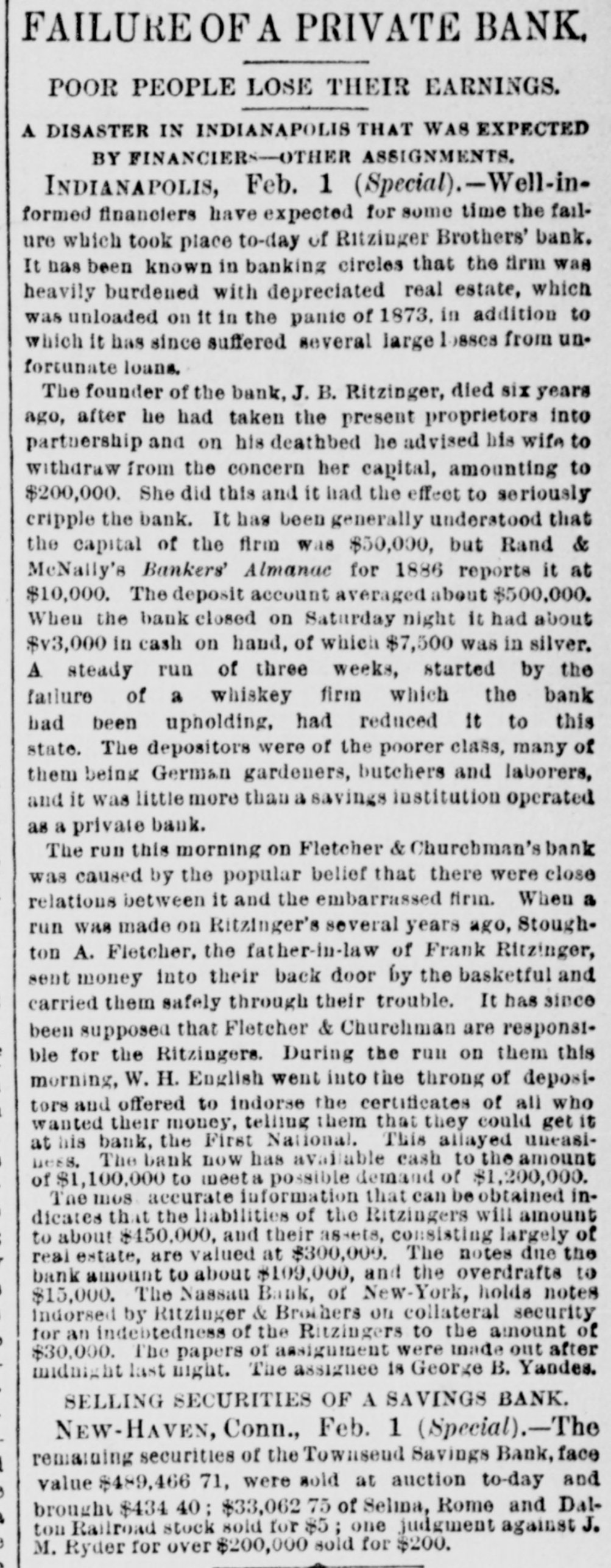
FAILURE OF A PRIVATE BANK. POOR PEOPLE LOSE THEIR EARNINGS. A DISASTER IN INDIANAPOLIS THAT WAS EXPECTED BY FINANCIERSOTHER ASSIGNMENTS. INDIANAPOLIS, Feb. 1 (Special).-Well-informed financiers have expected for some time the failure which took place to-day of Ritzinger Brothers' bank. It has been known in banking circles that the firm was heavily burdened with depreciated real estate, which was unloaded on it in the panic of 1873, in addition to which it has since suffered several large losses from unfortunate loans. The founder of the bank, J. B. Ritzinger, died six years ago, after he had taken the present proprietors into partnership and on his deathbed he advised his wife to withdraw from the concern her capital, amounting to $200,000. She did this and it had the effect to seriously cripple the bank. It has been generally understood that the capital of the firm was $50,000, but Rand & McNally's Bankers' Almanac for 1886 reports it at $10,000. The deposit account averaged about $500,000. When the bank closed on Saturday night it had about $v3,000 in cash on hand, of which $7,500 was in silver. A steady run of three weeks, started by the failure of a whiskey firm which the bank had been upholding, had reduced it to this state. The depositors were of the poorer class, many of them being German gardeners, butchers and laborers, and it was little more than a savings institution operated as a private bank. The run this morning on Fletcher & Churchman's bank was caused by the popular belief that there were close relations between it and the embarrassed firm. When a run was made on Ritzinger's several years ago, Stoughton A. Fletcher, the father-in-law of Frank Ritzinger, sent money into their back door by the basketful and carried them safely through their trouble. It has since been supposed that Fletcher & Churchman are responsible for the Ritzingers. During the run on them this morning, W. H. English went into the throng of depositors and offered to indorse the certificates of all who wanted their money, telling them that they could get it at his bank, the First National. This allayed uneasiness. The bank now has available cash to the amount of $1,100,000 to meeta possible demand of $1,200,000. The mos accurate information that can be obtained indicates that the liabilities of the Ritzingers will amount to about $450,000, and their assets, consisting largely of real estate, are valued at $300,000. The notes due the bank amount to about $109,000, and the overdrafts to $15,000. The Nassau Bank, of New-York, holds notes indorsed by Ritzinger & Brothers on collateral security for an indebtedness of the Ritzingers to the amount of $30,000. The papers of assignment were made out after midnight last night. The assignee 18 George B. Yandes. SELLING SECURITIES OF A SAVINGS BANK. New-HAVEN, Conn., Feb. 1 (Special).-The remaining securities of the Townsend Savings Bank, face value $489,466 were sold at auction to-day and brought $434 40; $33,062 75 of Selma, Rome and Dalton Railroad stock sold for $5; one judgment against J. M. Ryder for over $200,000 sold for $200.
Article from Morning Journal and Courier, March 17, 1886

Click image to open full size in new tab

Article Text

AT THE OLD STATE HOUSE. The Townsend Bank Depositors' Final Dividend May 3d-About $160,000. The final dividend to the Townsend bank depositors, 57.10 per cent., will be paid May 3d next to the depositors. Upon application of Receiver Dooliftle to Judge Phelps in the Superior court yesterday, Judge Phelps named May 3d as the date and the old State House as the place where that event will take place. There were 13,000 depositors when the bank went under. The dividends paid have been three, one of twenty per cent. and two of ten per cent. The last one was paid in 1879. The sum to be paid is $166,202.55, less a small sum for expenses. A period of six months is allowed depositors in which to claim their money.