4580. Bank of Illinois (Shawneetown, IL)

Bank Information

Episode Type
Suspension β†’ Closure
Bank Type
state
Start Date
June 15, 1842
Location
Shawneetown, Illinois (37.713, -88.187)

Metadata

Model
gpt-5-mini
Short Digest
7751e5a759623a1d

Response Measures

None

Description

Articles (June–Aug 1842) report the Bank of Illinois at Shawneetown failed to resume specie payments on the promised June 15, 1842 date, directors deferred resumption citing failure of New Orleans banks, its notes fell to ~50 cents, crowds assembled in anticipation of a run, and later actions (attachments, garnishment; bank described as 'prostrate') indicate it did not successfully resume and effectively failed. Cause of suspension is other banks (New Orleans) failing to pay specie. No clear record of formal receivership in the provided articles, but attachments and insolvency language support classification as permanent closure after suspension.

Events (4)

1. June 15, 1842 Run
Cause
Local Banks
Cause Details
Anticipation of resumption failing (due to New Orleans banks' non-payment) led depositors to assemble prepared to run on the bank.
Measures
Directors formally deferred resumption; notices published announcing deferral
Newspaper Excerpt
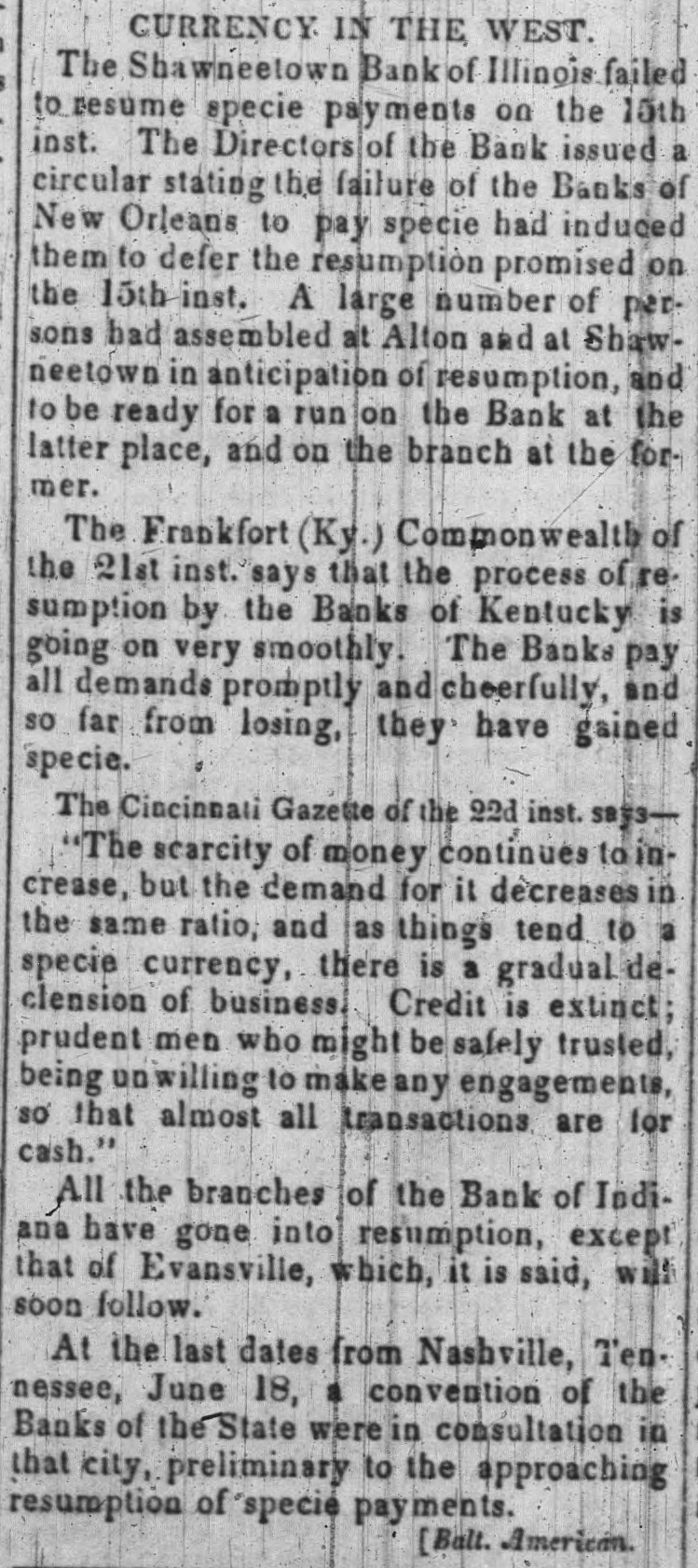
A large number of persons had assembled at Alton and at Shawneetown in anticipation of resumption, and to be ready for a run on the Bank at the latter place
Source
newspapers
2. June 15, 1842 Suspension
Cause
Local Banks
Cause Details
Directors stated failure of the New Orleans banks to pay specie induced them to defer and not resume specie payments on the promised June 15, 1842 date.
Newspaper Excerpt
The Shawneelown Bank of Illinois failed to resume specie payments on the 15th inst. The Directors ... deferred the resumption promised on the 15th-inst.
Source
newspapers
3. July 20, 1842 Other
Newspaper Excerpt
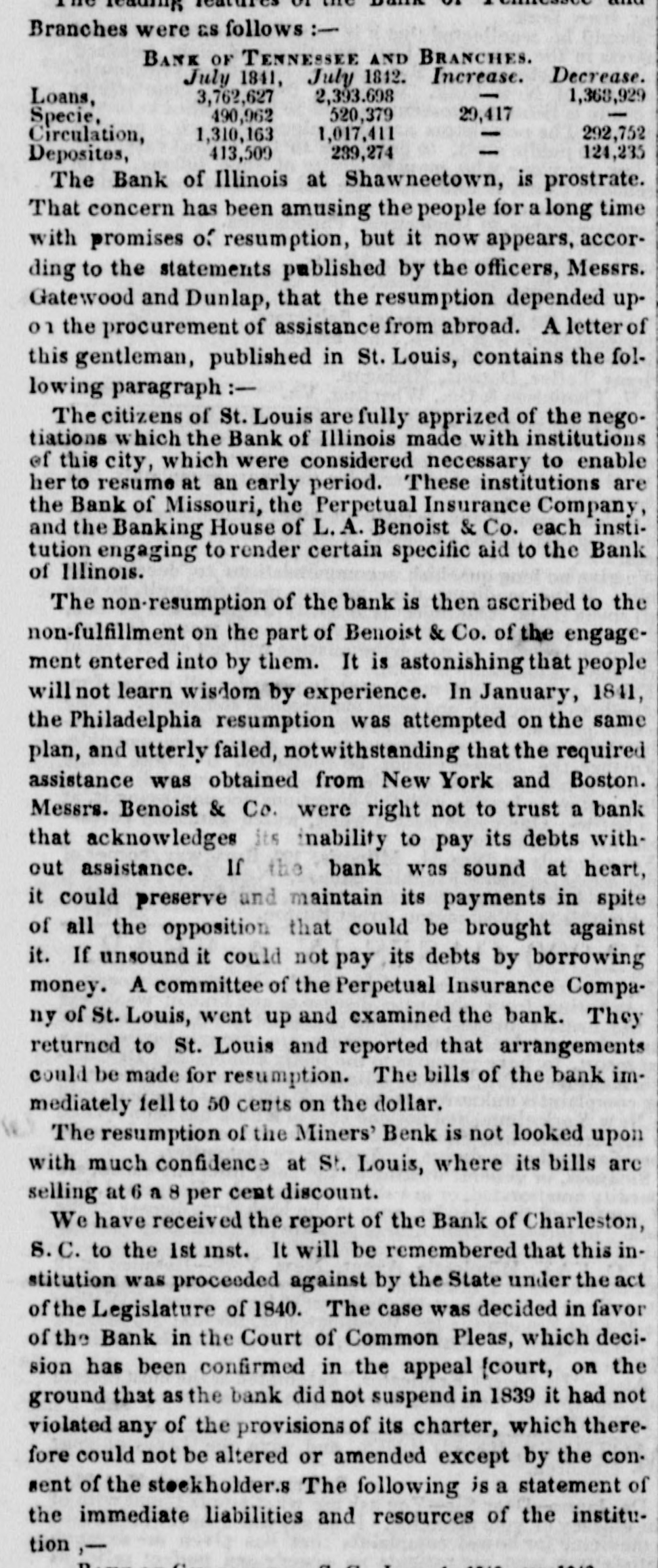
The Bank of Illinois at Shawneetown, is prostrate. ... the bills of the bank immediately fell to 50 cents on the dollar.
Source
newspapers
4. July 25, 1842 Other
Newspaper Excerpt
The Bank of Missouri has taken out an attachment against the Bank of Illinois, at Shawneelown, and garnisheed all persons in St. Louis supposed to be debtors to the latter Bank
Source
newspapers

Newspaper Articles (11)

Article from New-York Tribune, April 13, 1842

Click image to open full size in new tab

Article Text

Currency of Illinoix-Vincyard the Murderer Bailed, Correspondence of the Tribune. GALENA, III., March 23, 1812 The past winter has been one of the most has remarkable ever known in the Lead Mines. It been what is called a broken winter, exposed to very sudden changes of temperature, and the consequence has been an amount of sickness and mortality throughout all this section of country of hitherto without parallel, except in the time the cholera. The ice left the Mississippi and Fever Rivers very carly. and navigation was resumed the about twenty days earlier than usual. On morning of the 9th instant I counted three steamboats at the levee. Business is now pretty much at a stand among on account of the complete crash in money us, matters. The paper of the State Bank of Illinois. the Miners' Bank at Dubuque, Iowa. and the Bank of Illinois at Shawneetown. has constituted our chief circulation for the last six months: but now the State Bank paper is worth but fifty cents on the dollar. and the Miners' Bank can hardly be got off at any price. while a very small amount of the Shawneetown is the only good money we I have, and even that is shivering in the wind.' believe the conviction is fast becoming established that the State Bank will never be able to pay than four or five bits on the dollar of its circulation, more notwithstanding its fair statements. Let the whole Nation bear in mind that this great monster of the State Bank of Illinois, with a circulation of more than three millions of dollars, and which will swindle the community out of more than a million and a half, is the legitimate offspring of Loco-Focoism: that Loco-Fucuism brought it into existence, has sustained it through out, and legalized its suspensions and villanics. Bad as things are here, we are probably better off than any other place in Illinois, for we have the material on our levee (lead) which ought to command the gold and silver. There are here now probably one hundred thousand pigs of lead ready to be shipped, and large quantities are continually coming in from all parts of the mines. Lead is now selling here at $2.80 per hundred, in good money. The want of a National Bank is now felt with ten-fold force. and the curses which are heaped the head of Captain JOHN TYLER are deep and in bitter. on A Tyler is not to be found these diggings-even the office-holders deny the soft impeachment. The Democratic Whigs of the of Great West. if Ido not much mistake the signs the times will soon unfurl to the breeze the broad banner HENRY CLAY and a NATIONAL BANK, determined in stand or to fall with it." You are probably aware that Vineyard, the foul murderer of Arndt in the Legislative Council of Wiskonsan has been bailed by Chief Justice Dame in the swin of ten thousand dollars, and is now roaming at large. This result was expected by those who know Dame, though the excitement against him in the middle and eastern portions En- of the territory is very great. The Madison as quirer. Loco-Foco. and of the same politics Messrs. Vinevard and Dame. comments with sever and the unprecedented course of the Judge, the itv on that Vineyard will not stand his trial nor baii savs be paid. 1 understand that the friends of insulted Arndr. and others, desirous of vindicating the majesty of the laws. intend to employ Gen. JAMES WILSON, Surveyor General of Iowa, whose eloquence and power are well known at the East, to assist in the prosecution. Yours, &c. DESSAIX K POLAND, Historical. Literary, Monumental and Picturesque. No. 11. has just been published at No. 2 Pine-street. Its letter-press. which treats of Kosciazsko. The Castle of Overwi Boleslas the Great, and Popular Costumes of the Poles, is full of interest, but the il- A instrations it hograph) are rather primitive. piece of Music closes the number, (published by P. Sobolewski & Wyszinski.) K The Mail bags from Columbus, O. to Erie, Pa. have been ,twice cut open and robbed.

Article from The New York Herald, May 23, 1842

Click image to open full size in new tab

Article Text

The feeling in relation to American credit was by no means improved by the accounts from this side. The view taken of our affairs is expressed as follows in one of the London journals :To see a country in possession of the aggregate wealth and natural advantages of the United with no pubdeserving the name, with so little virtue in her lic debt citizens States, public as to leave the government practically insolan in modern and to sayour vent, is considered anomaly times, strongly of a rapid approach to political dissolution. In a commercial point of view it is little better than'a state of anarchy, for there is no security for the interchange of commodities except by the aid of the metals, the universally acknowledged representative of value, which in modern time cramps the energies and confines them within a relatively narrow circle. Whilst such a state of things remains, we cannot look for any revival of trade or extended outlet for our manufactures. Another paper remarks as follows:The miserable state of the American finances, and the evident inability of the executive to go on without a loan, continues a topic of much interest amongst the commercial and moneyed classes in the city. It is universally taken for granted that a strong effort will be made to raise the largest portion of the money in England, and that all the usual means and appliances go well understood by the loan inferior will be in to public into that it will be a jobbers, tion, lull and the their agents, security put requisi- perfectly safe investment. Warning, therefore, cannot be given at too early a period, that the past situation and conduct of the American central government, in respect to the public debt, afford no guarantee that can be relied upon for the future, after the examples we have had of the state executives, backed by their legislative assemblies, repudiating the sacred'pecuniary obligations. With a prevalent feeling such as is here described, it is not surprising that no improvement should be madei in the prices of our public securities. Upon the whole, the state of commercial affairs in England, bears a close re semblance to those of this country. In both a heavy reduction has taken place during the past year in the currency of the banks, attended by heavy failures of both banks and individuals, a great reduction in the prices of commodities, and now when the remaining banks are anxiously seeking suitable investments for the funds. The stagnation of the markets is prolonged by the agitation of, and the uncertain course of both governments on the tariffs. The settlement of this question upon both sides of the Atlantic, would seem to open the way to improvement in business. We understand that only about $200,000 of the United States loan has yet been taken. Mr. Forward has been here several days, in order to enter into negociations for the loan, but returned to Washington on Saturday afternoon. He has made certain preliminary stops, but has found some difficulty in completing the negociation. He did not go to Boston. The Bank of Illinois at Shawneetown, has published the following notice :BANK OF ILLINOIS, Shawneetown, May 4th, 1842. At a meeting of a Board of Directors this day, it was Resolved, That this Bank resume specie payment on or before the 15th day of June next. By order of the Board, JOHN SIDDALL, Cashier. It will be remembered that the Cattskill and Canajoharie Rail Road and the Ithaca and Owego Rail Road, both com panies to which the State loaned its credit to the amount of $200,000 the first, to and $315,700 to the last, failed to pay the interest. They have been sold out in consequence by the Comptroller. The Cattskill and Canajoharie Rail Road was knocked down, after considerable competition, for $11,600, to Mr. Amos Cornwall, of Cattskill, and his associates. This road is completed for twenty-eight miles, and is in operation to Cooksburg, twenty-six miles. It will undoubtedly be kept in operation as far as completed; and if not, the iron is believed to be worth more than the amount bid. The Ithaca and Owego Rail Road was sold, without competition, for $4500, to Archibald McIntyre, Esq. of this city. This road is completed, and has been in operation for several years. Mr. McIntyre is a large stockholder in the company, and will, it is believed, repair and improve the road. It is stated that the directors of the Bank of Amsterdam have made arrangements to redeem its bills in Albany, to take effect in a few days.


Article from The Ohio Democrat, June 2, 1842

Click image to open full size in new tab

Article Text

GEN. JACKSON'S FINE The Federal press 18 shouting because the friends of this old veteran failed in getting his fine restored to him The following from the Globe shows how they failed: The Federal party in the Senate to day contrived to defeat to remove the stigma of the judicial General tor at New while for it a body. The in the State Orleans, censure the Legislatures, intended on voting Jockson resolutions almost his which in conduct bro this of the course of the General law justifying bill New into Orleans. Congress, evidently They demanded show in declaring their that purpose the martial fine should to vindicate as the sentence: was of persion at be of restored, judicial State his this fame Legislatures from the secpe the and the whole proceeding in the in Congress, For the last two days, the effort in the Senate has been to stick amendments to the bill, which by implication, would put an interpretation on the act, that the body passing it did not mean to take into con sideration the right or wrong of the judicial conviction of the General, but simply to return the money as a remission of a fine-as an act of grace to an old mian, who might choose to leave the pecuniary earnings of his life to his family, rather than in the public coffers- who would take it, even coupled with the expression that the Government resigning, it, was not content to say about the sentence the but with understanding nothing penalty of a crime, judicial brought the declared imposing into view it by as that although the bill, matter that oThis was an a striking that the was right & pinion upon. the was sentence, a judge Congress oblique, would but in his express most decision, no that course was not effect, ArCongress, implication, the hostile Geueral's in as excluded General that Jackson, conclusion. justifiable; said Mr. that because cher, he is to this was an insult to him, which he would not vote for. It could not, therefore be expected that his friends would do it bill was every voting it-the federalists, in the main, us that General hoped against by The rejected; Jackson's adversaries democrat for it above It would was seize the occasion to evince a magnanimity party spirit. The result shows that they cannot offer him even drink of water. in the last feverish moments of exhausted nature, without putting poison in it." That justice will yet be done the old hero by the democracy of the country there is not a doubt. Federal ism has only shown her hand more plain, in refusing to do him justice. The time will come, when Federalism shall not add insult to injury, and fasten them on the character of such a man as Jackson. As the New Era says, "the example set to Legislatures by those of Ohio and New York, will, we are confident, be prompt ly imitated by the Connecticut Legislature now in ses sion, and by those of every State redeemed from Federal thraldom, as they successively meet. All opposition must before an expression sen give way full, though such tardy, expiation of of public great timent, and a a judicial at no we are will to the hero of prove iniquity, distant Orleans day, that national persuaded, that gratitude grows more intense as years pass over event, which form the noblest theme for American historians. BANK OF ST. CLAIR.-Thi Bank does not pay specie, and its notes are not taken at the Massillon or Wooster Banks. The community should repudiate all non-apecie paying Bank notes, and drive them from circulation. The Massillon Gazette, (Whig) speaking of the St, Clair Bank, says: "We are glad to see the Farmers refuse the notes of this their when money as to be at. We paper as curving got Bank such for trash, go against produce, good all There circulating is is nouse just in easily receiwhich specie cannot at a rate of say confidence in necesrency most upon rascally specie paying exchange. Banks be is We obtained, all again that is except that ary to enable us to have a good currency, equal, at all times, to silver.' That's the right to talk, and "we are glad to see" one to senses on But what a contrast aBanking matters. at least whig way paper coming between its the bove, and the miserable paper this in favor Bank bank county suspensions, slang of the and whig suspended in paper! Ever since the Ohio banks resumed, that paper has endeavored to destroy "confidence," abused the Legislature that passed the resumption law, and done its utmost to make the people believe there was no "good mouey' to be had. These have been his hobbies to deceive the people with, but it's no go, and we advise the Advocate readers to be ready to turn a sharp corner shortly. The election is coming on, and Judas want's to keep the county printing; consequently he will for tell that the in the last Re you again go whigs specie paying legislature banks, and passed perhaps the rumption law. Mark it if he does not. PROGRESS OF RESUMPTION-We learn by the New Orleans papers, that the banks of that city, agreed to resume specie payments on the 18th May. a The papers are in great glee about it. They call it glorious victory, &c., and well they may. In Illinois, the resumption ball is rolling on, as may be seen by the following notice published by the Bank of Illinois: Bank of Illinois. Shawneetown, May 4, 1842. At a meeting of a Board of Directors this day, it was Resolved, That this Bank resume specie payment on or before the the 15th day of June next. By order of the Board, JOHN SIDDALL, Cashier. The Indianapolis Journal of May 17th, says "The Board of Directors of the State Bank: of Indiana at their quarterly session last week, fixed the 15th day of June next for the resumption of specie payment, in all the Branches. Alaba.na, Virginia, Kentucky and Tennessee, will no doubt resume in full by mid-summer. All this shows that business and the currency are getting better, and that a better, sounder, hea!thier state of things is fast approaching CONGRESS. Both Houses have been engaged on the Appropriation Bills. The apportionment Bill not passed yet. The Pennsy Ivania Legislature commences its extra session on the 9th of this month, we believe, to district the State, and yet Congress, after compelling the States to hold extra sessions, after being in session


Article from The New York Herald, June 12, 1842

Click image to open full size in new tab

Article Text

MONEY MARKET. Saturday, June 11-6 P. M. At the Stock Board this morning sales were moderate in extent, and prices in some instances gave way, Harlem declined 1/2 per cent ; Stonington Mohawk Railroad Patterson improved Long Island Railroad 1. The Bank of Illinois at Shawnee town is to resume specie payments on the 15th instant, and unless the State Bank is able to resume on the same day, her charter becomes forfeited according to law. The policy of those who control that institution in Wall street and elsewhere has been of late to speculate in their own paper, that is,by depreciating the paper as much as possible,buy it in at low prices themselves, and thus pay their debts with a small per centage. This one of the tricks of banking that is supposed to be for the benefit of the people. The State of Michigan,it will be remembered, issued in violation of the Constitution, State paper called "Scrip," to circulate as money. The issuers of this fraudulent paper were well aware that it would soon depreciate in the market. They also passed a law at the same time regulating the business of brokers, under heavy penalties. It is now charged that the brokers have caused the depreciation of the illegal State paper money, because they buy it for what it is worth nd they endeavor to throw upon it those who suffer the am of the transaction. If the State had honestly paid its ebts in the first instance, there would have been-no illege paper to depreciate. A large sale of Re yoad Bonds is to take place at Philadelphia, on the 22nd Instan consisting of the following Redeemable Β£113,000 Phila., Wilm. and Balt. R. R. bonds, 6 percent, 1855 1850 Β£92,500 " and Reading Rail Road bonds, Β£205,500 These Bonds the Reading Railroad are convertible into company shares, at the option of the holder, at any time before 1850. The interest of both descriptions payaple semi-annually in London. We extract the following from the New York Daily Express of this morning :The Committee of ways and Means propose to repeal the Land Distribution Law, which is the great peculiarity of their project. On this will arise the great contest in Congress, to be dignified with much more importance as a revenuematter just now than it deserves, inasmuch as the revenues for lands are not now of sufficient importance to af. fordany great income to the Treasury, or to materially effect what should be the proposed rate offduties upon any articles. The two lines we have italicised contain an instance of the flippant folly withwhich commercial matters are treated in the Wall street papers. The editor who conducts that part of the paper, with the most self sufficient gravity, proceeds to discuss a question of which his statement proves his entire and surprising ignorance. The 25th section of the bill of the Committee of Ways and Means is as follows :Sec. 25. And be it further enacted, That the proviso to the sixth section of the act entitled An act to appropriate the proceeds of the sales of the public lands, and to grant pre-emption rights," approved September fourth, eighteen hundred and forty-one, be, and the same is hereby, repealed. The following is the proviso to the 6th section of the land bill:Provided, That if, at any time during the existence of this act, there shall be an imposition of duties on imports inconsistent with the provisions of the act of March second. one thousand eight hundred and thirty-three, entitled " An act to modify the act of the fourteenth of July, onethousand eight hundred and thirty-two, and all other acts imposing duties on imports," and beyond the rate of duty fine ! by that act, to wit, twenty per cent on the value of SUCH imports, or any of them, then the distribution provided in this act sha!l be suspended, and shall so continue until this cause of its suspension shall be removed; and when removed, if not prevented by other provisions of this act, such distribution shall be resumed. The tariff bill of the Committee of Ways and Means raises the duties on imports to an average of 35 per cent, instead of 20, consequently the land bill would be inoperative by its own proviso, but with the trickery, vacillation, and deception," which always marks the legislation ema. nating from " Harry del occidente" that proviso having been iserte.1 in the original bill to secure its passage is now to be repealed by a clause in the law, the prospective creation of which was the cause of the insertion. It is such disgraceful mountebank legislation, that destroys the credit of the country at home, and its dignity and the respect due to tabroad. So tortuous is the course of our public men, that their partisans never know the nature of their measures. To be sure the editor above quoted was never remarkable for any degree of shrewdness, nor is it necessary that he should be possessed of it. The party press for a quid pro quo agree to support a certain politician, right or wrong, and it is therefore not necessary for them to scrutinise his principles. The New York Courier and Enquirer has at the head of its column the following motto: " Principles not men." What the signification of these words may be, probably the worthy editor has not ascer. tained. He possibly thinks it some missile used in the regular army. Accordingly, we find his editorial columns uniformly supporting the broadest principles of free trade as those best likely to promote the welfare of the country, and at the same time that man who is the rankest advocate for high and oppressive duties on foreign commerce, is supported for the chief magistracy of the nation. Now, whether is the principle or the man" that the redoubtable editor contends for, may puzzle the simple minded. It is such leaky vessels as these that keep the mercantile community in constant suspense in regard to the action of Congress upon commercial matters, and which stagnates trade, and paralyses the whole business of the country. Sales at the Stock Exchange. S1000 NYork 6's, 1362. 911 100 shares Harl. RR cash 161 $1000 do 53/2's 1851, 881 50 do do cash 163 do $1300 Ohio 6's, 1860, cash 801 45 do


Article from Virginia Free Press, June 30, 1842

Click image to open full size in new tab

Article Text

CURRENCY IN THE WEST. The Shawneelown Bank of Illinois failed to resume specie payments on the 15th inst. The Directors of the Bank issued a circular stating the failure of the Banks of New Orleans to pay specie had induced them to defer the resumption promised on the 15th-inst. A large number of persons had assembled at Alton and at Shawneetown in anticipation of resumption, and to be ready for a run on the Bank at the latter place, and on the branch at the for mer. The Frankfort (Ky.) Commonwealth of the 21st inst. says that the process of resumption by the Banks of Kentucky is going on very smoothly. The Banks pay all demands promptly and cheerfully, and so far from losing, they have gained specie. The Cincinnati Gazette of the 22d inst. says"The scarcity of money continues to increase, but the demand for it decreases in the same ratio, and as things tend to a specie currency, there is a gradual declension of business. Credit is extinct; prudent men who might be safely trusted, being un willing to make any engagements, so that almost all transactions are for cash." All the branches of the Bank of Indiana have gone into resumption, except that of Evansville, which, it is said, will soon follow. At the last dates from Nashville, Ten. nessee, June 18, a convention of the Banks of the State were in consultation in that city, preliminary to the approaching resumption of specie payments. [Balt. American.


Article from The New York Herald, July 4, 1842

Click image to open full size in new tab

Article Text

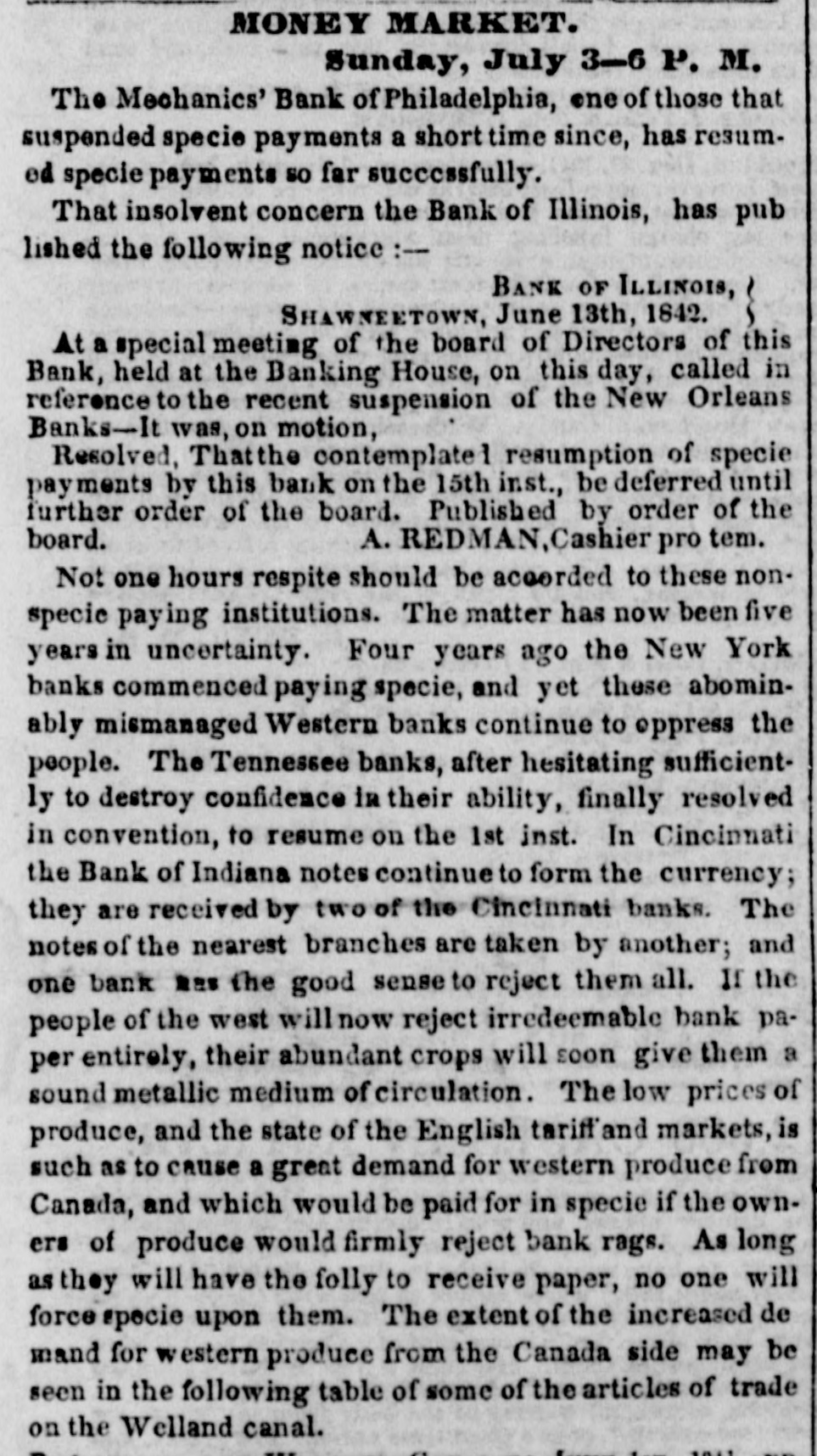
MONEY MARKET. Sunday, July 3-6 P. M. The Mechanics' Bank of Philadelphia, one of those that suspended specie payments a short time since, has resumed specie payments so far successfully. That insolvent concern the Bank of Illinois, has pub lished the following notice :BANK OF ILLINOIS, SHAWNEETOWN, June 13th, 1842. At a special meeting of the board of Directors of this Bank, held at the Banking House, on this day, called in reference to the recent suspension of the New Orleans Banks-It was, on motion, Resolved, That the contemplate resumption of specie payments by this bank on the 15th inst., be deferred until further order of the board. Published by order of the board. A. REDMAN, Cashier pro tem. Not one hours respite should be accorded to these nonspecie paying institutions. The matter has now been five years in uncertainty. Four years ago the New York banks commenced paying specie, and yet these abominably mismanaged Western banks continue to appress the people. The Tennessee banks, after hesitating sufficiently to destroy confidence in their ability, finally resolved in convention, to resume on the 1st inst. In Cincinnati the Bank of Indiana notes continue to form the currency; they are received by two of the Cincinnati banks. The notes of the nearest branches are taken by another; and one bank has the good sense to reject them all. If the people of the west will now reject irredeemable bank paper entirely, their abundant crops will soon give them a sound metallic medium of circulation. The low prices of produce, and the state of the English tariff and markets, is such as to cause a great demand for western produce from Canada, and which would be paid for in specie if the owners of produce would firmly reject bank rags. As long as they will have the folly to receive paper, no one will force specie upon them. The extent of the increased de mand for western produce from the Canada side may be seen in the following table of some of the articles of trade on the Welland canal.


Article from The New York Herald, July 20, 1842

Click image to open full size in new tab

Article Text

e reading UT THE VI Branches were as follows :BRANCHES. BANK OF TENNESSEE AND Decrease. Increase. July 1812. July 1841, 2,393.698 1,363,929 3,762,627 Loans, 29,417 520,379 490,962 Specie, 292,752 1,017,411 1,310,163 Circulation, 124,235 289,274 413,509 Depositos, The Bank of Illinois at Shawneetown, is prostrate. That concern has been amusing the people for a long time with promises of resumption, but it now appears, according to the statements published by the officers, Messrs. Gatewood and Dunlap, that the resumption depended up01 the procurement of assistance from abroad. A letter of this gentleman, published in St. Louis, contains the following paragraph :The citizens of St. Louis are fully apprized of the negotiations which the Bank of Illinois made with institutions of this city, which were considered necessary to enable her to resume at an early period. These institutions are the Bank of Missouri, the Perpetual Insurance Company, and the Banking House of L.A. Benoist & Co. each institution engaging to render certain specific aid to the Bank of Illinois. The non-resumption of the bank is then ascribed to the non-fulfillment on the part of Benoist & Co. of the engagement entered into by them. It is astonishing that people will not learn wisdom by experience. In January, 1841, the Philadelphia resumption was attempted on the same plan, and utterly failed, notwithstanding that the required assistance was obtained from New York and Boston. Messrs. Benoist & Co. were right not to trust a bank that acknowledges its inability to pay its debts without assistance. If the bank was sound at heart, it could preserve and maintain its payments in spite of all the opposition that could be brought against it. If unsound it could not pay its debts by borrowing money. A committee of the Perpetual Insurance Company of St. Louis, went up and examined the bank. They returned to St. Louis and reported that arrangements could be made for resumption. The bills of the bank immediately fell to 50 cents on the dollar. The resumption of the Miners' Benk is not looked upon with much confidence at St. Louis, where its bills are selling at 6 a 8 per cent discount. We have received the report of the Bank of Charleston, S.C. to the 1st inst. It will be remembered that this institution was proceeded against by the State under the act of the Legislature of 1840. The case was decided in favor of the Bank in the Court of Common Pleas, which decision has been confirmed in the appeal [court, on the ground that as the bank did not suspend in 1839 it had not violated any of the provisions of its charter, which therefore could not be altered or amended except by the consent of the stockholder.s The following is a statement of the immediate liabilities and resources of the institution -MA


Article from Martinsburg Gazette, July 21, 1842

Click image to open full size in new tab

Article Text

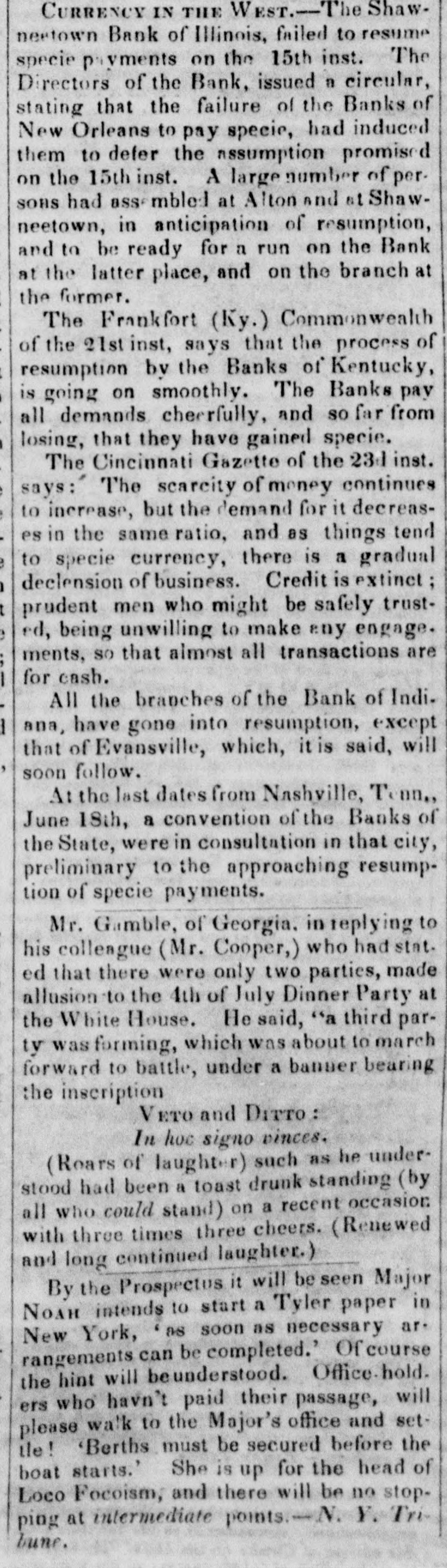
CURRENCY WEST.--The Shawneetown Bank of Illinois, failed to resume specie yments on the 15th inst. The Directors of the Bank, issued a circular, stating that the failure of the Banks of New Orleans to pay specie, had induced them to defer the assumption promised on the 15th inst. A large number of perSOHS had ass mbled at Alton and at Shawneetown, in anticipation of resumption, and to be ready for a run on the Bank at the latter place, and on the branch at the former. The Frankfort (Ky.) Commonwealth of the 21st inst, says that the process of resumption by the Banks of Kentucky, is going on smoothly. The Banks pay all demands cheerfully, and so far from losing, that they have gained specie. The Cincinnati Gazette of the 231 inst. says: The scarcity of money continues to increase, but the demand for it decreases in the same ratio, and as things tend to specie currency, there is a gradual declension of business. Credit is extinct; prudent men who might be safely trusted, being unwilling to make any engage. ments, SO that almost all transactions are for cash. All the branches of the Bank of Indi. ana, have gone into resumption, except that of Evansville, which, it is said, will soon follow. At the last dates from Nashville, Tenn., June 18th, a convention of the Banks of the State, were in consultation in that city, preliminary to the approaching resumption of specie payments. Mr. Gamble, of Georgia. in replying to his collengue (Mr. Cooper,) who had stat. ed that there were only two parties, made allusion to the 4th of July Dinner Party at the White House. He said, "a third party was forming, which was about to march forward to battle, under a banner bearing the inscription VETO and Dirro : In hoc signo vinces. (Roars of laughter) such as he understood had been a toast drunk standing (by all who could stand) on a recent occasion with three times three cheers. (Renewed and long continued laughter.) By the Prospectus it will be seen Major NOAH intends to start a Tyler paper in New York, as soon as necessary ar. rangements can be completed.' Of course the hint will beunderstood. Office.hold. ers who havn't paid their passage, will please walk to the Major's office and settle! Berths must be secured before the boat starts.' She is up for the head of Loco Focoism, and there will be no stopping at intermediate points. N. Y. Tribune.


Article from Lynchburg Virginian, July 25, 1842

Click image to open full size in new tab

Article Text

One half in 30 days, One fourth in 6 months. to The other fourth in 12 months. The certificates bear ten per cent interest. We understand that a full statement of their affairs may be expected on Monday. Crowds of interested depositors, and many more who had nothing to lose by the suspension, were in attendance during the morning, but there was. we are happy to say, no exhibition of any violence whatever. Those interested are sensible enough to know, that nothing of the kind will secure them the payment of their money, and will of course abstain from it. BANK OF ILLINOIS. The Bank of Missouri has taken out an attachment against the Bank of Illinois, at Shawneelown. and garnisheed all persons in St. Louis supp sed to be debtors to the latter Bank


Article from New-York Daily Tribune, August 12, 1842

Click image to open full size in new tab

Article Text

VOL. II. NO. 106. Shawneetown Bank-Election in Illimois, &cc. Correspondence of The Tribune. GALENA, Illinois, August 1, 1842. Absence from home and ill health must be the apology of your correspondent in the Lead Mines for his long silence. Coming hither frem my own New-England, "Clime of the brave! the high heart's home," I have been the subject of a full share of the diseases of the climate. Since I last had the pleasure of addressing you we had another severe shock in the monetary world. At that time the notes of the Bank of Illinois at Shawneetown constituted almost our entire circulation. She was to resume specie payments on the 15th of June, and the people had every confidence in her ability to resume, and in the honesty and integrity of those who controled her affairs. Every man who could get Shawnectown money thought he was safe. The miners took it freely for their mineral and many laid it by as specie funds. The mother Bank was about to establish a branch in this city, and our merchants anticipated some relief from the Eastern exchange which it was said the Bank would throw into the market. The 15th of June came, but with it, unfortunately, no resumption of specie payments by the Shawneetown Bank. The consequence was that her paper went down immediately to fifty cents on the dollar. In common withalmost every body, I was grossly deceived in the Shawneetown Bank, and I now freely confess it. Our people have been so often deceived, cheated and swindled by the Western Banks that they have very naturally lost all confidence in Bank paper. Our staple (lead) should secure to us the best currency in the country, and the principal transactions in it are now in specie. It is now dull at $2 25 per hundred, specie, which is lower than it has been for many years. This is election day in Illinois, and the contest is going on very quietly in this city. The result, as I have said in my previous letters, depends entirely upon the Southern part of the State. If Joseph Duncan runs ahead of his party among the Suckers, his chance of success will be fair. On the other hand, if be only gets the votes of the Whigs in the South he is badly beaten. In the North the Whigs will lose heavily on the vote at the Presidential election in 1840. Van Buren then carried the State by 1640 majority. The Locos in this section are united to a man on Ford and are making a vigorous rally. P. S. The polls have just been closed in this city and the vote stands for 553 411 Ford Duncan Enough has been heard from the balance of the County to render it certain that the Locos have carried the County of Joe Daviess, which gave 400 majority for Gen. Harrison. This looks badly.


Article from The New York Herald, September 24, 1842

Click image to open full size in new tab

Article Text

MONEY MARKET. Friday, Sept. 23-6 P. M. There has been generally a better feeling in the stock arket to-day, and prices have in many instances gone . Delaware & Hudson t; Mohawk 1 per cent; Harlem 1. was rumored that some interested parties had given serity to prevent the levying of a judgment on the pernal property of the Harlem Road. This is very well. will linger out a little longer. We understand that David Leavitt, Esq., the indefatigaand persevering receiver of the North American Trust has succeeded in unravelling the mysteries which rrounded that singular concern, and placed it on a more emly footing. A strong interest has been making by holders of broken Tety fund money to prevent the comptroller from reiving Bank of Lyons bills in commutation from the ety fund banks. The only demand for the broken bank Is is for that purpose. The Albany and Troy banks ld near $500,000 of that description of money, and if the mptroller decides to receive Bank of Lyons, it will probly depreciate the other money about 5 per cent. The mptroller seems to follow the law, in spite of all at mpts to bias him. The Farmers' & Mechanics' Bank of Rochester, a free nk, has received from the comptroller $20,000 of circu. ing bills, and have deposited $20,000 of New York 7 cent stock. This amount is to be increased. The operation of the new banking law is producing cu us results in promoting the circulation of individual Is. Before the creation of the joint stock banks in Lirpool, a large portion of the circulation consisted of the Is of known individuals, which circulated from hand to nd, with numerous endorsements, and were freely disunted by the private banker. Lately several individuals re have made deposits with the comptroller, and prored his endorsement to their private notes, designed to culate. They are printed in the regular form of bank tes, but read as follows :H. B. LORD, for the Farmers' Bank of Orange Counwill pay one dollar on demand to the bearer. H. B. LORD. WARWICK, August 18, 1842. Secured by pledge of public stock. The first deposite of this individual was $1000 New rk State 5's, for which he received $840. He has since posited $1000 of 5}'s additional, and again received $840, king $1680 of circulating notes. The following letter` will not be uninteresting to those our readers interested in the German trade, and imposins levied at Stade on the navigation of the Elbe. SIR -In the treaty of 1691 between Sweden and Ham rg, when Stade belonged to Sweden, it was stipulated at a duty of one sixteenth per cent. ad valorem should imposed. It is now stated that the English governent has consented to increase the duty to one-eighth per at. to the Hanoverian government, on the plea that the ncessions granted by Hanover to England in 1736 were vocable; it being held out as a threat that they would revoked if the demands of the Hanoverian government re not complied with. It is to be hoped that if the Eng government has consented to deuble the amount of ties secured by the treaty of 1691, it has also taken care render the concessions of 1736 now irrevocable. I am, yours, &c., R. W.D. llfracombe, Aug. 27, 1842. Checks of the Bank of Illinois at Shawneetown, upon Farmers' and Mechanics' Bank, Philadelphia, have en protested for non-payment, an attachment having en laid upon all the assets in that Bank belonging to the awneetown institution. n domestic exchanges there is very little doing, and no terial change in rates has taken place. They are toas follows: ORRENT RATES OF BANK NOTES AND DOMESTIC BILLS. Bank Notes. Exchange. Safety Fund 1/a