Article Text
BROADWAY BANK.
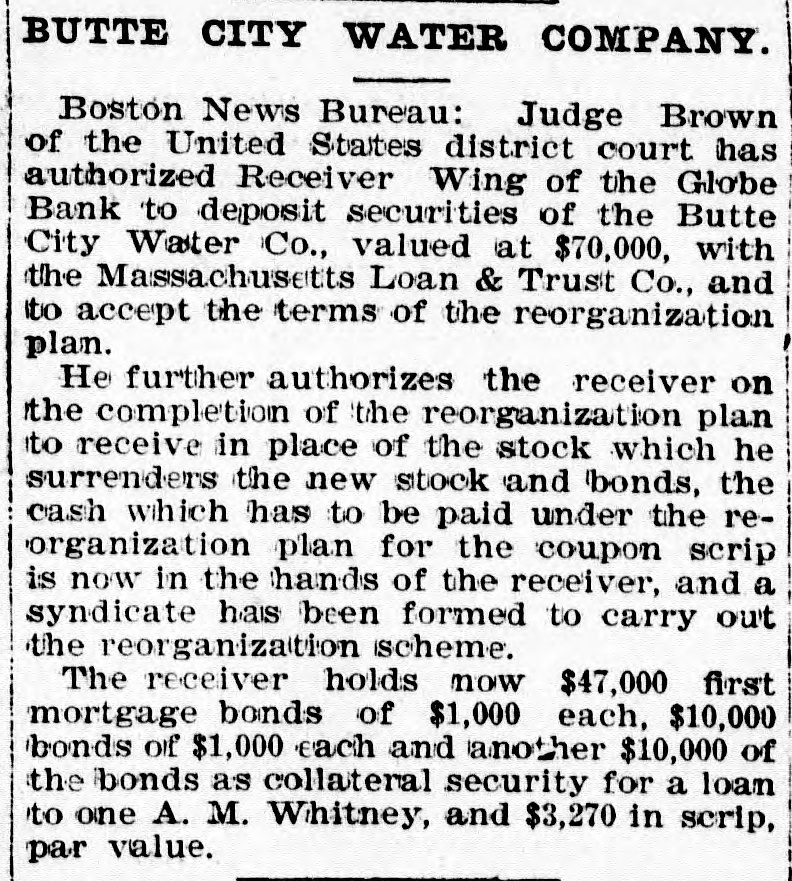
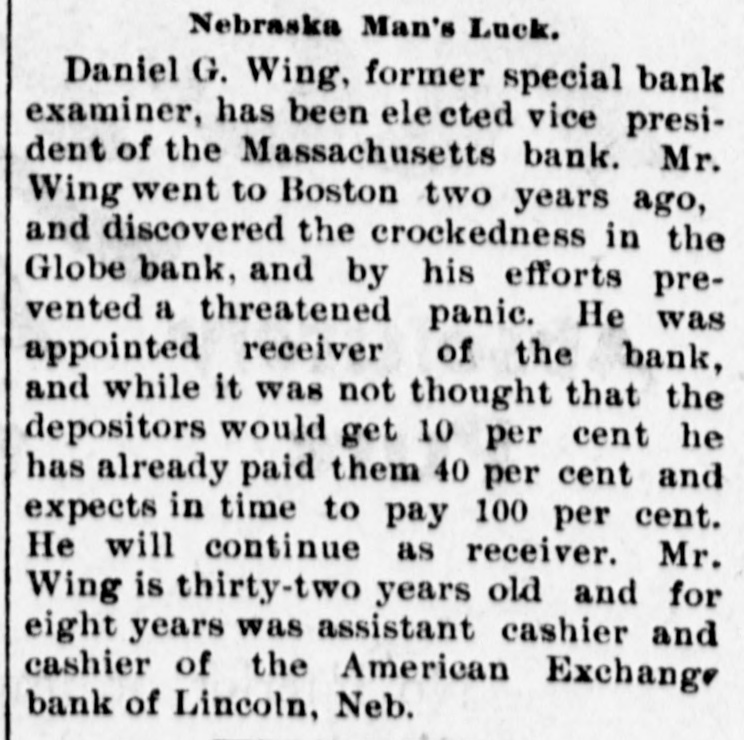
Boston, Dec. 26. There are but few developments in the banking situation, although Receiver Wing, who is in charge of both the closed institutions, the Globe and the Broadway National banks, has not paused in his work of readjusting the tangled affairs. Late yesterday he received word from Comptroller Dawes in Washington that the time limit for the reopening of the Broadway bank, which expires tonight, be extended for one week. This was good news to those who have been working assiduously toward getting the institution on its feet.
Notwithstanding numerous published interviews with prominent bankers and brokers as to the cause of the recent troubles, the general public have been much in the dark until Receiver Wing's long statement, which has in a great measure thrown light on many of the transactions in the Globe bank. Future information is looked for when ex-President Cole arrives from California and tells his side of the story, probably in the federal courts. Receiver Wing's statement follows:
"About Aug. 1 I came to Boston, under the new system inaugurated by the controller of the currency, for the special examination of banks. On Sept. 9 I found $600,000 of Globe bank checks outstanding, which did not appear on the books. Mr. Cole admitted this to be his personal loan.
"I felt to close the bank would cause not only the failure of that bank, but also, by reason of its relations to other banks, brokers and business houses, the probable failure of several important banking and business firms and individuals.
"Consequently Mr. Bigelow, who was the only director within reach, Mr. Cole and myself went to Washington, and laid the matter before the controller. Mr. Bigelow agreed to personally guarantee that Cole's shortage should be made good to the bank at once, Cole having turned over certain securities to him, and Messrs. Clark and Coolidge assisting in guaranteeing Mr. Bigelow.
"The controller of the currency directed that Mr. Cole should resign at once as president, that the whole matter should be laid before the directors, and that I should at the proper time report the facts to the district attorney.
"At this time Messrs, Coolidge and Clark were each borrowing not more than $100,000 of the bank, with plenty of securities at the then market price, and each had about $75,000 cash on deposit. Mr. Bigelow owed not more than that, and had more than enough on deposit to pay his loan.
"On the following Monday Coolidge and Clark gave Cole $80,000. Cole added $12,000 of his own money, and repaid $200,000 of the $600,000. The balance, $400,000, was repaid in three days by the sale of Cole's securities, a part being bought by Coolidge and Clark through their respective brokers.
"The bank's assets were thus bettered by $600,000 in cash. About a month later the facts, so far as known, were laid before the full board of directors, and further investigation showed that there were $300,000 more of checks outstanding not on the books, and that the indebtedness of the Lovell Arms company was really much in excess of the amount shown by the books, and that Mr. Cole was himself personally the holder of nearly $500,000 of the Lovell paper.
"There was also found an apparent overdraft of the Squires amounting to $525,000, in addition to their regular loan, which was in excess of the $100,000 limit.
"Mr. Cole admitted his responsibility for this overdraft, either to the bank or to the Squires, and turned over to the bank his own securities, including the Lovell paper owned by him, to secure the entire indebtedness, for which he admitted responsibility.
"This amounted to nearly $1,000,000, and the securities turned over, at their then market value, were considerably in excess of this amount.
"The six directors and Messrs, Coolidge and Clark then entered into a written guarantee that these securities should be sufficient to make good the Cole indebtedness.
"Mr. Stevens, who was elected president Nov. 8, the directors and Messrs. Coolidge and Clark have since then done everything in their power and made great personal sacrifices to save the bank from failure.
"The bank's assets are better off today by about $700,000 cash, over $1,000,000 of notes and securities, and the personal guarantee of these gentlemen,