Article Text
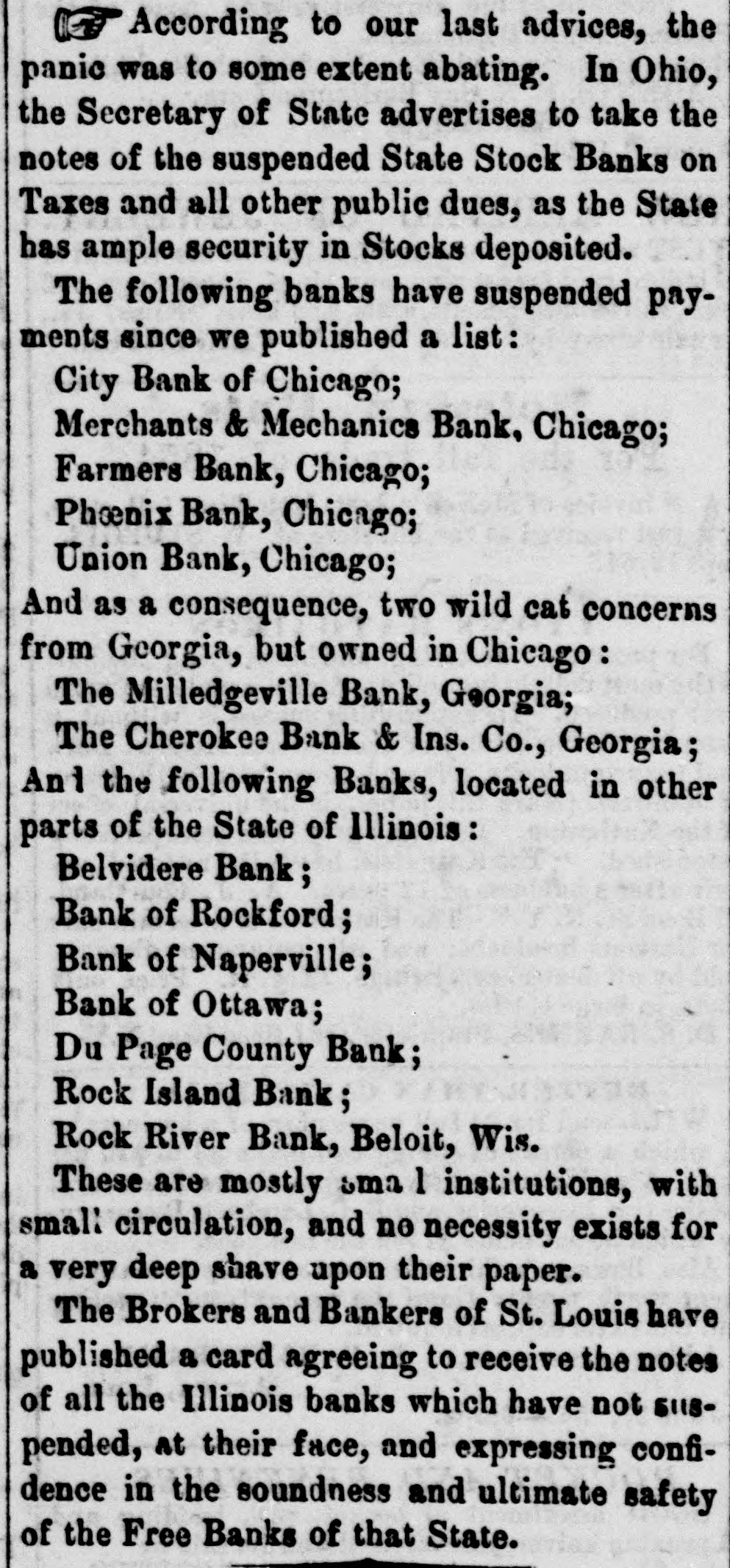
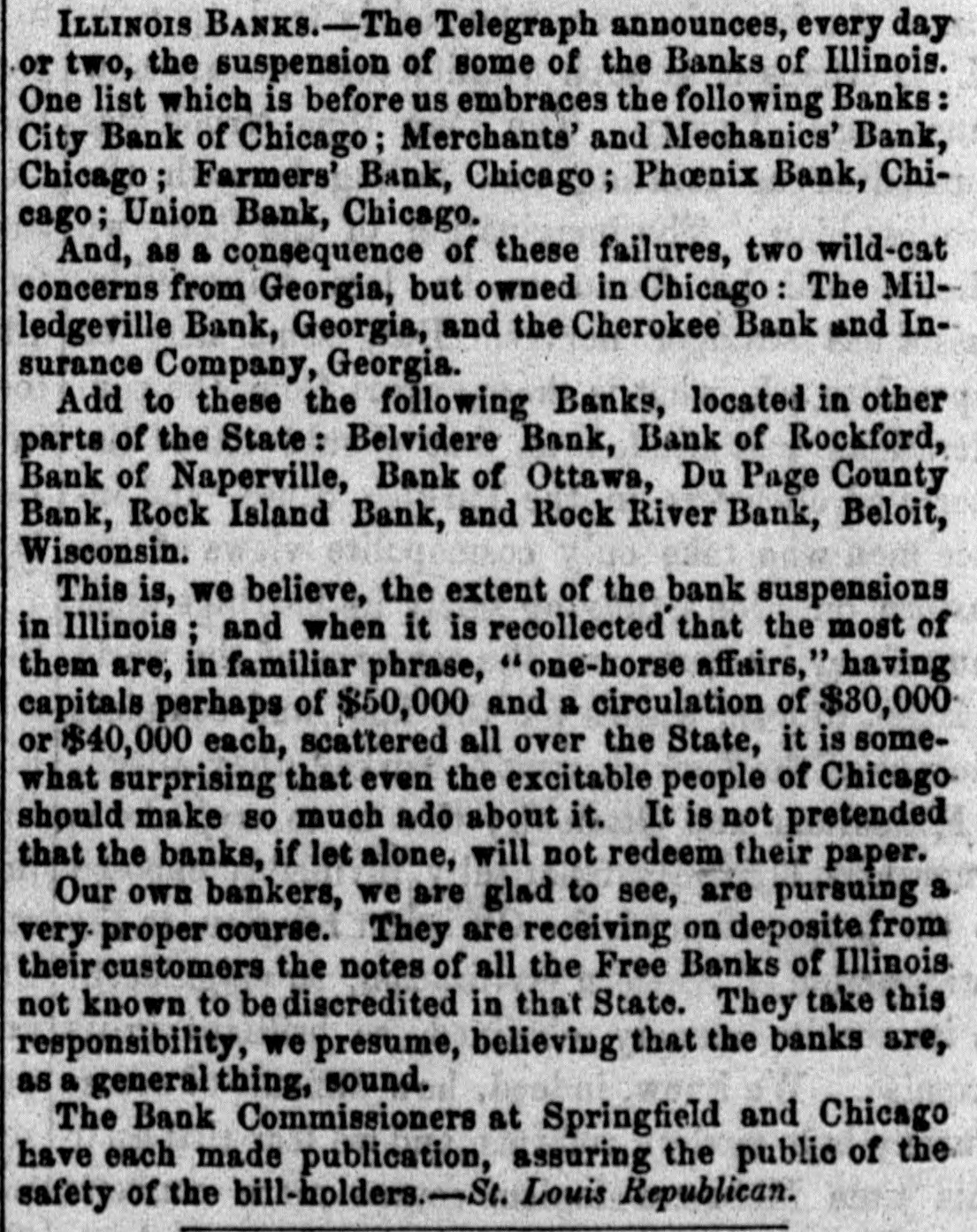
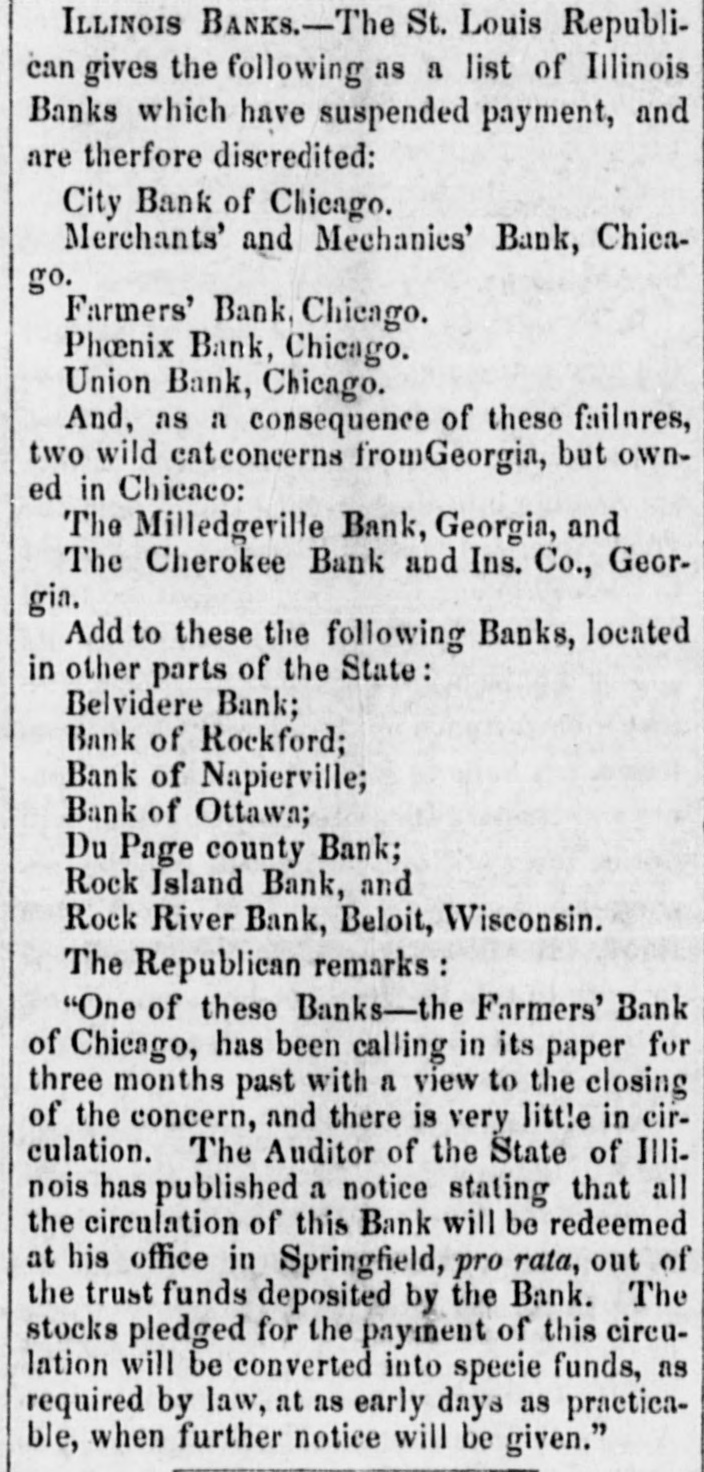
Bank Panic in Chicago, The panic, which had its origin a month or two ago in the failure of the Indiana free banks to make any definite arrangement for the redemption of their paper, and which has raged with more or less violence in Cincinnati, Cleveland, Pittsburgh, and other places ever since, finally broke out on Monday at Chicago, and threatened to carry all her banks and business men before it. The Merchants' and Mechanics' bank was the first to give way under the pressure, and with it went the Cherokee Insurance Com pany, of Dalton, Georgia, which was : shinplaster concern owned by the same bank. As soon as the fact became known the excitement grew intense about the streets, and all sorts of rumors were afloat Depositors and bill holders of other bank became uneasy, and a general rush to th banks followed, The "City bank" next elo sed its doors. and with it went down th bank of Milledgeville, Georgia, a shinplaste concern owned by that bank. The "Unior bank" of Forest, Brothers & Co., next expe rienced the effects of a run, and in a fey hours was forced to close its doors. Othe banks showedsigns of weakness, and close for a few hours, but we believe these are al the banks that have not yet resumed opera tions. With the closing of these banks came th general throwing out of the bills of th country banks with which they had connec tions by agency or otherwise, and thus th rumor was at once spread that those countr banks had also failed or suspended, Amon banks at which the finger was thus pointe were the bank of Naperville, the bank o Elgin, the Belvidere bank, Dupage Co bank, Ottawa bank, Rock Island bank, and several others, none of which, however, S far as we are advised, has failed to meet al it liabilities as presented, and the bills o which, being amply secured by state stocks are still current as any paper in the country and received by all the bankers and busines men in or out of Chicago, with a few unim portant exceptions. Indeed, a card is pub lished by nearly all the wholesale dealers in Chicago, in which they state that, seeing no just cause for the present panic in reference to the stock secured banks of the city and this state, they will continue to receive thei bills as heretofore, and the same course i again generally adopted by the bankers After diligent enquiry we cannot find that single country bank has yet suspended, and indeed, no serious run has yet been threat ened on any except in a few places immedi ately contiguous to Chicago, and there doubtless, the brokers and money shaver were at the bottom of it. The storm, however, appears to hav nearly spent itself in Chicago, and there is fair prospect of a calm, and speedy resump tion by the suspended banks. The Press o Thursday says: Yesterday, we are happy to say, ou streets were quiet. So far as we could lear the run on the Banks is over, and unles some new cause of alarm should arise, w have reason to hope the crisis is passed Business is moving along as usual, and seems to have returned to its original chan nels. It gives us great pleasure to say that w were assured last evening by one of the pro prictors of the City Bank, that they expec to resume business on Tuesday next. W also heard, but not officially, that the Unio Bank will resume in a few days. The directors of the Merchants and Mo chanic's Bank also publish a card this morn ing, which looks to the early resumption ( business. These facts will tend to strength en public confidence. With the resumption of these banks, ( course the Georgia money, for which the are responsible, will again become good, S that persons holding Milledgeville, Chere kee, &c., should by no means dispose of at present at the loss of a cent. It wi doubtless be all current again in a week, an the same patience which it is most profitabl to exercise in reference to our own bank will be found most profitable in reference t the Georgia banks. But when this foreig stuff does again become good, it will un doubtedly be the wisest course to exchang it as fast as possible for our own state cur rency, which we know to be safe.