
4529. La Salle Street Trust & Savings Bank (Chicago, IL)

Bank Information

Episode Type
Suspension → Closure
Bank Type
savings bank
Start Date
*
Location
Chicago, Illinois (41.850, -87.650)

Metadata

Model
gpt-5-mini
Short Digest
4b0d6133

Response Measures

None

Description

Articles describe the La Salle Street Trust & Savings Bank being closed by the state auditor (failed) with assets insufficient by about $2,000,000; a receiver brought suit against Central Trust Co. for providing dummy capital. No article describes a depositor run; this is a suspension/closure due to bank-specific insolvency and improper capitalization.

Events (2)

1. * Receivership
Newspaper Excerpt
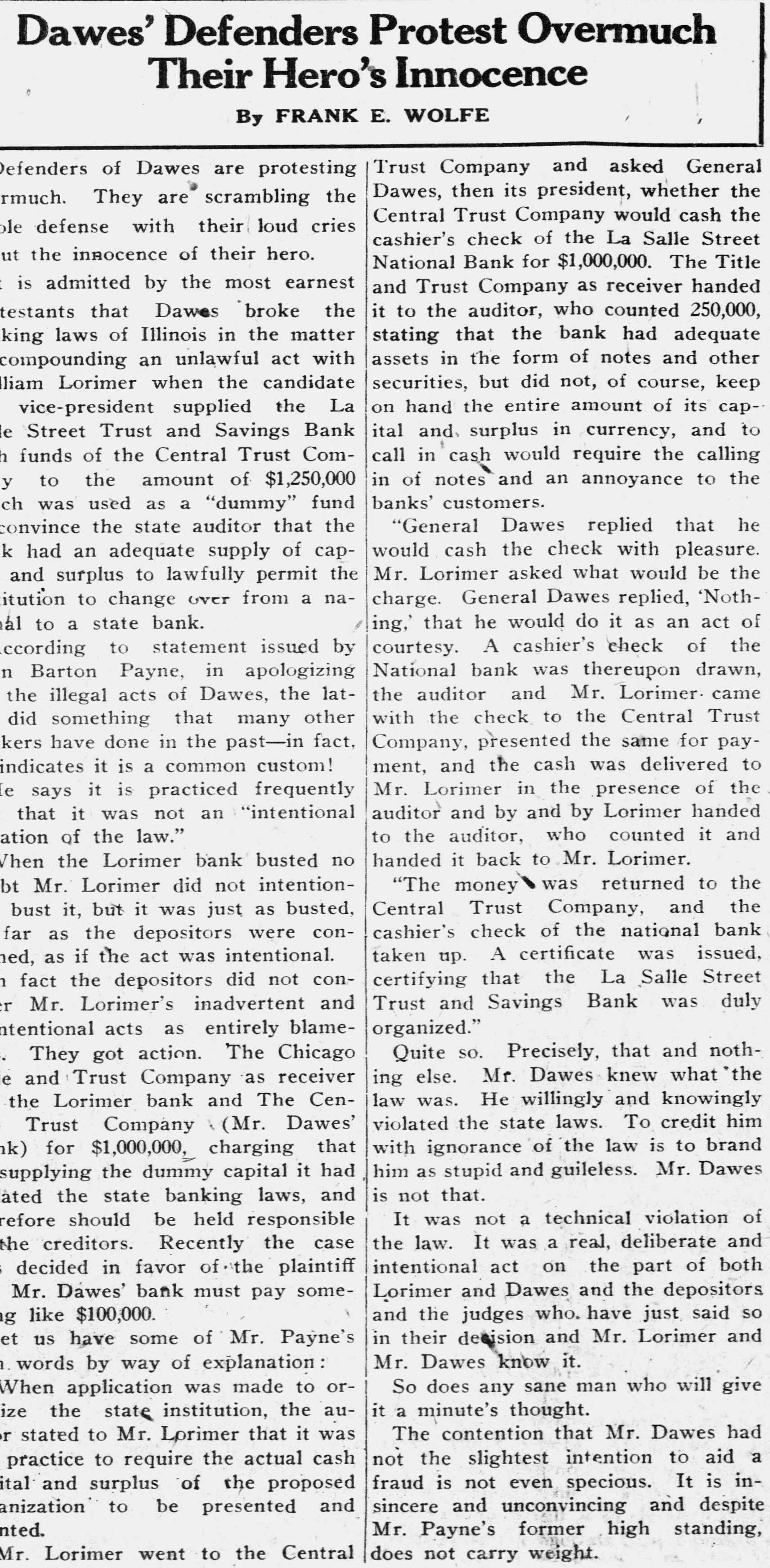
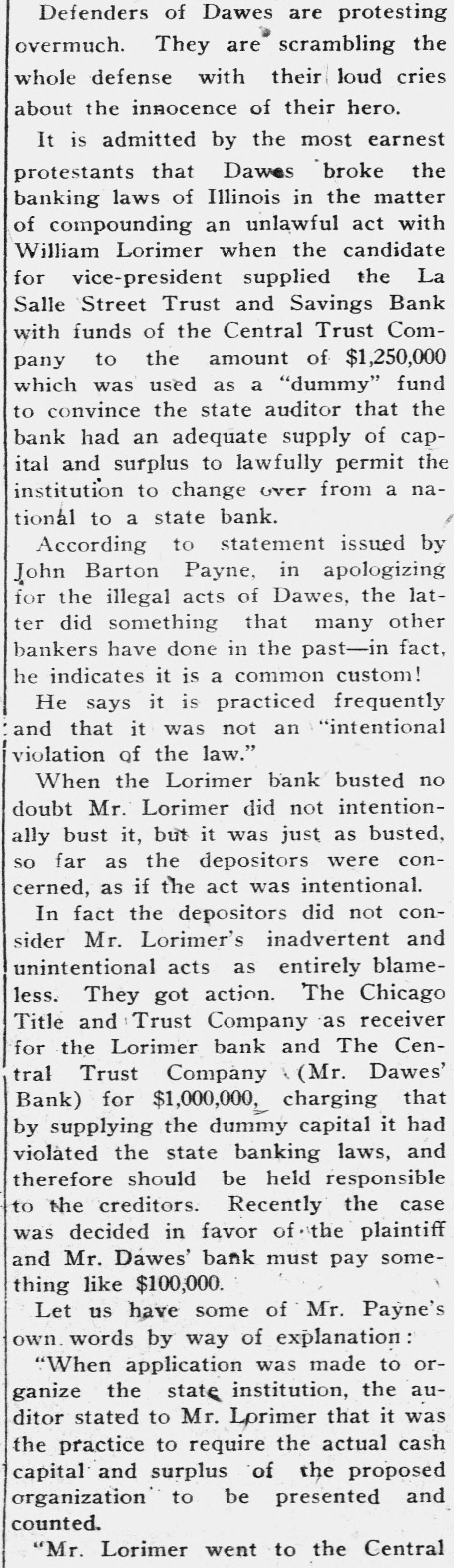
The Chicago Title and Trust Company as receiver for the Lorimer bank and The Central Trust Company (Mr. Dawes' Bank) for $1,000,000, charging that by supplying the dummy capital it had violated the state banking laws, and therefore should be held responsible to the creditors. Recently the case was decided in favor of the plaintiff and Mr. Dawes' bank must pay something like $100,000.
Source
newspapers
2. * Suspension
Cause
Bank Specific Adverse Info
Cause Details
Bank was undercapitalized/insolvent (assets insufficient by about $2,000,000) and had used dummy cash to appear properly capitalized when organized.
Newspaper Excerpt
When the La Salle Street Trust & Savings bank was closed by the state auditor, as it was two years later, with assets insufficient by $2,000,000 to meet the claims of depositors and creditors the receiver brought suit against the Central Trust Co.
Source
newspapers

Newspaper Articles (3)

Article from Twin City Review, October 3, 1924

Click image to open full size in new tab

Article Text

eth to his own hurt yet changeth not.' When his part in the Lorimer bank incident is cited, as it is eited by the State Federation of Labor, Mr. Dawes might truthfully say, "I still continue to stand for and by the courts though I haven't fared particularly well at their hands." For the rest the incident is not to Mr. Dawes' credit. The facts as stated in the declaration adopted by the state federation are correct. It contains the thought, if not the language of the supreme court. What the Central Trust Co., Mr. Dawes' bank did, was o furnish William Horace Lorimer $1,250,000 which was counted by a state bank examiner as the property of the La Salle Street Trust and Savings bank which Lorimer organized when his La Salle Street National bank was going on the rocks. The law requires that to begin business a state bank must have capital stock and surplus on hand with no liabilities. Mr. Lorimer did not have the money to he resorted to the simple expedient of getting it from Mr. Dawes, Taking with him Rife, the bank examiner r the state auditor and one of the directors of the new institution Lorimer, went to the Central Trust company. The supreme court record tells the rest: There $1,250,000 in currency was delivered to Lorimer by the cashier of the Central Trust Co. Rife counted the money and returned it to Lorimer together with the auditor's certificate authorizing the trust and savings bank to commence business as a bank. Lorimer handed the money back to the cashier, who returned the enshier's check, indorsed by the Cen. ral Trust Co. without recourse. When the La Salle Street Trust & Savings bank was closed by the state auditor, as it was two years later, with assets insufficient by $2,000,000 o meet the claims of depositors and creditors the receiver brought suit gainst the Central Trust Co., Mr. Dawes' bank, on the grounds that it ad received funds belonging to the lefunct institution and retined them without authority of law. The case went to the circuit court which found the Central Trust Co. lable to the amount of $1,487,854.16. The defense set un the plea that the whole transaction was done and carred out by William R. Dawes, casher of the Trust company under the authority and direction of Charles G. Dawes without the knowledge of the oard of directors and that the acts lone by them, the Daweses, were be ond their authority. The Supreme court took a different iew, and held the Trust company responsible. It swept away the technial defense that the auditor had counted the money and had satisfied himesif that it was all there, the drily remarking that "of agent was there to satisfy pinion course, rought the auditor's himself that not here was that much money in some ank in Chicago, and of course noody thought so.' However, the supreme court held hat the Central Trust Co. was only iable for the amount to which the capital stock of the National bank vas impaired at the time of the transer to the state bank and the case vent to a master in chancery for a determination of the value of assets. The only possible moral defense hat Mr. Dawes could offer was that e did not know the law of the state, i plea that the court said was immaterial, or that he did not know the it condition of the Lorimer bank, and would be a libel on Mr. Dawes ability as a banker to say that he did lot know what everybody knew. can be of fascism harge Mr. Dawes which relieved him. the of state His the federation brings against mniute men's" organization was, as e explained it, an attempt by nonartizan effort to get good men into unions conceived it to be in to establish open ffice. attempt The the disclaimed. shop, thing which Mr. Dawes i Dawes enjoys no As a candidate munities. But Mr. reciting special he must im- the attacks, and in fedbank incident the Lorimer expect vulnerable state ration has hit him in a return Decatur Herald.
Article from The Connecticut Labor News, October 25, 1924

Click image to open full size in new tab

Article Text

Dawes' Defenders Protest Overmuch Their Hero's Innocence By FRANK E. WOLFE Trust Company and asked General Defenders of Dawes are protesting Dawes, then its president, whether the rmuch. They are scrambling the Central Trust Company would cash the ole defense with their loud cries cashier's check of the La Salle Street ut the innocence of their hero. National Bank for $1,000,000. The Title : is admitted by the most earnest and Trust Company as receiver handed testants that Dawes broke the it to the auditor, who counted 250,000, stating that the bank had adequate king laws of Illinois in the matter assets in the form of notes and other compounding an unlawful act with lliam Lorimer when the candidate securities, but did not, of course, keep on hand the entire amount of its capvice-president supplied the La ital and surplus in currency, and to le Street Trust and Savings Bank h funds of the Central Trust Comcall in cash would require the calling in of notes and an annoyance to the y to the amount of $1,250,000 banks' customers. ch was used as a "dummy" fund convince the state auditor that the "General Dawes replied that he would cash the check with pleasure. k had an adequate supply of capMr. Lorimer asked what would be the and surplus to lawfully permit the itution to change over from a nacharge. General Dawes replied, "Nothal to a state bank. ing," that he would do it as an act of courtesy. A cashier's check of the according to statement issued by National bank was thereupon drawn, n Barton Payne, in apologizing the auditor and Mr. Lorimer- came the illegal acts of Dawes, the latwith the check to the Central Trust did something that many other Company, presented the same for paykers have done in the past-in fact, indicates it is a common custom! ment, and the cash was delivered to Mr. Lorimer in the presence of the le says it is practiced frequently that it was not an "intentional auditor and by and by Lorimer handed to the auditor, who counted it and ation of the law." handed it back to Mr. Lorimer. Vhen the Lorimer bank busted no bt Mr. Lorimer did not intention"The money was returned to the Central Trust Company, and the bust it, but it was just as busted, cashier's check of the national bank far as the depositors were contaken up. A certificate was issued, ed, as if the act was intentional. certifying that the La Salle Street h fact the depositors did not conr Mr. Lorimer's inadvertent and Trust and Savings Bank was duly organized." Intentional acts as entirely blameQuite so. Precisely, that and noth. They got action. The Chicago ing else. Mr. Dawes knew what the e and Trust Company as receiver the Lorimer bank and The Cenlaw was. He willingly and knowingly violated the state laws. To credit him Trust Company (Mr. Dawes' with ignorance of the law is to brand k) for $1,000,000, charging that him as stupid and guileless. Mr. Dawes supplying the dummy capital it had is not that. lated the state banking laws, and It was not a technical violation of refore should be held responsible the law. It was a real, deliberate and the creditors. Recently the case intentional act on the part of both I decided in favor of the plaintiff Lorimer and Dawes and the depositors Mr. Dawes' bank must pay someand the judges who. have just, said so g like $100,000. in their decision and Mr. Lorimer and et us have some of Mr. Payne's Mr. Dawes know it. 1. words by way of explanation So does any sane man who will give When application was made to orit a minute's thought. ize the state institution, the auThe contention that Mr. Dawes had r stated to Mr. Lorimer that it was not the slightest intention to aid a practice to require the actual cash fraud is not even specious. It is inital and surplus of the proposed sincere and unconvincing and despite anization to be presented and nted. Mr. Payne's former high standing, Mr. Lorimer went to the Central does not carry weight.


Article from The Connecticut Labor News, October 25, 1924

Click image to open full size in new tab

Article Text

Defenders of Dawes are protesting overmuch. They are scrambling the whole defense with their loud cries about the innocence of their hero. It is admitted by the most earnest protestants that Dawes broke the banking laws of Illinois in the matter of compounding an unlawful act with William Lorimer when the candidate for vice-president supplied the La Salle Street Trust and Savings Bank with funds of the Central Trust Company to the amount of $1,250,000 which was used as a "dummy" fund to convince the state auditor that the bank had an adequate supply of capital and surplus to lawfully permit the institution to change over from a national to a state bank. According to statement issued by John Barton Payne, in apologizing for the illegal acts of Dawes, the latter did something that many other bankers have done in the past-in fact, he indicates it is a common custom! He says it is practiced frequently and that it was not an "intentional violation of the law." When the Lorimer bank busted no doubt Mr. Lorimer did not intentionally bust it, but it was just as busted, SO far as the depositors were concerned, as if the act was intentional. In fact the depositors did not consider Mr. Lorimer's inadvertent and unintentional acts as entirely blameless. They got action. The Chicago Title and Trust Company as receiver for the Lorimer bank and The Central Trust Company i (Mr. Dawes' Bank) for $1,000,000, charging that by supplying the dummy capital it had violated the state banking laws, and therefore should be held responsible to the creditors. Recently the case was decided in favor of the plaintiff and Mr. Dawes' bank must pay something like $100,000. Let us have some of Mr. Payne's own. words by way of explanation : "When application was made to organize the state institution, the auditor stated to Mr. Lprimer that it was the practice to require the actual cash capital and surplus of the proposed organization to be presented and counted. "Mr. Lorimer went to the Central