
Farmers State Bank (Arkansas City, KS)

Episode Information

Episode UID
4511706591215
Episode Type
Run β†’ Suspension β†’ Unsure
Bank Type
state
Bank ID
451170659 hash
Start Date
March 15, 1901
Location
Arkansas City, Kansas (37.062, -97.038)

Metadata

Model
gpt-5-mini (chosen from majority vote of a three-model LLM ensemble)
Short Digest
ac7fa35ee132d752

Response Measures

None

Description

A run in March 1901 is clear; later (1912) articles mention a receiver, but the link/ timing between the 1901 run and ultimate receivership is not established in these clippings.

Events (3)

1. March 15, 1901 Run
Cause
Bank Specific Adverse Info
Cause Details
Withdrawals triggered by discovery that a Niles, Mich. cashier/stockholder (Johnson) disappeared and the bank held his notes, causing depositor alarm.
Measures
Bank obtained $90,000 in currency and provided funds to meet depositor demands; depositors were calmed.
Newspaper Excerpt
The Farmers' State Bank of Arkansas City, in which there has been a run, has received $90,000 in currency and the depositors are quieting down.
Source
newspapers
2. March 21, 1901 Run
Cause
Bank Specific Adverse Info
Cause Details
Withdrawals directly linked to the disappearance of a stockholder/cashier whose notes the bank held.
Measures
Funds provided for emergency demands; all depositor demands were met.
Newspaper Excerpt
The disappearance of Cashier Johnson ... who was a stockholder in the Farmers' State bank of Arkansas City, and whose notes that bank held, caused excitement at Arkansas City which culminated in the withdrawal of deposits.
Source
newspapers
3. February 1, 1912 Receivership
Newspaper Excerpt
The suit brought by the receiver of the Farmers' State Bank of Arkansas City, Kas., against a New York insurance company ... relating to cashier George A. Kimmel who disappeared in 1898 was to be tried in St. Louis next week.
Source
newspapers

Newspaper Articles (4)

Article from The Wichita Daily Eagle, March 15, 1901

Click image to open full size in new tab

Article Text

ALONG THE KANSAS NILE. Kansas has 187 rural mail routes. Missouri has only eighty-one. Harry Richter, lieutenant governor, says that public life doesn't pay. So far Crazy Carrie hasn't done a thing that anyone expected her to do. A Boston paper points out that Kansas has been unsettled ever since it was settled. The coming report of the state labor commissioner will contain the milling statistics of Kansas. Topeka this spring is to vote $70,000 bonds to buy grounds for the addition to the Santa Fe shops. There is talk of making a Populist the third member of the railroad commission, instead of a Democrat. Ex-Lieutenant Governor Harvey would not take the Democratic nomination for judge of the city court at Topeka. Senator Baker will resume the practice of law in Leavenworth, his son, E. B. Baker, being associated with him. The horrible charge is made against both candidates for mayor in Atchison that they can tell beer from cold tea. R. E. Eckert, a man who was taking orders in Bourbon county for a Louisville liquor house, has been arrested and sent to jail. The business men of Arkansas City have put up for mayor Frank J. Hess, the present mayor, who believes in a liberal policy. The Order of Select Friends, with headquarters at Fort Scott, a Kansas Insurance order, has quit business. The death rate was too high. The Farmers' State Bank of Arkansas City, in which there has been a run, has received $90,000 in currency and the depositors are quieting down. Henry Thurber, formerly private secretary to President Cleveland, is behind a projected railroad from Hutchinson to the coal fields of the Indian territory. The Democrats of Kansas have already begun to urge the re-election of Senator Harris. F. Dumont Smith, of Kinsley, has decided to break into the senatorial contest of 1902. Crazy Carrie will probably end up in Topeka by socking an ax into a pulpit or two. When it comes to hating, Carrie, when stirred up, can hate a preacher worse than anybody else in the world. Jim Orr has been nominated by the Democrats of Atchison for mayor against Donald, the Republican candidate. The fight is expected to be lively, as It is as complicated as the second hour in a game of champion chess. A grape-vine from Washington says that President McKinley recently said to Senator Burton: "Are there any more men in Kansas like Bristow? I want as many men like him connected with my administration as I can get." This was the parting shot Crazy Carrie gave the Home Defenders: "Oh, I know a pack of traitors when I see 'em. Where's my hat? F'll leave. The Lord will look after you hypocrites. The devil is laughing in his sleeve right now The Lord's work don't need any help from you." Mrs. H. C. Fleisher, a guest at a hotel in Arkansas City, recently by mistake took too much morphine. She was saved, but continued very fill and finally in a fit of vomiting threw up a small cork, which had evidently come from a two ounce bottle. She doesn't know when she swallowed it. "Jesse Powell, an old soldier. living In the southeast part of town," says the Emporia Gazette, "once threw William McKinley down when they were boys. Mr. Powell is now about 70 years old. When about 17, he worked on the farm of the father of the president. He did all kinds of hard work by the side of young BIL When = boy, Mr. McKinley was as good a worker as I ever knew, Mr. Powell said this morning. Think of seeing our president cutting weeds, pitchthe hay, plowing corn. chopping wood and doing such labor as the fathers of this country have all done, more or leas. Willie McKinley had a sister, Mins Hattie, and every Sunday Hattle and Jesse Powell went to church together. also to parties and taffy pulla Some people do not know that McKloley was relsed on & farm: but be was His father owned & good farm just actoss the river from Vanceburg, K. Hattle and Juste and Willie called each other W their given names, and were the best of friends. On Sundays. sometimes Jesse and William

Article from Hutchinson Gazette, March 21, 1901

Click image to open full size in new tab

Article Text

KANSAS ITEMS OF INTEREST. Helen Gould is expected to attend the Ottawa Chautauqua assembly. Independence now has two gas companies; the second having been given a franchise. Senator Baker resumes the practice of law in Leavenworth with his son as partner. W. B. Bird, of Topeka, succeeds W. L. Holcomb as clerk of the State Labor commissioner. "Fort Riley day" is one of the drawing cards for the A. R. encampment at Junction City, Daniel Jones, of Preston, was frozen to death on the prairie during the recent blizzard. E. A. Runyan has been acquitted of the charge of wrecking the state bank of Yates Center. Many students at the state normal school have smallpox. There are lifty cases in Lyon county. S.D. Whittington, of Kincaid, was recently killed by lightning. He left $30,000 life insurance. Judge Smart fined and committed a Garnett witness in a liquor trial because he couldn't remember. During the coal famine which prevailed a short time in Western Kansas cow chips were at a premium. The schools at Weir were joints, City ordered and closed churches until April on account of smallpox. President Stillwell, of the Orient railway, is going to Europe to place securities of his railway system. Mrs. Carry Liseomb, of Flint, Mich. is towns in Kansas visiting the Maccabees. instituting lodges of the Sisters of Pat Coney is at his home in Topeka and is almost blind from the effects of an explosion in his zine mime in Mis. souri. is made that fishermen are Kansas streams sweeping Complaint of which their fish, regardless of the new law prohibits seining. William Wykes. a prominent citizen near Caldwell, is was an but living Englishman had dead. lived in He Kan. sas 30 yeara. 6The anti-fusion election law is not in force until published in the statute books, and therefore does not apply to spring elections. Ellsworth Kelly, county school su. perintendent of Woodson county, writes stories for the Youth's Companion and McClure's. Under a new law city city clerks cannot refuse to allow registration books to be copied by representatives of political organizations A party of women have deetroyed one of the finest furnished saloons in Armourdale Guards were quickly in front of the other saloons. A passenger train on the Leavenworth, Kansas & Western was ditched Soldier and were Leo near injured: Chadwick, eleven passengers superintendent of bridges and buildings, being the most seriously hurt. The express car caught fire. General J. K. Hudson gave the industrial institute a library of 350 volis an and a umes. organized It by institution William of R. his Carter, planned negro, for the benefit race. General Hudson has felt kindly to colored people since his service as major in a colored regiment in the civil war. The trial of Miss Jessie Morrison is continued until the June term of the district court in El Dorado upon request of the state, for the reason that there would not be sufficient time for the trial at this term. which is limited to four weeks. A visitor to Nortonville one day was surprised to see the people of the town engaged in cleaning the park near the Santa Fe depot. Everybody was workwith was the result of of ing enthusiasm. newspaper work This for unity effort to beautify the town. Twenty-five men are employed in the freight department of the Wichita San1a Fe depot for the sole purpose of loading and unloading cars. The disappearance of Cashier John. son. of the bank at Niles, Mich., who was a stockholder in the Farmers' State bank of Arkansas City, and whose notes that bank held, caused excitement at Arkansas City which eulminated in the withdrawal of deposits. The depositors were met coolly, funds having been provided for such an emergency, and all of their demands were met. Postmaster William Drumpiller, of Logan, was killed in a railroad wreck between Washington and New York. ahadhoonto


Article from The Calumet News, February 1, 1912

Click image to open full size in new tab

Article Text

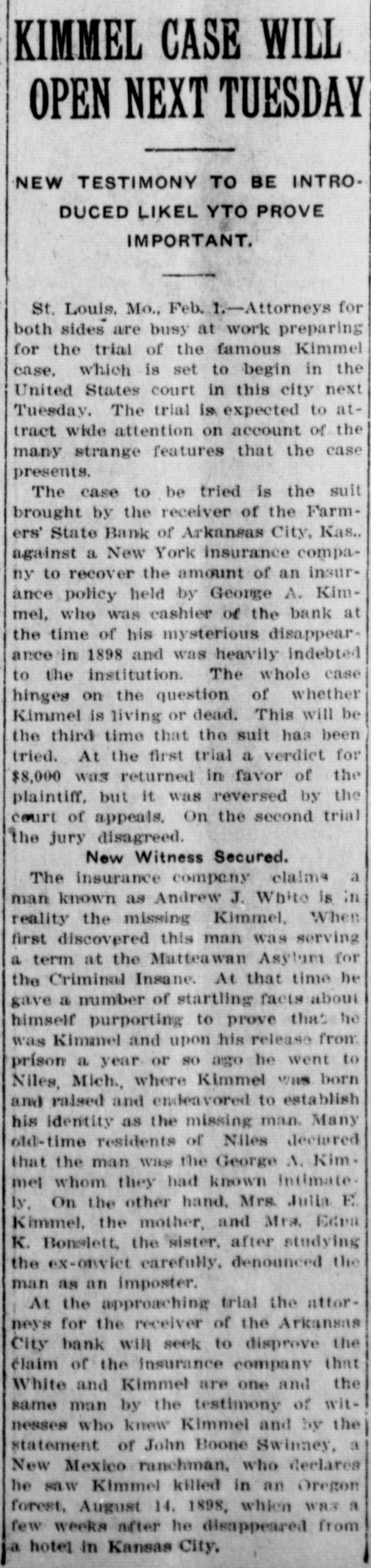
# KIMMEL CASE WILL # OPEN NEXT TUESDAY NEW TESTIMONY TO BE INTRO- DUCED LIKEL YTO PROVE IMPORTANT. St. Louis, Mo., Feb. 1.β€”Attorneys for both sides are busy at work preparing for the trial of the famous Kimmel case, which is set to begin in the United States court in this city next Tuesday. The trial is expected to at- tract wide attention on account of the many strange features that the case presents. The case to be tried is the suit brought by the receiver of the Farm- ers' State Bank of Arkansas City, Kas., against a New York insurance compa- ny to recover the amount of an insur- ance policy held by George A. Kim- mel, who was cashier of the bank at the time of his mysterious disappear- ance in 1898 and was heavily indebted to the institution. The whole case hinges on the question of whether Kimmel is living or dead. This will be the third time that the suit has been tried. At the first trial a verdict for $8,000 was returned in favor of the plaintiff, but it was reversed by the court of appeals. On the second trial the jury disagreed. New Witness Secured. The insurance company claims a man known as Andrew J. White is in reality the missing Kimmel. When first discovered this man was serving a term at the Matteawan AsylarΔ± for the Criminal Insane. At that time he gave a number of startling facts about himself purporting to prove that he was Kimmel and upon his release from prison a year or so ago he went to Niles, Mich., where Kimmel was born and raised and endeavored to establish his identity as the missing man. Many old-time residents of Niles deciored that the man was the George A. Kim- met whom they had known intimate- ly. On the other hand, Mrs. Julia E Kimmel, the mother, and Mrs. Edra K. Bonslett, the sister, after studying the ex-onvict carefully, denounced the man as an imposter. At the approaching trial the attor- neys for the receiver of the Arkansas City bank will seek to disprove the claim of the insurance company that White and Kimmel are one and the same man by the testimony of wit- nesses who knew Kimmel and by the statement of John Boone Swinney, a New Mexico ranchman, who declares he saw Kimmel killed in an Oregon forest, August 14. 1898, which was a few weeks after he disappeared from a hotel in Kansas City.


Article from The Washington Times, February 1, 1912

Click image to open full size in new tab

Article Text

# KIMMEL TRIAL TO BE HEARD AGAIN TO END MYSTERY Strange Case of Cashier Who Disappeared Attracts Attention. ST. LOUIS, Feb. 1.-Attorneys for both sides are busy at work prepar-ing for the trial of the famous Kimmel case, which is set to begin in the United States court in this city next Tuesday. The trial is expected to attract wide attention on account of the many strange features that the case presents. The case to be tried is the suit brought by the receiver of the Farmers' State Bank of Arkansas City, Kan., against a New York insurance company to re-cover the amount of an insurance policy held by George A. Kimmel, who was cashier of the bank at the time of his