Article Text
THE CRISIS IS PASSED
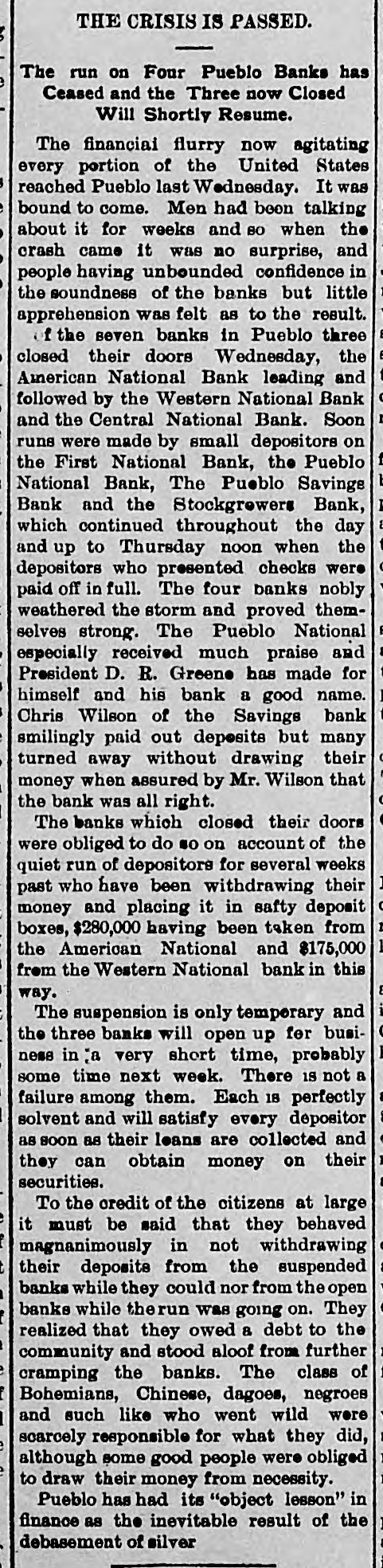
The run on Four Pueblo Banks has Ceased and the Three now Closed Will Shortly Resume. The financial flurry now agitating every portion of the United States reached Pueblo last Wednesday. It was bound to come. Men had been talking about it for weeks and BO when the crash came it was no surprise, and people having unbounded confidence in the soundness of the banks but little apprehension was felt as to the result. of the seven banks in Pueblo three closed their doors Wednesday, the American National Bank leading and followed by the Western National Bank and the Central National Bank. Soon runs were made by small depositors on the First National Bank, the Pueblo National Bank, The Pueblo Savings Bank and the Stockgrowers Bank, which continued throughout the day and up to Thursday noon when the depositors who presented checks were paid off in full. The four banks nobly weathered the storm and proved themselves strong. The Pueblo National especially received much praise and President D. R. Greene has made for himself and his bank a good name. Chris Wilson of the Savings bank smilingly paid out deposits but many turned away without drawing their money when assured by Mr. Wilson that the bank was all right. The banks which closed their doors were obliged to do so on account of the quiet run of depositors for several weeks past who have been withdrawing their money and placing it in safty deposit boxes, $280,000 having been taken from the American National and $175,000 from the Western National bank in this way. The suspension is only temporary and the three banks will open up for business in a very short time, probably some time next week. There is not a failure among them. Each 18 perfectly solvent and will satisfy every depositor as soon as their loans are collected and they can obtain money on their securities. To the credit of the citizens at large it must be said that they behaved magnanimously in not withdrawing their deposits from the suspended banks while they could nor from the open banks while therun was going on. They realized that they owed a debt to the community and stood aloof from further cramping the banks. The class of Bohemians, Chinese, dagoes, negroes and such like who went wild were scarcely responsible for what they did, although some good people were obliged to draw their money from necessity. Pueblo has had its "object lesson" in finance as the inevitable result of the debasement of silver