First National Bank (Ticonderoga, NY)

Episode Information

Episode UID
449101121
Episode Type
Run Only
Bank Type
national
Bank ID
44910 national
Charter Number
4491
Start Date
May 21, 1893
Location
Ticonderoga, New York

Metadata

Model
gpt-5-mini (chosen from majority vote of a three-model LLM ensemble)
Short Digest
a62a79b6ec9ae1b8

Response Measures

None

Events (3)

1. December 26, 1890 Chartered
Source
historical_nic
2. May 21, 1893 Run
Cause
Local Banks
Cause Details
Failures of Hemmond, Bush & Co. and the Vermont Investment and Guarantee Company precipitated withdrawals; a principal investor (C. E. Bush) was linked to both firms and the bank.
Newspaper Excerpt
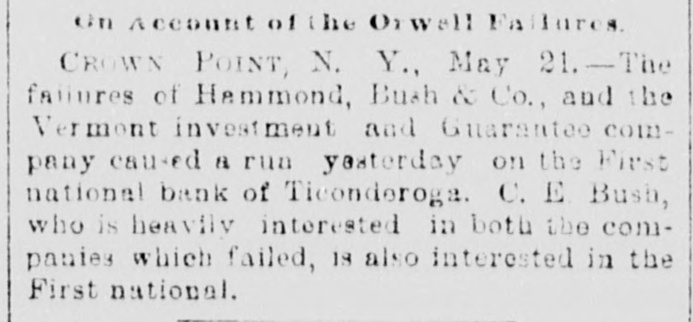
The failures of Hemmond, Bush & Co., and the Vermont Investment and Guarantee company caused a run yesterday on the First national bank of Ticonderoga.
Source
newspapers
3. December 16, 1910 Voluntary Liquidation
Source
historical_nic

Newspaper Articles (2)

Article from Burlington Weekly Free Press, May 25, 1893

Click image to open full size in new tab

Article Text

on Account of he O well Failures CROWN POINT, N. Y., May 21. - The failures of Hemmond, Bush & Co., and the Vermont investment and Guarantee company caused a run yasterday on the First national bank of Ticonderoga. C. E Bush, who is heavilv interested in both the compaules which failed, 18 also interested in the First national.


Article from The Birmingham Age-Herald, March 12, 1908

Click image to open full size in new tab

Article Text

FINANCIAL BILL HOTLY DENOUNCED Senator Clarke of Arkansas Hits Several Fierce Blows ALDRICH ATTEMPTS REPLY Investigation of Causes of the Panic Is Demanded by Senator Clarke, Who Also Denounces New York Stock Exchange. Washington, March 11.-Senator Clarke of Arkansas denounced the pending currency bill in a speech in the Senate today, declaring that no currency legislation should be enacted until an investigation is held as to the causes of the panic. "No such legislation is necessary now, said Mr. Clarke. "It is not only not necesI sary, but it may become dangerous. am not disposed to tolerate the idea of giving any support to the committee bill, nor the substitute proposed by the minority members of the Senate." If emergency currency is to be provided, Mr. Clarke said, the benefits should be extended all persons whose legitimate business demands cause them to need it. Mr. Clarke denounced the operations of stock exchanges and said the American people would not be satisfied with the proposed currency legislation without a complete knowledge of causes of the panic. "The time has arrived," he said, "when the affairs of the New .York stock exchange and other stock exchanges must be looked into." Mr. Clarke's reference to the stoppage of the payments by the New York banks called Mr. Aldrich to his feet with the remark that he did not believe the people would permit that course again to be pursued. "I trust the senator from Rhode Island as a historian," retorted Mr. Clarke, "but I do not trust him as a prophet." Mr. Clarke expressed the opinion that the majority would not pass the bill allowing the emergency circulation to be retired without limitation. Mr. Clarke said he would not only require a restriction of reserves, but he would deny to a national bank the right to pay interest on checking accounts. Senator Nelson suggested that the national banks should pay interest on the $250,000,000 of government deposits. Mr. Aldrich said that five years ago he had introduced a bill providing for the payment of interest on such deposits at the rate of 1 1/2 per cent, but, he added, senators had opposed that bill on the ground that it changed the nature of the loan. Former Senator Spooner and the late Senator Morgan, he said, opposed the bill. If that objection could be overcome he declared his willingness to again bring in such a measure. He did not know any reason unless it should be a legal one, of the kind suggested, why interest should not be charged on these deposits. Mr. Culberson, he said, had introduced a bill to require payment of interest on government deposits and it was now before the committee on finance. Mr. Bailey spoke at some length suggesting that the main purpose of his substitute was to favor the principle of government money instead of bank money He explained that he had provided for a distribution of the emergency currency in accordance with population, although he realized that business necessity was a greater measure of the amount they should have. But it was not possible to make sure of the business needs of the several sections and it was a simple matter to ascertain the population. An extended argument was made by Mr. Newlands of Nevada in favor of his view that the sending of a check from one state to another makes the business of banking interstate commerce.