4484. Hibernian Savings Bank (Chicago, IL)

Bank Information

Episode Type
Run Only
Bank Type
state
Start Date
December 22, 1896
Location
Chicago, Illinois (41.850, -87.650)

Metadata

Model
gpt-5-mini
Short Digest
eea8d79a

Response Measures

Partial suspension

Other: Officers declined payment on time deposits unless given the legal 60-day notice (measure to deter withdrawals).

Description

Multiple newspaper dispatches (Dec 22–23, 1896) report a short, small run on the Hibernian Savings Bank following the collapse of the National Bank of Illinois. Officers declined to pay time deposits without the legal 60-day notice; the run was short-lived and the bank did not suspend or enter receivership in these accounts.

Events (1)

1. December 22, 1896 Run
Cause
Local Banks
Cause Details
Run triggered by fallout from the collapse of the National Bank of Illinois; depositors frightened by that failure.
Measures
Officers declined to pay time deposits unless given the legal 60-day notice (to avoid embarrassing smaller banks).
Newspaper Excerpt
Runs were made on ... the Hibernian Savings bank, but none of the runs were of much importance.
Source
newspapers

Newspaper Articles (10)

Article from Deseret Evening News, December 23, 1896

Click image to open full size in new tab

Article Text

As a Result of the Fallure, CHICAGO, Dec. 22.-The Jailure of Augus & Gindele, general contractors; the American Brewing, Malting and Elevator company; the George A. Weiss Malting and Elevator company, and George A. Welss individually, all of these belug due to the collapse of the National bank of Illinois, and small runs on three banks, were the echoos today of the bank failures of yesterday. Runs were made on the Garden City Banking and Trust company, the Hisernian Savings bank and the Illinois Trust and Savings bank, but none of the runs were of much importance.


Article from The Topeka State Journal, December 23, 1896

Click image to open full size in new tab

Article Text

ing and Trust company had expected hat a run would be made upon their institution and were ready to meet it. They threw open the doors of the bank an hour earlier than usual, as they said they wanted to get the run out of the way, so they could transact their usual business without being disturbed. Quite a crowd of depositors had gathered at the doors before they were opened, and as soon as the bank was ready for business the depositors gave the paying tellers all they cared to do. The run kept up with energy for over an hour and then died away. At the close of business hours the officers announced that the amount taken in was treble that paid out and the bank was declared in better shape that at the openng in the morning, The run on the Hibernian Savings bank was of short duration as the officers declined to make any payment on ime deposits unless given 60 days notice. They said this was not because they were not prepared to pay all deposits in full, but because they wished to avoid embarrassment to smaller bankers who might not be prepared to pay all their deposits at once and who might be placed in an embarrassing position. The stronger banks were paying all demands for time deposits. There was a slight run on the Illinois Trust and Savings bank yesterday, the similarity of its name and that of the National Bank of Illinois having led some depositors to believe that the former was embarrassed. During the run in 1893, President John J. Mitchell of the Illinois Trust gave orders to pay all depositors who called for their money. This time, as soon as it became evident that there was likely to be a crowd in the bank, instructions were given the tellers to serve the customary 60 day notice, but to pay all depositors who could show that they wanted $100 of their money for a legitimate purpose. The result was that the score or more of people who had lined up at the paying teller's windows soon dispersed. Before the close of banking hours the excitement had completely died out. The giving of the notice was sanctioned by the clearing house committee and the object was to give the smaller ones the opportunity to point to its action as an excuse for giving the notice themselves which they did and thus effectually stopped a run. The Illinois Trust and Savings Bank is said to have $9,000,000 in cash on hand and is today loaning money instead of as in 1893, calling loans in to meet the demans of the savings depositors.


Article from The Anaconda Standard, December 23, 1896

Click image to open full size in new tab

Article Text

DUE TO THE FAILURE. A Few Big Firms Go Down With the Chicago National. Chicago, Dec. 22.-The failure of Angus & Gildene, general contractors: the American Brewing, Malting & Elevator company: the George A. Weisse Malting & Eelevator company, and George A. Weisse, individually, all of these being due to the collapse of the National Bank of Illinois, and small runs on three banks were the echoes to-day of the bank failure of yesterday. Runs were made on the Garden City Banking & Trust company. the Hibernian Savings bank and the Illinois Trust & Savings bank. but none of the runs were of much importance. The officers of the Garden City Banking & Trust company had expected a run would be made upon their institution and were ready to meet it. They threw open the doors of the bank an hour earlier than usual, as they said they wanted to get the run out of the way so they could transact their usual business without being disturbed. Quite a crowd of depositors had gathered at the doors before they opened and as soon as the bank was ready for visitors depositors gave the paying tellers all they cared to do. The run kept up with energy for over an hour and then died away. At the close of banking hours the officers of the institution announced that during the day the amount of money taken in was treble the amount paid out and the


Article from Rock Island Argus, December 23, 1896

Click image to open full size in new tab

Article Text

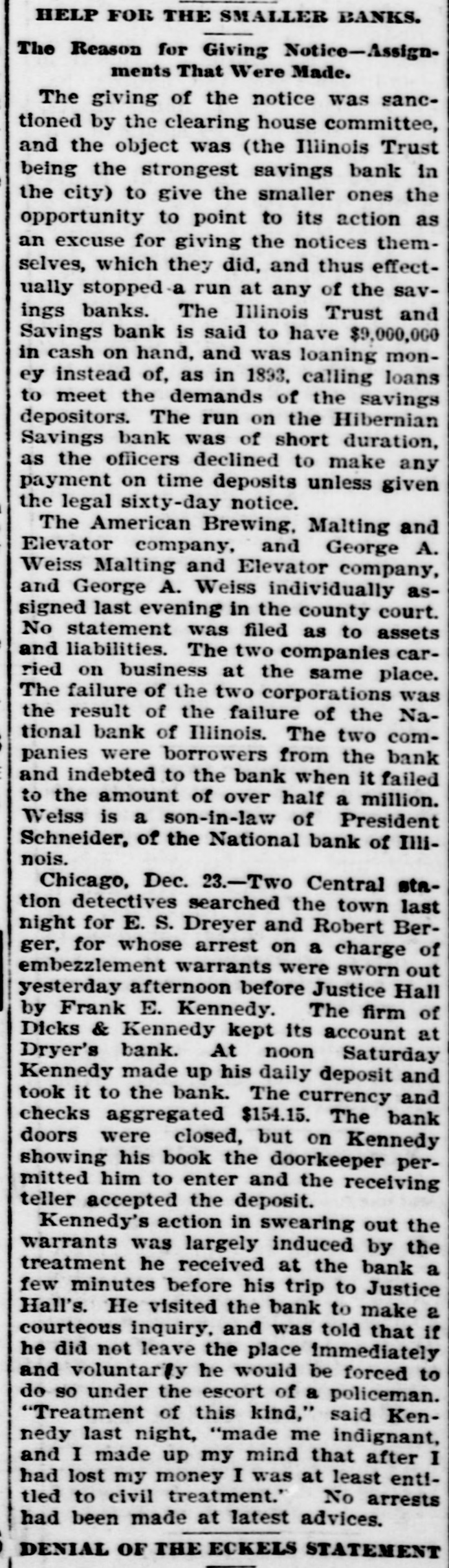
HELP FOR THE SMALLER BANKS. The Reason for Giving Notice-Assignments That Were Made. The giving of the notice was sanctioned by the clearing house committee, and the object was (the Illinois Trust being the strongest savings bank in the city) to give the smaller ones the opportunity to point to its action as an excuse for giving the notices themselves, which they did, and thus effectually stopped-a run at any of the savings banks. The Illinois Trust and Savings bank is said to have $9,000,000 in cash on hand, and was loaning money instead of, as in 1893, calling loans to meet the demands of the savings depositors. The run on the Hibernian Savings bank was of short duration, as the officers declined to make any payment on time deposits unless given the legal sixty-day notice. The American Brewing, Malting and Elevator company, and George A. Weiss Malting and Elevator company, and George A. Weiss individually assigned last evening in the county court. No statement was filed as to assets and liabilities. The two companies carried on business at the same place. The failure of the two corporations was the result of the failure of the National bank of Illinois. The two companies were borrowers from the bank and indebted to the bank when it failed to the amount of over half a million. Weiss is a son-in-law of President Schneider, of the National bank of Illinois. Chicago, Dec. 23.-Two Central station detectives searched the town last night for E. S. Dreyer and Robert Berger, for whose arrest on a charge of embezzlement warrants were sworn out yesterday afternoon before Justice Hall by Frank E. Kennedy. The firm of Dicks & Kennedy kept its account at Dryer's bank. At noon Saturday Kennedy made up his daily deposit and took it to the bank. The currency and checks aggregated $154.15. The bank doors were closed, but on Kennedy showing his book the doorkeeper permitted him to enter and the receiving teller accepted the deposit. Kennedy's action in swearing out the warrants was largely induced by the treatment he received at the bank a few minutes before his trip to Justice Hall's. He visited the bank to make a courteous inquiry, and was told that if he did not leave the place immediately and voluntarly he would be forced to do so under the escort of a policeman. "Treatment of this kind," said Kennedy last night, "made me indignant, and I made up my mind that after I had lost my money I was at least entitled to civil treatment." No arrests had been made at latest advices. DENIAL OF THE ECKELS STATEMENT Directors Indignant at What The Currency Comptroller Says. Directors of the insolvent National Bank of Illinois are indignantly denying the justice of Comptroller Eckels' criticism of their alleged carelesspees


Article from The Providence News, December 23, 1896

Click image to open full size in new tab

Article Text

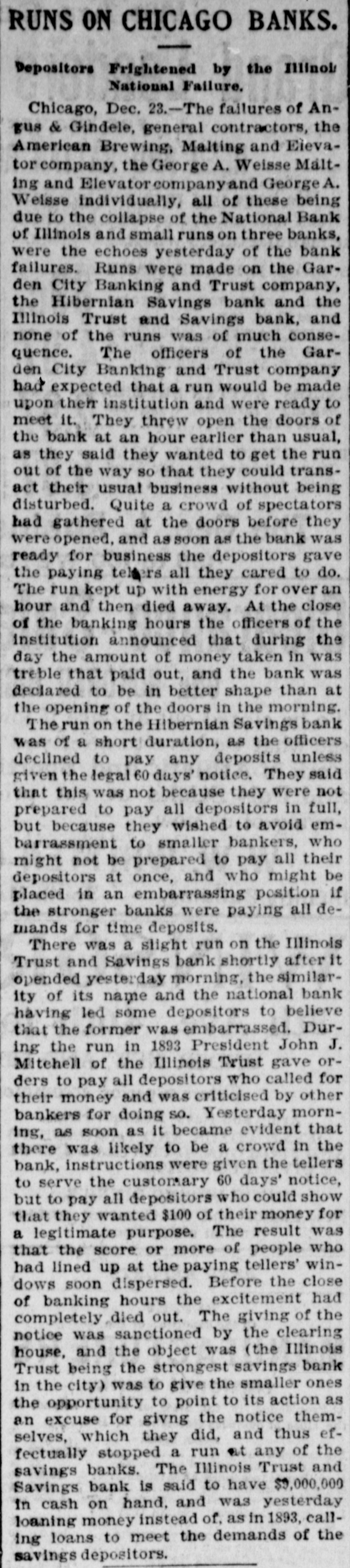
RUNS ON CHICAGO BANKS. Depositors Frightened by the Illinois National Failure. Chicago, Dec. 23.-The failures of Angus & Gindele, general contractors, the American Brewing, Malting and Elevator company, the George A. Weisse Malting and Elevatorcompanyand George A. Weisse individually, all of these being due to the collapse of the National Bank of Illinois and small runs on three banks, were the echoes yesterday of the bank failures. Runs were made on the Garden City Banking and Trust company, the Hibernian Savings bank and the Illinois Trust and Savings bank, and none of the runs was of much consequence. The officers of the Garden City Banking and Trust company had expected that a run would be made upon their institution and were ready to meet it. They threw open the doors of the bank at an hour earlier than usual, as they said they wanted to get the run out of the way so that they could transact their usual business without being disturbed. Quite a crowd of spectators had gathered at the doors before they were opened, and as soon as the bank was ready for business the depositors gave the paying telers all they cared to do. The run kept up with energy for over an hour and then died away. At the close of the banking hours the officers of the institution announced that during the day the amount of money taken in was treble that paid out, and the bank was declared to be in better shape than at the opening of the doors in the morning. The run on the Hibernian Savings bank was of a short duration, as the officers declined to pay any deposits unless given the legal 60 days' notice. They said that this was not because they were not prepared to pay all depositors in full, but because they wished to avoid embarrassment to smaller bankers, who might not be prepared to pay all their depositors at once, and who might be placed in an embarrassing position if the stronger banks were paying all demands for time deposits. There was a slight run on the Illinois Trust and Savings bank shortly after it opended yesterday morning, the similarity of its name and the national bank having led some depositors to believe that the former was embarrassed. During the run in 1893 President John J. Mitchell of the Illinois Trust gave orders to pay all depositors who called for their money and was criticised by other bankers for doing so. Yesterday morning, as soon as it became evident that there was likely to be a crowd in the bank, instructions were given the tellers to serve the customary 60 days' notice, but to pay all depositors who could show that they wanted $100 of their money for a legitimate purpose. The result was that the score or more of people who had lined up at the paying tellers' windows soon dispersed. Before the close of banking hours the excitement had completely died out. The giving of the notice was sanctioned by the clearing house, and the object was (the Illinois Trust being the strongest savings bank in the city) was to give the smaller ones the opportunity to point to its action as an excuse for givng the notice themselves, which they did, and thus effectually stopped a run at any of the savings banks. The Illinois Trust and


Article from Rock Island Argus, December 23, 1896

Click image to open full size in new tab

Article Text

HELP FOR THE SMALLER BANKS. The Reason for Giving Notice-Assignments That Were Made. The giving of the notice was sanctioned by the clearing house committee, and the object was (the Illinois Trust being the strongest savings bank in the city) to give the smaller ones the opportunity to point to its action as an excuse for giving the notices themselves, which they did, and thus effectually stopped a run at any of the savings banks. The Illinois Trust and Savings bank is said to have $9,000,000 in cash on hand, and was loaning money instead of, as in 1893. calling loans to meet the demands of the savings depositors. The run on the Hibernian Savings bank was of short duration, as the officers declined to make any payment on time deposits unless given the legal sixty-day notice. The American Brewing, Malting and Elevator company, and George A. Weiss Malting and Elevator company, and George A. Weiss individually assigned last evening in the county court. No statement was filed as to assets and liabilities. The two companies carried on business at the same place. The failure of the two corporations was the result of the failure of the National bank of Illinois. The two companies were borrowers from the bank and indebted to the bank when it failed to the amount of over half a million. Weiss is a son-in-law of President Schneider, of the National bank of Illinois. Chicago, Dec. 23.-Two Central station detectives searched the town last night for E. S. Dreyer and Robert Berger, for whose arrest on a charge of embezzlement warrants were sworn out yesterday afternoon before Justice Hall by Frank E. Kennedy. The firm of Dicks & Kennedy kept its account at Dryer's bank. At noon Saturday Kennedy made up his daily deposit and took it to the bank. The currency and checks aggregated $154.15. The bank doors were closed, but on Kennedy showing his book the doorkeeper permitted him to enter and the receiving teller accepted the deposit. Kennedy's action in swearing out the warrants was largely induced by the treatment he received at the bank a few minutes before his trip to Justice Hall's. He visited the bank to make a courteous inquiry. and was told that if he did not leave the place immediately and voluntarily he would be forced to do so under the escort of a policeman. "Treatment of this kind," said Kennedy last night, "made me indignant, and I made up my mind that after I had lost my money I was at least entitled to civil treatment." No arrests had been made at latest advices. DENIAL OF THE ECKELS STATEMENT


Article from The Austin Weekly Statesman, December 24, 1896

Click image to open full size in new tab

Article Text

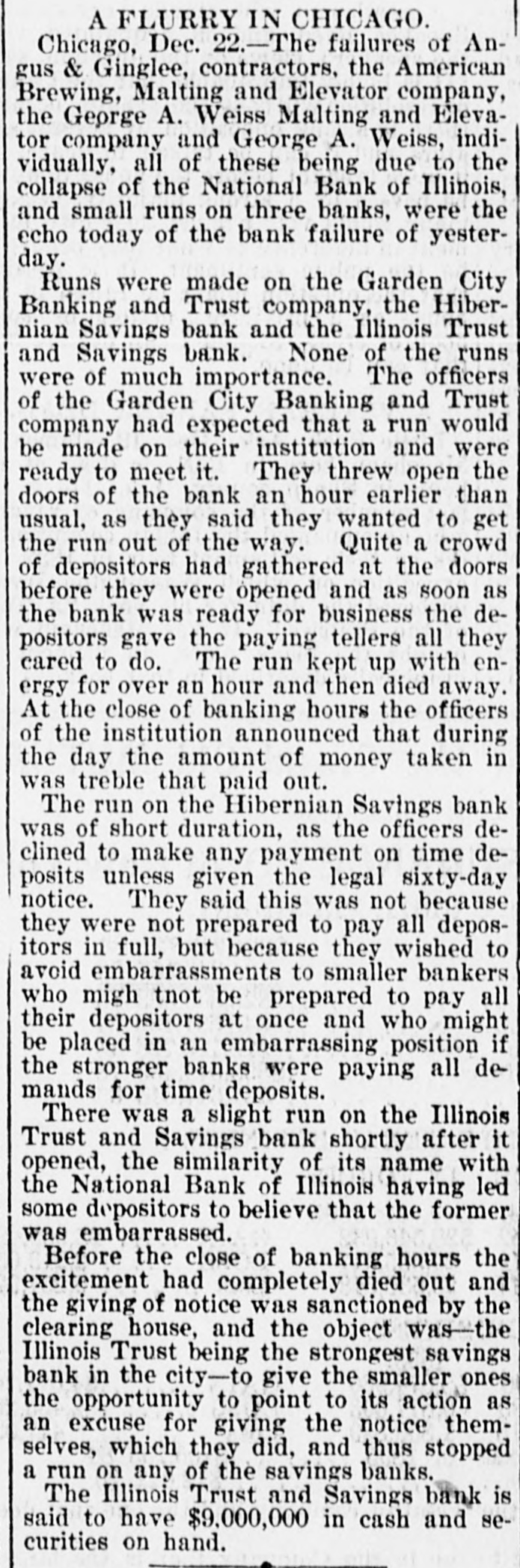
A FLURRY IN CHICAGO. Chicago, Dec. 22.-The failures of Angus & Ginglee, contractors, the American Brewing, Malting and Elevator company, the George A. Weiss Malting and Elevator company and George A. Weiss, individually, all of these being due to the collapse of the National Bank of Illinois, and small runs on three banks, were the echo today of the bank failure of yesterday. Runs were made on the Garden City Banking and Trust company, the Hibernian Savings bank and the Illinois Trust and Savings bank. None of the runs were of much importance. The officers of the Garden City Banking and Trust company had expected that a run would be made on their institution and were ready to meet it. They threw open the doors of the bank an hour earlier than usual, as they said they wanted to get the run out of the way. Quite a crowd of depositors had gathered at the doors before they were opened and as soon as the bank was ready for business the depositors gave the paying tellers all they cared to do. The run kept up with energy for over an hour and then died away. At the close of banking hours the officers of the institution announced that during the day the amount of money taken in was treble that paid out. The run on the Hibernian Savings bank was of short duration, as the officers declined to make any payment on time deposits unless given the legal sixty-day notice. They said this was not because they were not prepared to pay all depositors in full, but because they wished to avoid embarrassments to smaller bankers who migh tnot be prepared to pay all their depositors at once and who might be placed in an embarrassing position if the stronger banks were paying all demands for time deposits. There was a slight run on the Illinois Trust and Savings bank shortly after it opened, the similarity of its name with the National Bank of Illinois having led some depositors to believe that the former was embarrassed. Before the close of banking hours the excitement had completely died out and the giving of notice was sanctioned by the clearing house, and the object was the Illinois Trust being the strongest savings bank in the city-to give the smaller ones the opportunity to point to its action as an excuse for giving the notice themselves, which they did, and thus stopped a run on any of the savings banks. The Illinois Trust and Savings bank is said to have $9,000,000 in cash and securities on hand.


Article from The Cambria Freeman, December 25, 1896

Click image to open full size in new tab

Article Text

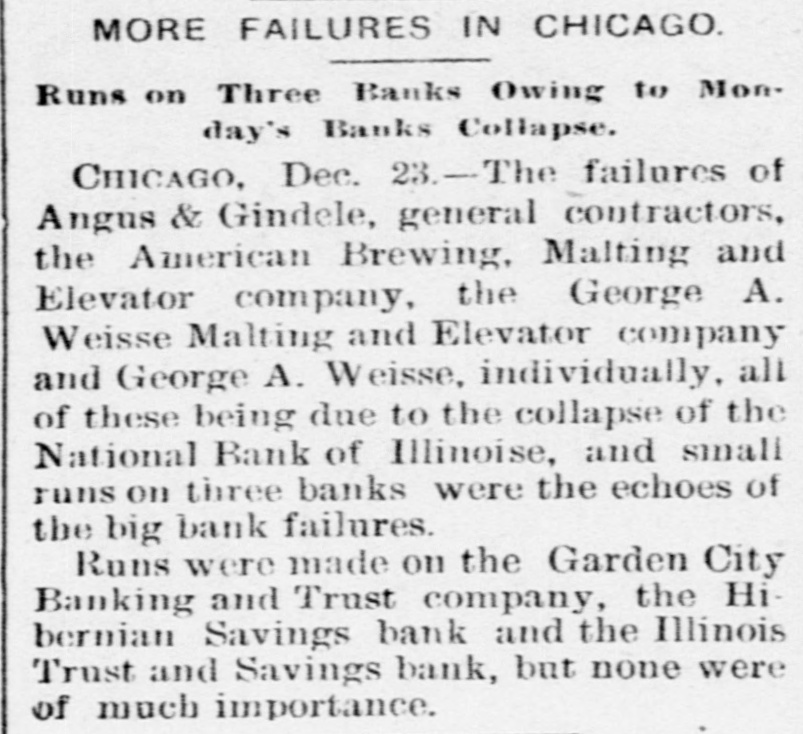
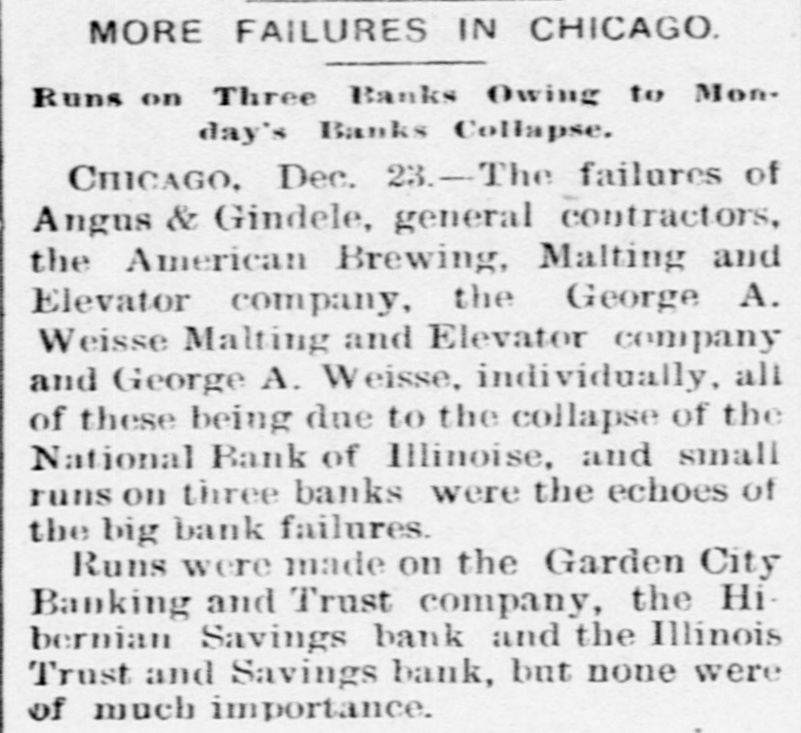
MORE FAILURES IN CHICAGO. Runs on Three Banks Owing to Monday's Banks Collapse. CHICAGO, Dec. 23.-The failures of Angus & Gindele, general contractors, the American Brewing, Malting and Elevator company, the George A. Weisse Malting and Elevator company and George A. Weisse, individually, all of these being due to the collapse of the National Bank of Illinoise, and small runs on three banks were the echoes of the big bank failures. Runs were made on the Garden City Banking and Trust company, the Hibernian Savings bank and the Illinois Trust and Savings bank, but none were of much importance.


Article from The Cambria Freeman, December 25, 1896

Click image to open full size in new tab

Article Text

MORE FAILURES IN CHICAGO. Runs on Three Banks Owing to Monday's Banks Collapse. CHICAGO, Dec. 23.-The failures of Angus & Gindele, general contractors, the American Brewing, Malting and Elevator company, the George A. Weisse Malting and Elevator company and George A. Weisse, individually, all of these being due to the collapse of the National Bank of Illinoise, and small runs on three banks were the echoes of the big bank failures. Runs were made on the Garden City Banking and Trust company, the Hibernian Savings bank and the Illinois Trust and Savings bank, but none were of much importance.


Article from The Kootenai Herald, December 26, 1896

Click image to open full size in new tab

Article Text

institution, and were ready to meet it. They threw open the doors of the bank an hour earlier than usual, as they said they wanted to get the run out of the way SO they could transact their usual business without being disturbed. Quite a crowd of depositors had gathered at the doors before they opened, and as soon as the bank was ready for visitors the depositors gave the paying tellers all they cared to do. The run kept up with energy for over an hour, and At the close of banking hours the ofMA then died away. ficers of the institution announced that during the day the amount of money taken in was treble the amount paid out and the bank was declared in better share than at the opening in the morning. The run on the Hibernian Savings bank was of short duration, as the officers declined to make any payment on time deposits unless given 50 days' notice. They said this was not because they were not prepared to pay all depositors in full, but because they wished to avoid embarrassment to smaller bankers who might not be prepared to pay all their depositors, and who might be placed in an embarrassing position. Another Run Stopped. The stronger banks were paying all demands for time deposits. There was a slight run on the Illinois Trust Savings bank shortly after it opened this morning, the similarity of it and the National Bank of Illinois having led some depositors to believe the former was embarrassed. This morning, as soon as it became evident there was likely to be a crowd in the bank, instructions were given to the Tellers to serve the customary 60 days' notice, but to pay all depositors who could show that they wanted $100 of their money for a legitimate purpose. The result was that the scores or more of people who had lined up at the paying tellers' windows soon dispersed. Before the close of banking hours the excitement had completely died out. The giving of the notice was sanctioned by the clearing house committee and the object was (Illinois Trust Company being the strongest savings bank in the city) to give the smaller ones the opportunity to point to its action as an excuse for giving the notice themselves, which they did, and thus effectually stopped a run. The Illinois Trust and Savings bank is said to have $9,000,000 in cash on hand and was today loaning money. Brewing Concerns Assign. The American Brewing, Malting and Elevator Company, the George Weisse Malting and Elevator Company and George A. Weisse assigned this evening in the county court. The assignments of the two companies, which are intimately connected in business, and that of Weisse were brought into court together at 6 o'clock. The assignee of the American Brewing and Elevator Company is the Chicago Title and Trust Company. The George Weisse Malting and Elevator Company assigned to the Security Title and Trust Company and that company is the assignee of Weisse also. No statement was filed as to the assets and nabilities. The failure of the two corporations was the result of the failure of the National Bank of Illinois. The two companies were borrowers from the bank and were indebted to it when it failed to the amount of over half a million dollars. As soon as the failure of the bank was announced preparations were begun for the closing up of the business of the two companies. Judge Horton earlier in the day appointed a receiver for the general contracting firm of Angus & Gildale on the application of John Angus, one of the members of the firm. The assets of the concern were placed at $300,000 and the liabilities at $250,000. An answer was filed to the bill by George A. Gildale, the other member of the firm, consenting to the appointment of a receiver. According to the bill, the National Bank of Illinois, which failed Monday, loaned the firm $250,000, and the suspension of that institution has nearly destroyed the credit of the contracting firm, SO there was nothing left but an application to a court for rebef. The assets of the partners consist principally of real estate, notes, accounts receivable, and contracts for completion of public works, elevated railroad construction and the erection of buildings.