First National Bank (Putnam, CT)

Episode Information

Episode UID
44801496
Episode Type
Run โ†’ Suspension โ†’ Closure
Bank Type
national
Bank ID
4480 national
Charter Number
448
Start Date
August 11, 1924
Location
Putnam, Connecticut (41.915, -71.909)

Metadata

Model
gpt-5-mini (chosen from majority vote of a three-model LLM ensemble)
Short Digest
2fc90a686e99ba7c

Response Measures

Accommodated withdrawals, Full suspension, Books examined

Other: Comptroller-appointed receiver took charge and the bank was placed in liquidation; out-of-town checks cashed in limited amounts and nearby banks offered facilities to help depositors.

Receivership Details

Depositor recovery rate
86.2%
Date receivership started
1924-08-13
Date receivership terminated
1931-12-01
OCC cause of failure
Governance
Share of assets assessed as good
83.6%
Share of assets assessed as doubtful
8.3%
Share of assets assessed as worthless
8.1%

Description

Closure led to federal receiver appointment and liquidation; embezzlement by the cashier triggered the run.

Events (5)

1. June 1, 1864 Chartered
Source
historical_nic
2. August 11, 1924 Run
Cause
Bank Specific Adverse Info
Cause Details
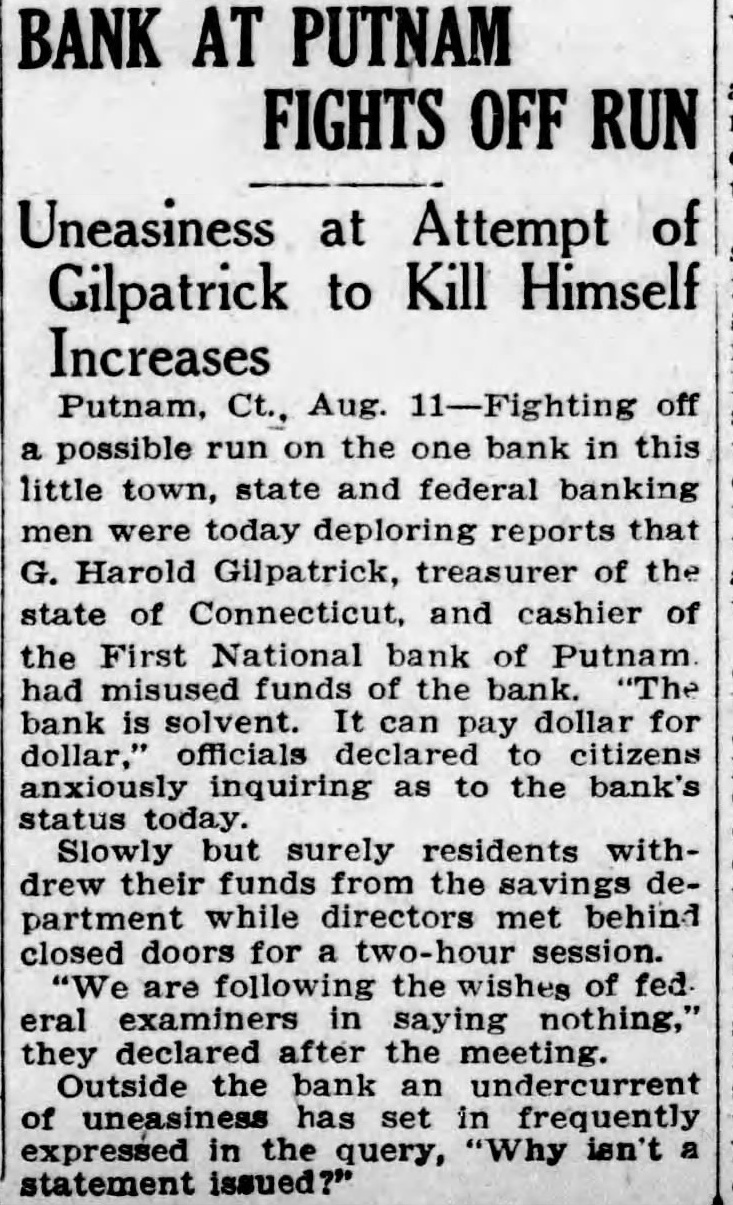
Withdrawals followed disclosure of the cashier G. Harold Gilpatric's suicide attempt and revelations of large shortages/defalcations in bank funds.
Measures
Bank changed opening hour; directors posted closing notice and attempted limited operations (receipt of payments only) before full suspension.
Newspaper Excerpt
A run on the savings department of the bank continued all day yesterday, with an average of about a score of depositors in line withdrawing funds.
Source
newspapers
3. August 12, 1924 Suspension
Cause
Government Action
Cause Details
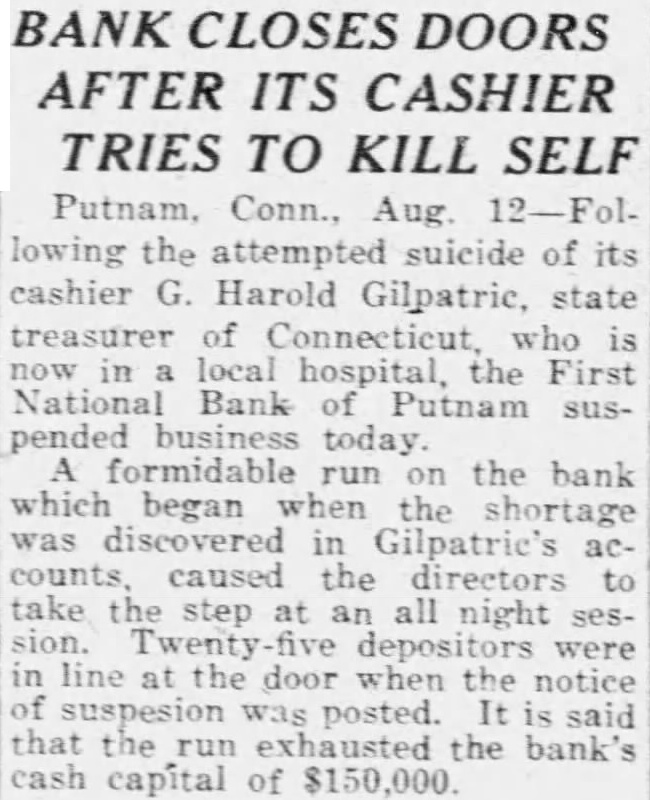
Directors closed the bank and the national bank examiner took charge after discovery of substantial shortages and the cashier's suicide attempt.
Newspaper Excerpt
The First National Bank of Putnam ... closed its doors today. An hour after the usual hour of opening the closing notice was posted on the bank's front doors. It was signed by N. S. Bean, chief national bank examiner.
Source
newspapers
4. August 13, 1924 Receivership
Source
historical_nic
5. August 15, 1924 Receivership
Newspaper Excerpt
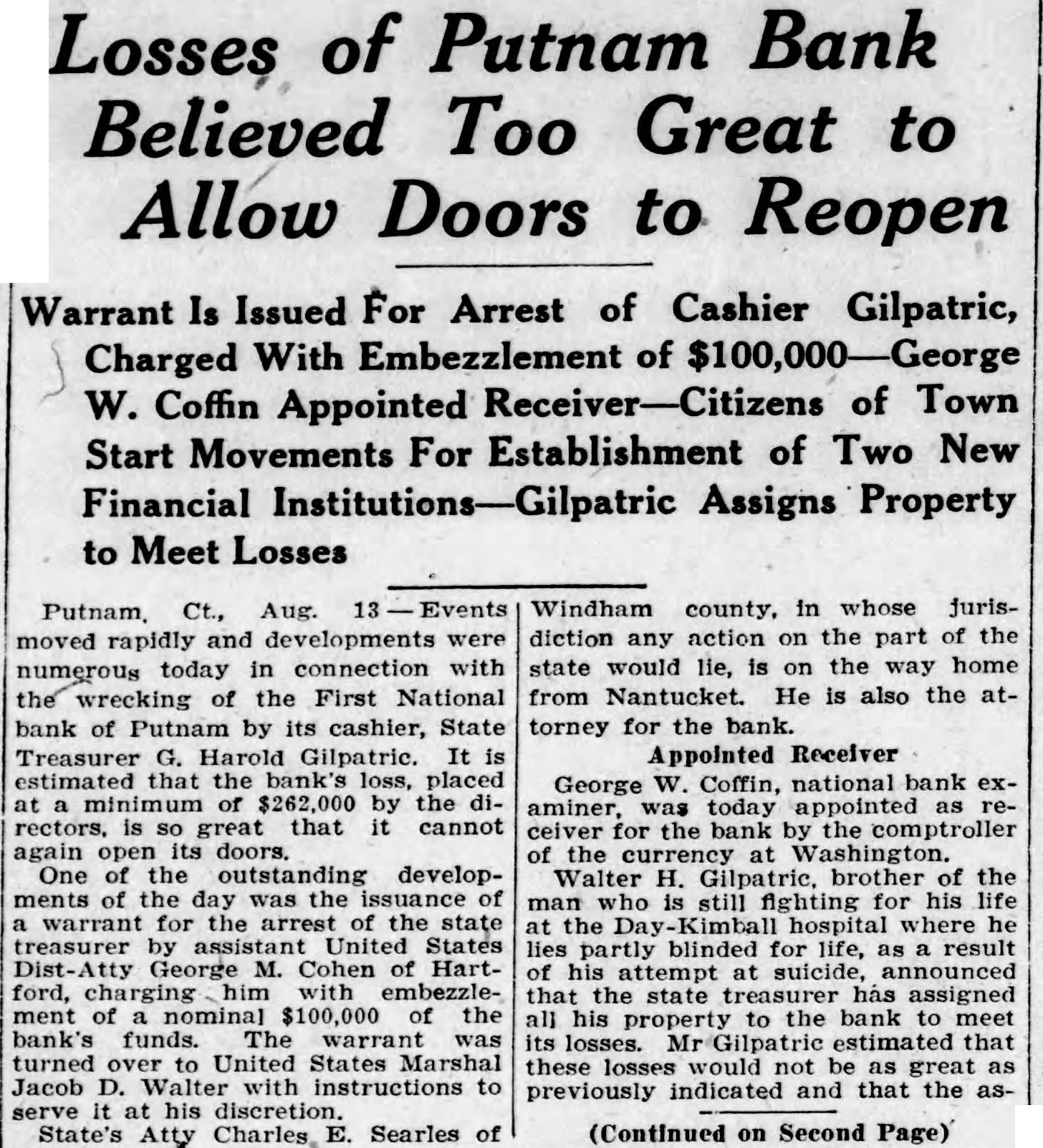
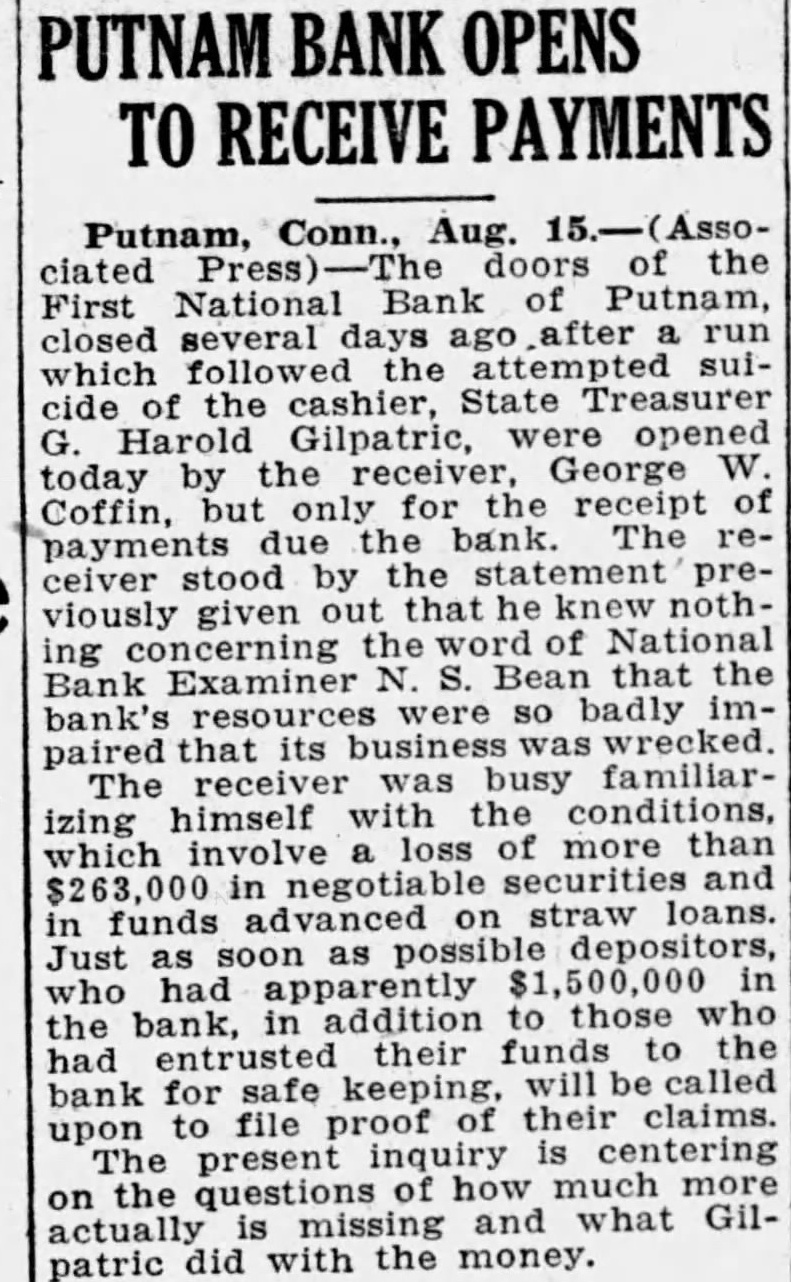
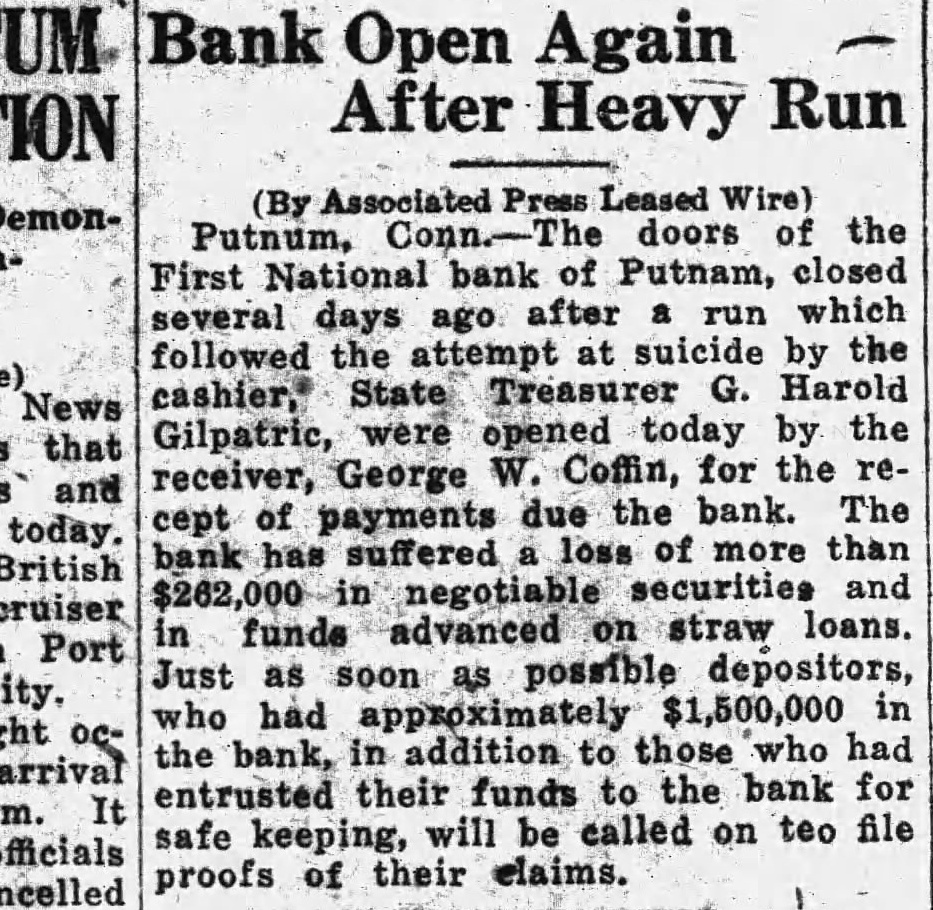
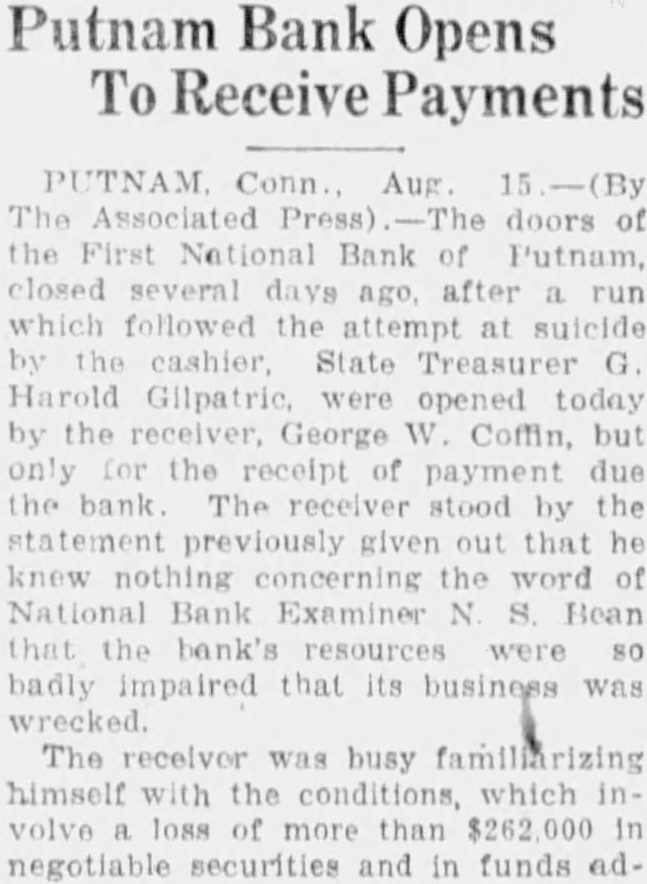
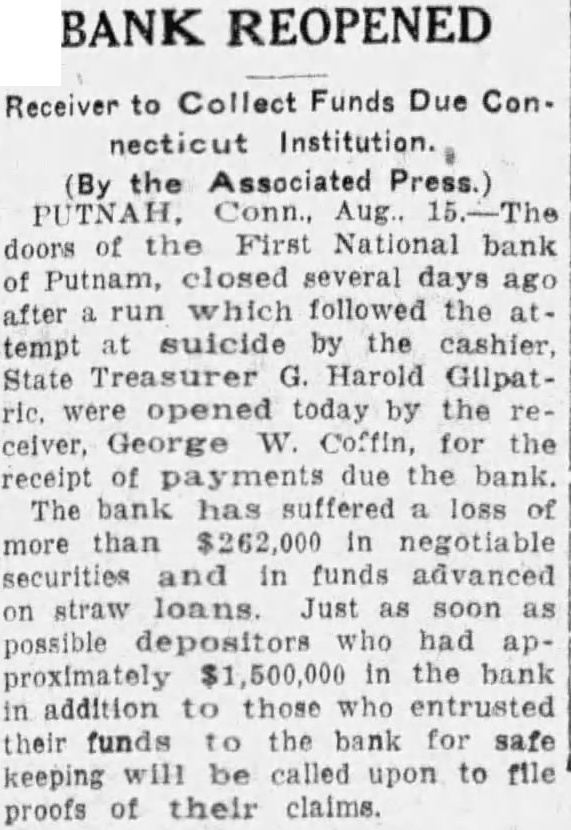
Comptroller Appoints Receiver For Bank ... George M. Coffin of New Haven, the receiver appointed by the Comptroller of Currency at Washington, D. C., because of defalcations aggregating $262,000 ... The doors of the First National Bank of Putnam ... were opened today by the receiver, George W. Coffin, for the receipt of payments due the bank.
Source
newspapers

Newspaper Articles (18)

Article from Evening Star, August 12, 1924

Click image to open full size in new tab

Article Text

GILPATRIC'S BANK CLOSED BY STATE Aged Patrons Weep at Institution Where Cashier Attempted Suicide. By the Associated Press. PUTNAM, Conn., August 12.-The First National Bank of Putnam, whose cashier, G. Harold Gilpatric, shot himself at his home last Thursday, closed its doors today. An hour after the usual hour of opening the closing notice was posted on the bank's front doors. It was signed by N. S. Bean, chief national bank examiner. Depositors in Tears. The notice was the first official statement that the bank directors had acted for the protection of the institution, whose funds have been admitted to be impaired. Before the posting, President Charles H. Brown notified all who called at the bank that the hour of opening had been changed to 10 o'clock, standard time, and a crowd began gathering. The directors were understood to be in session in the bank. A few of the older persons in the crowd were seen in tears. Gilpatric, also State treasurer, is in serious condition as a result of the bullet wound and probably permanently blind. A run on the savings department of the bank continued all day yesterday, with an average of about a score of depositors in line withdrawing funds. From friends of the State treasurer's family it was learned that in a note left for his wife after the shooting he revealed that he was financially involved.


Article from Daily Kennebec Journal, August 13, 1924

Click image to open full size in new tab

Article Text

CONFIRM $225,000 SHORTAGE PUTNAM BANK NOW CLOSED Putnam, Conn., Aug. 12-Staggered by the closing of the First National Bank this morning following a suicide attempt by the cashier, G. Harold G. patric, state treasurer, and the confirmed report of a $225,000 shortage in the instit on's funds, 400 merchants and manufacturers took cognizance of the situation today at a meeting which named a committee of 12 to meet the bank's directors, obtain a statement of conditions and cooperate with it in an attempt to save the business. The conference will be tomorrow morning at nine o'clock. That the financial situation is acute was admitted by prominent men who attended the meeting. Payrolls will become due at the end of the week, merchants are at a loss to know what to do with the daily receipts and many have pressing bills that must be met. Action of the directors followed an all-night session. Members of the Gilpatric family remain silent. Mr. Gilpatric's condition is unchanged. He is conscious and converses with hs relatives and doctors. He will be permanently blind. The bank's losses are largely in negotiable securities given to the bank for safe keping. it was said by an official of the institution. The further extent of the shortages in the cashier's accounts, it was indiacted by one of the directors, will depend upon completion of the investigation into the bank's loans. It was known that many of these were made by Mr. Gilpatric largely upon his own responsibility. Examination is now being made of these securities. It was determined definitely, according to an announcement by Governor Templeton today that Mr. Gilpatric's accounts as state treasurer are correct to the last penny. State funds of approximately $100,000 are involved, however, through deposits in the commercial department of the Putnam bank and the state must take its loss if there is to be a loss to the depositors, on the same terms as all others. National Bank Examiner N. S. Bean refused any information today about other activities in which Mr. Gilpatric was involved, but it is understood that a careful check is being made on a large number of loans made by Mr. Gilpatric. Inquiries also are being made as to the status of several companies with which he was connected. Bank Examiner Bean's action in taking over the bank's affairs today is the result of a vote taken by the directors to place the bank's affairs in his hands "pending further investigation." Up until today the directors had insisted that the bank was solvent. It was indicated that a receiver probably would be appointed within a day or two and that this might be Bank Examiner Bean or one of several officials from Washington. According to the last report on June 3 the bank had resources' which Cashier Gilpatric swore amounted to $2,330,370. This includes $986,968 in deposits subject to checks and an aggregate of $604,869 in time deposits. The capital stock paid in was $150.


Article from New Britain Herald, August 13, 1924

Click image to open full size in new tab

Article Text

PROTECTING GILPATRIC. Attempts to cover up the financial record of Connecticut's state treasurer as cashier of the First National bank of Putnam will fall. Since the day when G. Harold Gilpatric attempted suicide while his accounts at the bank were under surveillence, the bank examiners officially have been dull to take the public into their confidence, although unnamed officials have computed a shortage of more than $200.000 in securities. But truth will out: and it will cut deeper when exposed piecemeal than when fully revealed at one time. State and federal officials at Putnam are not enhancing the confidence of the public by attempting to submerge facts which they are in a position to know at first hand but which a false friendship and loyalty to Gilpatric Induces quietude. Lacking official reports, the public will accept as truth the unofficial reports. Gilpatric remains treasurer of the state; his private affairs are under a cloud; his public affairs are announced to be on a sound basis. Gilpatric can no longer function as state treasurer. The longer the governor 1 hesitates the graver the danger that S a break may occur in the wall of cont fidence that has been built up around o the treasurer's department. t Depositors of the Putnam bank were in tears when it was posted that the bank would be closed against further withdrawals. It is hoped that the bank remains sound, and that no IT person will lose a penny as a result r of Gilpatric's connection with the bank, or for any other reason. Yet banking business in Putnam is in a mess and a receiver for the bank is in prospect. Yet the examiners, after sufficient time to make at least a tentative statement, hesitate, doubtless hoping that it will not be necessary to make the facts known as they have found them, but possibly awaiting until partial or complete restitutions can be made D se that the supposed dolorous situati tion can be made to look less black -this at least is the supposition of in a patient public resulting from a w hush-up policy. W


Article from Putnam Patriot, August 15, 1924

Click image to open full size in new tab

Article Text

Comptroller Appoints Receiver For Bank, Shortage $262,000 CASHIER GILPATRIC HOVERS BETWEEN LIFE AND DEATH AT HOSPITAL.-FULL EXTENT OF HIS DEFALCATIONS STILL UNKNOWN.-NEW LOSSES CROP UP ALMOST DAILY.-BANK SOLVENT, JUDGE GEISSLER ASSERTS. Gilpatric's Resignation as State Treasurer Is Prepared But Not Signed.-Embezzlement Charge Waiting to Be Served.His Market Venture In Hartford In Receiver's Hands. In answer to this, it can be stated that With the First National Bank, of the shortage is known to be as large which he was cashier, in the hands of as $262,000 and that this figure is beGeorge M. Coffin of New Haven, the ing added to almost daily through the receiver appointed by the Comptroller discovery of heretofore unsuspected of Currency at Washington, D. C., defalcations. No one can state what because of defalcations aggregatthe final total of losses will amount to. ing $262,000 in negotiable securities Why did Mr. Gilpatric do it and left with the bank for safe keeping, what did he do with the money, are G. Harold Gilpatric continues a patwo questions which, it would appear, tient at the Day Kimball Hospital, no one can answer. hovering between life and death, perCould Refuse no Friend haps blinded for life, as a result of his attempt at suicide by shooting That Mr. Gilpatric's manipulation himself through the right temple, at of the funds of the bank are tracable, his home on Seward street, last Thursdirectly and surely, to his inability to day. say "no" to a friend in need of monThe doors of the bank, closed on ey, but who had no security whatever Tuesday by vote of the directors, to safeguard any loan, is the firm belief of those who loved and still love were thrown open yesterday, but only for the receipt of money due Harold Gilpatric. It has been estabthe bank. lished, with accuracy, that Mr. GilMr. Coffin was an extremely busy patric's operations extended back at man yesterday familiarizing himself least eighteen months. with the task that confronts him as Mr. Gilpatric's resignation as treasreceiver for the bank. He told a Paurer of the State of Connecticut has triot reporter this morning that it is been drawn, but as yet he has not impossible to forecast any date on signed it. The reason why he has not which the affairs of the institution affixed his signature to the document is because his doctors inform the famwill be wound up. It is a long drawn ily that it is inadvisable to have him out process, but one which he promdo so just now, because of the reacises to expedite as speedily as possition it would have on his condition. ble. His brother, Walter Gilpatrie, has Must File Proofs of Claims stated that there is no need of his As soon as arrangements can be brother resigning that position, becompleted, depositors who had $1,500,cause "he is practically out now. 000 in the bank will be called upon to One of the tangles that has resultfile proof of their claims. A similar ed from the closing of the bank, has procedure will have to be followed been the large number of outstanding with those who had securities in safe checks which people and business keeping at the bank. Until this is houses have had returned to them with done Mr. Coffin will be unable to get the request. "Please pay cash." Quick a complete check on the amount of to see Putnam's need, the Windham Mr. Gilpatric's irregular dealings County National Bank and the Danwith the bank's money. It is stated ielson Trust Co. of Danielson, have ofthat these proofs from depositors are fered their facilities for the convenuncovering, almost daily, additional ience of depositors whose money is losses. That the bank's total loss will tied up in the Putnam bank. The Danprobably exceed $262,000. the total ielson banks rising to Putnam's emerdiscovered to date, is the assurance of gency have been a great help in one of the directors, but he stated that straightening out Putnam's credit afit is impossible to arrive at any idea fairs and keeping business going withof the total defalcation until proofs out too much confusion. Likewise the of depositors are all in and Mr. Coffin Putnam Savings Bank has been a has made a complete check of everygreat help in a most trying situation. thing The bank has prepared itself and is Concerning the solvency of the bank. cashing out-of-town checks for any little is known beyond the statement reasonable sum. made at the public mass meeting on State's Attorney Arrives Thursday afternoon, by Judge M. H. State's Attorney Charles E. Searls, Geissler, who stated that 100 cents on who arrived home yesterday from a the dollar will be paid to every devacation at Nantucket Island, Mass., positor of the bank. has concerned himself officially with One of the questions which everyone has asked this week is: How (Continued on Page Five) much of the bank's money is missing?


Article from Putnam Patriot, August 15, 1924

Click image to open full size in new tab

Article Text

With the First National Bank, of which he was cashier, in the hands of George M. Coffin of New Haven, the receiver appointed by the Comptroller of Currency at Washington, D. C., because of defalcations aggregatthe left ing $262,000 with in bank negotiable for continues safe securities keeping, G. Harold Gilpatric a patient at the Day Kimball Hospital, hovering between life and death, perhaps blinded for life, as a result of his attempt at suicide by shooting himself through the right temple, at his home on Seward street, last Thursday. The doors of the bank, closed on Tuesday by vote of the directors, were thrown open yesterday, but only for the receipt of money due the bank. Mr. Coffin was an extremely busy man yesterday familiarizing himself with the task that confronts him as receiver for the bank. He told a Pato any triot impossible reporter forecast this morning that date it on is which the affairs of the institution will be wound up. It is a long drawn out process, but one which he promises to expedite as speedily as possible. Must File Proofs of Claims As soon as arrangements can be completed, depositors who had $1,500,000 in the bank will be called upon to file proof of their claims. A similar procedure will have to be followed with those who had securities in safe keeping at the bank. Until this is done Mr. Coffin will be unable to get a complete check on the amount of Mr. Gilpatric's irregular dealings with the bank's money. It is stated that these proofs from depositors are uncovering, almost daily, additional losses. That the bank's total loss will probably exceed $262,000, the total discovered to date, is the assurance of one of the directors, but he stated that it is impossible to arrive at any idea of the total defalcation until proofs of depositors are all in and Mr. Coffin has made a complete check of everything Concerning the solvency of the bank, little is known beyond the statement at mass on made Thursday the afternoon, public by Judge meeting M. H. Geissler, who stated that 100 cents on the dollar will be paid to every depositor of the bank. One of the questions which everyone has asked this week is: How much of the bank's money is missing?


Article from Putnam Patriot, August 15, 1924

Click image to open full size in new tab

Article Text

Comptroller Appoints Receiver for Bank. Shortage $262,000 (Continued from Page One) by the directors as $262,000, but this the bank's affairs and present condiamount is in excess of the loss. tion. He stated today that nothing had come to his attention that disDiscussed Donahue Affair closed the necessity of the state atWith respect to reports that there torney's office for Windham county to had been forgeries on mortgage deeds proceed against anyone connected given by Mr. Gilpatric to James Donwith the bank or any of its affairs. ahue, to the Cutler estate and to other Not Gilpatric's Signature interests in this city who had given him an aggregate of approximately It was learned from a reliable $200,000 to invest for them, Walter H source today that there has been disGilpatrie said that his brother assured covered among the papers of Mr. Gilhim specifically in the case of the Donpatric a note for $35,000, payable to ahue and Cutler instances that the G. Harold Gilpatric as trustee of the transactions were entirely regular. trust fund set up by the late Joseph My brother told me that he handCutler for his daughter, Miss Annie ed the mortgage for the Hartford Cutler. The note is not signed by Mr. property to Donahue for him to reGilpatric. Whose signature it is. cord," Mr. Gilpatric said. "If Donahowever, could not be learned. It is hue failed to record it we cannot help stated, however, that the note appears it. He (Donahue) has run to the to be worth its face value and therestate attorney for prosecution. We fore the trust fund is not in danger are sorry. We are concerned now in of losing anything by reason of the getting together all possible assets to note. The mortgage deed, said to have make up the losses. If these losses been given on Hartford property, canamount to anything like $262,000 I not be found. But this fact is also shall be greatly surprised. not conclusive of wrongdoing, as the Mr. Gilpatric indicated that by the deed may yet be found among the ef assignment to the bank he felt that no fects of Mr. Gilpatric yet to be found. wrong was being done to individuals Refuse to Make Statement who had entrusted funds to the state From the moment that the bank treasurer for safe keeping, because opened its doors as usual on Friday he believed his brother's accounts in morning, until the institution was this connection would be found corclosed for good by vote of directors rect Tuesday morning, directors and offi. A "certain element" was charged by cials have persistently refused to Mr. Gilpatric with disturbing condimake any sort of a public statement tions in recent days to the point where showing the status of the bank. They an effort to effect a settlement with were pleaded with by depositors and the bank that would maintain its solothers who had a right to know how vency had been obstrueted. the institution stood. But all that "They are trying to make my brothwas fortheoming was the reiterated er a goat for a great many things that statement that "The bank is solvent never took place, he said in discusand capable of meeting all its obligasing reports of mortgage and trust tions. fund irregularities. There was a decided run on the Prepared For Courts bank during Saturday morning, savWhen this thing is finished up I ings accounts being particularly af think that Putnam will find that all a fected by the continued absence of losses have been made good It will definite statement of facts concerning be true if they let us get things tothe bank gether. If they put Harold in bankIn the meantime directors of the bank held frequent meetings, but ruptcy no one knows what will happen. what they discussed and what they He has to face the courts on this. decided to do. was not made public. We are prepared for this. We are Decided "Run" Starts to let the its not so The bank opened at the usual hour the as we are on Monday morning A crowd gathcourse. much prepared with We are past concerned law take in makered within a few minutes and a line ing up for the consequences of the of about fifteen people assembled bepast. fore the savings department. People Events Develop Rapidly were withdrawing their money. Some Developments came thick and fast took away sizeable piles of bills. OthTuesday afternoon. one of them beers did not have as much on deposit, ing the announcement by Walter Gilbut they were withdrawing all that patric that his brother had assigned they had. It was a serious-faced his personal property to the bank to group of people, not excited or uncover any losses he may have caused strung, but taking a natural precauthat institution. The statement was tion in the face of the uncommunicaas follows: tive statement that the bank was sol"G. Harold Gilpatric has today exevent. Business in the commercial cuted and delivered to the First Na(checking) department was stated to tional Bank, an assignment of all his have been normal during the day, property to meet any loss sustained with deposits and withdrawals about as usual for a Monday's business. It by reason of his acts. From an est:mate of his assets, it is believed that was reported that one of the bank's heaviest depositors made a 100 per they will go a considerable way in offsetting such loses.' cent withdrawal during the day. The Mr. Gilpatric indicated that by the run on the savings department continued throughout the day, and is reassignment to the bank he felt that no wrong was being done to indiported to have totalled approximately viduals who had entrusted funds to $75,000. the man for safe keeping, because he In Session Eight Hours believed his brother's accounts in this The directors held a meeting in connection would be found correct. the forenoon, lasting two hours. In Trying to Raise Money the afternoon they met again, adIt is known that Mr. Gilpatrie's journing around o'clock and re-conbrothers have been working day and vening at about 8 o'clock. They remained in session until shortly after night for a week now, in an endeavor 10 o'clock. Everyone realized that to determine what property and entersomething of major importance was prises their brother had been financiforcing the directors to hold three ally interested in and which could be meetings in one day, each of which turned quickly into cash, to meet lasted hours in length. Everyone obligations disclosed by his operations. His assets included real estate and hoped they would break their silence and tell something about the bank, automobiles which are assessed for so that even the worst fears might $10,188 in Putnam: his share in the be satisfied. But their silence was island at Juniper Point, Maine, which Sphinx-like They had nothing to say Mr. Gilpatric owned jointly with Rev. and their continued refusal to divulge Harry Fosdick, the famous New York any information to the people who preacher; the Trumbull building prohad money in the bank, greatly inperty in Hartford, said to have a mar creased everyone's fears. ket value today of at least $150,000 Long before the scheduled hour of but encumbered with mortgages of opening the bank Tuesday morning $78,625; Worcester real estate havat 9 o'clock, a crowd had gathered ing a reported value upwards of before the front door. It was easily $200,000; his bank stock, Putnam to be seen that they were there for Woolen Co., stock: the Gilpatric the purpose of withdrawing their summer home at Juniper Point. and funds. They said little to one anin all probability many more items other and a decidedly sober expresabout which the public is uninformed. sion covered everyone's face. Gilpatric Heavily Bonded Delay Bank Opening Hour Bonds of $150,000 carried by the At 9 o'elock Charles H. Brown, American Surety Company of New president of the bank, stepped to the York City and the Hartford Accident front door and told those who were and Indemnity Company are protecwaiting to go inside that the bank tion for the State of Connecticut of would be ready to do business at 10 the funds over which Mr. Cem us This pronouncement greatly xuluas when are under the know agitateuth Sundiours They tednahoed to state treasurer are carrie the to York New company fears Miss Haz Mr. Baker was seen that by the news- bank


Article from Evening Star, August 15, 1924

Click image to open full size in new tab

Article Text

RIFLED BANK OPEN TO COLLECT DEBTS Little Light Shed on Gilpatric's Disposition of Stolen Money. By the Associated Press. PUTNAM, Conn., August 15.-The doors of the First National Bank of Putnam, closed several days ago after a run which followed the attempt at suicide by the cashier, State Treasurer G. Harold Gilpatric, were opened today by the receiver. George W. Coffin, for the receipt of payments due the bank. The bank has suffered a loss of more than $262,000 in negotiable securities and in funds advanced on straw loans. Just as soon as possible, depositors, who had approximately $1,500,000 in the bank, in addition to those who had intrusted their funds to the bank for safekeeping, will be called upon to file proofs of their claims. The authorities are continuing investigation of the extent of Gilpatric's embezzlements, both from the bank and from estates of which he was trustee. Little has been revealed as to what he did with the money, rumors of irregularities in his private life being unsupported. Gilpatric is in a hospital, and a Federal warrant charging embezzlement is awaiting service. His resignation as State treasurer has been prepared by relatives, but not signed.


Article from Daily Kennebec Journal, August 16, 1924

Click image to open full size in new tab

Article Text

Slow Work in Straightening Out Tangle of Accounts of Cashier Who Attempted Suicide-Condition Still Critical -Resignation As State Treasurer Prepared And Awaits His Signature Putnam, Conn., Aug. 15-By A. P.) -A half million dollars may be involved in the embezzlements of G. Harold Gilpatric, state treasurer and cashier of the First National Bank of Putnam, it was indicated today by those trying to straighten the tangle in which his attempt at suicide left his accounts. Gilpatric himself, does not know how much is gone. In a statement of assets made as a part of the letter to his wife, written before he fired the shot that will partially blind him, for life, he listed such of his belongings as he could remember, but could say of his obligations only that he was "hopelessly involved." The existence of this list of assets became known today, as did other facts in connection with the attempted suicide by which Gilpatric sought to close probably seven years of embezzlement. The list includes a number of items which it is believed will be difficult to realize anything like the face value on. The list included no mention of several mortgages that he holds. As assets these are worth more probably than some items listed. The likelihood that the losses will approximate $500,000 is based on accumulating instances of apparent embezzlement of negotiable bonds left with Gilpatric at the bank: the obtaining of money by means of straw notes, or notes with weak endorsements, and the indications that mortgages and mortgage notes obtained by Gilpatric as investments for estates in his charge will prove to be without standing. As yet the receiver, George W. Coffin. has not called for proof of claim and today with the bank reopened for everything but withdrawals. was in receipt of a number of inquiries from persons who entrusted Gilpatric with their funds without receipt. Those trying to straighten out Gilpatric's affairs have found they were those of a man overburdened with work. who had taken on more than he could possibly attend to. yet heasted that he "left business behind" when he ended the day at the bank. He made out his own income tax statements. was his own lawyer, accountant and adviser. Mrs. Gilpatric has told friends that there was nothing abnormal in her husband's life. His expenditures were in keeping with his income and he was concerned with the education of his children. Little Rhoda Gilpatric, 18 years old. having completed a course at a fashionable finishing school last June, was preparing to go to college next fall. Instead. she said at her father's bedside. "Don't mind. Dad: I'll go to work and we'll pay up this money." Although Gilnatric is conscious, his condition is critical and his resignation as state treasurer. prepared for signature several days has not been signed. As yet. Gilpatric has not been told that the bank is closed.


Article from Evening Star, August 19, 1924

Click image to open full size in new tab

Article Text

STATE MAY LOSE $30,000 ADDITIONAL Gilpatric Increased Connecticut Deposit by That Sum Before Bank Crashed. By the Associated Press. HARTFORD, Conn., August 19.-Accounts of the State treasury, which were taken over yesterday by Capt. Anson T. McCook, the new State treasurer, showed that the State deposit in the First National Bank of Putnam was increased from $90,000 to $120,000 within the past two months. The amount of the State's deposit in the bank wrecked by the defalcation of G. Harold Gilpatric, its cashier, and former State treasurer, previously had been set down as $100,000. As State treasurer, Gilpatric made the additional deposit which put the total of the State's funds in his bank $30,000 over the legal limit, soon after his return from the Republican national convention at Cleveland in June, which he attended as a guest. Deputy State Treasurer Thomas H. Judd of New Britain promptly protested to Mr. Gilpatric that the additional deposit was illegal, as the State law permitted such deposits only to the extent of 30 per cent of the capital, undivided profits and surplus of the bank, which. in this case was approximately $90,000. Gilpatric gave an explanation for his action and Judd was overruled. Deputy Treasurer Judd last night confirmed this information, but declined to comment. He went to Putnam the Sunday following Gilpatric's attempted suicide, and went over the situation there with directors of the involved bank with a view to protecting the State's interests. At that time the officials entertained hopes of saving the institution and rather than precipitate a run on the bank, Judd did not withdraw the State's deposit.


Article from New Britain Herald, August 19, 1924

Click image to open full size in new tab

Article Text

Will Report Direct to Washington. Putnam, Aug. 19.-Final checking of the accounts and assets of the First National bank of Putnam which closed its doors following disclosure of peculations of its cashier, former State Treasurer G. Harold Gilpatric, admitted to be at least $265,000 was in progress at the bank today. When this operation is completed, which is now expected to be within a short time, the assets of the bank will be formally turned over to the receiver, George W. Coffin of New Haven. The checking up of the assets with the receiver is understood to be for the purpose of assuring him that all the property for which he gives his receipt as receiver is actually within the possession of the institution. William B. Carolyn, national bank examiner, who is in charge of the examination of the bank, also is in charge of the checking process with the receiver. Assisting Mr. Carolyn in winding up the examination are Examiners A. W. Green and J. E. Farrell. When the examination of the bank's affairs is complete the report of the examination and condition of the bank will go to the comptroller of the currency in Washington. No report is to be made here. This has been made plain repeatedly by Receiver Coffin. The receiver was to have a conference today with Charles E. Searles, state's attorney, and also attorney for the bank, the nature of which was not disclosed. As soon as the assets of the bank are formally turned over to the receiver he will commence action looking toward liquidation of the affairs of the institution. Application for the charter of the new national bank to be established here went forward to the comtproller of currency today. Those in charge of the organization reported that pledges from 225 persons for shares of stock at $150 per share, amounting to $160,000, had been received, thus assuring the establishment of the bank with $100,000 capital and $50,000 surplus. The name of the new institution is the Citizens' National Bank of Putnam. Stockholders to Meet. Stockholders of the First National bank, which closed following the attempted suicide of the cashier, G. Harold Gilpatric, former state treasurer, have been called together to take such action as may be decided necessary for protection of their incerests, it was announced here today following an informal gathering of stockholders representing a considerablt proportion of the capital stock of b the Institution. A meeting will be o held Friday evening, August 22, to fi which all the stockholders have been nvited. t Following today's meeting the folowing statement was sent to all the stockholdere of the Institution: T "Stockholders owning more than w 50 shares of stock of the First NaIonal Bank decided at an informal gl pl do (Continued on Third Page)


Article from New Britain Herald, August 23, 1924

Click image to open full size in new tab

Article Text

FEDERAL AGENT IN e 8 INQUIRY AT PUTNAM (Continued From First Page) been pledged in subscriptions to the stock and surplus of the new institution. The promoters of the new bank started with $150,000 as their goal, of which $100,000 was to be the capitalization and $50,000 the surplus. This amount has been increased by reason of the over-subscription to $150,000 capital and $75,000 surplus. Promoters Still Active The expected action of the stockholders committee of the old bank in accordance with instructions of the resolutions adopted by the stockholders' meeting yesterday looking toward a possible reopening of the bank had no effect upon the plans for the new institution. Pending some definite official word from Washington whence emanated reports that the old bank would likely reopen, both projects will go forward, it was indicated today. The conference of the stockholders' committee with Receiver Coffin is expected to determine their future action toward the reopening of the old institution. National Bank Examiner Bean is still working on the accounts of the closed bank and the checking up of the assets is still in progress. When it will be finished is not known. Creditors of the bank are still presenting their claims at the institution. No Information on State Money No further information as to the disposition of the state money, which was drawn last June by Mr. Gilpatric from the state treasury for a special account in the form of checks. and reported not to have been on deposit at the First National bank here, has been found here. State officials have made known that the money was claimed by Mr. Gilpatric to have been an advance toward a local building project, on which the state school I fund intended to take a mortgage. I E. C. Rogers, proprietor of the Putnam Inn and a close friend of Mr. 1 Gilpatric, who had a building project I ia process about this time, knows t nething about the matter. he has dist closed. It is also on record that Mr. t Rogers negotiated d mortgage from the Putnam Savings bank in connecS tion with his building project which i consisted of a remodeling of his hotel. it So far as could be learned he had no loan from the First National bank. C


Article from New Britain Herald, August 23, 1924

Click image to open full size in new tab

Article Text

FEDERAL AGENT IN INQUIRY AT PUTNAM U. S. Grand Jury May Bring Indictment Against Cashier NEW BANK GOES FORWARD Backers Active in Spite of Belief First National May Reopen Doors-No Further Information Concerning Whereabouts of State's $10,000. Hartford. Aug. 23.-Agent John A. Dowd of the bureau of investigation of the department of justice was in Putnam Friday looking into certain phases of the defalcations of G. Harold Gilpatric as cashier of the First National bank. Mr. Dowd. who is in charge of the bureau for the Connecticut district, declined to discuss his investigations, but it was learned he went to Putnam on request of the office of the United States attorney. It is understood the Gilpatric case may soon be placed befor the federal grand jury with a view to seekiig an indictment of the former bank cashier, and the federal attorney was desirous of obtaining information in conection with the case that would not be forthcoming from the bank examiners. Putnam, Aug. 23.-No confirmation was obtainable here today of reports that department of justice agents were here from Washington investigating the conduct of the affairs of the First National bank, which was wrecked so badly, according to a statement of Federal Bank Examiner Norville S. Bean, by the alleged defalcations of its cashier, G. Harold Gilpatric, former state treasurer, that its liquidation seemed assured. Assistant District Attorney Cohen, who issued a federal warrant for the arrest of Mr. Gilpatric on a charge of embezzlement of a nominal $100,000, declined to deny or affirm the report. Directors of the bank, State's Attorney Charles M. Searles and others had heard nothing of any such visits, they declared today. $200,000 Pledged To New Bank While the committee, appointed yesterday at a meeting of the stockholders of the First National bank, announced their organization today with State Bank Commissioner John B. Byrne as chairman and Byron Bugbee secretary and sought a conference with Receiver George W. Coffin for this afternoon, those in charge of the new bank were not curtailing their activity. It was announced that a top tal of approximately $200,000 had (Continued on Page 10)


Article from Putnam Patriot, August 29, 1924

Click image to open full size in new tab

Article Text

aminers that there was anything wrong with the accounts of the local bank and that the affairs of its casher warranted closest scrutiny. Those who are in a position to talk are saying nothing. Borrowings Arouse Suspicion However, it is learned from one with whom Mr. Gilpatric talked a lot and knew very well, that Mr. Gilpatrie's personal affairs as disclosed through his borrowings here and there and of his almost frantie attempts to raise money in Hartford and elsewhere on doubtful securities, were in all probability the chief things that ied to National Bank Examiner Caroiyan starting to check up on certain phases of the local bank's activities. It Mr. Gilpatrie was borrowing to a tremendous extent, in comparison with his salary and probable income from private fortune, this fact would naterally arouse suspicions and of course lead to a most thorough scrutiny of his own and the bank's business dealings. Defalcations Quite Recent One question which has occupied the attention of about everyone in this vicinity, since the closing of the bank, has had to do with gossip surrounding the probable time at which Mr. Gilpatrie began appropriating securities in the possession of the bank for his own uses to recover on probable losses or over extensions in personal investments upon which he could not realze at once. Neither the bank examiners nor Receiver Coffin will say a word on this or any other point, for that matter. However, it is talked on the street among those who believe they have accurate information. that Mr. Gilpatrie's "borrowings" from his bank did not cover the period of time that has been often stated in the press. That the defalcations began within two and a half years, is the information one receives by having his ears close to the and one sources at ground. sundry is that further the moving informed of the bank into temporary quarters on Union street and the period that the bank did business there, afforded an excellent opportunity for one to take securities, for instance, without arousing particular suspicion. The securities could have been "misplaced" in the moving and had not been found. This would be a feasible answer to questions that depositors are known to have made during that period. In fact. one such depositor is reported to have made the statement that he received just this sort of an answer from Mr. Gilpatrie when he inquired about some of his securities which he had left there for safe keeping. His alarm subsided some months later when he again came into possession of his valuables, as they had been "found." Stockholders Meet As a result of the call issued by six stockholders of the First National


Article from Putnam Patriot, February 27, 1925

Click image to open full size in new tab

Article Text

CASES AGAINST BANK REMOVED Transferred to Federal Court, By Order of Superior Court This Morning Arguments to Jurisdiction May Be Made The cases of the Putnam Woolen Company, Selden B. Overlock and Maude Allard Whitmarsh against George M. Coffin, receiver of the First National Bank of Putnam, were among the short calendar matters taken up by Judge Frank D. Haines of the superior court this morning. By order of the court the cases were transferred to the United States distriet court where copies of the files must be returned not later than March 5. Attorney Charles E. Searls appeared for the receiver to support the motion for removal and Attorneys John F. Carpenter and William A. King as counsel for the Putnam Woolen Company, opposed the motion. Other plaintiffs were not represented. Attorney Searls argued, and quoted from the judicial code, that the appointment by the comptroller of the currency of a receiver for the bank made such receiver a government officer and as such, when sued at law or in equity, such suit should be brought to the United States court for, under the statute, a suit against a United States officer, or proceedings to liquidate the affairs of a bank, were matters of original jurisdiction of the Federal court. Mr. King questioned whether the present suits against the receiver were matters contemplated by the statute as liquidating a bank. However, the opposition to the removal was not insistent, Attorney King stating that it was more a formal opposition in order that the plaintiff might save its rights to plead in abatement or to the jurisdiction in the Federal court. He felt, he said, that if counsel stood idly by and allowed the transfer to be made without any opposition it might lose its day in court to argue on formal motions. Attorney Searls said he had prepared an order for the transfer to the Federal court and would add to the order that counsel appeared and objected to it, and "put up a bitter fight," said Mr. Searls. "if you say so." Judge Haines said the order prepared might be entered by the clerk.


Article from New Britain Herald, December 19, 1925

Click image to open full size in new tab

Article Text

GILPATRIC COVERED WITH STATE'S BONDS Report Shows He Used Conn. Liberty Certificates at Own Bank Hartford, Dec. 19 (AP)-How G. Harold Gilpatric, former state treasurer. used Liberty bonds belonging to the state for the purpose of COVering up shortages in accounts in the First National bank of Putnam was the information disclosed by the accounting firm of Hadfield, Rothwell & Soule, following the investigation partially made of securities in the state treasury. The investigation was halted by the state treasurer when it was made known that state securities had been tampered with by the former treasurer and legal action against the state for the recovery of bonds had been threatened. Much of this information is said to be contained in the report which this firm submitted to the governor. Frank Soule, of the accounting firm engaged by the receiver of the First National bank of Putnam and by creditors of the bank, and later by Governor Trumbull to check up the accounts of the state treasurer. had proceeded far enough in his probe in state affairs to be able definitely to trace state bonds in their devious courses. He had furnished he governor. the bank and the two outside interests which had retained him with proof of the mapipulations of Gilpatric as treasurer of the state. The report shows that bonds which were shown on the books of the state treasurer as having been received in the state treasury on Jan. I 4. 1920. were actually shown by Gil) patric in Putnam on a later date to an accountant. The accountant was at that time investigating the condition of a Putnam corporation and 30 bonds were shown him by Gilpatric. and claimed to be the property of the corporation. correspond ing in number to those credited to 11 the state. The accountants also determined that a fictitious entry had been made in the general ledger of the bank on June 28, 1920, for the pura pose of deceiving the federal bank examiner of the true condition of the e bank at that time with relation to 1. the subscription to the Fifth Victory โ‚ฌ loan. The auditors did not have an 1. opportunity to make an analysis of n the fifth issue before their work was S+ halted by the state officials but had ht proceeded sufficiently to report that S., if an alysis is made of this issue if will disclose further irregularities on the part of the state treasurer.


Article from Putnam Patriot, March 5, 1926

Click image to open full size in new tab

Article Text

URGED GILPATRIC TO COME OUT WITH TRUTH ATTORNEY CARPENTER WROTE FORMER CASHIER SEVEN PAGE LETTER-WAS INSTRUMENTAL IN MAKING HIM CASHIER.-DUTY TO PERFORM Putnam Lawyer Makes Further Revelations In Second Letter to Saul Berman Attorney J. F. Carpenter of this have liked to have seen Mr. Gilpatric city, counsel for large creditors of privately and would like to have been the First National Bank, has written accorded the same privilege given the a second letter to Saul Berman, receiver. but it was not to be and I referee in bankruptcy, in which the do not think it would have done much Putnam attorney sets forth more of good except that it might possibly his views on the way the matter of have given me some leads whereby I receiver Gilpatric's questioning has been handl- might have helped both the ed. and my clients. I do not think it adMr. Carpenter repeats that he has visable for me to attempt to get these given the receiver full information leads in public hearing. One has got as to his knowledge of the bank's to be decent to his friends and to affairs. While he did not consider those who are innocent. Out With the Truth his appearance at the hearing very important he would have liked to "On the day it was determined to have been there so as to have known bring Gilpatric from Atlanta I Was exactly the plans. frankly informed (not by you) that Mr. Carpenter again states that I would not be allowed to question the questioning of Gilpatric without him. I had given in most of my inhaving either the trustee or referee formation as to the bank's affairs present is illegal and that in his opinand I considered it merely a tempest ion the transcript of the records of in a teapot. At the same time I had the hearing in Putnam, taken by an been instrumental in making Gilpatric ordinary stenographer, can not legcashier of the bank and considered I ally be made a part of the bankrupt had a duty to perform and wrote Gilproceedings. He says that neither he, patric a seven page letter telling him nor any lawyer of standing, would go that he had not helped where he could before such a hearing take the chance help and not to adhere to any advice of having his client bound by statehis personal counsel might have giv ments made by the bankrupt under en him or might give him, but to come such circumstances. He is glad, howout and tell the whole truth, make a ever, that the receiver of the bank clean breast of the whole affair and was allowed opportunity to privately assist in every possible way. question Gilpatric concerning the af"I submitted the letter to the counfairs of the bank but states that there sel for the receiver, and, in fact, he has been much criticism of the invesmailed the letter. It seemed to me tigation being carried on in the rethat I, above all others, ought to deceiver's absence. mand of Gilpatric that he should help. Mr. Carpenter's letter continues: "I hope he has given the receiver Done His Part leads which will assist him. WhatMy situation is this: The matters ever assistance Gilpatric may have which I have completed have been given the receiver does not, of course, demonstrated and the results have concern the bankruptcy court except been given to the receiver or his at- insofar as it may lead to recoveries torney. As to whether or not I wish by the trustee in bankruptcy. at this time to take up incompleted To Come Across matters I am very much in doubt. It "It seems to me that after my per. would seem to me that insofar as sonal letter to Gilpatric and my let. actual service is concerned I have ter to ou, made public, Gilpatric done my part in furnishing all these ought to have been influenced to come various reports to the receiver or to across with the truth. his counsel. I don't think anybody "Finally, the public knows that the is more interested to really accomplish information considered so valuable something than I am because of the to the receiver has been furnished very large interests which I represent. him through me by Hadfield, RothAt the same time it is problematical to well and Soule, and I am very glad I me as to the best method to adopt as did so and I will be very glad to give to incompleted investigations. the receiver any further information Unpleasant Matters I can and in every possible way help in adjusting the affairs of the bank. "There is, of course, ample opporI would not have troubled you tunity to go into unpleasant matters, but I hardly think the receiver, his with this letter, but I am afraid the counsel or I would think it advisable public expects too much of me, and to do so. It is of little use to bring I want the public, and especially the out what has been lost beyond re- creditors of the bank, to know that covery. The situation is bad enough I have done all I could. "Very truly yours, as it is. John F. Carpenter." I frankly confess that I would


Article from Putnam Patriot, April 2, 1926

Click image to open full size in new tab

Article Text

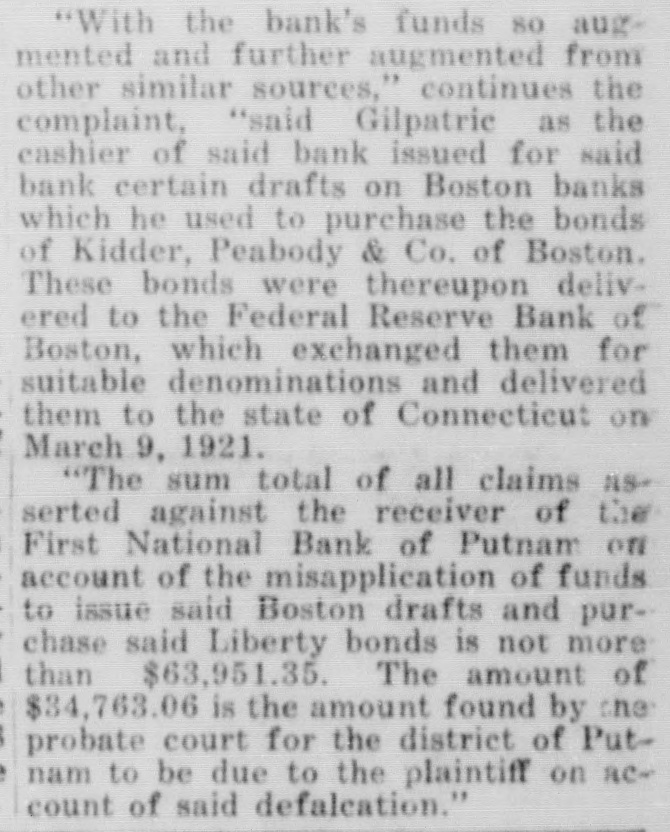
"With the bank's funds so augmented and further augmented from other similar sources," continues the complaint, "said Gilpatric as the cashier of said bank issued for said bank certain drafts on Boston banks which he used to purchase the bonds of Kidder, Peabody & Co. of Boston. These bonds were thereupon delivered to the Federal Reserve Bank of Boston, which exchanged them for suitable denominations and delivered them to the state of Connecticut on March 9, 1921. "The sum total of all claims asserted against the receiver of the First National Bank of Putnam on account of the misapplication of funds to issue said Boston drafts and purchase said Liberty bonds is not more than $63,951.35. The amount of $34,763.06 is the amount found by the probate court for the district of Putnam to be due to the plaintiff on account of said defalcation."


Article from Putnam Patriot, July 9, 1926

Click image to open full size in new tab

Article Text

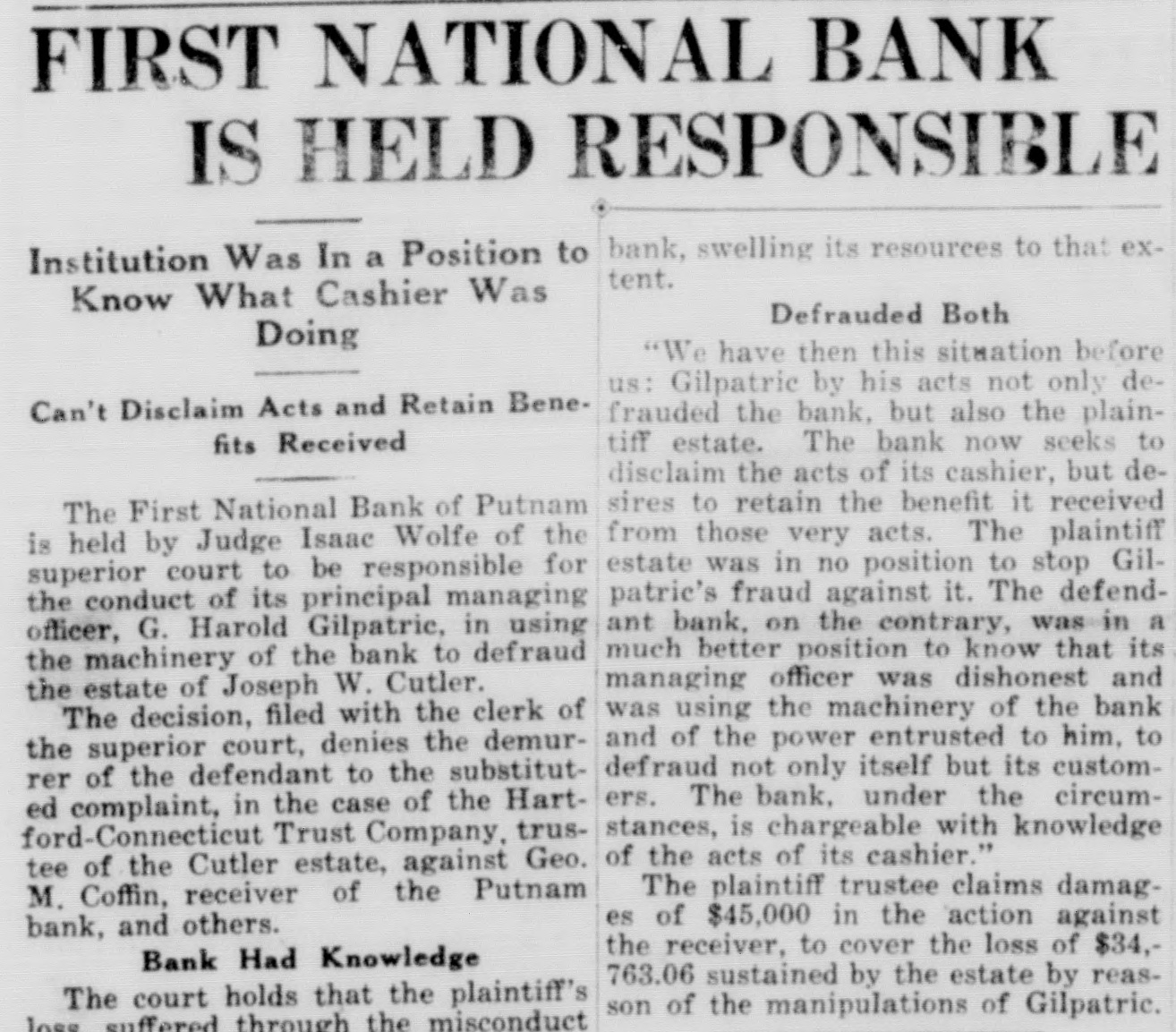
FIRST NATIONAL BANK IS HELD RESPONSIBLE bank, swelling its resources to that exInstitution Was In a Position to tent. Know What Cashier Was Defrauded Both Doing "We have then this situation before us: Gilpatric by his acts not only deCan't Disclaim Acts and Retain Benefrauded the bank, but also the plaintiff estate. The bank now seeks to fits Received disclaim the acts of its cashier, but desires to retain the benefit it received The First National Bank of Putnam from those very acts. The plaintiff is held by Judge Isaac Wolfe of the estate was in no position to stop Gilsuperior court to be responsible for patric's fraud against it. The defendthe conduct of its principal managing ant bank, on the contrary, was in a officer, G. Harold Gilpatrie, in using much better position to know that its the machinery of the bank to defraud managing officer was dishonest and the estate of Joseph W. Cutler. was using the machinery of the bank The decision, filed with the clerk of and of the power entrusted to him, to the superior court, denies the demurdefraud not only itself but its customrer of the defendant to the substituters. The bank, under the circumed complaint, in the case of the Hartstances, is chargeable with knowledge ford-Connecticut Trust Company, trusof the acts of its cashier." tee of the Cutler estate, against Geo. The plaintiff trustee claims damagM. Coffin, receiver of the Putnam es of $45,000 in the action against bank, and others. the receiver, to cover the loss of $34,Bank Had Knowledge 763.06 sustained by the estate by reasThe court holds that the plaintiff's son of the manipulations of Gilpatric. lose suffered through the misconduct