Metropolitan National Bank (Kansas City, MO)

Episode Information

Episode UID
446401163
Episode Type
Run โ†’ Suspension โ†’ Closure
Bank Type
national
Bank ID
44640 national
Charter Number
4464
Start Date
November 1, 1896*
Location
Kansas City, Missouri (39.100, -94.579)

Metadata

Model
gpt-5-mini (chosen from majority vote of a three-model LLM ensemble)
Short Digest
83123dca051fa1b6

Response Measures

Capital injected

Other: Metropolitan National was effectively liquidated/absorbed by the National Bank of Commerce (purchase of deposits / consolidation) as the remedial measure.

Description

Transaction described as a voluntary liquidation (absorption by National Bank of Commerce); earlier run from failure of Missouri National prompted weakness.

Events (5)

1. November 12, 1890 Chartered
Source
historical_nic
2. November 1, 1896* Run
Cause
Local Banks
Cause Details
Run triggered by failure/distress of the Missouri National Bank about six months earlier (mentioned May 1897).
Newspaper Excerpt
The failure of the Missouri National bank six months ago was the cause of a lively run upon the Metropolitan
Source
newspapers
3. May 23, 1897 Suspension
Cause
Voluntary Liquidation
Cause Details
Metropolitan National's affairs wound up via absorption by National Bank of Commerce; described as a voluntary liquidation effected at a loss to stockholders.
Newspaper Excerpt
the National Bank of Commerce of this city will absorb the business of the Metropolitan National Bank, having decided to buy the deposits of the latter institution
Source
newspapers
4. June 30, 1897 Voluntary Liquidation
Source
historical_nic
5. March 24, 1900 Receivership
Newspaper Excerpt
The Mutual Life of New York has paid its $50,000 policy, held by the Metropolitan National bank as security for a debt, to the receiver of the bank, ...
Source
newspapers

Newspaper Articles (5)

Article from The Enterprise, July 22, 1896

Click image to open full size in new tab

Article Text

GOLD GOES; BONDS WILL COME. Enormous Exports of the Yellow Metal Cause a Slump in Values of Stocks-Another Bond Is ne Expected-Banks to the Rescue of the Gold Reserve. NEW YORK, July 21.-The sum of $3,380,000 in gold was withdrawn from the sub-treasury yesterday. Of this amount $3,030,000, consisting of $1,480,000 in coin and $1,550,000 in bars, is for export to Europe on to-day's steamers. The remaining $350,000, taken by Canadian bankers, was for use here. Extensive covering of short contracts steadied the stock market at intervals late in the day, but the feeble rallies invariably brought offerings of long stocks and near 2 o'clock prices in some cases were the lowest in years. The large engagements of gold for to-day and the increase in the number of shippers created an uneasy feeling. There were indications of the movement spreading and that Thursday's European steamers, unless all signs fail, will carry out round amounts of the metal. Burlington dropped to 63%, the lowest in its history, while certain of the industrials sold lower than in the panic last year. President Tappan, of the Gallatin national bank, late in the day secured pledges from New York banks to contribute in the aggregate $15,000,000 in gold to the United States treasury in exchange for legal tenders. KANSAS CITY. Mo., July 21.-All Kansas City banks yesterday ceased issuing gold, either in exchange for bills as payment of checks or withdrawals of deposits. Cashier Rule, of the Bank of Commerce, who returned from St. Louis in the morning, said the banks there will take the same action, The reason given by the bankers here for this move is that it was the evident intention of many depositors to withdraw their deposits in gold and hoard the yellow metal in the belief that it will go to a premium. WASHINGTON, July 21.-The heavy gol 1 engagements for export in New York yesterday caused treasury officials to fear that more will follow before the week is ended. The treasury gold reserve at noon had been reduced to $90,787,635. In the absence of both the president and Secretary Carlisle from Washington, no expression of opinion can be obtained from them, but treasury officials who possess their confidence do not hesitate to say that if necessary to maintain the gold reserve another bond issue will be resorted to.


Article from The Morning News, May 24, 1897

Click image to open full size in new tab

Article Text

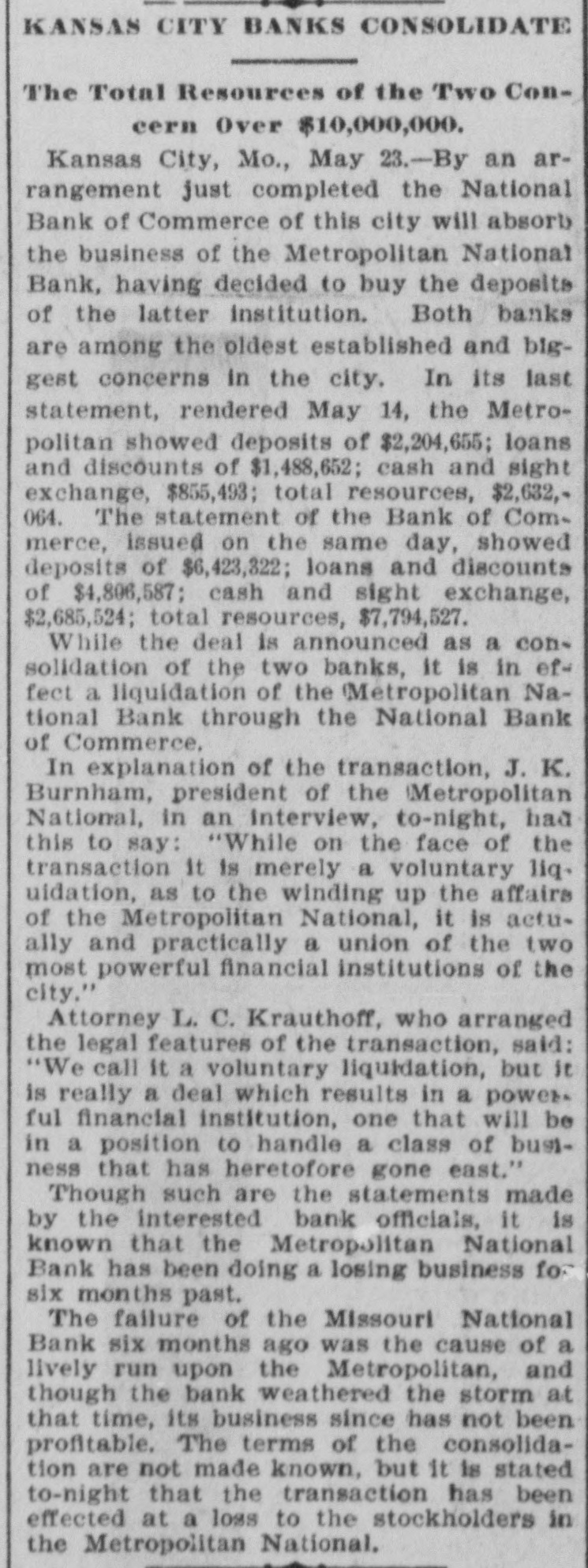
KANSAS CITY BANKS CONSOLIDATE The Total Resources of the Two Concern Over $10,000,000. Kansas City, Mo., May 23.-By an arrangement just completed the National Bank of Commerce of this city will absorb the business of the Metropolitan National Bank, having decided to buy the deposits of the latter institution. Both banks are among the oldest established and biggest concerns in the city. In its last statement, rendered May 14, the Metropolitan showed deposits of $2,204,655; loans and discounts of $1,488,652; cash and sight exchange, $855,493; total resources, $2,632,064. The statement of the Bank of Commerce, issued on the same day, showed deposits of $6,423,322; loans and discounts of $4,806,587; cash and sight exchange, $2,685,524; total resources, $7,794,527. While the deal is announced as a consolidation of the two banks, it is in effect a liquidation of the Metropolitan National Bank through the National Bank of Commerce. In explanation of the transaction, J. K. Burnham, president of the Metropolitan National, in an interview, to-night, had this to say: "While on the face of the transaction it is merely a voluntary liquidation, as to the winding up the affairs of the Metropolitan National, it is actually and practically a union of the two most powerful financial institutions of the city." Attorney L. C. Krauthoff, who arranged the legal features of the transaction, said: "We call it a voluntary liquidation, but it is really a deal which results in a power. ful financial institution, one that will be in a position to handle a class of business that has heretofore gone east." Though such are the statements made by the interested bank officials, it is known that the Metropolitan National Bank has been doing a losing business for six months past. The failure of the Missouri National Bank six months ago was the cause of a lively run upon the Metropolitan, and though the bank weathered the storm at that time, its business since has not been profitable. The terms of the consolidation are not made known, but it is stated to-night that the transaction has been effected at a loss to the stockholders in the Metropolitan National.


Article from The Saint Paul Globe, May 24, 1897

Click image to open full size in new tab

Article Text

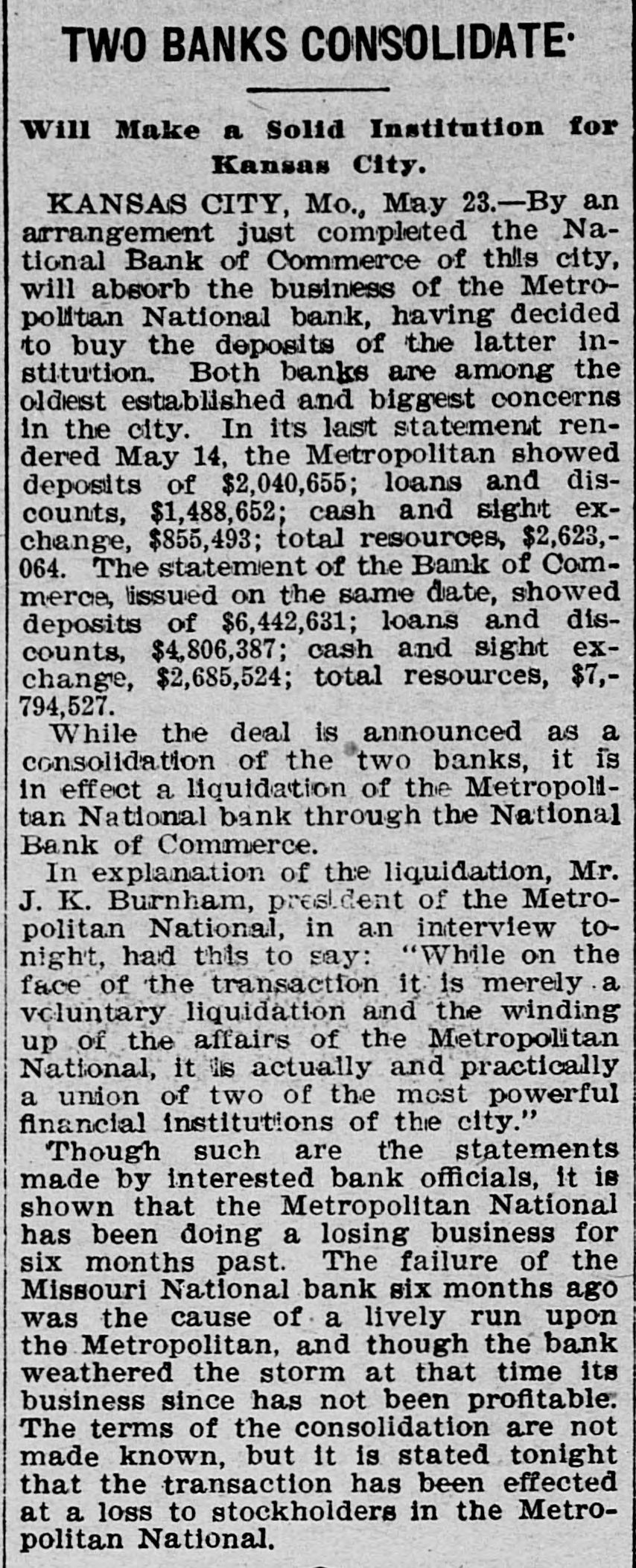
TWO BANKS CONSOLIDATE Will Make a Solid Institution for Kansas City. KANSAS CITY, Mo., May 23.-By an arrangement just completed the National Bank of Commerce of this city, will absorb the business of the Metropolitan National bank, having decided to buy the deposits of the latter institution. Both banks are among the oldest established and biggest concerns in the city. In its last statement rendered May 14, the Metropolitan showed deposits of $2,040,655; loans and discounts, $1,488,652; cash and sight exchange, $855,493; total resources, $2,623,064. The statement of the Bank of Commerce, issued on the same date, showed deposits of $6,442,631; loans and discounts, $4,806,387; cash and sight exchange, $2,685,524; total resources, $7,794,527. While the deal is announced as a consolidation of the two banks, it is in effect a liquidation of the Metropolitan National bank through the National Bank of Commerce. In explanation of the liquidation, Mr. J. K. Burnham, president of the Metropolitan National, in an interview tonight, had this to say: "While on the face of the transaction it is merely a voluntary liquidation and the winding up of the affairs of the Metropolitan National, it is actually and practically a union of two of the most powerful financial institutions of the city." Though such are the statements made by interested bank officials, it is shown that the Metropolitan National has been doing a losing business for six months past. The failure of the Missouri National bank six months ago was the cause of a lively run upon the Metropolitan, and though the bank weathered the storm at that time its business since has not been profitable. The terms of the consolidation are not made known, but it is stated tonight that the transaction has been effected at a loss to stockholders in the Metropolitan National.


Article from The Salt Lake Herald, May 24, 1897

Click image to open full size in new tab

Article Text

It is a Great Union. Kansas City, May 23.-In explanation of the liquidation, Mr. J. K. Burnham, president of the Metropolitan National, in an interview tonight, had this to say: "While on the face of the transaction it is merely a voluntary liquidation and the winding up of the affairs of the Metropolitan National, it is actually and practically a union of two of the most powerful financial institutions of the city." Though such are the statements made by interested bank officials it is known that the Metropolitan National has been doing a losing business for six months past. The failure of the Missouri National bank six months ago, was the cause of a lively run upon the Metropolitan. and though the bank weathered the storm at that time its business since has not been profitable. The terms of the consolidation are not made known but it is stated tonight that the transaction has been effected at a loss to the stockholders in the Metropolitan National.


Article from The Meeker Herald, March 24, 1900

Click image to open full size in new tab

Article Text

# COLORADO NOTES. The corner stone of the handsome new Masonic temple at Victor was laid on the 15th. Rev. J. B. Francolon, pastor of the parish of Manitou, has resigned his charge and left the city. He will be succeeded by Rev. John Kenny, late chaplain of Montcalm sanitarium. The companies which had policies out on the life of Frank E. Tyler, the Kansas City man who was burned to death near Alpine, Colo., last summer, have given up the attempt to prove that the case was another Fraker swindle and will pay up. Over one hundred residences are now under course of construction at Rocky Ford and arrangements have been made for the erection of new business blocks. The American Sugar Beet Company is pushing work on the sugar factory, 100 additional men having been put to work during the week. The Mutual Life of New York has paid its $50,000 policy, held by the Metropolitan National bank as security for a debt, to the receiver of the bank, and the smaller policies will be paid in a day or two. Detectives have been working on the case for months, but have not been able to substantiate the fraud theory. After considerable litigation between the Colorado & Southern Railroad Company and the city of Pueblo, the former, in consideration of the city vacating certain ground for its benefit, has made an appropriation of $5,000 to the city, to be used in the construction of the First street viaduct across the Fountain river and the Colorado & Southern tracks. Work will be resumed on the new viaduct. What appears to have been a dastardly attempt to burn the J. J. Maher Mercantile Company's building and Masonic hall, at Ouray, was made last Tuesday night, by placing a sack saturated with kerosene in some boxes under the rear stairway and setting fire to it. About sixty ladies of the order of Rebekah were holding a banquet in the lodge room, and they discovered the fire in time to avert a catastrophe. The constable of the precinct was arrested on suspicion at midnight. The National Beet Sugar Company, now erecting a half million dollar sugar factory, fifty miles east of Pueblo on the Missouri Pacific railroad, have 300 ment at work and expect to complete the factory by October 1st. This company proposes to raise its own beets, and has prepared about 4,000 acres of ground for this year's crop. Two trainloads of experienced beet growers will leave April 1st for Sugar City. With their arrival will be gin the planting of the first beet sugar crop in Otero county. Colorado College has lately been offered $50,000 toward the endowment of a science building, provided $60,000 for building purposes be secured by April 1st. The unexpectedness of the offer and the shortness of the time will necessitate great and unceasing efforts on the part of the college to meet the conditions. General Palmer has given $25,000, Mr. Howbert $2,500, and other gifts bring the total up to nearly $35,000. So there remains $25,000 to be raised in two weeks. A series of suits has been commenced in the United States courts covering the taking of timber, coal and other materials from government land. The first of the suits was filed on February 14th, when the government accused the Denver Tramway Company of cutting ties on government-land without permission. This suit includes not only the Tramway company and its officers, but also the Denver, Leadville & Gunnison railroad. The suit is a civil one for the value of the timber taken. The damages are placed at $10,489. Last Friday a second sult was filed for damages against Allen M. and E. T. Ghost, it being charged that they had taken $4,810 worth of coal from government land. The franchise of the Ouray and Red Mountain toll road, the connecting link on the Ouray route of the circle trip so many people from all parts of the world have traveled, will expire next month. The people of Ouray county expect the company, at the head of which is Otto Mears, to give up possession at that time, although a new corporation is said to have been organized for the purpose of assuming control. A recent decision in a Clear Creek county case held that no individual or corporation could take charge of a toll road after the life of a first franchise had expired. The Ouray road has been traveled for twenty years by passengers taking the stage at Silverton, and has been a bonanza for the owners. The Denver Republican says: Grand Junction will be colonized by Mormons. An influx of families from the city of the saints is now certain. Forty families have already made arrangements to take up in the Colorado beet sugar town. Many other families of the same faith are said to have decided to follow the forty now on the way to Grand Junction, and that Grand Junction will soon be so largely populated by Mormons that they may be able to control its politics is now thought to be highly probable. The Grand Junction sugar-beet factory is preparing to do a much larger business this year than last. Grand Junction citizens who were in Denver yesterday express the fear that too large an influx of Mormons would take the political control of affairs out of the hands of those who have lived in Grand Junction for years. An effort will be made to guard against this.