
First National Bank (Sewickley, PA)

Episode Information

Episode UID
446201091
Episode Type
Suspension β†’ Reopening
Bank Type
national
Bank ID
44620 national
Charter Number
4462
Start Date
November 15, 1890
Location
Sewickley, Pennsylvania

Metadata

Model
gemini-3-flash-preview (chosen from majority vote of a three-model LLM ensemble)
Short Digest
e32bdbbba5c64f91

Response Measures

None

Description

The bank was affected by the March 1933 Pennsylvania state banking holiday and the subsequent federal holiday.

Events (5)

1. November 10, 1890 Chartered
Source
historical_nic
2. November 15, 1890 Other
Newspaper Excerpt
The First National Bank of Sewickley opened for business yesterday in its handsome quarters, on Beaver street.
Source
newspapers
3. March 4, 1933 Suspension
Cause
Government Action
Cause Details
State-wide banking holiday declared by Governor Pinchot in response to national financial crisis.
Newspaper Excerpt
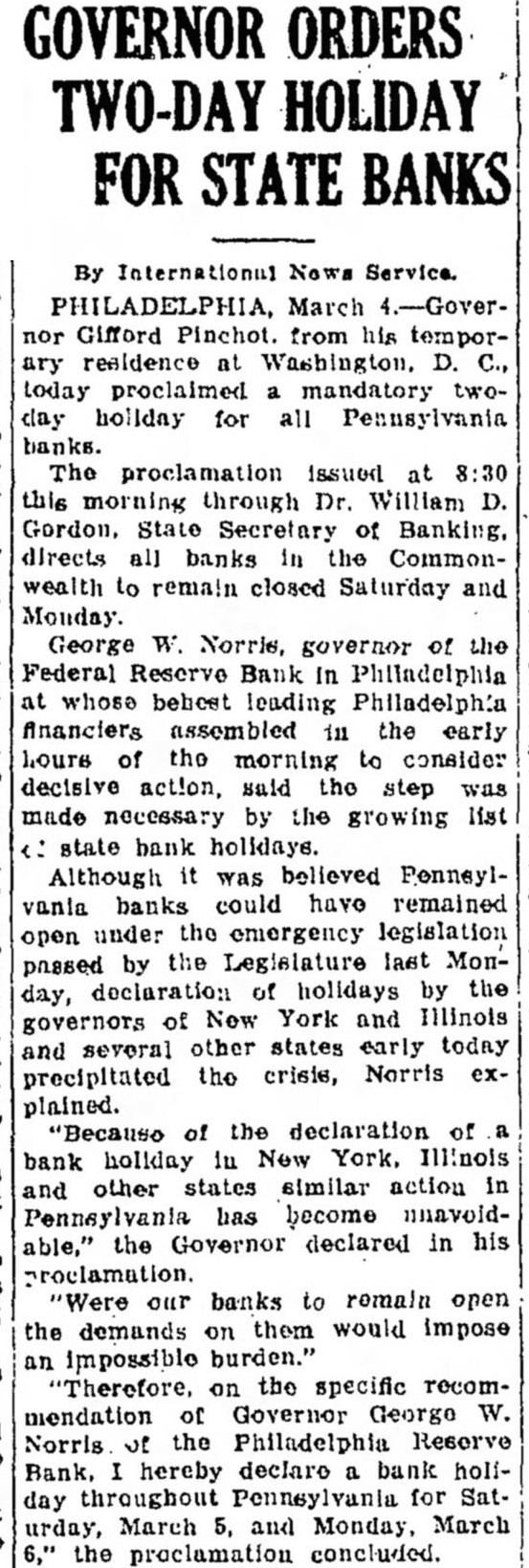
I hereby declare a bank holiday throughout Pennsylvania on Saturady, March 4, 1933, and Monday, March 6, 1933.
Source
newspapers
4. March 15, 1933 Reopening
Source
newspapers
5. July 14, 1933 Voluntary Liquidation
Source
historical_nic

Newspaper Articles (4)

Article from Pittsburg Dispatch, November 16, 1890

Click image to open full size in new tab

Article Text

the year. Not Up to the Mark. It was nobodys fault that a batch of panicky news came on the day set for the sale of the Exchange building, but the conjunction was unfortunate, as it no doubt prevented a deal. According to previous notice, the building was put under the hammer yesterday. There was a large crowd in attendance. The first bid was $90,000, or $2,000 a foot. The next was $100,000, and the next $125,000. Then, after a short pause, it was increased to $130,000 and then to $140,000. Another short breathing spell ensued, and then followed the best bid of the day, $145,000. This being $5,000 below the limit, and there being no prospect of raising it, the sale was adjourned. The sale failed to attract as many capitalists as had been expected, but as they were well represented by real estate agents, many of whom were present, their absence,it is thought, made no difference. Some curiosity was expressed to find a reason for the non-appearance of the gentleman who, as reported all along had for months had a standing bid of $150,000 ready to launch forth at the first opportunity. East End Realty. Business property in the East End has scored a big advance in prices in the last five years, and the demand for it is steadily widening and taking in a greater scope. Several sales made quite recently show clearly that buyers think well of the business advantages possessed by this part of the city. One of these involved the property on the northeast corner of Frankstown avenue and Station street, lot 30x100 feet, which brought $14,000. A lot 64x190, in the same locality, was picked upat a price approximating $23,000. The other transactions referred to were of less importance from a financial point of view, but equally significant as showing an active demand for the kind of property in question at good round figures. Homes for the People. Rapid transit has come to be the most important factor in the development of the suburban districts and the founding of country houses. It has rendered thousands of acres accessible to the industrial classes which a few years ago were practically worthless because of their isolation from the business centers. As the system of rapid transit is developed the movement of population toward the suburbs will increase, until in a few years they will be thickly built up. There is no reasonable doubt that this will be the outcome. With such a prospect few, if any, will deny that real estate in any of the surrounding districts is a good purchase at present prices. The Cost of Water. W. B. Bull, Superintendent of the Quincy, Ill., water works, furnishes the following table, taken from the Erie, Pa., water works report. It gives the cost of water to the average householder in 25 cities, compiled from official reports: Allegheny City, $24 50; Boston, $37 25; Buffalo, $25 50; Chicago, $21 75; Columbus, O., $32 80; Dayton, O., $45 80; Detroit, $28 25; Erie, Pa.. $21 75; East Saginaw, Mich., $26 50; Fall River. Mass., $31; Grand Rapids, Mich,, $33; Indianapolis, $32; Lawrence, Mass., $25 80; Milwaukee, $22; Minneapolis, $26; Newark, N. J., $26 25; New York City, $32 75; Omaha, Neb., $30; Philadelphia, $28 75: Pittsburg. $23 50: Sandusky. O., $25 50: St. Paul, $24 80: Syracuse, $31 75; Toledo, $28 50; Utica, N. Y., $31 50. Itappears from the above statement that $28 66 per annum is the average price paid for water by the householder circumstanced as above in the United States, if the above 25 cities afford a fair basis from which to construct an average. The Building Record. During the past week 31 permits were issued, representing 37 buildings-7 brick, 27 frame and 3 ironclad, the total cost of all being $51,432. The Twenty-first ward led with eight, followed by the Fourteenth, Eighteenth and Thirty-second, each having four buildings. The number of permits issued the previous week was 46, representing 51 buildings. The total number of permits issued this year to date is 15,997, representing 2,695 buildings. Yesterday's list follows: Charlotte J. Dawes, brick two-story and mansard dwelling, 83x40 feet, on Craig street, Fourteenth ward. Cost, $5,300. Joseph Bowden, two frame two-story dwellings, 20x16 feet each, on Cobden street, Twentyseventh ward. Cost. $2,300. Iron City Car Company, frame one-story office, 16x20 feet, on Pennsylvania Railroad, Twenty-first ward. Cost, $200. Margaret A. Lowry. frame two-story dwelling, 18x30 feet, on La Belle street, Thirty-second ward. Cost, $950. Business News and Gossip. There was considerable talk on Fourth ave. nne yesterday afternoon in regard to the embarrassment of the Barings, but as it was not a failure, and as nobody would lose anything by it, the conclusion reached was that the excitement over it wouldsoon subside. All concurred in saying that Pittsburg would not be affected beyond, perhaps, making financiers more cau tious in extending loans. W. I. Breane has just completed a fine three story business house at the intersection of Herron and Wylie avenues. There was a good movement in real estate last week. A season of dry weather is all that is needed to give it a boost. Buyers are ready and waiting. Property owners in upper Allegheny are anxiously awaiting the advent of rapid transit That part of the Northside is full of pictur esque building sites, and they will no doubt be eagerly sought for as soon as they can be quickly and conveniently reached. It is only a question of time when the Home wood race track will be cut up into building lots. The movement toward that end is gain ing strength every day. The First National Bank of Sewickley opened for business yesterday in its handsome quarters, on Beaver street. The bank starts off with a good line of deposits and indications of plenty of business. One of the city papers keep on quoting black berries and watermelons, showing that to it al seasons are the same. There were no large mortgages on file yester day, $4,500 being the most important. There were 32 in all, of which ten were for purchase money. Finishing touches are being put to the Ma sonic Temple in the East End. Heaters were put in yesterday. It will be dedicated about the first of the year, Movements in Real Estate. Samuel W. Black & Co. sold the property Nos. 49 and 51, Fourth avenue, having thero two three-story brick buildings, lot 46x54, 01 the corner of an alley, for a price approxima ting $25,000. Black & Baird sold to Mrs. Julia Hamilton new two-story and attic brick dwelling in Neg ley place, fronting 50 feet on the corner 0 Stanton avenue and Wayne alley by 133 feet in depth, being lot No. 1 in H. S. A. Stewart' plan, for $8,000 cash. Reed B. Coyle & Co. sold No. 145 Franklin street, Sixth ward, Allegheny, being a brici dwelling of eight rooms and all modern im provements, with lot 20x100 feet to an alley, for $7,000 cash. The purchaser is a well-known railroad man. Baxter, Thompson & Co. sold for W. R

Article from The Sun, August 17, 1893

Click image to open full size in new tab

Article Text

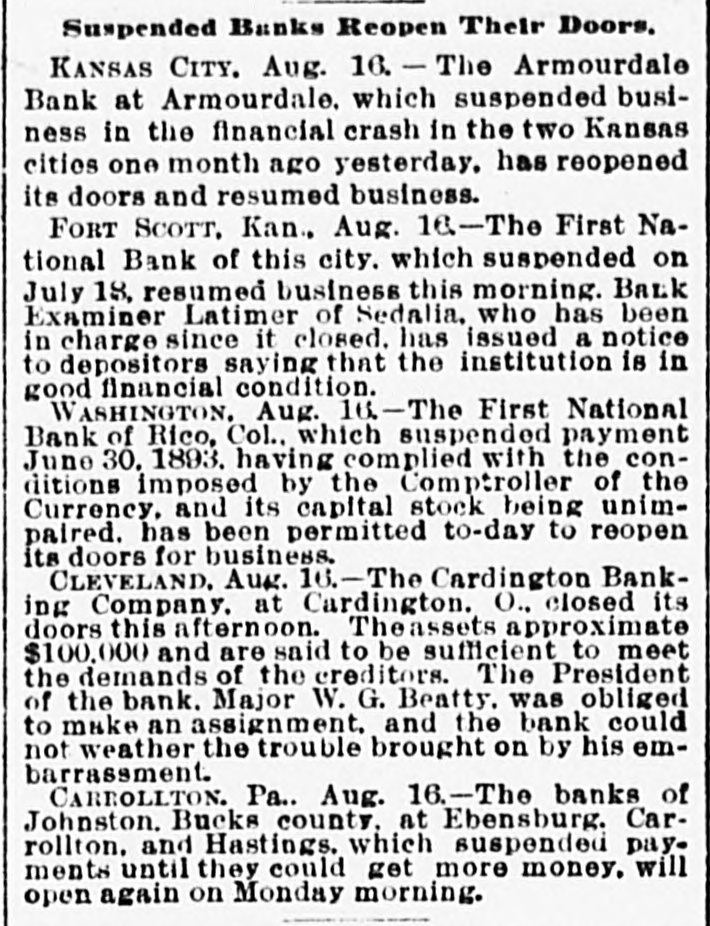
Suspended Banks Reopen Their Doors. KANSAS CITY. Aug. 16. - The Armourdale Bank at Armourdale. which suspended business in the financial crash in the two Kansas cities one month ago yesterday. has reopened its doors and resumed business. FORT SCOTT, Kan., Aug. 16-The First National Bank of this city. which suspended on July 18, resumed business this morning. Bank Examiner Latimer of Sedalia. who has been in charge since it closed. has issued a notice to depositors saying that the institution is in good financial condition. WASHINGTON. Aug. 16.-The First National Bank of Rico, Col., which suspended payment June 30. 1893. having complied with the conditions imposed by the Comptroller of the Currency. and its capital stock being unimpaired. has been permitted to-day to reopen its doors for business. CLEVELAND. Aug. 16.-The Cardington Banking Company. at Cardington. O., closed its doors this afternoon. Theassets approximate $100. 000 and are said to be sufficient to meet the demands of the creditors. The President of the bank. Major W. G. Beatty. was obliged to make an assignment. and the bank could not weather the trouble brought on by his embarrassment. CARROLLTON. Pa.. Aug. 16.-The banks of Johnston. Bucks county. at Ebensburg. Carrollton. and Hastings. which suspended payments until they could get more money. will open again on Monday morning.


Article from Evening Star, March 4, 1933

Click image to open full size in new tab

Article Text

# EARLY U. S. ACTION # PLANNED ON BANKS New York and Illinois Declare Holidays-Only Four States Unrestricted. (Continued From First Page.) Connecticut took similar action, bring- ing to 43 the list of States in which restrictions on withdrawals are opera- tive in some form or another. Only Montana, Colorado, North Da- kota and South Carolina remained without restrictions at noon today. Delaware's banks were open, but the State Legislature has already taken emergency action. These developments had brought from Representative Rainey, the next Speaker of the House, the prediction that "an extra session of Congress will be called at the earliest possible time." He said he felt that early next week, possibly Tuesday, would not be too soon. Pre- viously Rainey had told House mem- bers-elect to remain in Washington. Others at the Capitol said the session probably would begin Wednesday. The Federal Reserve Bank of New York was closed with all other bank- ing institutions of that State. The Federal Reserve Bank at Philadelphia also closed, under a holiday declared throughout Pennsylvania by Gov. Pin- chot. Later in the day the Minne- apolis Federal Reserve Bank suspended business. The closing of the New York Federal Reserve Bank meant the tying up of its huge gold reserve for the period of the holiday against withdrawal by either domestic or foreign agencies. In discussing the banking relief pro- gram, Senator Robinson said: "We do not know just when it will be completed, but it will be expedited all possible. The details can not be announced right now but you may be assured there will be no delay." Wagner Plans Action, Previously Senator Wagner, Demo- crat, of New York, had told newspaper men he would carry immediately to Democratic leaders an appeal for imme- diate emergency banking moves. In- formed at his hotel here of banking moratoria in New York and Illinois. Wagner said he would appeal this morn- ing to Democratic leaders to begin working out a program and some time this afternoon would call on Mr. Roose- velt with the same objective. A bank holiday, he said, "is the only thing to do" to meet the emergency of the banks themselves, but he added quick steps are necessary to enable them to reopen and continue opera- tions. Harvey Couch, Democratic member of the Reconstruction Finance CorpoΠ³Π°- tion, was the first White House caller this morning. He said after a brief conference with President Hoover he had discussed "matters incident to the banking situation," but declined to give details. Couch conferred last night with President-elect Roosevelt. Officials in Conferences. High officials both of the outgoing Republican and incoming Democratic administrations were in conference most of the night. Secretary of the Treasury Mills said afterward the Hoover administration would have no statement, but that governors of the Federal Reserve banks in Chicago and New York would have announcements. Demands Impossible. The hours between midnight and dawn saw banking officials in many States struggling with the problem, made acute by the flurrying of nervous- ness on the part of depositors. As a statement by the New York Clearing House Committee put it: "The unthinking attempt of the pub- lic to convert over $40,000,000,000 of deposits into currency at one time is, on its face, impossible." The statement added that the condi- tion clearing house banks is such that "they could, through the facilities of the Federal Reserve Bank, pay on de- mand every dollar of their deposits," but that withdrawals throughout the country as a whole have increased so that a "halt" is necessary "to enable the proper authorities to consider and adopt remedies to meet this situation, not for New York primarily, but for the Nation as a whole." Only a few States remained today in which restrictions on withdrawals had not been invoked. No Holiday in Virginla. In Virginia, Gov. Pollard said no general banking holidays would be de- clared because the State's laws already protect the banks and their depositors. In Maryland, the General Assembly early today approved the emergency banking legislation without a dissenting vote in either House. Gov. Ritchie signed it this morning, but said that the banking institutions of the State will not reopen Monday. The resources of the Reconstruction Finance Corporation earlier had been made available to hard-pressed, but solvent banks in States that have imposed moratoria on withdrawals. This was one of a number of de- velopments yesterday that included introduction of legislation to allow postal savings checking accounts and to confer upon the incoming admin- istration sweeping authority to main- tain the security of deposits. Reconstruction Corporation officials said their policy called for lending in- stitutions if the loans were well secured enough money to pay the percentage of deposits that could be withdrawn, provided the banks did not have the funds immediately available. It was emphasized this was not a new departure, but was simply the ap- plication of regulations decided upon for individual instances in the past to a situation spread into a number of States. Pinchot's Statement. Gov. Pinchot of Pennsylvania here for the inauguration issued the follow- ing statement: "Because of the declaration of a bank holiday in New York, Illinois and most of the other States, similar action in Pennsylvania has become unavoidable. "Were our banks to remain open, the demands upon them would impose an impossible burden. "Therefore, upon specific recom- mendation of Gov. Norris of the Phila- delphia Federal Reserve Bank, I hereby declare a bank holiday throughout Pennsylvania on Saturady, March 4, 1933, and Monday, March 6, 1933." Exchange Statement. A statement issued by the Govern- ing Committee of the New York Stock Exchange said: "The Governing Committee at a meeting held this morning in order to give full effect to the banking holiday declared by the Governor of the State of New York directed: "First, that the exchange be closed during such holiday: "Second, that members and firms registered on the exchange be pro- hibited from making any contracts for the purchase or sale or the borrowing or lending of any securities, and also from permitting their offices or facili- ties to be used for the purpose of mak- ing or carrying out any such contracts; "Third, that all deliveries be suspend- ed on all member contracts, except on such contracts as may be cleared by or settled through the Stock Clearing Corporation, and that in such cases deliveries shall be made as the Stock Clearing Corporation shall direct


Article from The Daily Courier, March 4, 1933

Click image to open full size in new tab

Article Text

GOVERNOR ORDERS TWO-DAY HOLIDAY FOR STATE BANKS By International Nows Service. PHILADELPHIA, March 4.-Governor Gifford Pinchot. from his temporary residence at Washington, D. C., today proclaimed mandatory twoday hollday for all Pennsylvania banks. The proclamation issued at 8:30 this morning through Dr. William D. Gordon, State Secretary of Banking, directs all banks in the Commonwealth to remain closed Saturday and Monday. George W. Norris, governor of the Federal Reserve Bank in Philadelphia at whose behest leading Philadelphia financiers assembled in the early Lours the morning to consider decisive action, said the step was made necessary by the growing list state bank holidays. Although it was believed Penneylvania banks could have remained open under the emergency legislation passed by the Legislature last Monday, of holidays by the governors of New York and Illinois and several other states early today precipitated the crisis, Norris explained. "Because of the declaration of bank holiday in New York, Illinois and other states similar action in Pennsylvania has become unavoidable," the Governor declared in his "Were our banks to remain open the demands on them would impose an impossible burden." "Therefore, on the specific recommendation of Governor George W. Norris of the Philadelphia Reserve Bank, hereby declare bank hollday throughout for Saturday, March 5, and Monday, March 6," the proclamation concluded.