Article Text
TILE COURTS.
Another Bill to Stop Suits Against
Bursted-Bank Stockholders.
Judge Drummond Decides the Title to
the Old Donegana Hotel.
Monday Afternoon's Proceedings Before
the State Supreme Court.
Full Text of Judge Miller's Decision in the
Mckee Whisky-Case.
New Suits, Bankruptcies, Con-
fessions, Judgrnents, Etc.
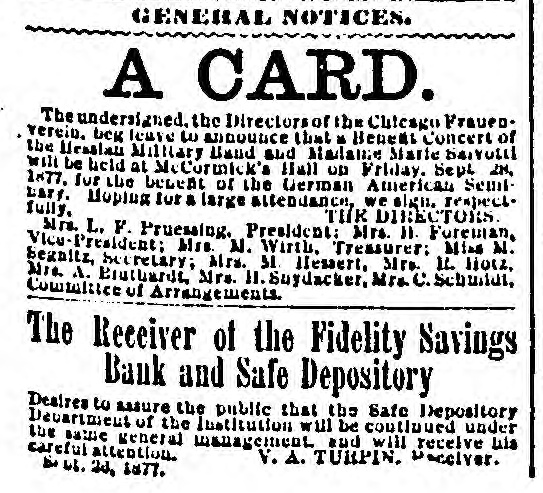
The expected bill to enforce the liability of the stockholders of the Fidelity Savings Bank and Bafe Depository, and to prevent suits by depositors against them, was filed yesterday by Dr. Turpin, the Receiver, and W. II. Potter, a depositor to the extent of $45, against John C. Ilaines, C. J. Haines, Jared Gage, George M. Gage, Frank J. Gage, Henry II. and George A. Shufeldt, Frank B. Tobey, E. 8. Williams, A. B. Merrill, Frank Merrlil, Cora Merrill, E. M. Haines, Melinda G. Haines, Fannie C. Haines, Edeline Bradway. Jeremiah Twohey, John R. Winterbotham, Emina M. Speth, E. J. Walsh, Mary II. Teed. Elizabeth Adams, Annie M. Brown, Helen M. Smith, Carrie W. Bali, J. E., Rood, Joseph Kuncera, John Bernhardt, W. L. Katzurn, J. II. Cruver, Elizabeth M. Price, George Wincock, G. W. Miller, J. A. Cameron, C. 8. Thornton, G. W. May, aud Amonetta S. Bickford. The Receiver sets out first his appointment as Receiver, the organization of the bank anıl its continuance in business until Sept. 24, when it became insolvent. From his examination he has ascertained already that the as-acts are less than the liabilitios by at least $200,-000, the amount of the capital stock. The liability of the stockholders, as he is informed, is to the depositors pro rata, and it is an asset of the bank, to be distributed according to the principles of equity, and is irrespective of the amount and value of the assets of the corpora-Hon. A large number of the creditors of the bank have begun suits against these stockholders, and there is great danger they will obtain judginents and secura priority of payment and Indquitable advantage. The Hability of the stockholders can only be established in a court of equity which may marshal the assets and determine the date of deposits, the time and good faith of trans-fers of stock, secure to the depositors as an ag-gregate body their rights, and provent the pref-erence of one depositor over another by his action at law.
The present stockholders in the bank are J. C. Haines, C. J. Haines, Jared Gage, George M. Gage, F. J. Gage, Heury IH. and George A. Shufeldt, A. B. Merrill, F. B. Tobey, E. S. Wiillams, Frank and Cora Merrill, Elijah M., Melinda G., and Fannie C. Haines, Edeline Bradway, Jero-miah Twolicy, and the bank itselt. J. R. Win-terbotham has been a stockholder within six months and is llable, though he does not hold any stock now. The Receiver therefore asks that an account be taken of the reasonable value of the assets of the bank and of its liabilities, that the stockholders be decreed to provide for any delleit to the extent of their stock, and that all parties who have begun suits against tho stockholders be restrained from prosecuting the same. Messrs. Hitchcock & Dupes appear for the Rocciver.
THE DONEGANA HOUBк.
Judge Drummond has just decided a case in-volving $39,000 and Obadiah Jackson's reputa-tion. The complainant was Janet Smith, ad-ministratrix of the estate of David Smith, who tiled a bill about a year ago against Obadiah Jackson and Edwin and Jo-seph Swift in the Circuit Court of Cook County to enforce n llen for $30,000 on what was known before the fire as the Done-gana House, on Clark street, near Polk. This property on the 1st of October, 1869, was sold to George N. Williams by C. C. Waite, and the same day Williams gave a note back to secure $300,000 of the purchase inoney secured by trust-deed to Obadiah Jackson on the property. The note was left with Jackson for collection, and in October, 1871, he transferred it to David Smith as his own property, to secure his own noto to Smith. Previously, and in October, 1808, Will-lams sold the property to a Mrs. Moody, and she in turn conveyed it in May, 1871, to Dr. Dyer. Ile kept it for about a year, and then sold it to Obailialı Jackson. All these conveyances were made subject to the trust-deed, and wero so expressed. During all this time Jackson pre-tended to hold the note for $30,000, and was occasionally making remittances to the owner of it, on the assumption that he still held it. The owner had no knowl-edge of Jackson's having pledged it to Smith. Some time subsequently Jackson desired to raise money on a pledge of the property, and claimed that he owned it, and that the $30,000 note had been pald, and that it had been burnt up in the Chicago firo of 1971. He thereupon produced a release of the trust-deed given by Williams to him, dated Oct. 2, 1871. This ro-lease ran to Dr. Dyer, but although it bore the above date it was shown on the trial that it was not executed at that time, and it was not acknowledged and recorded unill August. 1872. After having obtained a loan from Meaurs. Swift by means of this release on the assump-tion that he was the owner of the property, and that it was clear from the lien of the trust-doed, he obtained additional money upon the security of the property from a party named Carroll.
The question, therefore, was whether or not the lien of the trust-deed riven by Williams to Jackson, and by which the $30,000 noto was secured, was valid as against these subsequent olaims of the Swifts and Carroll. A fraud had been perpettrated by Jackson by which some of the litigants had to suffer, and the point was who was to be the loser.
Judge Drumnond held that the lien undertho trust-deed of 1803 was valli, and paramount to ths clatins of the Swifts and Carrolls. Even if it were not prior in point of time, it appeared that all the deeds of conveyanco from Williams down to Jackson had been made subject to this trust-deed. When the conveyance was made to Jackson in 1671 by Dyer, bo was clothed with the right of property and had ceased to occupy an indifferent and disinterested position of a mere Trustee, and therefore his acts had not the same significance, and the law would not at-tach the same effect to that as though he had been only a Trustee, and had not claimed to bo owner of the property. In other words, white all reasonable allowance would be made for hla acts as mero Truster when he became the owner of the property, his arts wero to bo criticised and were subject to suspicion as such owner, because then it was for his interest as the owner of the property to show or to maku partics who were dealing with him bellova tint this trust-deed had ceased to operate any longer as a llen. So when he made statements to the counsel for the Swifts or to others that the note was pald, they had noright to rely on such stato-ments, and more especially as in the case of that made to the Swifts, as the note had not at that time reached maturity. As to the release that was made by Jackson to Dyer purporting to bear date Oct. 3, 1871, although that was before he came directly interested in the property, still it was not acknowledged or recorded unth after he became owner of the property, and, there-fore, that was a circumstance suspicious of itself. It did not take effect as against tho prior, bona-lide holder of the $30,000 note sud prevent the operation of the lien of the trust-deed. It was the duty of the persons claiming