4406. Fidelity Bank (Chicago, IL)

Bank Information

Episode Type
Run → Suspension → Closure
Bank Type
state
Start Date
August 31, 1877
Location
Chicago, Illinois (41.850, -87.650)

Metadata

Model
gpt-5-mini
Short Digest
e9b2c113

Response Measures

Accommodated withdrawals, Full suspension, Books examined

Other: Receiver appointed and estate wound up; dividends paid in part and assets sold.

Description

Contemporary articles describe a run on the Fidelity (Aug 31, 1877) tied to panic from the collapse of the State Savings institution. The Fidelity subsequently becomes a 'defunct' institution with Receiver Dr. W. A. Turpin appointed and receivership proceedings and asset sales through 1878–1879, indicating it did not resume normal operations. Cause of the initial run is local bank failures/contagion rather than a discrete misinformation event.

Events (4)

1. August 31, 1877 Run
Cause
Local Banks
Cause Details
Depositors panicked by the collapse/distress of the State Savings institution—The collapse of the State has made them feel strangely insecure.
Measures
Bank paid depositors at the paying-window; officers kept ready cash on hand and pledged to stand by depositors; limited payments to accommodate rush.
Newspaper Excerpt
the run continues upon the Fidelity Bank...the crowd was peculiarly quiet and respectable...The bank will reopen at 10 o'clock this morning
Source
newspapers
2. September 1, 1877* Suspension
Cause
Bank Specific Adverse Info
Cause Details
After continued withdrawals and broader failures in the savings-banks area the institution was taken into receivership; insolvency and asset illiquidity cited in later reports.
Newspaper Excerpt
the Fidelity ... defunct institution ... Receiver, Dr. W. A. Turpin
Source
newspapers
3. November 9, 1877 Receivership
Newspaper Excerpt
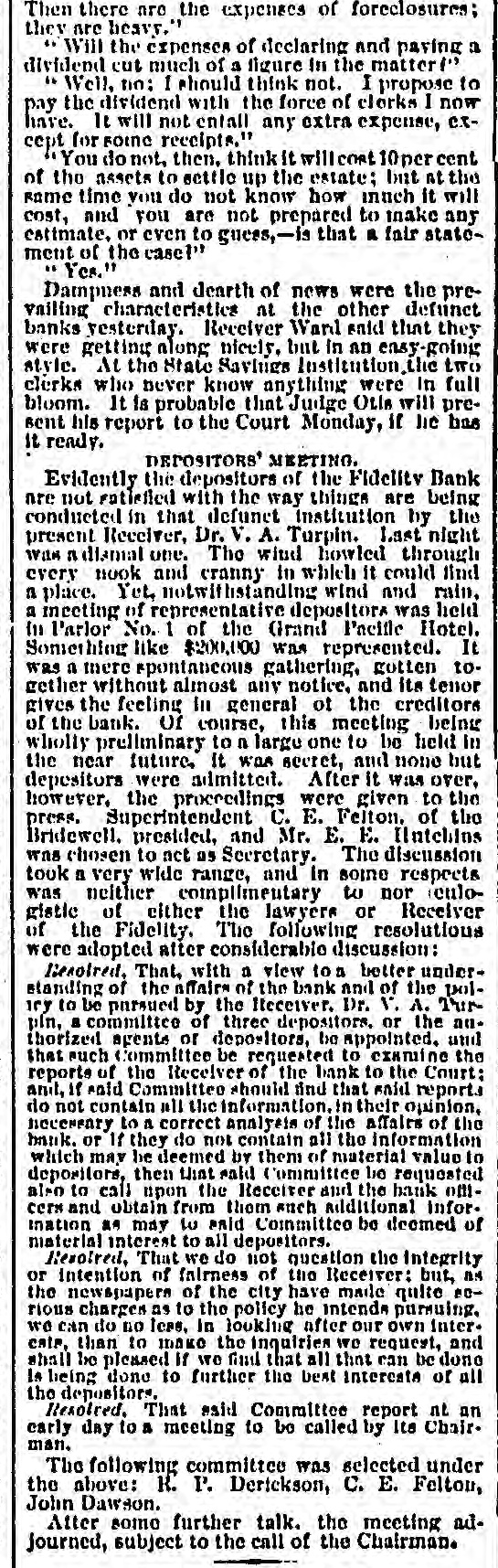
DEPOSITORS' MEETING...the depositors of the Fidelity Bank are not satisfied with the way things are being conducted in that defunct institution by the present Receiver, Dr. W. A. Turpin.
Source
newspapers
4. April 23, 1879 Other
Newspaper Excerpt
The Fidelity Bank Building, the Safe Depository, and Hooley's Theatre were sold ... Judge Munroe refused to confirm the sale ... Receiver Turpin would have paid the creditors some 12 per cent at once. The Receiver proposes to do nothing until fall ... but thinks ... will be able to pay nearly 10 per cent ...
Source
newspapers

Newspaper Articles (11)

Article from Chicago Daily Tribune, August 31, 1877

Click image to open full size in new tab

Article Text

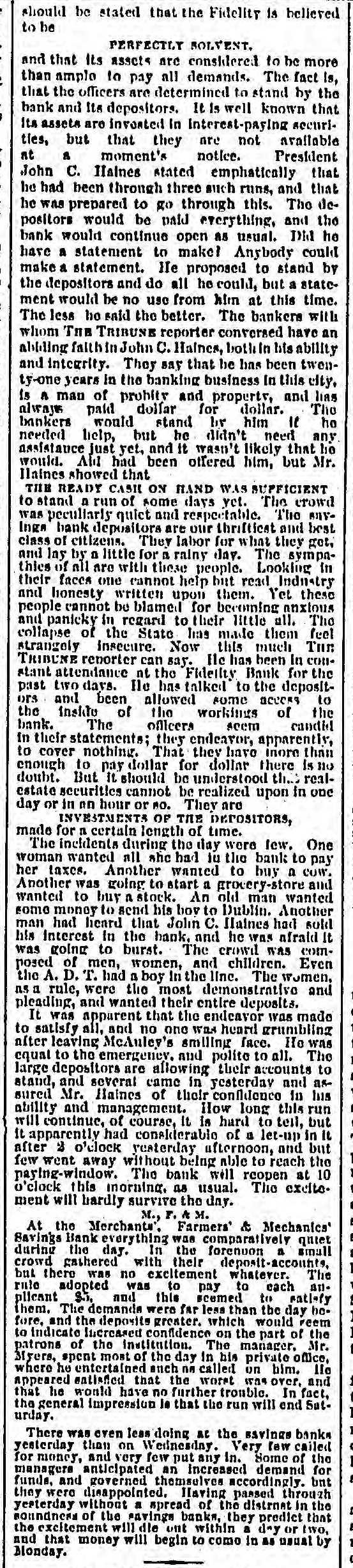
should be stated that the Fidelity is believed to he PERFECTLY SOLVENT. and that Its assets are considered to be more than ample to pay all demands. The fact is, that the officers are determined to stand by the bank and Its depositors. It Is well known that Its assets are invosted In Interest-paying securities, but that they are not available at a moment's notice. President John C. Haines stated emphatically that he had been through three such runs, and that he was prepared to go through this. The depositors would be paid everything, and the bank would continue open as usual. Did he have a statement to makel Anybody could make a statement. He proposed to stand by the depositors and do all he could, but a statement would be no use from him at this time. The less he said the better. The bankers with whom Tne TRIBUNE reporter conversed have an abbiling faith In John C. Haines, both In his ability and integrity They say that he has been twonty-one years In the banking business In this city, is A man of probity and property, and has always paid dollar for dollar. The bankers would stand br him If he needed help, but he didn't need any assistance just yet, and it wasn't likely that he would. Ald had been offered him, but Mr. llaines showed that THE READY CASH ON HAND WAS SUFFICIENT to stand a run of some days yet. The crowd was peculiarly quiet and respectable. The anyInga bank depositors are our thrifticst and best class of citizens. They labor for what they get, and Iny by a little for a rainy day. The sympathies of all are with these people. Looking in their faces one cannot help but read Industry and honesty written upon them. Yet these people cannot be blamed for becoming anxious and panicky in regard to their little all. The collapse of the State has made them feel strangely insecure. Now this much Tun TRIBUNE reporter can say. He has been In constant attendance nt the Fidelity Bank for the past two days. Ile has talked to the depositors and been allowed some access to the inside of the workings of the bank. The seem candid officers in their statements; they endeavor, apparently, to cover nothing. That they have more than enough to pay dollar for dollar there Isno doubt. But It should be understood th... realestate securities cannot be realized upon in one day or in nn hour or no. They are INVESTMENTS OF THE DEPOSITORS, made for a certain length of time. The incidents during the day were few. One woman wanted all she had ju the bank to pay her taxes. Another wanted to buy a cow. Another was going to start a grocery-store and wanted to buy n stock. An old man wanted some money to send his bov to Dublin. Another man had liend that John C. Ilaines had sold his Interest In the bank. nnd he was nfraid It was going to burst. The crowd was composed of men, women, and children. Even the A. D. T. had a boy In the linc. The women, and as rule, were the most demonstrativo pleading, and wanted their entire deposits. It was apparent that the endeavor was made to satisfy all, and no one was heard grumbling after leaving McAuley's smiling face. He was equal to the emergency, and polito to all. The large depositors are allowing their accounts to stand, and several came in yesterday and assured Mr. Haines of their confidence in his ability and management. How long this run will continue, of course, It is hard to tell, but it apparently had considerable of a t-up in It after 2 o'clock yesterday afternoon, and but few went away without being able to reach the paying-window. The bank will reopen at 10 o'clock this morning. as usual. The excite. ment will hardly survive the day. M., F. At the Merchants Farmers & Mechanics' Savings Bank everything was comparatively quiet during the day. In the forenuon a small crowd gathered with their deposit accounts, The but there was no excitement whatever. rule adopted was to pay to each all. plicant $5, and this scemed to eati-fy them. The demands were far less than the day hefore. and the deposits greater. which would reem to indicate Increased confidence on the part of the patrons of the Institution. The manager. Mr. Myers, spent most of the day In his private office, where he entertained such na called on him. lle appeared satisfied that the worst was over, and that he would have no further trouble. In fact, the general impression is that the run will end Saturday. There was even less doing at the savings banks yesterday than on Wednesday. Very few cailed for money. and very few put any In. Some of the managers anticipated an Increased demand for funds, and governed themselves accordingly. bnt they were dieappointed. Having passed through yesterday without a spread of the distrnat in the moundness of the savings banks, they predict that the excitement will die out within a day or two, and that money will begin to como in as usual by Monday.

Article from The New York Herald, September 1, 1877

Click image to open full size in new tab

Article Text

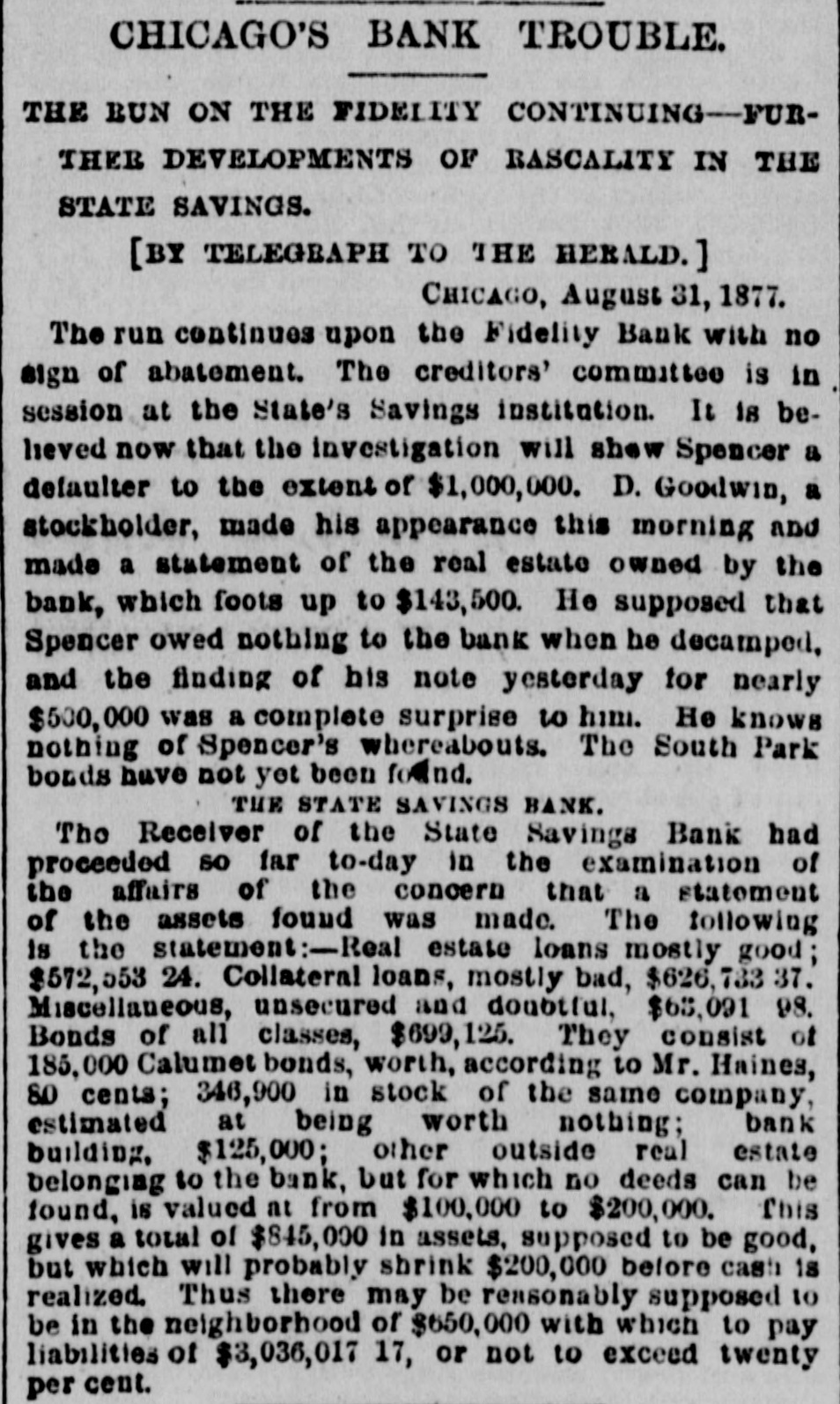
CHICAGO'S BANK TROUBLE. THE RUN ON THE FIDELITY CONTINUING-FUR THER DEVELOPMENTS OF RASCALITY IN THE STATE SAVINGS. [BY TELEGRAPH TO THE HERALD. ] CHICAGO, August 31, 1877. The run continues upon the Fidelity Bank with no sign of abatement. The creditors' committee is in session at the State's Savings institution. It is believed now that the investigation will shew Spencer a defaulter to the extent of $1,000,000. D. Goodwin, a stockholder, made his appearance this morning and made a statement of the real estate owned by the bank, which foots up to $143,500. He supposed that Spencer owed nothing to the bank when he decamped, and the finding of his note yesterday for nearly $500,000 was a complete surprise to him. He knows nothing of Spencer's whereabouts. The South Park bonds have not yet been found. THE STATE SAVINGS BANK. The Receiver of the State Savings Bank had proceeded so far to-day in the examination of the affairs of the concern that a statement of the assets found was made. The following is the statement:-Real estate loans mostly good; $572,553 24. Collateral loans, mostly bad, $626, 733 37. Miscellaneous, unsecured and doubtful, $65,091 98. Bonds of all classes, $699,125. They consist of 185,000 Calumet bonds, worth, according to Mr. Haines, so cents; 346,900 in stock of the same company, estimated at being worth nothing; bank building, $125,000; other outside real estate belonging to the bank, but for which no deeds can be found, is valued at from $100,000 to $200,000. This gives a total of $845,000 in assets, supposed to be good, but which will probably shrink $200,000 before cash is realized. Thus there may be reasonably supposed to be in the neighborhood of $650,000 with which to pay liabilities of $3,036,017 17, or not to exceed twenty per cent.


Article from Chicago Daily Tribune, September 29, 1877

Click image to open full size in new tab

Article Text

# THE COMMERCIAL LOAN. LIABILITY OF STOCKHOLDERS DETERMINED. Amid the crash of the Savings, the Merchants', Farmers' & Mechantes, and the Fidelity, the affairs of the defunct Commercial Loan & Trust Company have been completely forgotten by the public. Its efficient Receiver, J. D. Harvey, and persevering attorney, Gen. G. W. Smith, have not forgotten it, and yesterday Gen. Smith was winner in a chancery suit which promises to bring more assets to the depositors. The bank was organized in 1859 under a special charter, which provided among other things that "The stockholders in this corporation shall be holden to the creditors thereof for the amount of the capital stock each shall hold in the same." The bank made an assignment to Mr. Harvey in December, 1875, for the benefit of all its creditors ratably. Three dividends have since been declared of 56¼ per cent in all, nod the bank has been successful in an important suit in which George F. Harding was defendant, from the proceeds of which, about $24,000,-together with moneys which the Assignee will realize froin other sources, a further dividend of 13 per cent will be paid in October. This will leave the bank or the Assignee with a considerable amount of incumbered real estate and some few first mortrages. There will still be a deficit, however, of 15 or 20 per cent on the whole indebtedness of about $4:10,000. The Assignee and creditors, deeming the stockholders liable under the above-mentioned section, In 1876 took steps to enforce that liability, and a bill was filed in the Superior Court for that purpose. When it was brought to the attention of Judge Moore, however, he declined to hear it, because of his interest in the question in connection with some other bank. The case was therefore transferred to the Circuit Court, and came up a week ago ou the deinurrer to the bill, before Judge Williams. He, too, being interested, declined to hear the case, and it was transferred to Judge McAllister. Yesterday the case was argued before Judre McAllister on the demurrers to the bill, and they were overruled. The bill was filed by the Assignee and Henry Lamperter, one of the creditors of the bank, on behalf of himself and all other creditors. The bank and all the stockholders from Jan. 1, 1873, down to the date of the assignment were made defendants. The bill set out that the estate of the bank was not sufficient to pay its debts, and asked that the unsold portion of such estate might be scheduled, and its value ascertained; that the liability of each stockholder for the debts contracted by the corporation, and still existing, during the time he was such stockholder, might be ascertained and marshaled, and that the stockholders might be compelled to pay to the Assignee, or to some person to be appointed by the Court, the amount for which he should be found liable, and that the funds so derived should be distributed ratably among the classes of creditors who should be entitled to the same. THE OPPOSITION TO THE BILL was based principally upon the ground, first, that there was no liability under the charter; second, that a suit at law by each creditor against such stockholder as he should select was the proper way of enforcing the liability, if such existed, and that a sult in equity would not lie; third, that, even it a suit in equity would lie, it would not lis either on behalf of all creditors of the bank or against all the stockholders,-in other words, that there could be no combination by which all the interests could bo brought together and determined in one suit. The Court overruled the demurrers and held that the Assignee was the proper party, because his attitude to the sult was in the nature of a trustee to the estate, and the amount derived from the stockholders would operate to determine the amount which should be paid by him from the estate to creditors. For example, If any one class of creditors should, by reason of being able to enforce their claims against a solvent stockholder, be able to collect a large share of the remaining portion of their debt, they would not be entitled to share ratably with the other creditors in the distribution of the estate by the Assignee. That is, that the Assigned was entitled to go into a court of equity to ask directions concerning the distribution of the estate, and that the Court had power to direct him so to distributo as to do equity to all concerned. The Court also held that in order to avoid a multiplicity of suits, it was proper that one creditor out of the 4,000 should bring a suit on behalt of all, and that with respect to bringing an action at law, it was long time a matter of doubt whether the sole remedy was not in equity, and it is only of late years that the jurisdiction of courts of law has been sustained in suits against stockholders. As the law how stands, however, a court of equity had jurisdiction concurrently with a court of law, and in the case in question the Court held that it was the more proper and convontent form. The objection to the bill on account of its being multifarious was held not to be valid. It was further held tinat upon a decree the court might enforce the liability of the respective stockholders, although the amounts which they should pay, and the class of creditors to whom the moneys should go, might differ. The effect of this decision is to sustain the position of the creditors and the Assignee, both with respect to the liability of the stockholders and with respect to the mode of proceeding for enforcing that liability. It will also serve, perhape, na u precedent by which the liability of the stockholders in the other broken banks will be determined.


Article from Chicago Daily Tribune, November 9, 1877

Click image to open full size in new tab

Article Text

Then there are the expenses of foreclosures; they are heavy." Will the expenses of declaring and paying a dividend cut much of a figure In the matter " Well, no: 1 should think not. I propose to pay the dividend with the force of clorks I now have. It will not entall any extra expense, except for soine receipts." You do not, then, think It will cost 10 per cent of the assets to settle up the estate; but at the same time you do not know how inuch it will cost, and you are not prepared to make any estimate, or even to guess,-is that a fair statement of the casel" Yes." Dampuess and dearth of news were the prevailing characteristics at the other defunct banks yesterday. Receiver Ward said that they were getting along nicely, but in an easy-going style. At the State Savings Institution, the two clerks who never know anything were In full bloom. It la probable that Judge Other will present his report to the Court Monday, if lie has It ready. DEPOSITORS' MEETING. Evidently the depositors of the Fidelity Bank are not satisfied with the way things are being conducted in that defunct institution by the present Receiver, Dr. v. A. Turpin. Last night Was dismal one. The wind howled through every nook and cranny in which it could find a place. Yet, notwithstanding wind and rain, a meeting of representative depositors was held in l'arlor No. 1 of the Grand Pacific Hotel. Something like $200,000 was represented. It was a mere spontaneous gathering, gotten together without almost any notice, and its tenor gives the feeling In general of the creditors of the bank. Of course, this meeting being wholly preliminary to n large one to be held in the near future. It Was secret, and none but depesitors were admitted. After it was over, however, the proceedings were given to the press. Superintendent C. E. Felton. of the Bridewell. presided, and Mr. E. E. Intebins was chosen to net as Secretary. The discussion took a very wide range, and In some respects was neither complimentary to nor (culogistle of either the lawyers or Receiver of the Fidelity, The following resolutions were adopted after considerable discussion: Desolved. That, with a view to a better understanding of the affairs of the bank and of the polany to be pursued by the Receiver. Dr. v. A. This pin, a committee of three depositors. or the authorized agents of depositors, be appointed. and that such Committee be requested to examine the reports of the Receiver of the bank to the Court: and, If said Committee should find that said reports do not contain all the information. in their opinion, necessary to a correct analysis of the affairs of the bank. or If they do not contain all the information which may be deemed by them of material value to depositors, then that said Committee be requested also to call upon the Receiver and the bank officers and obtain from them such additional Infor. ination as may to said Committee be deemed of material interest to all depositors. Resolved, That we do not question the Integrity or intention of fairness of the Receiver: but, as the newspapers of the city have made quite 80rious charges as to the policy he intends pursuing, we can do no less, in looking after our own interesta, than to make the inquiries we request, and shall be pleased If we find that all that can be done is being done to further the best interests of all the depositors. Resolved. That said Committee report nt an early day to a meeting to be called by Its Chairman. The following committee was selected under the above: R. P. Derickson, C. E. Felton, John Dawson. Atter somo further talk. the meeting adjourned, subject to the call of the Chairman.


Article from Chicago Daily Tribune, November 25, 1877

Click image to open full size in new tab

Article Text

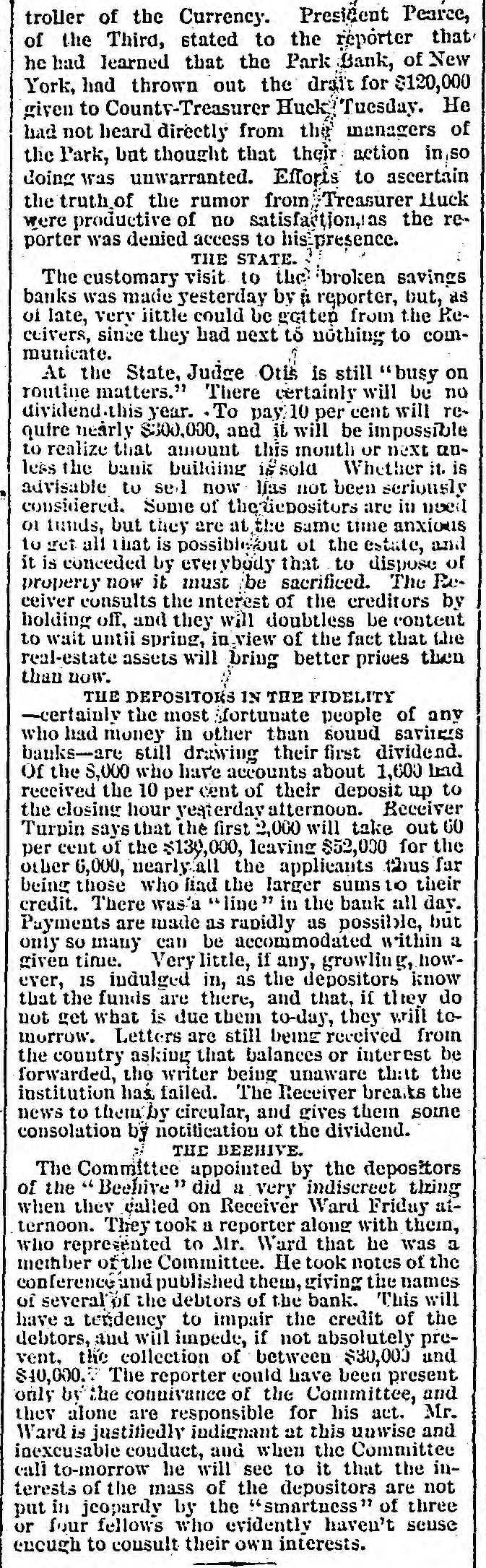
troller of the Currency. President Pearce, of the Third, stated to the reporter that he had learned that the Park Bank, of New York, had thrown out the draft for $120,000 given to County-Treasurer Huck Tuesday. He had not heard directly from the managers of the Park, but thought that their action in so doing was unwarranted. Efforts to ascertain the truth of the rumor from Treasurer Huck were productive of no satisfaction, as the re- porter was denied access to his presence. # THE STATE. The customary visit to the broken savings banks was made yesterday by a reporter, but, as of late, very little could be gotten from the Re- ceivers, since they had next to nothing to com- municate. At the State, Judge Otis is still "busy on routine matters." There certainly will be no dividend this year. To pay 10 per cent will re- quire nearly $300,000, and it will be impossible to realize that amount this month or next un- less the bank building is sold. Whether it is advisable to sell now has not been seriously considered. Some of the depositors are in need of funds, but they are at the same time anxious to get all that is possible out of the estate, and it is conceded by everybody that to dispose of property now it must be sacrificed. The Re- ceiver consults the interest of the creditors by holding off, and they will doubtless be content to wait until spring, in view of the fact that the real-estate assets will bring better prices then than now. # THE DEPOSITORS IN THE FIDELITY -certainly the most fortunate people of any who had money in other than sound savings banks-are still drawing their first dividend. Of the 8,000 who have accounts about 1,600 had received the 10 per cent of their deposit up to the closing hour yesterday afternoon. Receiver Turpin says that the first 2,000 will take out 60 per cent of the $130,000, leaving $52,000 for the other 6,000, nearly all the applicants thus far being those who find the larger sums to their credit. There was a "line" in the bank all day. Payments are made as rapidly as possible, but only so many can be accommodated within a given time. Very little, if any, growling, how- ever, is indulged in, as the depositors know that the funds are there, and that, if they do not get what is due them to-day, they will to- morrow. Letters are still being received from the country asking that balances or interest be forwarded, the writer being unaware that the institution has failed. The Receiver breaks the news to them by circular, and gives them some consolation by notification of the dividend. # THE BEEHIVE. The Committee appointed by the depositors of the "Beehive" did a very indiscreet thing when they called on Receiver Ward Friday af- ternoon. They took a reporter along with them, who represented to Mr. Ward that he was a member of the Committee. He took notes of the conference and published them, giving the names of several of the debtors of the bank. This will have a tendency to impair the credit of the debtors, and will impede, if not absolutely pre- vent, the collection of between $30,000 and $40,000. The reporter could have been present only by the connivance of the Committee, and they alone are responsible for his act. Mr. Ward is justifiedly indignant at this unwise and inexcusable conduct, and when the Committee call to-morrow he will see to it that the in- terests of the mass of the depositors are not put in jeopardy by the "smartness" of three or four fellows who evidently haven't sense enough to consult their own interests.


Article from Chicago Daily Tribune, December 13, 1877

Click image to open full size in new tab

Article Text

George Von Hollen, J. Jonas & Co. Anton Junker. L. J. Kadish, F. Koompfer. H. Kastens, John George Keller. Justus Killan, Adam Killan, Kille, E. Kisling, Conrad Kolb, P. Kotz. N Krane, George Kretzschmer. F. A. Krneger, Frank Kuhn, F. Lachner, A. Lamboth, 0. mick, Limberg. J. Lochr, Carl Lotz. C. H. McCorW. F. Madiener, L.. C. Malow, August Mayer. Mayer. A. Michel. T. C. Miller, Ambrose MIIance ler, Henry Mueller. Milwankee Mechanics InsurJohn Company, George Nonmeister, F. A. Oswold, OIL, John Pressler. 3. F. Pretsch, Mrs. Reinhold, Mrs. Maria Rettig. A. Rohn. P. W. A. Knehl. 3. Rutishanser, c. Saur, A. Schager, J. Schaller, W. Schick, A. Schwartz, H. Sontag. C. Spohr, & Tentonia Life Insurance Company, Troost of Co., Charles Vogt. J. A. Winter. The officers the bank are Tustus Killan, President: Francis J. Lockner and L. J. Kadish, Vice President: W, Haller, Cashier: Herman Niether, Assistant Cashier. The complainant, in view of these facts, neted for the nanal appaintment of a Receiver. Application was at once made to Judge Monro by tice Mr. Blanke, the solicitor for the complainant, nohaving also been given to the bank of the intended application. Mr. Blanke stated the contents of the bill in brief. remarking that the allegations were not materially different from those in the German Savings-Bank case, and that a Receiver was asked for. Col. Juessen. who appeared for the bank, nd. mitted the that It was insolvent. but wished to have appointment of A Receiver deferred a two, an he understood both depositore and day stock- or holders Ho were in favor of Mr. Killan, the President. depositors. already had the signature of thirds of the Mr. Blanke had no objection further than that and the proposed Receiver was an officer of the Judge Moore apparently quite willingly bank, poned the matter for two days. He referred to post. the matinee ton, Monday over the appointment of Mr. Hor. would and said he hoped some acceptable person be chosen by the parties interested. Cashier Haller has charge of the bank. and was to at work yesterday straightening out matters 50 factiitate a dividend. He said the stockholders as wanted Mr. Killan appointed Receiver. since the settlement and could be effected cheaper, and quicker, better by him than by a stranger. THE FIDELITY. Dr. Turpin, Receiver of the Fidelity Bank. terday filed a petition asking for leave to carry yes. out an arrangement he has made in reference to the Chicago west avings Institution building, on the north. corner of Dearborn and Madison streets. states the lot that In July, 1872, Tolman Wheeler leased He on which the building stands to the Chicago Savings ten. Institution & Trust Company for a term of afterward extended to twenty, years. The and bank then crected the present building thereon, attached put In cas fixtures, partition, and railings, March to out separable from the building. In sold Inst the building and ground lease were to John C. Haines and by him transferred to the Fidelity Bank. It was afterward at might the time of sale that the Chicago Savings agreed Bank a have a reconveyance of the property within reasonable time on payment of advances and interest been to the amount of moont $15,000. Default has the made In payment of rent of the building. and lease to the Chicago Savings Bank has been declared the bill forfeited. There la some doubt an to whether of rate to the Fidelity was absolute the have nature of a mortgage, and also on to who should or in the lixtures. Dr. Turpin has made an rangement with Mr. Hinckley, Receiver of the ar. Chicago to Savings Institution, by which the latter is lease, surrender possession of the building and ground ber but to collect and keep the rents for Novemredeom and within December, six and to be allowed to not done within that months. time Hinckley If this Is to In give pin. a quit claim deed to ite property to Dr. Tur. who will then have the tinal title beyond disto Dute The latter then nake that he may be allowed Judge carry out this agreement as above stated. and Moore gave him the required permission. Encouraged by this, the Receiver put in another are petition, setting out that among the bank's assets Lots Lots 7, M,and 0 in McAnney's Resubdivision of 20. 27, 28, and 20. Illock 2, of Lewis blan Subdivision of the southwest part of the northeast quarter of Sec. 30, 40, 13. These lots were appraised after the bank failed at $250 each. Lots Receiver has received an offer of $333. each The 7 and 8. one third cash, balance one and two for years, from llernard McCarthy. and of $333.31 thinks cash for Lot 0 from Caspar Christianson. lie lowed these offers excellent, and asks to be alThe to accept them. The request was granted. calls at the Fidelity for the dividend falling off, although there are over 3, 500 deposit- are ore In who have not yet received their 10 per cent. the Chicago Savings Institution case the Receiver, the W. S. Hinkley, filed a petition setting ont facts In relation to the sale of the bank build. Ing. as stated by Dr. Turpin It his petition, and asking Dr. leave to carry out the agreement made with Purpin. The required leave was given by Judge Moore. The furniture sold Tuesday brought $300. When there will be a dividend is still uncertain. THE BEE-HIVE. S. D. Ward, the Receiver of the Merhante', U Farmers' & Mechanics' Savings Bank, filed to a bill against Sydney and Caroline yesterday C. Myers in get hold of Myers Rush street property. which the name of his wife. the title to Lots *2*3 and 23, Illock The Receiver Blot Kinxie's states that Addition, is in Caroline C. Myers name. The north 48 feet of these lots line been improved by the erection of three three-story stone front houses on it. and the remainder of the lots forming northeast corner of Rush and Superior streets the vacant. These houses are incombered for is each, aud the vacant portion in covered by $4,500 000 mortgage. The Receiver has come to the a $3,and cinsion, papers upon in an his Investigation of the books conthat these houses were onlit hands by Myers, as Receiver, and that both land and houses were paid for, refe the incumbrances. with money of the bank of which Myers was at the time Cashier and general manuger, Tuis money has nover been repaid, but charged or on the books of the bank to the accounts is advances on real estate, .. houses, or Sydney Myers, Financial New Agent. York Myersund wife have, until recently, lived at No. 100 Rush street, and the Receiver even thinks the furniture and carpets of that house were bought with bank money. Myers is Insolvent. and unable to meet his Habilities. It ta further stated that houses are all occupied and Fielding rent, and the the d Receiver thinks that, insemuch AS 31re. be never thereof, paid they for the houses nor any Myers part bunk funds, he is entitled being to the rents bought from them. with lie therefore boke that the bousewand lots, together with the leases of the same. be assigned to a nil the defendants restrained from assigning him. or 1 conveying them. THE OTHERS. Judge Othe, of the State, said there was "nothLng new. 4 Receiver Horton is scheduling the assets of the German havings, and preparing papers. to as get into his hands everything that belongs to the to bank. A statement In detail may not be ready for 4 week or more. The answer to an Inquiry for Information at all 0 0 the suspended National Banks yesterday was Not n thing." 15 DISTRESS WARRANTS. THE FEES IN MISS M'KEN'S CASE. Some of the provisions of the law as It is ad. to ? ministered by the Justice courts are 80 enclously at variance with the general 1308 of right that. when a particularly glaring case comes up, causes not 14 little unfavorable commont. The un 1 fortunate occurrence which resulted in the death of of the Constable McElligott has drawn attention to the law under which distraints for rent are made, and the result of oven a casual examination er of the system as now in force In Chicago is quite


Article from Public Ledger, January 2, 1879

Click image to open full size in new tab

Article Text

# FROM CHICAGO. [Correspondence of the Ledger.] CHICAGO, December 30, 1878.-The Clark-St. Petrie murder trial, as your correspondent predicted from the start, resulted in a verdict of acquittal. The sensation took place last Friday night at 9'clock. The jury were out four hours. The verdict was received with applause by the spectators. Most certainly this has been one of the most remarkable trials ever before an American criminal court. The prosecution was strong persecution. This was carried to such an extent that the court, jurors and audience were horrified by the attorney for the prosecution introducing into court the portion of the murdered man's remains through which the fatal ball passed. Not only was this offensive to the eye, but also to the sense of smell. The proceeding was simply an outrage, and it is to be wondered at how his honor, Judge Gary, tolerated such a proposition. The only point in favor of the prosecution was this: the ball found in Mr. Clark's body, and the same fired from the pistol pawned by St. Petrie the day after the murder, presented certain defects of a similar nature. On the other hand the pawnbroker swore that he examined the pistol with a microscope for defects before loaning money on it, and that each chamber was dusty, or presented no evidence of having been recently fired. To-day I learned from a gentleman that the whole charge that Mrs. Clark and St. Petrie were criminally and lustfully intimate, which was a good motive for the murder, was trumped up by a religious faction opposed to Mrs. Clark. Throughout the whole trial the counsel for the prosecution displayed an animus far outside their prerogative, or consistent with common charity. It is a sad commentary that attorneys will forget, in their arguments, that the accused is presumed to be innocent until proven guilty, and that it is outside their province to prejudice, and should be far remote from the conduct of any gentleman. Colonels Van Buren and Munn were counsel for the defense, and Mr. Weber and Colonel Van Arman for the prosecution. Pistol and pool balls were exchanged by Messrs. John Leyden and Henry Bartellis yesterday afternoon. It was one of the usual Sunday amusements at Bridgeport, on the south side. Mr. Leyden now lies in hospital with a pistol ball somewhere in his head. It entered under the ball of the right eye. Bartellis is under arrest. Messrs. McClellan and Tucksbury, attorneys, had late chief deputy sheriff Garrick, and late sheriffs chief clerk Cunningham, arraigned before a magistrate Saturday for giving the said disciples of Blackstone a good shaking up. An explosion of a startling nature occurred in the south division of the city Saturday, on Wabash, one of the fashionable resident avenues. Mrs. Smith was searching for a gas leak in the basement. She struck a match. -Then she imagined an earthquake struck her. The lighted match caused a frightful explosion, causing considerable damage. One woman declares that when the side walk went up it was accompanied by a horse and cutter that have not yet come down. Fortunately, and certainly miraculously, Mrs. Smith was not very seriously injured. Blakie, the Fidelity safe deposit robber is in custody. Notwithstanding the fact that Dr. Turpin, the receiver of bank, did not want to prosecute, Justice Morrison bound him over. -Blakie was a confidential clerk of the bank for six years past. There is no accounting for poor George's criminal -conduct. Notwithstanding the hard times -Chicago is alive with theater and social amusements. Some of the hops and receptions are princely in design, while some of the costumes of the ladies are wonderfully attractive and costly. Chicago's commerce for the past year demonstrates that she is second to none of the cities of the Union. Just think of it; she has marketed to date 133,000,000 bushels of grain, 1,100,000,000 feet of lumber and 6,200,-000 hogs. Other items of commerce figure equally as high. Chicago's re-cord is one of which to be proud. The cold spell is still upon us. It was 6º below zero this morning. Many unfortunats have been picked out of the snow dead. I wish the LEDGER people all a a happy New Year. An revoir, NYAR.


Article from Little Falls Transcript, January 2, 1879

Click image to open full size in new tab

Article Text

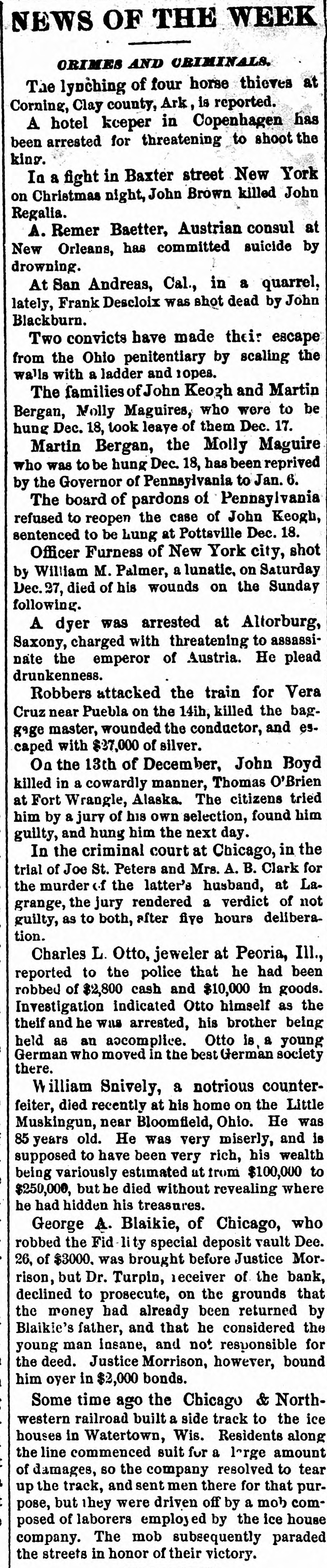
# NEWS OF THE WEEK ORIMES AND ORIMINALS. The lynching of four horse thieves at Corning, Clay county, Ark, is reported. A hotel kceper in Copenhagen has been arrested for threatening to shoot the king. In a fight in Baxter street New York on Christmas night, John Brown killed John Regalia. A. Remer Baetter, Austrian consul at New Orleans, has committed suicide by drowning. At San Andreas, Cal., in a quarrel, lately, Frank Descloix was shot dead by John Blackburn. Two convicts have made their escape from the Ohio penitentiary by scaling the walls with a ladder and ropes. The families of John Keogh and Martin Bergan, Molly Maguires, who were to be hung Dec. 18, took leave of them Dec. 17. Martin Bergan, the Molly Maguire who was to be hung Dec. 18, has been reprived by the Governor of Pennsylvania to Jan. 6. The board of pardons of Pennsylvania refused to reopen the case of John Keogh, sentenced to be hung at Pottsville Dec. 18. Officer Furness of New York city, shot by William M. Palmer, a lunatic, on Saturday Dec. 27, died of his wounds on the Sunday following. A dyer was arrested at Altorburg, Saxony, charged with threatening to assassinate the emperor of Austria. He plead drunkenness. Robbers attacked the train for Vera Cruz near Puebla on the 14ih, killed the baggage master, wounded the conductor, and escaped with $37,000 of silver. On the 13th of December, John Boyd killed in a cowardly manner, Thomas O'Brien at Fort Wrangle, Alaska. The citizens tried him by a jury of his own selection, found him guilty, and hung him the next day. In the criminal court at Chicago, in the trial of Joe St. Peters and Mrs. A. B. Clark for the murder of the latter's husband, at Lagrange, the jury rendered a verdict of not guilty, as to both, after five hours deliberation. Charles L. Otto, jeweler at Peoria, Ill., reported to the police that he had been robbed of $2,800 cash and $10,000 in goods. Investigation indicated Otto himself as the theif and he was arrested, his brother being held as an accomplice. Otto is a young German who moved in the best German society there. William Snively, a notorious counter-feiter, died recently at his home on the Little Muskingun, near Bloomfield, Ohio. He was 85 years old. He was very miserly, and is supposed to have been very rich, his wealth being variously estimated at from $100,000 to $250,000, but he died without revealing where he had hidden his treasures. George A. Blaikie, of Chicago, who robbed the Fid-lity special deposit vault Dee. 26, of $3000, was brought before Justice Morrison, but Dr. Turpin, receiver of the bank, declined to prosecute, on the grounds that the money had already been returned by Blaikie's father, and that he considered the young man insane, and not responsible for the deed. Justice Morrison, however, bound him oyer in $2,000 bonds. Some time ago the Chicago & North-western railroad built a side track to the ice houses in Watertown, Wis. Residents along the line commenced suit for a large amount of damages, so the company resolved to tear up the track, and sent men there for that purpose, but they were driven off by a mob composed of laborers employed by the ice house company. The mob subsequently paraded the streets in honor of their victory.


Article from Chicago Daily Tribune, April 23, 1879

Click image to open full size in new tab

Article Text

proposition, with two exceptions, and pledged themselves by signature to accept its conditions. A committee of three was appointed to present the proposition to the other creditors, and secure their written assent. About 11 o'clock yesterday morning sneak thieves broke into the cheap restaurant shanty kept by a woman named Anna Froen, on the corner of Dearborn avenue and Michigan street, opposite the County Building, while the pro- prietress was out. The pilferers entered by a back door, which was left unlocked, and helped themselves to a clock, pocket-book, and various articles of clothing. They escaped, in broad daylight, without detection. The victim is a neat, honest, hard-working woman, and only a day or two ago returned a sum of money which had been carelessly left lying on one of the tables in her restaurant to the rightful owner. Mr. Billings, the President of the People's Gas-Light and Coke Company, said yesterday, in reply to a reporter's interrogation, that he had not given thought to the last proposition made by the Council, because he had received no offi- cial notification of the action of that body. He was therefore unable to say anything on the subject further than that he had understood that all differences between the gas companies and the city were to be amicably settled before the pres- ent Council passed out of office. The proposi- tion which the Council decided Monday to make to the Billings Gas Company was to pay at the rate of $3 per $1,000 feet for the gas used up to Dec. 31, 1878. Coroner Mann yesterday held an inquest upon an unknown female infant found floating in the river at the foot of Kinzie street; and upon Ole Das, a Norwegian shoemaker who died sudden- ly of congestion of the lungs at No. 250 West Chicago avenue yesterday morning. Deceased was 45 years of age, and left a wife and family in poor circumstances. The inquest upon the unknown burglar, shot by special police- man Jeremiah Kennedy, was concluded at El- ton's yesterday. The jury commended the officer for his action, and expressed a wish that all persons paid to guard property would act as decisively, so that thieves and burglars might be more thoroughly discouraged. It will be remembered that the Fidelity Bank Building, the Safe Depository, and Hooley's Theatre were sold on the 10th of April last for the benefit of the Fidelity creditors. On Mon- day Judge Muuroe refused to confirm the sale upon the ground that the prices given were be- low the value of the property. The bank build- ing was sold for $50,000, the safe depository for $72,000, and the theatre for $60,000. Had this been sanctioned by the Judge, Receiver Turpin would have paid the creditors some 12 per cent at once. As it is now, the Receiver proposes to do nothing until fall with this prop- erty, but thinks that in the course of the sum- mer he will be able to pay nearly 10 per cent if he succeeds in realizing as much as he thinks he will upon some odds and ends. The regular monthly meeting of the Decora- tive Art Society was held in the parlors of the Palmer House yesterday morning. Mrs. J. Y. Scammon presided, and Miss Mary Peck acted as Secretary. The President presented her re- port of the Society's work for the spring, which was flattering in the extreme. The Chairman of the embroidery classes also made an en- couraging report of the work done in her de- partment. The classes are all well organized and well attended. The ses- sion was concluded with an excellent paper on "Woman in Art," by Mr. F. J. Jervis. He traced the gradual rise of art- education from the women of the Bible engaged in embroidering and decorating the Tyrian pur- ple to the art-clubs of the present day. He ar- gued that the brain had no sex, and that genius was as natural to woman as to man. He further advised the ladies to give up playing the piano, which is only artistic when it approaches perfec- tion, and to devote themselves to decorative art, designing, carving, engraving, and kindred arts. He encouraged his audience by remind- ing them that the Muses and the Graces were women, and even the Fates, who held in their hands the destiny of man, were represented as feminine deities. At the close of his address a unanimous vote of thanks was passed, after which the meeting adjourned. # THE COLORED EXODUS. An adjourned meeting of the colored citizens was held last evening in Olivet Church, to or- ganize and take into consideration ways and means for the aid of the colored brethren of the South who are engaged in the Kansas hegira. The Rev. De Baptiste occupied the chair, and there were about 150 persons present. A Committee on Permanent Organization made a long report, recommending that the So- ciety be known as the Emigration Aid Society of Chicago, and providing for the usual officers, regular monthly meetings, and the publication of an appeal for money and clothing for the ex- odists from the South. The report was adopted. A resolution was sprung on the meeting pro- posing to rescind the action taken at the last meeting, providing for the sending of two dele- gates to the Nashville Convention. It was pro- ductive of an extended discussion, its friends being in favor of sending the money which would otherwise go to the sustenance of the delegates to the emigrants themselves, and the other part of the meeting favoring the idea of sending delegates to the Convention, and hav- ing Chicago represented. The aims of the Con- vention were attacked, its purpose declared inimical to the best interests of the colored man, and when the reporter sought refuge from the Babel of noisy and angry voices, there was every prospect that the weighty matter would hang the meeting up till midnight. # THE WHEAT MARKET. The Directors of the Board of Trade met yes- terday, but did no business of any public inter- est. The wheat market was fluctuating, but showed no signs of a downward tendency. The false rumor about hot wheat in Armour & Dole's elevator, set afloat the day before, was so thoroughly exploded that no similar canard were put in circulation yesterday. The general feeling is one of positive conviction that there is no hot wheat now, and of absolute certainty that there will be none at any time this season. Those who are most thoroughly acquainted with the subject that is, with the quality of last year's wheat, and with the condition of the wheat as now is in the elevators are positive that no danger can possibly occur. The elevators, it is learned, are able to take care of and keep in good condition all the wheat which they have. Any future rumors in regard to hot wheat, there- fore, may be safely regarded as inventions got- ten up to bear the market. # THE CITY HALL.


Article from Chicago Daily Tribune, July 8, 1879

Click image to open full size in new tab

Article Text

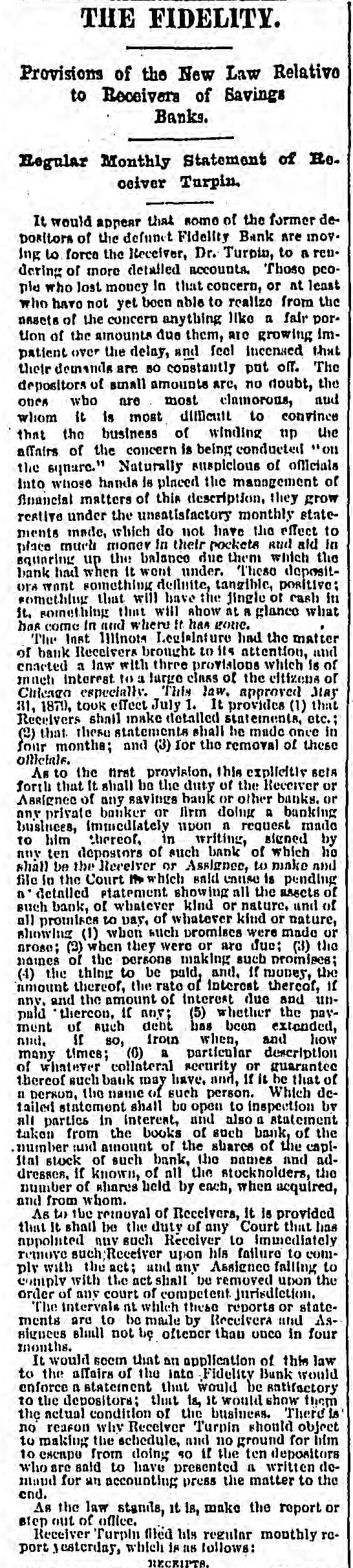
# THE FIDELITY. Provisions of the New Law Relativo to Receivera of Savings Banks. Regular Monthly Statement of Receiver Turpin, It would appear that some of the former depositors of the defunct Fidelity Bank are inov-ing to force the Receiver, Dr. Turpin, to a rendering of more detailed accounts. Those people who lost money in that concern, or at least who have not yet been able to realize from the assets of the concern anything like a fair portion of the amounts due them, are growing impatient over the delay, and feel incensed that their demands are so constantly put off. The depositors of small amounts are, no doubt, the ones who are most clamorous, and whom it is most difficult to convince that the business of winding up the affairs of the concern is being conducted "on the square." Naturally suspicious of officials into whose hands is placed the management of financial matters of this description, they grow restive under the unsatisfactory monthly state-ments made, which do not have the effect to place much money in their pockets aud aid in squaring up the balance due them which the bank had when it went under. These depositors want something definite, tangible, positive; somethiug that will have the jingle of cash in it, something that will show at a glance what has come in and where it has gone. The Inst Minota Legislature had the matter of bank Receivers brought to its attention, and enacted a law with three provisions which is of much interest to a large class of the citizens of Chicago especially. This law, approved May 31, 187), took effect July 1. It provides (1) that Receivers shail make detalled stateinents, etc.; (2) that these statements shall be made once in four months; and (3) for the removal of these ollletale. As to the first provision, this explicitly sets forth that it shall be the duty of the Receiver or Assignee of any savings bank or other banks, or any private banker or firm doing a banking businees, immediately upon a request made to him im thereof, in writing, signed by any ten depostors of such bank of which ho shall be the Receiver or Assignce, to make and file in the Court which sald entise is pending a detailed statement showing all the assets of such bank, of whatever kind or nature, und of all promises to vay, of whatever kind or nature, showing (1) when such promises were made or arose; (3) when they were or are due; (3) the names of the persons making such promises; (4) the thing to be pald, and, if money, the amount thereof, the rate of interest thereof, if any, and the amount of interest due and unpaid thercon, if any; (5) whether the payment of such dent has been extended, if so, iroin when, and how many times; (0) a particular description of whatever collateral security or guarantee thereof such bauk may have, and, if it be that of a person, the name of such person. Which de-tailed statement shall bo open to inspection by alt parties in interest, and also a statement taken from the books of such bank, of the number sud amount of the shares of the capi-ital stock of such bank, the names and ad-dresses, if known, of all the stockholders, the number of shares held by each, when acquired, and from whom. As to the renoval of Receivers, it is provided that it shall be the duty of any Court that has appointed any such Receiver to Immediately remove such Receiver upon his failure to com-ply with the act; and any Assigncc falling to comply with the act shall be removed upon the order of any court of competent jurisdiction. The intervale at which these reports or state-ments are to be made by Receivera and As-signees slull not be oftener than onco in four months. It would seem that an application of this law to the affairs of the lato Fidelity Bank would enforce a statement that would be satifactory to the depositors; that is, it would show them the actual condition of the business. There is no reason why Receiver Turpin should object to making the schedule, and no ground for him to escape from doing so if the ten depositors who are said to have presented a written de-maud for an accounting press the matter to the end. As the law stanuls, it is, make the report or step out of office. Receiver Turpin filed his regular monthly report yesterday, which is as follows: # RECRIPTS,


Article from Chicago Daily Tribune, March 14, 1880

Click image to open full size in new tab

Article Text

Project for a New Stock-Yard South- west of the City. Sales and Building Permits-The Brick Supply. Street Improvements-Real Estate in New York and Boston. Public Surveys of the United States- Miscellaneous. Real estate was more interesting last week for what might be than what was. Buyers were not very numerous or very eager, but a fair business was done, as shown in the record below. There were vast rumors afloat OF NEW ENTERPRISES, some of which could be hunted down, while the others remained intangible. Pittsburg capital- ists have negotiated for the site, on the North Side, of a large steel-spring factory. It will employ sixty hands, turn out two or three tons a day of wagon and buggy springs. The ma- chinery will be brought here from Pittsburg, and the promoters of the enterprise have abundant capital to insure its success. Specula- tion has been rife southwest of the city in acre property near the location of " a proposed stock- yards." A map has been prepared in good style, showing WHERE THE STOCK-YARDS will be situated. According to it they will oc- cupy the ground at the junction of the Wabash and Grand Trunk Railroads, between Seventy- second and Eighty-third streets, and west of Johnson avenue, and near the Belt Railroad, There have been rumors for some time in the city of dissatisfaction with the present stock- yards, and of a scheme to establish new yards elsewhere. The Vanderbilt interest have been credited with a plan of this sort, but are not mentioned authoritatively in connection with this enterprise. Among other parties mentioned as in it is Mr. George W. Waite, of Hyde Park. The map shows that the proposed stock-yards would occupy ABOUT 640 ACRES in Secs. 2, 3, and 35, in the Town of Worth, and part in the Town of Lake. The amount of capl- tal which it is proposed to spend is about $700,- 000 in all. A hotel is to be put up to cost $50,000. There will be a bank, and, of course, all the needed yards, pens, and buildings will be erect- ed if the scheme is carried out. As might be expected, the report that such an enterprise was on foot, strengthened, as it was, by the appear- ances for private circulation only-of the hand- some map, has created a stir in real estate in the vicinity, and there has been a good deal of speculation. Land bought a few weeks ago in Sec. 3, Town of Worth, for $125 an acre, is now not to be had for $200 an acre: in Sec. 32, in the Town of Lyons, prices have risen from $50 to $80 an acre. Prop- erty near the proposed yards is held at $500 an acre. Land near South Lynn bought for $200 an acre has been resold at $270. Inquiry FAILS TO CONNECT the railroads with the project, and this is its weak point; for it is the railroads who will say where the new stock-yards, if there are to be new yards, will be placed. But it is a certainty that a good deal of land is changing hands on the strength of the little that has been rumored on this point. A reporter learned that the scheme is visiona- ry-simply gotten up for the purposes of land speculation. Men who ought to know said that it was absurd to talk of stock-yards in that locality, because there would be nothing to sup- port them. Such an institution could not exist without packing-houses around it, since they were the backbone, shippers of cattle playing but a comparatively insignificant part, were not more than a finger. So the whole story is doubtless a real-estate canard, gotten up to start speculation in a certain quarter. The Chicago, Burlington & Quincy has bought of R. P. Derickson 200 feet on Ashland avenue, corner of Twenty-second street, for $200 a foot. Mr. S. W. Allerton has sold for $650 an acre the 90 acres on the lake shore at Clark's Point, which he bought a few months ago for $150 an acre. SOUTH CHICAGO REAL ESTATE is not the drug it was. The Receiver of the Fi- delity Bank having had conditional authority from the court to sell the southeast quarter of Sec. 12, 37, 14, for $40,000, one-third cash and the remainder in one, two, and three years, objec- tions were interposed by George A. Shufeldt and others to the effect that the property was rapid- ly rising in value. It was assessed in 1877 at $20,- 000; the offer is now $40.000, an advance of near- ly 40 per cent in two years. The objector is in- formed by competent persons that an almost immediate prospective value of this property is not less than $160.000, and that within one year it will bring that sum, or $1,000 per acre. Messrs. Chandler & Co. have sold the Paulina- street houses, Nos. 450, 458, 460, 462, and 464, at the advertised price; No. 832 Cottage Grove avenue for $7,500; Nos. 830, 828, and 826 for $7,000 each; and No. 6 Thirty-eighth street for $4.500. These comprised the Johnson Block, cor- ner of Thirty-eighth street and Cottage Grove avenue, the total consideration being $34,000. They were bought by an Ohio capitalist, No. 126 Johnson place was sold for $3,750; No. 1090 West Harrison street for $2,500; and the southwest corner of North Clark street and Belden avenue for $1,300; thirty-one feet on North Clark street, south of Belden avenue, for $1.000; No. 272 Ver- non avenue for $4,500; No. 990 West Harrison street for $2,000, less allowance for repairs; No. 128 North Western avenue for $1,200; two vacant lots near Kinzie street for $1,000; and No. 881 North Halsted street, store and vacant lot, for $3,900; all cash. In all, nearly $65,000 worth of real estate. Griffin & Dwight have sold two lots on West Twelfth street, for John Foster to Bernard Quinn; house and lot No. 175 South Green street, for Christiana Swinscoe to Henry Riemer; house and lot No. 38 Evergreen place, for Anna Ruger to William H. Waters; also, for Caroline Kleinmann, one lot on West Ohio street, near Robey. Thomas & Bragg report the following sales: Two brick houses and lots on Johnson place, near Thirty-seventh street, for $2.500 each; brick house and lot on South Robey street, near Twelfth street, for $2,800; No. 1037 Wabash ave- nue, brick house and lot near Twenty-third street, for $5,500; a lot 31x178 feet, west front, on Indiana avenue, between Twenty-ninth and Thirtieth streets, for $3,100; and two lots, south front, on West Seventeenth street, between Ash- land avenue and Paulina street, for $800. E. S. Dreyer & Co. have sold 10 acres, Sec. 15, 38, 13, for $175 per acre; 35 acres, S. W. ¼ of Sec. 10, 38, 13, for $267 per acre; 50x175 feet on Fred- erick street, east of Orchard, for $1,500; 200x125, northwest corner of Eugenie and Hammond streets, to the Board of Education for a school site, at $8,500; 24½x152 on North La Salle street, south of North avenue, west front, to Mrs. Jane Waters for $3,062; 18x100, Indiana street, west of Clark street, for $1,500; cottage and lot, North Franklin street, $2,800. The transfer was re- corded of the sale of 34 feet on North Clark street and 455 North La Salle street to O. Ostrum, for $61,000. H. C. Zuttermeister has sold lot and cottage on West Seventeenth street, between Union and Halsted, for $1,100; lot in Rawson Akerley's sub- division for $425; house and lot, West Eight- eenth street, for $2,000; house and lot on Han- nibal street, between Wood and Lincoln, for $1,050. IN THE SALES OF THE WEEK were 50x150 feet, improved, on West Adams street, northwest corner of Morgan, $20,000; 24x50, improved, on Chicago avenue, west of State street, $9,500; east half of Block 24, on Wentworth avenue, northwest corner of Fifty- eighth street, $11,000; 24x124½ on West Madison, east of Western avenue, $4,700; 50x136, on Mc- Grath street, west of Hoyne avenue, $3,500; 174x 123, on West Madison street, southeast corner of Rockwell, $8,700; 50x174, on Wabash avenue, south of Thirty-fourth street, $4,000; 22x91, im- proved, on West Congress street, west of Marsh- field, $4,500; 200x243, on Robey street, south of Blue Island avenue, $8,000; 50x181, on Wabash avenue, south of Thirty-first street, $11,600; 25x206, improved, on West Eighteenth street, east of Centre avenue, $2,600; 22x180, improved, on Wabash avenue, between Fifteenth and Sixteenth streets, $9,000; 20x180 on Ellis avenue, south of Brook street, $3,600; 72x125 on Walnut street, west of Fran- cisco street, $3,000; 25x100, improved, on In- diana street, southwest corner of North Franklin street, $7,000; 50x130 on Prairie avenue, near Thirtieth street, $6,250; 516½x269 on West Twenty-first street, southwest corner of Western avenue, $5,000; 93x131 on Dearborn avenue, southeast corner of Goethe street, $15,000; 40x100 on Ohio, west of Dearborn, $5,000; 50x80 on North Clark street, northeast corner of Ohio, $10,000; 36½x189 on Madison, west of Franklin street, $30.000; 25x124, improved, on Forest avenue, north of Thirty-eighth street, $6,000; 25x152 on North La Salle street, south of Grant street, $3,062; 60x127, improved, on Walnut