Bank of Topeka (Topeka, KS)

Episode Information

Episode UID
44000171267
Episode Type
Run Only
Bank Type
state
Bank ID
4400017 routing
Routing Number
44-0001
Start Date
July 3, 1905
Location
Topeka, Kansas (39.048, -95.678)

Metadata

Model
gpt-5-mini (chosen from majority vote of a three-model LLM ensemble)
Short Digest
6721cb747f71c796

Response Measures

None

Events (2)

1. July 3, 1905 Run
Cause
Local Banks
Cause Details
Spillover withdrawals following the failure/receivership of the First National Bank (panic in city banks).
Newspaper Excerpt
Other runs of a lesser degree were started on the State Savings Bank, the Bank of Topeka and on the Merchants' National Bank.
Source
newspapers
2. August 29, 1905 Run
Cause
Rumor Or Misinformation
Cause Details
A circulated rumor that the bank was shaky prompted small depositors to withdraw funds.
Measures
Bank withstood the strain; continued operations and paid withdrawals until close.
Newspaper Excerpt
As the result of a rumor to the effect that the condition of the Bank of Topeka was shaky there was a run on that institution today.
Source
newspapers

Newspaper Articles (10)

Article from The Montgomery Advertiser, July 4, 1905

Click image to open full size in new tab

Article Text

IT LOANED TOO MUCH BIG BANK FAILURE OCCURS AT TOPEKA, KAS. The First National Holds Papers of C. J. Devlin, Principal Stockholder, for $1,000,000-WIII Probably Pay Out. Topeka, July 3.-No definite statement was obtained up to a late hour today regarding the condition of the First National Bank, controlled by C. J. Devlin, the big coal mine owner, which closed its doors this morning. Colonel W. H. Rossington, vice-president of the bank, locked the institution's books in the vault to await the arrival of J. T Bradley, the national bank examiner, whom the comptroller had appointed receiver of the failed bank, and he would only say: "The bank's trouble has not been caused by dishonesty on the part of any one, but by lending too largely to one borrower. There has been no stealing." This borrower is, of course, Mr. Devlin, and the bank is said to hold the capitalist's paper to the amount of a million dollars. Mr. Devlin, whose sudden illness brought about the tangle in the big coal mining and railroad properties, valued, It is estimated, at close to seven millions of dolars, is still under the care of a physician and no statement could be secured from him. All that came from his home during the day or could be secured from other sources, was that the stricken coal operator had turned over to the bank nearly $700,000 in life insurance and about the same amount in Topeka real estate. Business assistants of Mr. Devlin gave it as their opinion that, if properly handled, this would allow the bank to pay out. Elmer Ames, bank examiner for the northern district of Kansas, who took charge pending the arrival of Receiver Bradley, would say nothing additional that would throw any light on the subject. Aside from the temporary flurry that the failure of the First National Bank caused upon the other banks of the city, probably the most interesting phase of the situation was the statement of State Treasurer Kelly that the bank held $547,000 of the State's funds and the knowledge that Mr. Devlin was one of three of Mr. Kelly's bondsmen. The statement was made that Treasurer Kelly had exceeded his authority in placing more of the State's money in the bank than the law allowed, but Mr. Kelly declined to discuss the matter at this time. Following the announcement of the failure a lively run was started on the Central National Bank and before closing time today it was known that something more than $100,000 had been withdrawn from this institution. The Central National also held some of Devlin's paper, but he likewise owns fifteen twenty-eighths of the capital stock of $250,000 of this institution. But it developed that the Central National Bank held but little of Devlin's paper and when its officers displayed $700,000 in cash and made every effort to pay the depositors as fast as they made demands, the excitement died down and at closing time only a few small depositors remained at the teller's window. Other runs of a lesser degree were started on the State Savings Bank, the Bank of Topeka and on the Merchants' National Bank. At none of the banks, however, was the demand for withdrawal great, only the small depositors taking their money and there was little excitement during the day.


Article from The Topeka State Journal, July 5, 1905

Click image to open full size in new tab

Article Text

NOT A TRUST FUND Receiver Bradley Says State is Like Other Depositors. Neither Will County or City Have Preference. IS NOT YET READY. Statement Won't Be Made for Several Days. Depositors Will Form a Protective Organization. J. T. Bradley, temporary receiver for the First National bank said this morning: "It will probably take from seven to ten days before we can issue a statement of the condition of the bank in behalf of the depositors and creditors. The law specifically provides that no statement shall be made until a thorough examination has been made. I am forbidden to make any statements whatsoever regarding the conditions of the bank until I receive permission from the comptroller of the currency. I am under strict instructions. It is manifestly impossible for us to give any sort of an idea now of the condition when the amounts represent run up into the millions. Unless we receive instructions otherwise the report will be sent to the authorities at Washington and those interested will have to receive their information from that source. There may be other instructions. We are expecting a legal expert from the comptroller's office) by tomorrow. Mr. Robert Lyons, who is the expert, will pass on all of these disputed points on claims to the satisfaction of those interested.' 'What claims will be considered preferred?" was asked. "From my legal acquaintance as a banker, I should consider first of all trust funds, then collections: all the money and funds which of right do not belong here. Deposits would be last." 'Would you consider the state's funds, preferred, under a trust?' The answer came forth with some hesitancy and reluctance. "Well, no, I presmue not. The city's and county's funds will not be preferred either and will have to take their place as depositors. E. F. Ames, bank examiner, said: "I have nothing to say. I am merely a clerk now acting under the directions of Mr. Bradley." A number of the depositors and others who had financial dealings with the bank lined the steps leading up to the side entrance of the bank this morning and consulted Mr. Bradley concerning disputed or questionable points affecting funds or securities tied up in the bank. In each instance the parties were referred to the arrival of a Mr. Lyons, the legal expert the government sends to Topeka. A, movement is on foot among the larger depositors in the bank to effect an organization to protect their L interests. The movement is headed by Sam Radges who is a large depositor. Attorneys will be engaged and the organization will employ every means to secure an equable adjustment of the bank's affairs. h John R. Mulvane, president of the S Bank of Topeka, said this morning: "There is no doubt at all but the First National is solvent. There is no doubt a but every depositor will be paid dollar for dollar. Very few people seem to take in account that there is $300,000 of capital stock and $93,000 in cash right now in the bank, close to $400,000 right in the bank at this time. In addition the United States will see to it that an assessment will be levied upon the stockholders if there are not sufficient securities to protect the depositors and creditors. There is no question in my mind but what good collateral was put up by Devlin to cover the amount that he borrowed from the bank.' Mr. Mulvane claims that the statet ment made that the Bank of Topeka e has $75,000 of Devlin's liabilities is false. "There is nothing in it whatever and b S we haven't a cent of Mr. Devlin's paper. Not a cent." he reiterated. The financial panic which prevailed t throughout the city on Monday had entirely disappeared by the morning of ; the Fourth. Not a symptom remained a, this morning and there was not a run or anything that appeared like one at any of the banks. The morning's n business was quiet and without special note. At a number of the banks the d Fourth was spent by the clerks in an effort to straighten out the tangle of the business which was precipitated Monday. The Bank of Topeka gave d their employes a holiday as usual on the Fourth but they came down early this morning to work upon the books and clear away the debris of the rush of Monday. is


Article from The Topeka State Journal, July 5, 1905

Click image to open full size in new tab

Article Text

END OF THE RUN. Over $300,000 Taken Out of Banks. This Was During the All Day Excitement Monday. FEW LARGE DEPOSITS People With Small Savings Got Their Money. Devlin Liabilities Believed to Be Under $3,000,000. Estimates secured from the officials of the Bank of Topeka, Central National, Merchants National and State Savings bank make the amount of funds withdrawn from those four institutions during Monday's run at $346,000, divided as follows: Bank of Topeka, $111,000. Central National, $150,000. State Savings, $60,000. Merchants National, $25,000. "Ninety per cent of the deposits withdrawn from our bank were in checks of less than $100," said John R. Mulvane of the Bank of Topeka. "Our depositors who withdrew were people who had but small amounts. But two broke over in the thousands and quite a number of them took out but $2 to $6," this is the statement of William Macferran, cashier of the State Savings. These are the statements which are also made by the Central National and Merchants National. This amount of $346,000 was distributed among some 1,800 depositors. A great many of these same people today returned to the bank where they had withdrawn their savings and redeposited. Sam Radges, who is endeavoring to secure an organization of the creditors of the bank stated this noon that a preliminary meeting looking to an organization will be held in a few days. In the meantime he is soliciting names of the depositors and those who are desirous of forming such an organization. "I understand,' said Mr. Radges, "that the insurance policy which Mr. Devlin has turned over as security is not worth anything whatever unless he dies within a few months. In other words, and I have this from good authority, that it is not a paid up policy. It just like fire insurance on a house." Radges has his entire fortune of $20,000 tied up by the failure. Cuts Down Liabilities. Later information revises the list of liabilities which the estate of Chas. J. Devlin will be responsible for on settlement. The revision reduces the amount by $179,000, making the total $2,631,000 instead of $2,810,000 as published Tuesday. Chas. S. Gleed, who is president of the holding corporation, said this noon: "It must be remembered that these liabilities are against the companies in which Mr. Devlin is interested and not personal liabilities. The personal notes which Mr. Devlin may have out can be covered by a few thousand dollars Mr. Devlin may be personally broke but it does not follow that the companies will fail to pay out. This is a point which has not been clearly brought out. The companies are good and it is against them that the liabilities hold and not against Mr. Devlin personally. Mr. Chas. S. Gleed stated that he was unable to determine whether the bank would pay out or not. Mr. J. W Gleed expressed his opinion in this manner: "I believe that the bank will pay its depositors in full if the men who are put in charge of the property manage it wisely.' Opinions still vary with reference to the status of the state as a creditor. John R. Mulvane gave it out as his opinion that in a national bank, the United States is the first preferred creditor, the state the second, the county the third and the city the fourth preferred creditor, the depositors coming last. "If this is true, said Sam Radges, "the depositors won't get a thing. For I have looked into this matter and a great deal of this collateral security is not worth its face value." Another prominent banker who did not wish his name to appear in print stated that the stand taken by State Treasurer Kelly is absolutely ridiculous. "If those in charge or the judge who makes the decision hands down an opinion of that character he should be impeached. It's the most ridiculous statement I have ever seen in print. That money had been collected by the bank and was lying there. It should have been taken out by Mr. Kelly. If such an interpretation is to be given to it, what is to prevent every one that wants to having money on deposit and simply writing across the back, 'these are collections to, be held in trust. It would be entirely possible for any one to have money on deposit for seventeen years at that rate and simply call it collections. If this does not put Mr. Kelly in a tight fix I don't see what can. Mrs. Devlin Won't Leave. Mrs. C. J. Devlin denied emphatically this afternoon that there was any foundation to the rumor that she was going east to raise funds to aid in securing the bank's creditors. She said: "I wish you would state for me that there is nothing whatever in that rumor. Of course I don't know what I am going to do next." Both Mr. Devlin and Mr. Hawley were reported as improving, this morning. Mrs. Devlin said: "Mr. Devlin is doing very nicely and is still improving. His physician forbids him to go out yet." It is stated that Mr. Deviin will not go away for a rest trip until the tangle which has taken place is entirely


Article from Iowa County Democrat, July 6, 1905

Click image to open full size in new tab

Article Text

NATIONAL BANK FAILS. Too Much Loaned to One Speculating Capitalist. Topeka, Kas., July 4. - No definite statement was obtainable up to a late hour yesterday regarding the condition of the First National bank, controlled by Charles J. Devlin, the big coal mine owner, which closed its doors yesterday morning. Colonel W. H. Rossington, vice president of the bank, locked the institution's books in the vault to await the arrival of J. T. Bradley, national bank examiner, whom the comptroller appointed receiver of the failed bank, and he would only say: "The bank's trouble was not caused by dishonesty on the part of any one, but by lending too largely to one borrower.' The borrower is, of course, Devlin. and the bank is said to hold the capitalist's paper to the amount of $1.000.000. Devlin, whose sudden illness brought about a tangle in big coal mining and railroad properties, valued, it is estimated, close to $7,000.000, is, still under the care of a physician, and no statement could be secured from him. Following the announcement of the failure, a lively run started on the Central National bank, but the officers made every effort to pay the depositors as fast as they made demands. The excitement died down, and at closing time only a few small depositors remained at the teller's window. Another run of lesser degree started on the State Savings bank, the Bank of Topeka and on the Merchant's National bank. At none was the demand for withdrawals great.


Article from The Spokane Press, August 29, 1905

Click image to open full size in new tab

Article Text

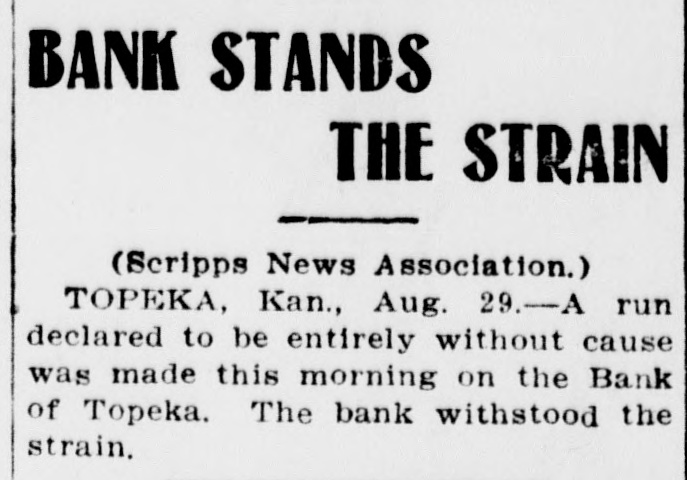
BANK STANDS THE STRAIN (Scripps News Association.) TOPEKA, Kan., Aug. 29.-A run declared to be entirely without cause was made this morning on the Bank of Topeka. The bank withstood the strain.


Article from The Topeka State Journal, August 30, 1905

Click image to open full size in new tab

Article Text

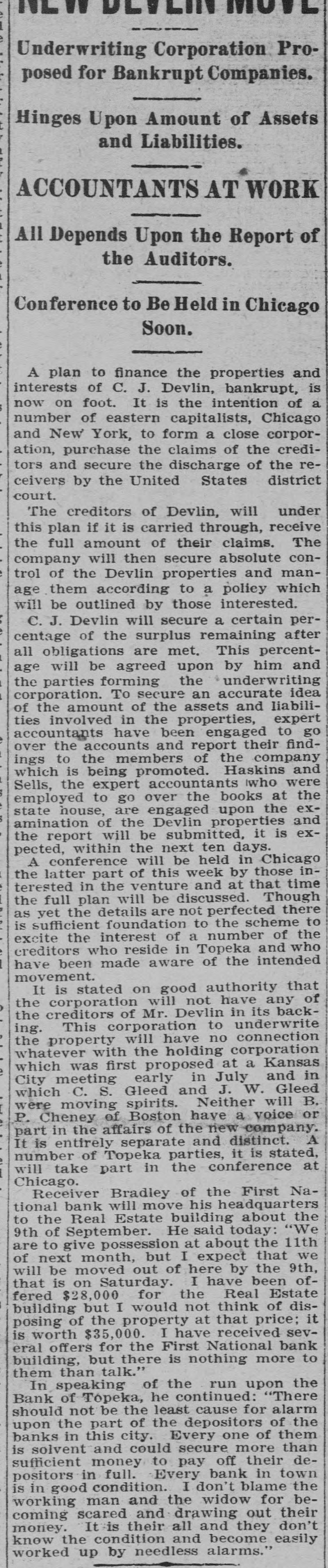
VLILIN MOTE Underwriting Corporation Proposed for Bankrupt Companies. Hinges Upon Amount of Assets and Liabilities. ACCOUNTANTS AT WORK All Depends Upon the Report of the Auditors. Conference to Be Held in Chicago Soon. A plan to finance the properties and interests of C. J. Devlin, bankrupt, is now on foot. It is the intention of a number of eastern capitalists, Chicago and New York, to form a close corporation, purchase the claims of the creditors and secure the discharge of the receivers by the United States district court. The creditors of Devlin, will under this plan if it is carried through, receive the full amount of their claims. The company will then secure absolute control of the Devlin properties and manage them according to a policy which will be outlined by those interested. C. J. Devlin will secure a certain percentage of the surplus remaining after all obligations are met. This percentage will be agreed upon by him and the parties forming the underwriting corporation. To secure an accurate idea of the amount of the assets and liabilities involved in the properties, expert accountants have been engaged to go over the accounts and report their findings to the members of the company which is being promoted. Haskins and Sells, the expert accountants who were employed to go over the books at the state house, are engaged upon the examination of the Devlin properties and the report will be submitted, it is expected, within the next ten days. A conference will be held in Chicago the latter part of this week by those interested in the venture and at that time the full plan will be discussed. Though as yet the details are not perfected there is sufficient foundation to the scheme to excite the interest of a number of the creditors who reside in Topeka and who have been made aware of the intended movement. It is stated on good authority that the corporation will not have any of the creditors of Mr. Devlin in its backing. This corporation to underwrite the property will have no connection whatever with the holding corporation which was first proposed at a Kansas City meeting early in July and in which C. S. Gleed and J. W. Gleed were moving spirits. Neither will B. P. Cheney of Boston have a voice or part in the affairs of the new company. It is entirely separate and distinct. A number of Topeka parties, it is stated, will take part in the conference at Chicago. Receiver Bradley of the First National bank will move his headquarters to the Real Estate building about the 9th of September. He said today: "We are to give possession at about the 11th of next month, but I expect that we will be moved out of here by the 9th, that is on Saturday. I have been offered $28,000 for the Real Estate building but I would not think of disposing of the property at that price; it is worth $35,000. I have received several offers for the First National bank building, but there is nothing more to them than talk.' In speaking of the run upon the Bank of Topeka, he continued: "There should not be the least cause for alarm upon the part of the depositors of the banks in this city. Every one of them is solvent and could secure more than sufficient money to pay off their depositors in full. Every bank in town is in good condition. I don't blame the working man and the widow for becoming scared and drawing out their money. It is their all and they don't know the condition and become easily worked up by needless alarms."


Article from Los Angeles Herald, August 30, 1905

Click image to open full size in new tab

Article Text

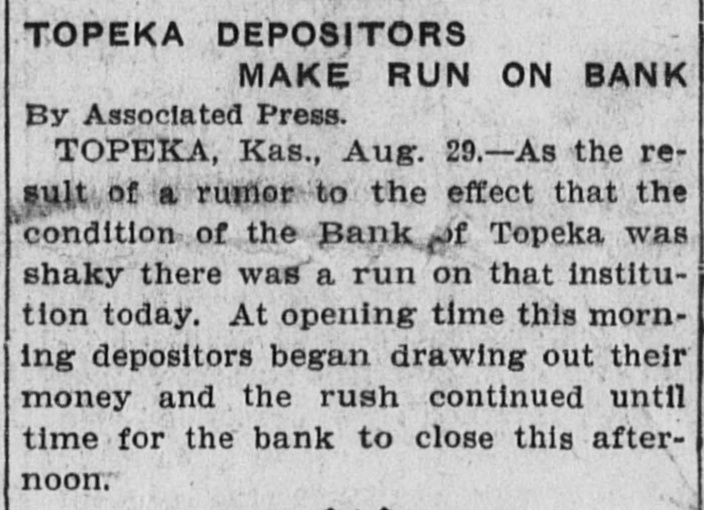
TOPEKA DEPOSITORS MAKE RUN ON BANK By Associated Press. TOPEKA, Kas., Aug. 29.-As the result of a rumor to the effect that the condition of the Bank of Topeka was shaky there was a run on that institution today. At opening time this morning depositors began drawing out their money and the rush continued until time for the bank to close this afternoon.


Article from The San Francisco Call, August 30, 1905

Click image to open full size in new tab

Article Text

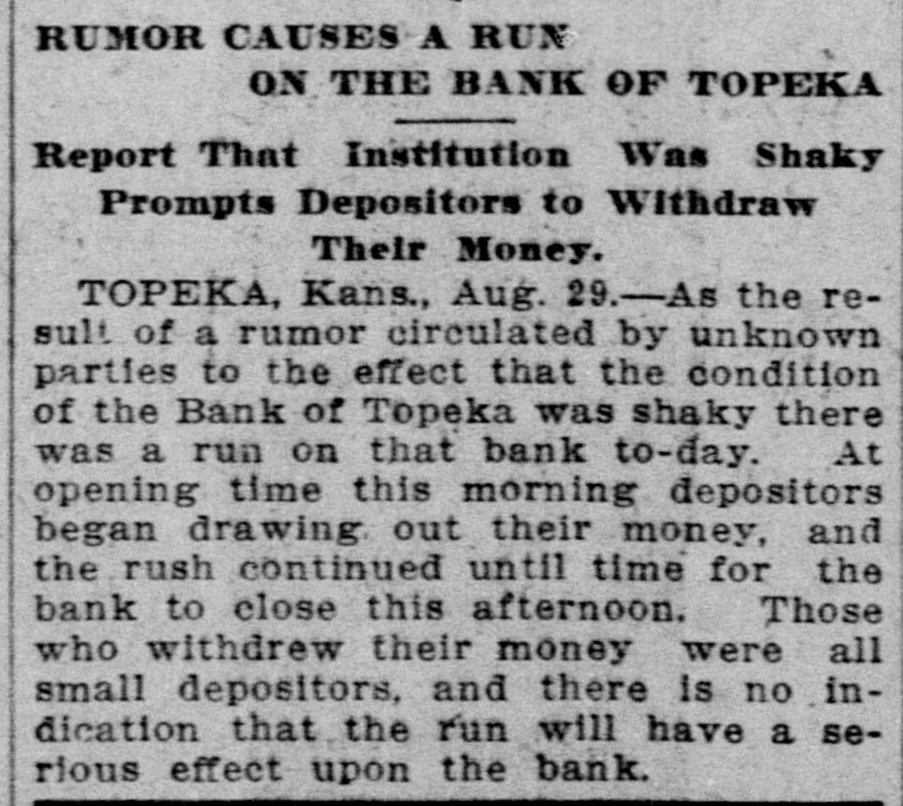
RUMOR CAUSES A RUN ON THE BANK OF TOPEKA Report That Institution Was Shaky Prompts Depositors to Withdraw Their Money. TOPEKA, Kans., Aug. 29.-As the result of a rumor circulated by unknown parties to the effect that the condition of the Bank of Topeka was shaky there was a run on that bank to-day. At opening time this morning depositors began drawing out their money, and the rush continued until time for the bank to close this afternoon. Those who withdrew their money were all small depositors, and there is no indication that the run will have a serious effect upon the bank.


Article from The Salt Lake Herald, August 30, 1905

Click image to open full size in new tab

Article Text

RUN ON TOPEKA BANK. TopeKa, Kan., Aug. 29.-As the result of an absurd rumor circulated by unknown parties to the effect that the condition of the Bank of Topeka was shaky, there was a run on that bank today. At opening time this morning depositors began drawing out their money, and the run continued until time for the bank to close this afternoon. Those who withdrew their money were all small depositors, and there is no indication that the run will have a serious effect upon the bank.


Article from The Topeka State Journal, August 31, 1905

Click image to open full size in new tab

Article Text

SNAPSHOTS AT HOME NEWS. Rev. and Mrs. John A. Bright have returned from their eastern trip. The White Sox return to Topeka on Friday to open a series of three games with Sedalia. Mr. and Mrs. J. T. Bauer, 1321 North Monroe street, are the parents of a boy born Wednesday. Now that the cruel war is over do you feel any more secure than you did when it was at its height. People are raking up leaves in their front yards. That means the early resumption of paying coal bills. Jailor Louis Kenny, who has been on the sick list for a month, expects to return for duty in a few days. Why couldn't we have had Marshall's band concerts on the State House steps one night of every week all summer? Rev. John A. Bright leaves today for Eureka to fill a three days' engagement of "throwing out the life line." The state school fund commissioners are meeting this afternoon to arrange the purchase of bonds for the school fund. Joseph Doud secured the necessary papers from the probate judge's office yesterday to enable him to mary Margaret Hogan. State Superintendent of Instruction I. L. Dayhoff leaves this evening for Rawlins county where he will attend the closing of the county institute. The run on the Bank of Topeka illustrated the old story that when the depositors found that they could get their money, they did not want it. The executive council met this morning at the office of Secretary of State J. R. Burrow. Nothing was done except the usual approval of bills. The drum corps of the Old Abe camp, Sons of Veterans, will go to the reunion of the G. A. R. at Denver next week with the members of the local camp. Bank Commissioner John Q. Royce yesterday issued the call for a statement of the condition of state banks. The report will cover the period up to August 25. Mr. and Mrs. J. F. Greenway returned home yesterday from a month spent in visiting at Salt Lake, Portland. Virginia City, Montana, and Denver, Colorado. Rev. S. S. Estey, and family, will return home from their vacation this week. Dr. Estey will fill the pulpit at the First Presbyterian church next Sunday morning and evening. Frank Long, formerly proprietor of the Oxford hotel, came from Hutchinson yesterday to look after his interest in the property which is now being controlled by Receiver Otis Allen. Stella B. White has filed a suit in the district court asking that she may have her maiden name restored and be granted a divorce from John J. White, who she says is anything but white. Detective Josiah Ross, who has been sick for the past week with kidney trouble, is still in a serious condition. It was announced Monday that an operation would be necessary, but none has been performed. Frank J. Thomas, who has been a salesman for the Southwestern Fuel company for a number of years, has resigned and will accept a position with the St. Louis & Rocky Mountain Coal company, with headquarters at St. Louis. W. H. Eastman and David L. Lakin have entered into a partnership for the purchase and sale of real estate, writing fire insurance and making loans at No. 115 West Sixth avenue. .Ind. phone No. -127. See them before buying-also list your property with them and get resulte. County Treasurer F. C. Bowen has received a draft for $7,116.97 from state which is the second semi-annual the dividend received from the state school fund. This allows about 43 cents per capita for the children of school age in the county. This amount is increased portionment. three cents per capita by the county apWhen the run was the most severe on the Bank of Topeka a customer came in and got a $20 check cashed and received a twenty dollar gold piece in return. He passed the gold piece back and asked for a bill in return. As the bank employe granted the request he said: "Looks like you would be glad to get any kind of money on a day like this." Mr. Arthur C. Neff of Toronto, Can., is in Topeka visiting his uncle, Judge S. S. Urmy. Mr. Neff is a public accountant, and his title is "Fellow Char tered Accountant. Closing some investigations in British Northwest Territory, Mr. Neff thought he would come down to Kansas and look up his uncle, whom he had not seen since infancy. He attended police court this morning drunks. while Judge Urmy fined a pair of plain The Abilene Reflector says: In the southeastern section of the Topeka cemetery a beautiful gray granite monument will soon be erected in memory of the late Simon Schlichter, who departed this life about one year ago. Mr. Schlichter resided in Abilene from 1883 to 1889, was a member of the Lutheran church and a successful business man, and left a host of friends here. His family continues to reside in Topeka. A short memorial service was held at the Elk club rooms last night in memory of Mother Florence, who had endeared herself to the members of that order by the assistance she has