Commercial National Bank (Seattle, WA)

Episode Information

Episode UID
439701139
Episode Type
Suspension โ†’ Closure
Bank Type
national
Bank ID
43970 national
Charter Number
4397
Start Date
November 23, 1894
Location
Seattle, Washington (47.606, -122.332)

Metadata

Model
gpt-5-mini (chosen from majority vote of a three-model LLM ensemble)
Short Digest
783377a744060485

Response Measures

None

Description

Contemporaneous reporting cites voluntary liquidation and later fraud/looting allegations against president H. W. Wheeler.

Events (5)

1. August 15, 1890 Chartered
Source
historical_nic
2. November 23, 1894 Suspension
Cause
Voluntary Liquidation
Cause Details
Bank went into voluntary liquidation during the 1894 panic; board resolved to liquidate and transfer business to Seattle National; later allegations of fraud by president H. W. Wheeler.
Newspaper Excerpt
On the same day the Commercial National bank, of Seattle, went into voluntary liquidation.
Source
newspapers
3. December 29, 1894 Voluntary Liquidation
Source
historical_nic
4. July 26, 1895 Other
Newspaper Excerpt
Since that date he has acted as such, and says it owns 110 shares of the capital stock ... on July 26, 1895, he was regularly appointed agent of the Commercial National bank, of Seattle, now in process of liquidation, by the board of directors. (agent appointed for liquidation/administration).
Source
newspapers
5. * Other
Newspaper Excerpt
Suit for appointment of a receiver for the long defunct Commercial National bank ... filed in the superior court today by Herman J. Brown (1903 petitions alleging fraud and seeking a receiver).
Source
newspapers

Newspaper Articles (12)

Article from The Seattle Post-Intelligencer, August 14, 1894

Click image to open full size in new tab

Article Text

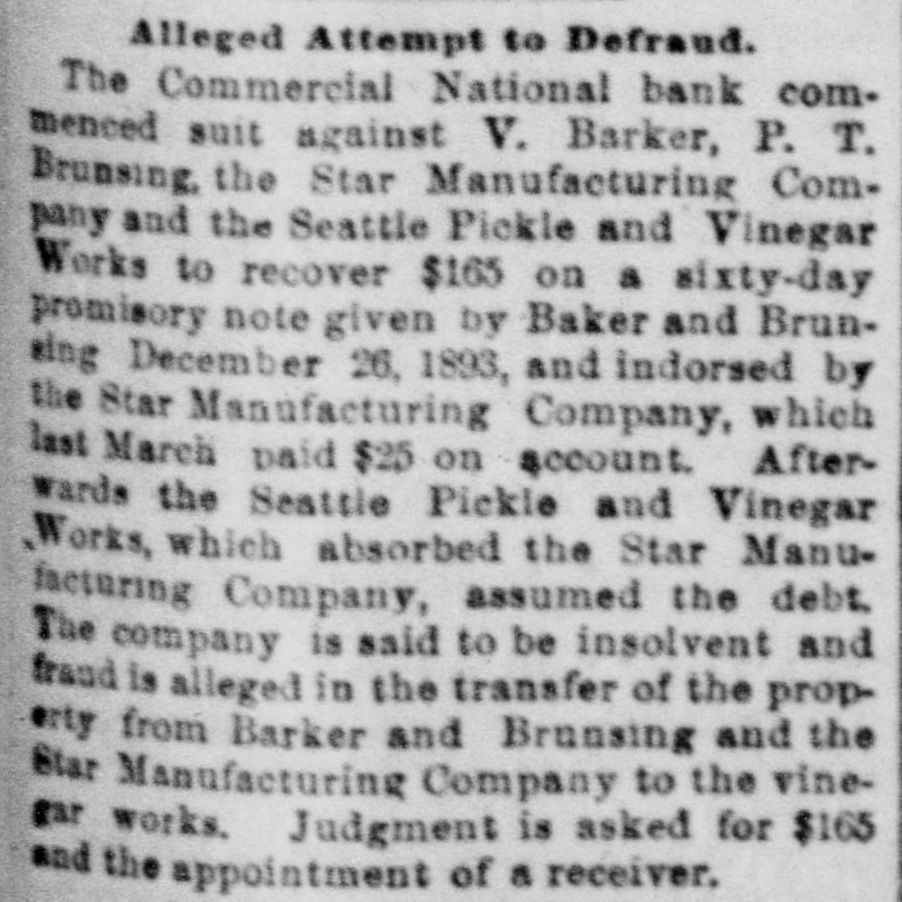
Alleged Attempt to Defraud. The Commercial National bank commenced suit against V. Barker, P. T. Brunsing, the Star Manufacturing Company and the Seattle Pickle and Vinegar Works to recover $165 on a sixty-day promisory note given by Baker and Brunsing December 26, 1893, and indorsed by the Star Manufacturing Company, which last March paid $25 on account. Afterwards the Seattle Pickle and Vinegar ,Works, which absorbed the Star Manufacturing Company, assumed the debt. The company is said to be insolvent and fraud is alleged in the transfer of the property from Barker and Brunsing and the Star Manufacturing Company to the vinegar works. Judgment is asked for $165 and the appointment of a receiver.


Article from The Yakima Herald, November 29, 1894

Click image to open full size in new tab

Article Text

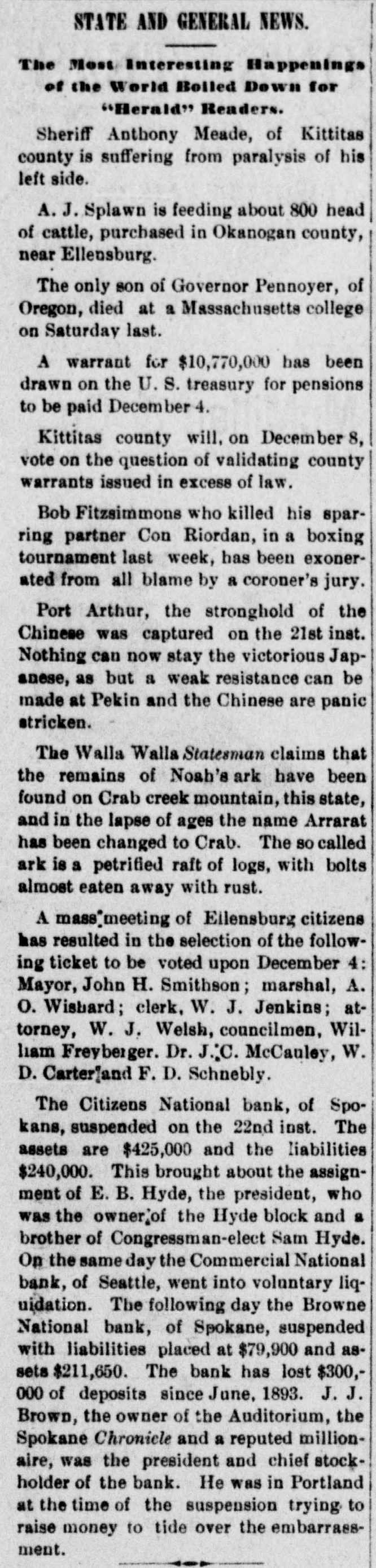
STATE AND GENERAL NEWS. The Most Interesting Happenings of the World Bolled Down for "Herald" Readers. Sheriff Anthony Meade, of Kittitas county is suffering from paralysis of his left side. A. J. Splawn is feeding about 800 head of cattle, purchased in Okanogan county, near Ellensburg. The only son of Governor Pennoyer, of Oregon, died at a Massachusetts college on Saturday last. A warrant for $10,770,000 has been drawn on the U.S. treasury for pensions to be paid December 4. Kittitas county will, on December 8, vote on the question of validating county warrants issued in excess of law. Bob Fitzsimmons who killed his sparring partner Con Riordan, in a boxing tournament last week, has been exonerated from all blame by a coroner's jury. Port Arthur, the stronghold of the Chinese was captured on the 21st inst. Nothing can now stay the victorious Japanese, as but a weak resistance can be made at Pekin and the Chinese are panic stricken. The Walla Walla Statesman claims that the remains of Noah's ark have been found on Crab creek mountain, this state, and in the lapse of ages the name Arrarat has been changed to Crab. The so called ark is a petrified raft of logs, with bolts almost eaten away with rust. A mass"meeting of Eilensburg citizens has resulted in the selection of the following ticket to be voted upon December 4: Mayor, John H. Smithson; marshal, A. O. Wishard; clerk, W. J. Jenkins; attorney, W. J. Welsh, councilmen, William Freyberger. Dr. J.C. McCauley, W. D. Carter]and F. D. Schnebly. The Citizens National bank, of Spokans, suspended on the 22nd inst. The assets are $425,000 and the liabilities $240,000. This brought about the assignment of E. B. Hyde, the president, who was the owner,of the Hyde block and a brother of Congressman-elect Sam Hyde. On the same day the Commercial National bank, of Seattle, went into voluntary liquidation. The following day the Browne National bank, of Spokane, suspended with liabilities placed at $79,900 and assets $211,650. The bank has lost $300,000 of deposits since June, 1893. J. J. Brown, the owner of the Auditorium, the Spokane Chronicle and a reputed millionaire, was the president and chief stockholder of the bank. He was in Portland at the time of the suspension trying to raise money to tide over the embarrassment.


Article from The Seattle Post-Intelligencer, January 1, 1895

Click image to open full size in new tab

Article Text

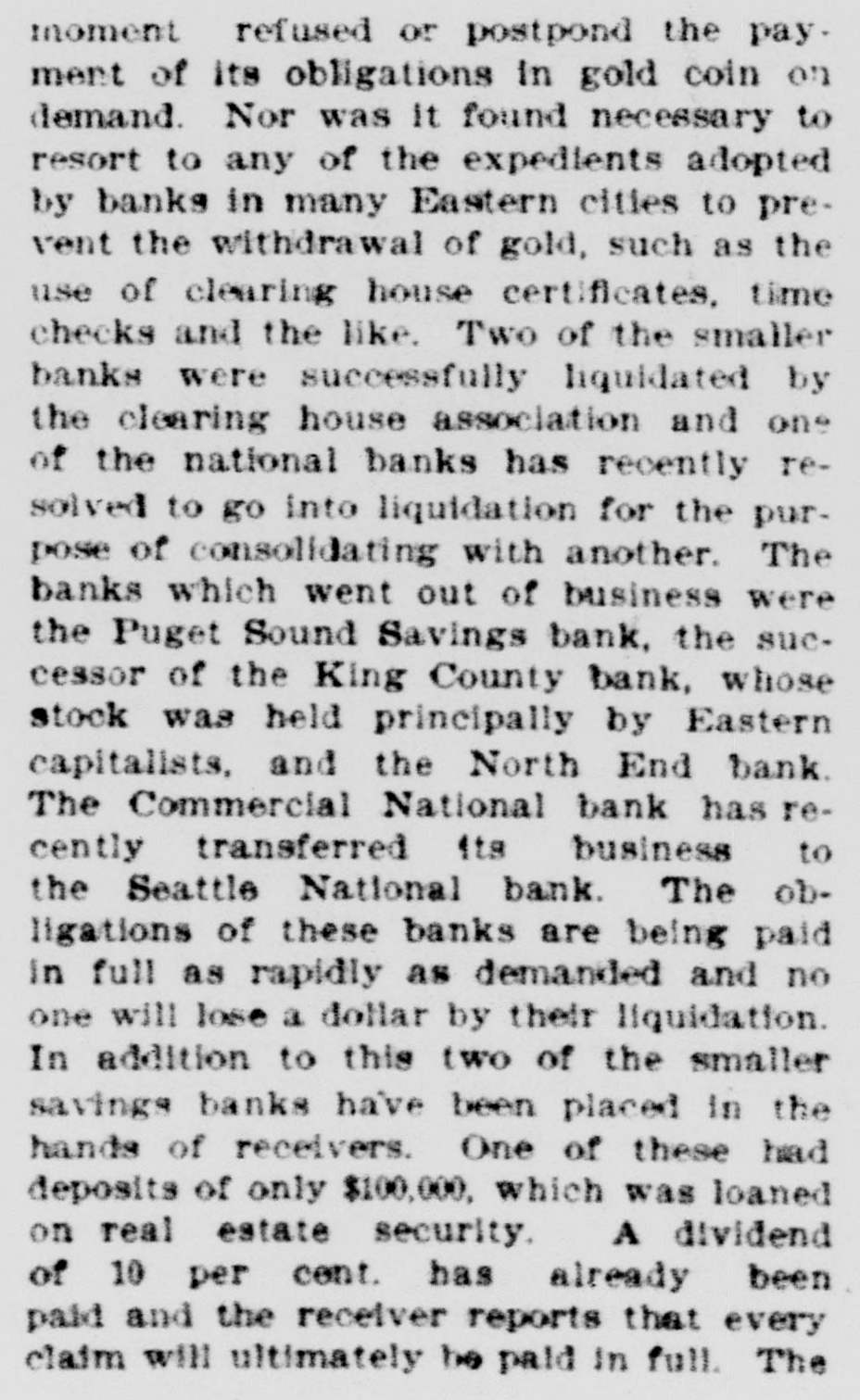
moment refused or postpond the pay. ment of its obligations In gold coin on demand. Nor was It found necessary to resort to any of the expedients adopted by banks in many Eastern cities to prevent the withdrawal of gold, such as the use of clearing house certificates, time checks and the like. Two of the smaller banks were successfully liquidated by the clearing house association and one of the national banks has recently resolved to go into liquidation for the purpose of consolidating with another. The banks which went out of business were the Puget Sound Savings bank, the successor of the King County bank, whose stock was held principally by Eastern capitalists, and the North End bank. The Commercial National bank has recently transferred 1ts business to the Seattle National bank. The obligations of these banks are being paid in full as rapidly as demanded and no one will lose a dollar by their liquidation. In addition to this two of the smaller savings banks have been placed in the hands of receivers. One of these had deposits of only $100,000, which was loaned on real estate security. A dividend of 10 per cent. has already been paid and the receiver reports that every claim will ultimately be paid in full. The


Article from The Seattle Post-Intelligencer, March 27, 1895

Click image to open full size in new tab

Article Text

A SERIOUS CHARGE. J.P. Gleason's Suit Against H. W. Wheeler and Others. CLAIMS HE WAS DEFRAUDED. Mrs. Clapsadle Renews Her Claim for Breach of Promise-Alleged Evasion of Execution. In a suit begun by Deputy Collector of Internal Revenue James P. Gleason against H. W. Wheler and the Pacific Mortgage Company in the superior court yesterday to get back $9,500 worth of promissory notes and valuable Seattle property. Gleason charges Wheeler with having looted the Commercial National bank of large sums of money. Gleason states in his complaint that Wheeler, through false and fraudulent representations. sold to him on August 24, 1894, one hundred shares of the capital stock of the Commercial National bank of the par value of $100 each. Gleason in payment of the stock claims to have given Wheeler eight promissory notes, six for $500 each and two for $1,000 each, all bearing the date of August 25, 1894/ and made payable four years after date. Another note for $2,500, payable to the Commercial National bank ninety days after date, he says, was given to Wheeler together with deeds to lots 5 in block 16. 7 in block 78, and 6 in block 64, of Central Seattle. The notes, he says, were secured by fifty shares of the purchased stock Gleason says that Wheeler made many fraudulent representations to him. Among other things It is claimed Wheeler represented to Gleason that the actual value of the stock in the bank was 20 per cent. above par; that the bank had a reserve of $25,000; that the securities held by the bank against the National Investment Company, the Puget Sound Lime Company, the American Investment Company, the Sidney Hotel Company, and the L H. Wheeler, W. T. Chalk and D. T. Denny loans, were as good as gold and every dollar collectible, and that every other security of the bank was first class: that the bank was in a first class financial and prosperousscondition and was doing a paying and profitable business. Wheeler, who was president of the bank, further represented to Gleason, according to the complaint, that he was obligated to the bank in the sum of $2,500, and that the note for $2,500 given by the plaintiff to the bank was given for the purpose of taking up and assumIng the obligation and that he would not draw any funds whatsoever from the bank upon the note. Wheeler also promised to and represented that he would remain in the bank and retain at least $10,000 worth of stock. Gleason alleges the truth of the matter to be that at the time he purchased the stock It was absolutely worthless, having little or no value. The bank, he says, had no reserve fund, and the obligations of the National Investment Company, the Puget Sound Lime Company, the American Investment Company, the Sidney Hotel Company. the Pacific Manufacturing Company and the Wheeler and Chalk loans were worthless, while the Denny loan was of little value. H. W. Wheler and his brothers, L. H. Wheeler and Lee Wheeler, were, Gleason says, the principal owners and holders of the stock in each of the corporations, and the loans made by H. W. Wheeler as president were made with the knowledge that they were insolvent and their securities of no value whatsoever, and for the purpose of deriving the benefits of loans personally through the corporations, "and had thereby cheated. looted and defrauded the bank of large sums of money and caused the same to suspend business." The bank, according to Gleason, was about to suspend at the time he purchased the stock, and did suspend soon afterwards. Wheeler, It is alleged. knew all of these facts. He was not obligated. It is claimed, to the bank upon his promissory note in the sum of $2,500, as he had stated. or in any sum greater than $1,800, which note Wheeler took up and withdrew $700 from the bank, replacing It by the $2,500 note drawn by Gleason in favor of the bank. The Pacific Mortgage Company. according to the complaint, was organized by Wheeler for the purpose of covering his illegal transactions and for the furthor purpose of preventing his creditors from reaching property conveyed to the Pacific Mortgage Company by him and held by the company in disguise and in the place of the defendant. On Novemher 1804 Gleason states Wheeler con-


Article from The Seattle Post-Intelligencer, October 20, 1895

Click image to open full size in new tab

Article Text

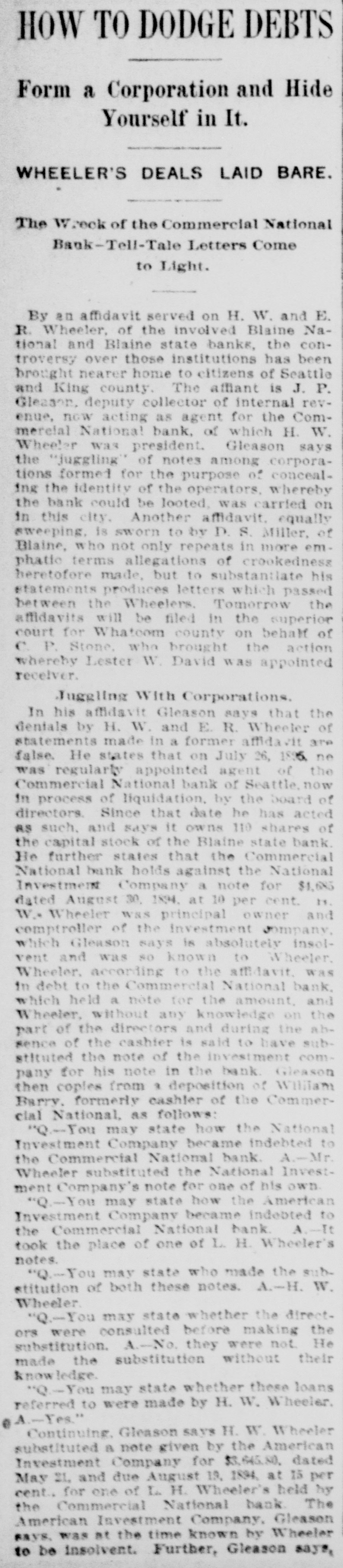
# HOW TO DODGE DEBTS Form a Corporation and Hide Yourself in It. # WHEELER'S DEALS LAID BARE. The Wreck of the Commercial National Bank-Tell-Tale Letters Come to Light. By an affidavit served on H. W. and E. R. Wheeler, of the involved Blaine Na- tional and Blaine state banks, the con- troversy over those institutions has been brought nearer home to citizens of Seattle and King county. The affiant is J. P. Gleason, deputy collector of internal rev- enue, now acting as agent for the Com- merelal National bank, of which H. W. Wheeler was president. Gleason says the "juggling of notes among corpora- tions formed for the purpose of conceal- ing the identity of the operators, whereby the bank could be looted, was carried on in this city. Another affidavit, equally sweeping, is sworn to by D. S. Miller, of Blaine, who not only repeats in more em- phatic terms allegations of crookedness heretofore made, but to substantiate his statements produces letters which passed between the Wheelers. Tomorrow the affidavits will be filed in the superior court for Whatoom county on behalf of C. P. Stone, who brought the action whereby Lester W. David was appointed receiver. Juggling With Corporations. In his affidavit Gleason says that the dentals by H. W. and E. R. Wheeler of statements made in a former affidavit are false. He states that on July 26, 1895, ne was regularly appointed agent of the Commercial National bank of Seattle, now in process of liquidation, by the board of directors. Since that date he has acted as such, and says it owns 110 shares of the capital stock of the Blaine state bank. He further states that the Commercial National bank holds against the National Investment Company a note for $1,685 dated August 30, 1894, at 10 per cent. H. W. Wheeler was principal owner and comptroller of the investment company, which Gleason says is absolutely insol- vent and was so known to Wheeler. Wheeler, according to the affidavit, was in debt to the Commercial National bank, which held a note for the amount, and Wheeler, without any knowledge on the part of the directors and during the ab- sence of the cashier is said to have sub- stituted the note of the investment com- pany for his note in the bank. Gleason then coples from a deposition of William Barry, formerly cashier of the Commer- cial National, as follows: "Q-You may state how the National Investment Company became indebted to the Commercial National bank. A.-Mr. Wheeler substituted the National Invest- ment Company's note for one of his own. "Q-You may state how the American Investment Company became indebted to the Commercial National bank. A. It took the place of one of L. H. Wheeler's notes. "Q-You may state who made the sub- stitution of both these notes. A.-H. W. Wheeler. "Q.-You may state whether the direct- ors were consulted before making the substitution. A.-No. they were not. He made the substitution without their knowledge. "Q-You may state whether these loans referred to were made by H. W. Wheeler. A.-Yes" Continuing, Gleason says H. W. Wheeler substituted a note given by the American Investment Company for $3.645.80, dated May 21, and due August 19, 1894, at 15 per cent.. for one of L. H. Wheeler's held by the Commercial National bank. The American Investment Company, Gleason says, was at the time known by Wheeler to be insolvent. Further, Gleason says,


Article from The Seattle Post-Intelligencer, December 18, 1895

Click image to open full size in new tab

Article Text

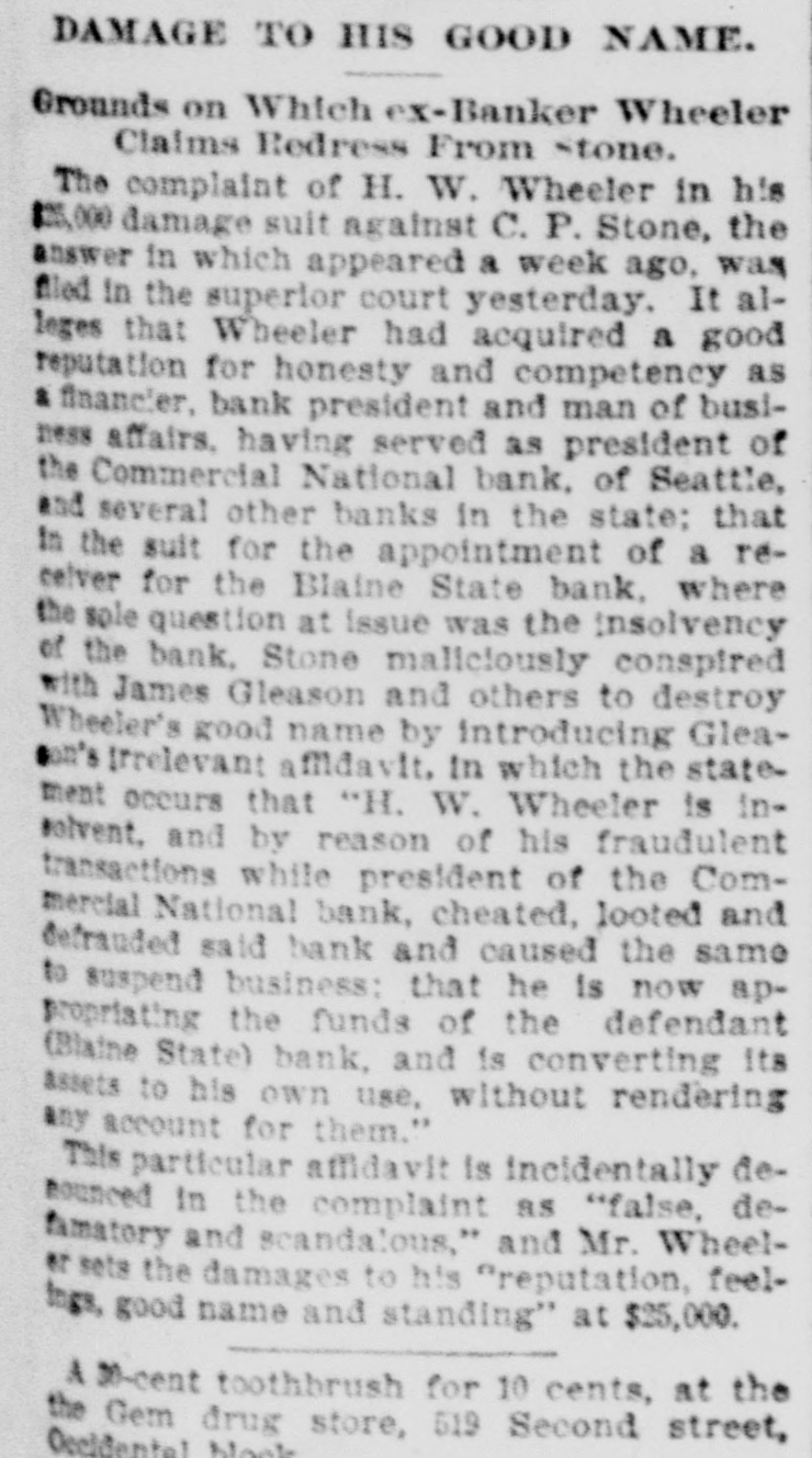
DAMAGE TO HIS GOOD NAME. Grounds on Which ex-Banker Wheeler Claims Redress From stone. The complaint of H. W. Wheeler in his $25,000 damage suit against C. P. Stone, the answer in which appeared a week ago, was filed in the superior court yesterday. It alleges that Wheeler had acquired a good reputation for honesty and competency as & financier, bank president and man of business affairs, having served as president of the Commercial National bank, of Seattle, and several other banks in the state: that In the suit for the appointment of a recelver for the Blaine State bank, where the sole question at Issue was the insolvency of the bank, Stone maliciously conspired with James Gleason and others to destroy Wheeler's good name by introducing Gleason's Irrelevant affidavit. In which the statement occurs that "H. W. Wheeler is insolvent. and by reason of his fraudulent transactions while president of the Commercial National bank, cheated, looted and defrauded said bank and caused the same to suspend business: that he is now appropriating the funds of the defendant (Blaine State) bank, and is converting its assets to his own use, without rendering any account for them." This particular affidavit is incidentally desounced in the complaint as "false, defamatory and scandalous," and Mr. Wheelor sets the damages to his "reputation, feelIngs, good name and standing" at $25,000. A 00-cent toothbrush for 10 cents, at the the Gem drug store, 519 Second street, Occidental block


Article from The Seattle Post-Intelligencer, March 15, 1896

Click image to open full size in new tab

Article Text

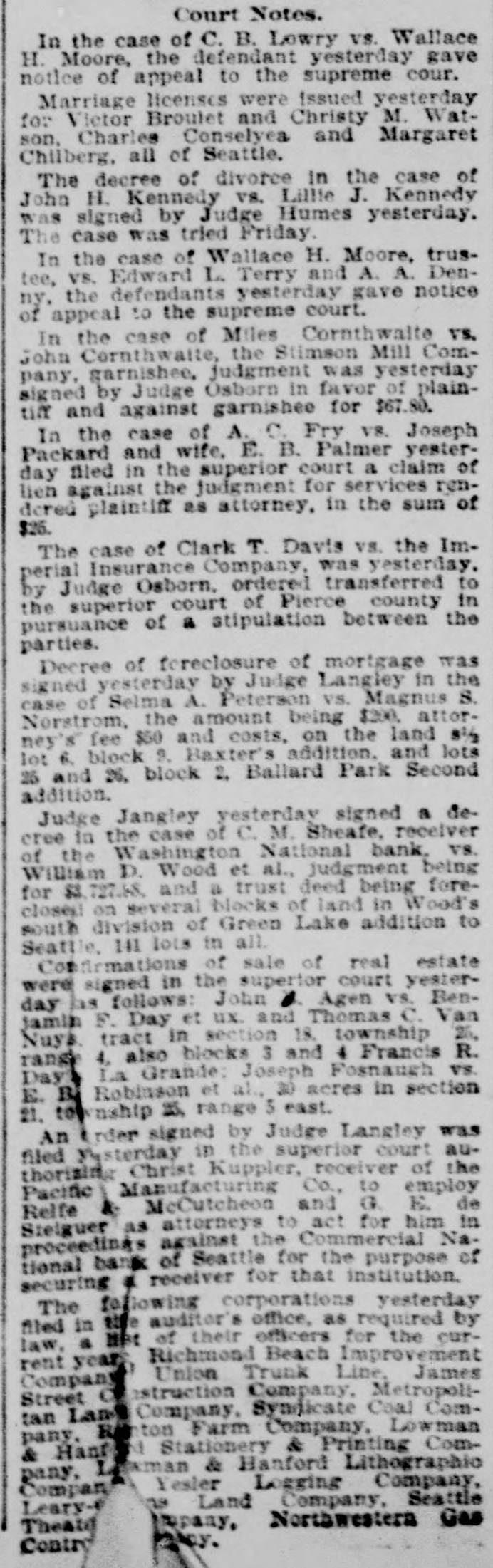
Court Notes. In the case of C. B. Lowry vs. Wallace H. Moore, the defendant yesterday gave notice of appeal to the supreme cour. Marriage licenses were Issued yesterday for Victor Broulet and Christy M. Watson, Charles Conselyea and Margaret Chilberg, all of Seattle. The decree of divorce in the case of John H. Kennedy vs. Lillie J. Kennedy was signed by Judge Humes yesterday. The case was tried Friday. In the case of Wallace H. Moore, trustee, vs. Edward L. Terry and A. A. Denny, the defendants yesterday gave notice of appeal to the supreme court. In the case of Miles Cornthwalte vs. John Cornthwaite, the Stimson Mill Company, garnishee, judgment was yesterday signed by Judge Osborn in favor of plaintim and against garnishee for $67.80. In the case of A. C. Fry vs. Joseph Packard and wife, E. B. Palmer yesterday filed in the superior court a claim of lien against the judgment for services rendcred plaintiff as attorney, in the sum of $26. The case of Clark T. Davis vs. the Imperial Insurance Company, was yesterday. by Judge Osborn. ordered transferred to the superior court of Pierce county in pursuance of a stipulation between the parties. Decree of foreclosure of mortgage was signed yesterday by Judge Langley in the case of Selma A. Peterson vs. Magnus S. Norstrom, the amount being $200. attorney's fee $50 and costs, on the land 5ยฝ lot 6. block 9. Baxter's addition. and lots 25 and 26, block 2, Ballard Park Second addition. Judge Jangley yesterday signed a decree in the case of C. M. Sheafe, receiver of the Washington National bank, vs. William D. Wood et al., judgment being for $8,727.68, and a trust deed being foreclosed on several blocks of land in Wood's south division of Green Lake addition to Seattle, 141 lots in all. Confirmations of sale of real estate were signed in the superior court yesterday las follows: John a Agen vs. Benjamin F. Day et ux. and Thomas C. Van Nuys. tract in section 18. township 25, range 4, also blocks 3 and 4 Francis R. Day La Grande: Joseph Fosnaugh vs. E. B Robinson et at, 30 acres in section 21. township 25, range $ east. An trder signed by Judge Langley was filed Yysterday in the superior court authorising Christ Kuppler, receiver of the Pacific Manufacturing Co., to employ Relfe & McCutcheon and G. E. de Stelguer as attorneys to act for him in proceedings against the Commercial National bank of Seattle for the purpose of securing a receiver for that institution. The following corporations yesterday filed in tife auditor's office, as required by law, a lift of their officers for the current years, Richmond Beach Improvement Company Union Trunk Line, James Street Construction Company, Metropolitan Land Company, Syndicate Coal Company, Renton Farm Company, Lowman & Hanfahi Stationery & Printing Company, Leaman & Hanford Lithographic Yesler Logging Company, Company as Land Company, Seattle Leary-9 mpany, Northwestern Gas Theate Contry


Article from The Seattle Post-Intelligencer, March 18, 1899

Click image to open full size in new tab

Article Text

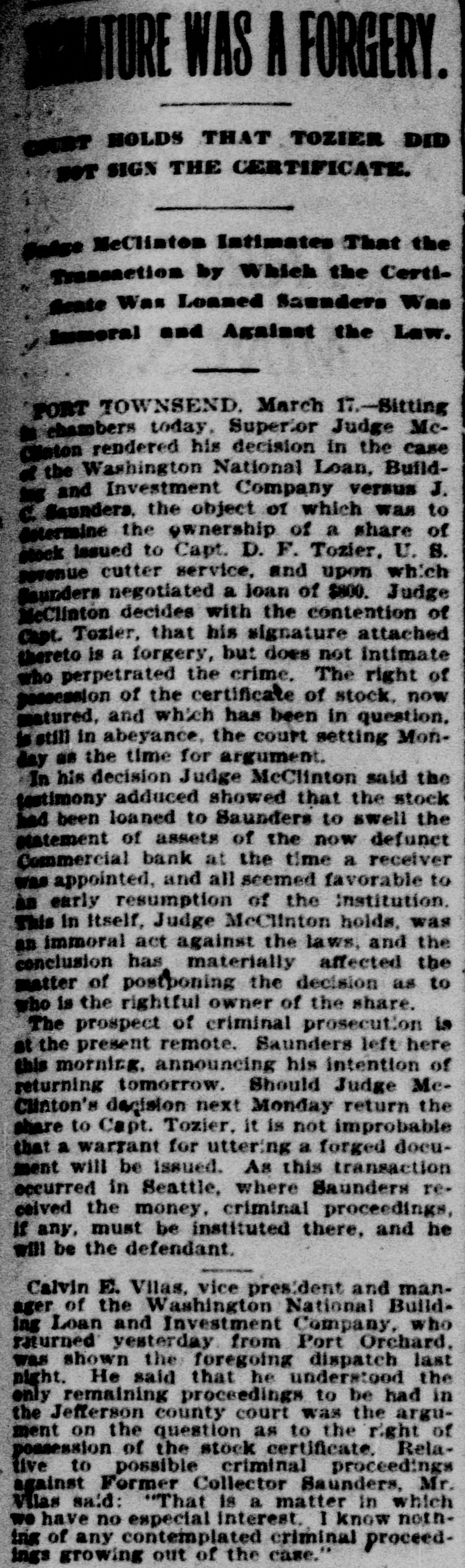
TURE WAS A FORGERY. HOLDS THAT TOZIER DID SIGN THE CERTIFICATE. MeClinton Intimates That the Transaction by Which the CertiSente Was Loaned Saunders Was Immoral and Against the Law. PORT TOWNSEND. March 17.-Sitting chambers today. Superior Judge McClinton rendered his decision in the case of the Washington National Loan, Buildthe and Investment Company versus J. C. Saunders, the object of which was to Getermine the ownership of a share of stock Issued to Capt. D. F. Tozier, U. S. sevenue cutter service, and upon which Baunders negotiated a loan of $800. Judge McClinton decides with the contention of Capt. Tozier, that his signature attached thereto is a forgery, but does not intimate who perpetrated the crime. The right of passession of the certificate of stock. now matured, and which has been in question. is still in abeyance, the court setting Monday as the time for argument. In his decision Judge McClinton said the testimony adduced showed that the stock had been loaned to Saunders to swell the statement of assets of the now defunct Commercial bank at the time a receiver was appointed, and all seemed favorable to ร n early resumption of the Institution. This In Itself, Judge McClinton holds, was an immoral act against the laws, and the conclusion has materially affected the matter of postponing the decision as to who is the rightful owner of the share. The prospect of criminal prosecution is at the present remote. Saunders left here this morning. announcing his intention of returning tomorrow. Should Judge MeClinton's decision next Monday return the share to Capt. Tozier. it is not improbable that a warrant for uttering a forged document will be issued. As this transaction occurred in Seattle, where Baunders recelved the money, criminal proceedings, If any, must be instituted there, and he will be the defendant. Calvin E. Vilas, vice president and manager of the Washington National Building Loan and Investment Company, who raturned yesterday from Port Orchard. was shown the foregoing dispatch last night. He said that he understood the only remaining proceedings to be had in the Jefferson county court was the argument on the question as to the right of possession of the stock certificate. Relafive to possible criminal proceedings against Former Collector Saunders, Mr. Vilas said: "That is a matter in which we have no especial interest. I know nothtrig of any contemplated criminal proceedings growing out of the case."


Article from The Seattle Star, December 30, 1903

Click image to open full size in new tab

Article Text

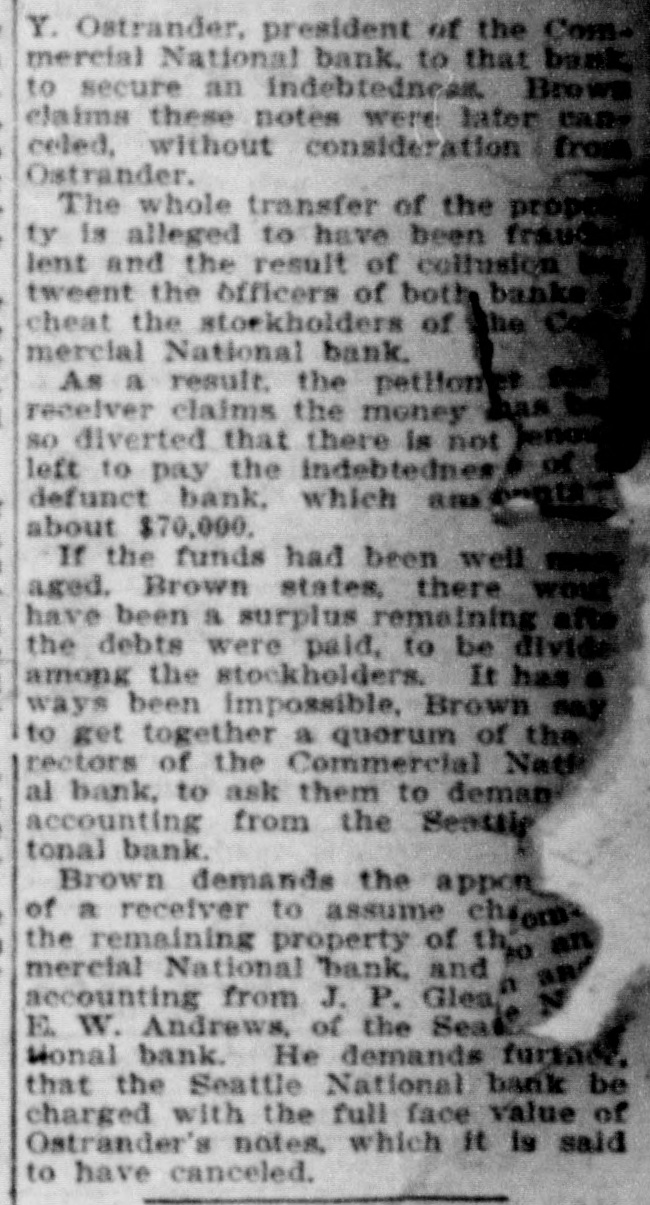
Y. Ostrander, president of the Commercial National bank, to that bank' to secure an indebtedness. Brown claims these notes were later canceled, without consideration from Ostrander. The whole transfer of the proper-< ty is alleged to have been fraudulent and the result of collusion betweent the officers of both banks to cheat the stockholders of the Commercial National bank. As a result, the petiioner for at receiver claims the money has been so diverted that there is not enough left to pay the indebtedness of the defunct bank, which amounts to about $70.000. If the funds had been well managed, Brown states, there would have been a surplus remaining after the debts were paid. to be divided among the stockholders. It has always been impossible, Brown sayse to get together a quorum of the drectors of the Commercial Nationat bank. to ask them to demand an accounting from the Seattle Natonal bank. Brown demands the appontment of a receiver to assume charge of the remaining property of the Commercial National bank, and also an accounting from J. P. Gleason and E. W. Andrews, of the Seattle National bank. He demands further, that the Seattle National bank be charged with the full face value of Ostrander's notes, which it is said to have canceled.


Article from The Seattle Star, December 30, 1903

Click image to open full size in new tab

Article Text

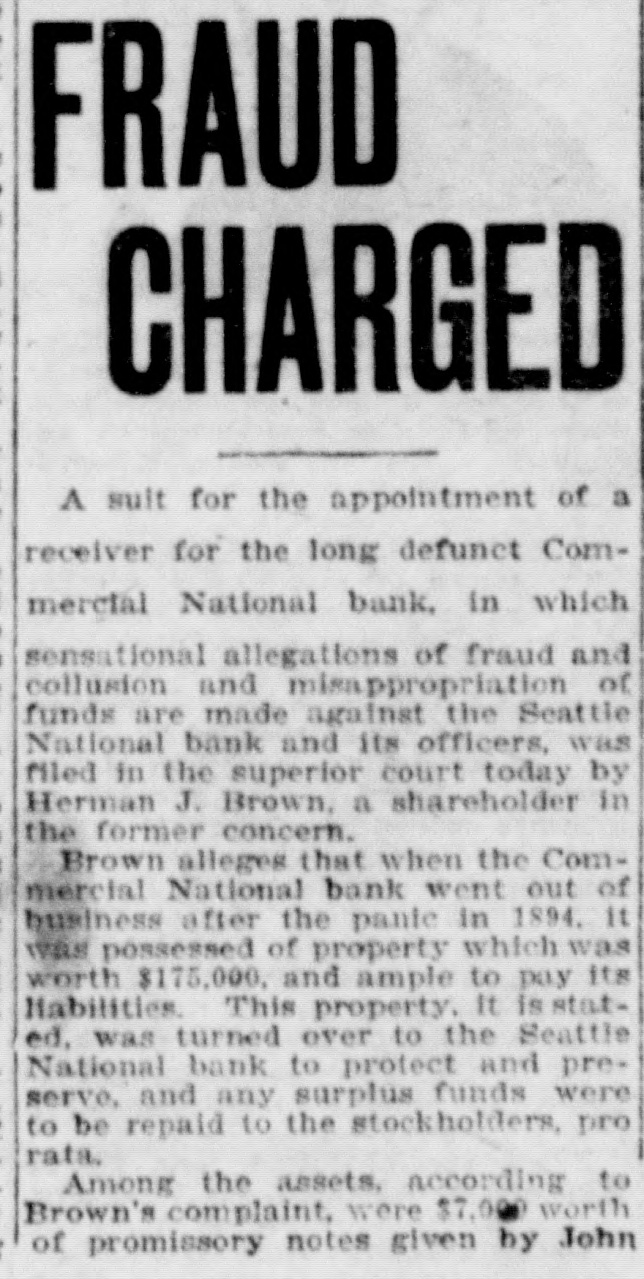
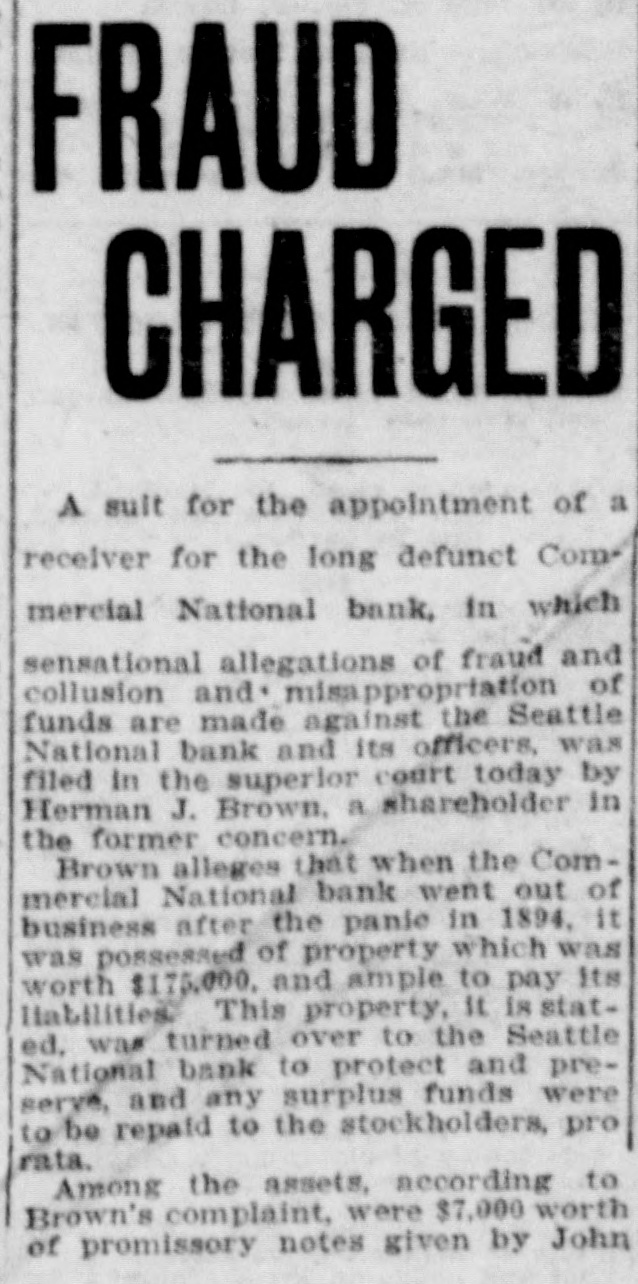
FRAUD CHARGED A sult for the appointment of a receiver for the long defunct Commercial National bank, in which sensational allegations of fraud and collusion and misappropriation of funds are made against the Seattle National bank and its officers, was filed in the superior court today by Herman J. Brown, a shareholder in the former concern. Brown alleges that when the Commercial National bank went out of business after the pante in 1894. It WAS possessed of property which was worth $175,000. and ample to pay its Habilities. This property. It is stated, was turned over to the Seattle National bank to protect and preserve, and any surplus funds were to be repaid to the stockholders, pro rata. Among the assets, according to Brown's complaint, were $7,000 worth of promissory notes given by John


Article from The Seattle Star, December 31, 1903

Click image to open full size in new tab

Article Text

FRAUD CHARGED A suit for the appointment of a receiver for the long defunct Commercial National bank, in which sensational allegations of fraud and collusion and misappropriation of funds are made against the Seattle National bank and its officers, was filed In the superior court today by Herman J. Brown, a shareholder in the former concern. Brown alleges that when the Commercial National bank went out of business after the panie in 1894, it was possessed of property which was worth $175,000. and ample to pay Its liabilities. This property, It is stated, was turned over to the Seattle National bank to protect and preserve, and any surplus funds were to be repaid to the stockholders, pro rata. Among the assets, according to Brown's complaint, were $7,000 worth of promissory notes given by John


Article from The Seattle Star, December 31, 1903

Click image to open full size in new tab

Article Text

Y. Ostrander, president of the Commercial National bank. to that bank, to secure an indebtedness. Brow claims these notes were later cans celed, without consideration fro Ostrander. The whole transfer of the proj ty is alleged to have been fraud lent and the result of collusion tweent the officers of both bank cheat the stockholders of he mercial National bank. As a result. the petition receiver claims the money so diverted that there is not left to pay the indebtednes defunct bank, which am about $70,000. If the funds had been well aged. Brown states, there wos have been a surplus remaining after the debts were paid, to be divid among the stockholders. It has . ways been impossible, Brown may to get together a quorum of the rectors of the Commercial Natt al bank, to ask them to deman accounting from the Senttig tonal bank. Brown demands the appon of a receiver to assume choom am the remaining property of the mercial National bank, and ร  G accounting from J. P. Glea E. W. Andrews, of the Seal: Monal bank. He demands furnince, that the Seattle National bank be charged with the full face value of Ostrander's notes, which it is said to have canceled.