Commercial Bank (Cincinnati, OH)

Episode Information

Episode UID
4346927491143
Episode Type
Run β†’ Suspension β†’ Closure
Bank Type
trust
Bank ID
434692749 hash
Start Date
March 27, 1895
Location
Cincinnati, Ohio (39.103, -84.515)

Metadata

Model
gpt-5-mini (chosen from majority vote of a three-model LLM ensemble)
Short Digest
8f86befe6eeb9c73

Response Measures

None

Events (5)

1. March 27, 1895 Receivership
Newspaper Excerpt
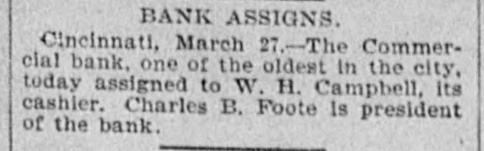
The Commercial Bank assigned this afternoon to W. H. Campbell, its cashier.
Source
newspapers
2. March 27, 1895 Run
Cause
Bank Specific Adverse Info
Cause Details
Heavy withdrawals precipitated after bank was forced to make good $50,000 of bad paper and adverse clearing-house report.
Measures
Bank closed its doors and suspended payment; later assigned to cashier/receiver.
Newspaper Excerpt
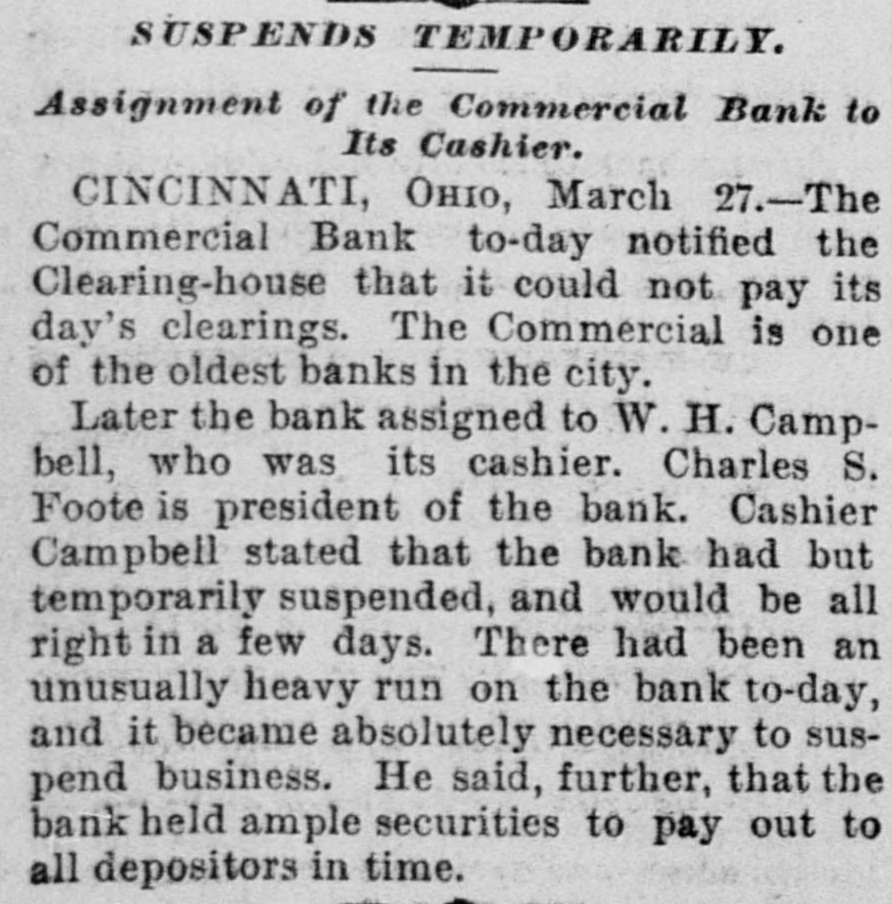
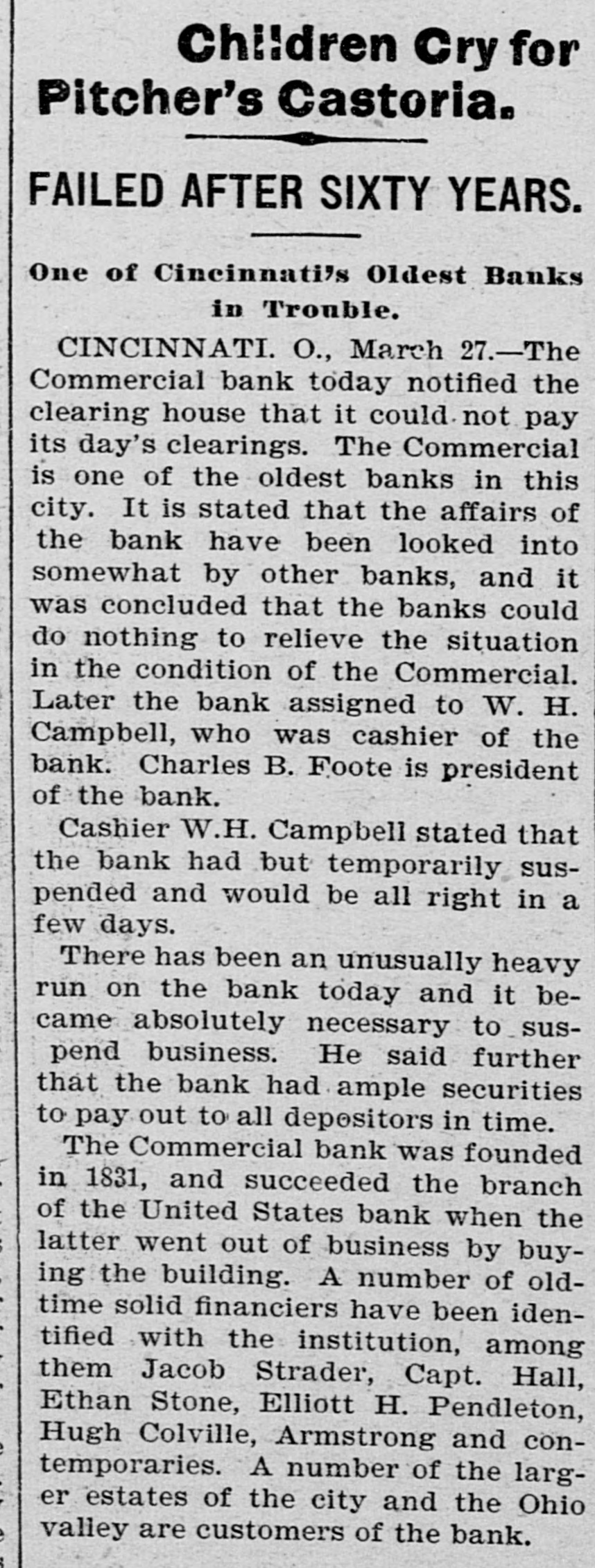
There had been an unusually heavy run on the bank to-day and it became absolutely necessary to suspend business.
Source
newspapers
3. March 27, 1895 Suspension
Cause
Bank Specific Adverse Info
Cause Details
Clearing-house directors refused to honor its paper after discovery of bad paper and ordered an investigation, precipitating suspension and assignment.
Newspaper Excerpt
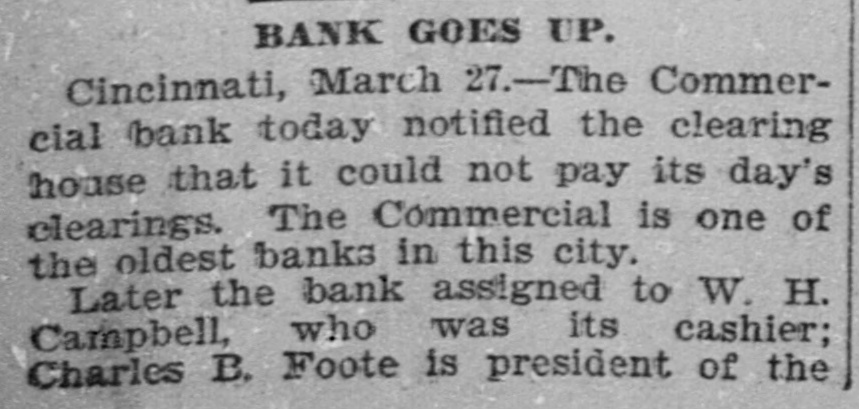
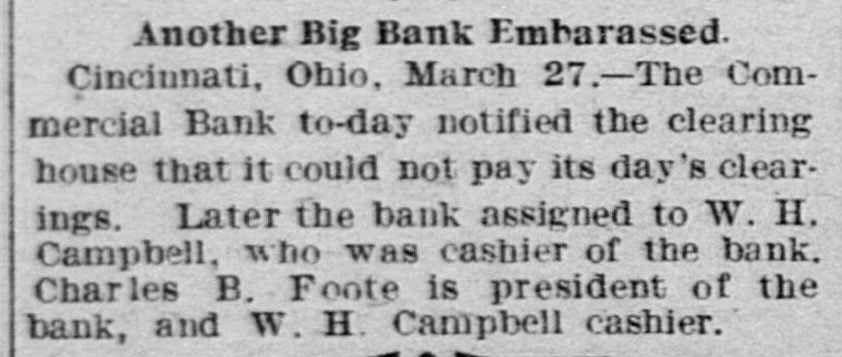
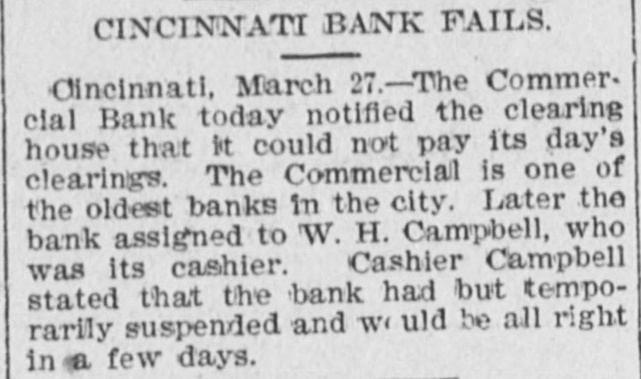
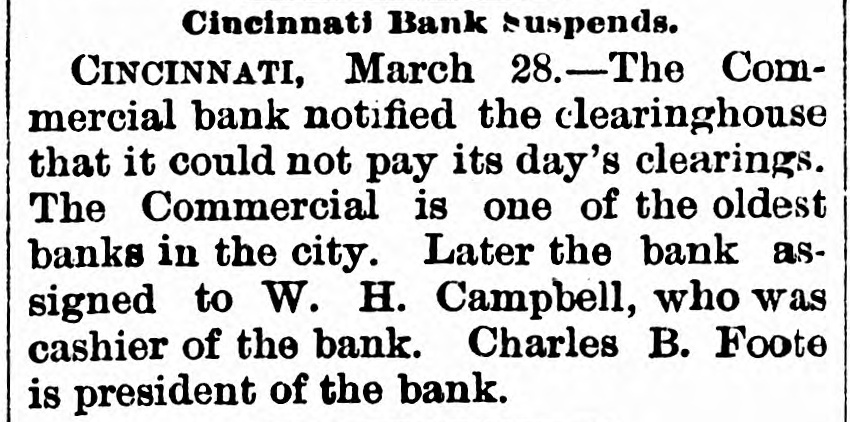
The Commercial Bank to-day notified the clearing house that it could not pay its day's clearings.
Source
newspapers
4. April 27, 1895 Other
Newspaper Excerpt
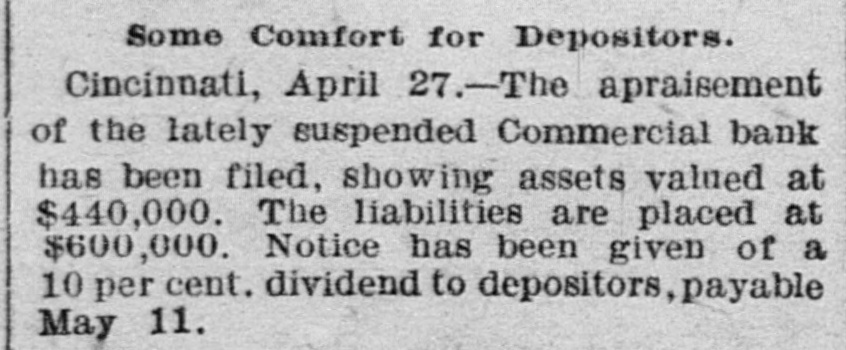
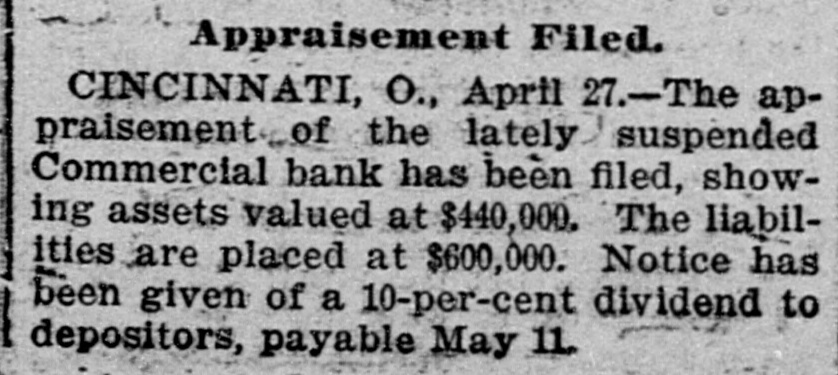
The appraisement of the lately suspended Commercial bank has been filed, showing assets valued at $440,000. The liabilities are placed at $600,000. Notice has been given of a 10-per-cent dividend to depositors, payable May 11.
Source
newspapers
5. August 13, 1895 Other
Newspaper Excerpt
Jude O'Neil rendered a decision today that the Commercial bank had been insolvent months before it closed...the court holds further that the bank was unlawfully conducted.
Source
newspapers

Newspaper Articles (17)

Article from The Indianapolis Journal, March 28, 1895

Click image to open full size in new tab

Article Text

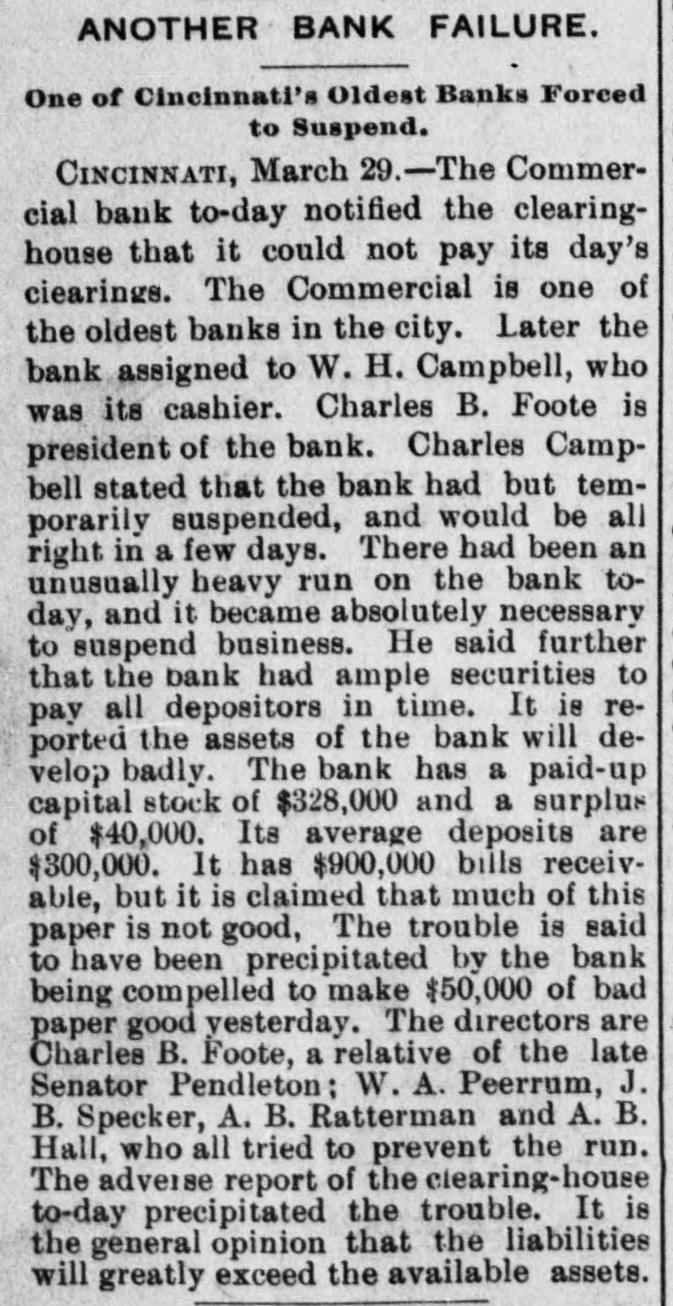
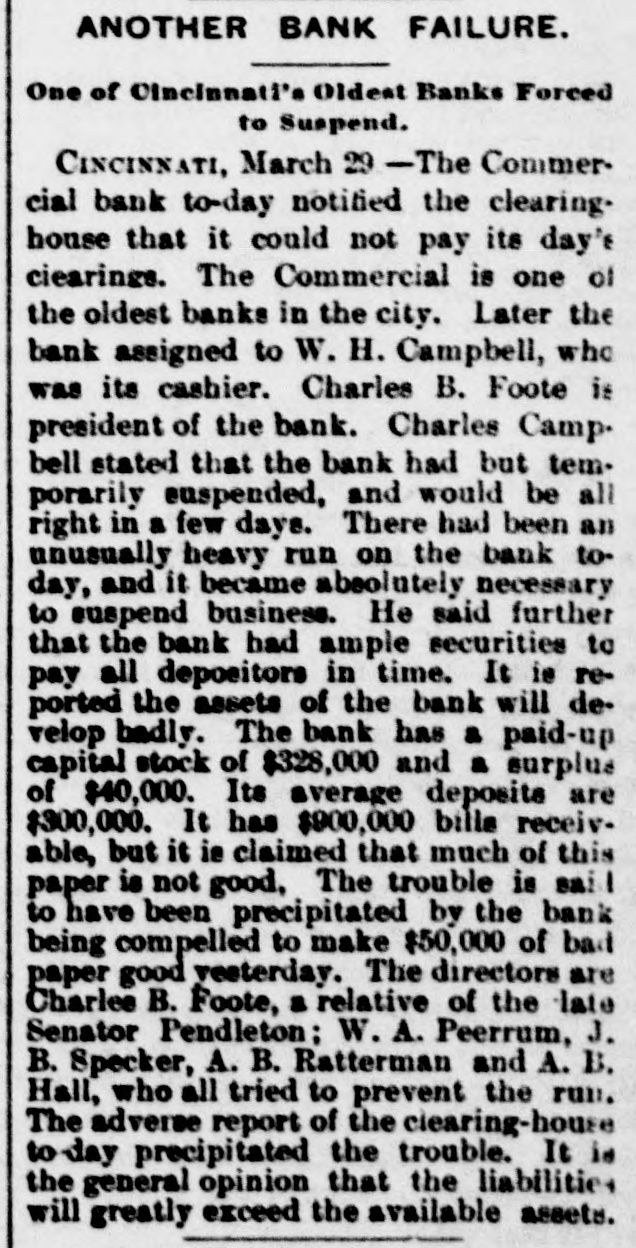
SUSPENDED PAYMENT COMMERCIAL BANK OF CINCINNATI FORCED TO CLOSE. Clearing House Association Refused to Extend Aid-Securities Ample to Pay Depositors. CINCINNATI, O., March 27.-The Commercial Bank to-day notified the clearing house that it could not pay its day's clearings. The Commercial is one of the oldest banks in the city. It is stated that the affairs of the bank have been looked into somewhat by other banks and it was concluded that the banks could no nothing to relieve the situation in connection with the Commercial. Later in the day the bank assigned to W. H. Campbell, who was cashier of the bank. Charles B. Foote is president of the bank and W. H. Campbell cashier. Cashier W. H. Campbell stated that the bank had but temporary suspended payment and would be all right in a few days. There had been an unusually heavy run on the bank to-day and it became absolutely necessary to suspend business. He said further that the bank held ample securities to pay out to all depositors in time. The Commercial Bank was founded in 1831 and succeeded the branch of the United States Bank when the last went out of business, by buying the building, A number of old-time, solid financiers have been identified with the institution, among them Jacob Strader, Captain Hall, Ethan Stone, Elliot H. Pendleton, Hugh Colville, Armstrong and contemporaries. A number of the large estates of the city and of the Ohio valiey are customers of this bank. To-night it is reported that the affairs of the bank will develop badly. The bank has a paid up capital stock of $328,000 and a surplus of $40,000. Its average deposits were $400,000. The stock was divided into shares of $50 each, and though little trading was done in it, it was quoted on the market at 921/2, asked. It has $900,000 bills receivable, but it is claimed that much of this paper is not good, that the trouble was precipitated by the bank being compelled to make $50,000 of bad paper good yesterday. The directors are Charles B. Foote, a relative of the late Senator Pendleton: William Herron, J. B. Specker, A. B. Batterman and A. B. Hall, who did all they could to prevent the run. Although the bank is the oldest in the State, it is the only one in Cincinnati that had to be carried during the panic two years ago. When the present trouble came on the clearing house appointed a committee to investigate it. The adverse report of the clearing house committee to-day precipitated the trouble, and it is the general opinion that the liabilities will greatly exceed the available assets.


Article from New-York Tribune, March 28, 1895

Click image to open full size in new tab

Article Text

A CINCINNATI BANK FAILS. Cincinnati, Ohio, March 27.-The Commercial Bank assigned this afternoon to W. H. Campbell, its cashier. The bank was compelled to make good $50,000 worth of bad paper yesterday. When the bank sent its paper to the clearing house this afternoon the directors of the association, on motion of Cashier Guthrie, of the National Lafayette Bank, suspended payment on the paper, and ordered an investigation of the bank's condition. This move proved fatal and precipitated the failure, which had been impending for some time. President Foote says that the bank will be able to pay dollar for dollar. The bank is the oldest in the city. It was organized in 1831. Charles B. Foote is president. The bank has a paid-up capital stock of $328,000, and a surplus of $40,000. Its average deposits were $400,000.


Article from The Seattle Post-Intelligencer, March 28, 1895

Click image to open full size in new tab

Article Text

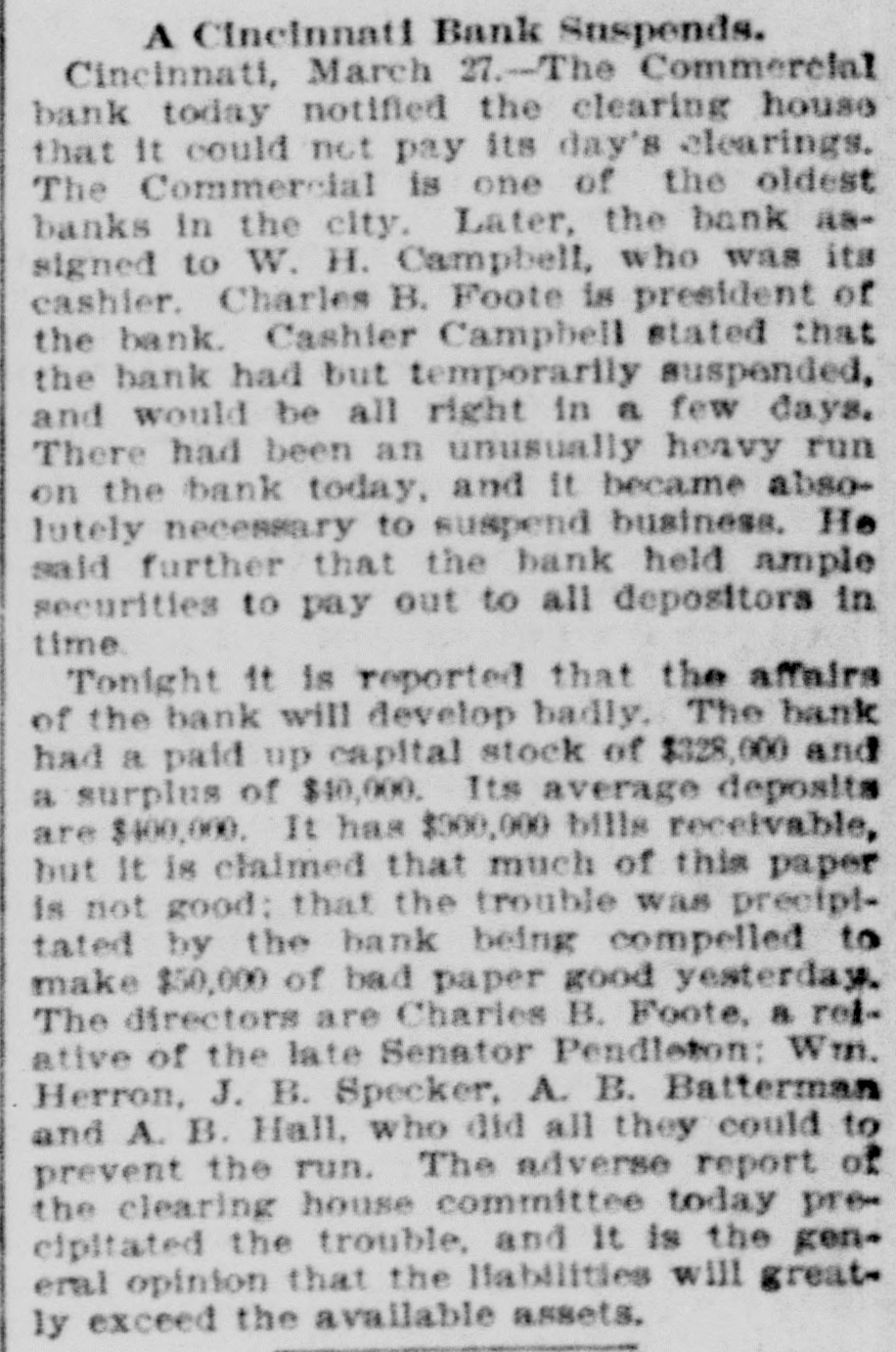
A Cincinnati Bank Suspends. Cincinnati, March 27.-The Commercial bank today notified the clearing house that it could not pay its day's clearings. The Commercial is one of the oldest banks in the city. Later, the bank assigned to W. H. Campbell, who was its cashier. Charles B. Foote is president of the bank. Cashier Campbell stated that the bank had but temporarily suspended, and would be all right in a few days. There had been an unusually heavy run on the bank today, and it became absolutely necessary to suspend business. He said further that the bank held ample securities to pay out to all depositors in time Tonight it is reported that the affairs of the bank will develop badly. The bank had a paid up capital stock of $328,000 and a surplus of $10,000. Its average deposits are $400,000. It has $000,000 bills receivable, but It is claimed that much of this paper is not good: that the trouble was precipttated by the bank being compelled to make $50,000 of bad paper good yesterday. The directors are Charles B. Foote, a relative of the late Senator Pendleton: Wm. Herron, J. B. Specker, A. B. Batterman and A. B. Hall, who did all they could to prevent the run. The adverse report of the clearing house committee today precipitated the trouble, and It is the general opinion that the liabilities will greatly exceed the available assets.
Article from The Times, March 28, 1895

Click image to open full size in new tab

Article Text

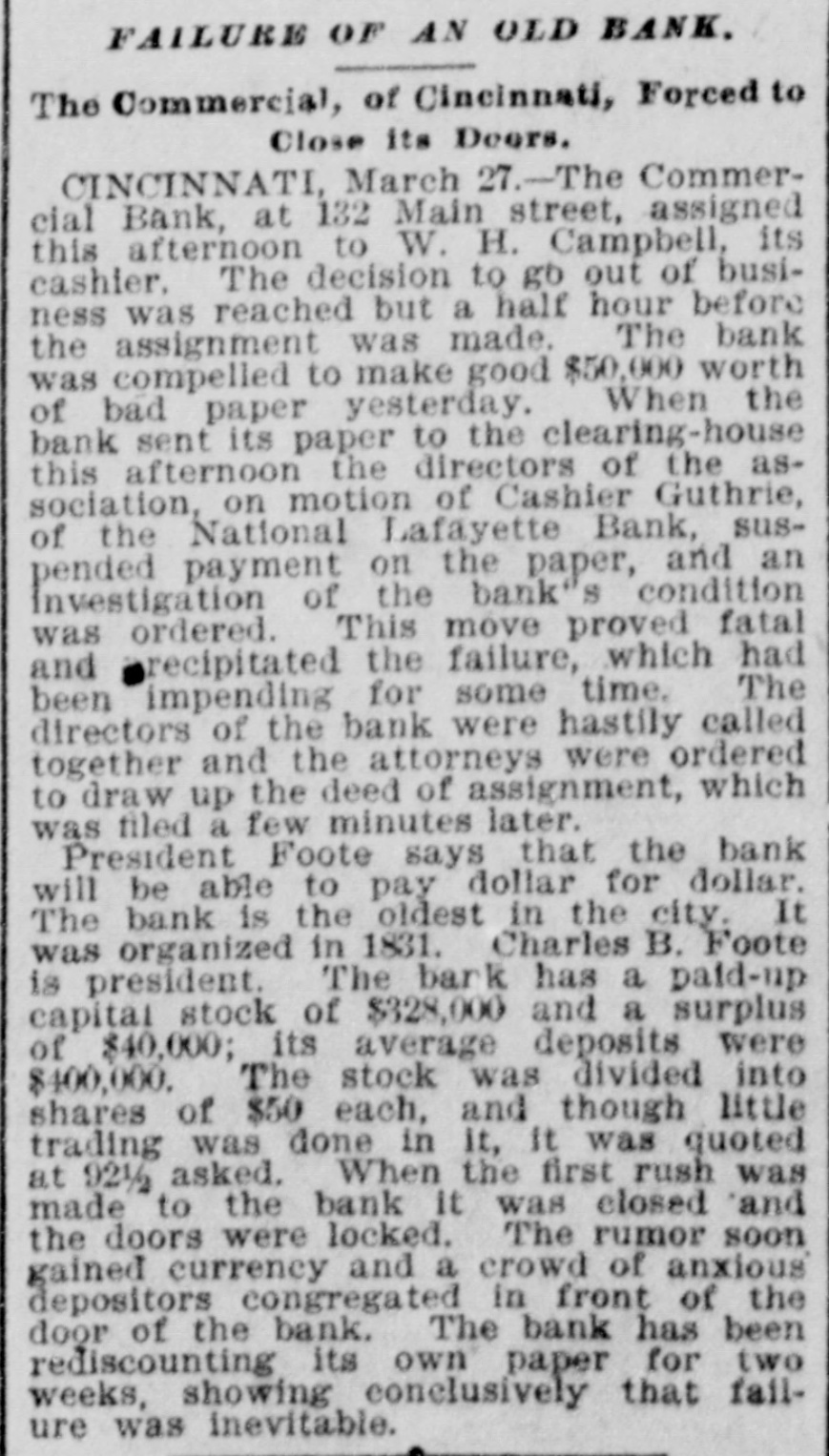
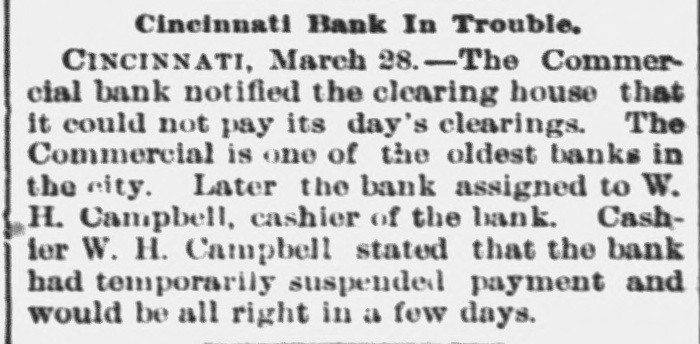
FAILURE OF AN OLD BANK. The Commercial, of Cincinnati, Forced to Close its Deers. CINCINNATI, March 27.-The Commercial Bank, at 132 Main street, assigned this afternoon to W. H. Campbell, its cashier. The decision to go out of business was reached but a half hour before the assignment was made. The bank was compelled to make good $50,000 worth of bad paper yesterday. When the bank sent its paper to the clearing-house this afternoon the directors of the association, on motion of Cashier Guthrie, of the National Lafayette Bank, suspended payment on the paper, and an Investigation of the bank"s condition was ordered. This move proved fatal and recipitated the failure, which had been impending for some time. The directors of the bank were hastily called together and the attorneys were ordered to draw up the deed of assignment, which was filed a few minutes later. President Foote says that the bank will be able to pay dollar for dollar. The bank is the oldest in the city. It was organized in 1831. Charles B. Foote is president. The bark has a paid-up capital stock of $328,000 and a surplus of $40,000; its average deposits were $400,000. The stock was divided into shares of $50 each, and though little trading was done in it, it was quoted at 921/2 asked. When the first rush was made to the bank it was closed and the doors were locked. The rumor soon gained currency and a crowd of anxious depositors congregated in front of the door of the bank. The bank has been rediscounting its own paper for two weeks, showing conclusively that failure was inevitable.


Article from The Herald, March 28, 1895

Click image to open full size in new tab

Article Text

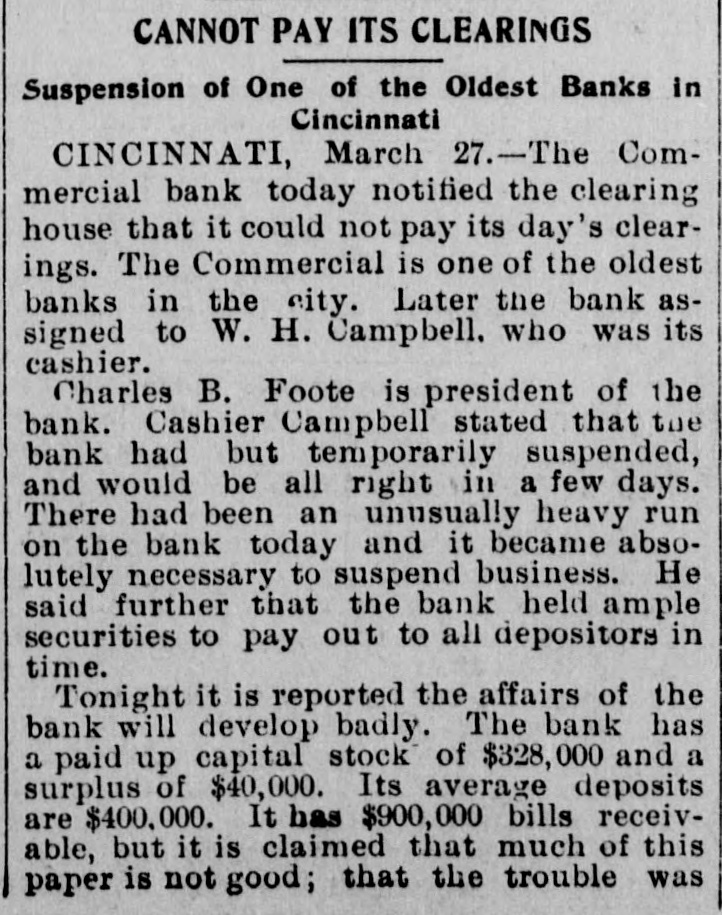
CANNOT PAY ITS CLEARINGS Suspension of One of the Oldest Banks in Cincinnati CINCINNATI, March 27.-The Commercial bank today notified the clearing house that it could not pay its day's clearings. The Commercial is one of the oldest banks in the city. Later the bank assigned to W. H. Campbell. who was its cashier. Charles B. Foote is president of the bank. Cashier Campbell stated that the bank had but temporarily suspended, and would be all right in a few days. There had been an unusually heavy run on the bank today and it became absolutely necessary to suspend business. He said further that the bank held ample securities to pay out to all depositors in time. Tonight it is reported the affairs of the bank will develop badly. The bank has a paid up capital stock of $328,000 and a surplus of $40,000. Its average deposits are $400,000. It has $900,000 bills receivable, but it is claimed that much of this paper is not good; that the trouble was


Article from The Morning News, March 28, 1895

Click image to open full size in new tab

Article Text

A CINCINNATI BANK FAILS. The Collapse Attributed to Bad Management. Cincinnati, O., March 27.-The Commercial Bank, located at 132 Main street, assigned this afternoon to W. H. Campbell, its cashier. The decision to go out of business was reported but half an hour before assignment. The bank was compelled to make good $50,000 worth of bad paper yesterday. When the bank sent its paper to the clearing house this afternoon the directors of the association, on motion of Cashier Guthrie of the National Lafayette Bank, suspended payment on the paper and ordered an investigation of the bank's condition. This move proved fatal and precipitated the failure, which had been impending for some time. The directors of the bank were hastily called together and the attorneys were ordered to draw up the deed of assignment, which was filed a few minutes later. President Foote says that the bank will be able to pay dollar for dollar. The bank is the oldest in the city. It was organized in 1831. Charles B. Foote is president. The 'bank has a paid up capital stock of $328,000, and a surplus of $40,000. Its average deposits were $400,000. The stock was divided into shares of $50 each, and very little trading was done in it. When the first rush was made to the bank it was closed and the iron doors were locked tight. The rumor soon gained circulation and a crowd of anxious deposiors congregated in front of the door. The Commercial Bank was at one time the main bank for the steamboats, and the PendlΓ©tons and Thomas Sherlock were heavily interested. The opinion on Third street is that the crash came about through bad management. Swing & Morse, the attorneys for the bank, and Robert Clarke & Co. are among the heaviest depositors. The bank has been rediscounting its own paper for two weeks, showing conclusively that failure was inevitable.


Article from The San Francisco Call, March 28, 1895

Click image to open full size in new tab

Article Text

SUSPENDS TEMPORARILY. Assignment of the Commercial Bank to Its Cashier. CINCINNATI, OHIO, March 27.-The Commercial Bank to-day notified the Clearing-house that it could not pay its day's clearings. The Commercial is one of the oldest banks in the city. Later the bank assigned to W. H. Campbell, who was its cashier. Charles S. Foote is president of the bank. Cashier Campbell stated that the bank had but temporarily suspended, and would be all right in a few days. There had been an unusually heavy run on the bank to-day, and it became absolutely necessary to suspend business. He said, further, that the bank held ample securities to pay out to all depositors in time.


Article from Pawtucket Tribune, March 28, 1895

Click image to open full size in new tab

Article Text

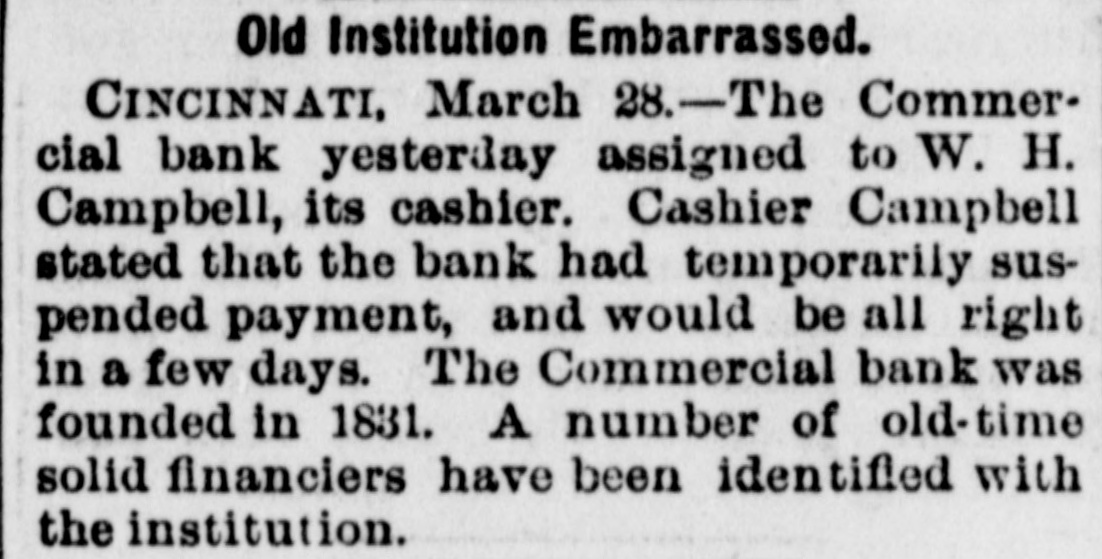
Old Institution Embarrassed. CINCINNATI, March 28.-The Commercial bank yesterday assigned to W. H. Campbell, its cashier. Cashier Campbell stated that the bank had temporarily suspended payment, and would be all right in a few days. The Commercial bank was founded in 1831. A number of old-time solid financiers have been identified with the institution.


Article from Birmingham Age-Herald, March 28, 1895

Click image to open full size in new tab

Article Text

A CINCINNATI BANK, The Oldest in the City, Goes to the Wall With a Crash-Much Excitement. CINCINNATI, March 27.-The Commercial bank, located at 132 Main street, assigned this afternoon to W. H. Campbell, its cashier. The decision to go out of business was reached but a half hour before the assignment was made. The bank was compelled to make good $50,000 worth of bad paper yesterday. When the bank sent its paper to the clearing house this afternoon the directors of the association, on motion of Cashier Guthrie of the National Lafayette bank, suspended payment on the paper and ordered an investigation of the bank's condition. This move proved fatal, and precipitated the failure, which has been impending for some time. The directors of the bank were hastily called together, and the attorneys were ordered to draw up the deed of assignment, which was filed a few minutes later. President Foote said that the bank will be able to pay dollar for dollar. The bank is the oldest in the city. It was organized in 1831. Charles B. Foote is, president. The bank has a paid up capital of $328,000 and a eurplus of $40,000. Its average deposits were $400,000. The stock was divided into shares of $50 each, and very little trading was done in it. It was quoted at 921/2 asked. When the rush was made to the bank it was closed and the iron doors were locked tight. The rumor soon guined circulation and a crowd of anxious depositors congregated in !rout of the door. The Commercial bank was one time the main bank for the steamboats, and the Pendletone and Thomas Sherlock were heavily interested. The opinion on Third street is that the crash came about through bad management. Swing & Morse, attorneys for the bank, and Robert Clark & Co. are among the heaviest depositors. The tank has been rediscounting it own paper for two weeks, showing con. clusively that failure was inevitable.


Article from St. Paul Daily Globe, March 28, 1895

Click image to open full size in new tab

Article Text

Children Cry for Pitcher's Castoria. FAILED AFTER SIXTY YEARS. One of Cincinnati's Oldest Banks in Trouble. CINCINNATI. O., March 27.-The Commercial bank today notified the clearing house that it could. not pay its day's clearings. The Commercial is one of the oldest banks in this city. It is stated that the affairs of the bank have been looked into somewhat by other banks, and it was concluded that the banks could do nothing to relieve the situation in the condition of the Commercial. Later the bank assigned to W. H. Campbell, who was cashier of the bank. Charles B. Foote is president of the bank. Cashier W.H. Campbell stated that the bank had but temporarily suspended and would be all right in a few days. There has been an unusually heavy run on the bank today and it became absolutely necessary to suspend business. He said further that the bank had ample securities to pay out to all depositors in time. The Commercial bank was founded in 1831, and succeeded the branch of the United States bank when the latter went out of business by buying the building. A number of oldtime solid financiers have been identified with the institution, among them Jacob Strader, Capt. Hall, Ethan Stone, Elliott H. Pendleton, Hugh Colville, Armstrong and contemporaries. A number of the larger estates of the city and the Ohio valley are customers of the bank.


Article from The Indianapolis Journal, March 30, 1895

Click image to open full size in new tab

Article Text

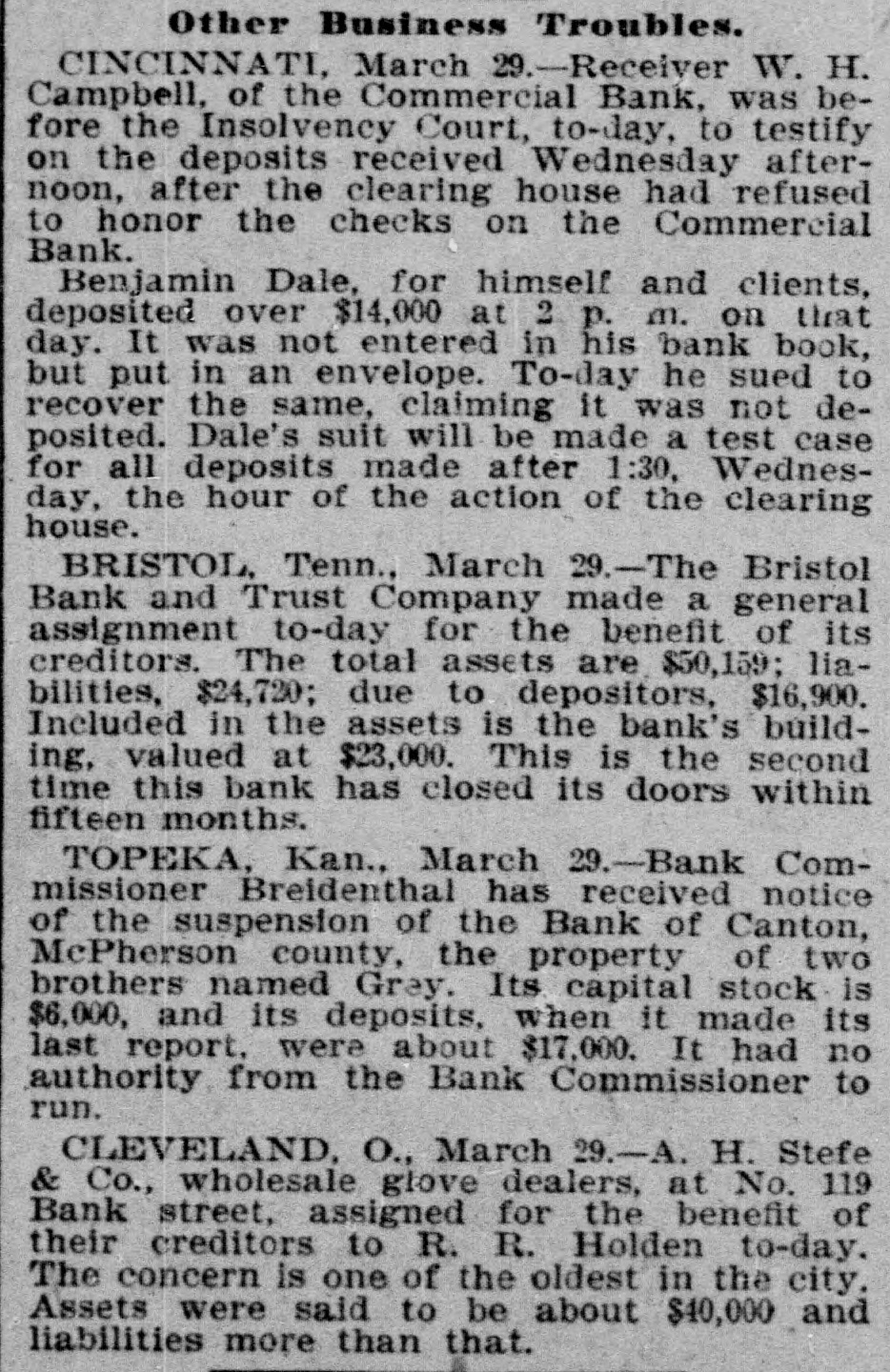
Other Business Troubles. CINCINNATI, March 29.-Receiver W. H. Campbell, of the Commercial Bank, was before the Insolvency Court, to-day, to testify on the deposits received Wednesday afternoon, after the clearing house had refused to honor the checks on the Commercial Bank. Benjamin Dale, for himself and clients, deposited over $14,000 at 2 p. m. on that day. It was not entered in his bank book, but put in an envelope. To-day he sued to recover the same, claiming it was not deposited. Dale's suit will be made a test case for all deposits made after 1:30, Wednesday, the hour of the action of the clearing house. BRISTOL, Tenn., March 29.-The Bristol Bank and Trust Company made a general assignment to-day for the benefit of its creditors. The total assets are $50,159; liabilities, $24,720; due to depositors, $16,900. Included in the assets is the bank's building, valued at $23,000. This is the second time this bank has closed its doors within fifteen months. TOPEKA, Kan., March 29.-Bank Commissioner Breidenthal has received notice of the suspension of the Bank of Canton, McPherson county, the property of two brothers named Gray. Its capital stock is $6,000, and its deposits, when it made its last report, were about $17,000. It had no authority from the Bank Commissioner to run. CLEVELAND, O., March 29.-A. H. Stefe & Co., wholesale glove dealers, at No. 119 Bank street, assigned for the benefit of their creditors to R. R. Holden to-day. The concern is one of the oldest in the city. Assets were said to be about $40,000 and liabilities more than that.


Article from The Anaconda Standard, April 3, 1895

Click image to open full size in new tab

Article Text

FROM FAR AND NEAR. NASHVILLE, April 2.-Two hundred and fifty local democrats have signed a call for a mass meeting to declare in favor of seating H. Clay Evans, republican contestant for the governorship. DES MOINES, April 2.-Municipal elections were held at few Iowa cities yesterday. At Keokuk the republicans cleaned up everything but two aldermen and the city marshal. In Dubuque, the democrats elected the mayor and secured control of the city council. TOLEDO, April 2.-The board of elections announced the election of Major, republican, for mayor by 21 plurality. CINCINNATI, April 2.-George C. Miller's sons, among the oldest carriage manufacturers of the city, assigned to-day to Howard Miller, treasurer. The immediate cause is the (suspension of the Commercial bank. which carried a large amount of the firm's paper. Assets and liabilities are each between $20,000 and $30,000. BANGOR, Me., April 2.-Near Veasi. four miles from here this morning, the Aroostock express, which left here at 6:40 o'clock, collided. Fireman Clide of the express is reported killed and several were injured. The Pullman was late. JEFFERSON CITY, Mo, April 2.-Governor Stone has authorized the statement that he will issue a proclamation to-morrow convening the legislature in extra session about the 23rd inst., for the enactment of the election and registration laws and for legislation to suppress corrupt lobbies. WASHINGTON, April 2.-There were only four members of the cabinet at the white house to-day to attend the regular Tuesday meetingSecretaries Gresham, Lamont and Herbert, and Postmaster General Bissell. The president has arranged to remove to Woodley this afternoon. ALBANY, April 2.-The Geary racing bill has passed the assembly as reported from the codes committee; ayes 89, nays 11. UNIONTOWN. Pa., April 2-The coke workers were greatly excited to-day when informed that rents of the companies' houses had been advanced from 30 to 40 per cent. and there is talk of a general strike. The men claim the advance of 14 per cent. which went into effect yesterday was only a ruse to prevent a strike, as they will not be benefited in the least by it. A convention will be held to-morrow to consider the matter. WASHINGTON, April 2.-Captain Howg ite has been indicted again for alleged fraud; on the goyernment during the time he was disbursing officer of the signal service. There are three indictm ents-one alleged forgery of a $4,000 account with the American Union Telegraph company in 1879. another embezzlement, and the third a faisification in accounts. NEW YORK, April 2.-Argum ent on the application for the removal to Washin it on of the case of Charles A. Dana and William Laffin was to have been heard to-day by Judge Brown in the United States district court. Both Dana and Laffin are under indictment for criminal libel against Frank B. Noyes of the Washington Evening Star. Hearing, by consent of counsel on both sides, was adjourned until next Friday. PITTSBURG. April 2.-The executive board of the Pittsburg district of United Mine Workers is in session here to-day. No information will be given out. It is not considered probable that the meeting will develop any weakness on the part of the strikers. The outlook is favorable for them. WINONA.. Minn., April 2.-An investigation has revealed a shortage of $22,000 in the accounts of George C. Scott, late-cashier of the Mississippi River Lozging company. WASHINGTON, April 2.-The president has pardoned John Hopkins. senten ced in Utah to three months in jail and $300 fine for unlawful cohabit alion. The sentence has expired and the pardon is granted to restore citizenship.


Article from Mexico Weekly Ledger, April 4, 1895

Click image to open full size in new tab

Article Text

Gilbert, the Dahomey glant,dled at New York. Mollie Easley, living near Princeton, Ky., killed herself with a rifle. Five children lost their lives in a burning house at Minot, N. D. Unprecedented heat and drought are reported from many sections. Safe blowers secured over $1,000 from the Auburn (III.) State Bank. Captain J. B. Old, Representative of Oregon county, Missouri, died suddenly. The Japanese fleet will bombard Takua on the island of Formosa, today. Postmaster General Bissell is giving pointers to his successor, William L. Wilson. Postmaster General Bissell said his official farewell to the members of the Cabinet. The Hawaiian Advisory Council has passed a law prohibiting the return of exiles. The Commercial Bank of Cincinnati assigned to W. H. Campbell, its cashier. The Navy Department has contracted for a new class of gunboats, carrying sails. The Monterey has been ordered to Peruvian ports to protect American property. The wife of Noah Strevil says that he killed his father near Fort Scott, Kan., March 15. Samuel B. Reed was burned to death near Trenton, Mo., said to have been a case of suicide. It is said that if the monetary conference is called President Cleveland will appoint delegates. The defense in the Taylor brothers' murder trial attempted to prove an alibi at Carrollton, Mo. Li Hung Chang's condition is improved and he may be able to resume the peace negotiations-next week. The foreign agent of the Agricultural Department doesn't give a very cheerful account of European crop prospects. Jim Parsons and Tobe Smith are in jail at Paris, Tex., charged with a murder committed in Murray county, Georgia. Threats of lynching Noah Strevil, who, his wife says, murdered his father near Fort Scott, Kas., are being made. Secretary Campbell, of the Lexington (Ky.) Chamber of Commerce, was killed on his porch by an unknown person. M. A. Fyke was appointed by Governor Stone as Police Commissioner of Kansas City, vice Bernard Corrigan, resigned. Sam McWilliams, the "Verdigris Kid," and George Sanders were killed at Bragg, I. T., being the last of the Cook gang. It is estimated that if the income tax is held valid that the revenues of the present fiscal year will amount to $370,000,000. The juries disagreed in the cases of Whalen and Cella, charged with St. Louis election frauds, and tried at Boonville, Mo. Cora Smith confessed at Omaha, Neb., that she murdered her father. Her mother is serving a life sentence for the crime. Mrs. Mary Berger, 86 years old, was bound and gagged and subjected to terrible treatment by robbers at Springfield, III. Sherman Woodrey, who escaped from jail at Dexter, Mo., on Sunday, and was recaptured Monday, escaped again Tuesday night. The Kansas City (Mo.) Grand Jury is said to have returned indictments against Charles S. Owsley, late Recorder of Voters. The body of Joe Underwood, leader of the attack on the Cincinnati Southern train, has been found near the scene of the fight. President Cleveland is reported to have emphatically announced that he has been converted to viewing with favor the income tax.


Article from The Indianapolis Journal, April 6, 1895

Click image to open full size in new tab

Article Text

Loaned Too Much Money. CINCINNATI, April 5.-There was a hearing to-day in the insolvency court of a suit brought by James H. Hambleton, a stockholder in the Commercial Bank of this city, against the Commercial Bank and its directors, C. B. Foote, William H. Campbell, A. B. Ratterman, J. B. Specker, W. A. Hall and William Herron. The suit asks for an order for an accounting in order that the directors may be held personally responsible to stockholders for loss by alleged illegal acts of the directors. The case also involves a petition for the removal or the late cashier, W. H. Campbeil, from the position of receiver of the bank, inasmuch as he was one of the directors of the bank included in the suit accusing the directors of illegality in the administration of its affars. President Charles B. Foote testified that three or four times he had loaned to single individuals sums exceeding one-tenth of the capital stock. Mr. Foote also admitted that he had loaned individuals as much as 25 per cent. of the capital stock. He said he made these loans himself. On further


Article from Wood County Reporter, April 11, 1895

Click image to open full size in new tab

Article Text

NEWS OF THE WORLD. HOME HAPPENINGS. Minister Thurston left Washington for Honolulu. Five children were suffocated in a Γ¬re at Minot, N. D. Property valued at $60,000 was destroyed at St. Charles, Ill. Wheat in European countries has been injured by frost. Miss Kathryn Kidder, the actress, who is a Chicago girl, has been presented by New York friends with a loving cup especially manufactured for her. Mrs. W. H. B. Williams murdered her two children in Columbus, Ohio. John B. Koetting, the Milwaukee banker, goes to prison. A national live pigeon shoot has been begun at Paterson, N. J. Mrs. Chamberlin, at one time the only white child in Chicago, is dead. The Commercial bank of Cincinnati has temporarily suspended. A nephew of Chauncey M. Depew committed suicide in Kansas. William L. Wilson has been sworn in as postmaster general. The president appoints a Nicaragua canal commission. Rhode Island goes republican by increased majorities. Gov. Stone of Missouri calls an extra session of the legislature. The postoffice at Springfield, III., was robbed of $10,000 worth of stamps. George B. Swift, rep., was elected by the largest plurality ever given a mayoral candidate in Chicago. Rumor that Secretary Gresham will leave the cabinet is without foundation. The Illinois supreme court decided that the apportionment act of 1893 was legal. Nebraska towns voted on license 01 no license for saloons. License carried in a majority. Republicans carried St. Louis by 12.000 majority in a total of 53,000. The city council is unanimously republican. George W. Prince, republican, was elected to congress in the tenth Illinois district by 7,000 plurality. David M. Stone, the editor of the New York Journal of Commerce, died at his home in Brooklyn, aged 78. Two unknown men were drowned "y the upsetting of a boat at Pitts burg during a drunken brawl. Coroner's investigation at Elkhart Ind., proves that Milton Kehres did not commit suicide, but was murdered The bill to legalize racing in New York state passed the assembly by a vote of 89 to 11. Catholic Knights of Pythias a Terre Haute. Ind. have refused to obey the order to quit the society. Suit against the Homestake Mining company by Samuel Allerton, of Chi cago, was withdrawn at Sioux Falls. Governor Holcomb will ask Nebrask: legislature to add $50,000 to the appro priation for the drought sufferers. The supreme court of Iowa has sus tained the constitutionality of the mulet law. Reports of Illinois banks show the state to rank fourth in the matter o individual deposits. President Cleveland is said to be very much annoyed at the result o the municipal election in Chicago. Rev. W. Cleveland. brother of the president. has been requested to re


Article from St. Paul Daily Globe, April 28, 1895

Click image to open full size in new tab

Article Text

Appraisement Filed. CINCINNATI, O., April 27.-The appraisement of the lately suspended Commercial bank has been filed, showing assets valued at $440,000. The liabilities are placed at $600,000. Notice has been given of a 10-per-cent dividend to depositors, payable May 11.


Article from The Seattle Post-Intelligencer, August 14, 1895

Click image to open full size in new tab

Article Text

Bank Failures. Memphis, Tenn., Aug. -The Bank of Shelby failed to open this morning. Later it was placed in the hands of R. T. Matthews, under a deed of trust. The liabilitles are stated to be $107,000; assets, $137.000, of which $36 is cash on hand. The amount due depositors is about $95,000. Joseph J. Williams is president, E. B. Lacy cashier. Cincinnati, Aug. 13.-Jude O'Neil rendered a decision today that the Commercial bank had been insolvent months before it closed. and that all depositors who could identify their money would recover the same. The court holds further that the bank was unlawfully conducted. and its officers are liable for violation of the law and the stockholders for losses. Merced, Cal., Aug. 13.-Warrants have been sworn out at Snelling, this county, charging the officers and directors of the Merced bank. which suspended last October, with embezzlement. The officers are John Ruddle, president; C. Landram, vice president; J. R. Howeil, cashier: directors, J. D. Price, A. Zirker, H. G. Peck, J. R. White, C. C. Nelson. Nelson is a supervisor who just successfully resisted a sult to oust him from office for allowing $9,000 of the county money to be on open deposit in the Merced bank when it suspended. The charges against the bank officials and directors are based on evidence produced in the suit to oust Nelson from office.