Washington National Bank (New York, NY)

Episode Information

Episode UID
433501095
Episode Type
Suspension β†’ Closure
Bank Type
national
Bank ID
43350 national
Charter Number
4335
Start Date
March 23, 1891
Location
New York, New York (40.714, -74.006)

Metadata

Model
gpt-5-mini (chosen from majority vote of a three-model LLM ensemble)
Short Digest
100e53752672da2c

Response Measures

None

Description

No contemporaneous reports describe a depositor run; directors later voted voluntary liquidation.

Events (4)

1. June 5, 1890 Chartered
Source
historical_nic
2. March 23, 1891 Suspension
Cause
Bank Specific Adverse Info
Cause Details
Capital found impaired due to large unsecured/poor loans by President Sherman (estimated losses ~ $120k–$143k); examiner Hepburn took charge.
Newspaper Excerpt
The Washington National bank will not open its doors tomorrow.
Source
newspapers
3. April 13, 1891 Other
Newspaper Excerpt
At a meeting of the directors and stockholders of the Washington National bank held here today it was decided that the bank should go into voluntary liquidation.
Source
newspapers
4. April 13, 1891 Voluntary Liquidation
Source
historical_nic

Newspaper Articles (22)

Article from The Roanoke Times, March 24, 1891

Click image to open full size in new tab

Article Text

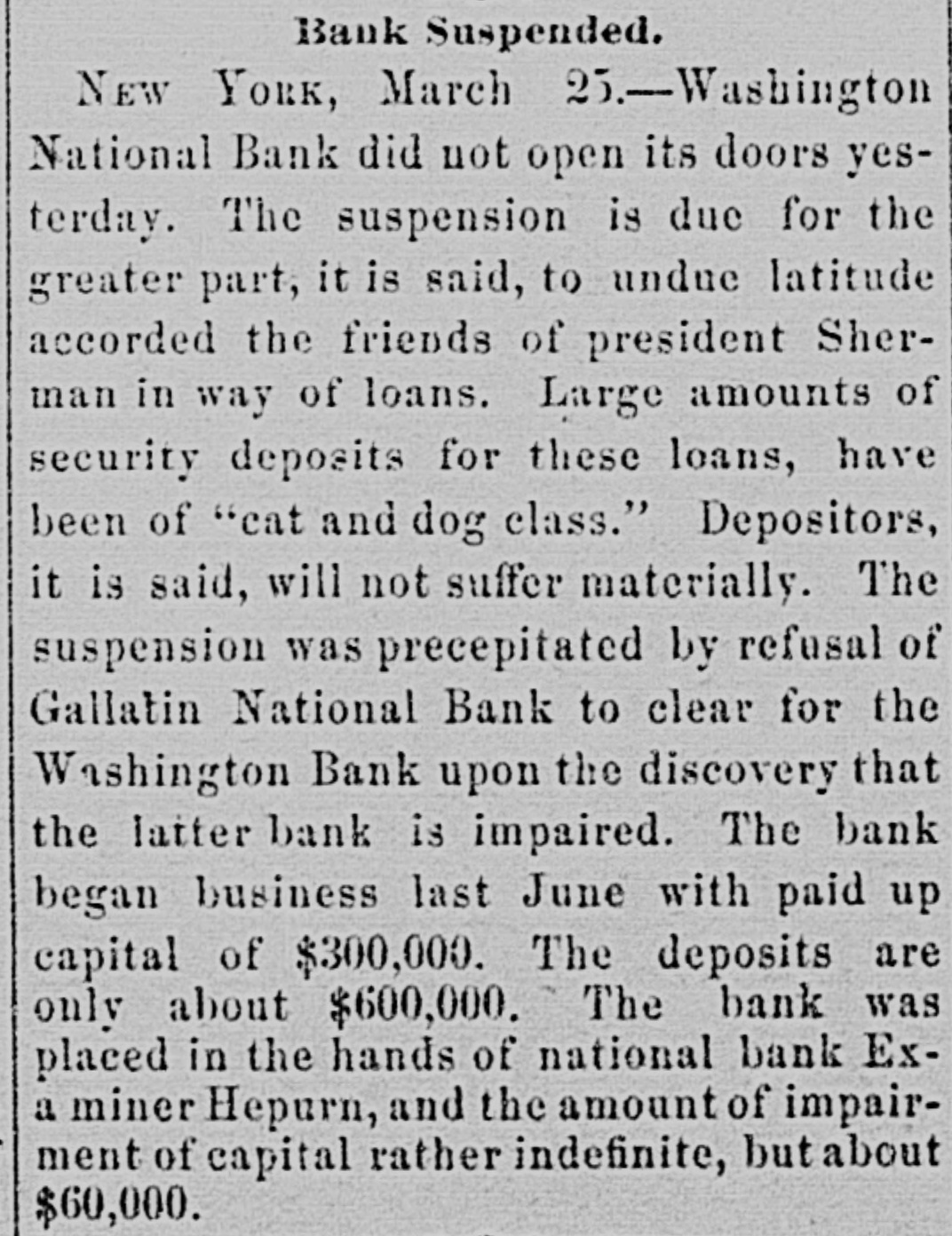
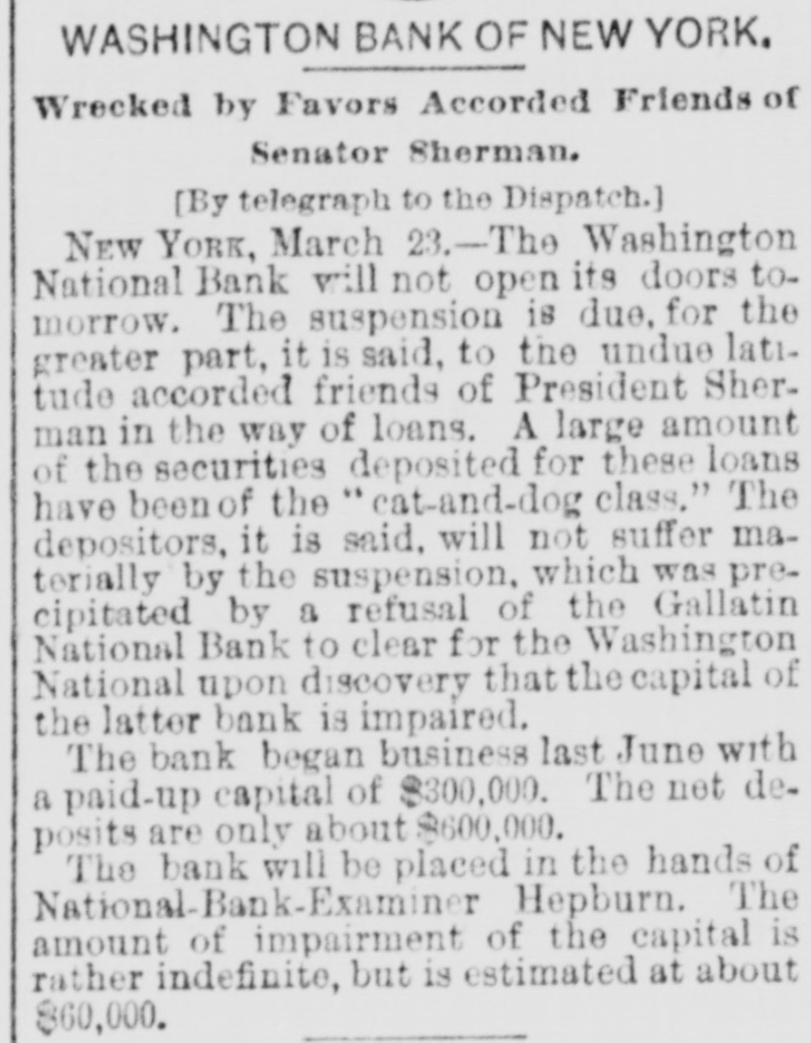
# ANOTHER BANK GOES UNDER. The Washington National Will Not Open Doors Today. NEW YORK, March 23.β€”[Special.]β€” The Washington National bank will not open its doors tomorrow. The suspension is due, for a greater part, it is said, to undue latitude accorded the friends of President Sherman in the way of loans. A large amount of securities deposited for these loans have been of the "cat and dog class." Depositors, it is said, will not suffer materially by the suspension, which was precipitated by the refusal of Gallatin National bank to clear for Washingtoh National upon the discovery that the capital of the latter bank is impaired. The bank began business last June with a paid up capital of $300,000. The net deposits are only about $600,000. The bank will be placed in the hands of National Bank Examiner Hepburn. The amount of the impairment of the capital is rather indefinite, but estimated at about $60,000.


Article from Telegram-Herald, March 24, 1891

Click image to open full size in new tab

Article Text

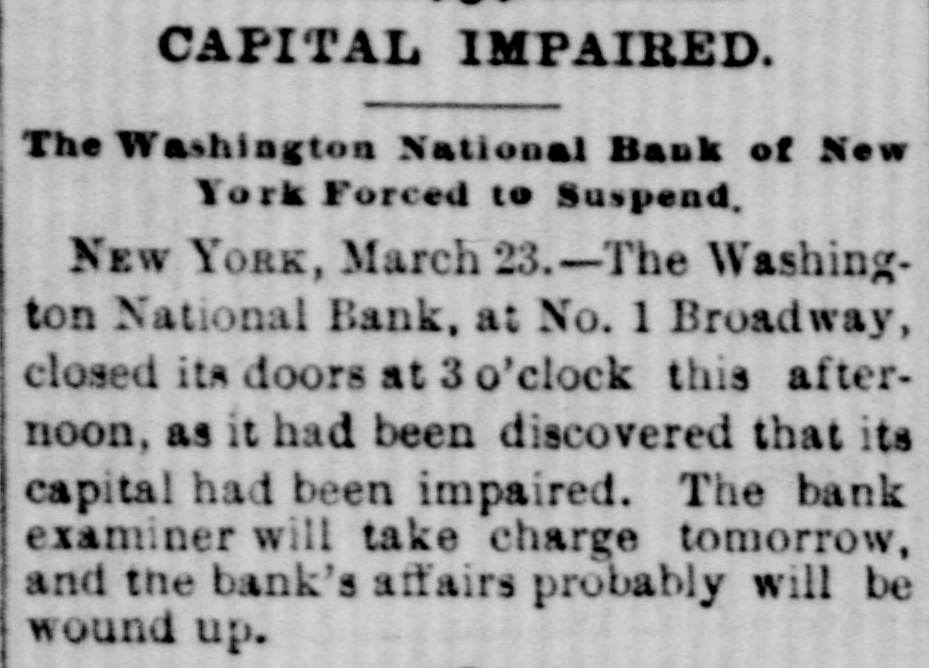
CAPITAL IMPAIRED. The Washington National Bank of New York Forced to Suspend, NEW YORK, March 23.-The Washington National Bank, at No. 1 Broadway, closed its doors at 3 o'clock this afternoon, as it had been discovered that its capital had been impaired. The bank examiner will take charge tomorrow, and the bank's affairs probably will be wound up.


Article from Alexandria Gazette, March 24, 1891

Click image to open full size in new tab

Article Text

NEWS OF THE DAY. It is reported that Senator Edmunds will resign his seat in the Senate. S: Paul's Episcopal Church, New Orleaus, was destroyed by fire yesterday. Lose estimated at $45,000. Floods in Maine have destroyed railroad and county bridges and undermined mills and other property. Ex-Prasident Cleveland has written a letter to the Indiena Tarif Reform Leaguesuggesting the necessity of pushing their doctrine. The Washington National Bank of New York has suspended, owing to the latitude permitted the friends of the president in the way of loane. The bulls raided the bears on the Chicago board of trade yesterday, and May wheat was shoved up 2, and there were also advances in corn and oats. During a quarrel in Philadelphia yesterday Jane Coulson, aged 80 years, was thrown downstaire by her niece, Hannah Coulson. Mrs. Coulson sustained injuries from which she will probably die, and Hannah was arrested. Ernest Hardenstein and John G. Cashman, editors of papers in Vicksburg, Miss., met in mortal combat on the streets there yesterday evening and Hardenstein was killed. The discussion that brought about the difficulty was in regard to the action of the citizens of New Orleans in killing the Hennessy assassins. It is stated that the Queen of Hawaii, under the influence of her English friends, will not accept the new commercial treaty with the United States, and will seek from Caneda and Australia an arrangement elmilar to the commercial treaty heretofore existing between Hawaii and the United States. Two members of the Hawaiian cabinet will resign, it is said, because of the appointment of Chas. H. Wilson, an illiterate workman, but a favorite of the Queen, to be marshal of the kingdom.


Article from Morning Journal and Courier, March 24, 1891

Click image to open full size in new tab

Article Text

NEWS BY TELEGRAPH. From All Quarters. ANOTHER BANK FAILURE The Washington National at New York Closed. MAJOR M'KINLEY ON THE TARIFF. Timothy Healey Assaulted By a Mob. AN EPIDEMIC OF GRIP IN NEW YORK. Three Men Killed By an Explosion. ITS DOORS CLOSED. National Washington Failure of New the York-Its Liberality Capital Seri of Bank impaired by the ously Bank's President, YORK, 1 Broadway a the NEW March at No. The Washington owing closed to National bank this afternoon, The serious its doors impairment late of been its loaned capital. out by bank's resources two have friends or confederthe president of its discovery to condition is not was a ates and the made. The bank accidentally of the Clearing House member through the Gallatin associa- na- the tion, but clears a new rule of tional bank. house Under which went into in effect this Jan- way clearing the bank's clearings to examinauary 1, their accounts Bank must tion by submit the clearing house. representing To-day the clearExaminer Hepburn, appeared at the its Washington affairs. tional ing house, bank to examine that its announcement capital was na- He soon discovered soon as this was prosimpaired. As President Sherman to inform but recovered had been too liberal directors to his friends. that foot trated, the was made that he sufficiently Two ac- up in loaning have money been discovered probably total losses. and $121,000 counts that are secured by poor a is for collateral, and the which had on John Silva, "hung on for One worthless $50,000 $70,000, president and other prom- draft been a cashed by It is the said that good Silva to-morrow. had hook.' to make had this a capital draft of $300,000 and of of the his innotice that The posits ised The bank president $600,000. Gallatin national for the debank stitution bank has will bank. given no longer Director said: clear Tilghman "The of bank It will to-morrow. will not open of Bank I am I the charge Examiner Hep- be placed in most probably will wound be up. paid in burn and that depositors said that the depositive Cashier Granger to both himvelopments the were directors. a None was and idea that the transactions full." self surprise president of them and in- of had volved any in any irregular about the details were he could say nothing which the funds says: Tilghman, a in the bank's afwithdrawn the Sidell methods by director of the bank, ago. "The irregularities a week V A fairs were a cursory discovered examination about impairment Saturday was last in After found that the This H made good by I was to have been this morning it the was neighborhood but of $75,000. the the President impair- direc- sum tors to-day, informed them had been that discovered ment was larger aggregate about be. It was and it was thought business. to I decided Sherman than would discontinue than $60,000 June more with then deto began business last The net A paid-up The bank capital about of $300,000. $600,000, and depositors DirectTilgham full. President will or be paid confidence in of the posits a had the are full only declares that the directors. Sherman at his He has disappeared. was found President Sherman He said the first man loan home this collateral was His made on overdrawn his from less he who had evening. poor the bank account. to a opin- and object was to from save failure. He is be of paid. the man that this maney between will $73,000 ion was for loan was and This overdraft $75,000. almost The the second same conditions. made made under would also be and good. he believed The sum involved this who received was about who it repre- was $60,Bridgeport, 000 and the Conn., firm man of gentleman, that city here. He said Mr. sents Sherman a brass refused to give his in name. closing up the in full. bank the directors and that were the depositors hasty would be paid


Article from The Seattle Post-Intelligencer, March 25, 1891

Click image to open full size in new tab

Article Text

BUSINESS TROUBLES. Crookedness and Mismanagement Bring Disester to Many Enterprises. BOSTON, March 24.-An expert accountant is at work upon the books of the Boston Water Power Company, investigating rumors that have been prevalent for several days of an overissue of the company's stock. The company's affairs have been in an unsatisfactory state for some time. BEAUMONT, Tex., March 24.-The Warren Lumber Company went into the hands of a receiver today. The assets and liabilities are estimated at $500,000. LOUISVILLE, March 24.--Further developments in the Schwartz bank failure show that the institution has been practically insolvent since 1873. In that year bad investments were made in real estate, and since then the bank seems to have done comparatively little profitable business. Sr. PAUL, March 24.-A Pioneer Press special from Pierre, S. Dak., says: The Capital Investment Company, generally known as the Woonsocket Company, is in trouble. At the election March 17, the old and officers were ousted. and and Reed and secretary. The to the office, and president directors Carpenter was give illegal, up respectively the former claiming matter officers elected the into the courts. that the old officers, refused election going Reed claim Carpenter Vice-President President and is Secretary Ryan, Treasurer Hinds, are wreck the company. have a notice ing Gorton Lumley, to published and warning w'officers. These attempt- officers people not to pay moneys to the NEW YORK, March 24.-Technically speaking, the doors of the Washington National bank, whose failure was spread broadcast yesterday afternoon, have not been closed as it was announced they would be. Conspicuously posted on the doors was the following notice: At the request of the directors I have taken the possession of this bank in the name of comptroller of the currency. Edward A. Lacey, under whose direction its affairs will be liquidated. A. B. HEPRURN, National Bank Examiner. The clerks were all at their accustomed desks in the bank, but no money was received or paid out. It was said at 10 o'clock that there was nothing new to make public at that hour. Sidell Tilghman, one of the directors, today said the capital stock was $300,000, and it had been impaired to the extent of $130,000 by loans made by President Sherman. Tilghman said he in the depositors would be paid that the only persons full, felt certain and who A will notice be losers will be the stockholders. was posted this afternoon that all checks drawn on the Washington National bank by the Commercial National bank of Fremont, Neb., will be paid by the First National bank of this city. United States Examiner Hepburn gave in a lengthy statement this afternoon, which out he said that as far as his examination extends there will be an apparent of to the bank from various sources $143,000. loss This would still leave the stockholders entitled to a dividend of 50 per cent. He thinks the depositors will be paid in full. Among the instances of bad business he says the bank received out-ofand sent "no protest," bank to hold them done, responding marked town collections instructing them subject the forward cor- to At the same time they that had been deposited and to stand. No one checks items order. these collections, allowed certified against thing such "but ails the bank," added Hepburn, everything. Inadequate surety for loans, to parties of notorious inpecuniosity bankloans and utter disregard for established principles has characterized the man- of ing throughout. The comptroller reagement the currency will probably appoint a ceiver. Judge Ingraham, of the supreme court, the entered a final decree dissolving today North River bank. Francis S. Higgins was appointed receiver. NASHVILLE, Tenn., March 24.-AnderGreen & Co., wholesale dry liabilities goods, son, this city, failed today. The assets of about $175,000. It is said the to are cover the liabilities. Inability the will make collections was the cause of failure.


Article from The Indiana State Sentinel, March 25, 1891

Click image to open full size in new tab

Article Text

ANOTHER BANK FAILURE The Washington National of New York Suspends. President Sherman Loans to His Friends. Mr. Havemyer Poses as a Public Benefactor. The Sugar Trust an Eleemosynary Institution. Matters of General Interest in the Business World. NEW YORK, March 23.-Official announcement was made late tonight that the Washington national bank, at No. Broadway, would not open its doors tomorrow. The bank's resources have been loaned out by the president to two friends, and the discovery of its condition was accidentally made. The bank is not a member of the clearing house association, but clears through the Gallatin national bank. Under a new rule of the clearing house, which went into effect Jan. 1, the banks clearing in this way must submit their accounts to examination by the clearing house. Today, Bank Examiner Hepburn, representing the clearing house, appeared at the Washington bank to examine its affairs. He soon discovered that its capital was impaired. As soon as this announcement was made, President Sherman, who has been in charge of the bank. was prostrated, but recovered sufficiently to inform the directors that he had been too liberal in loaning money to his friends. Two accounts have been discovered which foot up $121,000 that are probably total losses. One is for $70,000, secured by poor and worthless collateral, and the other, a draft for $50,000 on John Silva, which had been cashed by the president and "hung on a hook." It is said that Mr. Silva has promised to make this draft good tomorrow. The bank has a capital of $300,000 and deposits of $600,000. The only offic rs present when the complete announcement was made by the bank examiner were the cashier, J. T. Granger, and director, Sidney Tilghman. The president had then gone away-no one knew where. The president of the Gallatin bank at once gave notice that his institution would no longer clear for the Washington bank. This news prevented any attempt being made to make up the losses. Director Tilghman said: "The bank will not open tomorrow. It will be placed in charge of Bank Examiner Hepburn and most probably wound up. I am positive that every depositor will be paid in full." Cashier Grainger said that the developments were a surprise to both himself and the directors. None of them had any idea that the president was involved in any irregular transactions and he could say nothing about the details of the methods by which the funds were withdrawn.


Article from Daily Tobacco Leaf-Chronicle, March 25, 1891

Click image to open full size in new tab

Article Text

bankusky bonds William for a new county, court O., house. will issue $150,000 ing derrick Wesseman at Fort Wayne, was killed Ind. by a fallLouis Breedlove, farmer, near Urbana, O., assigned to the tune of $13,000. Van Wert, O., wants better $135,000. vice, and will put in works at water a cost ser- of was William Maynard, of Columbus, daughter. arrested for outraging his year-old O., The state board of tax commissioners. of Hovey Indiana, is chairman has been organized. Governor Horses H. and cattle about have die.1. A number D are affected with old time Washington epizootic. was John k Holland, a deserter from the iled by a train Hamilton, O. navy, He tramping to avoid arrest Rev. Joab Harper, 74, and Mrs. single Honey, 49. of Jeffersonville, O., tired Mary of life, have joined i sucs The trial of Charle Coomts for murder of Walter McClure, began the at Crawfordsville, Ind., Monday. Charlie Golden, of Hamilton, his hunting received a big charge of shot while in thigh. May lose the limb. Engineer Farrow and Fireman Dickison the were dangerously injured by a wreck on Pan-Handle near Coshoeton. Now they say a servant girl in Perrien's The family was kidnapped during the holidays. police think they smell amice. Near New Vienna, O., Told Moore, aged 19, quarreled with his father, William Moore, him. and shot and instantly killed George Taylor and John Loew met in Aurora saloon and popped at an other. hurt. Aims were bad and away no one each was Point Jefferson, O., is now a option favor town The vote was 2 to local 1 fluid. of no more "red licker, " or amber in John Wilson and Henry Matthews, Laporte, Ind., were thrown into a of ables. car by three men and robbed of their cattle valuT.T. Dixon, of Akron, tried to kill wife. Truman Golden, a passer-by inter his band. fered, and was nearly killed by the hus The wreeking of his barbershop at Sher rodsville is said to be the cause of Calvin lumbus. Dunlap's insanity. He was taken to CoMexico, near Perv, Ind., had deaths from diphtheria recently. Nearly seven every family in the place has from one to seven cases. Judgments aggregating $19,000 were tered Monday at Philadelphia a gainst enproprietors of the Colonnade hotel, H. the &C.R. Crump. . F. Chauncey, stranger, who was injured in a runaway accident at Mansfield, O., died after remaining unconscions nearly one week. Mack & Company, of Albany, sent by express to Detroit two months ago a $ . 00 package of coupon bonds which has disap. peared on the way. A bill has been inroduced in the Ohio legislature to appropriate $2,500 for monument to Capt. Desmond, killed a during the Cincinnati riots, Abner Abbott. formerly of Parkersburg, W. Va., was found floating in a river Wyoming territory. He had a $3,000 in check peared. on his person before he disap The board of directors of the Cincionati held their last day, management of the workhouse the meeting institution Tuespassing missioners. into the control of the police com The viticultural commission of California has been awarded a gold melal and diploma by the Paris exposition the display of native brandies at the recent exposition. The capital of the shington National bank, of New York, has been so impaired through the presid nt loaning to irre sponsible friends that the bank examiner has taken charge of the affairs. In a house of prostitution on George street, Cincinnati, Louis Benzinah mortally wounded by "Kid" Dugan, was who then tried to kill May Riley, the proprietress, over whom the difficulty arose. Abner Hazelett, of Muncie, Ind.. turned home for supper and found his rewife, baby and furniture gone. The woman is said to have returned to her former vorced. husband, from whom she was diThe South Side market house in Pitis burg was burned at midnight Morday night. Loss 00,000; insurance Stewart, of the partment, Assistant Caief not known fire dewas injured about the head by falling walls. Miss Nora Gray, while crossing a creek near Ramsey, III., on the railroad bridge, was surprised Monday evening by the approach of a train. She jumped from the bridge, which is fifty feet high. but wee
Article from Los Angeles Herald, March 25, 1891

Click image to open full size in new tab

Article Text

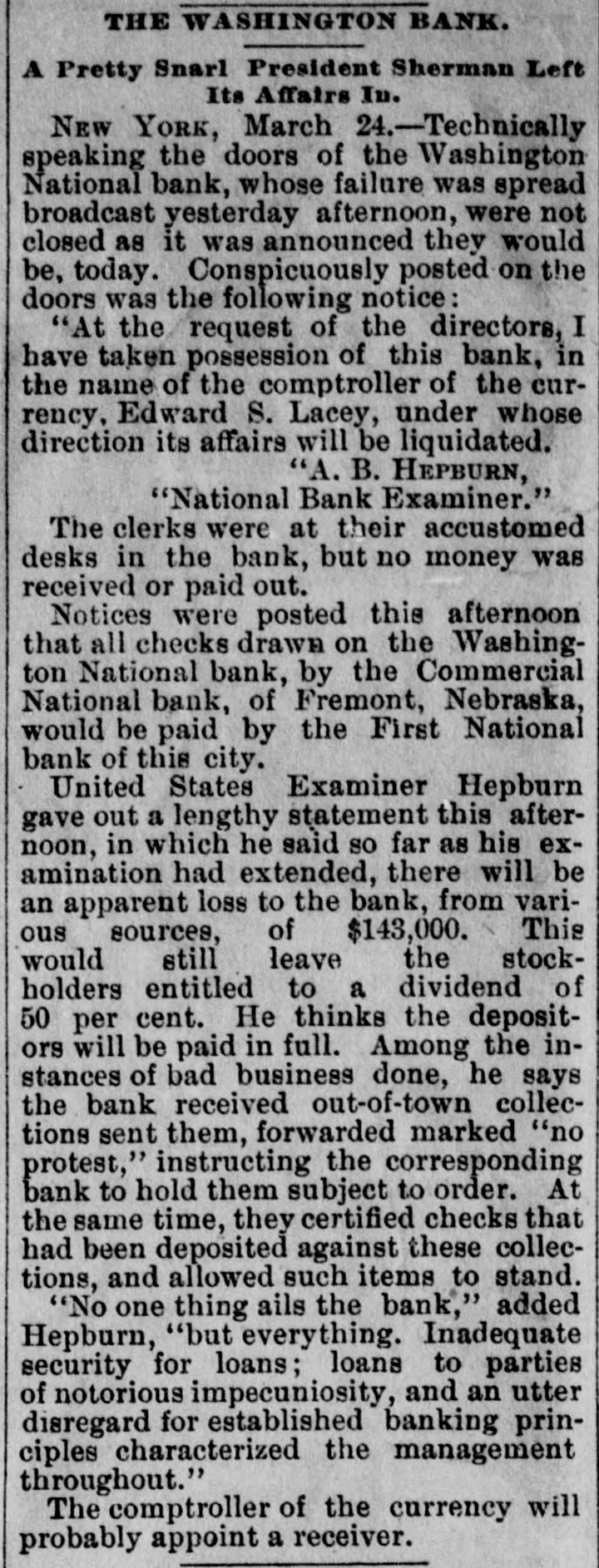
THE WASHINGTON BANK. A Pretty Snarl President Sherman Left Its Affairs In. NEW YORK, March 24.-Technically speaking the doors of the Washington National bank, whose failure was spread broadcast yesterday afternoon, were not closed as it was announced they would be, today. Conspicuously posted on the doors was the following notice: "At the request of the directors, I have taken possession of this bank, in the name of the comptroller of the currency, Edward S. Lacey, under whose direction its affairs will be liquidated. "A. B. HEPBURN, "National Bank Examiner." The clerks were at their accustomed desks in the bank, but no money was received or paid out. Notices were posted this afternoon that all checks drawn on the Washington National bank, by the Commercial National bank, of Fremont, Nebraska, would be paid by the First National bank of this city. United States Examiner Hepburn gave out a lengthy statement this afternoon, in which he said so far as his examination had extended, there will be an apparent loss to the bank, from various sources, of $143,000. This would still leave the stockholders entitled to a dividend of 50 per cent. He thinks the depositors will be paid in full. Among the instances of bad business done, he says the bank received out-of-town collections sent them, forwarded marked "no protest," instructing the corresponding bank to hold them subject to order. At the same time, they certified checks that had been deposited against these collections, and allowed such items to stand. "No one thing ails the bank," added Hepburn, "but everything. Inadequate security for loans; loans to parties of notorious impecuniosity, and an utter disregard for established banking principles characterized the management throughout." The comptroller of the currency will probably appoint a receiver.


Article from The Record-Union, March 25, 1891

Click image to open full size in new tab

Article Text

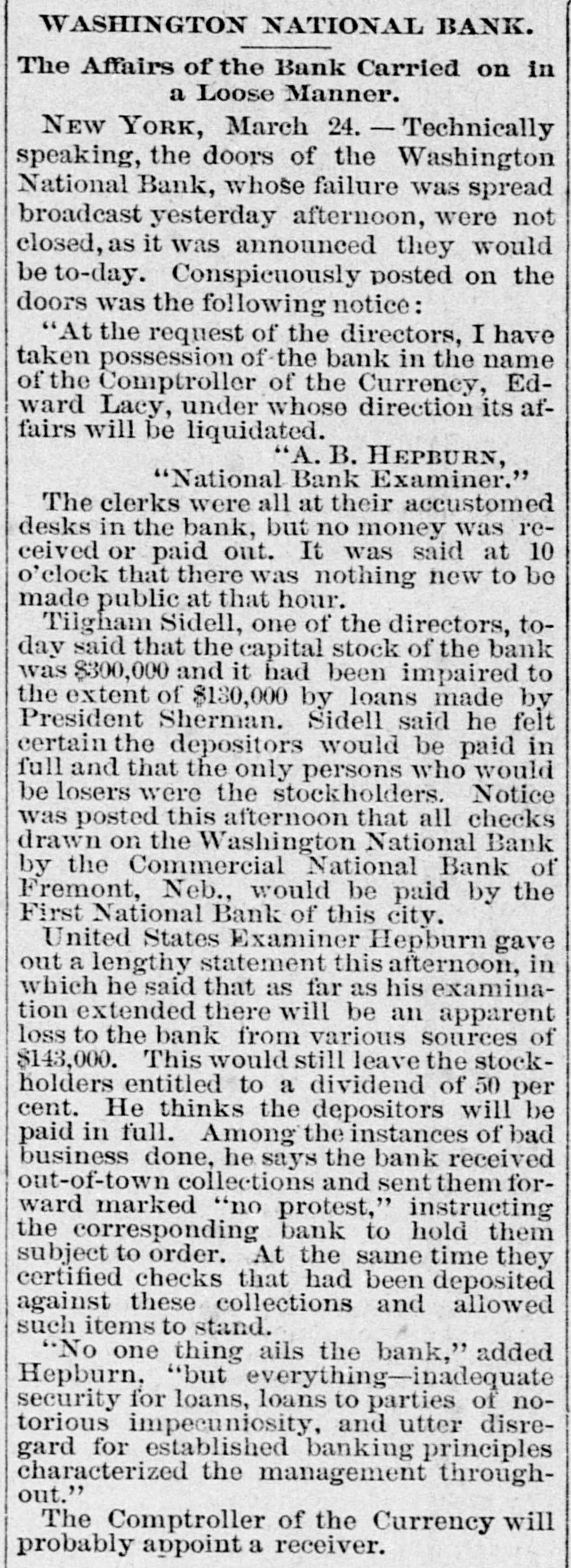
WASHINGTON NATIONAL BANK. The Affairs of the Bank Carried on in a Loose Manner. NEW YORK, March 24. - Technically speaking, the doors of the Washington National Bank, whose failure was spread broadcast yesterday afternoon, were not closed, as it was announced they would be to-day. Conspienously posted on the doors was the following notice: "At the request of the directors, I have taken possession of the bank in the name of the Comptroller of the Currency, Edward Lacy, under whose direction its affairs will be liquidated. "A.B. HEPBURN, "National Bank Examiner." The clerks were all at their accustomed desks in the bank, but no money was received or paid out. It was said at 10 o'clock that there was nothing new to be made public at that hour. Tilgham Sidell, one of the directors, today said that the capital stock of the bank was $300,000 and it had been impaired to the extent of $130,000 by loans made by President Sherman. Sidell said he felt certain the depositors would be paid in full and that the only persons who would be losers were the stockholders. Notice was posted this afternoon that all checks drawn on the Washington National Bank by the Commercial National Bank of Fremont, Neb., would be paid by the First National Bank of this city. United States Examiner Hepburn gave out a lengthy statement this afternoon, in which he said that as far as his examination extended there will be an apparent loss to the bank from various sources of $143,000. This would still leave the stockholders entitled to a dividend of 50 per cent. He thinks the depositors will be paid in full. Among the instances of bad business done, he says the bank received out-of-town collections and sent them forward marked "no protest," instructing the corresponding bank to hold them subject to order. At the same time they certified checks that had been deposited against these collections and allowed such items to stand. "No one thing ails the bank," added Hepburn, "but everything-inadequate security for loans, loans to parties of notorious impecuniosity, and utter disregard for established banking principles characterized the management throughout." The Comptroller of the Currency will probably appoint a receiver.


Article from Grant County Herald, March 26, 1891

Click image to open full size in new tab

Article Text

WRECKED THE BANK. The Washington National of New York Forced to Suspend Because Its President Loaned Nearly Half of Its Capital on Worthless Securities. NEW YORK, March 25.-Official announcement was made late Monday night that the Washington national bank at No. 1 Broadway would not open its doors to-day. The bank's resources have been loaned out by the president to two friends, and the discovery of its condition was accidentally made. The bank is not a member of the Clearing house association, but clears through the Gallatin national bank. Under a rule of the clearing house which went into effect January 1 the banks clearing in this way must submit their accounts to examination by the clearing house. Monday Bank Examiner Hepburn, representing the elearing house, appeared at the Washington bank to examine its afairs. He soon discovered that its capital was impaired. As soon as this announcement was made President Sherman, who has been in charge of the bank, was prostrated, but recovered sufficiently to inform the directory that he had been too liberal in loaning money to his friends. The bank had a capital of $800,000 and deposits of $600,000. Cashier Grainger said that the developments were a surprise to both "nimself and the directors. None of them had any idea that the president was involved in any irregular transactions, and he could say nothing about details of the method by which the funds were withdrawn. Mr. Tilghman, a director of the Washington national bank, says the impairment of the capital is in the neighborhood of $135,000. President Sherman said: "I wish to have it understood that I alone bear the burden of responsibility. It was impossible for me to avoid the overdraft, and after it was made I could do no better than to make it a loan. Permitting a man to open an account by depositing out-of-town drafts and drawing against them was an error of judgment -a very unfortunate error. No one friendly has been benefited by the transaction, nor was there any real attempt to conceal the affairs of my administration of the institution from the directors. They were fully informed of the transfer of the overdraft to a loan. The other affair I did not mention for one reason only, and that was that I hoped that the man, if his difficulties were not to cover his shortnoised abroad, would be able age. "I have shown too much sympathy. A bank officer has no right to have a heart or to try to save a man who is in difficulties. Still it is hard to see a worthy man go down without an effort being made to save him." He admitted that the security was not first-class Wall street collateral, but he hoped to recover the money in a short time. He did not believe, and does not believe now, that the account will be lost. But the security he had taken, he said, would not stand the scrutiny of the clearing house. This overdraft was between $73,000 and $75,000. Director Sidell Tilghman gave the names of two persons to whom President Sherman gave unsecured loans. One was John S. Silver, formerly a trustee of the defunct American Loan and Trust Company, the aggregates of whose drafts were $51,000. Another was Capt. F. S. Norton, who recently sailed across the Atlantic in his life boat and is believed to be lost. Ten thousand dollars was loaned him on the stock of his company, now absolutely worthless. The third man was not named. He owes the bank $42,000. of which only $7,000 is secured. Tilghman speaks very bitterly of the loose way in which the bank's affairs have been conducted, and it is believed that sensational developments are forthcoming.


Article from Belmont Chronicle, March 26, 1891

Click image to open full size in new tab

Article Text

and sank. It is estimated that six hundred Italians perished. THURSDAY. The total number of lives lost by the sinking of the Utopia in Gibraltar Bay is 576. Secretary Foster says he is not a candidate for U. S. Senator, and thinks Senator Sherman will be reΓ«lected. The New York bankers who want gold for export to Europe, have indicated their willingness to take coin. The J. & A. Simpkinson Company, dealers in boots and shoes, Cincinnati, assigned. Assets $300,000, liabilities $400,000. Suit has been brought against the Standard Oil Company, of New York, for forfeiture of charter for connection with the Trust. Bernard Jarter and his two daughters, thirteen and eighteen years old, perished in a tenant-house fire in New York, that was of incen diary origin. The Brice-Thomas party has secured control of the Monon by purchasing $5,800,000 of bonds. A thorough re-organinization under new management is contemplated. FRIDAY'S NEWS. Henry Averling, a well-known actor, committed suicide in New York by taking cyanide of potassism. Allen W. Thurman has resigned from the Board of Control of base ball clubs under the National Agreement. Ex-Representative Felton has been elected U. S. Senator by the California Legislature, to succeed Senator Hearst. The Wesleyan Ecumenical Conference in America has been postponed to October 7, to escape the heat of summer for the sessions. It is reported from Washington that all the Italians slain by the New Orleans mob were naturalized Americans, which disposes of the protest of the Italian Government. A life convict in the Wisconsin Penitentiary suggests to the Secretary of the Navy that the deficiency of men in the navy be made up from the inmates of penitentiaries. SATURDAY'S NEWS. Hon. L. T. Neal says he is not a candidate for Governor of Ohio. The Union Pacific Railroad Company will put on a mortgage of $250,000,000, the largest ever recorded. Lewis Purdy, Postmaster at Scrub Oak, N.Y., who was appointed during the administration of President William Henry Harrison, and has held the office continuously since, is dead. It is reported that the main support of the Chilian insurgents comes from the English nitrate traders and speculators who are offended at the Government because it will not submit to their dictation. The Legislative Committee investigating charges against the Cincinnati Board of Public Improvements has submitted a report finding the evidence was largely hearsay; that there was doubt as to any irregularity on part of Council; that Comptroller Stevens has been guilty of malfeasance in office; that the testimony does not sustain the charges of malfeasance and corruption against members of the Board of Public Improvements; that the existing conditions from Angust till the Board was legislated out of office would have justified the Governor in taking summary action had power of removal been vested in him. SUNDAY'S NEWS. The Cincinnati Republicans on Saturday nominoted John B. Mosby for Mayor, and Rufus B. Smith, Judge of Superior Court. The engineer at Benjamin Binager's saw mill at Albany, Ind., tried to raise steam on low water SO as to start the pumps. The mill is wrecked and one man seriously injured. MONDAY'S NEWS. John A. Mackay, the comedian, died of pneumonia at the Burnet House, Cincinnati. The total shortage of ex-Treasurer Woodruff, of Arkansas, as officially stated, is $369,746.83. Near Flat Top, W. Va., a Hungarian whorobbed another of $260, was lynched by a mob of his countrymen. N. P. Tobin, of Franklin, Pa., was murdered by burglars, who then set fire to the house to hide the crime. Near Caldwell, O., George Harris, while under the influence of whisky, cut his wife's throat from ear to ear and then his own. TUESDAY'S NEWS. Parnell will resign and stand for reΓ«lection to Parliament. The religious revival at Steubenville, O., closed Sunday night, the roll of converts numbering some 600. Near Vienna, O., Todd Moore, aged nineteen, quarreled with his father, William Moore, and shot and instantly killed him. The capital of the Washington National Bank, of New York, has been so impaired through the PrΓ©sident loaning to irresponsible friends that the Bank Examiner has taken charge of its affairs. IT is not the extremes of heat and cold so much as the sudden changes in temperature that causes certain climates to be unhealthful. When, however, the sys St em is invigorated with Ayer's Sarsapar lla, these changes are rarely attended is with injurious results. The Government Secretary of British


Article from Pittsburg Dispatch, March 27, 1891

Click image to open full size in new tab

Article Text

THE intimation that the Washington National Bank of New York suspended because its President loaned a Mr. Silver money without security evokes the remark that too much silver is sometimes harmful.


Article from Evening Star, March 28, 1891

Click image to open full size in new tab

Article Text

THE WASHINGTON BANK TO BESUME.-Controller Lacey this morning received from Bank Examiner Hepburn his report on the Washington National Bank of New York. The report is very gratifying and will not call for the appointment of a receiver. In fact. it is understood that arrangements have been perfected by which the bank will resume business on Monday.


Article from The Record-Union, March 29, 1891

Click image to open full size in new tab

Article Text

NATIONAL BANKS. The New Bank at Kansas City Ready for Business. WASHINGTON, March -The Comptrolier of Currency received a telegram to-day from the Examiner in charge of the American National Bank of Kansas City, Mo., saying that the entire amount of capital of the bank ($500,000) had been paid in, and the bank will open IOr business on Tuesday or Wednesday. The Examiner says: The bank has $1,700,000 in the vault, including $635,000 which had been taken from the bank by the Examiner, and which has just been restored by order of the Comptroller of Currency. Comptroller Lacey to-day received the official report of Examiner Hepburn in regard to the Washington National Bank of New York, but refused to disclose its contents. He has addressed a communication to Hepburn, suggesting that only two courses are open if receivership is to be avoided. In the first place, the Comptroller can levy an assessment of fifty per cent. upon the capital stock, which would reinforce the assets of the bank by $150,000 cash. This could be done, however, in case the directors and large stockholders would agree to advance for the shareholders not prepared for immediate payment. In case this amount is paid in the Comptroller wodld permit the bank to resume business, and the amounts due depositors and creditors would be immediately available. In case resumption is impracticable, the Comptroller suggests that $357,000, in addition to the immediate available assets already in hand, would enable the bank to pay the creditors promptly in full, whereupon they could vote to go into voluntary liquidation and close the affairs of the bank themselves. This might be raised upon a pledge of loans and discounts of the bank, supplemental, if necessary, by a personal guarantee of the larger stockholders. If one of these plans is not adopted, it will be his duty to appoint a receiver and close the bank up in the usual way.


Article from The Helena Independent, March 29, 1891

Click image to open full size in new tab

Article Text

The Treasury Department Thrown Into Consternation by a New Counterfeit. Bogus Two-Dollar Silver Certificates Issued That Almost Defy Detection. Affairs of Two National Banks Now in Charge of the Comptroller of the Currency. WASHINGTON, March 28.-A sensation has been caused at the treasury department by the discovery of a counterfeit two dollar silver certificate 60 nearly perfect as to be almost impossible of detection. The paper with silk threads through it is for the first time almost a perfect imitation in the counterfeit just discovered. So far as is now known it is only used in counterfeiting certificates of the series of 1886. It is estimated that there are now nearly 810,000,000 of these notes in circulation and the problem before the treasury department is how to get them back into the treasury and substitute a new series without embarrassment before any considerable quantity of the counterfeit notes gets into circulation. This was the subject of a secret confer nce at the treasury depart. ment this afternoon between Secretary Foster and leading officials of the bureau of engraving and printing. it was practically decided to suspend the printing of $2 silver certificates and institute a new series of the same denomination. These will contain a vignette of Secretary Windom and be issued as soon as the necessary plates can be engraved. It will take about two months to prepare the plates, and in the meantimo the government will exert it utmost endeavors to secure and destroy the plates and other paraphernalia used in the manufacture of the counterfeit. The comptroller of currency received A telegram to-day from the examiner in charge of the American National bank of Kansas City saying that the entire Amount of the capital of the bank, $500,000. had been paid in and the bank would be open for business Tuesday or Wednesday next. The examiner says the bank has $1,700,000 in the vault. including $635,000 which had been taken from the bank by the examiner and which has just been restored by order of the comptroller of currency. Comptroller Lacey to-day received the official report of Examiner Hepburn regarding the Washington National bank of New York, but refused to disclose its contents. He addressed a communication to Hepburn suggesting that only two courses are open if a receivership is to be avoided. In the first place, the comptroller can levy an assessment of 50 per cent upon the capital stock, which would re-inforce the assets of the bank by $150,000 cash. This could be done, however, only in case the directors and larger stockholders would agree to advance for the shareholders not prepared for immediate payment. In case this amount is paid in the comptroller would permit the bank to resume business and the amounts due the depositors and creditors would be immediately available. In case resumption is impracticable the comptroller suggests that $357,000 in addition to the immediate available assets already in hand would enable the bank to pay creditors promptly in full, whereupon they could vote to go into voluntary liquidation and close the affairs of the bank themselves. This might be raised upon the pledge of loans and discounts of the bank sxpplemented, if necessary, by the personal guarantee of the larger shareholders. If one of these plans is not adopted it will be his duty to appoint a receiver and close the bank up in the usual way.


Article from New-York Tribune, March 29, 1891

Click image to open full size in new tab

Article Text

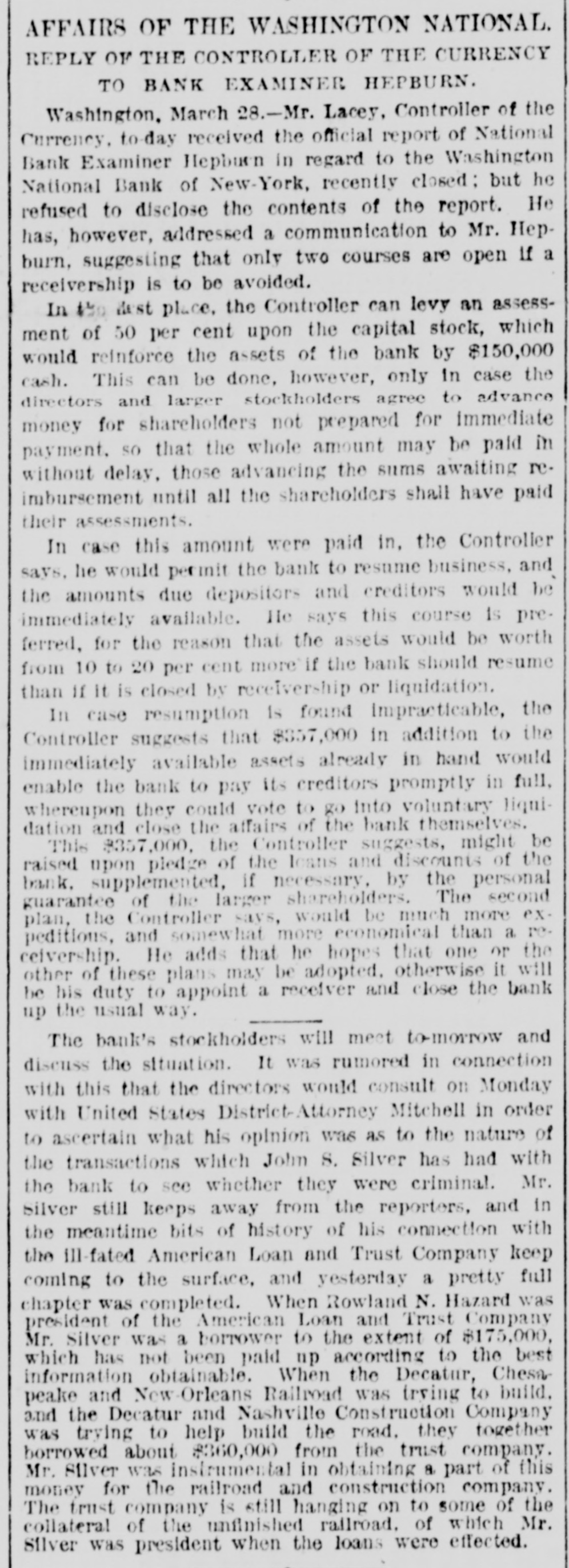
AFFAIRS OF THE WASHINGTON NATIONAL. REPLY OF THE CONTROLLER OF THE CURRENCY TO BANK EXAMINER HEPBURN. Washington, March 28.-Mr. Lacey, Controller of the Currency. to-day received the official report of National Bank Examiner Hepburn in regard to the Washington National Bank of New-York, recently closed: but he refused to disclose the contents of the report. He has, however, addressed a communication to Mr. Hepburn, suggesting that only two courses are open If a receivership is to be avoided. In $50 dest place. the Controller can levy an assessment of 50 per cent upon the capital stock, which would reinforce the assets of the bank by $150,000 cash. This can be done, however, only in case the directors and larger stockholders agree to advance money for shareholders not prepared for immediate payment. so that the whole amount may be paid in without delay. those advancing the sums awaiting reimbursement until all the shareholders shall have paid their assessments. In case this amount were paid in, the Controller says, he would permit the bank to resume business, and the amounts due depositors and creditors would be immediately available. He says this course is preferred, for the reason that the assets would be worth from 10 to 20 per cent more if the bank should resume than If it is closed by receivership or liquidation. In case resumption is found impracticable, the Controller suggests that $357,000 in addition to the immediately available assets already in hand would enable the bank to pay its creditors promptly in full. whereupon they could vote to go into voluntary liquidation and close the affairs of the bank themselves. This $357,000, the Controller suggests, might be raised upon pledge of the loans and discounts of the bank. supplemented, if necessary. by the personal guarantee of the larger shareholders. The second plan, the Controller says, would be much more expeditions, and somewhat more economical than a POceivership. He adds that he hopes that one or the other of these plans may be adopted. otherwise it will be his duty to appoint a receiver and close the bank up the usual way. The bank's stockholders will meet to-morrow and discuss the situation. It was rumored in connection with this that the directors would consult on Monday with United States District-Attorney Mitchell in order to ascertain what his opinion was as to the nature of the transactions which John S. Silver has had with the bank to see whether they were criminal. Mr. Silver still keeps away from the reporters, and in the meantime bits of history of his connection with the ill-fated American Loan and Trust Company keep coming to the surface, and yesterday a pretty full chapter was completed. When Rowland N. Hazard was president of the American Loan and Trust Company Mr. Silver was a borrower to the extent of $175,000, which has not been paid up according to the best information obtainable. When the Decatur, Chese peake and New-Orleans Railroad was trying to build. and the Decatur and Nashville Construction Company was trying to help build the road. they together borrowed about $360,000 from the trust company. Mr. Silver was instrumental in obtaining a part of this money for the railroad and construction company. The trust company is still hanging on to some of the collateral of the unfinished railroad. of which Mr. Silver was president when the loans were effected.


Article from Pittsburg Dispatch, March 29, 1891

Click image to open full size in new tab

Article Text

WASHINGTON BANK AFFAIRS. Two Plans by Which a Receivership Can Now Be Avoided. W ASHINGTON, March 28.-Mr. Lacey, Controller of the Currency, to-day received the official report of National Bank Examiner Hepburn in regard to the Washington National Bank, of New York, recently closed, but refused to disclose its contents. He has, however, addressed a communication to Mr. Hepburn, suggesting that only two courses are open if a receivership is to be avoided. In the first place, the Controller can levy an assessment of 50 per cent upon the capital stock, which would reinforce the assets of the bank by $150,000 cash. In case this amount was paid in the Controller says he would permit the bank to resame business. If resumption is found impracticable the Controller suggests that $357,000 in addition to the immediately available assets already in hand would enable the bank to pay its creditors promptly in full, whereupon they could vote to go into voluntary liquidation and close the affairs of the bank themselves,


Article from Morning Journal and Courier, April 10, 1891

Click image to open full size in new tab

Article Text

TELEGRAPHIC JOTTINGS. Over a hundred French Canadians left Montreal yesterday to settle in Lynn, Mass. The Canadian cruisers will go into service about the first of May to protect the Canadians fisheries. The suspension of port works in Argentine is imminent. Fourteen generals have signed a manifesto against the Mitre-Roca coalition. The formation of a gigantic copper trust was inaugurated in Philadelphia yesterday which in extent and importance promises to eclipse even the sugar trust. Right Hon. George Augustus Frederick Cavendish-Bentinck, member of parliament for White Haven, is dead. He was born in 1821 and was a conservative. The strike of the Burlington switchmen is assuming a serious nature. The yards at Omaha are guarded by a strong detail of police and the strikers are at present quiet. Trouble is feared. The directors of the Washington National bank of New York met yesterday and voted in their opinion the bank should go into voluntary liquidation. They will recommend such action to the stockholders at their meeting on Monday. Three tramps went to sleep under a side tracked freight car near Pittsburg Wednesday night. Early yesterday morning an engine pulled the car out, killing John Mooney and an unknown man, and cutting off both feet of John Kerns of Philadelphia. Two Kansas towns elected women po-


Article from The Seattle Post-Intelligencer, April 14, 1891

Click image to open full size in new tab

Article Text

Business Failures. LANCASTER, Pa., April 13.-Thomas Baumgartner assigned this afternoon. His liabilities are estimated at from $560,000 to $750,000, and the assets are probably very small. Baumgartner was a member of the firm of Baumgartuer & Eberman, which assigned Saturday. The failure was brought about largely, it is said, by over indorsement and enormous speculations, largely on borrowed capital. Henry L. Stehman, a large farmer and tobacco dealer of East Hempfield township, made an assignment today. Liabilities, $100,000; assets about the same. BOSTON, April 13-A minority of the stockholders of the Para Rubber Shoe Company have petitioned for the appointment of a receiver for the company, alleging fraud and insolvency of the firm. The capital stock is $1,000,000. Of this amount the officers of the company are said to own or control about two-thirds. George D. Clapp, one of the directors, asserted that the company was perfectly sound. NEW YORK, April 13.-At a meeting of the directors and stockholders of the Washington National bank held here today it was decided that the bank should go into voluntary liquidation. LONDON, April 13.-At a meeting of creditors of Prior, Woolen & Co., timber merchants, whose failure was recently announced, it was shown that the unsecured liabilities amount to Β£42,000. A scheme of arrangement was agreed upon which provides for vesting the firm's property for the benefit of creditors. On April 2 an official statement issued by Prior, Woolen & Co., who are partners in the house of Heatley, Woolen & Co., of San Francisco, showed that the liabilities of the concern amounted to Β£56,800, and the assets to Β£104,055.


Article from Grant County Herald, April 16, 1891

Click image to open full size in new tab

Article Text

Epitome of the Week. INTERESTING NEWS COMPILATION. DOMESTIC. THE work of inclosing and securing the grave of Gen. Sherman at St. Louis has been completed and the military guard about the tomb would be withdrawn. YALE and Harvard have completed arrangements for a series of annual athletic contests, this year's meeting to be at New Haven, Conn., May 16. LATER developments prove that Alexander Snyder, an old citizen of Goshen, Ind., thought to have been murdered by tramps, was attacked in his sleep by rats. THE steamer Earle Kinsley, from Hiawa, arrived at San Francisco and reported that in northern China there had been a severe flood and that over 10,000 people had been drowned. Two YOUNG women at White Oaks, N.M., committed suicide by shooting themselves with the same revolver. They belonged to wealthy families and left a note saying: "Death is sweet, and we prefer it to life." Two CHILDREN at Plattsville, Col., were fatally burned by the explosion of a can of kerosene which they were using to start a fire. GEORGE HARRIS, who cut his wife's throat and did the work successfully, was sentenced at Caldwell, O., to a life term in the state penitentiary. BY an explosion in a Hungarian boarding-house at Braddock, Pa., eleven men were burned, four fatally. PHILADELPHIA'S new mayor gives the police department ten days to get out of polities or out of the city's employ. THE New York Methodist conference has decided overwhelmingly that women shall not be admitted to the general conference. THE Stockbridge savings bank at Stockbridge, Mass., has gone into a receiver's hands. Depositors would lose 25 per cent. DOZENS of cattle, horses and hogs were dying of hydrophobia in Britt, la. A mad dog run amuck in that vicinity several weeks ago. HENRY M. STANLEY'S lecture tour in the United States is over. He said in New York that the total number of miles he had traveled in all his exploration of Africa was 25,000, and that he had beaten that record by over 2,000 miles on his lecture journey. LEWIS BOOKER. one of the most prominent business men in Richmond, Va., was arrested, charged with misappropriating $100,000 of fid iciary funds. TOOF. McGowa & Co., grocers and cotton factors at Memphis, Tenn., have failed for $126,728. THE most valuable cargo of coffee ever brought to this country arrived at Baltimore. It consisted of 23,328 bags, worth $660,213. THE town of Tobias, Neb., was nearly wiped out by fire. DAVID DAVIS, a detective employed in hunting out illicit stills, was found murdered near Elkhorn, Va. THREE of the Hungarians who were in the labor riot at Braddock, Pa.. last New Year's day in which Michael Quinn was killed. were convicted of murder and sentenced to be hanged. THE celebration of the 100th anniversary of the establishment of the American patent system was begun in Washington, a large number of inventors participating. N. BYRES & Co., lumber dealers at Laneaster, Pa., have failed for $190,000. MICHIGAN salt manufacturers have formed a new organization to control the price of their product. Two UNKNOWN men were seen to capsize in a boat on the Mississippi river at Davenport, la. CHARLES E. KINCAID. the newspaper correspondent on trial in Washington for the shooting of ex-Representative Taulbee, of Kentucky, in February, 1890, was acquitted. THE championship season of the American association of baseball clubs opened on the 8th. THE loss to the oyster beds near New Orleans caused by the crevasse at Ames' plantation will reach $500,000. THE United States treasurer has paid the governor of Tennessee the direct taxelaims of the state, amounting to $392,000. THE directors of the Washington national bank of New York have decided to close up the institution. A TERRIBLE cyclone visited Nevada, Mo., and houses were wnroofed, wires prostrated and havoc played in all directions. One person was killed. Two SOCIETY women at Albuquerque, N. M., became insane from the use of cosmetics on their faces. FRED HUNDLEY, 18 years of age, was sentenced to fourteen years in the penitentiary at Huron, S. D., for shooting his father over a quarrel in putting down a carpet last summer. JAMES Cow and his mother quarreled in Jeffersonville. Ind. She struck him with a stone. when he shot and killed her. THE Central hotel at New London, Conn., was burned, and Michael Daley, father of the proprietors, was suffocated in his room.


Article from Pittsburg Dispatch, April 17, 1891

Click image to open full size in new tab

Article Text

SQUEEZED THE DIRECTORS. Complications Arising From Two Recent Heavy Failures. ASBURY PARK, N.J., April 16.-Couneilor McGill has appointed ex-State Treasurer Toffey receiver of the Decatur and Nashville Improvement Company. This corporation was organized under the laws of New Jersey for the purpose of constructing the Decatur, Chesapeake and New Orleans Railway. This is the railroad company whose bonds figure exclusively in the failures of the American Loan and Trust Company and the Washington National Bank, both of New York. J. Edward Simmons, the President of the Fourth National Bank of New York, is the receiver of the American Loan and Trust Company. Receiver Toffey has made, through counsel, a demand that Receiver Simmons return to him bonds of the Decatur, Chesapeake and New Orleans Railway Company of the face value of $333,000. Receiver Toffey claims that $183,000 worth of the bonds were squeezed out of the Decatur and Nashville Improvement Company as extra or additional collateral security upon certain loans. The other $150,000 worth of the bonds, Receiver Toffey alleges, were obtained by some of the directors of the American Loan and Trust Company by a similar process of "squeezing." The Decatur and Nashville Improvement Company had been promised certain loans. These loans were withheld until the $150,000 in bonds of the railway company were turned over to the directors of the loan company. These directors subsequently turned the bonds over to the loan company, and Mr. Simmons now has possession of them as the receiver of that corporation. If the bonds are not returned to Receiver Toffey he will bring suit for their recovery.


Article from New-York Tribune, August 8, 1891

Click image to open full size in new tab

Article Text

TO REPLACE THE WASHINGTON BANK. A MOVEMENT ON FOOT TO ESTABLISH A NEW INSTITUTION ON THE SITE OF THE OLD. Some of the stockholders and old customers of the Washington National Bank, at No. 1 Broadway, which went into the hands of a receiver several months ago, are urging the adoption of some plan of reorganization by which the bank may, under another name and under conservative management, be enabled to resume business. The stockholders who have agreed to enter into such a movement represent $150,000 of the old stock. Among them are General Granville M. Dodge, who was the vice-president of the bank, and J. T. Granger. the cashier. Sidell Tilghman, who was the most prominent among the opponents of any attempt to reorganize the institution at the time of its failure, will not be represented in the new organization. The new institution will be entirely new-new name, new directors and changed policy. The promoters of the enterprise assert that there can be no lack of business, as the books of the Washington National show that between June 1 and October 11, 1890, there was an increase of more than $1,000,000 in the deposits. Nearly all the obligations of the Washington National, it is said, have been discharged, and the funds now accumulating are held for the benefit of stockholders. There is said to be a bright outlook for a final settlement with stockholders, and it is now estimated that they will receive in dividends between 60 per cent and 75 per cent of their original investments. It is thought that the prompt settlement which was made with the depositors in the old institution would induce them to return to the reorganized bank. Under the plan of reorganization the stockholders will be asked to leave in whatever dividends they might receivΓ© from the settlement of the affairs of the Washington National as a subscription toward the capital stock of the new bank. the subscriber to receive full-paid stock to the amount of his dividends, and the new people putting in enough to-make up the original capital of $800,000.