Article Text
Closed Its Doors
WASHINGTON, D. C., May 31.-The banking house of Middleton & Co. closed its doors this morning, caused by a steady run since the New York collapse. Liabilities not yet known.
Click image to open full size in new tab
WASHINGTON, D. C., May 31.-The banking house of Middleton & Co. closed its doors this morning, caused by a steady run since the New York collapse. Liabilities not yet known.

Click image to open full size in new tab
DEVELOPMENTS IN THE CASE TODAY. The Other City Banks All Right. It was expected that the suspension of the Middietons Saturday would cause uneasiness among bank depoitors to -day, but except in a few cases no unusual demands were made upon the banks. The demands that were made came, as a rule, from small depositors and persons unexperienced in banking affairs. Mr. John W. Thompson, president of the Metropolitan national bank, stated to a STAR reporter that at the close of business Saturday his bank held more cash than when it opened in the morning. This was the case with the other national banks. To-day, he said, the dividends of the Metropolitan railroad would be paid at the bank, which distributed considerable money in the community, and would have a good effect. All of the banks of the city, he said, were sound, and there was not the slightest reason for a lack of confidence in any of them. "When people get frightened, though," said Mr. Thompson, "they are like wild horses, and you a cannot control them. There is no evidence of lack of confidence in any of the national banks, and no reason for such a lack of confidence. They are not engaged in speculation, and are perfectly able to pay all they owe. If there were runs on such banks, it is not the banks that would suffer so much as the business community at large. which has financial relations with the banks. The banks, for instance, hold large numbers of demand loans, and of course if there were calls upon them, would call in the loans. You can see how that would affect the community. But there is no cause for alarm. At our bank to-day the persons depositing money are in the majority. PROPOSED CLEARING HOUSE. Mr. Thompson has had interviews with the several bank presidents with the view of taking steps to establish a clearing house here, as suggested in Saturday's STAR. "I have had that in mind," he said to a STAR reporter. "since 1873. attempted to start it then, but I think we will succeed now. We will have a clerk come over from Baltimore, probably this week, to instruct our people in the clearing house business. Mr. Thompson has since Saturday made a private investigation of various banks here, besides the national banks, and the result is that he expresses perfect confidence in them. THE CLOSED MIDDLETON BANK presented a very dreary appearance to-day. The original notice of suspension still adorned the front door, which was locked for a while, and but a few interested persons allowed inside. Neither D. W. nor S. E. Middleton had put in an appearance this morning, but it was stated that the latter was expected during the day. Mr. Green, the assignee, had no statement to make, as he had scarcely had time to look at the books as yet. A DEED OF TRUST FROM D. W. MIDDLETON TO SECURE CERTAIN CREDITORS. This morning a deed of trust, given by D. W. Middleton and wife to George F. Green, was placed on record. It is dated May 31st, and recites that as the firm of Middleton & Co. are indebted to Mrs. Janet Smith $1,000, W. P. Thompson $2,000, Mr. Sawyer, Mr. Lloyd and Mrs. Boggs in unequal sums, aggregating $4,000; D. W. Mahon $1,000, Lydia Joliy $2,000 and Henry English $500-aggregating $10,500; and as the firm has made an assignment he (D. W. Middleton), being destrous to give and provide further and additional security for the payment of the amounts due the persons named, conveys to George F. Green all right and title of D. W. Middleton in square north of square 563, lot 1, square 11, and lots 6, 7 and 8, square 20, and alí right and title in real estate of every description in the District and his title to 50 shares in the Post Sewing Machine Combination company Mr. Green is to sell the property at public auction and of the purchase money. after deducting charges, with a commission of five per cent, to pay whatever shall remain unpaid of said debts pro rata. Some members of the bar stated that the assignment of the assets of the bank should have included all the property of the firm and their individual property, and that this deed would not hold good. A DEED was placed on record this morning for the transfer by D. W. Middleton, Jr., to James H. McKenney of two frame houses on M street, between 12th and 13th. and a brick house on the corner of N and 13th streets, the consideration being $12,000. What Mr. D. W. Middleton Says. THE LIABILITIES NOT OVER $300,000, HE THINKS. Mr. D. W. Middleton was found at his residence, 214 New Jersey avenue, by a STAR reporter this morning. He was still complaining of the trouble in his head, and looked depressed and weary as he walked into the room and occasionally passed his hand across his forehead. He protested his utter inability to approximate the liabilities or assets of the bank. saying that he knew nothing of the state of the books. He said that he had been sick and unable to attend to business for some time before his retirement from the firm a week ago. There had been a run on the bank, he says, and he understands that during the past week It had been much worse up to the time of the suspension, so, even knowing how the accounts stood when he left, he could not say what had been drawn out since. He thought, however, that matters would not be quite as bad as stated in the papers, and that the liabilities would not amount to more than $300,000. The trouble was brought about through bad loans and the sudden withdrawal of large amounts, some of the papers presented having been for amounts of four and five years standing. He said he had intended to go down to the bank to-day, but was not able to do so, and would have to postpone it until to-morrow. What S. E. Middleton Says.
Click image to open full size in new tab
WASHINGTON, June 2.-D. W. Middleton, of the suspended banking house of Middleton & Co., said today that he thought the liabilities of the firm would not exceed $300,000, and that the suspension was the result of bad loans and the steady withdrawal of deposits for three weeks.
Click image to open full size in new tab
One of the rumors in connection with the suspension of the bank of Middleton & Co., of Washington, is that it was precipitated by the drawing by Mrs. Hayward Hutchinson of a heavy deposit which she had in that bank. The estate of the late H. M. Hutchinson is one of the sureties on the bond of Col. Burnside, the de faulting disbursing officer of the Postoffice Depart ment. It is said that Mrs. Hntchinson, SO as to keep the government from seizing the money 1. make the Burnside defalcation good. decided to draw it out herself. The bank was. it is said. 1111able to pay the entire amount to the credit of Mrs. Hutchinson, and that it was a great deal less than $100,000, as stated.
Click image to open full size in new tab
Rathbone. WASHINGTON, June 10.-Suit has been instituted by W. H. Harris in the name of Col. Henry R. Rathbone, now in an insane asylum in Germany, against the recently suspended banking firm of Middleton & Co., for damages, assessed at $50,000, for wrongful conversion is to their own use of bonds deposited in their hands for safe keeping.
Click image to open full size in new tab
THE MORNING NEWS IN BRIEF. An Epitome of Current Events-Incident and Accident at Home and AbroadThe way of the World. Isaac Jonnings, a farmer, of Pendleton county, W. Va., shot his son dead Sunday in mistake for a panther. Chief Engineer W. J. Lambdin United States navy, was stricken with paralysis nt his home, near Perryville, Md. Mrs. John Moulder, a sister, was summoned, and she dropped dead on entering the house. Reports have reached Cairo, to the effect that the rebels, nine days ago, massacred Hussein Kbalifa Pasha, commander at Berber, and all his family; the garrison, which was faithful to the khedive, and the European traders who remained there. A suit has been instituted in the name of Colonel Henry R. Rathbone, now in the Hanover insane asylum, against the recently suspended banking firm of Middleton & Co., of Washington, D. C., for damages assessed at $50,000 for the alleged wrongful conversion to their own use of bonds deposited in their hands for safe keeping. The House committee on elections in the contested election case of Campbell vs. Morey, of the Seventh Ohio district, to. day, by vote of 8 to 4, agreed to report in } favor of unseating Mr. Morey, Republi can, and seating the contestant, a Demo crat. A suit has been brought in the superior court of San Francisco, against N. C. Goodwin, the'well-known actor, by L M. Bayliss, manager of the Gaity theatre, in Sydney, Australia, for a breach of contract made in New York to play for forty weeks e in the Australian colonies. The damages are laid at $30,000. The 1,000th performance in the Tabor grand opera house at Denver was cele a brated on Monday night. The large audience was successfully photographed with the aid of fifty electric lights, and each lady who was present was given a I copy of the photograph as a souvenir. The h performance was the "School for Scandal," with Madame Rhea The steamship Plover, sent to rescue n the crew of the sailing brig Confederate e has returned to St. John's Newfoundland. Capt. Manuel, of the Plover, reports Notre Dame bay heavily packed with floe ice and the Confederate lying helpless in the ice sixteen miles north of Foge. He succeeded in getting within twelve miles of the unfortunate vessel and saving 45 of her crew, after they had suffered terrible y hardships. The Plover was then com 1 pelled to retreat, leaving 29 men behind, in the neighborhood of the wreck. e

Click image to open full size in new tab
The Giant Powder Company's inaga zine, containing 2000 pounds of powder; situated three and a half miles east of Denver, Colorado, blew up yesterday 1 morning. A new farm house three hundred yards distant from the maga8 zine was demolished, but the occupants escaped injury. A number of plate glass fronts in the city of Denver were smashed. A suit has been instituted in the name of Colonel Henry R. Rathbone, now in the Hanover Insane Asylum, against the recently suspended banking firm of Middleton & Co., of Washington, D. C., for damages assessed at $50,000 for the alleged wrongful conversion to their own use of bonds deposited in their hands for safe-keeping. A motion was granted in the United States Circuit Court in New York yesterday for a nolle prosequi in the case of Samuel J. Singleton, who was indicted under the Civil Rights act for refusing to sell tickets to a place of amusement to a colored man. The motion was granted on the ground that the law bearing on this subject was unconstitutional. Samuel E. Hobkins, whose body was found on the Long Island (New York) shore on Sunday, was drowned April 17th with his son and a Mr. West, of Germantown, Pa., by the upsetting of a small yacht. Mr. Hopkins was a descendant of Johns Hopkins, the founder of the university in Baltimore, of which city he was a native. During a severe thunder storm in Harrisburg, Pa., yesterday afternoon, Frank Dively and his wife were struck by lightning and killed, at their doorway. Several other persons received shocks, and a number of buildings were struck. Altogether, five thunder storms prevailed within a circuit of seven miles. The rain-fall was the heaviest known in many years. Two Italians were killed and four others severely injured by a land slide at Deep Cut, on the SouthPennsylvania Railroad on Monday. The engine of a train on the Connectiout Valley Railroad was thrown from a trestle bridge, at Hartford, yesterday morning. The engineer and fireman were badly injured. A serious cave-in occurred yesterday morning in No. 4 colliery of the Delaware and Hudson Company, near Plymouth, Pa. Five acres of the ground sank four inches, and 17 frame houses were damaged. The celebration of the semi-centennial of the city of Rochester, N. Y., was wound up yesterday with a procession including 10,000 public school children, a banquet, an illumination, and displays of fireworks. Patrick Murray, a carpenter, said to be from Philadelphia, was found dead in a barn in East Jamacia,Long Island, yesterday. He had expired from rupture of the heart. A natural gas well, said to be equal in pressure to the Westington Well in Pittsburg, has been struck at a depth of 1200 feet on Raccoon Creek, in Washington County, Penna. Tilden G. Abbott, the thieving cashier of the Watertown (Masachusetts) Bank, was yesterday sentenced to eight years' imprisonment in the penitentiary. Pinder & Winchester's steam tannery and currying shop, in Salem, Massachusetts, were burned early yesterday morning. The loss is estimated upwards of $100,000. The Ohio River Railroad, from Wheeling to Parkersburg, in West Virginia, was finished on Monday last, and will be regularly opened to traffic on Monday next.
Click image to open full size in new tab
The adjourned record of the court of inquiry case of Gen. David G. Swaim was made public to day. It sets forth the facts as found and concludes: The court is of the opinion that while it is not prepared to say that any specific act developed by the evidence is actually fraudulent yet the evidence does show a series of transactions discreditable to any officer of the army, and which especially demands the severest condemnation, when engaged in by an officer holding a high position and peculiar relations to the administration of justice in the army, held by Brigadier-General Swaim. The Secretary of War laid the report before the President to-day and it was decided to order a court martial for the trial of Gen. Swaim. The detail for the court will be made in few days.
Minor Washington Notes.
Col. J. J. P. Burnside, late disbursing officer of the postoffice department to-day gave bale in the sum of $20,000 and was released from jail.
A suit has been begun in the name of Col. Henry R. Rathbone, now in the Hanover insane asylum, against the suspended banking firm of Middleton & Co., for $5000 for wrongful conversion of bonds deposited in their hands for safe keeping.
Click image to open full size in new tab
[By telegraph to the Dispatch.] WASHINGTON, D. C., June 13.-The investigations of the committee of creditors of the suspended banking tirm of Middleton & Co. lead to the belief that not half a cent on the dollar will be realized by the creditors. The principal accounts have been kept in the heads of the members of the firm. The books have not been settled in ten years, and where the money has gone to is likely to be made the subject of legal investigation. The amount involved is about $400,000, and the cleanness of the sweep goes a long distance ahead of Grant & Ward and the Penn Bank of Pittsburgh.
Click image to open full size in new tab
The Middleton Failure. WASHINGTON, June i4.-D. W. Middleton, of the suspended banking house of Middleton &Co., had published a card, in which he pronounces "false as language can make it" the statement printed in the Star last evening relative to the misappropriation of funds and securities which had been entrusted to the firm. He says: "We have lost a great deal in bad investments and mistaken judgmeuts alone, which, as far as I know, explains all. My immediate family are next to the heaviest losers, which certainly will'show the truth of the statement as to my individual cause of the failure."
Click image to open full size in new tab
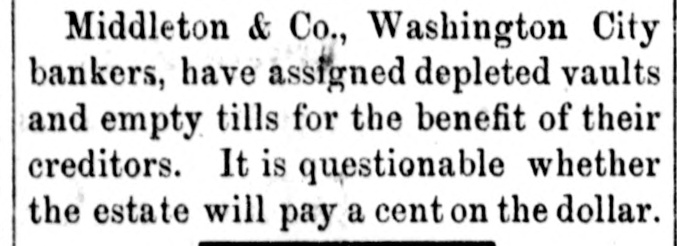
, Washington City bankers, have assigned depleted vaults and empty tills for the benefit of their creditors. It is questionable whether the estate will pay a cent on the dollar.
Click image to open full size in new tab
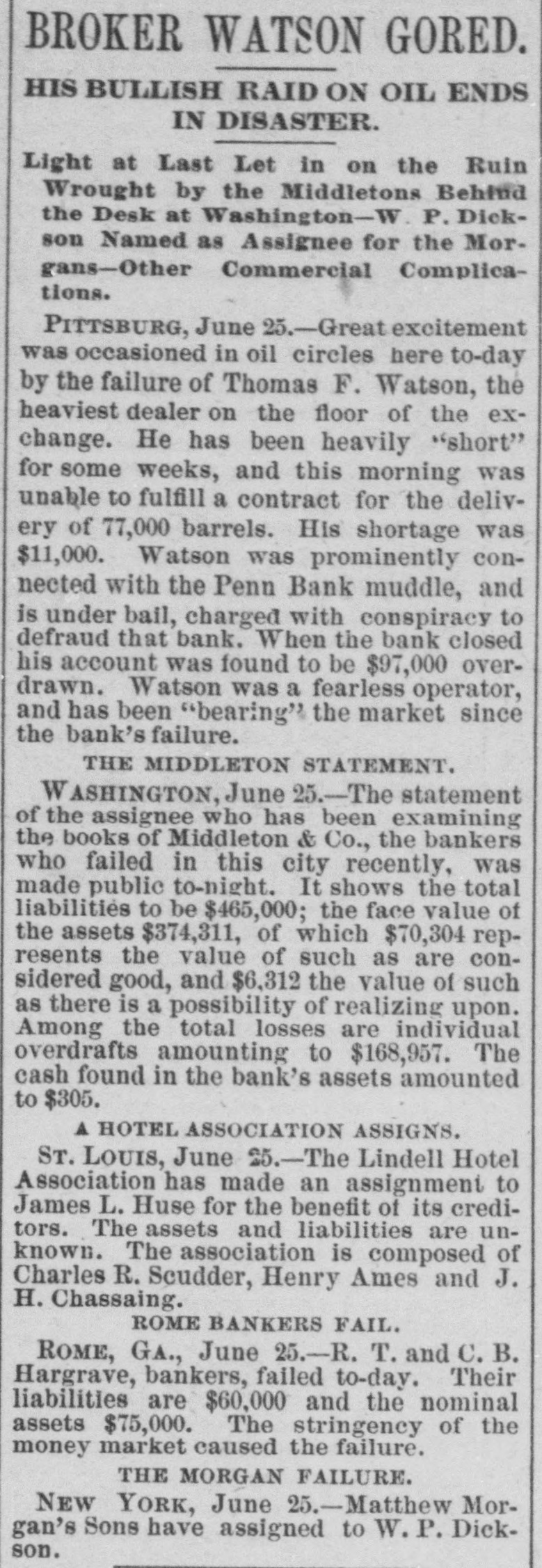
HIS BULLISH RAID ON OIL ENDS IN DISASTER. Light at Last Let in on the Ruin Wrought by the Middletons Behind the Desk at Washington-W. P. Dickson Named as Assignee for the Morgans-Other Commercial Complications. PITTSBURG, June 25.-Great excitement was occasioned in oil circles here to-day by the failure of Thomas F. Watson, the heaviest dealer on the floor of the exchange. He has been heavily "short" for some weeks, and this morning was unable to fulfill a contract for the delivery of 77,000 barrels. His shortage was $11,000. Watson was prominently connected with the Penn Bank muddle, and is under bail, charged with conspiracy to defraud that bank. When the bank closed his account was found to be $97,000 overdrawn. Watson was a fearless operator, and has been "bearing" the market since the bank's failure. THE MIDDLETON STATEMENT. WASHINGTON, June 25.-The statement of the assignee who has been examining the books of Middleton & Co., the bankers who failed in this city recently, was made public to-night. It shows the total liabilities to be $465,000; the face value of the assets $374,311, of which $70,304 represents the value of such as are considered good, and $6,312 the value of such as there is a possibility of realizing upon. Among the total losses are individual overdrafts amounting to $168,957. The cash found in the bank's assets amounted to $305. A HOTEL ASSOCIATION ASSIGNS. ST. LOUIS, June 25.-The Lindell Hotel Association has made an assignment to James L. Huse for the benefit of its creditors. The assets and liabilities are unknown. The association is composed of Charles R. Scudder, Henry Ames and J. H. Chassaing. ROME BANKERS FAIL. ROME, GA., June 25.-R. T. and C.B. Hargrave, bankers, failed to-day. Their liabilities are $60,000 and the nominal assets $75,000. The stringency of the money market caused the failure. THE MORGAN FAILURE. NEW YORK, June 25.-Matthew Morgan's Sons have assigned to W. P. Dickson.
Click image to open full size in new tab
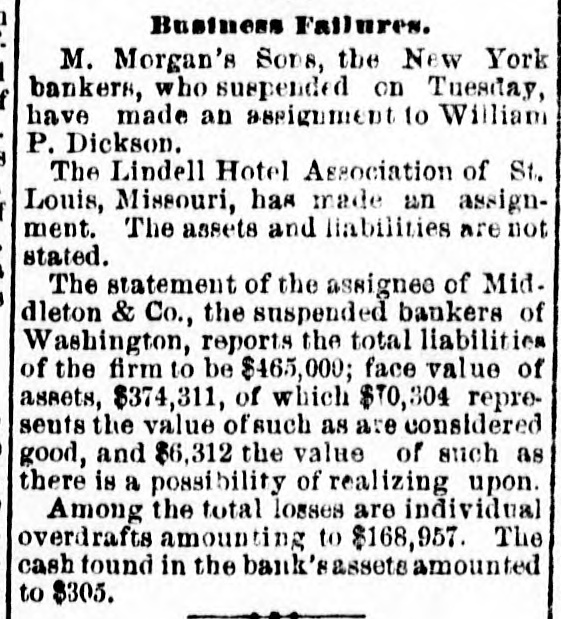
M. Morgan's Sons, the New York bankers, who suspended on Tuesday, have made an assignment to William P. Dickson. The Lindell Hotel Association of St. Louis, Missouri, has made an assignment. The assets and liabilities are not stated. The statement of the assignee of Mid. dleton & Co., the suspended bankers of Washington, reports the total liabilities of the firm to be $465,000; face value of assets, $374,311, of which $70,304 represents the value of such as are considered good, and $6,312 the value of such as there is a possibility of realizing upon. Among the total losses are individual overdrafts amounting to $168,957. The cash found in the bank's assets amounted to $305.
Click image to open full size in new tab
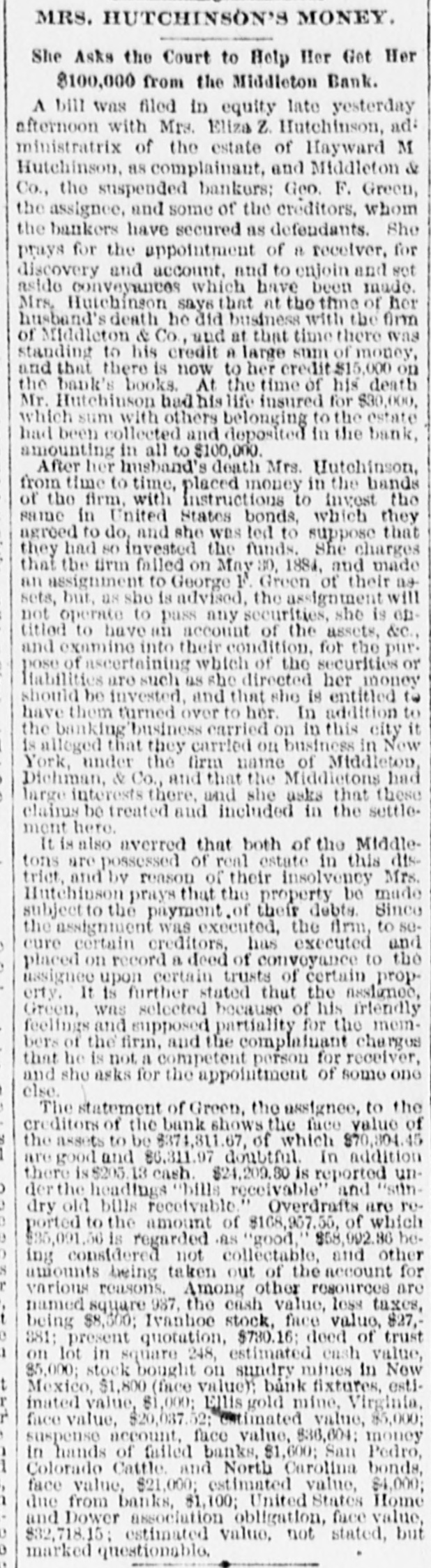
MRS. HUTCHINSON'S MONEY. She Asks the Court to Help Her Get He $100,000 from the Middleton Bank. A bill was filed in equity late yesterday afternoon with Mrs. Eliza Z. Hutchinson, ad ministratrix of the estate of Hayward M Hutchinson, as complainant, and Middleton a Co., the suspended bankers; Geo. F. Green the assignee, and some of the creditors, whon the bankers have secured as defendants. Sh prays for the appointment of a receiver, fo discovery and account, and to enjoin and so aside conveyances which have been made Mrs. Hutchinson says that at the time of he husband's death he did business with the firm of Middleton & Co., and at that time there wa standing to his credit A large sum of money and that there is now to her credit $15,000 o the bank's books. At the time of his deat Mr. Hutchinson had hislife insured for $30,000 which sum with others belonging to the estate had been collected and deposited in the bank amounting in all to $100,000. After her husband's death Mrs. Hutchinson from time to time, placed money in the hand of the firm, with instructions to invest th same in United States bonds, which the agreed to do, and she was ted to suppose the they had so invested the funds. She charge that the firm failed on May 30, 1884, and mad an assignment to George F. Green of their a sets, but, 08 she is advised, the assignment will not operate to pass any securities, she is of titled to have an account of the assets, &e and examine into their condition. for the pur pose of ascertaining which of the securities o liabilities are such as she directed her mone should be invested, and that she is entitled t have them turned over to her. In addition t the banking business carried on in this city is alleged that they carried on business in No York, under the firm name of Middletor Dichman, & Co., and that the Middletons ha large interests there, and she asks that thes claims be treated and included in the settle ment here. It is also averred that both of the Middle tons are possessed of real estate in this di trict, and by reason of their insolvency Mr Hutchinson prays that the property be mud subject to the payment. of their debts. Sinc the assignment was executed, the firm, to so cure certain creditors, has executed an placed on record a deed of convoyance to th assignee upon certain trusts of certain proj crty. It is further stated thut the assigned Green, was selected because of his friendl feelings and supposed partiality for the men bers of the firm, and the complainant charge that he is not a competent person for receive and she asks for the appointment of some on else. The statement of Green, the assignee, to th creditors of the bank shows the face value ( the assets to be $374,311.67, of which $70,804. are good and $6,311.97 doubtful. In additio there is $205.13 cash. $24,209.80 is reported un der the headings "bills receivable" and "sth dry old bills receivable." Overdrafts are r ported to the amount of $168,957.55, of which $35,091.56 is regarded as "good," $58,992.86 b ing considered not collectable, and other amounts being taken out of the account f various reasons. Among other resources a named square 987, the cash value, loss taxe being $8,500; Ivanhoe stock, face value, $27 881; present quotation, $780.16; deed of tru on lot in square 248, estimated cash valu $5,000; stock bought on sundry mines in No Mexico, $1,800 (face value): bank fixtures, est inated value, $1,000; Ellis gold mine, Virgini face value, $20,037.52; estimated value, $5,00 suspense account, face value, $36,604: mone Dade
Click image to open full size in new tab
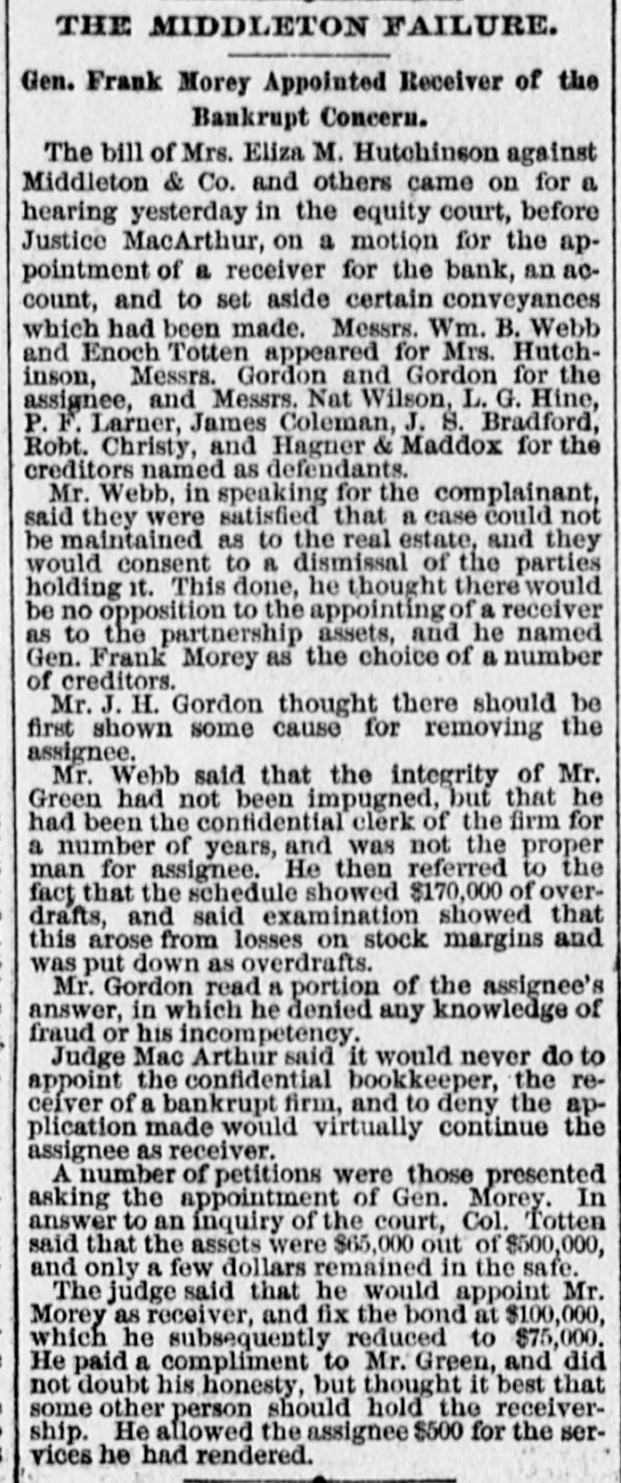
Filled With Brief Mention of Many Minor Events of Yesterday. Andrew Glass, superintendent of the Belt line street cars, was fined 85 in the police court yesterday for working a lame horse. The hearing in the case of Mrs. Hutchinson against Middleton & Co. for the appointment of a receiver for the bank has been set for next Friday. The number of deaths last week was 97, 48 of which were white and 49 colored, the rate of mortality being 25.20 per 1,000 for the whole population. The commissioners yesterday approved the application for liquor license of Mrs. S. Beck, and disapproved those of A. H. Beck and W. J. Fitzgerald. A petition signed by n. number of colored men was received by the commissioners yesterday asking the reappointment of Mr. J. H. Brooks as school trustee. The building inspector has notified the owners of Boyle's hotel on Street, between First street and New Jersey avenue, to strengthen the south wall in thirty days. T. J. Fisher has notified the commissioners that the owners will sell the station house on Massachusetts avenue, between Ninth and Tenth streets northwest, for $10,000. Mrs. Metzerott, widow of the late W. G. Metzcrott, has recelved a handsome silver pitcher from the National Metropolitan Fire Insurance company as a grateful remembrance of the services of her husband, who was president of the company. Windsor & Ford, by their attorney, Mr. J. H. Ford. have filed n bill in equity against N. B. Clarke, Le Roy Tuttle, F. M. Green, trustees, and others, to set aside the sale of certain property on the ground of fraud. A temporary restraining order was issued against GCO. W. Hall, the Inst purchaser enjoining him. The Ivanhoe Literary and Dramatic club has elected the following officers: L. Raymond Peak, president; Bennett S. Jones, vice president; Paschal J. Plant, recording secretary; John C. Scott, corresponding secretary; Samnel R. Dove, treasurer: Aloysius P. Geirer, first censor; Philip J. Hemlock, second censor. In the police court yesterday Richard Harris, W. H. Brainard, and T. W. Berry were charged with permitting gaming in the premises occupied by the Americus club, which was raided July 3. After hearing some evidence the court gave the prosecution one week longer to produce testimony touching the question of control. The bids for furnishing a large supply of terra cotta pipe for the new sewers were opened yesterday. There were five bidders, the price ranging from 23 to 26 cents for 12inch pipe; 32 to 35 cents for 15-inch size; 48 to 57 cents for 18-inch pipe; SO to 93 cents for 21inch size; $1 to $1.38 for 24-inch size; 85 to 50 eents for 12x6 branch; 55 to 66 cents for 15x6 branch: 70 cents to $1 for 18x6 branch; $1.25 to $1.75 for 21x6 branch; $2 to $2.76 for 24x6 branch. No awards were made.
Click image to open full size in new tab
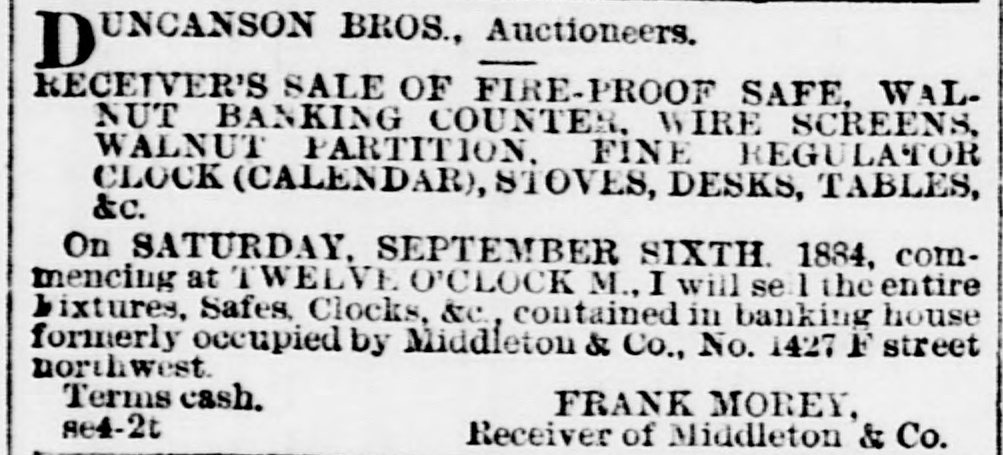
Gen. Frank Morey Appointed Receiver of the Bankrupt Concern. The bill of Mrs. Eliza M. Hutchinson against Middleton & Co. and others came on for a hearing yesterday in the equity court, before Justice MacArthur, on a motion for the appointment of a receiver for the bank, an account, and to set aside certain conveyances which had been made. Messrs. Wm. B. Webb and Enoch Totten appeared for Mrs. Hutchinson, Messrs. Gordon and Gordon for the assignee, and Messrs. Nat Wilson, L. G. Hine, P. F. Larner, James Coleman, J. S. Bradford, Robt. Christy, and Hagner & Maddox for the creditors named as defendants. Mr. Webb, in speaking for the complainant, said they were satisfied that a case could not be maintained as to the real estate, and they would consent to a dismissal of the parties holding it. This done, he thought there would be no opposition to the appointing of a receiver as to the partnership assets, and he named Gen. Frank Morey as the choice of a number of creditors. Mr. J. H. Gordon thought there should be first shown some cause for removing the assignee. Mr. Webb said that the integrity of Mr. Green had not been impugned, but that he had been the confidential clerk of the firm for a number of years, and was not the proper man for assignee. He then referred to the fact that the schedule showed $170,000 of overdrafts, and said examination showed that this arose from losses on stock margins and was put down as overdrafts. Mr. Gordon read a portion of the assignee's answer, in which he denied any knowledge of fraud or his incompetency. Judge Mac Arthur said it would never do to appoint the confidential bookkeeper, the receiver of a bankrupt firm, and to deny the application made would virtually continue the assignee as receiver. A number of petitions were those presented asking the appointment of Gen. Morey. In answer to an inquiry of the court, Col. Totten said that the assets were $65,000 out of $500,000, and only a few dollars remained in the safe. The judge said that he would appoint Mr. Morey as receiver, and fix the bond at $100,000, which he subsequently reduced to $75,000. He paid a compliment to Mr. Green, and did not doubt his honesty, but thought it best that some other person should hold the receivership. He allowed the assignee $500 for the services he had rendered.
Click image to open full size in new tab
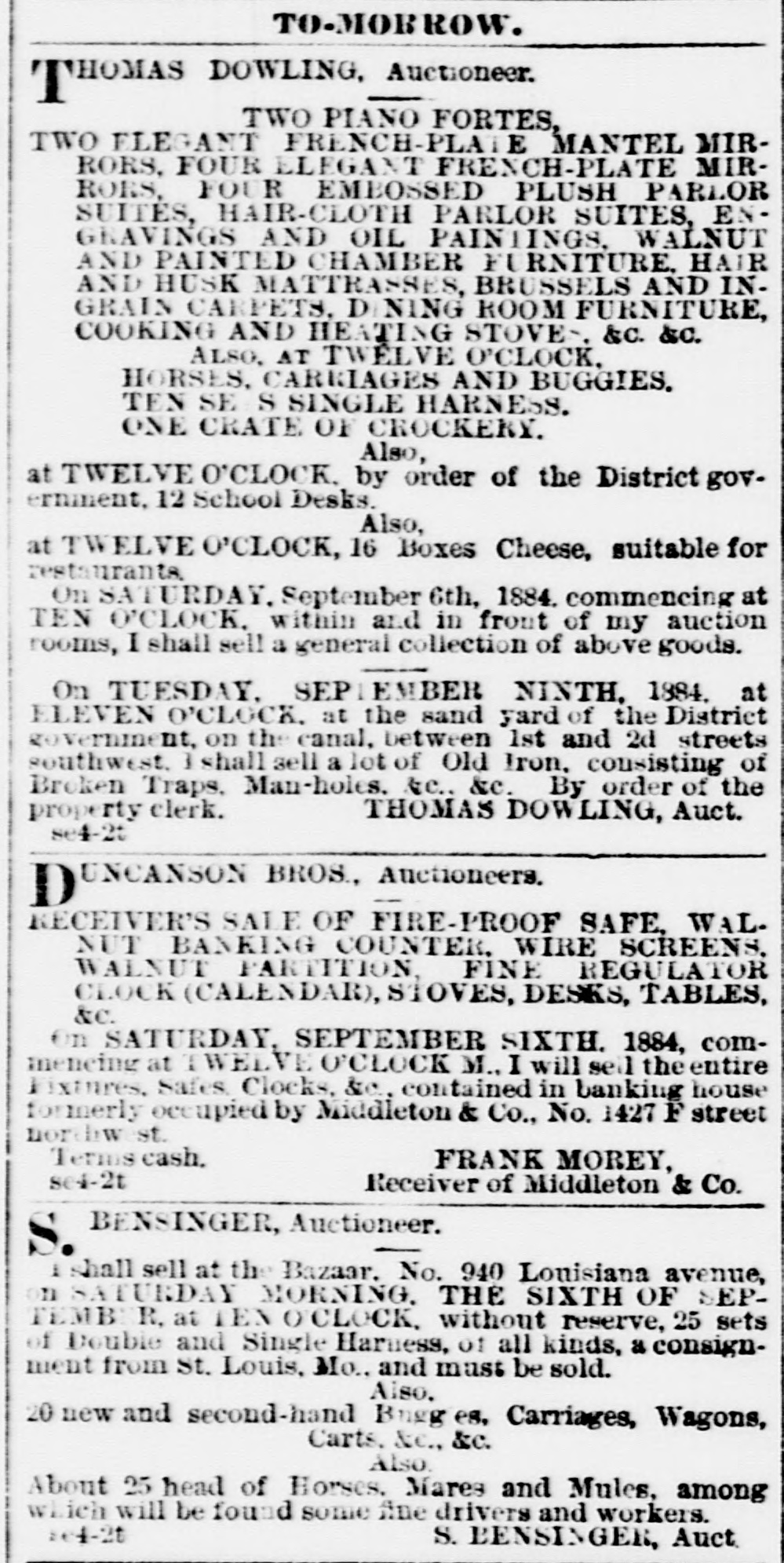
, Auctioneers. D RECEIVER'S SALE OF FIRE-PROOF SAFE, WALNUT BANKING COUNTER. WIRE SCREENS, WALNUT PARTITION, FINE REGULATOR CLOCK &c. (CALENDAR), STOVES, DESKS, TABLES, On SATURDAY, SEPTEMBER SIXTH 1884, commencing at TWELVE O'CLOCK M., I will sell the entire bixtures, Safes, Clocks, &c, contained in banking house formerly occupied by Middleton & Co., No. 1427 F street northwest. Terms cash. FRANK MOREY, se4-2t Receiver of Middleton & Co.
Click image to open full size in new tab
HOMAS DOWLING, Auctioneer. T TWO PIANO FORTES, TWO ELEGANT FRENCH-PLATE MANTEL MIRRORS, FOUR ELEGANT FRENCH-PLATE MIRRORS, FOUR EMBOSSED PLUSH PARLOR SUITES, HAIR-CLOTH PARLOR SUITES, ENGRAVINGS AND OIL PAINTINGS, WALNUT AND PAINTED CHAMBER FURNITURE, HAIR AND HUSK MATTRASSES, BRUSSELS AND INGRAIN CARPETS, DINING ROOM FURNITURE, COOKING AND HEATING STOVES. &c. &c. ALSO, AT TWELVE O'CLOCK, HORSES, CARRIAGES AND BUGGIES. TEN SE S SINGLE HARNESS. ONE CRATE OF CROCKERY. Also, at TWELVE O'CLOCK, by order of the District government, 12 School Desks. Also, at TWELVE O'CLOCK, 16 Boxes Cheese, suitable for restaurants. On SATURDAY, September 6th, 1884. commencing at TEN O'CLOCK, within and in front of my auction rooms, I shall sell a general collection of above goods. On TUESDAY, SEPTEMBER NINTH, 1884. at ELEVEN O'CLOCK. at the sand yard of the District government, on the canal, between 1st and 2d streets southwest. shall sell a lot of Old Iron, consisting of Broken Traps, Man-holes. Ac., &c. By order of the property clerk. THOMAS DOWLING, Auct. se4-2t UNCANSON BROS., Auctioneers. D RECEIVER'S SALE OF FIRE-PROOF SAFE, WAL. NUT BANKING COUNTER. WIRE SCREENS, WALNUT PARTITION, FINE REGULATOR CLOCK (CALENDAR), STOVES, DESKS, TABLES, &c. On SATURDAY, SEPTEMBER SIXTH. 1884, commencing at TWELVE O'CLOCK M., I will sell the entire Fixtures. Safes. Clocks, &c., contained in banking house formerly occupied by Middleton & Co., No. 1427 F street northw st. Terms cash. FRANK MOREY, se4-2t Receiver of Middleton & Co. BENSINGER, Auctioneer. i 1 shall sell at the Bazaar. No. 940 Louisiana avenue, on SATURDAY MORNING. THE SIXTH OF SEPTEMB R, at TEN O'CLOCK, without reserve, 25 sets of Double and Single Harness, of all kinds, a consignment from St. Louis, Mo., and must be sold. Also, 20 new and second-hand Bugg es, Carriages, Wagons, Carts. &c., &c. Also. About 25 head of Horses. Mares and Mules, among which will be found some fine drivers and workers. se4-2t S. BENSINGER, Auct
Click image to open full size in new tab
card it as the last of these failures here. It is the last of the weak banks. All of the banks now are strong and in excellent condition. I speak, of course of the recognized banking institutions WHAT BANKER BATEMAN SAYS Mr. Bateman, the banker, says: "Mr. Cooke has the earnest sympathy or all the bankers in the city. I have no doubt from what I know of Mr. Cooke's affairs that the assets far exceed the liabilities, and his suspension, in my opinion, will be but temporary. The failure of Middleton & Co. and Squier & Co. has to some extent affected all the private banks in the District, and the general distrust and panic has caused a gradual but steady decline in deposits. The banks of the city will lose nothing. I am satisfied. when all the facts are known, Mr. Cooke's conduct will be judged highly honorable in all respects." NO EXCITEMENT AT THE DOWN-TOWN BANKS. The announcement of the suspension down town caused little excitement, and some of the banking houses were unaware of it as late as 11 o'clock. The banks on 7th street-the Second National, the National Bank of the Republic, the Central National, and the Bank of Washington-were found quietly doing their usual business this afternoon. being entrely unaffected by the rumor. Mr. Norment, of the Central National, said that the National and other down-town banks were not the least affected by the suspension, and he saw no reason whatever to doubt the stability of the down-town banks. This sentiment was voiced by officers of the other banks. A HISTORY OF THE FIRM. The firm of H. D. Cooke & Co., which suspended to-day, was established in 1873. The name of Cooke has been intimately identified with the banking interests of the city for many years. Mr. Henry D. Cooke was a son of the late Henry D. Cooke, and a nephew of Jay Cooke, the once celebrated banker. Mr. Henry D. Cooke, sr., was a member of the banking firm of Jay Cooke & Co., which falled in September, 1873, causing one of the most memorable financial panies ever experienced in this country. He was also president of the First National bank of this city, which was located on 15th street, and which fell in the crash that followed the Jay Cooke failure. He was highly esteemed as a citizen, and when the territorial form of government for the District was adopted, in 1871, was appointed as the first governor of the District, in which office he was succeeded by Alex. R. Shepherd. Mr. Cooke, Sr., died about four years ago. Mr. Henry D. Cooke, jr., was assistant cashier in the First National bank under the presidency of his father. About a year after the failure in 1873 be began banking busine-s for himself, being first associated with Mr. John Sherman, a nephew of Senator Sherman. Subsequently he was in business with Mr. Lester A. Bartiett and other gentlemen, the name of the firm being H. D. Cooke & Co. He formed his present partnership about a year ago. Mr. Cooke has been considered as one of the ablestand brightest of the young business men of the city. He has always been very popular, and his present reverses have called forth expressions of sympathy from every side. When the condition of his affairs became known this morning the sum of $30,000 was tendered by bankers to tide him over his difficulties, but was declined. The firm, It is stated, had no connection with any New York house, such as would involve it in the suspension. The business has been largely a brokerage business, and it is said the largest creditors are persons who have been speculating through the firm. Mr. Cooke was in New York yesterday, and coming home on the train seemed to be in such good spirits as to preclude the idea that he had any knowledge that the house would close. At the depot he was met by Mr. Corson.
Click image to open full size in new tab
The case of Frederick Koones against the District of Columbia was decided in the court in bane yesterday. This was a bill filed to enjoin the collector of taxes and the District from collecting certain taxes due by Koones, on the ground that he had paid the same by check on Middleton & Co., dated May 29, but, through the negligence, as was claimed, of the collector, it was not presented until the 31st of May, when the bank had suspended. The court held that a check so given was not payment: that the collector had no authority in law to receive the same, and that in receiving the check as he did he was simply acting as agent for the complainant, and that the only thing the collector could receive in payment of taxes was money. Justice Merrick delivered the oninion ofthe court. BRING the babiesto have their pictures taken
Click image to open full size in new tab
The receiver of the late firm of Middleton & Co., the Washington firm of bankers who failed a couple of years ago, announces that the creditors of the firm will receive one cent on the dollar. This failure would do credit to Wall street.
Click image to open full size in new tab
A REMINISCENCE OF THE MIDDLETON FAILUREIn the New York supreme court yesterday a suit was tried for the recovery of $3,500 from ex-Secretarv of the Navy Geo. M. Robeson and Banker Austin P. Brown. Ernest Dichman and Wm. P. Tuttle are the plaintiffs. In May, 1884, Mr. Robeson drew a check for $3,500, which was made payable to Austin P. Brown, or order, and was directed to the Camden Safe Deposit and Trust company. Mr. Brown indorsed Mr. Robeson's check and then deposited with the banking firm of Middleton & Co., of this city. It became known that the firm of Middleton & Co. might not realize upon it. On May 31, 1884, Middleton & Co. failed, and a receiver was appointed. The dishonored check came into the hands of Middleton, Dichman & Co., of New York city, in the process of a settlement with the bankrupt firm.