Lincoln National Bank (Washington, DC)

Episode Information

Episode UID
424701599
Episode Type
Suspension โ†’ Reopening
Bank Type
national
Bank ID
42470 national
Charter Number
4247
Start Date
March 6, 1933
Location
Washington, District of Columbia (38.895, -77.036)

Metadata

Model
gpt-5-mini (chosen from majority vote of a three-model LLM ensemble)
Short Digest
8e83b0fdd8162caf

Response Measures

None

Events (3)

1. March 5, 1890 Chartered
Source
historical_nic
2. March 6, 1933 Suspension
Cause
Government Action
Cause Details
National four-day bank holiday proclaimed by President Roosevelt and enforced via federal regulations (Regulation No. 10); local banks closed pending licenses.
Newspaper Excerpt
the bank holiday proclaimed by President Roosevelt
Source
newspapers
3. March 13, 1933 Reopening
Newspaper Excerpt
Banks prepare for opening tomorrow ... awaiting word from the Federal Reserve Bank at Richmond for permission to resume activities tomorrow. ... local banks expected to reopen tomorrow morning.
Source
newspapers

Newspaper Articles (5)

Article from Evening Star, July 24, 1921

Click image to open full size in new tab

Article Text

BY I. A. FLEMING. In August, 1907, the date being selected at the height of the panic of that eventful year, a rich man's panic, and for special reasons, there were doing business in Washington, ten national banks, ten savings institutions and five trust companies. National banks showed deposits of $32,266,109; savings institutions, $4,737.643, and the trust companies, $20,715,162, a total of $57,718,914. It is a far cry back to 1907 measured by the changes in the banking business in Washington, but the improvement of the last fourteen years is an evidence that the banking business has been the leader in material prosperity, rather than the follower; that it has been sanely and safely conducted is further evidenced by the fact that in the period covered depositors have not lost a dollar. There have been some banking failures, but they have been of the kind that have resulted in loss to shareholders, with the money of the depositors safe. Of the national banks then in existence only the National City and the Traders' banks have gone by the board through liquidation. Of the savings banks, the citizens' was absorbed by the District National, but another Citizens' has taken its place; the Fourteenth Street Savings and Washingtotn Exchange passed to other ownership and quit; Eldredge Jordon acquired the Merchants and Mechanics' and its several branches. and they passed on with the United States Trust Company. The United States Trust Company started in the panic year, and after a very large growth in deposits largely purchased with the Merchants and Mechanics,' the International Banking Corporation and the Fourteenth Street Savings, was taken in part by the Munsey Trust Company, the divers branches going with the parent concern. In the savings banks one misses the most promising of all the lot in 1017. the Home Savings. But it is well placed. incorporated in the American Security and Trust Company, at $400 a share for its stock, when it had over $10,000,000 deposits. The banks that were in business in 1907 and are in business in 1921 have prospered. There may be some interest in the then and now comparison of deposits, the thing that counts in money making for banks. A Comparative Table. The following table tells a story of struggle and effort during the fourteen years and the measure of reward obtained.


Article from The Washington Times, March 9, 1933

Click image to open full size in new tab

Article Text

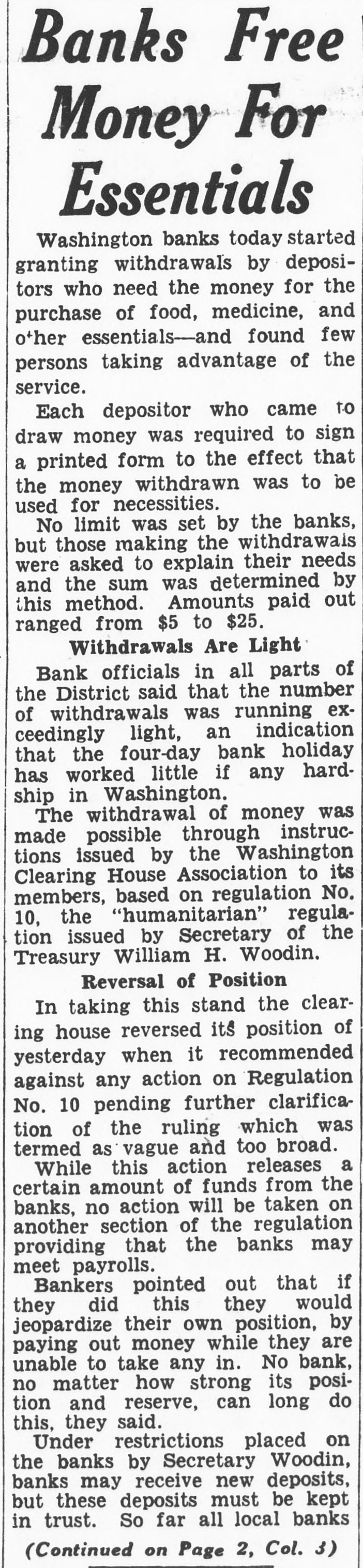
Banks Free Money For Essentials Washington banks today started granting withdrawals by depositors who need the money for the purchase of food, medicine, and other essentials-and found few persons taking advantage of the service. Each depositor who came to draw money was required to sign a printed form to the effect that the money withdrawn was to be used for necessities. No limit was set by the banks, but those making the withdrawais were asked to explain their needs and the sum was determined by this method. Amounts paid out ranged from $5 to $25. Withdrawals Are Light Bank officials in all parts of the District said that the number of withdrawals was running exceedingly light, an indication that the four-day bank holiday has worked little if any hardship in Washington. The withdrawal of money was made possible through instructions issued by the Washington Clearing House Association to its members, based on regulation No. 10, the "humanitarian" regulation issued by Secretary of the Treasury William H. Woodin. Reversal of Position In taking this stand the clearing house reversed its position of yesterday when it recommended against any action on Regulation No. 10 pending further clarification of the ruling which was termed as vague and too broad. While this action releases a certain amount of funds from the banks, no action will be taken on another section of the regulation providing that the banks may meet payrolls. Bankers pointed out that if they did this they would jeopardize their own position, by paying out money while they are unable to take any in. No bank, no matter how strong its position and reserve, can long do this, they said. Under restrictions placed on the banks by Secretary Woodin, banks may receive new deposits, but these deposits must be kept in trust. So far all local banks (Continued on Page 2, Col. 3)

Article from The Washington Times, March 10, 1933

Click image to open full size in new tab

Article Text

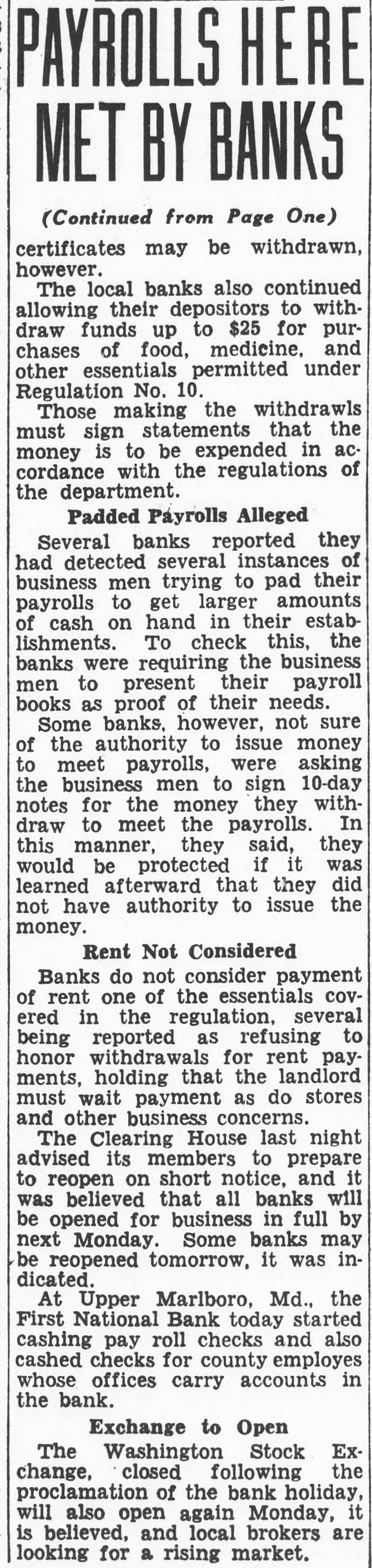
PAYROLLS HERE MET BY BANKS (Continued from Page One) certificates may be withdrawn, however. The local banks also continued allowing their depositors to withdraw funds up to $25 for purchases of food, medicine, and other essentials permitted under Regulation No. 10. Those making the withdrawls must sign statements that the money is to be expended in accordance with the regulations of the department. Padded Payrolls Alleged Several banks reported they had detected several instances of business men trying to pad their payrolls to get larger amounts of cash on hand in their establishments. To check this, the banks were requiring the business men to present their payroll books as proof of their needs. Some banks, however, not sure of the authority to issue money to meet payrolls, were asking the business men to sign 10-day notes for the money they withdraw to meet the payrolls. In this manner, they said, they would be protected if it was learned afterward that they did not have authority to issue the money. Rent Not Considered Banks do not consider payment of rent one of the essentials covered in the regulation, several being reported as refusing to honor withdrawals for rent payments, holding that the landlord must wait payment as do stores and other business concerns. The Clearing House last night advised its members to prepare to reopen on short notice, and it was believed that all banks will be opened for business in full by next Monday. Some banks may be reopened tomorrow, it was indicated. At Upper Marlboro, Md., the First National Bank today started cashing pay roll checks and also cashed checks for county employes whose offices carry accounts in the bank. Exchange to Open The Washington Stock Exchange, closed following the proclamation of the bank holiday, will also open again Monday, it is believed, and local brokers are looking for a rising market.


Article from The Washington Times, March 13, 1933

Click image to open full size in new tab

Article Text

BANKS PREPARE FOR OPENING TOMORROW All to Resume at Same Time If Reserve Board 0. K's Clearing House Plea Washington banks today were awaiting word from the Federal Reserve Bank at Richmond for permission to resume activities tomorrow. It is expected that the Federal Reserve will honor the request of the Washington Clearing House Association and send out notification simultaneously, so that all banks here which are members of the system will receive licenses and open at the same time. The Clearing House made this request, pointing out that failure of any bank to open at the same time as the others might be misconstrued by depositors. While the local banks are expected to reopen tomorrow morning. Secretary of the Treasury William H. Woodin issued instructions to banks that they guard against hoarders. Withdrawals Limited Until more normal conditions have been established. the Secretary instructed, withdrawals should be limited at the discretion of the bank to necessary funds. This will permit the banks to restrict withdrawals of, in their judgment, the money to be taken out of circulation. Warning was again issued that 3 o'clock Friday is the deadline for those who have been hoarding gold or gold certificates to turn them in. Names to Be Listed At the close of the banking lists of those who sums or 1 will be have gold day February Friday withdrawn gold certificates large sent Reserve to since the of governor of the Federal at Richmond for such action as the Government may deem advisable in view of the President's edict against hoarding. It is believed that few persons will fail to turn in their gold as the President asked, bankers pointing out that in the past few days many thousands of dollars have already been turned in at local banks and at the Treasury. Today, the last of the bank holiday proclaimed by President Roosevelt, found Washington banks carrying on limited business and prepared for general reopening tomorrow. The reopening is expected to give a bc m to local business. Savings banks and other institutions here which are not members of the Federal Reserve System have applied to the Comptroller of the Currency for licenses to reopen, and it is expected that they will be given permission to resume on Wednesday.


Article from The Washington Times, March 17, 1933

Click image to open full size in new tab

Article Text

STOCKHOLDERS AND PATRONS TO CONFER Commercial National Chief To Bare Plan to Reorganize; D. C. Banking "Normal" Washington banks licensed to reopen after the bank holiday are back on a practically "normal" operating basis, local bankers declared as reopenpositors today that followed the rush the of deon ing of 20 local the banks usual volume Tuesday fell away to of business. Clearing House records showed that checks totalling $1,716,728.31 were cleared yesterday. This figure, it was said, is about the normal day's clearing. Wednesday $2,888,365.93 was cleared, but this large sum was due to the Government pay day and to some of the outstanding checks from the holiday period still being cleared, it was said. Depositors to Meet Plans for reorganization and reopening of the Commercial National Bank, the only institution in the District placed in the hands of a receiver as a result of the recent banking crisis, will be discussed at a meeting of depositors and stockholders to be held at the Mayflower Hotel tomorrow night. Col. Wade H. Cooper, president of the bank, who called the meet- a ing, declared he would hold series of such gatherings if necessary in order that the 20,000 depositors may learn "the true facts" leading up to the closing of the institution February 28. A "safe and sure" plan for speedy recovery of the bank has been developed by Colonel Cooper, he said, and he expects to reveal this at the meeting tomorrow night. Merger Plans Wait Plans for reorganization and possible consolidation of the 13 Washington banks which were not licensed to reopen at the end of the President's national bank holiday were still in abeyance today. Officials of the banks are exmeet pected shortly to to discuss in the conference possibility of receiving Federal aid in event plan of consolidation may be worked out. Meanwhile conservators of the banks are working over the assets of the institutions, preparatory to making a report to the Comptroller of the Currency as to their strength and the possibility of reorganization for the protection of depositors and stockholders. One Reopening Denied Reports that one of the 10 savings banks which failed to receive a license would open tomorrow was denied at the office of the Comptroller of the Treasury and by the conservator handling the affairs of the bank. The conservator pointed out that he has been at work for only two days on the bank's affairs, and said it would probably require several weeks before his report on the assets would be completed and sent to the Treasury Department, which will then act on the question of issuing a license.