Click image to open full size in new tab
Article Text
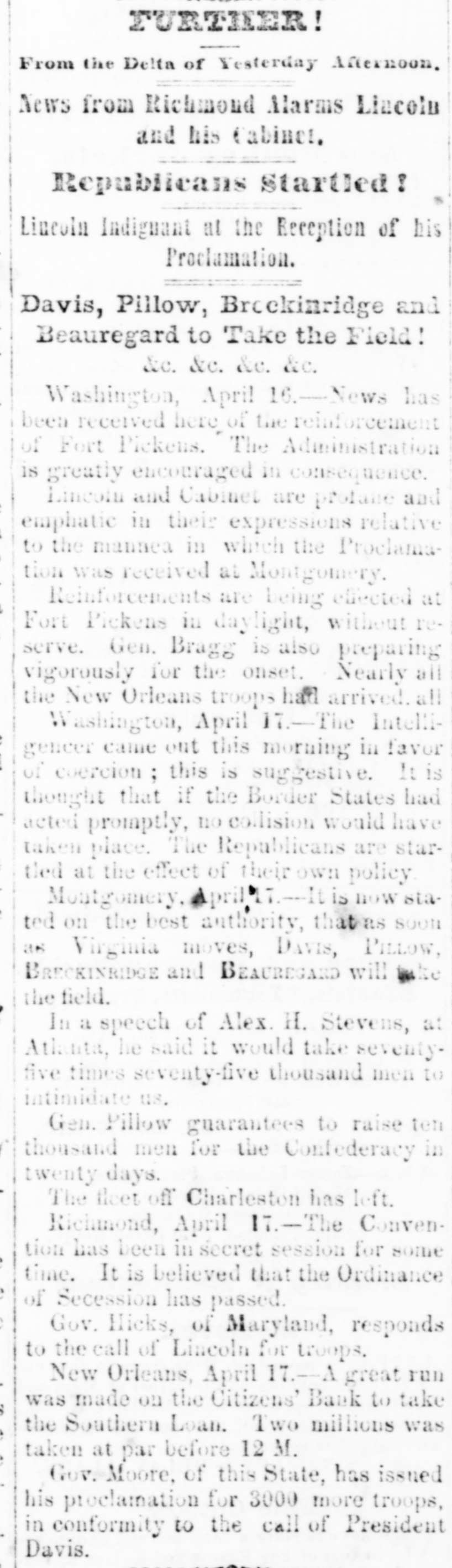
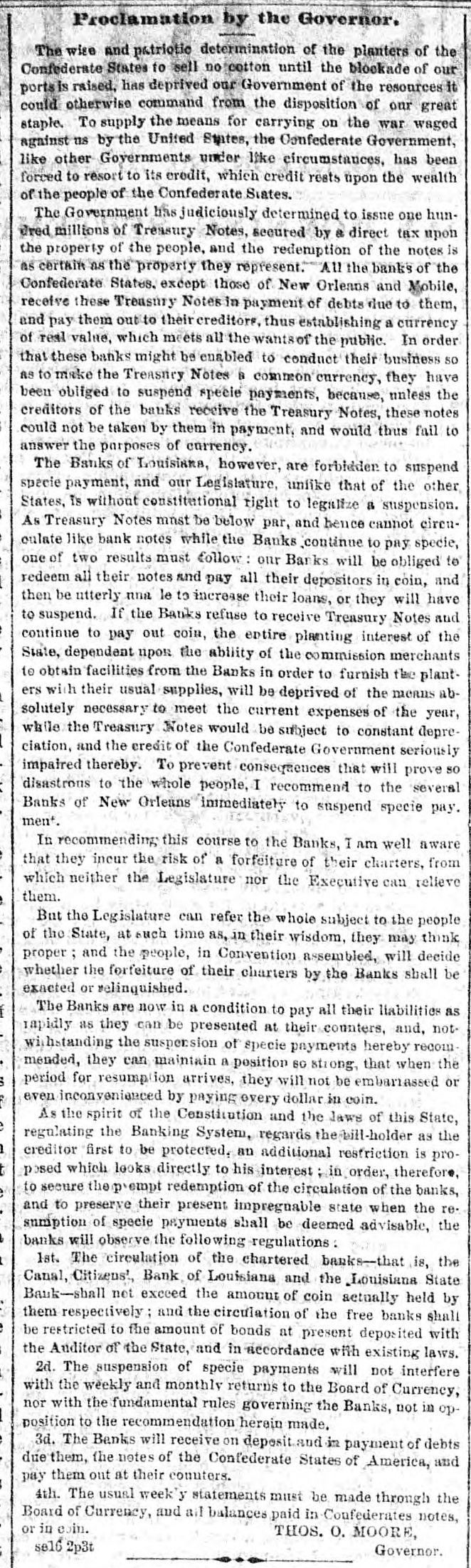
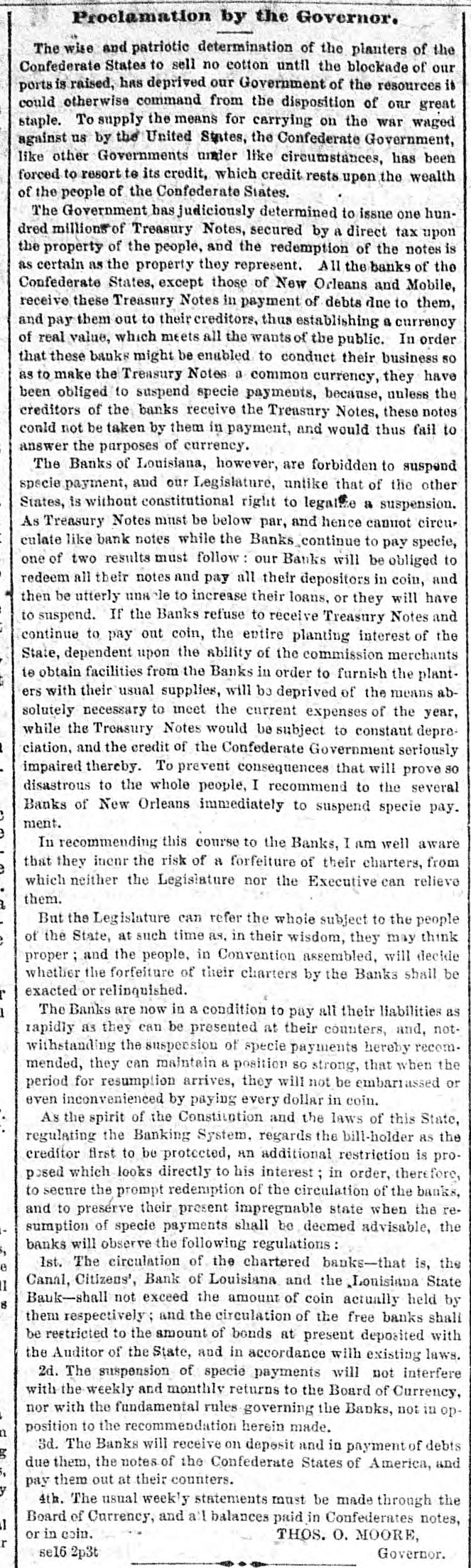
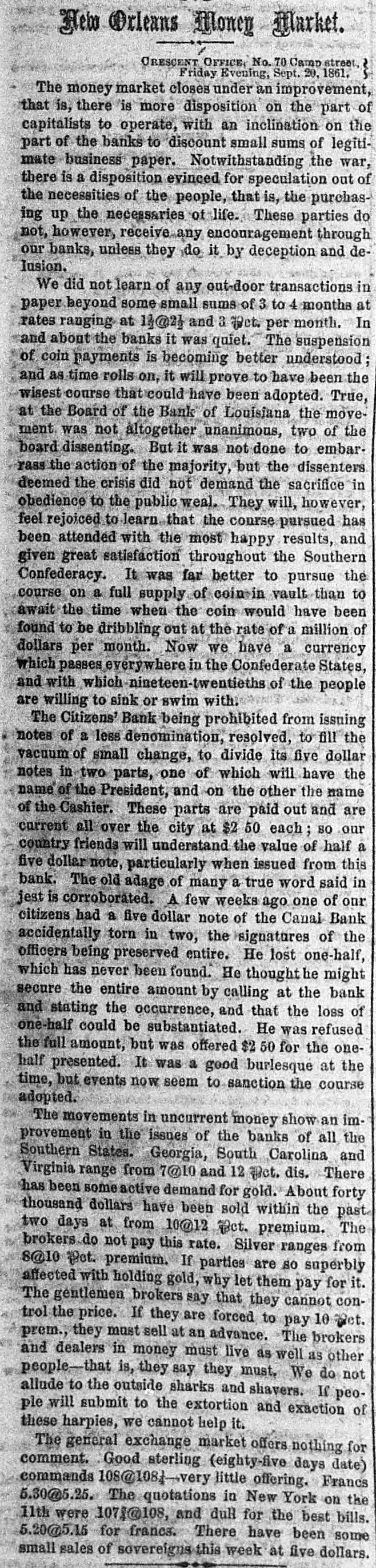
expressed, they passed at par in several seaports of Dixie "for at least a month," as Col. Capers carefully puts it, "after they were issued." Several large bills of exchange were bought in London and Paris at par. But the financial boom of the Confederacy didn't last long. When it came to be August, '61, the Canal and Citizens' banks in New Orleans were the only ones handling Confederate money at par. On the 9th of August even they suspended specie payments, notifying the Richmond authorities of their intention two days in advance by a private cipher dispatch. Col. Capers has the original of this dispatch, in pursuance of which the Government made quite a saving speculation for itself by buying up all the foreign exchange it could lay its hands on in New Orleans, Mobile, Savannah, Charleston and Richmond during the two days of grace.
Col. Capers's recollection of those early days of the war are a continuous story of makeshifts and expedients. The young Government lived from hand to mouth. One of the first naval officers to report for duty was Raphael Semmes, afterwards commander of the *Alabama*. He was on hand before they had a deck for him to stand on, and worked for a short time in the treasury department at Montgomery. A merchant vessel was soon bought and Semmes, after inspecting her, returned to Montgomery and announced to his fellow-clerk, Col. Capers: "She is a good craft, sir, a good craft. When I have strengthened her timbers and cut her down to fighting trim, my word for it, she will do brave work, sir."
She was accordingly altered and armed and, with Semmes on her quarter-deck, made good his prediction to the dire cost of such as went down to the sea in ships under the Stars and Stripes in those days. The vessel was the *Sumter*.
SEMMES WHITTLES FOR I'S PAPERS.
But when she was read to sail and her register made out, it was discovered at the last moment that the treasury department of the Confederate States had no seal. There wasn't an engraver to be found in Montgomery, and Semmes was impatient to get his papers and be off. So he and Col. Capers, aided by a handy young army surgeon, and at the expense of two or three penknives, carved a rude seal upon a piece of boxwood, which met the immediate need. Semmes got his register, and the *Sumter* set sail under the Stars and Bars. There was quite a time over the adoption of that flag. A considerable number were in favor of sticking to the old flag, with slight modifications, but Mr. Miles, of South Carolina, chairman of the Congressional flag committee, argued at length in his report against this sentimental idea, and added, by way of a clincher, that Liberia and the Sandwich Islands had flags very similar to ours, and the committee was not disposed, therefore, if for no other reason, "to keep, copy or imitate it. They have no inclination to borrow second-hand what has already been pilfered or appropriated by a free negro community and a race of savages."
The very first Confederate flag that the sun ever saw, Col. Capers testifies, was hoisted by Judge Clitherall at Montgomery. He was in the confidence of the flag committee, and as soon as they told him the design selected he got his lady friends together and had one made. On the day the committee was to report to Congress he mounted the roof of the Capitol, fixed his flag to the halyards of the staff and waited.
The recommendation of the committee was approved. He got his signal from below, and in the twinkling of an eye the new ensign of the South was floating proudly in the caresses of the gentle March wind. The news spread quickly through the city, and when Judge Clitherall shouted down from his lofty perch, "Three cheers for the Confederate flag" the crowd answered with a mighty greeting that, it was thought at the time, must have given an earache to the bronze statue on the dome of the far Northern Capitol.