Investment Trust Company of America (Topeka, KS)

Episode Information

Episode UID
4206489691157
Episode Type
Suspension β†’ Closure
Bank Type
trust
Bank ID
420648969 hash
Start Date
May 4, 1896
Location
Topeka, Kansas (39.048, -95.678)

Metadata

Model
gemini-3-flash-preview (chosen from majority vote of a three-model LLM ensemble)
Short Digest
f88e3bbe0d709cbc

Response Measures

None

Description

The company was placed in receivership following a suit by bondholders over defaulted interest; there is no evidence of a depositor run.

Events (2)

1. May 4, 1896 Receivership
Newspaper Excerpt
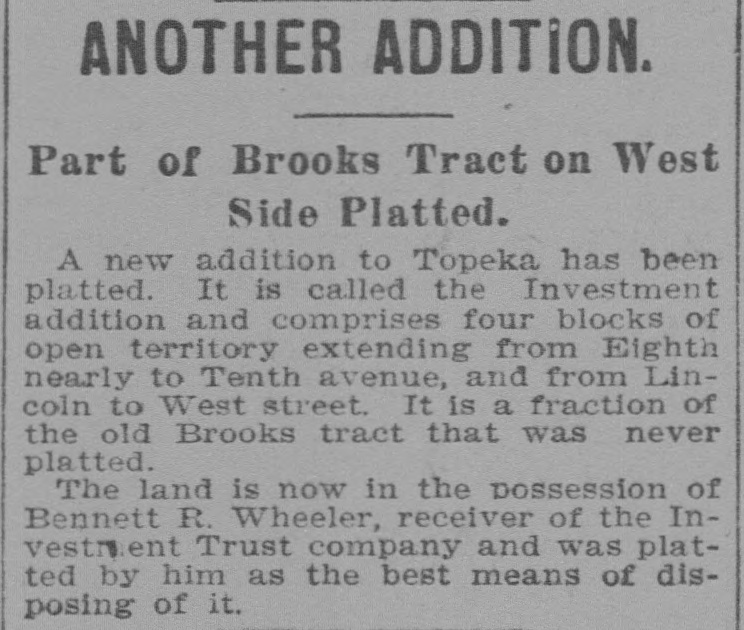
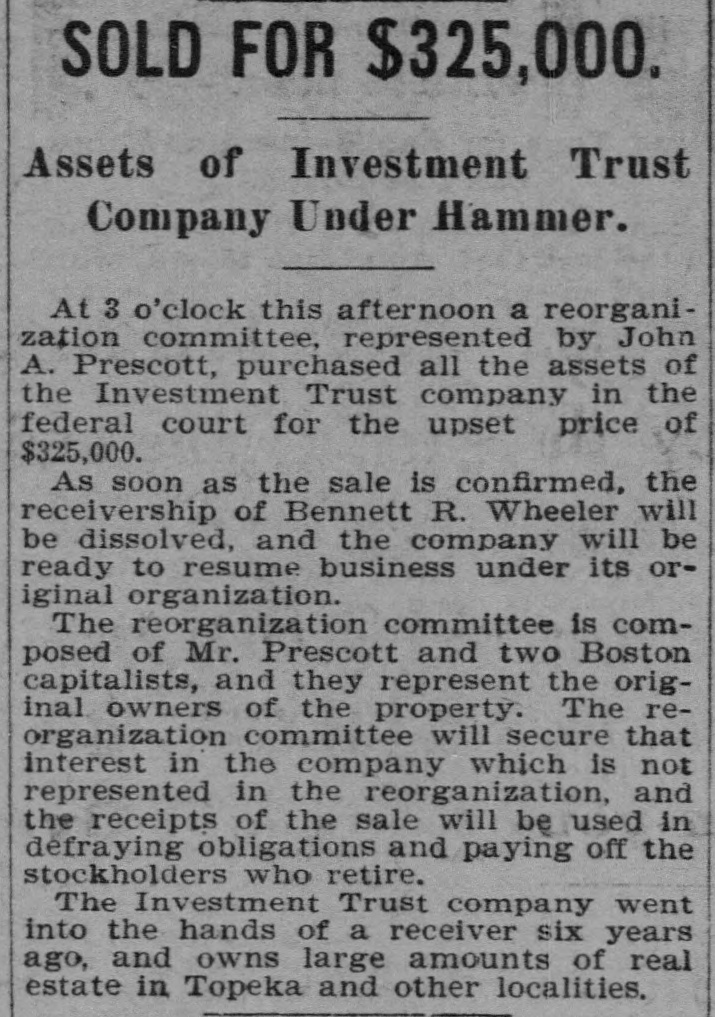
Judge C. G. Foster, of the U.S. district court, has appointed C. O. Knowles and Bennett R. Wheeler receivers of the Investment Trust company of America
Source
newspapers
2. May 4, 1896 Suspension
Cause
Bank Specific Adverse Info
Cause Details
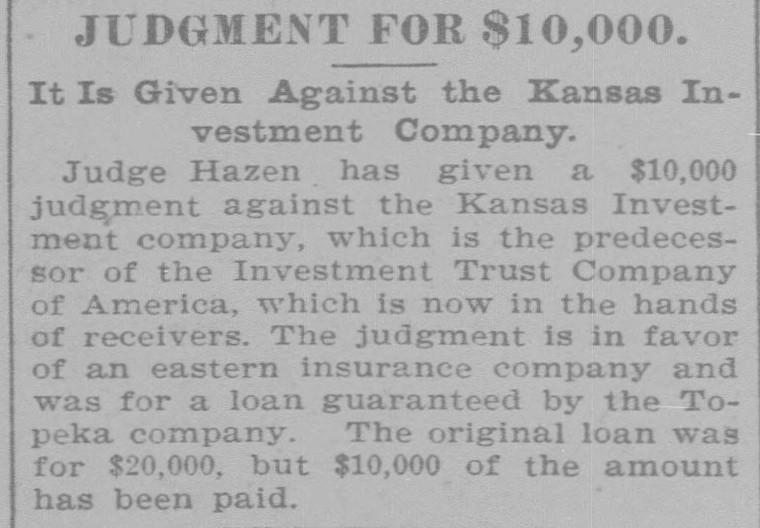
Filing of a suit by bondholders representing $10,000 of Eastern bonds on which interest was defaulted.
Newspaper Excerpt
The Investment trust company, of America, with headquarters here, has been placed in a receiver's hands.
Source
newspapers

Newspaper Articles (10)

Article from Santa Fe Daily New Mexican, May 4, 1896

Click image to open full size in new tab

Article Text

RECEIVERS APPOINTED. Prominent Kansas Investment Company Passes Into Control of United States Court. Topeka, Kas., May 4.-Judge C. G. Foster, of the U.S. district court, has appointed C. O. Knowles and Bennett R. Wheeler receivers of the Investment Trust company of America, doing business in this city. The concern is a large dealer in investment bonds and among its directors are a half dozen New England capitalists. The advertisements of the company state that its authorized capital is $3,000,000; paid in capital, $1,400,000. The receivers are friendly to the company, Bennett R. Wheeler being secretary. Its president is H.E. Ball. Wheeler says that the outstanding debenture bonds, over $2,000,000, are amply secured by real estate.


Article from Las Vegas Daily Optic, May 4, 1896

Click image to open full size in new tab

Article Text

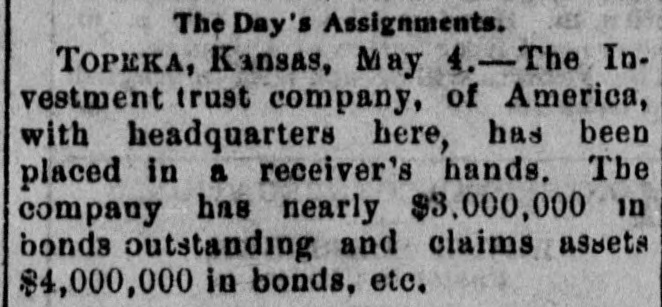
The Day's Assignments. TOPEKA, Kansas, May 4.-The Investment trust company, of America, with headquarters here, has been placed in a receiver's hands. The company has nearly $3,000,000 in bonds outstanding and claims assets $4,000,000 in bonds, etc.


Article from San Antonio Daily Light, May 4, 1896

Click image to open full size in new tab

Article Text

Receivers for an Investment Company. TOPEKA, Kas., May 4.-Judge Foster, of the United States district court, has appointed C. O. Knowles P. G. Noel and Bennet R. Wheeler, as receivers for the Investment Trust company of America, doing business in this city. The concern is a large dealer in investment bonds and among its directors are Wm. Lloyd Garrison, of Boston. and half a dozen other New England capitalists. Garrison is in the city, sick, at Hotel Throop. The advertisements of the company state its authorized capital at $3,000,000 and paid in capital $1,400,000. The receivers are friendly to the company, Bennet R. Wheeler being secretary. The president is H. E. Ball. Mr. Wheeler says that while the outstanding debt and entire bonds are over two million dollars they are amply secured by real estate. The company. or one of its allies, is said to hold twenty-five thousand acres of land near Hutchins. The advertising matter of the company gives B. M. Davies, of Chicago, as one of the directors, and Railroad Commissioner S. T. Howe, and William Sims, of Topeka, as other directors.


Article from The Indianapolis Journal, May 5, 1896

Click image to open full size in new tab

Article Text

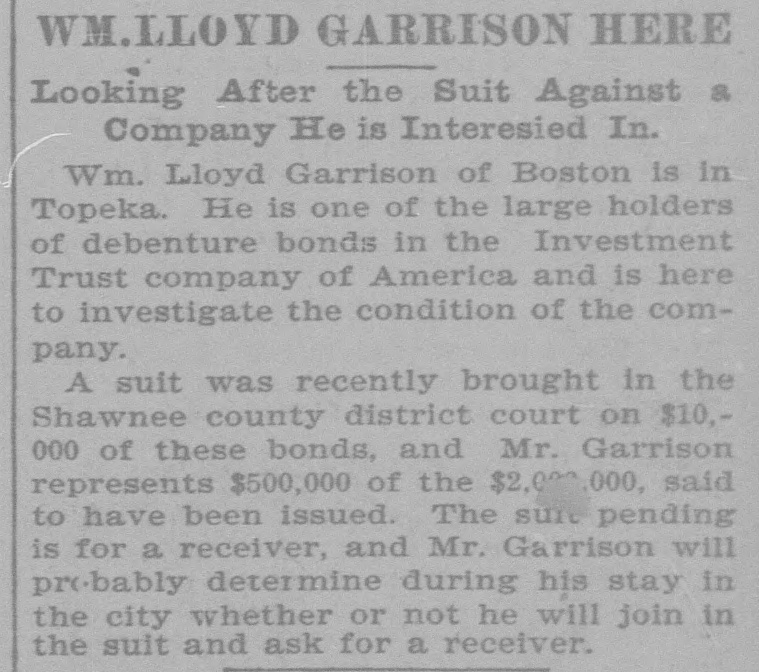
KANSAS CONCERN FAILS. Investment Trust Company of America in Charge of Receivers. TOPEKA, Kan., May 4.-Judge C. G. Foster of the United States District Court, has appointed C. O. Knowles, P. G. Noel and Bennett R. Wheeler receivers for the Investment Trust Company of America, doing business in this city. The concern is a large dealer in investment bonds, and among its directors are William Lloyd Garrison, of Boston, and a half dozen other New England capitalists. Garrison is in the city, sick, at the Hotel Throop. The advertisements of the company state its authorized capital at $1,000,000 and paid-in capital $1,400,000. The receivers are friendly to the company, Bennett R. Wheeler being secretary. The president is H. E. Ball. Mr. Wheeler says that, while the outstanding debenture bonds are over $2,000,000, they are amply secured by real estate. The company, or one of its allies, is said to hold 25,000 acres of land near Hutchinson, Kan. The advertising matter of the company gives B. M. Davies, of Chicago, as one of the directors, and Railroad Commissioner S. T. Hose and William Sims, of Topeka, as other directors. The liabilities of the Investment Trust Company of America are admitted by the members of the company to be $2,800,000, but it claims there are securities to the amount of $4,000,000, consisting of lands, etc. The immediate cause of the crisis, it is evident, was the filing of a suit in the District Court here by attorneys who represented about $10,000 of Eastern bonds, on which interest was defaulted. This suit brought William L. Garrison here. Mr. Garrison said to-day: "I had hoped that receivers would not be necessary, but have determined that the interests of the Eastern bondholders will be best served by the appointment of the friendly receivers, and have consented to their appointment. The appointment was made to avoid suits of numerous small bondholders and to avoid an unfriendly receivership."


Article from The Salt Lake Herald, May 5, 1896

Click image to open full size in new tab

Article Text

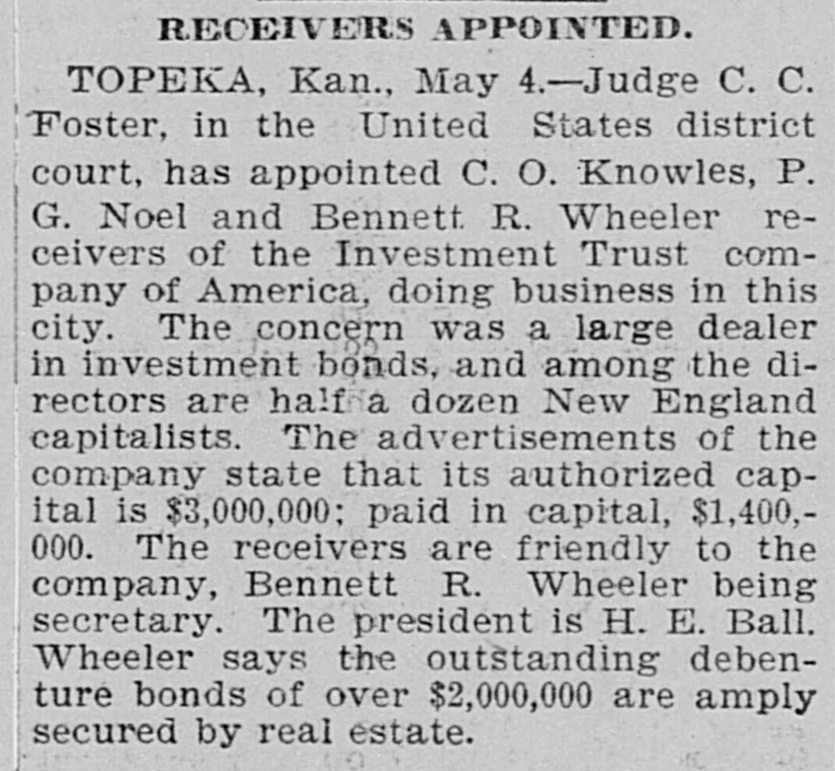
RECEIVERS APPOINTED. TOPEKA, Kan., May 4.-Judge C. C. Foster, in the United States district court, has appointed C. O. Knowles, P. G. Noel and Bennett R. Wheeler receivers of the Investment Trust company of America, doing business in this city. The concern was a large dealer in investment bonds, and among the directors are halfra dozen New England capitalists. The advertisements of the company state that its authorized capital is $3,000,000; paid in capital, $1,400,000. The receivers are friendly to the company, Bennett R. Wheeler being secretary. The president is H. E. Ball. Wheeler says the outstanding debenture bonds of over $2,000,000 are amply secured by real estate.


Article from The Topeka State Journal, May 6, 1896

Click image to open full size in new tab

Article Text

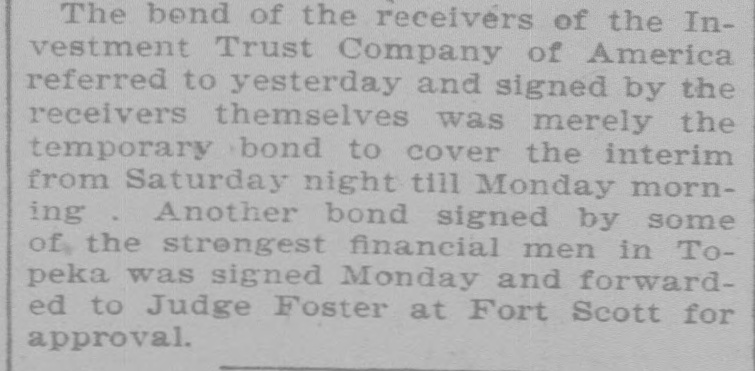
The bend of the receivers of the Investment Trust Company of America referred to yesterday and signed by the receivers themselves was merely the temporary bond to cover the interim from Saturday night till Monday morning - Another bond signed by some of the strengest financial men in Topeka was signed Monday and forwarded to Judge Foster at Fort Scott for approval.


Article from The Bryan Daily Eagle, May 6, 1896

Click image to open full size in new tab

Article Text

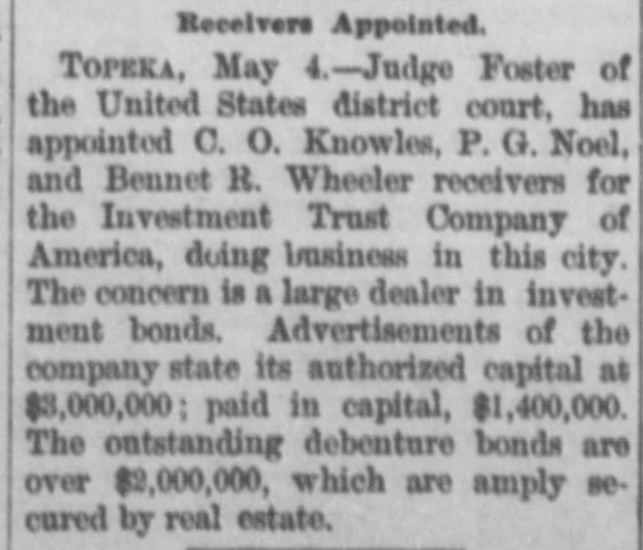
Receivers Appointed. TopeKa, May 4.-Judge Foster of the United States district court, has appointed C. O. Knowles, P. G. Noel, and Bennet R. Wheeler receivers for the Investment Trust Company of America, doing business in this city. The concern is a large dealer in investment bonds. Advertisements of the company state its authorized capital at $8,000,000; paid in capital, $1,400,000. The outstanding debenture bonds are over $2,000,000, which are amply secured by real estate.


Article from Abilene Weekly Reflector, May 7, 1896

Click image to open full size in new tab

Article Text

NEWS NOTES. At Platte City, Mo., Watt Reed, a wealthy farmer, was found guilty of murdering his neighbor, Newton Winn, and sentenced to 99 years in the penitentiary. At Topeka, Kan., receivers were appointed for the Investment Trust Co. of America. The outstanding debenture bonds are over $2,000,000 and said to be amply secured. At the democratic primary at Burton, Mo., James Dennis struck J. W. Dougherty with a brick. James Dougherty, a brother, fired at Dennis, killing him, but not until after Dennis had wounded both Doughertys. The prohibition state convention of Missouri will be held at Sedalia, May 7 and 8. The W. C. T. U. diamond medal contest will occur on the evening of the oth, and the State Junior Prohibition league will meet on the 7th. Indications point to a large attendance.


Article from The L'anse Sentinel, May 16, 1896

Click image to open full size in new tab

Article Text

# DOMESTIC. Fire destroyed the Adirondack hotel, Emerson bank, the music hall and several residences and stores at Warrensburg, N. Y., the total loss being $100,000. At Camden, N. J., Thomas J. Potter, a painter, and his wife were killed by the cars. Thomas Brennan, engineer, and Douglas Wilcox, conductor, were killed in a freight train wreck near Liberty, Neb. The Investment Trust company of America, doing business in Topeka, Kan., went into the hands of receivers with liabilities of $2,800,000. Three women delegates to the Methodist conference in Cleveland withdrew their claims in order to avoid strife. All the street car lines in Milwaukee were tied up by a strike of employes for an increase of wages. A five-story building was blown up in Cincinnati by an explosion and six persons were killed and many others were injured, some fatally. The visible supply of grain in the United States on the 4th was: Wheat, 55,519,000 bushels; corn, 11,319,000 bushels; oats, 8,240,000 bushels; rye, 4,414,000 bushels; barley, 1,139,000 bushels. The annual report of John S. Seymour, commissioner of patents, says that during the year 21,998 patents and designs were issued. The aggregate receipts were $1,245,247; expenditures, $1,084,496. The fire losses in the United States and Canada during the month of April were $12,010,600, about $1,000,000 more than the total for the month in 1895. An investigation of the trust funds collected by the state department in Washington shows a shortage of $30,000. The firm of E. & G. Friend & Co., wholesale dealers in leaf tobacco in New York, failed for $200,000. The dwelling of William Harris in Albermarle county, Va., was burned, and his four children were cremated. Rev. Prof. William Henry Green, D. D., celebrated the 50th anniversary of his appointment as instructor in the Princeton (N. J.) theological seminary. A broken rail on the Baltimore & Ohio road at New Haven, O., caused a freight wreck, fatally injuring two persons and seriously injuring a number of others. The German-American Title company of Louisville, Ky., failed for $225,000. Mrs. H. Eastby and her daughter Clara started from Spokane, Wash., to walk to New York. They live on a farm and hope to make enough money in the venture to lift a mortgage. "Cotton Head" Schmidt, the 17-year-old German boy, and Sam Foster, a negro, convicted of the murder of Bertram Atwater, the Chicago artist, in St. Louis on January 23, were sentenced to be hanged June 18. As the result of an explosion of a gasoline stove in a Brooklyn (N. Y.) tenement house Mrs. Rebecca Cohen and her two children and Mrs. Pastern were killed. An additional shortage of about $250,000 was said to have been found in the accounts of ex-City Attorney William C. Moreland, of Pittsburgh, Pa. A vast labor organization of housemaids was formed in New York, nearly every kitchen in the city being represented on the rolls of the union. The American Medical association met in 47th annual session at Atlanta, Ga. Crop reports from Illinois, Indiana, Michigan, Wisconsin and Iowa were favorable. The American Trading society of New York, with liabilities of $526,000, went into a receiver's hands. The women of Liberty Center, O., sent notice to the saloonkeepers to close their doors in ten days or their places would be blown up with dynamite. At Churchill Downs Ben Brush won the twenty-second Kentucky derby, completing the distance, 1ΒΌ miles, in 2:07ΒΌ.


Article from The Topeka State Journal, September 18, 1897

Click image to open full size in new tab

Article Text

# LOSES SIX HUNDRED. A Topeka Boy's Money and Clothing Burned At the Explosion at Blossburg, New Mexico. Narrow Escape From Death - The Starvation Wages Paid Miners- Lawlessness Breeding on Parsimony. The following interview with W. H. Caldwell, of 820 North Harrison street, gives the facts of the blowing up and burning of the store owned by the Blossburg, New Mexico, Mercantile Co., of which C. M. Higginson, is president, A. Douglas, manager, and E. Wilder, treasurer. This store is located at the coal mining town of Blossburg, six miles west of Raton, in Colfax county. Mr. Caldwell's son, Robert, went out there some two or more years ago, when the store was first established by C. J. Devlin, and has been there as an em- ploye ever since, mines having passed from the direct control of the Santa Fe Railroad company, to the control of the Maxwell Land Grant company, under the direct control of the above named officials. Being in constant communica- tion with his son, Mr Caldwell has been kept informed about matters at Bloss- burg, through letters written by him, and has known for some time that trou- ble was likely to occur there at any mo- ment. A Journal reporter visited Mr. Cald- well at the office of the receivers of the Investment Trust company, in the Real Estate building and drew from him the facts as gleaned by him from recent telegrams and letters, as follows: "Mr. Caldwell, will you give me some facts relative to the trouble at Bloss- burg, as briefly noted in last evening's Journal?" "Yes, sir, I can speak quite advisedly about it, and will read you some para- graphs from my son's letters. Some time last week Frank Woodard, fuel inspector for the Santa Fe, now residing at Trinidad, was here and visited my family. He told us that trouble was likely to occur at Blossburg, because the coal miners were very restless on account of short work and being stirred up by traveling agitators. He also re- counted to me the scene that occurred some time ago when one of these agi- tators came there and made a violent anarchistic speech. In a day or two after this we received a letter, dated September 5, 1897, from my son, Robert who is employed at the store, and I'll read you this paragraph. 'Mr. Wiggs expected to open the works about the 15th or 20th of this month (September), then the men will have work four or five days a week: if he doesn't we will have to defend ourselves and the company property againse mobs. The people are desper- ate. They are positively destitute and have not even enough to live on in a strike so they dare not strike. Some time ago an agitator came here and spoke in the street. His first words were: 'Save your pennies and buy a gun, pawn your shoes and socks and buy a gun-get a gun if you have to steal one!' Then he rounded out the most infamous anarchistic speech that was ever delivered anywhere, saying, among other things, 'Start with the President at Washington and kill him. Then come down to your senate and house of representatives and shoot them down! Don't let one escape! If you do you are cowards. When you have finished them come to Raton and kill every member of the Maxwell Land Grant company. Then come here to Blossburg, your home, where you see your wives and children starving be- cause the company store won't trust you for something for them to eat. Get some dynamite and blow up the store, but first take all you want out of it- it is yours, they stole it from you and if you haven't got sense enough to steal it back you ought to starve. Steal all you want from the company store then blow the thing into eternity and string every operator in it to the first pole you come to.' "That very night they learned for the first time, of the existence in Blossburg, of an anarchistic organization of over 100 members, calling themselves The Iron Brotherhood. They held a meeting