American National Bank (Denver, CO)

Episode Information

Episode UID
415901156
Episode Type
Suspension β†’ Reopening
Bank Type
national
Bank ID
41590 national
Charter Number
4159
Start Date
April 22, 1896
Location
Denver, Colorado (39.739, -104.985)

Metadata

Model
gpt-5-mini (chosen from majority vote of a three-model LLM ensemble)
Short Digest
33791e726657f469

Response Measures

None

Receivership Details

Date receivership started
1896-07-25
Date receivership terminated
1897-01-07
OCC cause of failure
Losses

Description

Closure attributed to internal dissensions and heavy withdrawals; later resumed business in Jan 1897.

Events (7)

1. November 13, 1889 Chartered
Source
historical_nic
2. April 22, 1896 Suspension
Cause
Bank Specific Adverse Info
Cause Details
Internal dissensions, steady shrinkage of deposits and inability to collect bills; withdrawals over $200,000 in days prior prompted directors to close.
Newspaper Excerpt
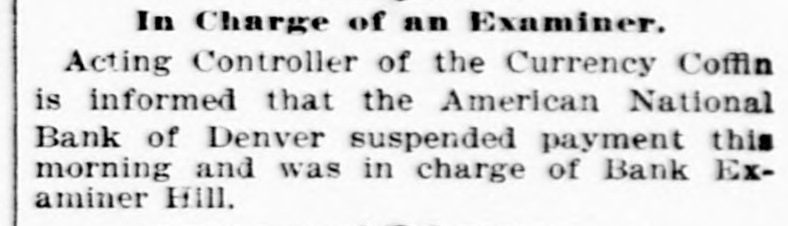
This bank has closed its doors by a vote of its directors, and it is in my hands as representative of the government.
Source
newspapers
3. May 2, 1896 Other
Newspaper Excerpt
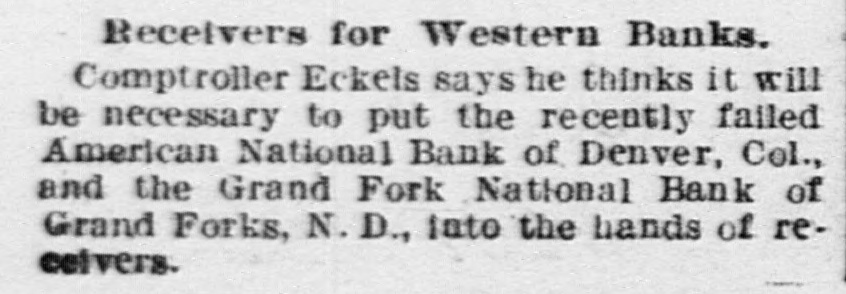
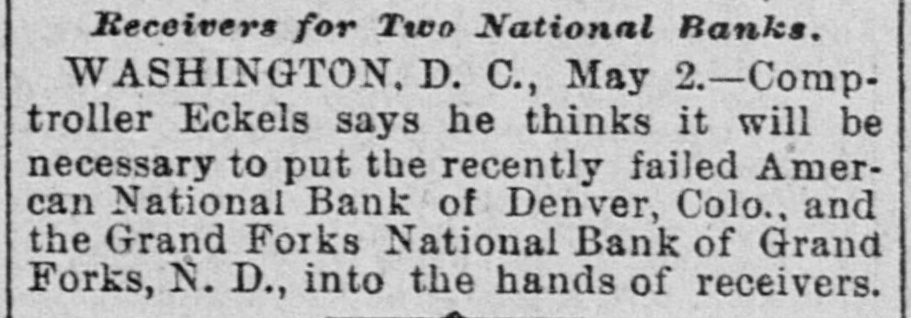
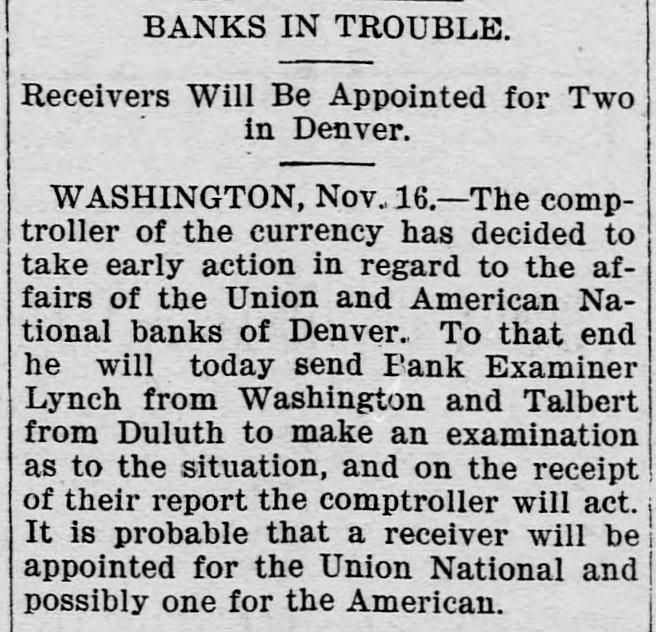
Comptroller Eckels says he thinks it will be necessary to put the recently failed American National Bank ... into the hands of receivers.
Source
newspapers
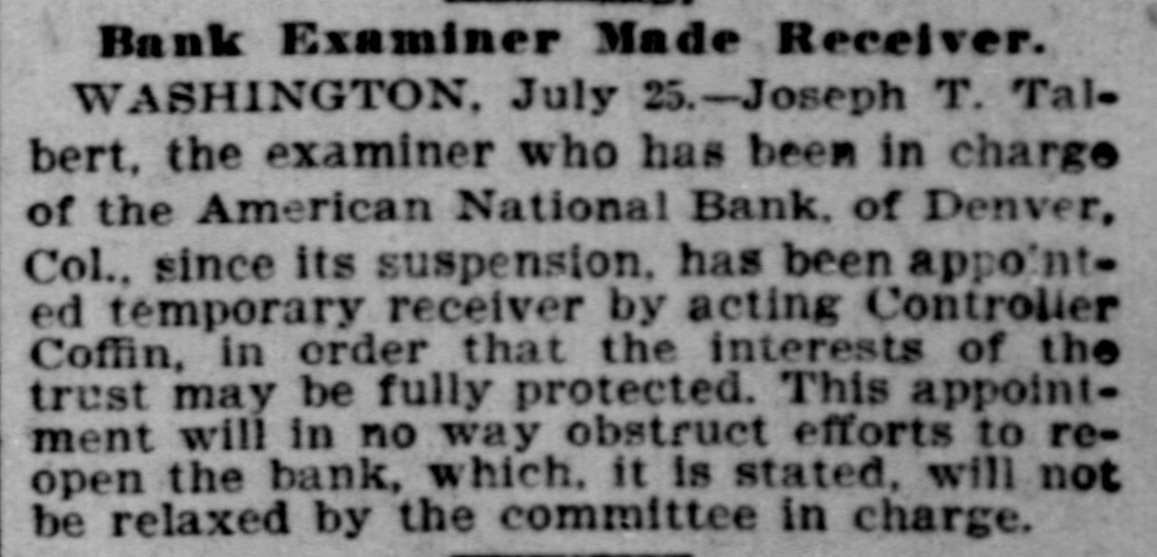
4. July 25, 1896 Receivership
Source
historical_nic
5. January 7, 1897 Reopening
Newspaper Excerpt
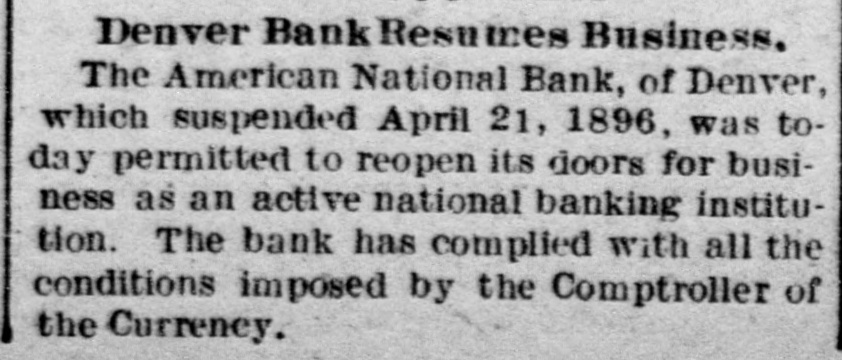
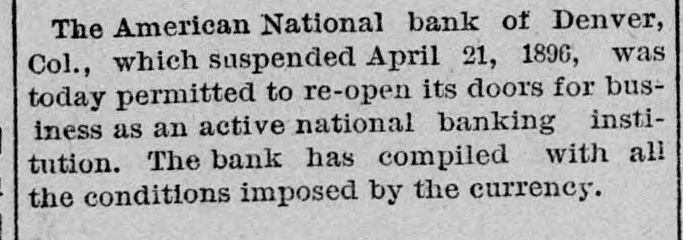
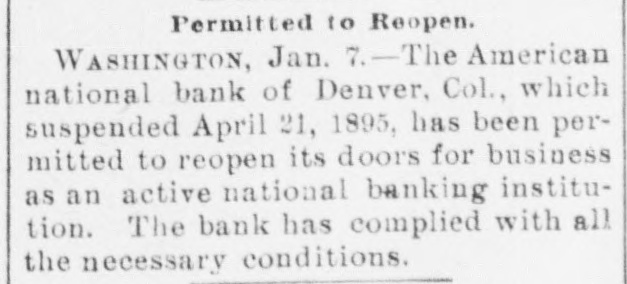
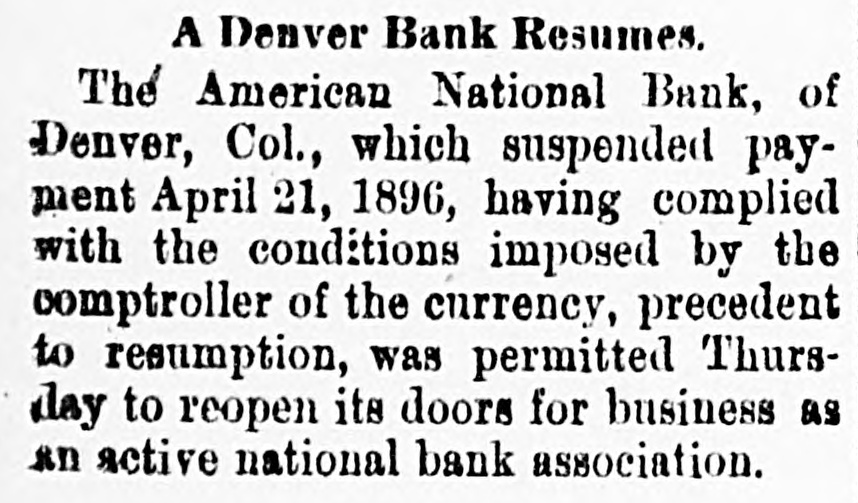
The American National bank of Denver ... has today been permitted to re-open its doors for business as a national banking association.
Source
newspapers
6. January 7, 1897 Restored To Solvency
Source
historical_nic
7. April 1, 1899 Voluntary Liquidation
Source
historical_nic

Newspaper Articles (24)

Article from Las Vegas Daily Optic, April 22, 1896

Click image to open full size in new tab

Article Text

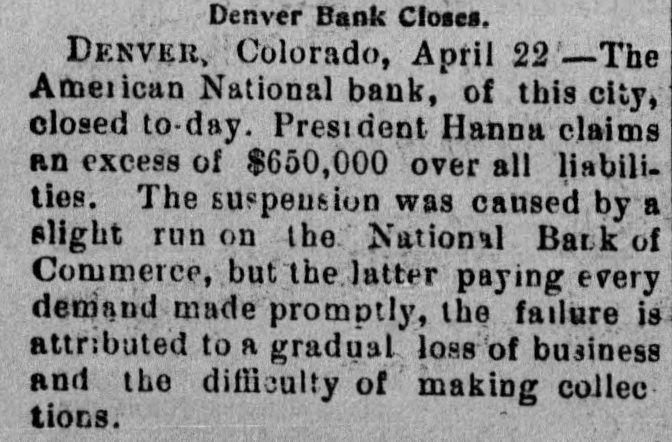
Denver Bank Closes. DENVER, Colorado, April 22 - The American National bank, of this city, closed to-day. President Hanna claims an excess of $650,000 over all liabilities. The suspension was caused by a slight run on the National Bank of Commerce, but the latter paying every demand made promptly, the failure is attributed to a gradual loss of business and the difficulty of making collec tions.


Article from The Wichita Daily Eagle, April 23, 1896

Click image to open full size in new tab

Article Text

GONE TO THE WALL American National Bank of Denver and Various Commercial Firms, Denver, Colo., April 22.-The American National bank failed to open this morning, the directors having decided to liquidate. The step was taken on account of internal dissension. It is said that all the depositors will be paid in full. Joseph T. Hill is in charge of the bank on /behalf of the government. The condition of the bank has been weak for a long time. At the last report, March 6, the total deposits were $1,451,291; loans and discounts $1,128,271; cash on hand $232,265; capital stock $500,000; surplus fund $150,000. The assets amount to. $2,245,175 and it is claimed that there will be but little trouble experienced in realing on them. There was a run on the Bank of Commerce which ended about noon. All demands were promptly met. At the other banks the deposits exceeded the withdrawals. President John R.Hanna of the American National bank in a published statement over his signature says: "The shrinkage of deposits and but comparatively few new customers to replenish the loss and the inability to collect our bills resulted in our inability to continue our business. I believe the depositors will eventually receive the entire amount due them. We have $650,000 excess of assets (exceeding our capital) over our liabilities. The stockholders also may be assessed $500,000 more, if necessary, to pay the depositors. With this surplus I cannot see any loss to them." D. H. Moffat, president of the Flest National park said that the failure was a weeding-out process which would not have any disastrous effects. The Denver clearing house offered to advance $300,000 to tide the bank over the crisis in its affairs provided the leading directors and stockholders would become responsible for the sum by signing the necessary papers. It is said that none of them except Thomas M. Patterson would agree to this. It was then decided to close the institution. John R. Hanna, president, and Howard, cashier, of the American National bank, were arrested late this afternoon on warrants from Justice Chapman's court charging them with receiving deposists after the bank was known to be in a failing condition. Both were released on bonds. Syracuse, N. Y., April 22.-T. C. & J. C. Miller manufacturers of knit goods at Baldwinsville, have made a general assignment. The firm declines to give the amount of assets and liabilities. Preferences are made for $66,000. Cincinnati, O., April 22.-The piano firm of Crawford, Ebersols & Smith assigned today. Their liabilities are estimated at $800,000; assets $1,000,000.


Article from The Seattle Post-Intelligencer, April 23, 1896

Click image to open full size in new tab

Article Text

Business Failures. Denver. April 22.-The American National bank failed to open this morning. The following notice was posted: "This its bank has closed its doors by vote of directors, and is in my hands, as representative of the government, Zeph T. Hill." The failure does not come as a surprise or indicate any lack of confidence in the genΓ©ral business situation. The condition of the bank has been weak for a long time, because of internal dissensions. The retirement from the directorate and sale of stock by several wealthy men materially reduced the business of the bank. At the last report. made at the close of business March 6. the total deposits were $1,471,951; loans and discounts, $1,128,271; cash on hand, $232,265. The capital stock is $500,000, surplus $150,000. The assets amount to $2,245,173. and it is claimed there will be little trouble realizing on them. The following statement was taken from the books of the American National bank this morning: Resources, cash and exchange, $70,300; bills receivable, $1,078,000; stocks and securities, $265,435: real estate, $136,590: excess on circulation, $22,000; total, Liabilities: Individual deposits, demand deposits, $1,572,325. $530,712; $28,698; banks, time $97,024; deposits, $66,297; due to other A borrowed money, $142,500: total, $805,231. comparison of this statement with that published in March shows that the bank's deposits and reserve have declined very rapidly. Over $200,000 was withdrawn on Monday and Tuesday of this week, and, there being only $70,000 left, the directors decided that the best thing to do was to close the bank. Beside the resources given above there are notes for $500,000 set aside for the recent reduction of the capital stock from $1,000,000 to $500,000 and a fifth interest in the Strong mine at Victor. The president of the bank is John R. Hanna. The directorate consists of some of the leading men of Denver, including File P. Ernest, William and Moritz Barth. Mitchell Benedict, George W. Ballantine and T. J. O'Donnell. In consequence of the failure a run has been started on the National Bank of Commerce. John R. Hanna, president, and Howard Evans, cashier of the American National bank. were arrested late this afternoon on warrants sworn out in Justice Chapman's court, charging them with receiving deposits after the bank was known to be in a failing condition. Both were released on bonds. The run on the National Bank of Commerce ended about noon. All the demands were promptly met. At the other banks the deposits exceeded the withdrawals. President John R. Hanna, of the American National bank. in a published statement over his signature, said: "The shrinkage of deposits and but comparatively few new customers to replenish the loss and the inability to collect our bills, resulted in our inability to continue our business. I believe the depositors will eventually receive the entire amount due them. We have $350,000 in excess of assets exceeding OLT capital over our liabilities. The stockholders also may be assessed $500,000 more if necessary to pay the deposKors. With thus surplus I cannot see any loss to them." D. P. Moffat, president of the First National bank. said the failure was a weeding-out process which would not have any serious effect. The Denver clearing house offered to advance $300,000 to tide the bank over the crisis in its affairs, provided the leading directors and stockholders would become responsible for the sum by signing the necessary papers. It is said that none of them except Thomas Patterson would agree to this. It was then decided to close the institution. Chicago, April 22. -The Mason & Davis Company, manufacturers of stoves and ranges, failed today. and made John J. Whirl assignee. The assets are $73,000, liabilities $107,000. Syracuse, N. Y., April 22--T. C. & J. C. Miller. manufacturers of knit goods at Baldwinsville, have shut down their works and made a general assignment to Thomas H. Benton Crane and Wills Wendell The mill gave employment to 200 people. Preferences are made for $66,000 exclusive of interest and pay of employes. Cincinnati, April 22-The firm of Crawford. Eversole & Smith has assigned to D. D. Woodmansee. The liabilities are $800,000. assets $1,000,000. The firm succeeded Smith & Nixon, which was established in 1828.


Article from Birmingham State Herald, April 23, 1896

Click image to open full size in new tab

Article Text

BIG BANK FAILURE. A Run Was Made on Another Bank, Which Stood the Strain. Denver, Col., April 22.-The American National bank failed to open its doors this morning, a notice being posted on the window that "By order of the directors the bank is in the hands of the government." Bank Examiner Hillo took charge. The event caused much excitement, and a run was at once precipitated on the National Bank of Commerce, a crowd of clamorous depositors gathering soon after 10 o'clock. The bank stood the drain, and at noon had paid every check presented. It is understood that the associated banks will aid the National Bank of Commerce should it be necessary. The failure of the American was not unexpected in banking circles. One by one its leading financial backers have been dropping out, and financiers knew that the failure was inevitable. At the meeting of the associated banks, held in the First National parlors last night, proffers to assist the failed concern were made provided the directors would do their part. This being refused, the American closed. The failure and the run caused intense excitement throughout the city, and large crowds gathered about the two banking houses involved. As the Bank of Commerce continued to pay off steadily, the excitement began to subside. Nothing unusual occurred at the other banks. At 12:30 o'clock the run on the Bank of Commerce ended, after two-thirds of the depositors had withdrawn their funds. A public meeting has been called by the angry depositors of the American National to protest against the alleged rottenness of the institution.


Article from The Laramie Republican, April 23, 1896

Click image to open full size in new tab

Article Text

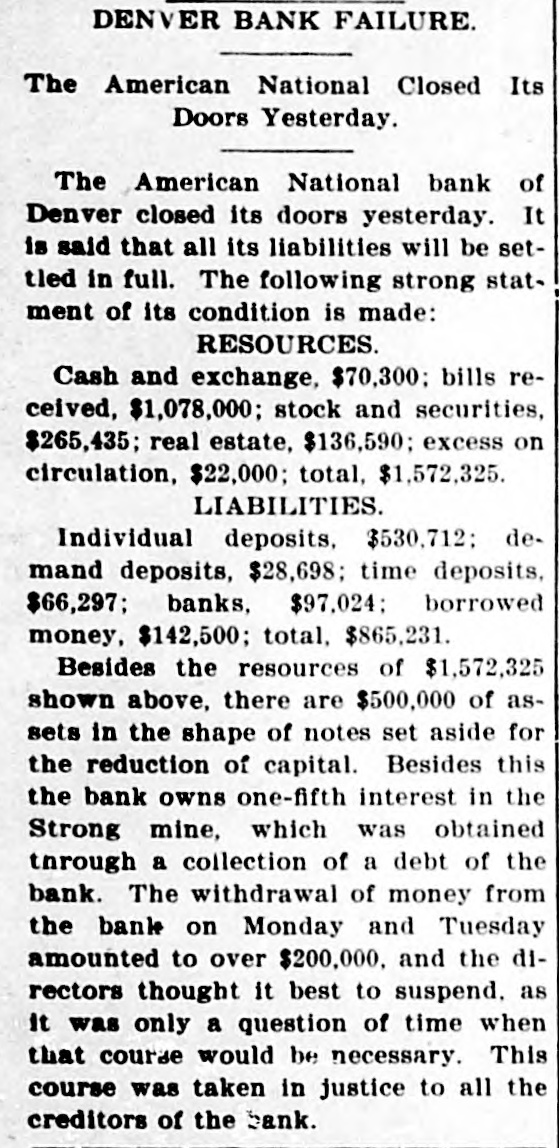
DENVER BANK FAILURE. The American National Closed Its Doors Yesterday. The American National bank of Denver closed its doors yesterday. It is said that all its liabilities will be settled in full. The following strong statment of its condition is made: RESOURCES. Cash and exchange, $70,300: bills received, $1,078,000; stock and securities, $265,435; real estate, $136,590; excess on circulation, $22,000; total, $1,572,325. LIABILITIES. Individual deposits, $530,712: demand deposits, $28,698; time deposits, $66,297; banks, $97,024: borrowed money, $142,500; total, $865,231. Besides the resources of $1,572,325 shown above, there are $500,000 of assets in the shape of notes set aside for the reduction of capital. Besides this the bank owns one-fifth interest in the Strong mine, which was obtained through a collection of a debt of the bank. The withdrawal of money from the bank on Monday and Tuesday amounted to over $200,000. and the directors thought it best to suspend. as It was only a question of time when that course would be necessary. This course was taken in justice to all the creditors of the bank.


Article from The Herald, April 23, 1896

Click image to open full size in new tab

Article Text

CLOSED ITS DOORS The American National Bank of Denver Will Pay Depositors DENVER, April 22.-The American National bank failed to open this morning. The following notice was posted: "This bank has closed its dors by a vote of its directors, and is in my hands as a representative of the government." This is signed by Zeph T. Hill. The failure does not come as' a surprise nor indicate any lack of confidence in the general business situation. The condition of the bank has been weak for a long time, because of internal dissensions. The failure started a run on the Bank of Commerce, which ended about noon. All demands were promptly met. At the other banks the deposits exceeded the withdrawals. President John R. Hanna of the American National bank, in a published statement over his signature, says: The shrinkage of deposits and but few new customers to replenish the losses, and the inability to collect our bills resulted in our inability to continue our business. I believe the depositors will eventually receive the entire amount due them. We have $350,000 excess of assets(exceeding our capital) over our liabilities. The stockholders may be assessed $500,000 more, if necessary to pay the depositors. With this surplus I cannot see any loss to them. John R. Hanna, president, and Howard Evans, cashier, of the American National bank, were arrested late this afternoon on warrants sworn in Justice Chapman's court charging them with receiving deposits after the bank was known to be in a failing condition. Both were released on bonds.


Article from Richmond Dispatch, April 23, 1896

Click image to open full size in new tab

Article Text

BANK RUN IN DENVER. The American National Fails-Bank of Commerce Suffers. DENVER, COL., April 22.-The American National Bank failed to open its doors this morning, a notice being posted in the window that "By order of the directors the bank is in the hands of the government." Bank-Examiner Hillo took charge. The event caused much excitement, and a run was at once precipitated on the National Bank of Commerce, a crowd of clamorous depositors gathering coon after 10 o'clock. The bank stood the drain, and at noon had paid every check presented. It is understood that the Associated Banks will aid the Bank of Commerce, should it be necessary. The failure of the American was not unexpected in banking circles. One by one its leading financial backers have been dropping out, and financiers knew that failure was inevitable. At a meeting of the Associated Banks, held in the First National parlors last night, proffers to assist the failed concern were made, if the directors would do their part. This being refused, the American closed. The failure and the run caused intense excitement throughout the city, and crowds gathered about the two bankinghouses involved. As the Bank of Commerce continued to pay off steadily, however, the excitement began to subside. At 12:30 the run on the Bank of Commerce had ended, after two thirds of the depositors had withdrawn their funds. A public meeting has been called by the angry depositors of the American National for to-morrow, to protest. against the alleged rottenness of the institution.


Article from The Salt Lake Herald, April 23, 1896

Click image to open full size in new tab

Article Text

DENVER, April 22.-The American National bank failed to open this morning. The following circular was posted: "This bank has closed its doors by a vote of its directors, and it is in my hands as representative of the government. ZEPH P. HILL." The failure does not come as a surprise, nor does it indicate any lack of confidence in the general business situation. The condition of the bank has been weak a long time because of internal dissensions. The retirement from the directory and the sale of the stock of several wealthy men materially reduced the business of the bank. At the last report made at the close of business March 6, the total deposits were $1,471,951; loans and discounts, $1,126,251; cash on hand, $232,265; capital stock, $500,000; surplus, $150,000. The assets amount to $2,245,173 and it is claimed there will be but little trouble in realizing on them. The following statement was taken from the books of the American National bank this morning: Resources, cash and exchange, $70,300; bills receivable, $1,078,000; stocks and securities, $265,435; real estate, $136,590; excess on circulation, $22,000; total $1,572,325. Liabilities-Individual deposits, $530,712; demand deposits, $49,719; time deposits, $66,275; due other banks, $97,025; (borrowed money, $142,000; total, $886,231. A compilation of this statement with that furnished in March shows that the bank's deposits and reserve declined very rapidly. Over $200,000 were withdrawn on Monday and Tuesday of this week, and there being only $70,000 left, the directors decided that the best thing to do was to close the bank. Besides the resources above there are notes for $500,000 set aside for the recent reduction of the capital stock from a million to $500,000, and a fifth interest in a strong mine at Victor. The president of the bank is John R. Hanna. The directorate consists of some of the leading men of Denver, including Fine P. Ernest, William and Moritz Barth, Mitchell Benedict, George W. Ballantine, T. J. O'Donnell. In consequence of the failure a run has been started on the National Bank of Commerce. John R. Hanna, president, and Howard Evans, cashier of the American National bank, were arrested late this afternoon on warrants from Justice Chapman's court charging them with receiving deposits after the bank was known to be in a failing condition. Both were released on bonds. The run on the Bank of Commerce ended about noon. All demands were promptly met. At the other banks the deposits exceeded the withdrawals. President John R. Hanna of the American National bank, in a published statement over his signature, says: "The shrinkage of deposits and but comparative few new customers to replenish the loss, and the inability to collect our bills, resulted in our inability to continue our business. I believe the depositors will eventually receive the entire amount due them. We have $650,000 excess of assets (exceeding our capital)) over our liabilities. The stockholders also anay be assessed $500,000 more, if necessary to pay the depositors. With this surplus I cannot see any loss to them." D. H. Moffat, president of the First National bank, said the failure was a weeding out process which would not have any disastrous effects. The Denver clearing house offered to advance $300,000 to tide the bank over the crisis in its affairs provided the leading directors and stockholders would become responsible for the sum by signing the necessary pa ers. It is said that none of them except Thomas M. Patterson would agree to this. It was then decided to close the institution.


Article from Morning Appeal, April 24, 1896

Click image to open full size in new tab

Article Text

CONDENSED ITEMS. The American National Bank at Denver failed yesterday, and the failure was folowed by a run on the National Bank of Commerce. Christian Anderson of Connecticut was killed by lightening as he sat at the dinner table with fourteen relatives. No one else was hurt Bootn Tucker says that there have been fiew desertion from the Salvation Army in America, and several of the deserters have returned to the army. An Iowa farmer experimenting with the Roentgen photography claims to have accidntally discovered rays that will convert base metals into gold. The Senate Committee on Claims has reported in favor of paying $330,150 to the heirs of John Roach in connection with the building of the Chicago, Boston and Atlanta. A nephew of Rev. Dr. Parkhurst was killed in Texas by the premature explosion of a shell while a salute was being fired by the United States artilery, in which he was a private, The Hungarian police are ivestigating the circumstances of the death of Baron de Hirsch, there being rumors that it was of a suspicious character. These rumors, however, are generally discredited. When the United authorities finally decided that Chin Yuen Sing was not entitied to live in America, and must be sent back to China, it was found that Chin was dead and buried. But the authorities are not satisfied as to the identity of the dead man, and have a suspicion that Chin's body does not rest in the grave.


Article from Deseret Evening News, April 24, 1896

Click image to open full size in new tab

Article Text

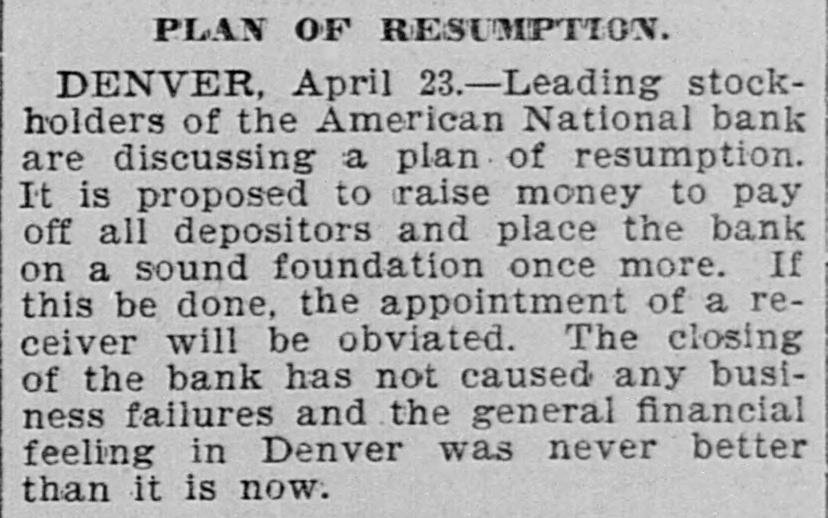
American National Bank. DENVER, April 23.-Leading stock. holderso: 01 the American National I tank are discussing a pan of resumption. It is proposed to ra:se money to py off all depositors and place the bank on is sound foundation once more. If this be cone, the appointment of & receiver will be obviated. The closing of the bank has not caused any business fax 1. ures, and the general flosocial feeling Ifi Denver was never better than It is now.


Article from The Topeka State Journal, April 24, 1896

Click image to open full size in new tab

Article Text

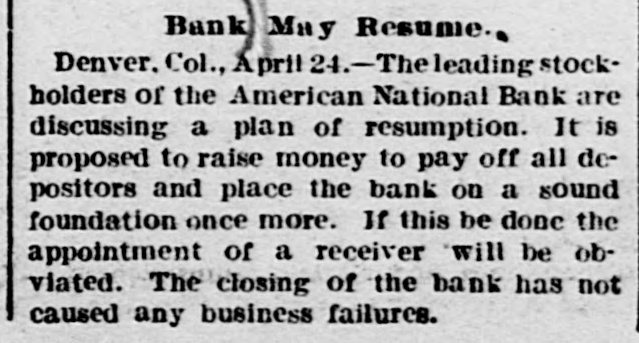
The Denver Bank May Reopen. Denver, April 24.-Leading stockholders of the American National bank are discussing a plan of resumption. It is proposed to raise money to pay off all depositors and place the bank on a sound foundation once more. If this is done, the appointment of a receiver will be obviated. The closing of the bank has not caused any business failures and the general financial feeling in Denver was never better than it is now.


Article from Great Falls Weekly Tribune, April 24, 1896

Click image to open full size in new tab

Article Text

Will Pay in Full. DENVER, April 22.-The American National bank failed to open this morning. Notice was posted on the doors that the directors had decided to liquidate. The step was taken on account of internal dissension. It is said all depositors will be paid in full. Seth P. Hill is in charge of the bank on behalf of the government. At the last report, made at the close of business March 2, the total deposits were $1,471,951; loans and discounts, $1,128,271; cash on hand, $232,285. The capital stock of the bank is $150,000. The assets amount to $2,245,173, and it is claimed but little trouble will be experienced in realizing on them. There was a run on the Bank of Commerce, but it ended about noon, as all demands were promptly met. At the other banks, the deposits exceeded the withdrawals. President John R. Hanna of the American National bank, in a published statement, says: "The shrinkage of deposits and but comparatively few customers to replenish the loss, and inability to collect our bills, resulted in our inability to continue. I believe the depositore will eventually receive the entire amount due them. We have $650,000 excess of assets (excluding our capital) over our liabilities. Stockholders also may be assessed $500,000 or more, if necessary, to pay depositors. With this surplus, I cannot see any loss to them." John R. Hanna. president, and Howard Evans, cashier of the American National bank, were arrested late thisafternoon on a warrant from Justice Chapman's conrt, charging them with receiving deposits when the bank was known to be in a failing condition. Both were released on bonds.


Article from The Houston Daily Post, April 26, 1896

Click image to open full size in new tab

Article Text

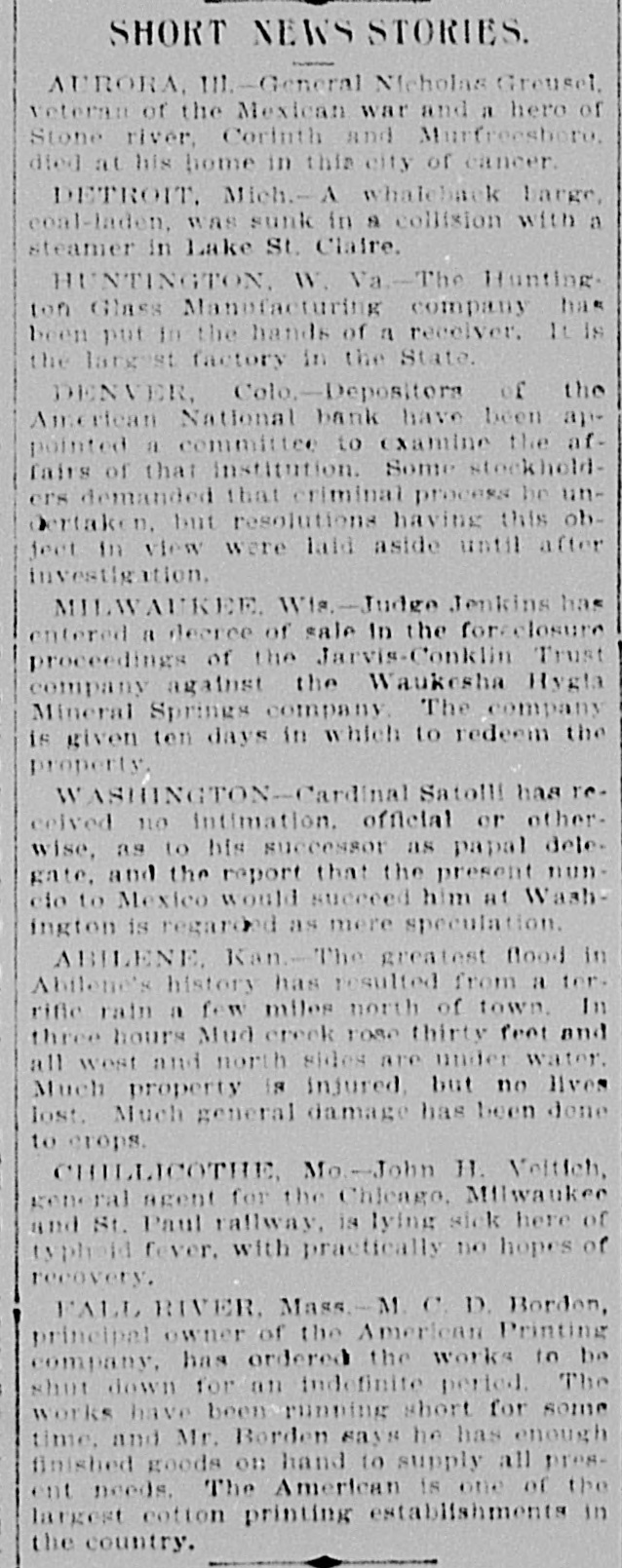
SHORT NEWS STORIES. AURORA, Ill-General Meholas Greusel, veteran of the Mexican war and a hero of Stone river, Corinth and Murfreesboro, died at his home in this city of cancer. DETROIT. Mich.-A whaleback barge, coal-laden, was sunk in a collision with a steamer in Lake St. Claire. HUNTINGTON, W. Va.-The Hunting ton Glass Manufacturing company has been put In the hands of a receiver. It is the largest factory in the State. DENVER, Colo.-Depositors of the American National bank have been appointed a committee to examine the affairs of that institution. Some stockholders demanded that criminal process be unGertaken, but resolutions having this ohjeet in view were laid aside until after investigation. MILWAUKEE. Wis.-Judge Jenkins has entered a decree of sale In the forcelosure proceedings of the Conklin Trust company against the Waukesha Hygla Mineral Springs company. The company is given ten days in which to redeem the property. WASHINGTON-Cardinal Satolli has recelved no intimation. official or otherwise, as to his successor as papal detegate, and the report that the present nuncio to Mexico would succeed him at Washington is regarded as mere speculation. ABILENE, Kan-The greatest flood in Abilene's history has resulted from a terrifle rain a few miles north of town. In three hours Mud creek rose thirty feet and all west and north sides are under water. Much property is injured, but no lives lost, Much general damage has been done to crops. CHILLICOTHE, Mo.-John H. Veitich, general agent for the Chicago, Milwaukee and St. Paul rallway, is lying sick here of typhoid fever, with practically no hopes of recovery. FALL RIVER, Mass.-M. C. D. Bordon, principal owner of the American Printing company, has ordered the works in be shut down for an indefinite period. The works have been running short for some time, and Mr. Borden says he has enough finished goods on hand to supply all present needs. The American is one of the largest cotton printing establishments in the


Article from The Dakota Chief, April 30, 1896

Click image to open full size in new tab

Article Text

Denver Bank Closes. The doors of the American National Bank at Denver closed Wednesday. A notice was posted that the directors had decided to liquidate on account of internal dissensions. It is said the depositors will be paid in full. The statement of the condition at the time of closing the doors shows: Resources, $1,572,325; liabilities, $865,231. In consequence of the failure a run was begun on the National Bank of Commerce.


Article from The San Francisco Call, May 3, 1896

Click image to open full size in new tab

Article Text

Receivers for Two National Banks. WASHINGTON, D. C., May 2.-Comptroller Eckels says he thinks it will be necessary to put the recently failed Amercan National Bank of Denver, Colo., and the Grand Forks National Bank of Grand Forks, N. D., into the hands of receivers.


Article from The Madisonian, May 9, 1896

Click image to open full size in new tab

Article Text

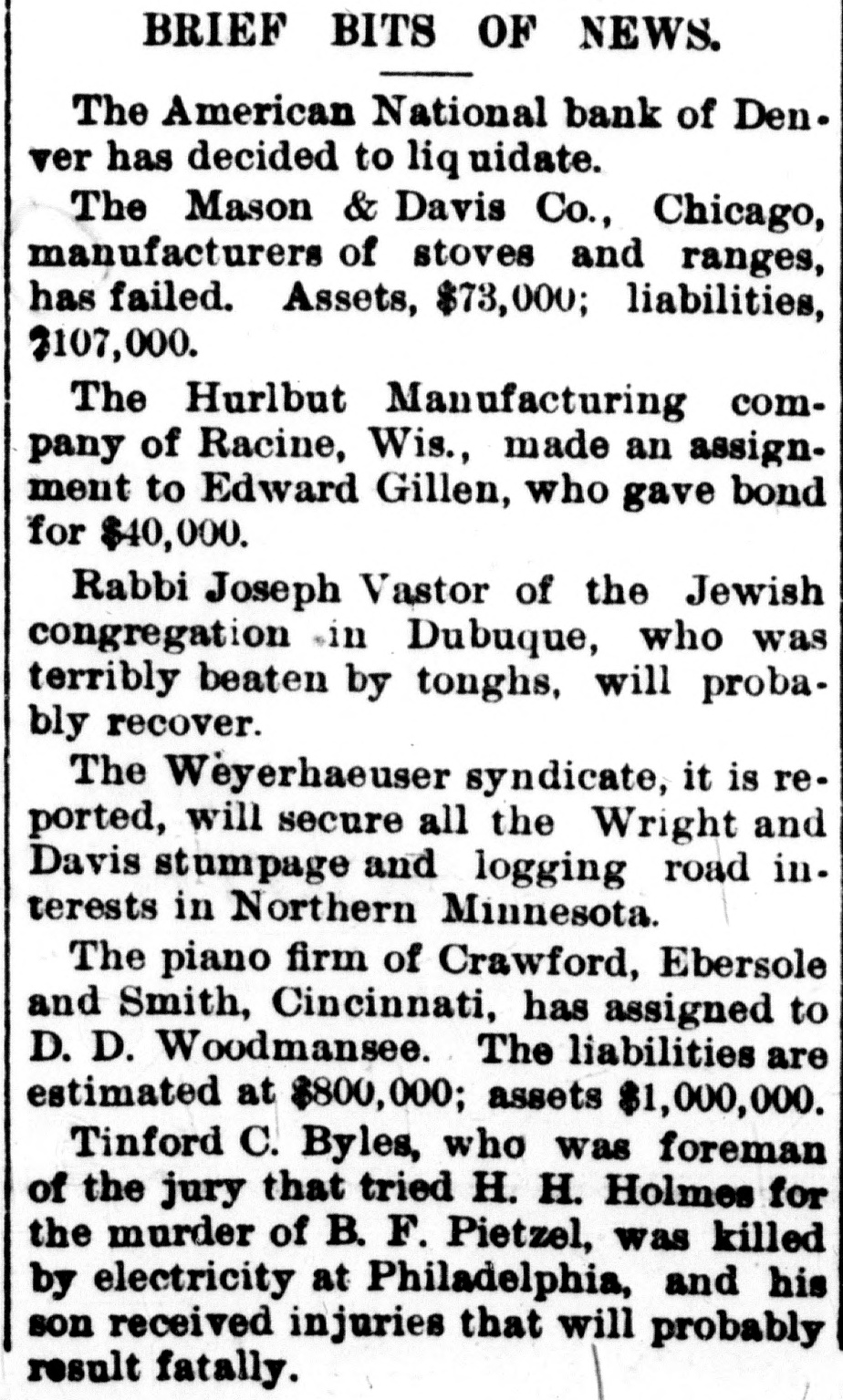
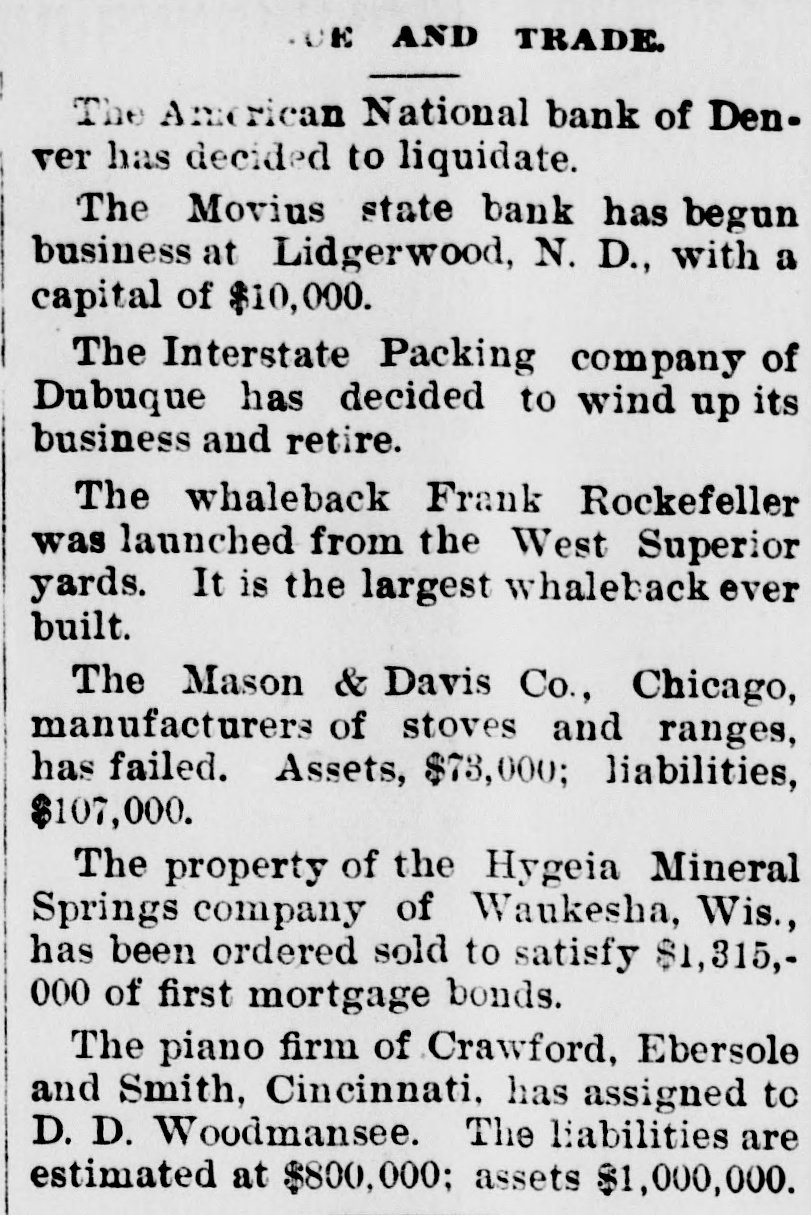
OK AND TRADE. The American National bank of Denver has decided to liquidate. The Movius state bank has begun business at Lidgerwood, N. D., with a capital of $10,000. The Interstate Packing company of Dubuque has decided to wind up its business and retire. The whaleback Frank Rockefeller was launched from the West Superior yards. It is the largest whaleback ever built. The Mason & Davis Co., Chicago, manufacturers of stoves and ranges, has failed. Assets, $73,000; liabilities, $107,000. The property of the Hygeia Mineral Springs company of Waukesha, Wis., has been ordered sold to satisfy $1,315,000 of first mortgage bonds. The piano firm of Crawford, Ebersole and Smith, Cincinnati, has assigned to D. D. Woodmansee. The liabilities are estimated at $800,000; assets $1,000,000.


Article from The Record-Union, May 13, 1896

Click image to open full size in new tab

Article Text

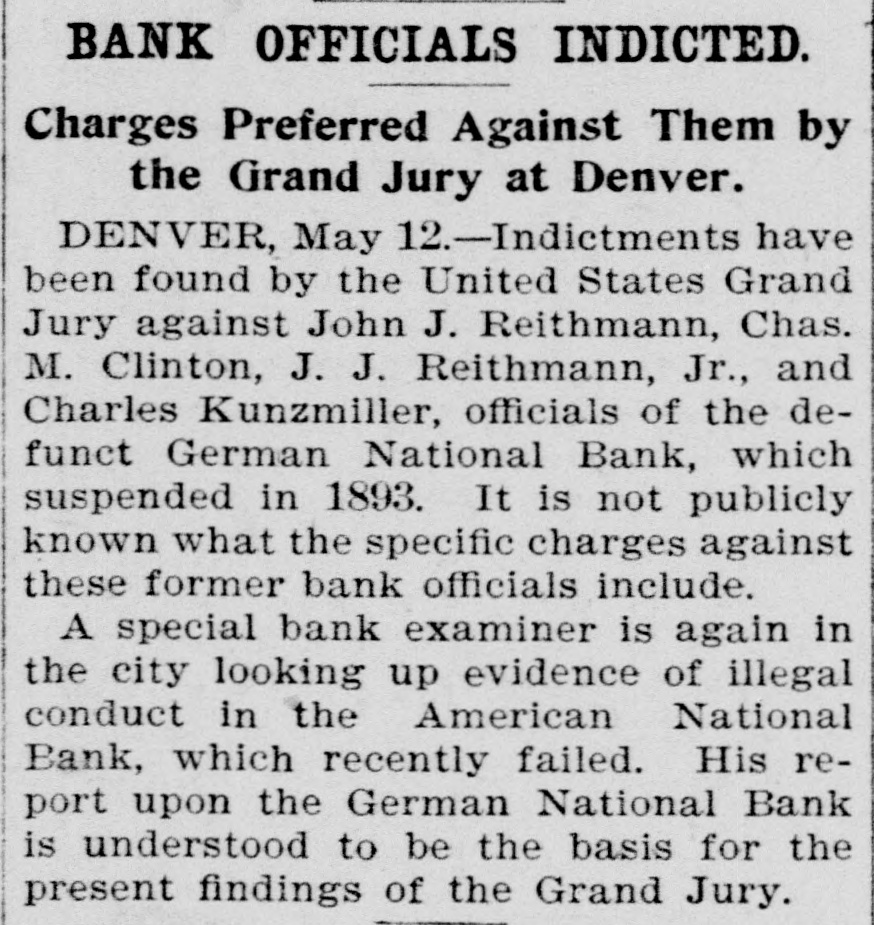
BANK OFFICIALS INDICTED. Charges Preferred Against Them by the Grand Jury at Denver. DENVER, May 12.-Indictments have been found by the United States Grand Jury against John J. Reithmann, Chas. M. Clinton, J. J. Reithmann, Jr., and Charles Kunzmiller, officials of the defunct German National Bank, which suspended in 1893. It is not publicly known what the specific charges against these former bank officials include. A special bank examiner is again in the city looking up evidence of illegal conduct in the American National Bank, which recently failed. His report upon the German National Bank is understood to be the basis for the present findings of the Grand Jury.


Article from The Evening Times, May 14, 1896

Click image to open full size in new tab

Article Text

BANK OFFICIALS INDICTED. Accused of Receiving Deposits When the Institution Was Insolvent. Denver, Colo., May 14.-A majority of the suspended American National Bank depositors have agreed to accept certificates bearing 4 per cent interest, and the probabilities are that the bank will soon resume business. Ten per cent of the deposits will be paid in cash when the bank resumes. and the remainder in six equal installments half yearly. The federal grand jury has indicted four officials of the defunct German National Bank on the charge of receiving deposits when they knew the bank was insolvent. Thoseindicted are John J. Riethmann, father and son; Charles McClinton and Charles Kunzmiller, jr.


Article from The Daily Morning Journal and Courier, May 15, 1896

Click image to open full size in new tab

Article Text

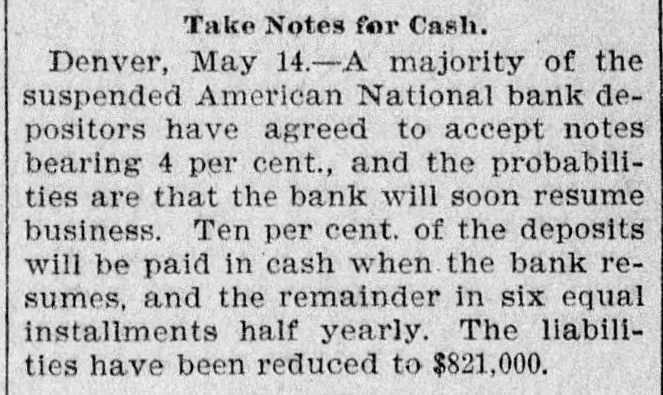
Take Notes for Cash. Denver, May 14.-A majority of the suspended American National bank depositors have agreed to accept notes bearing 4 per cent., and the probabilities are that the bank will soon resume business. Ten per cent. of the deposits will be paid in cash when the bank resumes, and the remainder in six equal installments half yearly. The liabilities have been reduced to $821,000.


Article from The San Francisco Call, May 20, 1896

Click image to open full size in new tab

Article Text

BANKING LAWS VIOLATED, Indictments Caused by a Loan of More Than Ten Per Cent of the Capital Stock. 0. E. Miller's Mixed State of Finances Leads Up to What He Calls Spitework. DENVER, CoLo., May 19.-0. E. Miller of Chicago, president of the Hernia Treatment Company, has been indicted by the Grand Jury on the charge of embezzling $125,000 of the Commercial National Bank's funds. Cbarles H. Dow, who was president of the bank, was also indicted on the charge of complicity with Miller to defraud the depositors, and with having violated the banking law by loaning Miller $145,000, which was more than 10 per cent of the bank's capital stock. Miller was a prominent man in Denver prior to the panic of 1893. His indebtedness to the National banks of the city is said to have aggregated $345,000; $192,000 was obtained from the Commercial and German banks, and the remainder from institutions which survived the panic. The American National, which suspended recently. is said to be a creditor of Miller. The receivers of the German and Commercial have been pressing Miller for a settlement, but it is alleged he put them off with promises which were not kept. Instead, it is said, he bonded his company in Chicago for $325,000, and gave none of the banks a cent of the proceeds. It was on the receipt of this news that the receivers of the banks withdrew objection to Miller's prosecution. CHICAGO, ILL., May 19.-0. E. Miller, upon being advised that an indictment had been found against him by the Federal grand jury at Denver on a charge of embezzlement, surrendered to United States Marshal Arnold before the deputy who had been sent to his office in the Masonic Temple could lay hands on him. Mr. Miller said he would go to Denver gladly, and intimated that the indictment was expected by him. He added: "In another month the statute of limitations would have prevented my prosecution. It is all spitework. This persecution of me is not the work of the depositors nor of the receiver, because I settled with them in January, 1895. The total of my indebtedness to the banks of Denver was $200,000 and I borrowed $30,000 from the Commercial-not $125,000."


Article from The Wichita Daily Eagle, January 8, 1897

Click image to open full size in new tab

Article Text

GOT A STRAIGHT TIP BANKS THAT STOOD FROM UNDER A GREAT FINANCIAL SMASH. Somebody. Nobody Will Tell Who, Told Certain Favored Banks What Was Going to Happen to the National Bank of IIIIneis, Giving Them an Opportunity to Withdraw Their Deposits Which They Were Swift to Improve-Eckles Names Bank Receivers-American National, of Denver Re-opens-Day's List of Failures Chicago, Jan. 7.-It has been ascertained positively that several banks which had deposits in the defunct Natioral Bank of Illinois were warned of what was to come and as a result their money was withdrawn just in time to save them from being carried down with the wreck. Henry W. Austin, president of the Oak Park State bank, made the statement today that he had received information of the dangerous condition of the Illinois National during the week previous to the failure. Acting upon this tip, Mr. Austin says, he immediately took out of the bank the money his bank had there. Five thousand dollars was withdrawn Friday previous to the Monday in December when the National Bank of Illinois failed to open its doors for business. The following day, Saturday, $45,000 more, which constituted the balance due the Oak Park State bank by the National Bank of Illinois was taken out. Hinckley and Tilden, proprietors of the West Side bank, were also warned In time to withdraw their cash from the tottering institution. Mr. Austin refused positively to state who his informant was. He said, however, that he was not a director or official of the Illinois National. BANK RECEIVERS NAMED. Washington, Jan. 7.-The comptroller of the currency has appointed Bank Examiner Blancing temporary receiver of the First National Bank of Sioux City, and Examiner Anheir receiver of the Citizens National bank, of Fargo, N. D. Both of these appointments are temporary, pending resumption. Bank Examiner Turtilot has been appointed rereiver of the Second National, of Grand Forks, N. D. The comptroller has received information that the Commercial National bank of Roanoke, W. Va., which suspended some time ago, has raised sufficient funds with which to go into liquidation without the intervention of a receiver. DENVER BANK RE-OPENS. Washington, Jan. 7.-The American National bank of Denver, Colo., which suspended payment April 21, 1896, having complied with the conditions imposed by the comptroller of the currency precedent to resumption, has today been permitted to re-open its doors for business as a national banking association. Denver, Colo., Jan. 7.-The American National bank re-opened today under its old management with $600,000 cash on hand to meet liabilities and conduct business. There remains but $200,000 of liabilities to be provided for out of all other assets of the bank. DAY'S LIST OF FAILURES. New York, Jan. 7.-J. J. Johnston & Co., a corporation, dealers in diamonds, jewelry and silverware, today assigned to John R. Keim, and Arthur H. Masten. The liabilities are reported to be $219,000 and assets about $201,000. St. Paul, Minn., Jan. 7.-A Preston, Minn., dispatch to the Dispatch says: The Bank of Canton, at Canton, and the Citizens bank of Lanesboro, both owned and operated by Field, Kelsey & Co., suspended business yesterday. Lancaster, Pa., Jan. 7.-Schroder, Smith & Schroder's ready-mixed paint works were entirely destroyed by fire today. The origin of the fire is unknown. The members of the firm decline to make an estimate of the loss, but it is thought to be fully covered by insurance.


Article from Shoshone Journal, January 15, 1897

Click image to open full size in new tab

Article Text

The Mississippi river is receding. Actress Marston Leigh is dead. Senator Palmer is threatened with pneumonia. Fairbanks is the coming senator from Indiana. The Boer government wants Β£200,000 for the Jameson raid. The American National bank of Denver has reopened. Fire in the Eden Musee, Pittsburg, did $10,000 damages. J. H. Johnson & Co., jewelers of New York, assigned. Liabilities, $219,600; assets $20,700. The tug Dauntless applied for clear ance papers and was refused by order of the secretary of war. Reports from Pinar del Rio are to the effect that Weyler's withdrawal has encouraged the insurgents greatly. Captain-General Weyler, it is stated, has given permission to the sugar plan t ers to resume work on their estates. The president has pardoned Ephraim Yonng, director of the Spring Garden National bank of Philadelphia. He was onvicted of embezzling and misappro. priating the funds of the bank and sentenced in May, 1894. The Bimetalic league of Great Britain has cabled to Boston expressing profound sorrow to the members of that organization of the death of General Francis A. Walker, who is described in the message of condolence as "The great exponent of monetary justice." The league also ordered a wreath to be placed on Mr. Walker's coffin. The joint resolution requesting Great Britain to pardon Mrs. Florence Maybrick has been indefinitely postponed in the senate. Efforts are being made to unseat Idaho legislators who are for Dubois for senator.


Article from The Forrest City Times, January 15, 1897

Click image to open full size in new tab

Article Text

PERSONAL AND GENERAL. LIZZIE PFEIFFER, a Chicago telephone operator, put her week's pay in her stocking, on the 6th, and started for home. Footpads held her up at Fifty-third street and demanded her money. She denied having any, and the robbers searched her and secured the money. THE American national bank of Denver, Col., which suspended April 21, 1895, has been permitted to re-open its doors for business as an active national banking institution, having complied with all the necessary conditions. SIMON COOPER, a negro desperado, who had killed five persons, was surrounded by a sheriff's posse in Sumter county. S. C., on the 8th, and killed. Gov. Evans was asked for a cannon, as Cooper kept up a fusilade with his Winchester rifle on the posse, but a lucky shot finally brought him down. He was afterwards hanged and riddled with bullets. THE Bank of Canton, at Canton, Minn., with a capital of $10,000, and the Citizens' bank, of Lanesboro, a small institution, both operated by Field, Kelsey & Co., suspended business on the 6th. r THE British ship Ulrica, Capt. Johnson, which arrived, on the 4th, at Queenstown from San Francisco, and sailed later for Dublin, went ashore, on the 7th, on Copeland island, on the northwest coast of Ireland, and became a total wreck. Her crew was saved. IT is now estimated that 325,000 persons have fled from Bombay as a result of the spread of the bubonic plague. They are scattering contagion in the villages up the country. Ex-PENSION EXAMINER JAMES A. JORDAN was sentenced in the United States court at Grand Rapids, Mich., on the 8th, for defrauding the government. The penalty imposed was that he pay a fine of $1,000 and return to the department all misappropriations of funds. He paid the fine and was released. PART of the winter quarters, at Bridgeport, Conn., of Barnum & was on Bailey's show burned the night of the 7th. Wild and exciting scenes took place in the menagerie. Elephants, lions, tigers, bears and all manners of fierce and strange breasts were taken out of the buildings in safety. A MISPLACED switch caused a wreck on the Erie railway at Orangeville, O., on the 8th. Train No. 82 went into a diteb, and ten cars were completely wrecked. A steam snow plow was also demolished. THE weekly statement of the associated banks New York city for the week ended the 9th showed the fallowing changes: Reserve, increase. $1,704,500; loans, increase, $259,700; specie, increase, $550,700; legal tenders, increase, $14,467,100; deposits, increase, $17,253,200; circulation, de. crease, $692,300.


Article from Macon Beacon, January 16, 1897

Click image to open full size in new tab

Article Text

PERSONAL AND GENERAL. THE tariff hearings before the ways and means committee were continued, on the 6th, "raw wool" being the schedule under consideration. A DISPATCH from Manila, the capital of the Philippine islands, on the 5th. said that the Spanish troops had defeated and totally routed a force of 4,000 insurgents at Olmansas. CHRIST SCHAUER. Jr., treasurer of the Nation's bank for savings, of Allegheny, Pa., was found hanging in the Allegheny gymnasium, corner Ohio and North streets, on the 5th. A FORMAL denial of the statement that it is the intention of the Spanish government to supersede Gen. Weyler as captain-general of Cuba, was published in the Madrid Epoca, an inspired organ, on the 6th. THE convent at Robervale, Lake St. John, Quebec, was destroyed by fire on the night of the 5th. Mother Depositaire and seven of the nuns are missing and undoubtedly perished in the flames. THE Polish church troubles in Bay City, Mich., have broken out afresh, a riot having started at St. Stanislaus church on the morning of the 5th. A mob of several hundred angry Poles attacked the parsonage, breaking every window and driving Father Bogacki and his bodyguard into the basement where they were besieged. Several men were dangerously wounded. BERNARD KRAUSE, a Chicago tailor, became tired of life, on the 4th, and jumped into Lake Michigan, but was frightened into coming ashore by a policeman drawing his revolver and threatening toshoot him. THE annual celebration of the anniversary of the wedding of George Washington was held at Sherry's, in New York city, on the 6th. by the New York chapter of the Daughters of the American Revolution. SANFORD GRANT, a scion of one of the oldest and wealthiest Scranton (Pa.) families, has been sued for $10,000 for kissing pretty Mrs. Emma May Bradish twice-once on the cheek and once on the lips--without her consent. CARLOS EZETA, ex-president of Salvador, now exiled in Oakland, Cal., has declared his disapproval of the Central American federation by which Salvador, Honduras and Nicaragua are united. He says the people of the re. publics were not consulted, and that the union was accomplished without their warrant or approval. THE wedding of Miss Edith Lyman the ward of Hon. Chauncey M. of New York, Collins, Depew, and Rechid of state Bey. Count Czaykowski, councilor of the Turkish embassy at Rome, was I celebrated at Paris on the 7th. LIZZIE PFEIFFER, R Chicago telephone her week's pay her operator, put and started in for stocking, on the 6th, home. Footpads held her up at Fifg ty-third street and demanded her money. She denied having any, and t the robbers searched her and secured the money. o THE American national bank of DenC ver, Col., which suspended April 21, A 1895, has been permitted to re-open its 0 doors for business as an active nao tional banking institution, having o complied with all the necessary con. ditions. SIMON COOPER, a negro desperado, a who had killed five persons, was surP a sheriff's posse in Sumter n S. C., on the 8th, county. rounded by and killed. as m Gov. Evans was asked for a cannon, Cooper kept up a fusilade with his a Winchester ride on the posse, but a lucky shot finally brought him down. He was afterwards hanged and riddled with bulleta