Capital National Bank (Indianapolis, IN)

Episode Information

Episode UID
415801113
Episode Type
Suspension β†’ Reopening
Bank Type
national
Bank ID
41580 national
Charter Number
4158
Start Date
September 18, 1892
Location
Indianapolis, Indiana (39.768, -86.158)

Metadata

Model
gpt-5-mini (chosen from majority vote of a three-model LLM ensemble)
Short Digest
b57912fabeb56646

Response Measures

None

Events (5)

1. November 13, 1889 Chartered
Source
historical_nic
2. September 18, 1892 Other
Newspaper Excerpt
The demand was wholly unexpected by us, but we were perfectly able to meet it, he said. ... Otto Frenzel ... asked the paying-teller to cash a $140,000 check ... the paying teller made trips to the big vault and piled up greenbacks.
Source
newspapers
3. May 11, 1893 Suspension
Cause
Correspondent
Cause Details
Suspension precipitated by failure/closing of Chemical National Bank of Chicago, to which Capital had large deposits (reported ~$60,000-$100,000).
Newspaper Excerpt
The Capital National Bank of this city has suspended.
Source
newspapers
4. June 20, 1893 Reopening
Newspaper Excerpt
After five weeks' suspension the Capital National bank resumed payment today. ... The suspended Capital National Bank opened for business promptly at 9 o'clock yesterday morning.
Source
newspapers
5. July 1, 1912 Voluntary Liquidation
Source
historical_nic

Newspaper Articles (22)

Article from The Indianapolis Journal, September 18, 1892

Click image to open full size in new tab

Article Text

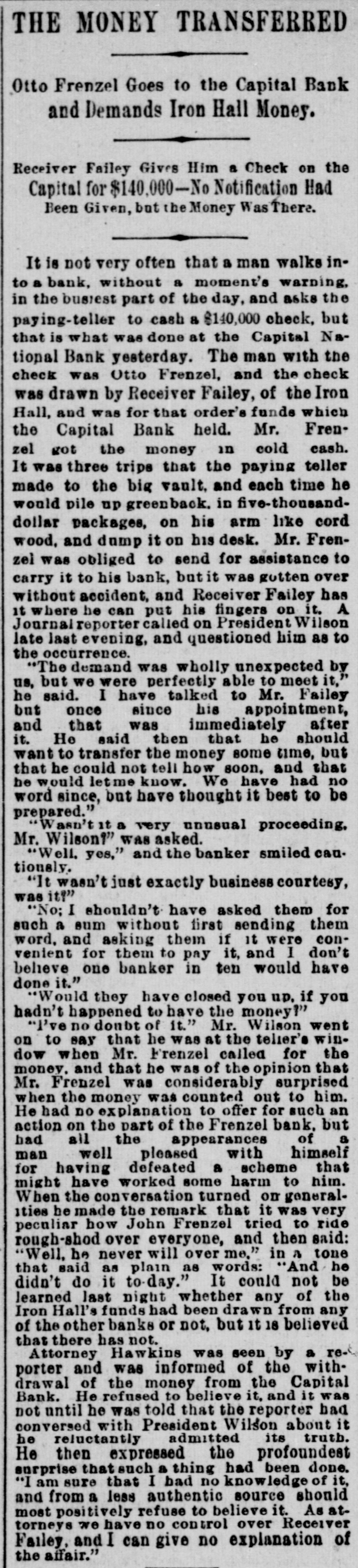
THE MONEY TRANSFERRED Otto Frenzel Goes to the Capital Bank and Demands Iron Hall Money. Receiver Failey Gives Him a Check on the Capital for $140,000-No Notification Had Been Given, but the Money WasThere. It is not very often that a man walks into a bank, without a moment's warning, in the busiest part of the day, and asks the paying-teller to cash a $140,000 check, but that is what was done at the Capital National Bank yesterday. The man with the check was Otto Frenzel, and the check was drawn by Receiver Failey, of the Iron Hall, and was for that order's funds which the Capital Bank held. Mr. Frenzel got the money in cold cash. It was three trips that the paying teller made to the big vault, and each time he would pile up greenback. in five-thousanddollar packages, on his arm like cord wood, and dump it on his desk. Mr. Frenzel was obliged to send for assistance to carry it to his bank, but it was gotten over without accident, and Receiver Failey has it where he can put his fingers on it. A Journal reporter called on President Wilson late last evening, and questioned him as to the occurrence. "The demand was wholly unexpected by us, but we were perfectly able to meet it," he said. I have talked to Mr. Failey but once since his appointment, and that was immediately after it. He said then that he should want to transfer the money some time, but that he could not tell how soon, and that he would letme know. We have had no word since, but have thought it best to be prepared." Wasn't it a very unusual proceeding, Mr. Wilson?" was asked. "Well. yes," and the banker smiled cautionsly. "It wasn't just exactly business courtesy, was it?" "No; I shouldn't have asked them for such a sum without first sending them word. and asking them if it were convenient for them to pay it, and I don't believe one banker in ten would have done it." "Would they have closed you up. if you hadn't happened to have the money?" "I've no doubt of it." Mr. Wilson went on to say that he was at the telier's window when Mr. Frenzel called for the money. and that he was of the opinion that Mr. Frenzel was considerably surprised when the money was counted out to him. He had no explanation to offer for such an action on the part of the Frenzel bank. but had all the appearances of a man well pleased with himself for having defeated a scheme that might have worked some harm to him. When the conversation turned on generalities he made the remark that it was very peculiar how John Frenzel tried to ride rough-shod over everyone, and then said: "Well, he never will over me." in a tone that said as plain as words: "And he didn't do it to-day." It could not be learned last night whether any of the Iron Hall's funds had been drawn from any of the other banks or not, but it 18 believed that there has not. Attorney Hawkins was seen by a reporter and was informed of the withdrawal of the money from the Capital Bank. He refused to believe it, and it was not until he was told that the reporter had conversed with President Wilson about it he reluctantly admitted its truth. He then expressed the profoundest surprise that such a thing had been done. "I am sure that I bad no knowledge of it, and from a less authentic source should most positively refuse to believe it. As attorneys we have no control over Receiver Failey, and I can give no explanation of the affair."
Article from Evening Journal, May 11, 1893

Click image to open full size in new tab

Article Text

Other Banks Wrecked. INDIANAPOLIS, May 11.-The - Capital National Bank of this city has suspended. CHICAGO, May 11.-The Columbia National Bank has failed.


Article from The Herald, May 12, 1893

Click image to open full size in new tab

Article Text

BANK EXAMINERS. Officers Detailed to Take Charge of the Suspended Institutions. WASHINGTON, May 11.-Comptroller Eckels has designated D. A. Cook, bank examiner for Illinois outside of Chicago, to take charge of the Columbia national bank of Chicago, which failed this morning, He also telegraphed Hugh Young, bank examiner for Western Pennsylvania, residing at Pittsburg, to proceed at once to Indianapolis, Ind., and take charge of the Capital national bank of that city.


Article from The Morning Call, May 12, 1893

Click image to open full size in new tab

Article Text

NOT IN GOOD STANDING. A Failure That Will Carry Down Country Banks. CHICAGO, May 11.-The Columbia National Bank of this city failed this morning. It had a capital of $1,000,000, and deposits of $1,400,000. Rumors that it was in tronble have been current nearly a week. It did business with small country banks mostly. It was not in esteem among the other city banks. Notices announcing the suspension were posted on the doors and soon after Bank Examiner Sturges took charge of it. By the authority of the Comptroller of the Currency the bank was reorganized two years ago out of the old United States National. The assets are estimated at $2,250,000, of which $1,000,000 are deposits, the remainder discounts. The liabilities are $1,500,000. A constant run since the announcement of the Chemical Bank snspension caused the directors to close its doors. A call for help was made this morning, but there was not time for investigation before responding to it and suspension came. The Columbia was not a member of the Clearing-house. The last statement, May 4, was as follows: Assets-Loans and discounts, $1,624,932; bonds, $341,258; furniture and fixtures, $12,718; exchange, $615,985. Total, $2,584,881. Liabilities-Capital stock, $1,000,000; surplus, $50,000; undivided profits, $41,931; circulation, $45,000; deposits, $1,437,950. Total, $2,594,881. President Wiggins says the immediate cause of the failure was a suit by the Sioux City Loan and Trust Company, which failed a few days ago. The Columbia had $35,000 on deposit with that concern, and the news of this fact led to the run which ended in the bank's collapse. A meeting of the officers and directors was held this afternoon and at its conclusion it was announced that the bank would probably resume busicess in a short time. Cashier Preston of the Metropolitan National Bank, through which the Columbia cleared. said to-night that the failure was not a bad one and that he saw no reason why the suspension should beanything but a temporary one. WASHINGTON, May 11.-Comptroller Eckels has designated D. A. Cook, Bank Examiner for Illicois outside of Chicago, to take charge of the Columbia National Bank of Chicago, which failed this morning. He has also telegraphed Hugh Young, Bank Examiner for Western Pennsylvania, residing at Pittsburg, to proceed at once to Indianapolis, Ind., and take charge of the Capital National Bank of that city. The Comptroller has been notified that the stockholders of the Chemical National Bank of Chicago will make good the impaired capital and resume business, paying all depositors, both the main bank and the World's Fair branch, in full.


Article from Grand Rapids Herald, May 14, 1893

Click image to open full size in new tab

Article Text

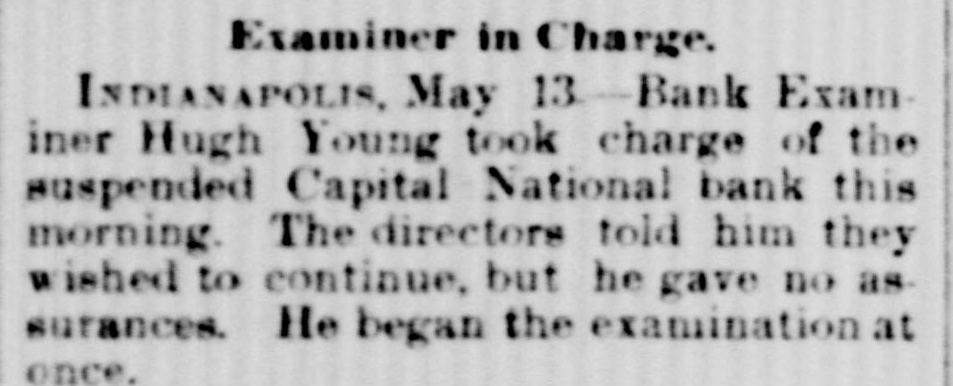
Examiner in Charge. INDIANAPOLIS May 13 Bank Exam iner Hugh Young took charge of the suspended Capital National bank this morning. The directors told him they wished to continue, but he gave no as surances. He began the examination at once,


Article from Reporter and Farmer, May 18, 1893

Click image to open full size in new tab

Article Text

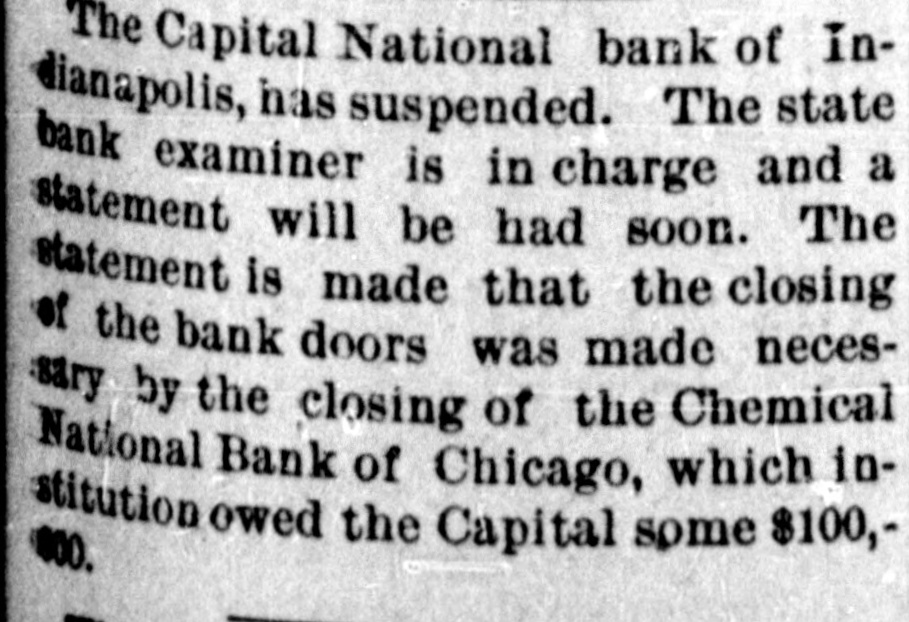
The Capital National bank of Indianapolis, has suspended. The state bank examiner is in charge and a statement will be had soon. The statement of is made that the closing the bank doors was made necessary by the closing of the Chemical National Bank of Chicago, which institution owed the Capital some $100,000.


Article from The Farmers' Union, May 18, 1893

Click image to open full size in new tab

Article Text

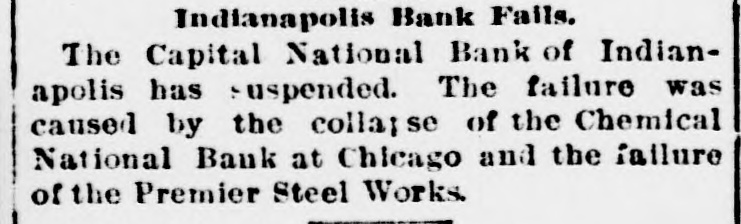
Indianapolis Bank Fails. The Capital National Bank of Indianapolis has suspended. The failure was caused by the collaise of the Chemical National Bank at Chicago and the failure of the Premier Steel Works


Article from The Iola Register, May 19, 1893

Click image to open full size in new tab

Article Text

WILLIAM C. RENFROW was inaugurated governor of Oklahoma on the 10th, but he is not governor yet, for President Cleveland has declined to sign his commission until he can incertain convention intervestigate THE biennial charges against of the him. national Y. M. C. A., at Indianapolis, Ind., met on the 10th with a large attendance. THE Vermont building at the world's fair was dedicated on the 10th and the event brought many New Englanders to witness it. THE Bank of Santa Clara County, Cal., closed its doors, having discovered an embezzlement of nearly $200,000. THE village of North Galveston, Ind., was almost totally destroyed by fire and five lives were lost in the flames. THOMAS NELSON PAGE, the southern novelist, will be married June 8at Elmhart. Ill., to the widow of the late Henry Field, of Chicago. A MARRIAGE license was issued at Clinton, Ia., for a boy of 16 and a girl of 13, the parents of each having given their consent. THE boilers in the electric light plant at La Junta exploded destroying the building, wrecking a planing mill near by and killing Charles Sheppard, the engineer. By the burning of the postal car near Goodrich, Cal., the entire eastern edition of the California Magazine for May was destroyed. THE Oklahoma G. A. R. has been in session at El Reno. THE mutilated remains of two men were found in a barrel at Kansas City, Mo. Investigation showed that medical students had been perpetrating an old'and horrible hoax. THE Columbia National bank of Chicago failed on the 11th. THE Capital National bank of Indianapolis, Ind., failed on the 11th. THE fifth annual congress of the Scotch-Irish Society of America met at Springfield, O., with President Robert Bonner, of New York, in the chair and many distinguished men as delegates. FIRE at Spring Lake, Mich., started by a spark from a passing steamboat, caused a conflagration which destroyed half the town. THE committee investigating the misconduct of Theodore Thomas, musical director at the world's fair, recommended that he be dismissed. JESSE JACKSON, Scott Bunner and Edward Newcomb, of the gang that blew up the Santa Fe express car at Wharton, I. T., last November and secured only a basket of grapes for their trouble, pleaded guilty and were sentenced to two years in the penitentiary. Gov. BOIES, of Iowa, has appointed a committee to investigate the report that Dr. Hill and his attendants of the state insane asylum had been guilty of brutal and inhuman treatment to patients, resulting in several mysterious deaths. THE failure of the Bank of Santa Clara, Cal., is now believed to be complete, all the assets having been wiped out. There are well-grounded reports of fraud, involving men of reputed wealth and much prominence. IT has been decided that for the present $1 shall be the price of an Isabella souvenir quarter. At this rate the board of lady managers will realize $40,000 out of the $10,000 appropriated to the woman's department of the world's fair-a bit of financiering unequaled by any act of the men connected with the exposition. THE houses of three prominent citizens who are prosecuting saloon cases at Muscatine, Ia., were blown up by dynamite. No fatalities resulted. AT a meeting of the local directory of the world's fair it was decided to open the world's fair on Sunday, May 21. A TORNADO SWEPT through Livingston county, Mich., doing a great amount of damage to farm property. QUITE a number of bank failures in Indiana resulted from the suspension of the Columbia National of Chicago. TROUBLE with the Navajos has been averted by the intervention of Chief Black Horse, who has succeeded in getting the murderers of Ranchman Welsh delivered up.


Article from Macon Beacon, May 20, 1893

Click image to open full size in new tab

Article Text

MISCELLANEOUS. THE prominent firm of Brueder & Wolf, manufacturers of carpets, Vienna, has failed. The liabilities are 1,000,000 florins. THE Capital National bank of Indianapolis, Ind., failed on the 11th. THE fifth annual congress of the Scotch-Irish Society of America met at Springfield, O., with President Robert Bonner, of New York, in the chair and many distinguished men as delegates. THE Columbia National bank of Chicago failed on the 11th. THE big levee at Lakeport, on the Mississippi, broke the other morning, flooding portions of Arkansas and Mississippi. FIRE at Spring Lake, Mich, started by a spark from a passing steamboat," caused a conflagration which destroyed half the town. THE committee investigating the misconduct of Theodore Thomas,musical director at the world's fair, recommended that he be dismissed. A POLICEMAN and four members of a drunken mob were killed in a collision at Durango, Mex. THE New York Central engine 999, which made a record of 100 miles an hour, beat the record by doing a mile in thirty-two seconds, which is equivalent to 1121/4 miles an hour. THE number of Chinamen complying with the registration law was 3,303about 8 per cent. FRANCIS H. WEEKS, a New York lawyer and defaulter, has fled. He owed margins to brokers and lost trust funds in speculation. NEW YORK banks make a better showing than for over a year. THE United States coast survey steamer was reported aground in the St. Lawrence. THE liabilities of Robinson & Co., the bankers of Wilmington, Del., are at $325,000 and suspended placed assets at had $200,000. The Knights of Pythias a large amount of the order's money in the bank. THE great sewing machine trust has died in its incipienoy. After the general details had been arranged and the combination of five companies had been believed assured the Domestic people suddenly announced that they did not care to consolidate. AT a meeting of the local directory of the world's fair it was decided to open the world's fair on Sunday, May 21. A TORNAI swept through Livingston county, Mich., doing a great amount of damage to farm property. CLEARING house returns for the week inended May 11 showed an average crease of 10.0 compared with the corre- New sponding week of last year. In York the increase was 12.9. QUITE a number of bank failures in Indiana resulted from the suspension of the Columbia National of Chicago. THE Robinson bank at Wilmington, Del., has failed. THE whisky house of W. H. Thomas & Son, an extensive concern at Louis ville, Ky., has failed. Liabilities over $500,000; assets as much TROUBLE with the Navajos has been averted by the intervention of Chief Black Horse, who has succeeded in get ting the murderers of Ranchman Welsh delivered'up Two masked men held up a Mobile Ohio train at Laketon, Ky., but gotvery little. S.T.K. PRIME, of crop report fame, in an interview says the financial condition of the farmers of the west and southwest is of the best.


Article from Arizona Weekly Citizen, May 20, 1893

Click image to open full size in new tab

Article Text

TELEGRAPHIC. 11 of Musdence and catine Journal of two and the city MUSCATINE, Ia., Molin May editor nostmaster of the of those in cases resecuting engaged citizens up were blown saloon keepers against this The early with morning forare wrecked houses no killed. tunately of 11 May The Bank Eng., of the disrate England 3 per from count LONDON today cent. to 31/2. The 11. May NAPOLIS, INDIA has city Bank Capital National The bank State Carended. Ind., of this examiner is in charge. Y. N. 11. The New May made Anday beat cord that 1121/2 valentito Butcentral miles! eng hour mile 10 32 second York of 102 Marday doing miles per hour. 11 Mo. The May head CIEY, KANBAS of men two less bodies and limbless in fl in Blue were ating barrel found last Their night. he and ds had limbs No blunt axe. been or ing cloth other was found. indicate river late that the off with meanes inden itication Iil., The ColumCHICAGO, bia failed Barl National It had capital morningMay of this city of $1, of It is depos SLA00,000. the poor was fulure col CO and This lapse loans. lections of a at that break caused Ind: of in the here. 21/2 wheat cents price the After May by order Presion dent creden their present on early auched touched before the country to the memory tials are The latter of public resol in terest tions James of reJames Blount, every ports. question include dinz of the olored, late from the eneech touching negro he Blaine. made of 8 the Southern recede Alabed neglect not and Grant. resowou Lincoln over lution cot read could and party hoped taken by immigranguage who be denied should A It was mosition declaring discus the that Emission English to olution this killed. the Union ouncing for refusing was country. New York A platform en ut tions, was adopted club of a Hebrew. the doctor Committee- mmittee It by section. by admission League to mended read by and with pride conrecomment then inted ablican a emof law adiday ployes in all clared tion to the during rassage Harrison their of calling pro- defaror of the the tect wage, greas for gance the sa of earners to intere:ts to the capital ermine interest the recomm declared by in the acis faith at for the the the and and labor labor, secret by ballot of backed up tion of supple Vections, ion the and system suppress or in food whether Pinkers on the Tracer De ballot first 404. Yourg's D. C. May of roduct. all was by elected a vote president of 902 to re10.-A from Honolu last came eaterday meet WASHINGTOON week mailed in April and ting. was port during he Gresham the cabinet chara it the is it contents Secretary by to cret, formati but presumed eident that the in time taken Owing to its were ntains kept such termined to cew 1030 to Mr. succeed Stevens minister of The 10. Cal, bank May SAN JOSE, its today closed, Clara Santa county doors. was about This action bythe of that from 3150, shortage discovery.com Hayw existed and last died cashier word manager the frectors informeted in the ties books. 000 to of the bank, president that and regularifiled patiThis Leonard new at of fixing liability and 44,000. the dead and both in for used cashier $190,000 belief is that money stock and estate. real mining Leonard's be hat bad showe borrow schedule of the most the from bank, $138,082 being cotes k 10. D. Fran WAS who stant WASHINGTON pringfield postmas. resigned, 30 ter general, native today of Spring H. Jones approvide of ted H first Clay field, Evans Ill., and the in Yale class up the atuay he bar veare of gradua age. ted from ediately took to the of engaged He was assembly of He '75 and of law. in Since the active Lamber practice from of Illinoia general 18 the presidistrict. Jones of clubs dent the league Democratic to last the and was He national Democratic ive has taken interhe in and and est State national of man 10 deliv been he of dedica at the Mr. inments. Jones on bag the State building instant. World's 10. ing May an oration oral Illinois the 18th reviewin BERLIN, at in field the the Temp tion of the Fair on While mplehofer the the today ordered German Emperor the officers guards imperial principal to and gsed him address gather as them follows: diea "I ly been have of in the late the zaichetage patriotism I will ing the hope if comthe but bill, the adop military to ad pt ing refuse should Reichetag bill the into am op carrytic determined effect despite unpatriptic that am alone tion. and the the with princes at TemThe emperor is excite the plehofeman people people speach causing, of the enor It ap Gazette German Those that eays who with ment forth leaded speak paus in word ing the ination sence a in the double heard the Empere unusual to to convey abide prohis declaration widespread be at every of his de There is that to not hesitate wid would ag Rateb it The the by Emperor and with bostile the to new the in bill. darese tell can you my my didly bill the ben Emp officere necessity to told you ing his felt the decision, as was first pro-


Article from The Kinsley Graphic, May 26, 1893

Click image to open full size in new tab

Article Text

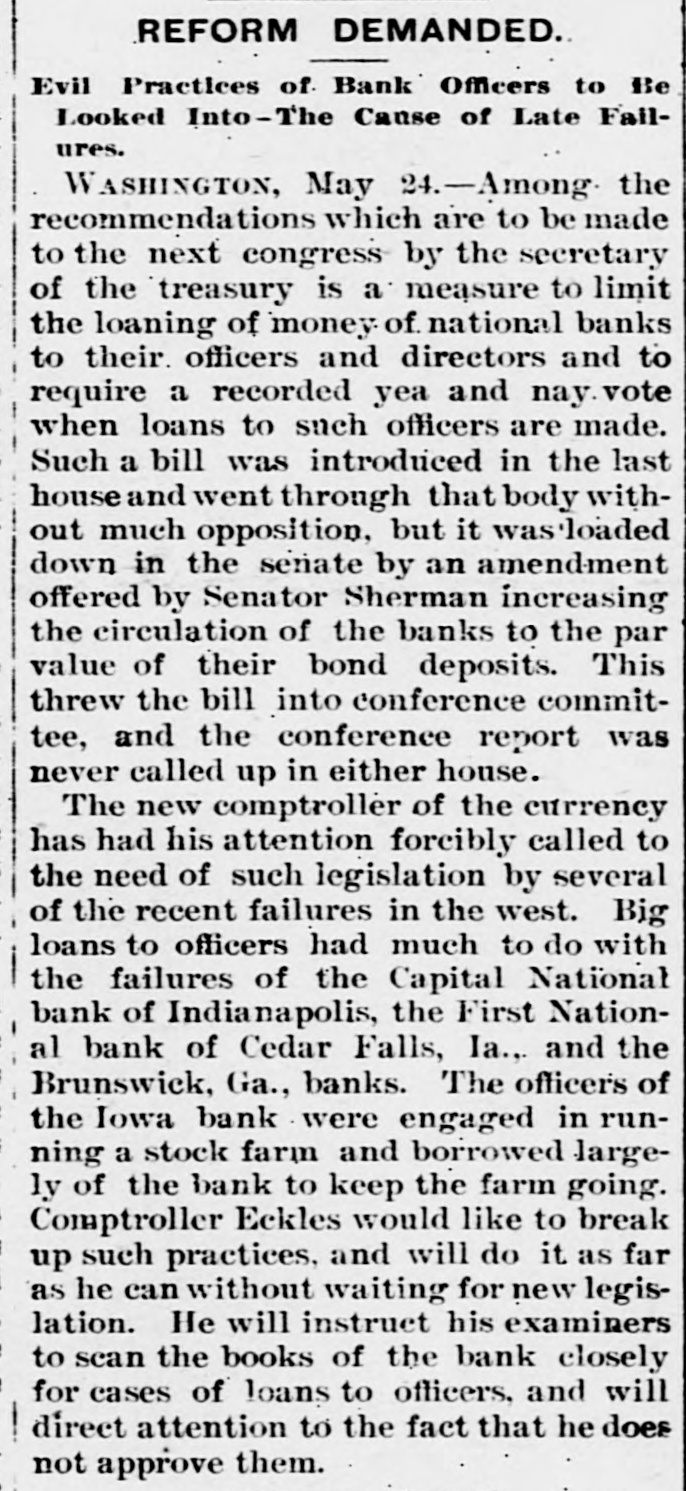
REFORM DEMANDED. Evil Practices of Bank Officers to Be Looked Into-The Cause of Late Failures. WASHINGTON, May -Among the recommendations which are to be made to the next congress by the secretary of the treasury is a measure to limit the loaning of money of national banks to their. officers and directors and to require a recorded yea and nay. vote when loans to such officers are made. Such a bill was introduced in the last house and went through that body without much opposition, but it was loaded down in the senate by an amendment offered by Senator Sherman increasing the circulation of the banks to the par value of their bond deposits. This threw the bill into conference committee, and the conference report was never called up in either house. The new comptroller of the currency has had his attention forcibly called to the need of such legislation by several of the recent failures in the west. Big loans to officers had much to do with the failures of the Capital National bank of Indianapolis, the First National bank of Cedar Falls, la. and the Brunswick, Ga., banks. The officers of the Iowa bank were engaged in running a stock farm and borrowed largely of the bank to keep the farm going. Comptroller Eckles would like to break up such practices, and will do it as far as he can without waiting for new legislation. He will instruct his examiners to scan the books of the bank closely for cases of loans to officers, and will direct attention to the fact that he does not approve them.


Article from Fort Worth Gazette, May 27, 1893

Click image to open full size in new tab

Article Text

is NEED NEW BANK LAWS. LOANS TO OFFICERS MUST BE LIMITED IN AMOUNT. e The Secretary of the Treasury Will Urge Upon f Congress a Measure Which Will Tend to Make Banks Much Safer. Washington May 20.-Among the recommendations which are to be made to the next congress by the secretary of the treasury will be a measure to limit the loan of- of the money of national banks to their ficers and directors and to require a recorded yea and may vote when loans to such offi ers are made, Such a bill was introduced In the last house and went through that body without much opposition, but It was loaded down In the setiate by an amendment offered by Senator Sherman Increasing the circulation of the banks to the par value of their bond deposits. This threw the bill Into conference committee and the conference report was never called up in either house. The new comptroller of the currency has had his attention forcibly called to the need of such legislation by sΓ©veral of the recent failures In the west. Big loans to officers had much to do with the failures of the Capital national bank of Indianapolis, the First-national bank of Cedar Falls, Iowa, and the Brunswick, Ga., banks. The officers of the Iowa bank were engaged in running a stock farm and borrowed largely of the bank to keep the farm going. Comptroller Eckels would like to break such practices and will do It HM far na he can without walting for new legislation. He will Instruct his examiners to sean the books of the banks closely for cases of loans to officers and will direct attention to the fact that he does not approve them. Another point to which the new comptroller Is directing his attention Is the origInal Issae of bank charters. He proposes to exact additional guarantees of the standing and financial resources of Lite men who ask for charters, and will endeavor to satisfy himself of their responsibility before grant. ing the authority, which is In his discretion, "to commence the business of banking. He will probably require from each Incorporafor a personal statement of his assets and Habilities, and will ask the member of congress from the district to give some personal attention to the truthfulness of such representation before affixing his indorsemeut. as how to the treasury regulations he is of the called upon department. do under Mr. Eckels believes that It is useless to allthorize institutions which are not strong enough to stand permanently on their feet, and that some discrimination should be exercised In authorizing them in communities already largely equipped with banking faetlities.


Article from Baxter Springs News, May 27, 1893

Click image to open full size in new tab

Article Text

REFORM DEMANDED. Evil Practices of Bank Officers to Be Looked Into - The Cause of Late Fallures. WASHINGTON, May 24.-Among the recommendations which are to be made to the next congress by the secretary of the treasury is a measure to limit the loaning of money of national banks to their officers and directors and to require a recorded yea and nay vote when loans to such officers are made. Such a bill was introduced in the last house and went through that body without much opposition, but it was'loaded down in the senate by an amendment offered by Senator Sherman increasing the circulation of the banks to the par value of their bond deposits. This threw the bill into conference committee, and the conference report was never called up in either house. The new comptroller of the currency has had his attention forcibly called to the need of such legislation by several of the recent failures in the west. Big loans to officers had much to do with the failures of the Capital National bank of Indianapolis, the First National bank of Cedar Falls, Ia., and the Brunswick, Ga., banks. The officers of the Iowa bank were engaged in running a stock farm and borrowed largely of the bank to keep the farm going. Comptroller Eckles would like to break up such practices, and will do it as far as he can without waiting for new legislation. He will instruct his examiners to scan the books of the bank closely for cases of loans to officers, and will direct attention to the fact that he does not approve them.


Article from The Salt Lake Herald, June 4, 1893

Click image to open full size in new tab

Article Text

Suspended Bank Will Resume. WASHINGTON, June 3.-As the result of a conference between Comptroller Eckles ard the officials of the failed Capital National bank of Indianapolis this morning, the comptroller announced that the bank would probably resume in about two weeks.


Article from The Washington Bee, June 10, 1893

Click image to open full size in new tab

Article Text

Suspended Banks May Resume. Comptroller Eckels of the Treasury Department says that there are indications that the Chemical National Bank, of Chicago, and the Capital National Bank, of Indianapolis, Ind., will resume business.


Article from Fort Worth Gazette, June 20, 1893

Click image to open full size in new tab

Article Text

The Capitol National bank of Indianapolis, which suspended May 11. resumed business yesterday, and ended the day with more money than it had at the beginning Confidence is coming out of the woods.


Article from St. Paul Daily Globe, June 20, 1893

Click image to open full size in new tab

Article Text

Resumed Business. INDIANAPOLIS, June 19.-After five weeks' suspension the Capital National bank resumed payment today. The suspension was precipitated by the failure of the Chemical National Bank of Chicago, in which the Capital had something like $80,000.


Article from The Indianapolis Journal, June 20, 1893

Click image to open full size in new tab

Article Text

HAS REOPENED ITS DOORS. Public Confidence in the Capital National Bank Well Demonstrated. No Indications of a Run, and Deposits Came Close Up to the WithdrawalsOfficials Well Satisfied. The suspended Capital National Bank opened for business promptly at 9 o'clock yesterday morning. and when the curtains were pulled down at the usual hour in the evening, the total amount of the deposits received during the day almost equaled the amount of the withdrawals. It was an unusual circumstance in the history of suspended banks resuming. and it speaks volumes for the general business confidence in Indianapolis. The bank had $800,000 in cash ready to pay out if demanded, but the withdrawals did not exceed one-tenth this sum. At no time was there a heavy run, not over twenty-tive people being in line at the paying-teller's window at one period of the morning. In the afternoon it seemed that the bank was transacting its usual volume of business. The heaviest demands of the day were from small depositors and people who had received checks on the bank just before the suspension. Bank Examiner Hugh Young turned the institution over to the officials at9 o'clock, for at that hour his supervision ended. There were hardly half a dozen depositors at the doors at that hour and the first man to withdraw his deposit was a laboring man. Like others who followed him, he explained that he had confidence in the bank but needed the money which had been tied up. This was the general explanation of those who took out the sums they had in the bank. Within ten minutes after the opening the line of depositors increased to fifteen, and about that time men began to come in to make deposits and show their confidence in the institution and its new management. Many of these were South Meridian-street merchants. Other depositors came, and, after sizing up the situation, went away without asking for their money. On the Daying teller's desk were huge heaps of greenbacksand coin. Whenever the crowd threatened to become large a second Daying teller was put to work, and in this manner the line was thinned out at a rapid rate. The light run lasted about an hour. At noon Examirer Young stated that the bank had paid out about $50,000 and had received in deposits about $40,000. He was surprised that the demands were not greater, and intimated that it would have been better if the small depositors had, for the most Dart, been paid off at once. He thought when the bank opened the first days' withdrawals would amount to at least $200,000. The day's business, he said, showed an excellent financial condition in the city. President Byram was much gratified at the outcome. He said the deposits far exceeded his anticipations. One of the deposits amounted to $10,000. He said the bank had not yet considered the matter of entering the clearing house association. A policy will be determined upon as soon as the bank gets in good working order. Examiner Young left for Pittsburg yesterday afternoon. He has made many friends here during his stay.


Article from Grant County Herald, June 22, 1893

Click image to open full size in new tab

Article Text

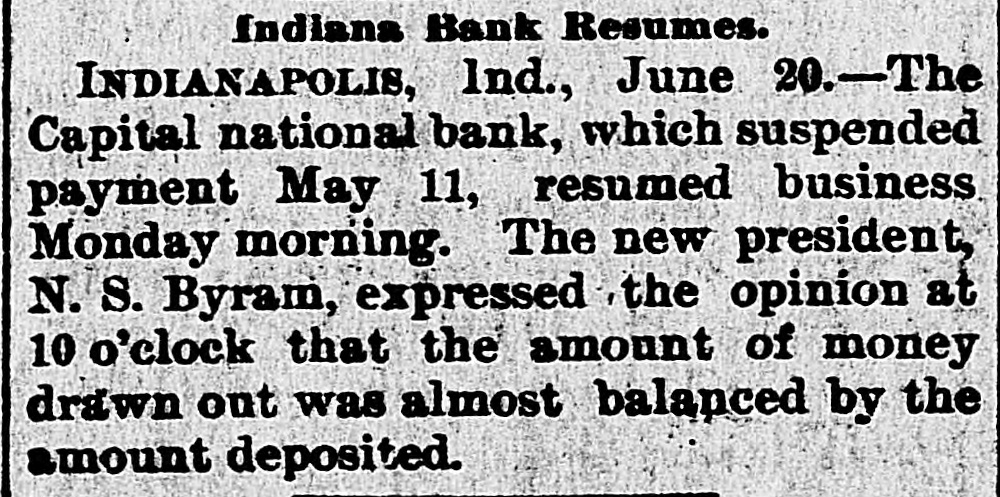
Indiana Bank Resumes. INDIANAPOLIS, Ind., June 20.-The Capital national bank, which suspended payment May 11, resumed business Monday morning. The new president, N. S. Byram, expressed the opinion at 10 o'clock that the amount of money drawn out was almost balanced by the amount deposited.


Article from The Irish Standard, June 24, 1893

Click image to open full size in new tab

Article Text

Indiana Bank Resumes. INDIANAPOLIS, Ind., June 20.-The Capital national bank, which suspended payment May 11, resumed business Monday morning. The new president, N. S. Byram, expressed the opinion at 10 o'clock that the amount of money drawn out was almost balanced by the amount deposited.


Article from The Enterprise, June 28, 1893

Click image to open full size in new tab

Article Text

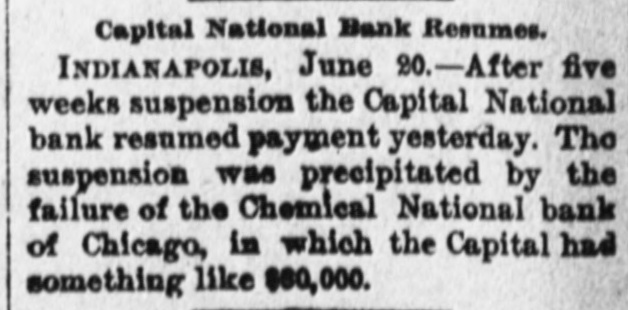
Capital National Bank Resumes. INDIANAPOLIS, June 20.-After five weeks suspension the Capital National bank resumed payment yesterday. The suspension was precipitated by the failure of the Chemical National bank of Chicago, in which the Capital had something like $60,000.


Article from The Helena Independent, January 1, 1894

Click image to open full size in new tab

Article Text

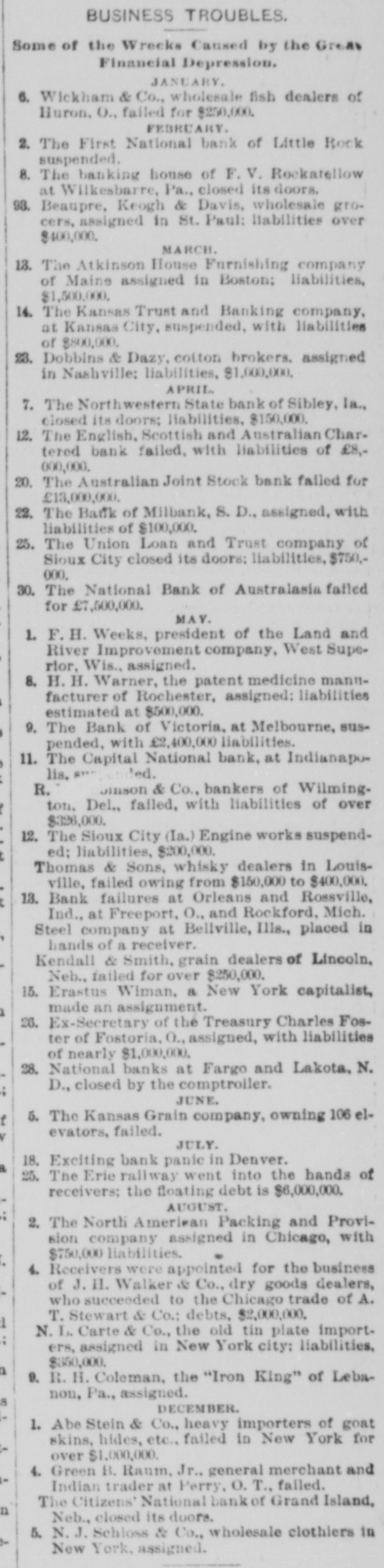
BUSINESS TROUBLES. Some of the Wrecks Caused by the Great Financial Depression. JANUARY. 6. Wickham & Co., wholesale fish dealers of Huron. O., failed for $250,000. FEBRUARY. 2. The First National bank of Little Rock suspended. 8. The banking house of F. V. Rockatellow at Wilkesbarre, Pa., closed its doors. 93. Beaupre, Keogh & Davis, wholesale grocers, assigned in St. Paul: liabilities over $400,000. MARCH. 13. The Atkinson House Furnishing company of Maine assigned in Boston: liabilities, $1,500,000. 14. The Kansas Trust and Banking company, at Kansas City, suspended, with liabilities of $800,000. 23. Dobbins & Dazy, cotton brokers. assigned in Nashville: liabilities, $1,000,000. APRIL. 7. The Northwestern State bank of Sibley, la., closed its doors; liabilities, $150,000. 12. The English, Scottish and Australian Chartered bank failed, with liabilities of Β£8,000,000. 20. The Australian Joint Stock bank failed for Β£13,000,000. 22. The Barik of Milbank, S. D., assigned, with liabilities of $100,000. 25. The Union Loan and Trust company of Sioux City closed its doors: liabilities, $750.000. 30. The National Bank of Australasia failed for Β£7,500,000. MAY. 1. F. H. Weeks, president of the Land and River Improvement company, West Superior, Wis., assigned. 8. H. H. Warner, the patent medicine manufacturer of Rochester, assigned: liabilities estimated at $500,000. 9. The Bank of Victoria, at Melbourne, suspended, with Β£2,400,000 liabilities. 11. The Capital National bank, at Indianapoled. lis. 8" R. Jinson & Co., bankers of Wilmington. Del., failed, with liabilities of over $326,000. 12. The Sioux City (Ia.) Engine works suspended; liabilities, $200,000. Thomas & Sons, whisky dealers in Louisville, failed owing from $150,000 to $400,000. 13. Bank failures at Orleans and Rossville, Ind., at Freeport, O., and Rockford, Mich. Steel company at Bellville, Ills., placed in hands of a receiver. Kendall & Smith, grain dealers of Lincoln, Neb., failed for over $250,000. 15. Erastus Wiman, & New York capitalist, made an assignment. 26. Ex-Secretary of the Treasury Charles Foster of Fostoria, O., assigned, with liabilities of nearly $1,000,000. 28. National banks at Fargo and Lakota. N. D., closed by the comptroller. JUNE. 5. The Kansas Grain company, owning 106 elf evators, failed. JULY. 18. Exciting bank panic in Denver. 25. The Erie railway went into the hands of receivers; the floating debt is $6,000,000. AUGUST. 2. The North American Packing and Provision company assigned in Chicago, with $750,000 liabilities. 4. Receivers were appointed for the business of J. H. Walker & Co., dry goods dealers, who succeeded to the Chicago trade of A. T. Stewart & Co.: debts, $2,000,000. 1 N. L. Carte & Co., the old tin plate importers, assigned in New York city: liabilities, $850,000. 9. R. H. Coleman, the "Iron King" of Lebanon, Pa., assigned. S DECEMBER. 1. Abe Stein & Co., heavy importers of goat skins, hides, etc., failed in New York for over $1,000,000. 4. Green B. Raum, Jr., general merchant and Indian trader at Perry, O. T., failed. The Citizens' National bank of Grand Island, n Neb., closed its doors. 5. N.J. Schloss & Co., wholesale clothiers in New York, assigned.