Article Text
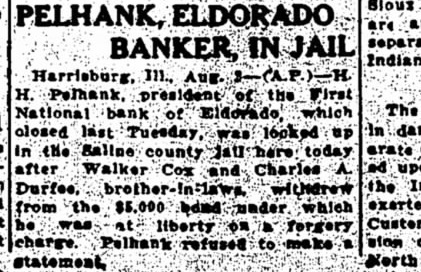
PELHANK, BANKER, president First National bank Eldorado, which closed Tuesday, county Walker Cox and Charles upon withdrew the which exerted the forgery Custer refused
e6e3303c4f98aa2dNone
Click image to open full size in new tab
PELHANK, BANKER, president First National bank Eldorado, which closed Tuesday, county Walker Cox and Charles upon withdrew the which exerted the forgery Custer refused
Click image to open full size in new tab
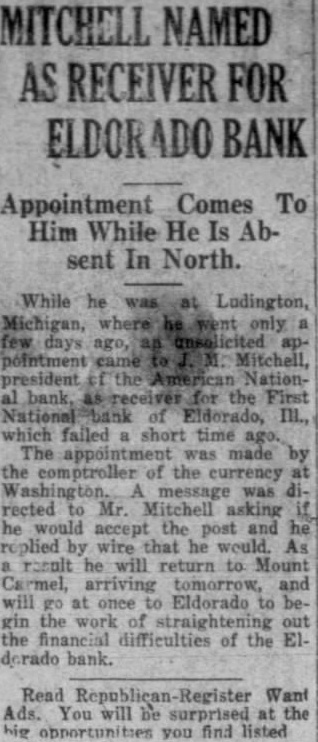
MITCHELL NAMED AS RECEIVER FOR ELDORADO BANK Appointment Comes To Him While He Is Absent In North. While he was Ludington, Michigan, where only few days ago, appointment came Mitchell, president the American National bank, receiver for the First National "bank of Eldorado, which failed short time ago. The appointment was made the comptroller of the currency Washington. A message was di rected to Mr. Mitchell asking he would accept the post and replied by wire that he would. As result he will return to Mount Carmel, arriving tomorrow, and will go at once to Eldorado to begin the work of straightening out the financial difficulties of the Elderado bank. Read Republican Register Want Ads. You will be surprised at the hig opportunities you find listed
Click image to open full size in new tab
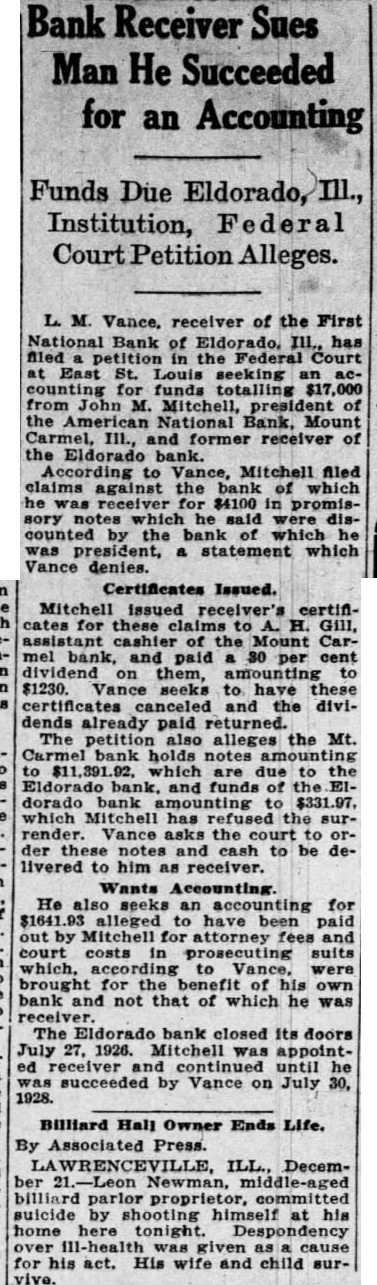
Bank Receiver Sues Man He Succeeded for an Accounting Funds Due Eldorado, Ill., Institution, Federal Court Petition Alleges. L. M. Vance. receiver of the First National Bank of Eldorado, III,, has filed the Federal Court at East St. Louis seeking an acfor funds totalling $17,000 from John M. Mitchell, president the American National Bank, Mount Carmel, III., and former receiver of the Eldorado bank. According to Vance, Mitchell filed claims against the bank of which he receiver for $4100 in promissory he said were discounted by the bank which he was president, a statement which Vance denies. Certificates Issued. Mitchell issued receiver's certificates for these to H. Gill, cashier the Mount Carmel bank, and paid 30 per cent dividend on them, to $1230. Vance seeks to have these certificates canceled and the dividends already paid returned. The petition alleges the Mt. Carmel bank holds notes ting to which are due to Eldorado bank. and funds of the E1dorado bank amounting to $331.97 which Mitchell has refused the surrender. asks the to der notes cash to be delivered to him as receiver. Wants Accounting. He also seeks an accounting for $1641.93 alleged to have been paid out by Mitchell for attorney fees and court costs in prosecuting suits which. to Vance. were brought for the of his own bank and not that of which he was receiver. The Eldorado bank closed its doors July 27, 1926. Mitchell was appointed receiver until was succeeded by Vance on July 30, 1928. Billiard Hall Owner Ends Life. By Associated Press. LAWRENCEVILLE, ILL., December -Leon Newman, middle-aged billiard parlor proprietor, committed suicide by shooting himself at his home here tonight. Despondency over ill-health given cause for his act. His wife and child survive.
Click image to open full size in new tab
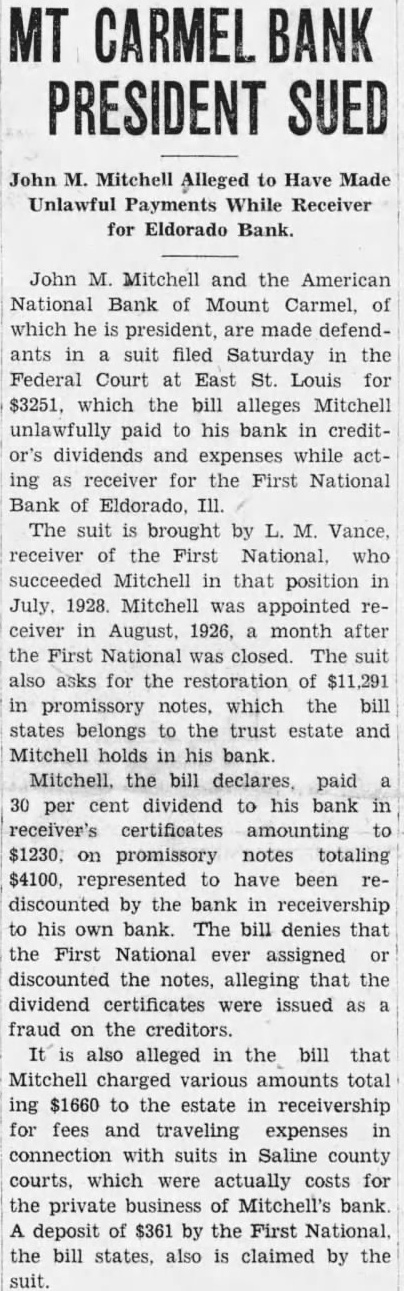
PRESIDENT SUED John M. Mitchell Alleged to Have Made Unlawful Payments While Receiver for Eldorado Bank. John M. Mitchell and the American National Bank of Mount Carmel, of which he president, are made defendants in suit filed Saturday in the Federal Court at East St. Louis for which the bill alleges Mitchell unlawfully paid to his bank in creditdividends and expenses while ing as receiver for the First National Bank of Eldorado, The suit brought by M. Vance, receiver of the First who succeeded Mitchell in that position in July. 1928. Mitchell was appointed ceiver in August. 1926, month after the First National was closed. The suit also asks for the restoration of in promissory which the bill states belongs to the trust estate and Mitchell holds in his bank. Mitchell. the bill paid 30 per cent dividend to his bank receiver's certificates amounting promissory notes totaling represented to have been discounted by the bank in receivership to his own bank. The bill denies that the First National ever assigned discounted the notes, alleging that the dividend certificates were issued fraud on the creditors. also alleged in the bill that Mitchell charged various amounts total $1660 to the estate in receivership for fees and traveling expenses in connection with suits in Saline county courts. which were actually costs for the private business of Mitchell's bank. deposit of $361 by the First National. the bill states, also is claimed by the suit.
Click image to open full size in new tab
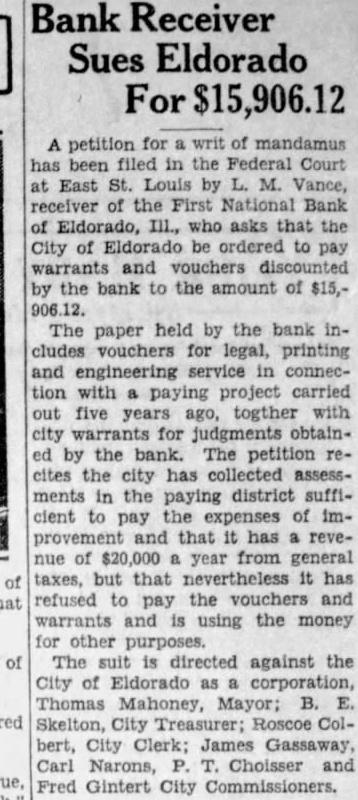
Bank Receiver Sues Eldorado For $15,906.12 A petition for a writ of mandamus has been filed in the Federal Court at East St. Louis by L. M. Vance, receiver of the First National Bank of Eldorado, Ill., who asks that the City of Eldorado be ordered to pay warrants and vouchers discounted by the bank to the amount of $15,906 The paper held by the bank includes vouchers for legal, printing and engineering service in connection with a paying project carried out five years ago, togther with city warrants for judgments obtained by the bank. The petition recites the city has collected assessments in the paying district sufficient to pay the expenses of improvement and that it has a revenue of $20,000 a year from general taxes, but that nevertheless it has refused to pay the vouchers and warrants and is using the money for other The suit is directed against the City of Eldorado as Thomas Mahoney, Mayor; B. E. Skelton, City Treasurer; Roscoe Colbert, City Clerk; James Gassaway, Carl Narons, P. T. Choisser Fred Gintert City Commissioners.
Click image to open full size in new tab
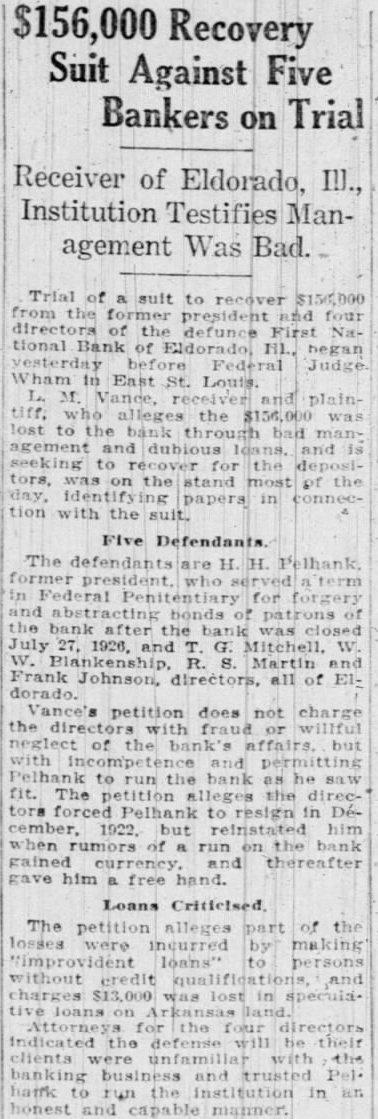
$156,000 Recovery Suit Against Five Bankers on Trial Receiver of Eldorado, III., Institution Testifies Management Was Bad. of to from the four directors of the tional Bank of Judge. East St. Louis the $156,000 lost to the bank bad agement dubious and is eking for was stand the papers in tion with the Five Defendants H. H. in Federal and abstrac bonds of of the bank after the was July and T G. W. Martin Frank Johnson, all dorado. Vance's petition does not charge the directors with fraud or willful of the bank' affairs but and Pelhank to run the bank as he saw fit. The petition the forced Pelhank to resign in cember, but reinstated him rumors of run the bank thereafter free hand. The losses credit was lost the defense will be their clients and trusted to run the in honest and manner.