Article Text
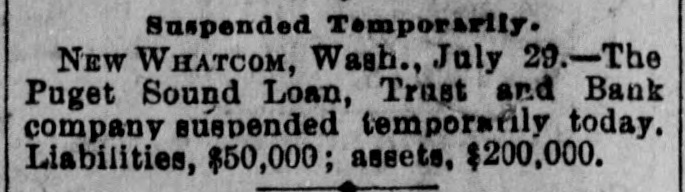
Suspended Temporarily
NEW WHATCOM, Wash., July 29.-The Puget Sound Loan, Trust and Bank company suspended temporatily today. Liabilities, $50,000; assets, $200,000.
Click image to open full size in new tab
NEW WHATCOM, Wash., July 29.-The Puget Sound Loan, Trust and Bank company suspended temporatily today. Liabilities, $50,000; assets, $200,000.
Click image to open full size in new tab
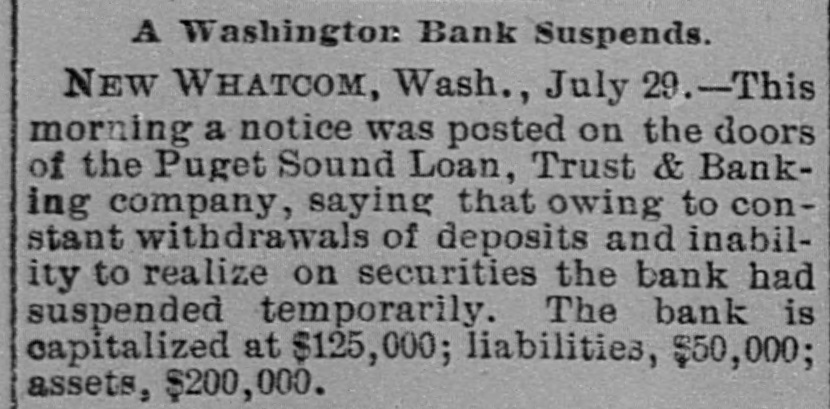
NEW WHATCOM, Wash., July 29.-This morning a notice was posted on the doors of the Puget Sound Loan, Trust & Banking company, saying that owing to constant withdrawals of deposits and inability to realize on securities the bank had suspended temporarily. The bank is capitalized at $125,000; liabilities, $50,000; assets, $200,000.
Click image to open full size in new tab
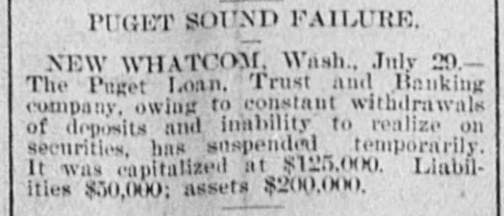
PUGET SOUND FAILURE, NEW WHATCOM, Wash., July 29.The Puget Loan, Trust and Banking company, owing to constant withdrawals of deposits and inability to realize on securities, has suspended temporarily. It was capitalized at $125,000. Liabilitles $50,000; assets $200,000.
Click image to open full size in new tab
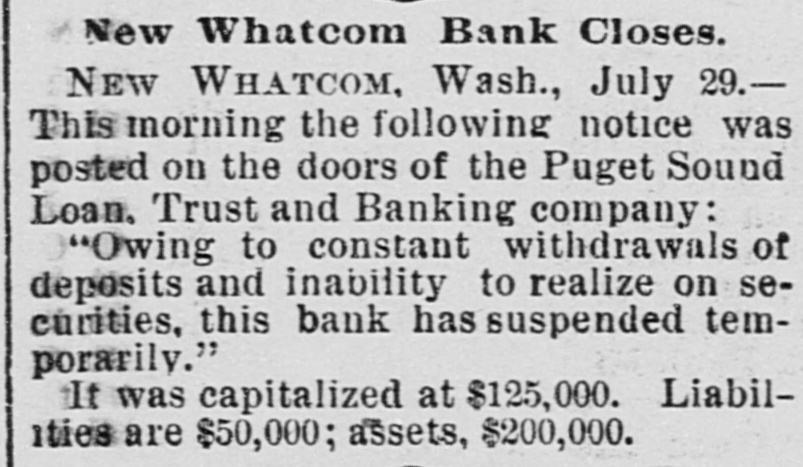
NEW WHATCOM, Wash., July 29.This morning the following notice was posted on the doors of the Puget Sound Loan. Trust and Banking company: "Owing to constant withdrawals of deposits and inability to realize on securities, this bank has suspended temporarily." It was capitalized at $125,000. Liabilities are $50,000; assets, $200,000.
Click image to open full size in new tab
A Loan and Trust Bank Suspends. NEW WHATCOM. Wash.. July 30.-The following notice was posted yesterday on the doors of the Puget Sound Loan. Trust and Banking Company: "Owing to constant withdrawals of deposits and inability to realize on securities, this bank has suspended temporarily." It was capitalized at $125,000; liabilities $50,000; assets, $200,000.
Click image to open full size in new tab
ROTTEN BANK, GOOD RECEIVER. #tockholders Borrowed $100,000 From Puget Sound Loan Company. WHATCOM. Dec. 18. - [Special.]-The hearing of the petition for the removal of Bank Receiver Richards, of the Puget Sound Loan, Trust and Banking Company, was concluded this afternoon and the argument of the counsel is being heard at an evening session of court. No evidence was introduced in support of the allegation in the supplementary petition that the receiver had represented himself as having been assured by Judge Winn that the petitioners could not succeed in their attempt to secure his (the receiver's) removal. The testimony today showed that a majority of the stockholders are indebted to the bank and that the aggregate of such indeptedness is nearly $100,000. It pears that about $1,700 is represented in the application for the receiver's removal, and that since he assumed charge the habilities have been reduced $17,000 and new occurity to the amount of about $25,000 obtained. The general opinion seems to be that the petitioners have not made out a good case against the receiver, but that they have succeeded in making out a very bad showing for the bank.
Click image to open full size in new tab
WHATCOM, Dec. 28.-[Special.]-Hon, Frank H. Richards has tendered bis resignation as receiver of the Puget Sound Loan, Trust and Banking Company, and his report will be presented to the court Saturday. Hon. George A. Black, of Fairhaven, has been appointed to succeed him.
Click image to open full size in new tab
WHATCOM, Jan. 10.-[Special.]-In his final report to the court as receiver of the Puget Sound Loan, Trust and Banking Company, Frank H. Richards expresses the opinion that "there can be no question that ultimately all of the creditors will receive their claims in full, with interest, but undoubtedly a pesiod of at least two years will elapse before such a result can be reached, owing to the nature of the seeurities held by the bank and the general depression of business." He recommends that "an assessment be immediately levied upon the stock of the corporation for the benefit of the creditors," as it seems to him that it "would be more consonant with justice and equity that the stockholders should bear the burden, if any there should be, of waiting until such securities are realized upon, rather than that such burden should be borne by parties who have in good faith deposited money or have become creditors of this institution." This opinion, bowever, is not held by the the new receiver, George A. Black, who argues that those of the stockholders who could pay an assessment have already paid for their stock, and that nothing could reasonably be expected now from those who have never paid anything. He might have added that the bulk of the bank's assets is in bills receivable due from the stockholders, and it these are paid the bank's obligations can be settled without invoking the provisions of the law relating to assessments.
Click image to open full size in new tab
DESTORS WANT THE BANK OPENED Is Order to Be Rid of the Receiver, Who Threatens to Sue. WHATCOM. Feb. 11.-{Special.]-The directors of the Paget Sound Loan, Trust and Banking Company, now in charge of a receiver, have determined to make an effort to secure. sufficient funds to terminate the receivership and reopen the institution. This determination is due not so much to a laudable desire to settle the just claims of creditors as to anxiety to avoid proceedings against themselves for the collection of the large suins which they individually owe to the bank. Receiver Black is not inclined to talk about the situation for publication, but from a gentieman who is thoroughly acquainted with the true status of affairs the POST-INTELLIGENCER correspondent learns that a proposition in the nature of an ultimatum has been submitted by the receiver which will force the directors to either "fish or cut bait." Of the six directors four, Messrs. Pettibone, Eldridge, Morgan and Wade, owe the bank as principals or indorsers upwards of $100,000, the president himself being held responsible for $66,000. Now it appears they have been notified they must speedily provide funds with which to pay the bank's obligations to depositors, or steps will be immediately taken to dispose of the collateral deposited by them as nominal security for their loans and overdrafts, and to obtain judgments against them to the full extent of their obligations. The only way in which such action by the receiver can be prevented is for the directors to terminate the receivership by reopening the bank, and to do this it will be necessary for them to obtain liberal extensions from the creditors and provide a considerable sum for the payment of demand claims. It is said that some of the directors were ignorant of the true inwardness of the bank's affairs notil last Thursday, when the receiver showed his hand and called for a show down.
Click image to open full size in new tab
WHATCOM, Feb. 16.-[Special.]-Aceord ing to the supplementary report of the county treasurer, Whatcom county has a credit of a little over $1,200 in the suspended Puget Sound Loan and Trust Company bank. The September report gave the county a credit there of over $6,000. The late report does not account for the difference, but it is supposed to be due to the' settlement of some personal obligations of the treasurer, with the knowledge and consent of the commissioners. That the matter is all straight is not doubted. The Reveille this morning says that the POST-INTELLIGENCER correspondent "seems dead set that the bank shall never reopen again, and prefers that the city and county shall wait ten years under a receivership for their money rather than accept an amicable extension of a year and help a mismanaged institution on its feet again." The Reveillo may now enjoy, if it can, the distinction of being the only paper that has seen fit to declare in favor of the reopening of the "mismanaged institution," presumably under the same mismanagement which brought about its downfall by loaning to its directors and stockholders, upon notoriously rotten securities, $100,000 of its deposits. If the Reveille is on the inside in the deal perhaps it can inform the public what assurance it has that the claims of the city and county. and of the other creditors, will be paid at the expiration of one year if the institution is permitted to resume, and further, what warrant it has for the assumption that it will take "ten years" to settle up its affairs under the receivership? Ex-Receiver Richards, in his first report, recommended that the stockholders be assessed, and expressed the opinion that the creditors might reasonably expect to get their money within two years.
Click image to open full size in new tab
WHATCOM, April 20. - [Special] - Receiver Black, of the Puget Sound Loan, Trust and Banking Company. has brought suit against J. W. Morgan, one of the directors and also president of the Bellingham Bay National bank, for the collection of personal promissory notes of about $6,000, and has also sued C. W. Carter, vice president of the Bellingham Bay National bank, for $1,000. The receiver says these gentlemen are having a petition circulated asking the court to remove him or at least reduce the expenses of the receivership, which he says are about $300 per month.
Click image to open full size in new tab
Trying to Open a Whatoom Bank. WHATCOM, May 13.-[Special]-The directors of the Puget Sound Loan, Trust and Banking Company have empowered Cashier Patch, who is Receiver Black's assistant, to conduct negotiations with capitalists with a view to securing funds if possible with which to pay off the most pressing claims and reopen the bank. The argument of the city upon its claim that it is a preferred creditor for about $7,000 was heard by Judge Winn this week, and will be passed upon in a day or two. The former receiver told the POST-INTELLIGENCER correspondent that the city's claim was not a preferred one and would not be so considered by him, and his successor takes the same view of it.
Click image to open full size in new tab
WHATCOM, Nov. 20. - [Special.] - Receiver Black, of the Puget Sound Loan, Trust and Banking Company, has filed his answer to the petition to the court requesting that his final report be called for preparatory to the reopening of the bank under the conditions agreed to by the creditors. While Mr. Black expresses the opinion that the interests of the stockholders and creditors would be best subserved by terminating the receivership and reopening the bank in proper manner, his answer implies some distrust of the proposition now under consideration and practically agreed upon. In his opinion delinquent stock subscriptions amounting to about $23,000 should first be paid up or secured 80 as to be available as bank assets, and collections should be forced upon the-bank's own bills receivable, which are mainly obligations of its own directors and stockholders, instead of hypothecating its best securities to obtain funds for reopening and continuing the former policy of doing business largely upon paper capital. As stated some months ago in the POST-INTELLIGENCER, if the stockholders and directors would pay their indebtedness to the bank it could pay every dollar of its liabilities and reopen with a good cash surplus. But that is doubtless out of the question at present, and very likely the proposition to which the creditors, including the city, have agreed, is the best that can now be obtained. Under its provisions the time of payment of deposits is distributed over a period of two and a half years. The city is a creditor to the extent of about $17,000. The receiver's state. ment of the condition of the finances of the institution has not yet been filed.
Click image to open full size in new tab
WHATCOM, Nov. 23.-7Special.]-Cs Patch, of the reconstructed Puget Sound Loan, Trust and Banking Company, says the bank will reopen for business next Monday under very favorable conditions, Hestates that sufficient funds have been secured to pay all demand claims and have an ample surpius for the transaction of a conservative business. He takes ezeeption to the statement of Receiver Black in his answer to the petition for the termination of the receivership, as reported in the PosT-INTELLIGENCER yesterday, that funds for reopening have been secured only by hypothecating the bank's best securities, and says that on the contrary a large portion of the amount has been obtained upon securities put up by the stockholders independent of the bank's assets. The unpaid stock subscriptions and indebtedness of former directors, referred to yesterday, he savs, have been secured in a manner entirely satisfactory to the new board of directors and the persons furnishing the funds for reopening. The total liabilities are placed at $60,000 and the assets at $180,000, from which the new management expects to realize at least $120,000. The demand claims, under the agreement with the creditors, will not exceed $7,600, including the small deposits, which will be paid in full. Some of the larger depositors, who are secured, principally banks, have agreed to wait two years before requiring pay ment of the amounts due them. Depositors are to be paid in six installments, dve of 10 per cent. each at intervals of six months, and one of 50 per cent. in thirty months. The bank's nominal capital is $125,000. Of th 8, Mr. Patch says, all but $10,300 has been paid in, and this is a part of $21,000 which was held as treasury stock, the remainder of it having been sold prior to the panic, none of it below par and some of it at a premium. None of the new directors were in any way connected with the former management, and none of them are indebted to the bank. They are Victor A. Roeder, president; L. L. Work, vice president; O. P. Brown, F. N. Bronson and Dr. R. 8. Bragg. W. L. Patch, to whose efforts the reopening of the institution is largely due, will continue as cashier.
Click image to open full size in new tab
Puget Sound Loan, Trust and Banking Co. Unable to Make Payments. Whatoom, Nov. 22.-Special.-The Puget Sound Loan, Trust and Banking Company posted notice of suspension this morning. The total liabilities are $58,000, nominal assets $176,000. The failure is due to heavy withdrawals since the suspension of the Bellingham Bay and Bennett National banks, two weeks ago, and inability to meet claims for about $4,500 due on the 27th. or the liabilities $38,700 is In the form of certificates of deposit representing extensions and borrowed money; $15,500 is in notes, mostly for borrowed money; $3,000 in debenture bonds, and only $1,200 to depositors on open account. During the panic of 1893 the bank, which is organized under the state law. closed on the 29th of July and went into the hands of ex-State Senstor F. H. Richards as receiver. who was succeeded by George A. Black, of Fairhaven. Prior to reopening. on the 27th of November, 1894. its liabilities were, in round numbers, $65,000. which amount was increased by $17,500 In cash borrowed to meet demand claims and leave a few thousand upon which to do business. Ten per cent. was paid then, 10 per cent. six months ago, and 10 per cent. will be due next Wednesday. Under the reopening agreement the total obligations were to be met in two years, the final payment to be 50 per cent. While only two payments have been met, the liabilities have been reduced $7,000, but high expenses. heavy interest and taxes have prevented a betfor showing. Of the liabilities upon certificates about $12,500 is to the city. Of the assets $103,100 is in bills receivable, and the remainder in real estate and real estate mortgages. V. A, Roeder. son of Capt. Henry Roeder. the well-known pioneer, is president of the bank, and L. L. Work is vice president and cashier. He has been appointed temporary receiver, and If appointed permanent receiver he has offered to do the work for the same salary that he is now receiving and pay his own clerk hire. He has been careful and conservative in his management of the complicated affairs of the bank, and is generally regarded with confidence by its creditors.
Click image to open full size in new tab
A Bank Failure NEW WHATCOM, Wash., Nov. 22.The Puget Sound Loan, Trust & Banking company posted a notice of suspension today. The total liabilities are $58,000; nominal assets, $175,000. The failure is due to heavy withdrawals since the suspension of the Bellingham Bay and Bennett National banks two weeks ago, and the inability to meet claims for $4,500 due on November 27.
Click image to open full size in new tab
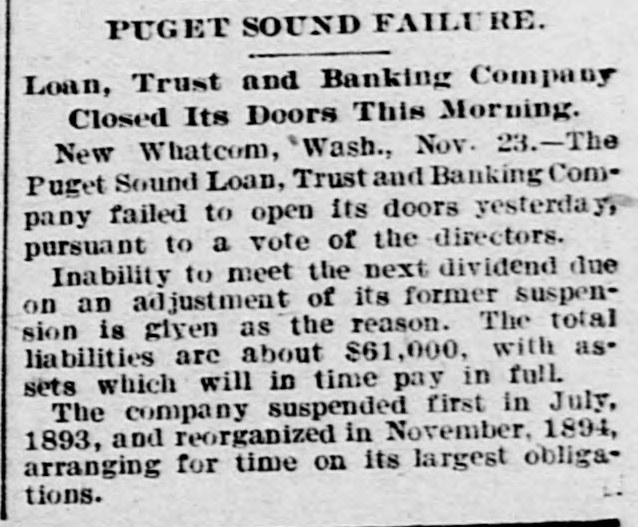
Loan, Trust and Banking Company Closed Its Doors This Morning. New Whatcom, "Wash., Nov. 23.-The Puget Sound Loan, Trust and Banking Company failed to open its doors yesterday, pursuant to a vote of the directors. Inability to meet the next dividend due on an adjustment of its former suspension is given as the reason. The total liabilities are about $61,000, with as* sets which will in time pay in full. The company suspended first in July, 1893, and reorganized in November, 1894, arranging for time on its largest obligations.
Click image to open full size in new tab
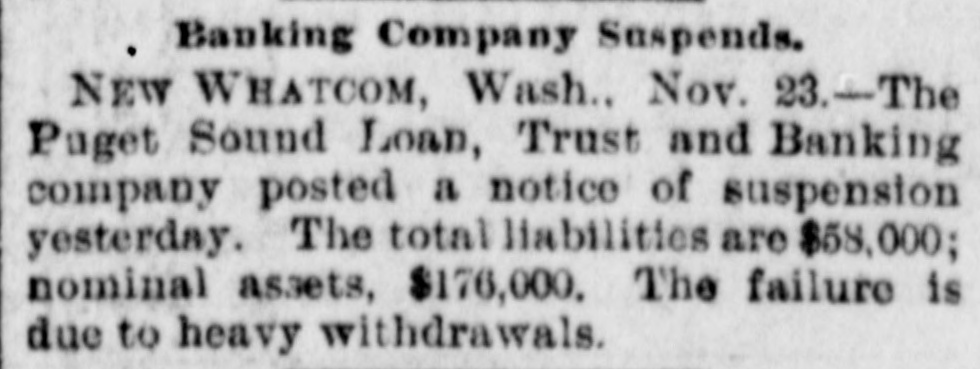
. Banking Company Suspends. NEW WHATCOM, Wash.. Nov. 23.-The Puget Sound Loan, Trust and Banking company posted a notice of suspension yesterday. The total liabilities are $58,000; nominal assets, $176,000. The failure is due to heavy withdrawals.
Click image to open full size in new tab
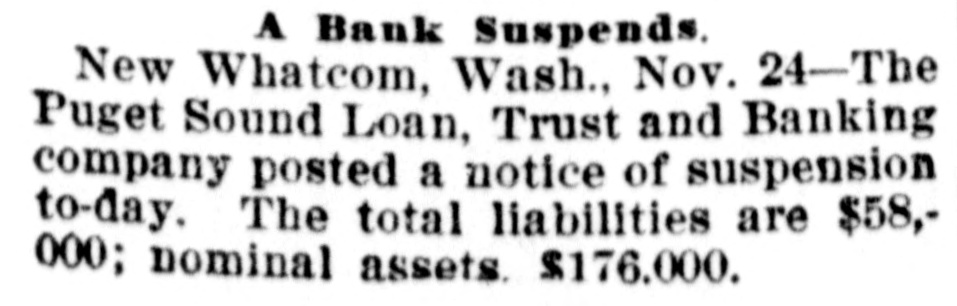
New Whatcom, Wash., Nov. 24-The Puget Sound Loan, Trust and Banking company posted a notice of suspension to-day. The total liabilities are $58,000; nominal assets. $176.000.
Click image to open full size in new tab
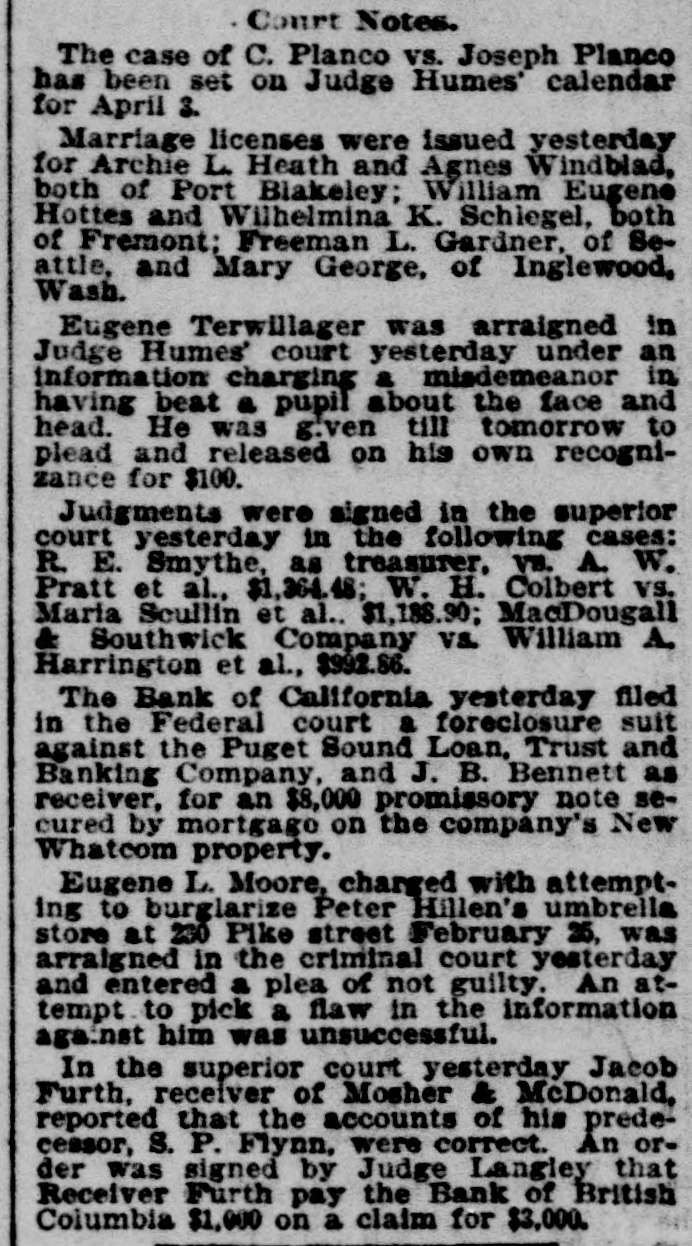
The case of C. Planco vs. Joseph Planco has been set on Judge Humes' calendar for April 3. Marriage licenses were issued yesterday for Archie L. Heath and Agnes Windblad, both of Port Blakeley; William Eugene Hottes and Wilhelmina K. Schiegel, both of Fremont: Freeman L. Gardner, of Seattle, and Mary George, of Inglewood, Wash. Eugene Terwillager was arraigned in Judge Humes' court yesterday under an information charging a misdemeanor in having beat a pupil about the face and head. He was given till tomorrow to plead and released on his own recognizance for $100. Judgments were signed in the superior court yesterday in the following cases: R. E. Smythe, as treasurer, VS. A. W. Pratt et al., $1,364.48; W. H. Colbert vs. Maria Scullin et al., $1,188.90; MacDougall & Southwick Company vs. William A. Harrington et al., $992.86. The Bank of California yesterday filed in the Federal court a foreclosure suit against the Puget Sound Loan, Trust and Banking Company, and J. B. Bennett as receiver, for an $8,000 promissory note secured by mortgage on the company's New Whatcom property. Eugene L. Moore, charged with attempting to burglarize Peter Hillen's umbrella store at 230 Pike street February 25, was arraigned in the criminal court yesterday and entered a plea of not guilty. An attempt to pick a flaw in the information against him was unsuccessful. In the superior court yesterday Jacob Furth, receiver of Mosher & McDonald, reported that the accounts of his predecessor, S. P. Flynn, were correct. An order was signed by Judge Langley that Receiver Furth pay the Bank of British Columbia $1,000 on a claim for $3,000.
Click image to open full size in new tab
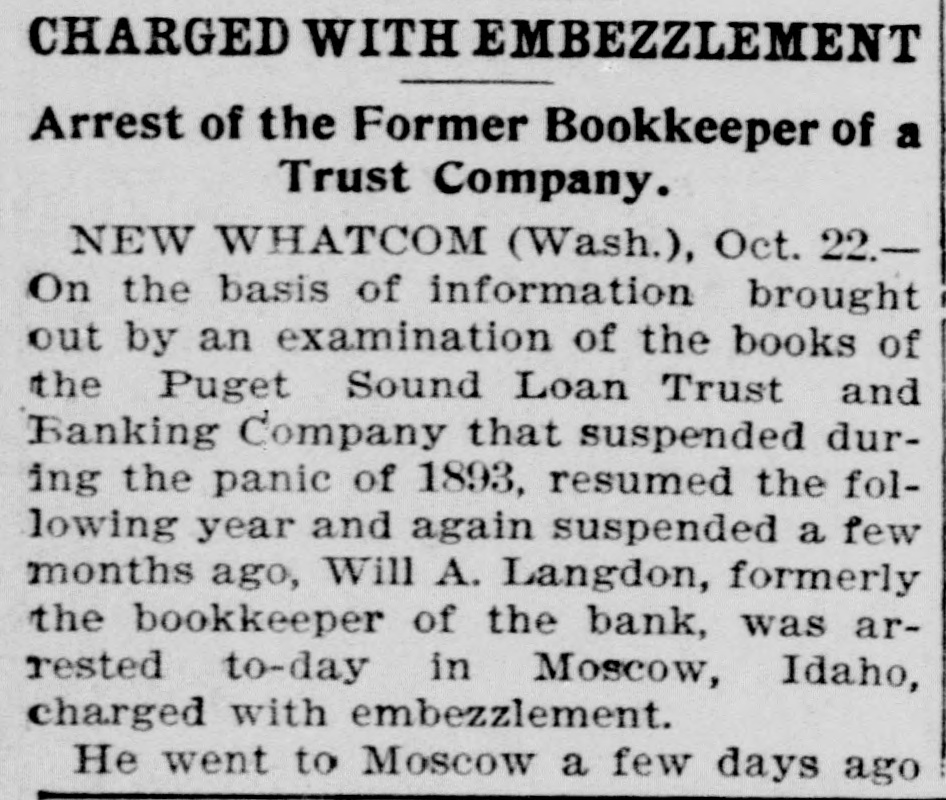
CHARGED WITH EMBEZZLEMENT Arrest of the Former Bookkeeper of a Trust Company. NEW WHATCOM (Wash.), Oct. 22.On the basis of information brought out by an examination of the books of the Puget Sound Loan Trust and Banking Company that suspended during the panic of 1893, resumed the following year and again suspended a few months ago, Will A. Langdon, formerly the bookkeeper of the bank, was arrested to-day in Moscow, Idaho, charged with embezzlement. He went to Moscow a few days ago