Mercantile National Bank (Pueblo, CO)

Episode Information

Episode Type
Run → Suspension → Closure
Start Date
March 29, 1915
Location
Pueblo, Colorado (38.254, -104.609)
Bank Type
national
Charter Number
4108
Alt. names
American National Bank

Metadata

Response Measures

Full suspension, Books examined

Other: Bank was closed by order of the controller of currency and placed in the hands of a receiver (receivership/closure following examiner investigation).

Receivership Details

Depositor recovery rate
84.0%
Date receivership started
1915-03-30
Date receivership terminated
1923-09-19
OCC cause of failure
Fraud
Share of assets assessed as good
48.7%
Share of assets assessed as doubtful
17.8%
Share of assets assessed as worthless
33.5%

Events (5)

1. August 31, 1889 Chartered
Source
historical_nic
2. March 29, 1915 Run
Cause
Bank Specific Adverse Info
Cause Details
Runs followed sudden resignation of cashier and reports of poor loans and an examiner investigating the institution.
Newspaper Excerpt
The Mercantile National bank closed its doors here today, after the beginning of a run by depositors.
Source
newspapers
3. March 30, 1915 Suspension
Cause
Government Action
Cause Details
Closed by order of the state controller/controller of currency following the run and reported troubles.
Newspaper Excerpt
The Mercantile National bank ... was closed today by order of the state controller.
Source
newspapers
4. March 30, 1915 Receivership
Newspaper Excerpt
C. C. Slaughter, until recently cashier of the Mercantile National bank of Pueblo, Colo., now in the hands of a receiver, has been indicted by the federal grand jury ... H. H. Seldomridge receiver of the Mercantile National bank of Pueblo, against the Harriman National bank ... when the Mercantile failed ...
Source
newspapers
5. March 30, 1915 Receivership
Source
historical_nic

Newspaper Articles (20)

Article from The Topeka State Journal, March 29, 1915

Click image to open full size in new tab

Article Text

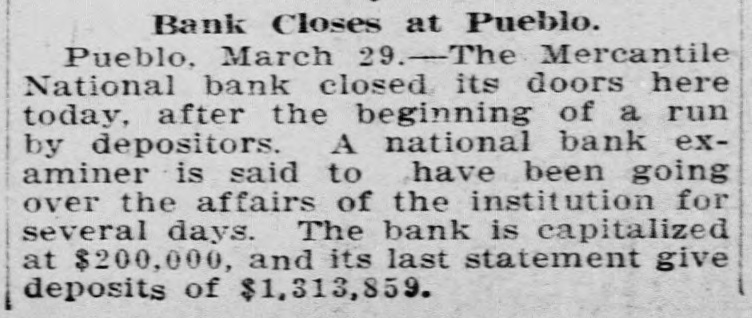
Bank Closes at Pueblo

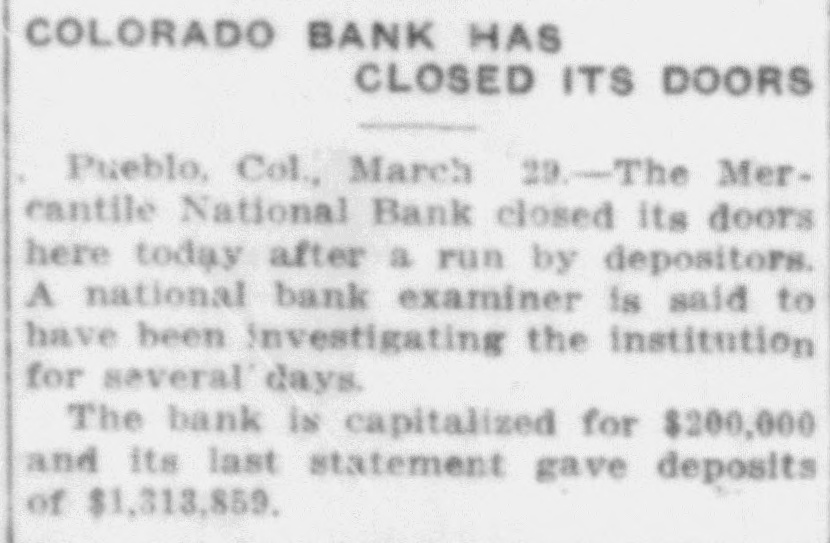
Pueblo, March 29.-The Mercantile National bank closed its doors here today, after the beginning of a run by depositors. A national bank examiner is said to have been going over the affairs of the institution for several days. The bank is capitalized at $200,000, and its last statement give deposits of $1,313,859.


Article from Daily Capital Journal, March 29, 1915

Click image to open full size in new tab

Article Text

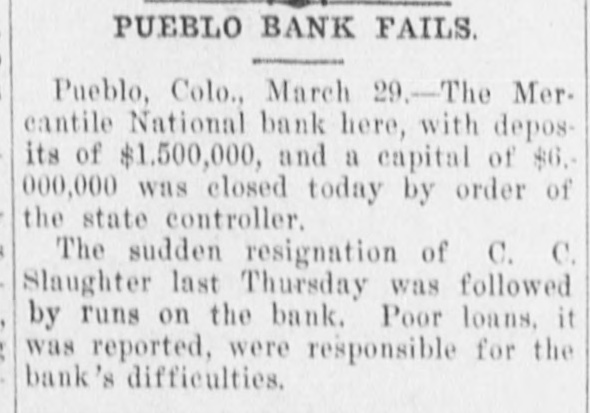
PUEBLO BANK FAILS

Pueblo, Colo., March 29.-The Mercantile National bank here, with deposits of $1,500,000, and a capital of $6.000,000 was closed today by order of the state controller. The sudden resignation of C. C. Slaughter last Thursday was followed by runs on the bank. Poor loans, it was reported, were responsible for the bank's difficulties.


Article from Daily Kennebec Journal, March 30, 1915

Click image to open full size in new tab

Article Text

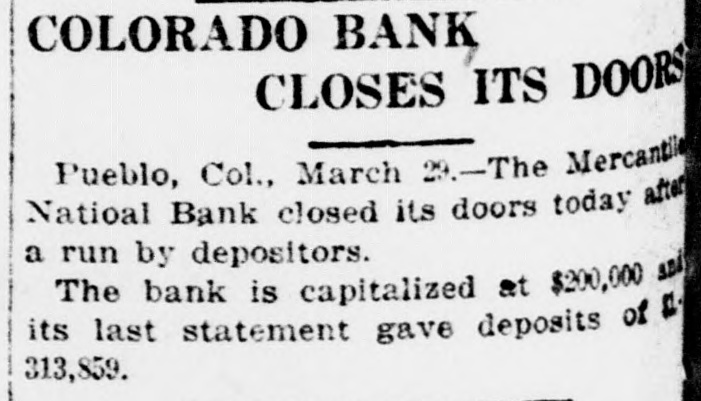
COLORADO BANK CLOSES ITS DOORS Pueblo, Col., March 29.-The Mercantile Natioal Bank closed its doors today after a run by depositors. The bank is capitalized at $200,000 and its last statement gave deposits of n 313,859.


Article from The Pensacola Journal, March 30, 1915

Click image to open full size in new tab

Article Text

COLORADO BANK HAS CLOSED ITS DOORS Pueblo, Col., March 29.-The Mercantile National Bank closed its doors here today after a run by depositors. A national bank examiner is said to have been investigating the institution for several' days. The bank is capitalized for $200,000 and its last statement gave deposits of $1,313,859.


Article from Weekly Journal-Miner, March 31, 1915

Click image to open full size in new tab

Article Text

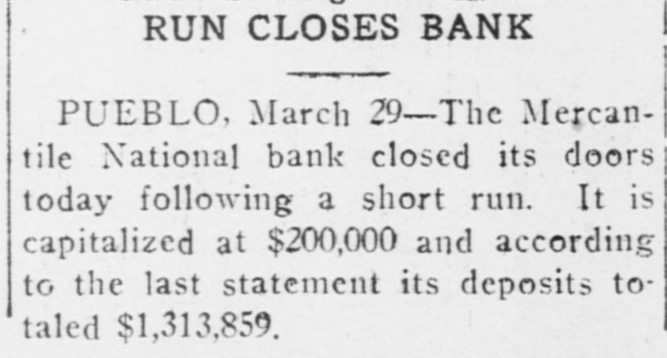
RUN CLOSES BANK PUEBLO, March 29-The Mercantile National bank closed its doors today following a short run. It is capitalized at $200,000 and according to the last statement its deposits to taled $1,313,859.


Article from Abilene Weekly Reflector, April 1, 1915

Click image to open full size in new tab

Article Text

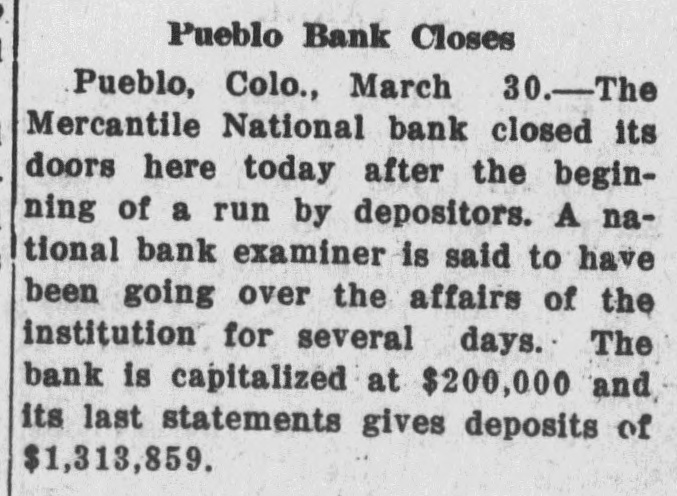
Pueblo Bank Closes Pueblo, Colo., March 30.-The Mercantile National bank closed its doors here today after the beginning of a run by depositors. A national bank examiner is said to have been going over the affairs of the institution for several days. The bank is capitalized at $200,000 and its last statements gives deposits of $1,313,859.


Article from Eagle River Review, April 2, 1915

Click image to open full size in new tab

Article Text

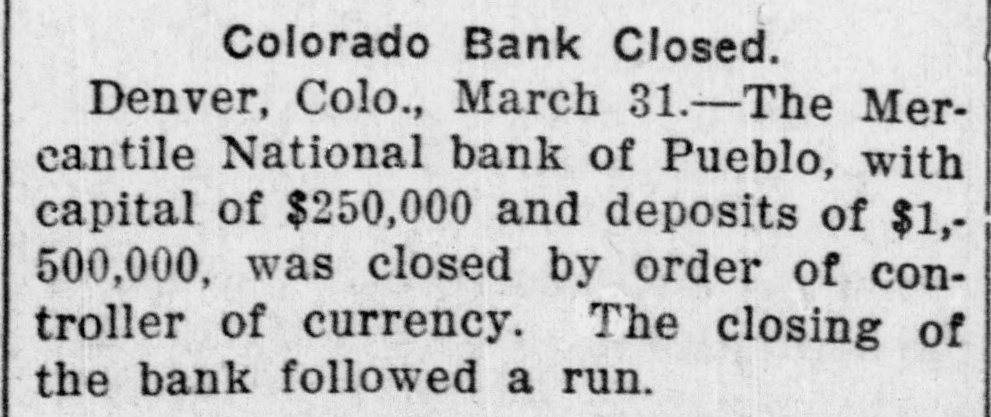
Colorado Bank Closed

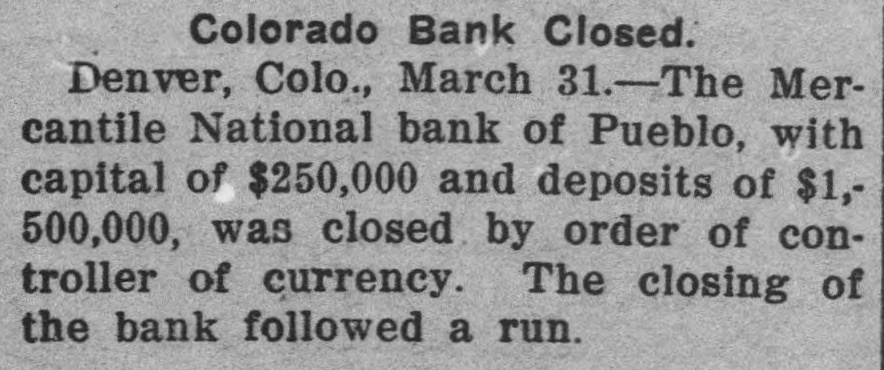
Denver, Colo., March 31.-The Mercantile National bank of Pueblo, with capital of $250,000 and deposits of $1,500,000, was closed by order of controller of currency. The closing of the bank followed a run.


Article from Northern Wisconsin Advertiser, April 2, 1915

Click image to open full size in new tab

Article Text

Colorado Bank Closed

Denver, Colo., March 31.-The Mercantile National bank of Pueblo, with capital of $250,000 and deposits of $1,500,000, was closed by order of controller of currency. The closing of the bank followed a run.


Article from Wauwatosa News, April 2, 1915

Click image to open full size in new tab

Article Text

Colorado Bank Closed

Denver, Colo., March 31.-The Mercantile National bank of Pueblo, with capital of $250,000 and deposits of $1,500,000, was closed by order of controller of currency. The closing of the bank followed a run.


Article from Wausau Pilot, April 6, 1915

Click image to open full size in new tab

Article Text

Colorado Bank Closed

Denver, Colo., March 31.-The Mercantile National bank of Pueblo, with capital of $250,000 and deposits of $1,500,000, was closed by order of controller of currency. The closing of the bank followed a run.


Article from Vernon County Censor, April 7, 1915

Click image to open full size in new tab

Article Text

Colorado Bank Closed

Denver, Colo., March 31.-The Mercantile National bank of Pueblo, with capital of $250,000 and deposits of $1,500,000, was closed by order of controller of currency. The closing of the bank followed a run. a


Article from Clearwater Republican, April 16, 1915

Click image to open full size in new tab

Article Text

WORLD'S NEWS
BRIEFLY ITEMIZED

ITEMS OF GENERAL INTEREST FRESH FROM OUR DAILY NEWSPAPER SERVICE.

GATHERED OVER THE GLOBE

Happenings National, Historical and Political and Personal Events Herewith Selected for Our Many Readers.

Lord Kitchener has called on Canada for a second expeditionary force.

Two cases of bubonic plague and one death at Havana were reported Sunday.

Peter S. McNally of Boston, formerly widely known as a long-distance swimmer and life saver, died of heart failure Saturday.

Pope Benedict has issued a decree for the recital of prayers for peace in Roman Catholic churches over the world during the month of May.

American shipbuilding during the nine months ended March 31 has not kept pace with construction during the same period of the previous year.

The purchase of a site upon which to erect at Niles, Ohio a $300,000 memorial to President McKinley, who at one time lived there, took place Monday.

Six thousand bales of American cotton aboard the steamer San Guglielmo were destroyed by fire in the Naples harbor recently. The loss is estimated at 1,000,000 lire ($200,000).

Carranza authorities in Nuevo Laredo announce that all danger of an early Villa attack upon the border city had been removed by the retreat of Villa forces in that territory.

Salt Lake's 5-cent fare automobile service was discontinued Saturday as a result of the inability of the operators to obtain the surety bonds required by the city ordinance recently enacted.

The British steamer Harpalyce, the first relief boat of New York state and under charter to the commission for relief in Belgium, has either been torpedoed or sunk by a mine in the North sea.

Coney C. Slaughter, until recently cashier of the Mercantile National bank of Pueblo, Colo., now in the hands of a receiver, has been indicted by the federal grand jury on a charge of falsifying the books of the bank.

Jean Herail, an officer in the French cavalry, was acquitted by a court martial, which tried him for killing his wife at Compiegne last November because she persisted in following the army in order to be near him.

The Iowa senate has passed the Klinker bill, which provides that absent voters may send their ballots to their home precincts by mail. It was designed primarily for the benefit of traveling men. The bill now goes to the governor, having already been passed in the house.
Article from The Lamar Register, April 28, 1915

Click image to open full size in new tab

Article Text

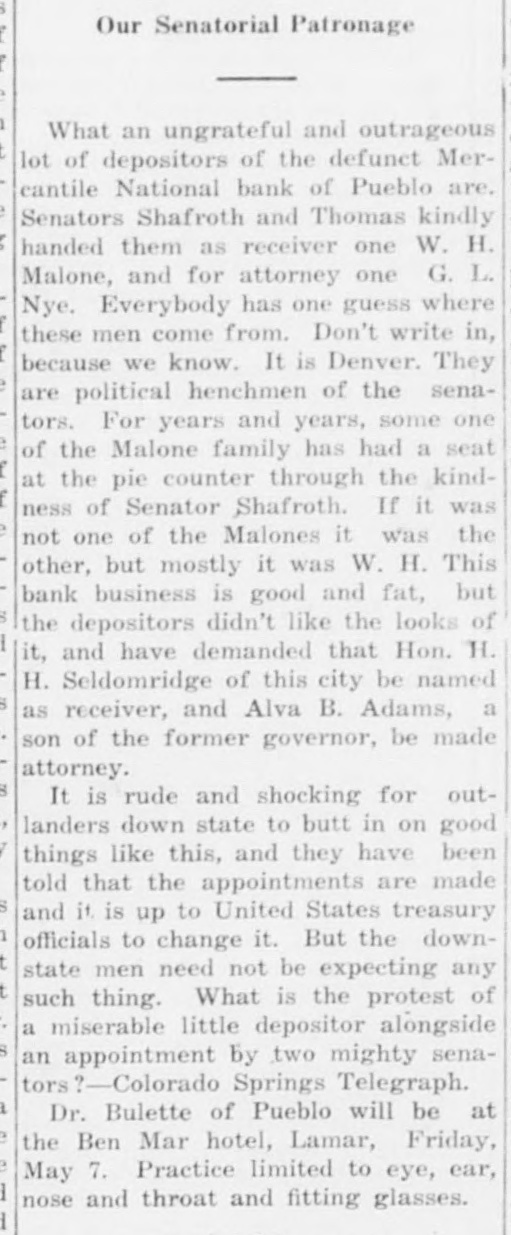
Our Senatorial Patronage What an ungrateful and outrageous lot of depositors of the defunct Mercantile National bank of Pueblo are. Senators Shafroth and Thomas kindly handed them as receiver one W. H. Malone, and for attorney one G. L. Nye. Everybody has one guess where these men come from. Don't write in, because we know. It is Denver. They are political henchmen of the senators. For years and years, some one of the Malone family has had a seat at the pie counter through the kindness of Senator Shafroth. If it was not one of the Malones it was the other, but mostly it was W. H. This bank business is good and fat, but the depositors didn't like the looks of it, and have demanded that Hon. H. H. Seldomridge of this city be named as receiver, and Alva B. Adams, a son of the former governor, be made attorney. It is rude and shocking for outlanders down state to butt in on good things like this, and they have been told that the appointments are made and it is up to United States treasury officials to change it. But the downstate men need not be expecting any such thing. What is the protest of a miserable little depositor alongside an appointment by two mighty senators ?-Colorado Springs Telegraph. Dr. Bulette of Pueblo will be at the Ben Mar hotel, Lamar, Friday, May 7. Practice limited to eye, ear, nose and throat and fitting glasses.


Article from The Dolores Star, September 17, 1915

Click image to open full size in new tab

Article Text

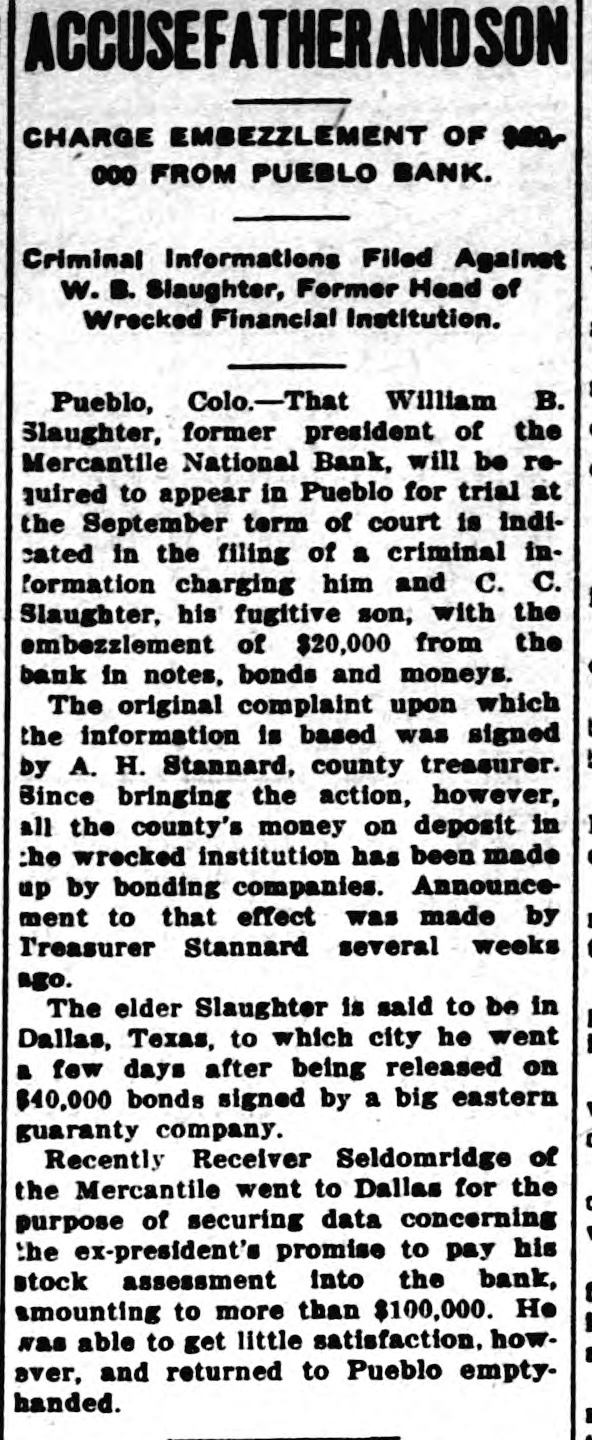
ACCUSEFATHERANDSON

CHARGE EMBEZZLEMENT OF $20,- 000 FROM PUEBLO BANK.

Criminal Informations Filed Against W. B. Slaughter, Former Head of Wrecked Financial Institution.

Pueblo, Colo.-That William B. Slaughter, former president of the Mercantile National Bank, will be re- quired to appear in Pueblo for trial at the September term of court is indi- cated in the filing of a criminal in- formation charging him and C. C. Slaughter, his fugitive son, with the embezzlement of $20,000 from the bank in notes, bonds and moneys.

The original complaint upon which the information is based was signed by A. H. Stannard, county treasurer. Since bringing the action, however, all the county's money on deposit in the wrecked institution has been made up by bonding companies. Announce- ment to that effect was made by Treasurer Stannard several weeks ago.

The elder Slaughter is said to be in Dallas, Texas, to which city he went a few days after being released on $40,000 bonds signed by a big eastern guaranty company.

Recently Receiver Seldomridge of the Mercantile went to Dallas for the purpose of securing data concerning the ex-president's promise to pay his stock assessment into the bank, amounting to more than $100,000. He was able to get little satisfaction, how- ever, and returned to Pueblo empty- handed.


Article from Semi-Weekly Herald, October 28, 1915

Click image to open full size in new tab

Article Text

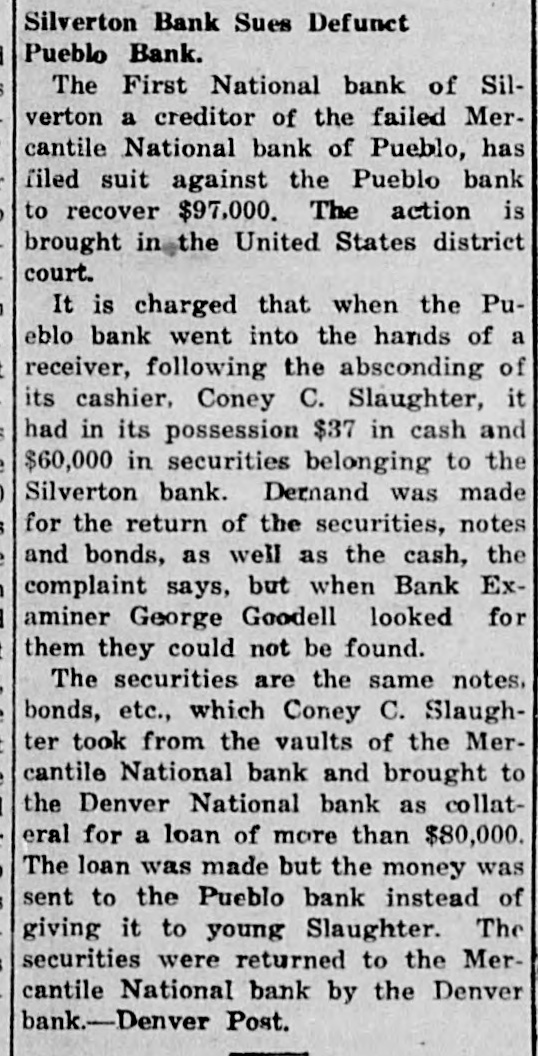
Silverton Bank Sues Defunct Pueblo Bank. The First National bank of Silverton a creditor of the failed Mercantile National bank of Pueblo, has filed suit against the Pueblo bank to recover $97,000. The action is brought in the United States district court. It is charged that when the Pueblo bank went into the hands of a receiver, following the absconding of its cashier, Coney C. Slaughter, it had in its possession $37 in cash and $60,000 in securities belonging to the Silverton bank. Dernand was made for the return of the securities, notes and bonds, as well as the cash, the complaint says, but when Bank Examiner George Goodell looked for them they could not be found. The securities are the same notes. bonds, etc., which Coney C. Slaughter took from the vaults of the Mercantile National bank and brought to the Denver National bank as collateral for a loan of more than $80,000. The loan was made but the money was sent to the Pueblo bank instead of giving it to young Slaughter. The securities were returned to the Mercantile National bank by the Denver bank.-Denver Post.


Article from The Julesburg Grit-Advocate, June 8, 1916

Click image to open full size in new tab

Article Text

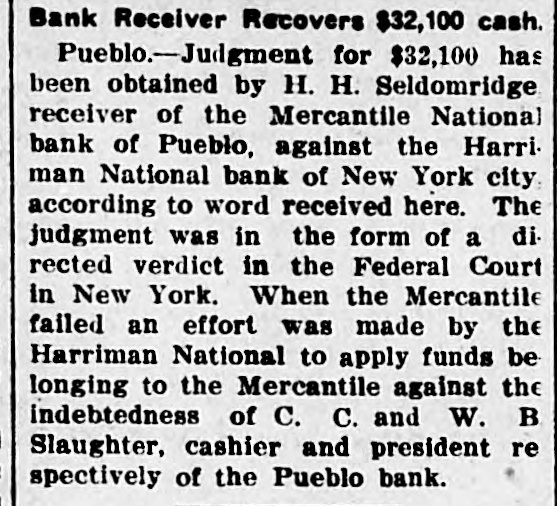
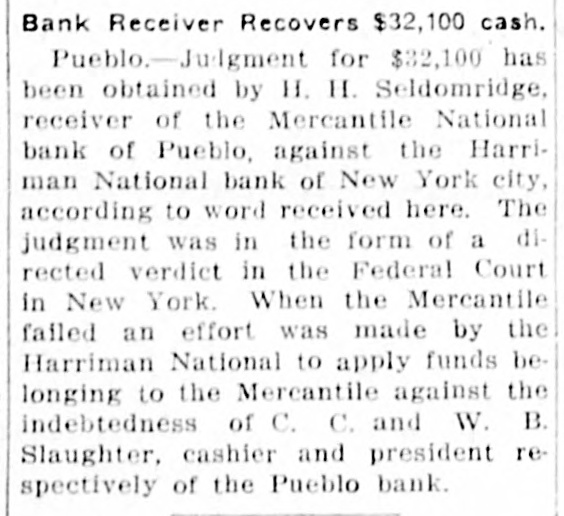
Bank Receiver Recovers $32,100 cash. Pueblo.-Judgment for $32,100 has been obtained by H. H. Seldomridge receiver of the Mercantile National bank of Pueblo, against the Harriman National bank of New York city according to word received here. The judgment was in the form of a directed verdict in the Federal Court in New York. When the Mercantile failed an effort was made by the Harriman National to apply funds be longing to the Mercantile against the indebtedness of C. C. and W. B Slaughter, cashier and president re spectively of the Pueblo bank.


Article from The Arvada Enterprise, June 8, 1916

Click image to open full size in new tab

Article Text

Bank Receiver Recovers $32,100 cash.

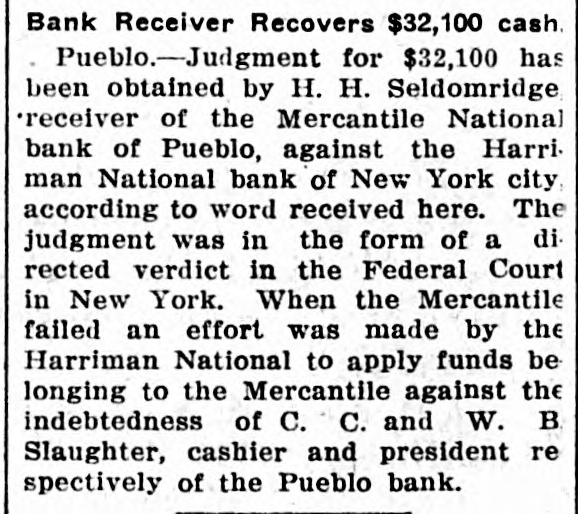
Pueblo.—Judgment for $32,100 has been obtained by H. H. Seldomridge, receiver of the Mercantile National bank of Pueblo, against the Harriman National bank of New York city, according to word received here. The judgment was in the form of a directed verdict in the Federal Court in New York. When the Mercantile failed an effort was made by the Harriman National to apply funds belonging to the Mercantile against the indebtedness of C. C. and W. B. Slaughter, cashier and president respectively of the Pueblo bank.


Article from Cheyenne Record, June 8, 1916

Click image to open full size in new tab

Article Text

Bank Receiver Recovers $32,100 cash. Pueblo.-Judgment for $32,100 has been obtained by H. H. Seldomridge receiver of the Mercantile National bank of Pueblo, against the Harri. man National bank of New York city according to word received here. The judgment was in the form of a directed verdict in the Federal Court in New York. When the Mercantile failed an effort was made by the Harriman National to apply funds be longing to the Mercantile against the indebtedness of C. C. and W. B. Slaughter, cashier and president re spectively of the Pueblo bank.


Article from San Antonio Light, April 10, 1923

Click image to open full size in new tab

Article Text

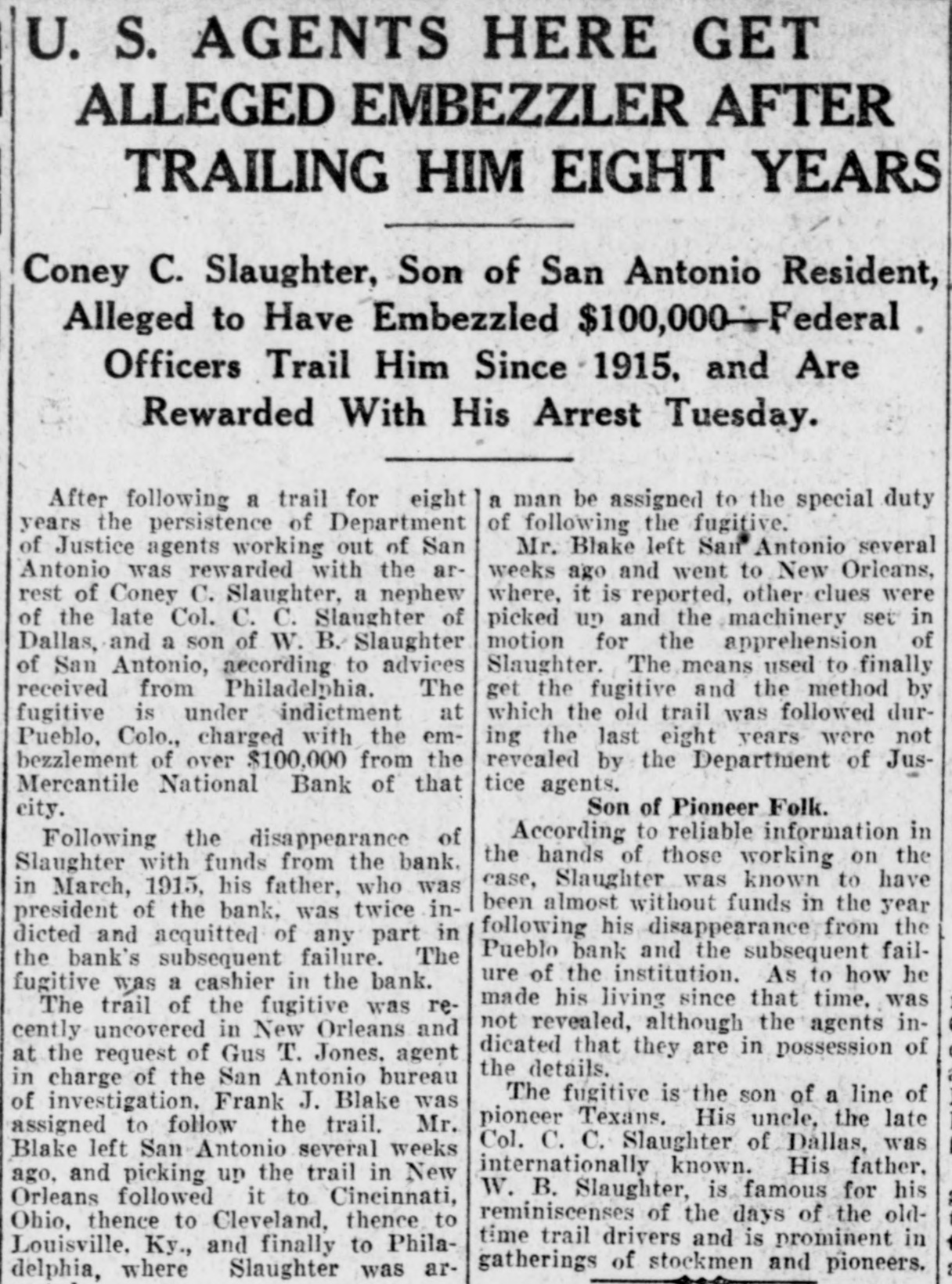
U. S. AGENTS HERE GET ALLEGED EMBEZZLER AFTER TRAILING HIM EIGHT YEARS Coney C. Slaughter, Son of San Antonio Resident, Alleged to Have Embezzled $100,000 Federal Officers Trail Him Since 1915, and Are Rewarded With His Arrest Tuesday. a man be assigned to the special duty After following a trail for eight years the persistence of Department of following the fugitive. Mr. Blake left San Antonio several of Justice agents working out of San Antonio was rewarded with the arweeks ago and went to New Orleans, rest of Coney C. Slaughter, a nephew where, it is reported, other clues were of the late Col. C. C. Slaughter of picked up and the machinery set in Dallas, and a son of W. B. Slaughter motion for the apprehension of Slaughter. The means used to finally of San Antonio, according to advices get the fugitive and the method by received from Philadelphia. The which the old trail was followed durfugitive is under indictment at Pueblo, Colo., charged with the eming the last eight years were not bezzlement of over $100,000 from the revealed by the Department of JusMercantile National Bank of that tice agents. Son of Pioneer Folk. city. According to reliable information in Following the disappearance of the hands of those working on the Slaughter with funds from the bank. case, Slaughter was known to have in March, 1915, his father, who was been almost without funds in the year president of the bank, was twice infollowing his disappearance from the dicted and acquitted of any part in Pueblo bank and the subsequent failthe bank's subsequent failure. The ure of the institution. As to how he fugitive was a cashier in the bank. made his living since that time, was The trail of the fugitive was renot revealed, although the agents incently uncovered in New Orleans and dicated that they are in possession of at the request of Gus T. Jones. agent the details. in charge of the San Antonio bureau The fugitive is the son of a line of of investigation. Frank J. Blake was pioneer Texans. His uncle, the late assigned to follow the trail. Mr. Col. C. C. Slaughter of Dallas, was Blake left San Antonio several weeks internationally known. His father, ago, and picking up the trail in New W. B. Slaughter, is famous for his Orleans followed it to Cineinnati, reminiscenses of the days of the oldOhio, thence to Cleveland, thence to time trail drivers and is prominent in Louisville, Ky., and finally to Philagatherings of stockmen and pioneers. delphia, where Slaughter was ar-


Article from The Kansas City Star, April 10, 1923

Click image to open full size in new tab

Article Text

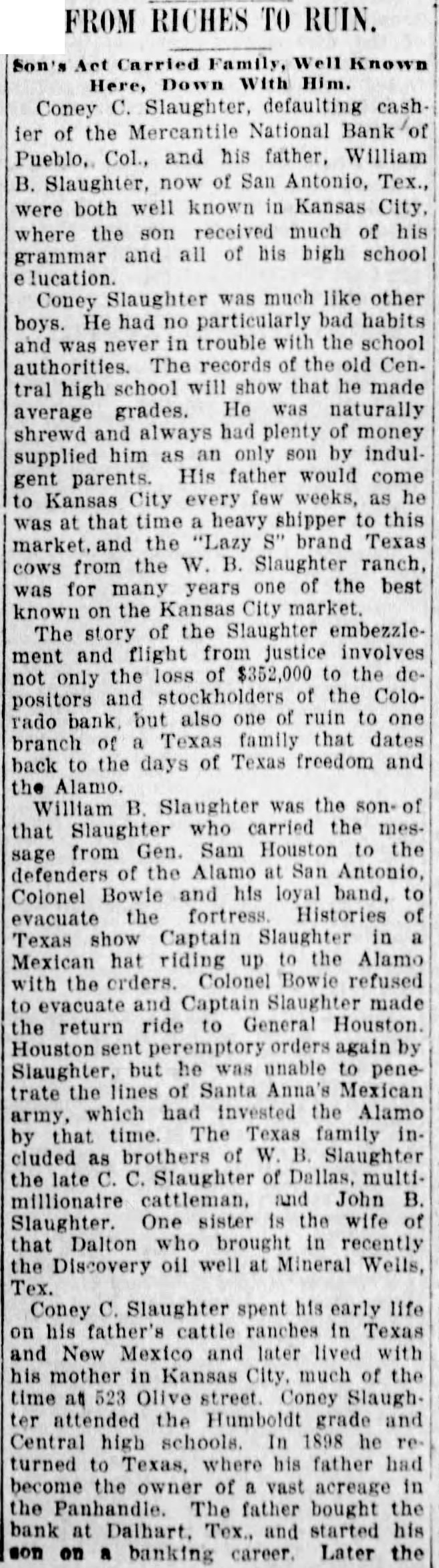
FROM RICHES TO RUIN.

Son's Act Carried Family, Well Known Here, Down With Him.

Coney C. Slaughter, defaulting cashier of the Mercantile National Bank of Pueblo, Col., and his father, William B. Slaughter, now of San Antonio, Tex., were both well known in Kansas City, where the son received much of his grammar and all of his high school education.

Coney Slaughter was much like other boys. He had no particularly bad habits and was never in trouble with the school authorities. The records of the old Central high school will show that he made average grades. He was naturally shrewd and always had plenty of money supplied him as an only son by indulgent parents. His father would come to Kansas City every few weeks, as he was at that time a heavy shipper to this market, and the "Lazy S" brand Texas cows from the W. B. Slaughter ranch, was for many years one of the best known on the Kansas City market.

The story of the Slaughter embezzlement and flight from justice involves not only the loss of $352,000 to the depositors and stockholders of the Colorado bank, but also one of ruin to one branch of a Texas family that dates back to the days of Texas freedom and the Alamo.

William B. Slaughter was the son of that Slaughter who carried the message from Gen. Sam Houston to the defenders of the Alamo at San Antonio, Colonel Bowie and his loyal band, to evacuate the fortress. Histories of Texas show Captain Slaughter in a Mexican hat riding up to the Alamo with the orders. Colonel Bowie refused to evacuate and Captain Slaughter made the return ride to General Houston. Houston sent peremptory orders again by Slaughter, but he was unable to penetrate the lines of Santa Anna's Mexican army, which had invested the Alamo by that time. The Texas family included as brothers of W. B. Slaughter the late C. C. Slaughter of Dallas, multimillionaire cattleman, and John B. Slaughter. One sister is the wife of that Dalton who brought in recently the Discovery oil well at Mineral Wells, Tex.

Coney C. Slaughter spent his early life on his father's cattle ranches in Texas and New Mexico and later lived with his mother in Kansas City, much of the time at 523 Olive street. Coney Slaughter attended the Humboldt grade and Central high schools. In 1898 he returned to Texas, where his father had become the owner of a vast acreage in the Panhandle. The father bought the bank at Dalhart, Tex., and started his son on a banking career. Later the