First State Bank (Wildrose, ND)

Episode Information

Episode UID
4096325291521
Episode Type
Suspension β†’ Closure
Bank Type
state
Bank ID
409632529 hash
Start Date
September 1, 1926
Location
Wildrose, North Dakota (48.631, -103.184)

Metadata

Model
gpt-5-mini (chosen from majority vote of a three-model LLM ensemble)
Short Digest
75a33ab69d1ddb5e

Response Measures

None

Description

A receiver (L. R. Baird) is already substituted for the bank in court records, indicating closure/receivership.

Events (1)

1. September 1, 1926 Receivership
Newspaper Excerpt
L. R. Baird, as receiver of the First State Bank of Wildrose, (substituted for said bank as a defendant)
Source
newspapers

Newspaper Articles (2)

Article from The Bismarck Tribune, September 1, 1926

Click image to open full size in new tab

Article Text

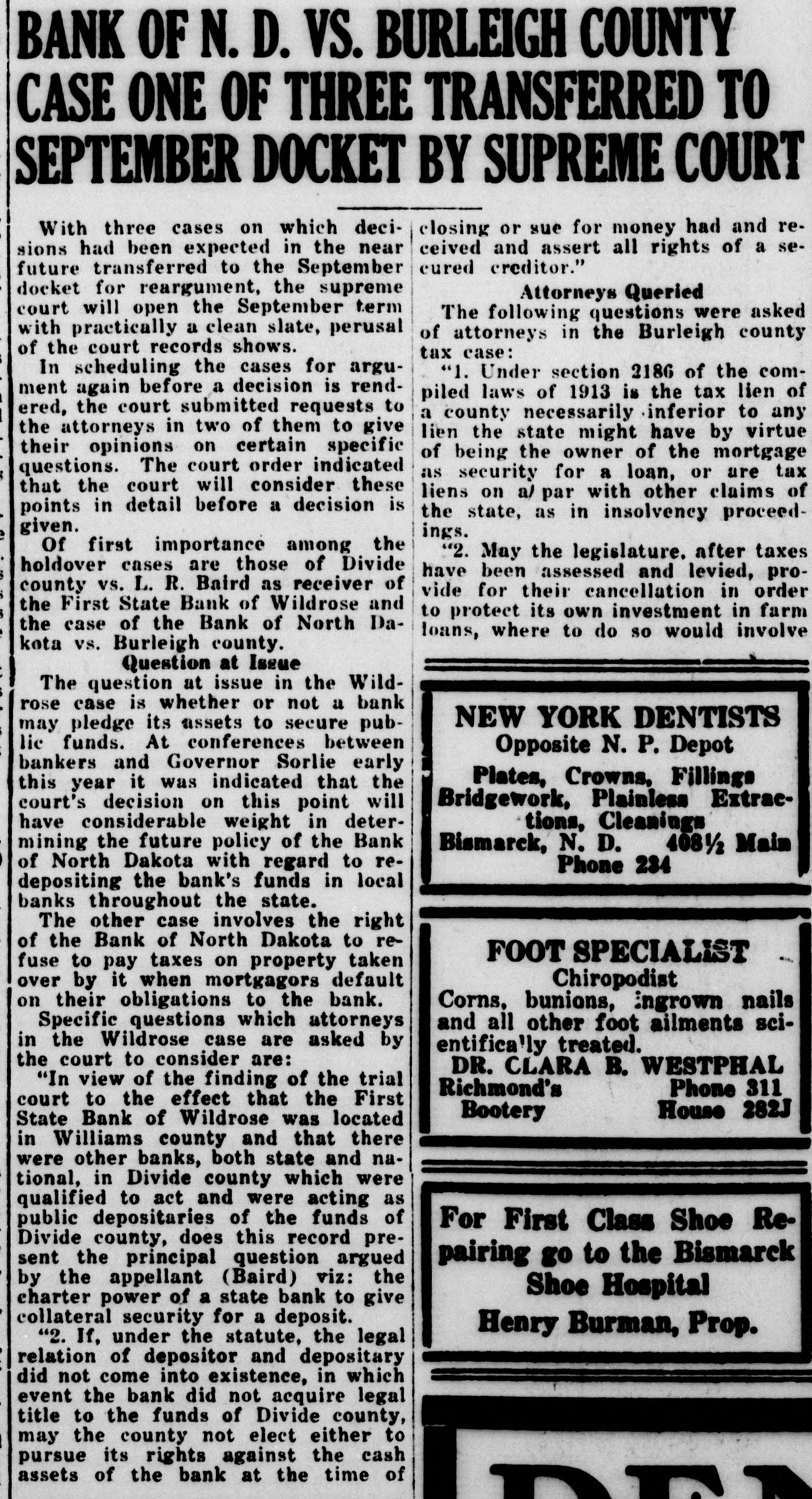
BANK OF N. D. VS. BURLEIGH COUNTY CASE ONE OF THREE TRANSFERRED TO SEPTEMBER DOCKET BY SUPREME COURT With three cases on which deciclosing or sue for money had and received and assert all rights of a sesions had been expected in the near cured creditor." future transferred to the September docket for reargument, the supreme Attorneys Queried court will open the September term The following questions were asked with practically a clean slate, perusal of attorneys in the Burleigh county of the court records shows. tax case: In scheduling the cases for argu"1. Under section 2186 of the comment again before a decision is rendpiled laws of 1913 is the tax lien of ered, the court submitted requests to a county necessarily inferior to any the attorneys in two of them to give lien the state might have by virtue their opinions on certain specific of being the owner of the mortgage questions. The court order indicated as security for a loan, or are tax that the court will consider these liens on a/ par with other claims of points in detail before a decision is the state, as in insolvency proceedgiven. ings. Of first importance among the "2. May the legislature. after taxes holdover cases are those of Divide have been assessed and levied, procounty vs. L. R. Baird as receiver of vide for their cancellation in order the First State Bank of Wildrose and to protect its own investment in farm the case of the Bank of North Daloans, where to do so would involve kota vs. Burleigh county. Question at Issue The question at issue in the Wildrose case is whether or not a bank NEW YORK DENTISTS may pledge its assets to secure public funds. At conferences between Opposite N. P. Depot bankers and Governor Sorlie early Plates, Crowns, Fillings this year it was indicated that the Bridgework, Plainless Extraccourt's decision on this point will have considerable weight in detertions, Cleanings mining the future policy of the Bank Main Bismarck, N. D. 4081/2 of North Dakota with regard to rePhone 234 depositing the bank's funds in local banks throughout the state. The other case involves the right of the Bank of North Dakota to reFOOT SPECIALIST fuse to pay taxes on property taken over by it when mortgagors default Chiropodist on their obligations to the bank. Corns, bunions, Engrown nails Specific questions which attorneys and all other foot ailments sciin the Wildrose case are asked by entifically treated. the court to consider are: DR. CLARA B. WESTPHAL "In view of the finding of the trial Richmond's Phone 311 court to the effect that the First House 282J Bootery State Bank of Wildrose was located in Williams county and that there were other banks, both state and national, in Divide county which were qualified to act and were acting as public depositaries of the funds of For First Class Shoe ReDivide county, does this record present the principal question argued pairing go to the Bismarck by the appellant (Baird) viz: the Shoe Hospital charter power of a state bank to give collateral security for a deposit. Henry Burman, Prop. "2. If, under the statute, the legal relation of depositor and depositary did not come into existence, in which event the bank did not acquire legal title to the funds of Divide county, may the county not elect either to pursue its rights against the cash assets of the bank at the time of


Article from The Bismarck Tribune, November 27, 1926

Click image to open full size in new tab

Article Text

# SUPREME COURT From Divide County County of Divide, a municipal corporation, Plaintiff and Respondent, vs. L. R. Baird, as receiver of the First State Bank of Wildrose, (substituted for said bank as a defendant), Defendant and Appellant, and C. A. Christianson, et al, Defendants and Respondents. Syllabus: 1. The business of banking is affected with a public interest and the legislature may prohibit it altogether, or may prescribe the conditions under which it may be conducted. 2. A bank has such powers as are expressly given it; these are express powers. In addition, it may exercise certain powers which are incidental to those expressly given; but the incidental powers are such only as are necessary to carry on the business of banking, that is, such as are incidental to the powers expressly enumerated. 3. A banking corporation is created for a more limited and special purpose than is a corporation organized under the general statutory charter, for the purpose of conducting ordinary business; it is the grantee of the exclusive privilege to do a specified business in a manner circumstanced by definite restrictions. It is wholly the creature of statute; and it does business by legislative grace. 4. The pledging of assets to secure a general deposit cannot be sustained as the exercise of an incidental power, necessary to carry on the business of banking. An attempt to pledge goes beyond the charter powers of the corporation and is not an incident to the privilege to receive general deposits. 5. The legislature has prescribed the mode in which a bank may receive and a public corporation make a deposit of public funds. That mode is by a personal or surety bond as security. This statute is a part of the corporate charter, insofar as it relates to the exercise of power by a bank. The power is express, not incidental or implied; and when a legislative enactment prescribes one mode of exercising an express power or privilege, it implies an inhibition to exercise the given power in any other way. 6. When a pledge of a bank's bills receivable is wholly gratuitous, one which the public board could not require or the bank make, even had the latter been authorized by the directors, such pledge is no part of the contract of deposit; nor is it in any legal sense a part of the consideration therefor. 7. The legislature has at all times since statehood recognized a distinction between a loan and deposit of money; and in the case of the funds of public corporation loans have been prohibited while deposits thereof have been sanctioned by law. From the fact that a bank may secure a loan, by pledging its bills receivable, the inference is not warranted that the legislature intended to give the banks the power to pledge their assets to secure either a public or a private deposit. 8. The general creditors of a bank are innocent parties and have equities which are superior to those of a county seeking to enforce a pledge of assets to secure a public deposit when the defense of ultra vires is interposed against the public corporation. As between the creditors and depositors of an insolvent bank whose contractual relation with the corporation was created lawfully intra viresβ€”and the plaintiff, whose contract of pledge was ultra vires of the bank, the former must be preferred, and they are not estopped to assert the want of power. 9. A county is a political subdivision of the state; and it may speak and act only in the manner and in the matters prescribed by the legislature in statutes enacted pursuant to constitutional authority.