United States Bank of Pennsylvania (Philadelphia, PA)

Episode Information

Episode Type
Run → Suspension → Closure
Start Date
October 1, 1839*
Location
Philadelphia, Pennsylvania (39.952, -75.164)
Bank Type
state

Metadata

Notes

Multiple suspensions beginning 1839; final run/suspension in Feb 1841 followed by partial assignment later that year.

Events (5)

1. October 1, 1839* Suspension
Cause
Bank Specific Adverse Info
Cause Details
Philadelphia banks, including the U.S. Bank, stopped specie payments amid insolvency/over-expansion and contagion from the bank's difficulties
Newspaper Excerpt
the Banks in Philadelphia, [including the U. S. Bank,] had mostly stopped specie payments
Source
newspapers
2. February 6, 1841 Run
Cause
Bank Specific Adverse Info
Cause Details
Heavy drafts presented and reports the bank failed to meet demands generated a large run on the U.S. Bank and others
Measures
Efforts at resumption and coordinated aid were attempted; other Philadelphia banks discussed assistance and temporary measures to enable resumption
Newspaper Excerpt
the streets of our city were filled with a clamarous multitude ... poured ... into all our banks, but particularly into the portals of the U.S. Bank for specie
Source
newspapers
3. February 6, 1841 Suspension
Cause
Bank Specific Adverse Info
Cause Details
Following runs and inability to meet large drafts, the U.S. Bank and most Philadelphia banks suspended specie payments
Newspaper Excerpt
All the Banks of the City, with two or three exceptions, have just suspended specie payments
Source
newspapers
4. September 8, 1841 Other
Newspaper Excerpt
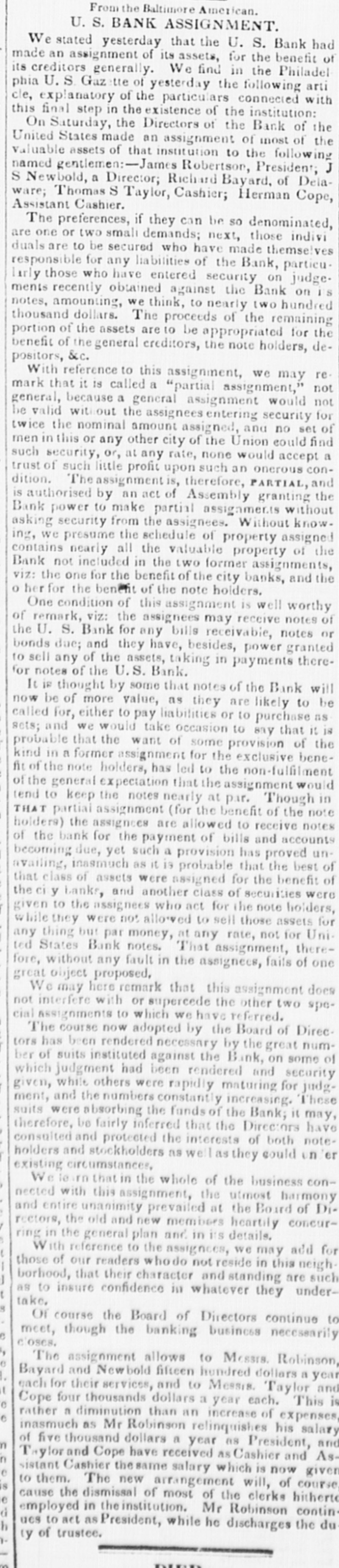
the Directors of the Bank of the United States made an assignment of most of the valuable assets of that institution to the following named gentlemen ... The assignment is, therefore, PARTIAL ... the banking business necessarily closes.
Source
newspapers
5. September 9, 1841 Receivership
Newspaper Excerpt
We stated yesterday that the U. S. Bank had an assignment of its assets, for the benefit of creditors generally ... the Board of Directors continue meet, though the banking business necessarily closes.
Source
newspapers

Newspaper Articles (24)

Article from True American, April 18, 1839

Click image to open full size in new tab

Article Text

s £18,000,000 sterling in 1838. WE DON'T LIKE to see a lady on a bright sun-shiny day, as was yesterday, promenading the banquette when she exhibits such a want of taste as we shall describe. We saw one, who had rather a pretty face, and a passing fair person-some might exclaim in their admiration, quel taille! but the arrangement of her attire was rather outre. Imprimis, she wore a white bonnet and black veil-2dly, a black dress, with black cape, fringed with black lace-3dly, white shoes, and lastly walked under a snuff-colored parasol. Black shoes are becoming with a white dress, but not vice versa. We looked at the lady's face, and hoped she was ugly. We were disappointed, for it had a sweet expression, and as if a better display of taste would have helped it considerably. A heavy black veil is no more fit to accompany a thin, white summer bonnet, than while satin shoes to set off a coarse black bombazet dress. COMMERCIAL AFFAIRS.-Referring to the present condition of commercial affairs, the N. Y. Commercial Advertiser saya: It is not to be denied that the present is a time of severe commercial triel-especially in this city, and also at the South. The banks have been curtailing, stocks are depressed, money is scarce, and there have been a few suspensions. A variety of causes have contributed to this pressure-and among them not a little, the senseless panic that has existed in connexion with the Maine boundary question. Another cause may be found by looking back a few months, in the premature resumption of specie payments by the Bank of the United States. The bank was forced into that resumption by the late executive of Penneylvania. to serve a political object, before, in the sound judgment of Mr Biddle, it ought to have been. Not, however, because of the condition of the bank itself, because, as the event proved, the bank was abundantly able to resume. But it was the desire of the direction of that bank, that the resumption at the south and southwest should be simultaneous, and the Bank of the U. States was then exerting its energies, as it had been for months before, to enable the banks in those directions 10 resuine with it. 'I he consequences of this forced measure are now seen at the south, where the banks are again yielding to the pressure. Yet another cause of the pressure, both in this eity and at the south, is found in the fact that we have too much cotton on hand. The south western banks as well as individuals, have been playing at the hazardous game of monopoly, and in order to effect a rise in the market afroad, tog much of the article has been bought up and kept back at home. Weare informed that there are 90,00 hales on hand. One of two things must take place-either the cotton or the specie must be sent forward.


Article from Rutland Herald, October 22, 1839

Click image to open full size in new tab

Article Text

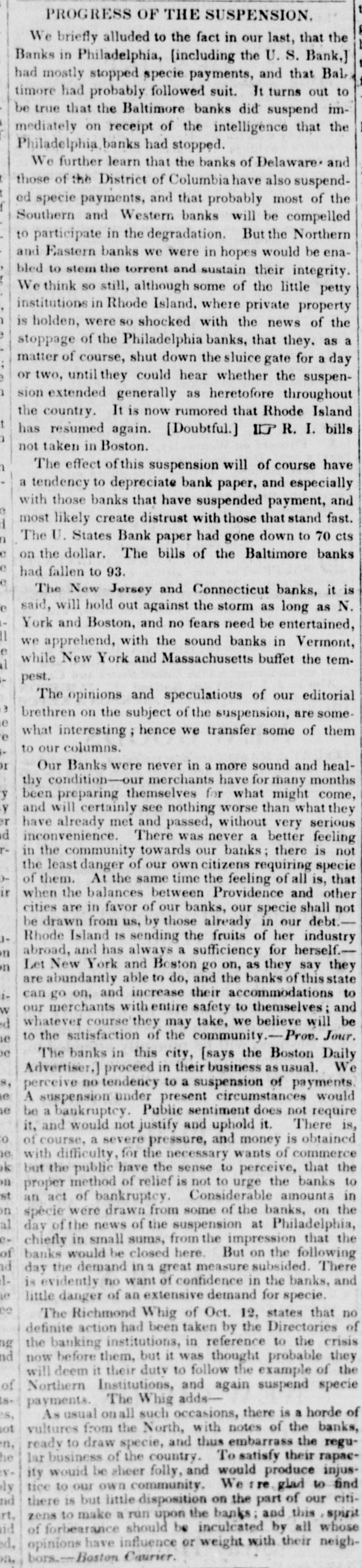
PROGRESS OF THE SUSPENSION.

We briefly alluded to the fact in our last, that the Banks in Philadelphia, [including the U. S. Bank,] had mostly stopped specie payments, and that Baltimore had probably followed suit. It turns out to be true that the Baltimore banks did suspend immediately on receipt of the intelligence that the Philadelphia, banks had stopped. We further learn that the banks of Delaware and those of the District of Columbia have also suspended specie payments, and that probably most of the Southern and Western banks will be compelled to participate in the degradation. But the Northern and Eastern banks we were in hopes would be enabled to stem the torrent and sustain their integrity. We think so still, although some of the little petty institutions in Rhode Island, where private property is holden, were so shocked with the news of the stoppage of the Philadelphia banks, that they, as a matter of course, shut down the sluice gate for a day or two, until they could hear whether the suspension extended generally as heretofore throughout the country. It is now rumored that Rhode Island has resumed again. [Doubtful.] IR. I. bills not taken in Boston.

The effect of this suspension will of course have a tendency to depreciate bank paper, and especially with those banks that have suspended payment, and most likely create distrust with those that stand fast. The U. States Bank paper had gone down to 70 cts on the dollar. The bills of the Baltimore banks had fallen to 93.

The New Jersey and Connecticut banks, it is said, will hold out against the storm as long as N. York and Boston, and no fears need be entertained, we apprehend, with the sound banks in Vermont, while New York and Massachusetts buffet the tempest.

The opinions and speculatious of our editorial brethren on the subject of the suspension, are somewhat interesting ; hence we transfer some of them to our columns.

Our Banks were never in a more sound and healthy condition our merchants have for many months been preparing themselves for what might come, and will certainly see nothing worse than what they have already met and passed, without very serious inconvenience. There was never a better feeling in the community toward our banks; there is not the least danger of our own citizens requiring specie of them. At the same time the feeling of all is, that when the balances between Providence and other cities are in favor of our banks, our specie shall not be drawn from us, by those already in our debt.- Rhode Island is sending the fruits of her industry abroad, and has always a sufficiency for herself.- Let New York and Boston go on, as they say they are abundantly able to do, and the banks of this state can go on, and increase their accommodations to our merchants with entire safety to themselves; and whatever course they may take, we believe will be to the satisfaction of the community.-Prov. Jour.

The banks in this city, [says the Boston Daily Advertiser,] proceed in their business as usual. We perceive no tendency to a suspension of payments. A suspension under present circumstances would be a bankruptcy. Public sentiment does not require it, and would not justify and uphold it. There is, of course, a severe pressure, and money is obtained with difficulty, for the necessary wants of commerce but the public have the sense to perceive, that the proper method of relief is not to urge the banks to an act of bankruptcy. Considerable amounts in specie were drawn from some of the banks, on the day of the news of the suspension at Philadelphia, chiefly in small sums, from the impression that the banks would be closed here. But on the following day the demand in a great measure subsided. There is evidently no want of confidence in the banks, and little danger of an extensive demand for specie.

The Richmond Whig of Oct. 12, states that no definite action had been taken by the Directories of the banking institutions, in reference to the crisis now before them, but it was thought probable they will deem it their duty to follow the example of the Northern Institutions, and again suspend specie payments. The Whig adds-

As usual on all such occasions, there is a horde of vultures from the North, with notes of the banks, ready to draw specie, and thus embarrass the regu-lar business of the country. To satisfy their rapacity would be sheer folly, and would produce injustice to our own community. We re glad to find there is but little disposition on the part of our citizens to make a run upon the banks; and this spirit of forbearance should be inculcated by all whose opinions have influence or weight with their neighbors. Boston Caurier.


Article from Columbus Democrat, November 16, 1839

Click image to open full size in new tab

Article Text

From the Charleston Mercury.
WHERE IS THE MISRULE.

With an effrontery remarkable even in them, some of the Whig presses attribute the present in-solvency of the Great Regulator and "tenacious holder" to the war of the Government on the Banks, as they choose to call the safe and prudent policy whereby the administration haraught to protect the interests of the people and save the credit of the confederaey, as represented by its government, from sharing in the disgraceful catastrophe to which the nurse and idol of whiggery has been so reeklessly and shamefully hastening. It is impossible even if they can find political hacks, to report and profess to believe so false an accusation that they can dupe many into a sincere bebel of it.

What has produced the present and past calamities in which the United States Bank has involved country! Over-action, over-banking, and over-trading, stimulated by over banking, resulting in a depreciated currency, of which Philadelphia Banking has been the fruitful mother-the cause and most accurst effect."

Did the evil began with the removal of the Deposites, the specie circular and the refusal of recharter, measures which though liable in part to objections on the score of the arbitrary assumption of responsibility, have nevertheless evinced the forecast o their author! No! the country had long before groaned under the misrule of THE REGULATOR. Gen. Jackson was not President whien Mr. Cheves was called for, to eut away the rottenness and rapair and remodel the crazy machinery of that beau idal of financial engines, and Mr. Cheves predicted then not from any apprehension of government hostility ne divorce, but from the inherent tendencies of the institution itself, the very catastrophe which now infiets disaster wheresoever operations have baen extenied by the United States Bank. Over banking, and not the removal of the deposits, caused the last suspension as it has esaved this. The deposits when removed, were not withdrawa from the use of banks, but on the contrary, owing to the much accumulated serplus revenue more use than ever was made of the pubie deposites, by the Banks, to which they were transferred, and the condition then and now and the entire history of the United States Bank testifies that if it had remained the sole depository it would not have been more abstinent of its issues then were the Pet Banks, Hence was aggravated the apopletie plethora of our currency, and it was not a stroke from the sword of General Jackson-bus a slight blow from seross the Atlantic-nay, a mere serateh of a pen in the Londen Bank parleur, that visited American credit with sudden paralysis.

If the last stispension cannot justly, much less can the present be traced to the policy of our government Government has had neither the will nor the power to touch the private deposites and other bases of issue of the Bank of the United States under its State charter-nor has any injurious discrimination been made by government officers between United States Bank paper and that of other banks. Armed cap-apie in its vaunting rejuveniscence, the Bank commenced its sweeping and unserupulous career of stupendous speculation and government stood not in its path nor barred its daring progress -as with rapid strides it marched on to its own bankruptcy, and marked its track with the wide spread ruin of every interest upon which it could clutch its rapacious grasp. It invaded the colton fields of the South West with a virtual writ of eject-sment against the tenants, and not satisfied with the legitimate highway, raked for jobs in every secluded nook-and obtrusively shouldering the merchant from his long prescribed peculiar province, usurped the foot-paths and bye ways of trade, and even there in an unworthy enterprize, and on an inglorious battle ground has put the retribution -Jer which it falls, "gasli'd with dishonorable wounds," It has issued its post notes to sustain its of illegitimate and ill-fidgad cotton speculations, and failing to sustain the one is unable to redeem the other. It has thus dutifully fulfilled the prediction of its late President-who complained that the last resumption was premature and must be followeed speedily by another suspension. His own bank has made good his warning by playing the first card kin the game. Other banks, some of them conduer.ed with similar recklessness, and many though prudent and blameless of the cause, yet labouring under unavoidable entangiment with the unsound, have deemed themselves compelled to follow suit. of and without the specie clause, so must it be; for those who have most power will ever be most prone to abuse power, and the Bank of the largest capital and consequently of the largest issues and wildest connexions will be the most unsound; and though not always as in the present case the first to suspend-will force the weaker Banks either to utier inaction or to suspension,

Now what has the Government done to contribute to this result-a result the likelihood of which ethe Administration party has all along pronounced, er and which if we mistake not, Mr. Calhoun predicted in the Senate even as to the very time! Has the Government done aught, since the resumption, to oppress or embarrass the banks? Decidedly not On the contrary, it has treated them with a wise and mereiful forbearance and protection. It has done nothing to banish specie or cause a run upon at the banks. It has contracted no foreign debts; it has given all reasonable indulgence to its debtors: sit has pressed nobody; receiving their paper it has granted its credit to all specie paying banks and indulged those in its debt. By its Treasury notes it has at once increased the specie circulation of the country and extended facilities to our merchants for the payment of the revenue duties. All this of good has Government done! But then frsgoth, it has persevered bonestly and firmly in its determination to secure the people's treasure against the mismanagement and fraud ef the Philadelphia system and surely if to excite the mere anticipation that Government will hereafter commence permanently to withhold from the use of banks money which is not theirs and to the beneficial use of which bankers have no stronger claim than any other class of businees men and farther by the operation of the specie clause to secure a wholesome currency and compel the banks to soundness; dif creating the mere apprehension of this is "a war upon the currency and its derangement and prostration by the Government," as we are told by the National Intelligencer, surely the whole system of banking must be unsound. It it this fals to the ground at the very dread of being left to stand alone, and to sustain itself without extraneous support, Government would rob the people to pension the bankere, should it extend to such dependant institutions eleemosinary aid from the publie coffers.

Many honestly mistook for cause and effect a mere coincidence between the last suspension and the remediat action of the Government; but time and discussion have convinced most of these of their error and a little reflection and examination will satisfy them also with such facts before them as those above enumerated that it is equally erroneous to lay any portion of the monentary troubies at the door of the Administration. It may be supposed with truth that the new United States Bank, though it was grown young again under its State charter, did not necessarily receive health with youth but was


Article from The Columbia Democrat, December 14, 1839

Click image to open full size in new tab

Article Text

FOREIGN.
15 DAYS LATER FROM EUROPE.

The steamer Liverpool arrived yesterday afternoon, having sailed on her regular day, and bringing London dates of the evening of the 15th November, and Liverpool of the 16th idem.

The news by her is far more favorable than was anticipated. British stocks were at about the rates which they bore when the Great Western sailed. There was little doing in the English Funds. Attention began to be directed to the forthcoming official return of the assets and liabilities of the Bank of England, which was expected to be out in a few days. It was confidently anticipated that they would show a considerable increase in the stock of Bullion since the last returns were made public. The London Morning Chronicle contains the statement of the affairs of the U. S. Bank, up to the 1st of October, and is quite savage upon the London Times for its strictures upon that beautiful concern.

The Cotton market had improved a far hing within a fortnight, and the sales of American descriptions were large. The Wool market had also improved and much business was doing at Leeds. There was quite a stagnation in the Manchester market, and money was very tight there.

The damp and wet state of the weather had injured the new wheat, much of which was sold at a decline of 2s. but dry parcels commanded full prices, while all descriptions of foreign meet with a steady demand to a moderate extent. We make extracts from one of our English papers showing what was thought of the suspension of the U. S. Bank. It is amusing to be told that the principle sufferers by that Bank on the other side are Americans-residents in France! We shall next be told that John Bull never did own any of the stock, while we are weak enough to believe that full $25,000,000 of the thirty five, is owned by British capitalists.

"That the U. S. Bank may be ultimately broken up is not improbable, for throughout the States there was a general derangement of commercial affairs. On the 7th of October, the Bank's shares, at New York, were at 100 1-4. on the 12th they fell to 70; but by the 18th a reaction had taken place, and prices were quoted at 78 1-2 to 82. In face of all these difficulties the Liverpool has brought home 80,000/ in specie, chiefly sovereigns; and the Wellington packet-ship, which had previously sailed from New York for London, had on board specie to the same amount. The Liverpool brought home the first account of her own arrival at New York. Matters were in great confusion when the Liverpool sailed, but as we have said, there were signs of amendment. It is not unreasonble to suppose that the arrival of the Great Western with the news of Mr.Jaudon's favorable arrangements in London would operate powerfully in the restoration of the public mind.

The suspension of specie payments by the banks in the United States was not un-anticipated in this country. The immediate effect of the intelligence brought by the Liverpool, at the Exchange, was a reduction in price of U. S. Bank of Philadelphia shares from 19 1-2 to 15 1-2. Other American securities also suffered in value. Although the decline in the U. S. Bank shares are 30 per cent., the effects will scarcely be felt in this country, the amount held here being comparatively small, and in the hands of parties possessed of State Stocks, the value of which have befallen the Banks. The decided opinion of many well informed American merchants is, that Mr. Jaudon has secured himself, and has ample means to meet all his own engagements. The greatest sufferers on this side the Atlantic are Americans resident in France, who derive the greater part of their income from funds in the banks which have suspended payment."

There was nothing of importance from the Continent. There had been another coospiracy detected at Paris. Mr. Wheaton, our Minister to Prussia, had it was said, obtained better terms of duty for American cotton taan Dr. Bowring had been able to obtain for British produce or manufactures.


Article from The Columbia Democrat, May 9, 1840

Click image to open full size in new tab

Article Text

Bank of the United States.-"Bicknell's [Philadelphia] Reporter says: "The Philadelphia banks continue the system of marking checks, although some of them pay out their own notes with more freedom than they did a fortnight ago. All checks except those on the Bank of the United States, are now received on deposite and in payments of debts, so that the system is not attended with so much inconvenience as formerly."

The above article should be remembered by every candid man who now is, or ever has been, in favor of the Bank of the United States. It is a pregnant commentary upon the great Regulator, both upon itself, and the banks in Philadelphia which have had the greatest share of its regulation. They are all now in the miserable condition of using unpaid checks as a circulating medium! And while this resource is mortifying and degrading enough to those who use it, yet the great Regulator is at too low an ebb itself to have its checks admitted into this class of circulation! Her unpaid checks though marked "good," are not receivable at any bank in Philadelphia! Yet this is the bank which has had the power to make two suspensions of specie payments in three years, and the audacity to charge the whole upon the Government. Checks on her are not now received in deposite at other Philadelphia banks, or in payment of debts! In other words, the Bank of the United States is outlawed in Philadelphia! Great will be the loss to the American stockholders. Globe.


Article from Morning Herald, May 20, 1840

Click image to open full size in new tab

Article Text

The Pennsylvania Legislature is now again an object of attention and anxiety from all quarters The question of the interest on the State debt, is a matter of vital importance. In February last, $620 000 fell due, and was not paid until the money was borrowed from a bank notoriously insolvent. Of this amount $220.000 was due on a temporary loan, contracted to pay part of the interest due in August, 1839. In about two months a similar sum again falls due, and as yet no provision has been made to meet it. It is now too late to resort to taxation. and unless the $3,000,000 loan, recently authorised, can be borrowed from the banks, the state will entirely fail. The whole connection of the executive of Pennsylvania with the U. S. Bark, has been disgraceful in the extreme. In July, 1829, a loan of $1,000,000 was authorised by the state of Pennsylvania, and the stock was issued to the U. S. Bank and by her transmitted to Europe. The amount was placed to the credit of the state on the books of the U. S. Bank, and remained so up to the ist of January, 1940. The stock is now part of the pledge in the hands of the Rothschilds for the U. S. Bank debentures, now on the London market for sale. The state was thus made a tool of to support the credit of the U. S. Bank, while its own credit was suffered to be lost. There is now held in the London market about $3,000,000 of Pennsylvania stock on U. S. Bank account, which cannot be disposed of, the price being about 76 per cent. The debentures for which this stock is security are held at 99 per cent, but are very dull of sale, and the required amount cannot be procured on them. An additional supply of the same stock will have a very ruinous effect upon the debentures.

The private arrangement between the U. S. Bank and Gor. Porter, previous to the failure of the bank, by which the bank became possessed of $1,500,000 of stock issued in August, and failed immediately after, has never transpired. Certain it is, however, that a certain Philadelphia gentleman was actively engaged as a go-between from the bank parler to the governor. The result was, that the bank became possessed of the State stock, and remitted it to sustain Mr. Jau-don, without the State receiving any equivalent. It must be recollected that the loan was made when the bank paid specie. and payment received after the suspension. The details we will give in a few days. The question now is, will the State be able to borrow the money? and, if so, will it be available to meet the interest, $600,000 accruing on the 1st August? If the amount is borrowed from the banks, they will be unable to resume next January. If the State cannot borrow the money she must fail, and that failure will put the death blow to Ameri-can credit abroad.

The State of Pennsylvania has been brought into this position by the influence and management of the U. S. Bank. In the latter part of last yer wherever that in titution was at a loss for securities to raise money on in Europe, the State issued the steek"w: hout ceremony. The following is a list of the stocks issued 1889-


Article from Morning Herald, October 7, 1840

Click image to open full size in new tab

Article Text

There is evidently more buoyancy in the money market generally, and the disposition to invest seems to be gaining ground. New-York State 5's were in demand this morning. The uncertainty attending the position of the U. S. bank, is sufficiently depressing to counteract all the confidence which the progress of political events might otherwise create in the rise of property. From the many rumors with which the Philadelphia papers are filled, it appears that the U. S. bank acknowledges its inability to resume without the aid of the other Philadelphia banks. The same papers, however, which state that these banks are proffering aid to the U. S. bank, also state that they are seeking aid themselves from the Eastern banks. This bolstering system, if contemplated, will not do. The banks must stand on their own responsibility. The attempt to bolster the Southern banks, was one great means of ruining the U. S. bank; and when she failed last year, if the sound banks had then cut her adrift as did the New-York institutions, their difficulties would now have been over. They have acknowledged repeatedly that the indebtedness of the U. S. bank has been constantly increasing. It will continue to do so until resumption is effected independently -not on a system of borrowing, but by an ability to pay their debts.

Almost the only evil under which we now labour is the suspension of the southern banks. The excitement of the elections, and the prospect of a great contest, in a great measure diverts the attention of mercantile men, from the real cause of existing evils, which is the inability or unwillingness of the south to pay as long as the U. S. Bank stands ready to prey upon them, in order to resuscitate its fallen fortunes. The cry of a new National Bank is raised as the nanacea which is to remedy the evils growing out of the bankruptcy of the old one. Mr. Webster, in his speech, entertained a vague idea of a national bank, but gave no hint as to locality. New York does not want another national bank located in Philadelphia. The centre of business should be the centre of financial operations. Philadelphia will scarcely consent to the location of a bank in New York. The interests of the United States Bank will conflict with the interests of the new Bank. But having settled time and place, and amount of capital, say, $50,000,000, who is to be entrusted with the management, Mr. Biddle? We apprehend even that gentleman's high name would scarcely command the confidence of business men, after recent late events. In fact, the o'd system of conducting the banking system has been entirely broken up. The splendid dashing enterprises of Mr. Biddle, without counting cost, extended their influence through every grade of society; singly, individuals, and collectively, the whole country, lived beyond their income, because the means of doing so were furnished from the fountain head, in the shape of bank credits, and extended down through all the channels of social intercourse. When the time came to pay, and every body was astonished to find that he had not the means, Mr. Biddle exclaimed "Well, we have eaten too much, and drank too much, the remody is economy."

This remedy has been applied, and the debts are discharged. We havenot the means, however, of resuming our former splendour; we are free from debt, industry is rapidly enriching the country; and trade is increasing its vigor daily. The minds of those who formerly were dazzled with fictitious prosperity, who lived upon the means of others under the shape of credit; and who are possessed of large quanties of fictitious property, are hankering after a return to that state of things. To reach it more bank capital is proposed as the readiest way. This cannot, however, succeed, the public mind is not prepared for a new race of speculation. The multitudes of people who quited their various employments, in former years, and engaged in speculation, was such as to impoverish the country in a very great degree. Since that time all those persons have returned to their useful and productive employments; and under their properly directed energies the real wealth of the country has immensely increased, and its debts not only discharged but balances accumulating in its favor. Its ingreased real wealth has formed the basis of that lucrative business now doing, and which is increasing on a stable basis.

The grasping speeulators are now at work to upset and reverse this state of things. They wish the accumulated wealth of the country to be brought within the vortex of speculation; they are looking for the public mind to be again inoculated with the mania which shall draw the industrious from their employments, cut farms up into town lots, inflate prices, overrun the country with the products of foreign industry, and increase the annual tribute we are now paying Europe in the shape of interest; until the revulsion comes, and people awaking from their delusions, go back as heretofore to the employments they have quitted with the fruits of their industry, past, present and to come, mortgaged to the banks for their idle speculation.


Article from Morning Herald, October 9, 1840

Click image to open full size in new tab

Article Text

MONEY MARKET

Thursday, Oct. 8.--P. The Stock market was again heavy this morning, and prices of most descriptions declined. United States Bank I cent; Delaware and Hudson 1 per cent; Stonington Sales of cent. Farmer's Trust avanced 2 per cent. per Illinois 6 per cent, 1860, were made at 801; Indiana Fives, 76 The sales of New York Erie Railroad Stock, advertised for sale at auction this morning, were again indefinitely postponed. The United States Bank has, it appears, directly acknow- from the its inability to resume without assistance solicitledged suspended banks, from which she has directly other ed aid. In consequence of this application, the following notice has been circulated: BANK OF NORTH AMERICA, October 5, 1840. Sir-At a meeting of Directors, this day, the adopted- followDear Preamble and Resolution was unanimously solicited the ing Bank of the United States has Institution to Whereas the City Banks, to enable that and it beaid of the other pay ments upon the 15th January it will be resnme ing understood specie that, without such assistance, unable to effect That the President be to entertained of the several Banks the sense and the Presidents of the necessity of some Atwood by Resolved, this Board, that object, application;andt requested that Messrs. immediate express to and united action Robins be upon a committee the to represent subject, this Bank which in is here- ge neral conference on at the Office of the Board of on by to next, at half past 7 Thursday invited evening be held this importar o'clock. Trade, Pres't. Very respectfully, JNO. RICHARDSON, fourteen banks of Philadelphia wish to the avoid endea the If the of the United States Bank, which was retten institutions, they will usefulness to individual safety. The period forever. chieferror ver bolster of look only En- ex- on to their own the United States Bank, is gone be at the the part of protract her existence, can only the discredit of deavors to stockholders, and redound to of the U.States pense of the generally. The credit resusitated American so securities far gone, that it can scarcely ever be loss, and Bank is at a disadvantage, and consequent successfully It is working National Bank is proposed, the of the new as it is a new wound up, the smoother will be the operation the bank. which have transpired since the nature arrival as of to inEvents from Europe, are of such a the last the probability of the establishment crease steamer since Mr. dissolution Jaudon's of institution. stay.- in It is well known that Bank, he has been its main Europe, Jaudon's as agent first of the arrival in Lendon, those he who was the were object forOn Mr. The petty jealousies of monied of dislike. of the bank, and the powerful there would merly agents imagined his establishment in opposition to interest, who were arrayed In a very short habits, and the gradual him. of conflict with their business interests, time, however, his great urbanity him deve- the manner, strict resources of mind, gained of for Europe.lopement of admiration immense of the mercantile men destruction last respect and saved the Bank from to Phila had occasion to the last year, in delphia, year, His high and he qualities sustained it since. Bank express On for his his late disapprobation return Cowper- which of the management has been of the seconded by Mr. left Biddle, the concern, Mr. and opinion he and other officers, who have new Directors, and serious breach no longer disposed to One of a thwaite, ny has arisen. The investigate. take assertion three ma the Stockholders, and are are determined to satisfaction, spent for Stockholders facts, recently, for affairs his of own the bank, and found every in examining utter the confusion, that satisfied no correct himself decision be arrived at, and the most tion could thing days in such He, however, judicious cents-not applica- that, has Mr. Jaudon with of the the best assets, management, the stock might be worth 80 become more. Under all with these the circumstances, state of things, and the it is institution highly proba- lives a disgusted the Bank. Whether former position as ble he will quit can no longer occupy it this country and Euor dies, of it communication opening between for a new money power, rope. means This construction will leave of an which materials of men with re already large capitals organfor the in this city ;a company of a house, the European Such agent a ising propose the organization Jandon, resident in London. by the of which is to immediately be Mr. fill the space left open powerful concern will the United States Bank, and the form rivalry a of the failure of which will put down which Mr. Jaucombination, other houses. The reputation last year, places him Primes and for himself in Europe the age. Mr. Biddle coming was a don earned first financiers of financier, and among theoretical the rather than Bank a practical at a time of great prosperity for time, into the control magnificent of the theories successfully speculation was a folhe carried out from the task when find Mr. Jaudon's he shrank It is then that we and cool judgment great practical and surmounting a season difficulties Amidst talents, but lowed by revulsion. knowledge no control. obstacles, admiration over of rising of which he he has won causes and discredit, His the other general above revulsion European had world. and representative appearance.on the of and new unembarrassed be two the may and respect side of the now as the concern, agent through which renewed the countries effect. happiest The following of Illinois OF with intercourse a perfect between confidence, is statement will have of the the finances of the State THE STATE ILLINOIS:7,960,500 $ 990,000 00 FINANCES Internal OF Michigan vement Canal. 1,190,049.13 On account of Revenue Illinois and and State House Total $12,140,648 13 Improve. $3,778,500.00 50,000 Available means meantristing belonging Bank to and Internal stock, Reilroad und Iron. debts Available ment that will Fund, meaus proba obably belonging be paid. to Canal Total $3,829,500 first makes the available means. her LandsThis Inst entire account indebtedness deducted of from the state, the above hr $3,812,048 to the 279,192 Her unavailable m Internal means Improve- 40.332) acres. Belon," Belonging ment ing system... to the Canal Total 910,514 acres. $1,047,541 552,000 due 125,000 0 Unavailable debts due Revenue Internal due to the Improve F und Canal for Fund eat State Fund. House.


Article from The Hawk-Eye and Iowa Patriot, October 15, 1840

Click image to open full size in new tab

Article Text

and worn through the streets, the man being followed by a troop of hurrahing Vanites. This insult to the ladies and to every American heart, was treated by it the whigs with that contempt which merited. From the fact of his appearing at his hotel we leave the public to judge whether there is not ground for the belief that Allen suggested or approved of it. Mo. Republican. BANK.-Resumption of Specie Payments.-The Philadelphia Inquirer of Saturday say: We learn. with pleasure, that an arrangement is now in progress between the U.S. Bank and other Banks of Philadelphia, which is likely to have a considerable effect in reviving public confidence. In order to facilitate and render certain a general resumption of specie the Philadelphia loan the U. S. Bank payments, fered to Bank $1,000,000; has ofof a the Bank Pennsylvania has made the similar offer, and a proposition to was yesterday the Farmers' and same rectors effect of before Mechanics' the Dibank. The U. S. bank is indebted to each of the others. both in bank notes held by them and balances. The plan is, smaller banks to return payto the extent for the on demand, of notes $1,000,and to receive in able 000 each, exchange if post in a year, or longer, neThis will, of course, notes, cessary. payable bank, and reduce great the liabilities of the U. S. ly assist her in the resumption of specie payments. It is believed that the other of Philadelphia will also particiin this generous work, in about a sist pate banks bringing condition and of thus things well asearnestly desired by all who wish to so and character of PhiladelThe details of the have not, as yet, been phia. the business thoroughly arrangement arranged, but we believe it is contemplated to effect a reduction of the immediate liabilof the larger bank, to the extent of millions. The Eastern great to ities four have or professed five willingness resumption, banks assist Pennsylvania in the work of it is to be hoped that, if necessary, will now act in the spirit The best ex- of and they professions. understanding institutions of their ists among the moneyed the Philadelphia at the present time, and Cur prospect is certainly encouraging. money market continues easy. The keenness with which the Presi- the dential contest is carried on, all over Union, says the St. Louis Gazette, New may be judged from the excitement in are York. The people, on both sides, collecting en masse. Meeting after meetBennet says: ing is the order of both, day and night. The political excitement of the country closincreases every day. The week just to has added masses of fresh elements thousand ing conflagration, just like a fire the cords of dry hickory thrown upon a in Broadway. Mr Webster's remarkable, curious, has oriShaksperian at Patchogue, and asionished ginal and bewildered every body, and the democracy almost insane his hufrantic made with vexation. His wit, set the his flashes of sarcasm have mor, Custom House beside themselves-given of the fresh dash of vinegar to the poet a Post-and called forth the strongest'e down. of Silas Wright to sober them excitaYork was never in an the country rewide so ble forts New condition-nor such far and crazy. Distinguished of men Queen the good old language and turn to call their opponents "come Bess, flog them if they will and threaten arm's to length"--while leading return reinto officers of the government sink a and threaten to as the the forehead of the foe, ligious compliment, in General Har- little in stone David did to big Goliah. thing ( General Jackson, every abroad, runrison, of man or beast, is singing the shape races, speaking writing, highest ring and electioneering. The have alsongs, lowest of both parties lost their most and the lost their senses-and some sobriety. JONSING ON BANKING SAM two old friends, Sam Jonsing Com- and The Gumbo, met last night at the their disPete Bank. The burden of and mercial appeared to be upon banking, throwing course of which we published as has nea part light upon this subject which new ver been touched by Gouge.


Article from The Ohio Democrat and Dover Advertiser, October 23, 1840

Click image to open full size in new tab

Article Text

Some curious movements are taking place ingPhiladelphia. While Mr. Webster is travel ling the country delivering speeches in favor of a national bank, the United States Bank itself 18 not inactive. It has made application to the other banks of the city of Philadelphia, to enas ble it to resume the payment of its notes on the 25th of January. and HH we inter from the fol. lowing circular of the Bank of North America, which has been published in the newspapers its application has been favorably received. Bank of North America, October 5, 1840. Dear sir. -At a meeting of Directors this day, the following preamble and resolution was un. animously adopted : Whereas the Bank of the United States has solicited the aid of the other City Banks, to enable that institution to resume specie payments on the 15th January, and it being understood, that without such assistance, it will be unable to effect that object. Resolved, That the President he requested to express to the Presidents of the several Banks the sense entained by this Board, of the necessi ty ofsome immediate & united action upon the application : and that Messrs. Atwood and Roh ins be a committee to represent this Bank in gen eral conference upon this important subject, which 18 hereby invited to be held at the office f the Board of Trade, on Thursday evening next, at half past 7 clock. Very respectfully. J. RICHARDSON president. The city banks of Philadelphia in fact, are so much entangled in the affairs of that great institution and so much in its power that they cannot refuse to do almost any thing it asks. If Harrison, therefore. should succeed in his canvass for the presidency, we shall see the Penn. sylvania Bank of the United States made, by the solvent banks, as good as new, a perfectly sol. went institution, ready to receive a new charter from Congress. That it will renew its applica tion for a national charter there can be little doubt. That it will -occeed with a whig major ity in Congress there can be as little. That pow erful institution understands how to influence legislatures; it has carried a majority in Con gress before now, and would have been a national bank still, but for the veto of General Jackson, it also carried a majority, in the Penn sylvania state legislature in direct opposition to the wishes of the people of Pennsylvania, and received from that state a charter which ena bled it to run its career of mischief to the pre sent moment. No power overa legislature is so strong as that of corporations. Besides, there is the argument which will be used with great force, that if a new bank a chartered by Congress, it will be difficult if no impossible in the present state of the publi mind to find subscribers to the stock. The co venience of taking an institution already organ ized will be dwelt upon and will doubtless b the pretext by which the friends of the measur will attempt to justify themselves to the public H. Y, Evening Post,


Article from Morning Herald, December 8, 1840

Click image to open full size in new tab

Article Text

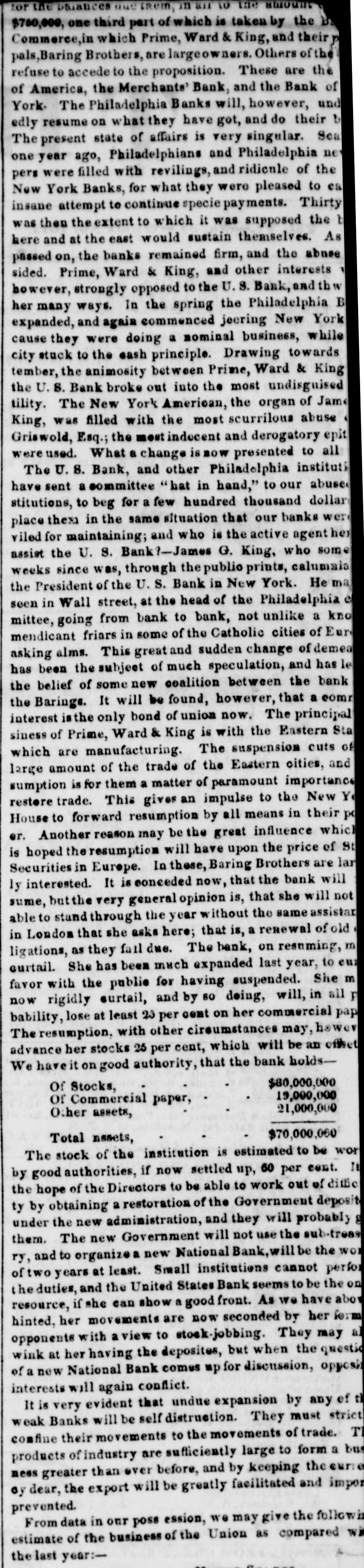
$750,000, one third part of which is taken by the Bank of Commerce, in which Prime, Ward & King, and their principals, Baring Brothers, are large owners. Others of the refuse to accede to the proposition. These are the of America, the Merchants' Bank, and the Bank of York. The Philadelphia Banks will, however, undoubtedly resume on what they have got, and do their best. The present state of affairs is very singular.

Sea one year ago, Philadelphians and Philadelphia papers were filled with revilings, and ridicule of the New York Banks, for what they were pleased to call insane attempt to continue specie payments. Thirty was then the extent to which it was supposed the t here and at the east would sustain themselves. As passed on, the banks remained firm, and the abuse subsided. Prime, Ward & King, and other interests however, strongly opposed to the U. S. Bank, and threw her many ways. In the spring the Philadelphia B expanded, and again commenced jeering New York cause they were doing a nominal business, while city stuck to the cash principle. Drawing towards September, the animosity between Prime, Ward & King the U. S. Bank broke out into the most undisguised hostility. The New York American, the organ of James King, was filled with the most scurrilous abuse of Griswold, Esq.; the most indecent and derogatory epithets were used. What a change is now presented to all.

The U. S. Bank, and other Philadelphia institutions, have sent a committee "hat in hand," to our abused institutions, to beg for a few hundred thousand dollars to place them in the same situation that our banks were reviled for maintaining; and who is the active agent here to assist the U. S. Bank?-James G. King, who some weeks since was, through the public prints, calumniating the President of the U. S. Bank in New York. He may be seen in Wall street, at the head of the Philadelphia committee, going from bank to bank, not unlike a knot of mendicant friars in some of the Catholic cities of Europe, asking alms. This great and sudden change of demeanor has been the subject of much speculation, and has led to the belief of some new coalition between the bank and the Barings. It will be found, however, that a common interest is the only bond of union now. The principal business of Prime, Ward & King is with the Eastern States, which are manufacturing. The suspension cuts of a large amount of the trade of the Eastern cities, and resumption is for them a matter of paramount importance to restore trade. This gives an impulse to the New York House to forward resumption by all means in their power. Another reason may be the great influence which it is hoped the resumption will have upon the price of State Securities in Europe. In these, Baring Brothers are largely interested. It is conceded now, that the bank will resume, but the very general opinion is, that she will not be able to stand through the year without the same assistance in London that she asks here; that is, a renewal of old obligations, as they fail due. The bank, on resuming, must curtail. She has been much expanded last year, to curry favor with the public for having suspended. She must now rigidly curtail, and by so doing, will, in all probability, lose at least 25 per cent on her commercial paper. The resumption, with other circumstances may, however, advance her stocks 25 per cent, which will be an offset. We have it on good authority, that the bank holds-

Of Stocks, $30,000,000 Of Commercial paper, 19,000,000 Other assets, 21,000,000

Total assets, $70,000,000

The stock of the institution is estimated to be worth, by good authorities, if now settled up, 60 per cent. It is the hope of the Directors to be able to work out of difficulty by obtaining a restoration of the Government deposites under the new administration, and they will probably get them. The new Government will not use the sub-treasury, and to organize a new National Bank, will be the work of two years at least. Small institutions cannot perform the duties, and the United States Bank seems to be the only resource, if she can show a good front. As we have above hinted, her movements are now seconded by her former opponents with a view to stock-jobbing. They may also wink at her having the deposites, but when the question of a new National Bank comes up for discussion, opposing interests will again conflict.

It is very evident that undue expansion by any of the weak Banks will be self distruction. They must strictly confine their movements to the movements of trade. The products of industry are sufficiently large to form a business greater than ever before, and by keeping the currency dear, the export will be greatly facilitated and import prevented.

From data in our possession, we may give the following estimate of the business of the Union as compared with the last year:-


Article from The Ohio Democrat, December 18, 1840

Click image to open full size in new tab

Article Text

VOLUME2 NUMBER 67

soverign power,in ridding the country, eas far as practicable, of the existing vil. Ite power to act as a regulator is no. more, as is proved by experience, a to induce the as it expands, and 10 than thing expand power local compal banks But them to contract when it contracts the experience proves that it stands full as much in need of a regulator as banks themeelves. And why Its object is should it not? the local its the stock- same make large dividends for Its temptations are & to the same laws holders. -to is subject the firade. same It was organized on the same principles, and subject to the same impulse the with like institutions created by States. It ie, therefore, unreasonable expect, that in its administration there to would be more safety than in similar be state institutione; or, that it would banks capable of regulating the local be beneficially, when it has proved to incapable of regulating itself. THE STATE BANK. The late Bank of the United States, the expiration of its charter in 1836, ou a new one from the centering not received Pennsylvania, equal, State than if the of greater powers and privileges, its former. Its capital was the same; stockholders the same, and its managein the hands of the same It was said, by the officers. ment continued charter President It of the Bank, when the new their was presented 10 the stockholders for e acceptance, that it was then in a safer, r stronger, and in more prosperous con- the dition than it ever was; and that exisconnection which had previously In a ted between the Bank and the General ben Government was an unnatural one, e eficial neither to the Bank or the GovS ernment, The stockholders were pres to accept of the new charter from in on the ground that it was to In more sed the State, respect desirable than the granted by the Yet, every vernment. old charter, no withs anding General Go. all n n these boasted advantages under the new to 80 far from its being able y the exchanges and currenregulate charter, banks the in and to keep the other proin of e cy, check, it is now univereally admit- and ted per to have been one of the leading agents in k under which the most active ficulties producing country the has difD, of been for the last eighteen So far from 118 it months. laboring the first, regulating unhe other banks, it was we former charter, to expand its cirnd and engage in ed culation der its hazardoustrade the firet and speculation. It was among as 11 to suspend specie payments, and the last of to resume. We have seen it, instead pa exerting its power to restore to the coun iniltry a sound currency, using all its fluence to prevent the other banks from its their notes in institution now, after d, redeeming this specie.-We having five see hetween four and al under its new, and, as was e; years been in operation utterly claim- proe advantageous character, al, in a state of sus to from surrounding 'he trated, ed, king aid pension, institutions, and asin order to save it from bankruptcy. id. What reason have we to believe that the ng influence of this institution ere have been different be its corporate powers eal would fate ceived or if and it had privil= re- inis eges from the General Government stead of the State of Pennsylvania As nal before remarked, the source from il. I it derived its charter could neithwhich take ly from or add to its means to meet ing or have it any that course of ion it in its present uch we are the er from its Whether,therefore, involved engagements, pursuing guided b prevented difficultic policy drawn by that the of experience, or by opinions bes critical investigation pative tendencies of a eaa believe United that we are foreed to exwould but add to the ural ligh from an Bank, institution and, of by the the States' such of the curreucy. is a the paper in ate, du specie basis, tend to it rangement ly the out increasing increasingr corresponding circulation, involve ratio, great with de- the whole paper system, eooner or later, in eacommon ruin. It is not, therefore, ren one of a U States Bank o Terthe multiplication of paper money very by by the creation the present that the evils attendaut on its we banking system, are to be remedied. The danger to be apprehended from one all an institution, in a political poin dis is not to be or onIte friends exsuch of view. regarded. overlooked claim, that would possess the power of regulating tate the nine hundred and fifty=four loca ion with their capital of three hun 10 twenty-fou the that it would possess late, dred and banks, ting millions. this Admit power what would be the political consequent ered if it should act in friendly allianc this es, with the National Executive, and wield althis vast money power for political pur. taxthe poses? If is claimed, that the is patron aires of the National Executive bor. subage dy too great and dangerous to publi OZ but tended executive natronage the entir liberty. If we add to the already


Article from The Pilot and Transcript, January 8, 1841

Click image to open full size in new tab

Article Text

UNITED STATES BANK

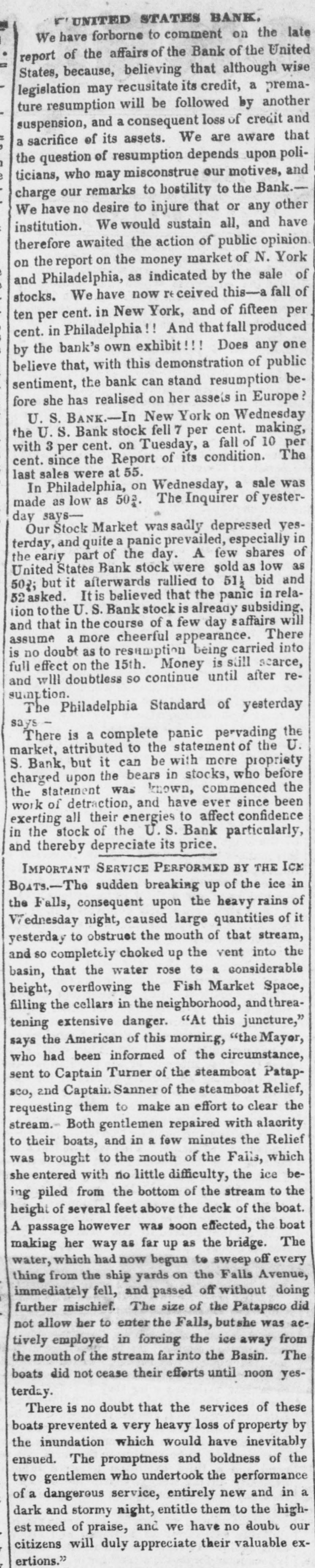
We have forborne to comment on the late report of the affairs of the Bank of the United States, because, believing that although wise legislation may recusitate its credit, a premature resumption will be followed by another suspension, and a consequent loss of credit and a sacrifice of its assets. We are aware that the question of resumption depends upon politicians, who may misconstrue our motives, and charge our remarks to hostility to the Bank.We have no desire to injure that or any other institution. We would sustain all, and have therefore awaited the action of public opinion on the report on the money market of N. York and Philadelphia, as indicated by the sale of stocks. We have now re ceived this-a fall of ten per cent. in New York, and of fifteen per cent. in Philadelphia!! And that fall produced by the bank's own exhibit! Does any one believe that, with this demonstration of public sentiment, the bank can stand resumption before she has realised on her asseis in Europe? U.S. BANK.-In New York on Wednesday the U. Bank stock fell? per cent. making, with 3 per cent. on Tuesday, a fall of 10 per cent. since the Report of its condition. The last sales were at 55. In Philadelphia, on Wednesday, a sale was made as low as 502. The Inquirer of yesterday saysOur Stock Market wassadly depressed yesterday, and quite a panic prevailed, especially in the early part of the day. A few shares of United States Bank stock were sold as low as 502; but it afterwards rallied to 51 1/2 bid and 52asked. It is believed that the panic in relation to the U.S Bank stock is already subsiding, and that in the course of a few day saffairs will assume a more cheerful appearance. There is no doubt as to resumption being carried into full effect on the 15th. Money is still scarce, and will doubtless so continue until after resumption. The Philadelphia Standard of yesterday says There is a complete panic pervading the market, attributed to the statement of the U. S. Bank, but it can be with more propriety charged upon the bears in stocks, who before the statement was known, commenced the work of detraction, and have ever since been exerting all their energies to affect confidence in the stock of the U. S. Bank particularly, and thereby depreciate its price. IMPORTANT SERVICE PERFORMED BY THE ICE BOATS.-The sudden breaking up of the ice in the Falls, consequent upon the heavy rains of Wednesday night, caused large quantities of it yesterday to obstruet the mouth of that stream, and so completely choked up the vent into the basin, that the water rose to a considerable height, overflowing the Fish Market Space, filling the cellars in the neighborhood, and threatening extensive danger. "At this juncture," says the American of this morning, "the Mayor, who had been informed of the circumstance, sent to Captain Turner of the steamboat Patapsco, and Captain Sanner of the steamboat Relief, requesting them to make an effort to clear the stream. Both gentlemen repaired with alacrity to their boats, and in a few minutes the Relief was brought to the mouth of the Falls, which she entered with no little difficulty, the ice being piled from the bottom of the stream to the height of several feet above the deck of the boat. A passage however was soon effected, the boat making her way as far up as the bridge. The water, which had now begun to sweep off every thing from the ship yards on the Falls Avenue, immediately fell, and passed off without doing further mischief. The size of the Patapsco did not allow her to enter the Falls, butshe was actively employed in forcing the ice away from the mouth of the stream far into the Basin. The boats did not cease their efforts until noon yesterday. There is no doubt that the services of these boats prevented a very heavy loss of property by the inundation which would have inevitably ensued. The promptness and boldness of the two gentlemen who undertook the performance of a dangerous service, entirely new and in a dark and stormy night, entitle them to the highest meed of praise, and we have no doub our citizens will duly appreciate their valuable exertions."


Article from Staunton Spectator, and General Advertiser, January 14, 1841

Click image to open full size in new tab

Article Text

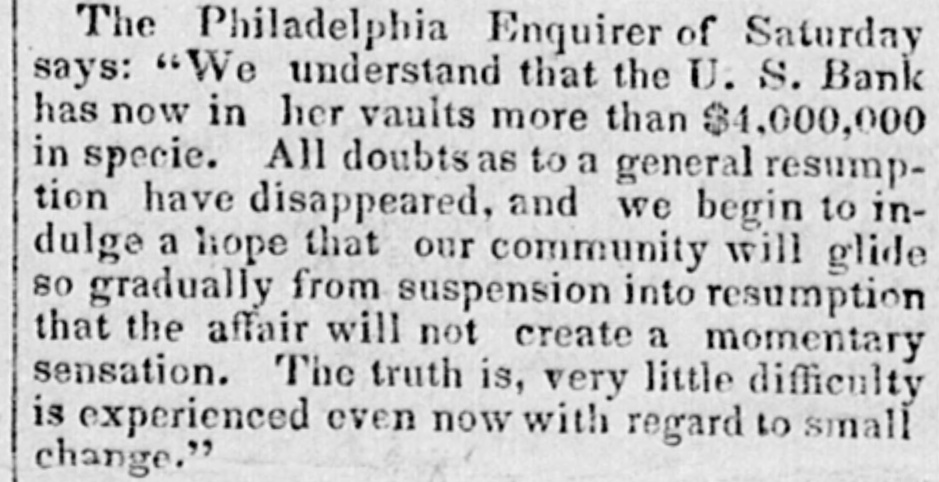
The Philadelphia Enquirer of Saturday says: "We understand that the U. S. Bank has now in her vaults more than $4,000,000 in specie. All doubts as to a general resumption have disappeared, and we begin to indulge a hope that our community will glide so gradually from suspension into resumption that the affair will not create a momentary sensation. The truth is, very little difficulty is experienced even now with regard to small change."


Article from Daily Richmond Whig, January 15, 1841

Click image to open full size in new tab

Article Text

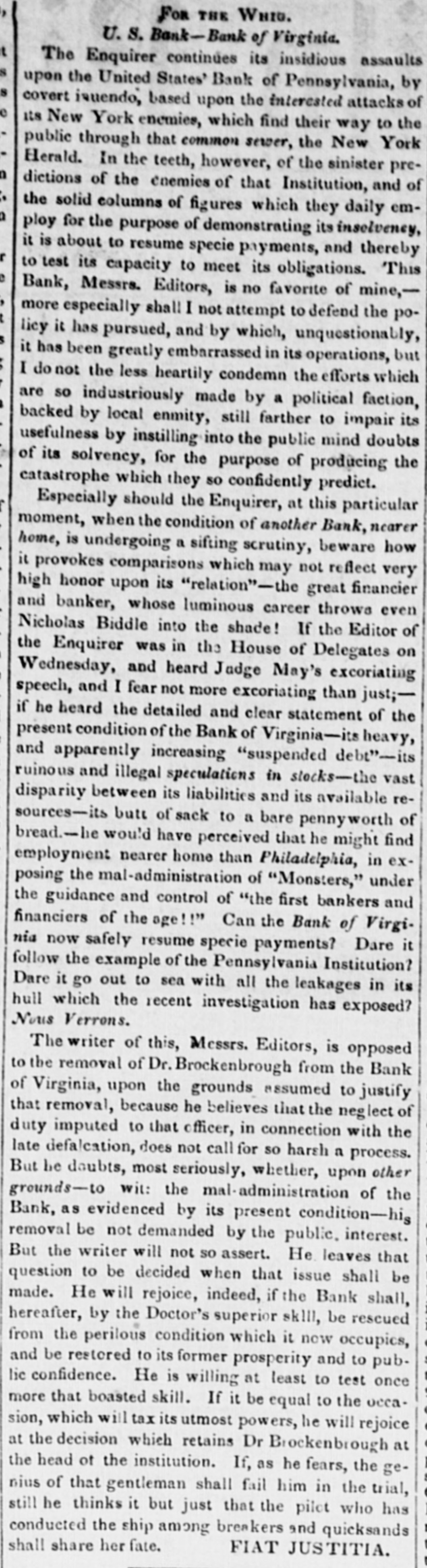
, For THE WHIG. U. S. Bank-Bank of Virginia. t The Enquirer continues its insidious assaults S upon the United States' Bank of Pennsylvania, by S covert isuendo, based upon the interested attacks of e its New York enemies, which find their way to the public through that common sewer, the New York Herald. In the teeth, however, of the sinister pren dictions of the enemies of that Institution, and of . the solid columns of figures which they daily ema ploy for the purpose of demonstrating its inselvency, it is about to resume specie payments, and thereby to test its capacity to meet its obligations. This Bank, Messra. Editors, is no favorite of mine,more especially shall I not attempt to defend the policy it has pursued, and by which, unquestionably, it has been greatly embarrassed in its operations, but I not the less heartily condemn the efforts which are so industriously made by a political faction, backed by local enmity, still farther to impair its usefulness by instilling into the public mind doubts of its solvency, for the purpose of producing the catastrophe which they so confidently predict. Especially should the Enquirer, at this particular moment, when the condition of another Bank, nearer home, is undergoing a sifting scrutiny, beware how it provokes comparisons which may not reflect very high honor upon its "relation"-the great financier and banker, whose luminous career throws even Nicholas Biddle into the shade! If the Editor of the Enquirer was in the House of Delegates on Wednesday, and heard Jadge May's excoriating speech, and I fear not more excoriating than just;if he heard the detailed and clear statement of the present condition of the Bank of Virginia-its heavy, and apparently increasing "suspended debt"-its ruinous and illegal speculations in slocks-the vast disparity between its liabilities and its available resources-its butt of sack to a bare pennyworth of bread.-he would have perceived that he might find employment nearer home than Philadelphia, in exposing the mal-administration of "Monsters," under the guidance and control of "the first bankers and financiers of the age!!" Can the Bank of Virginia now safely resume specie payments? Dare it follow the example of the Pennsylvania Institution? Dare it go out to sea with all the leakages in its hull which the recent investigation has exposed? Nous Verrons. The writer of this, Messrs. Editors, is opposed to the removal of Dr. Brockenbrough from the Bank of Virginia, upon the grounds assumed to justify that removal, because he believes that the neglect of duty imputed to that officer, in connection with the late defalcation, does not call for so harsh a process. But he doubts, most seriously, whether, upon other grounds-to wit: the mal-administration of the Bank, as evidenced by its present condition-hig removal be not demanded by the public. interest. But the writer will not so assert. He leaves that question to be decided when that issue shall be made. He will rejoice, indeed, if the Bank shall, hereafter, by the Doctor's superior sklll, be rescued from the perilous condition which it now occupies, and be restored to its former prosperity and to public confidence. He is willing at least to test once more that boasted skill. If it be equal to the occasion, which will tax its utmost powers, he will rejoice at the decision which retains Dr Brockenbrough at the head of the institution. If, as he fears, the genius of that gentleman shall fail him in the trial, still he thinks it but just that the pilot who has conducted the ship among breakers and quicksands shall share her fate. FIAT JUSTITIA.


Article from Martinsburg Gazette, January 21, 1841

Click image to open full size in new tab

Article Text

From the Philadelphia North American, Jan. 16. RESUMPTION DAY. It would puzzle the pencil of Hogarth to sketch the motley acene presented at the counter of the U. S. Bank yesterday. First you would see some active sharp sighted broker, very polite, and asking for only some fifty thousand; then would follow a distrustful depositor, half doubting whether it was best after all to burthen himself with the specie, and when he had got it looking for all the world as if he knew not where to go or what to do with it, and quite ready to accuse his stars for his fully. Not so with the next one, be is a gaunt tall figure, with a face so thin that only one person can look at it at a time, pinching a few bills in his long bony fingers, and quite determined to hold on to it with one hand, for fear of some cheat, till the specie shall rattle in the other. Then comes a hostes Quickly with her full red face and go-a-head manger, shaking her bills and determined to take ample revenge for all the shinplasters and counterfeit notes which her roguish customers have palmed off on her. Then comes up a sailor, and taken all aback when he sees the piles of gold and silver, and looking as if ready to knock down the man who had told him the bank was not safe and sound. Then strides up a huge Irishman, bringing his own bill and those of some dozen others. But what shall he do with the dol. lars? he finds a hole, or suspects there is one, in each of his pockets. So he off's hat and has them thrown into that, when out drops the crown, and the dollars roll around the floor to the merriment of all save the son of Erin. Then approaches a spare laundress with her ten dollar bill, asks for go'd, takes the eagle and deposits it in bersnuff box before she has stirred an inch from the counter. Then comes the Ethiopian, with his white ivory flashing through the curl of his dark lips: be has some how got a ten dollar bill, wants it all in fifty cent pieces, ahoves the shiners into his pockets, ejaculating as he turns away "I guess we II empty a their big box for them to-day." Then strictes up Locofuco with his elbows out, and his nose red enough to illuminate his footsteps in the darkest night, "here Mister, is a shinplaster of yours, if it's good for any thing give US the hard stuff." Then comes wheasing along a countryman with a bag on his back filled with specie, rolls it from his shoulder upon the counter, and requests its amount in bank bills. Had a man sprung out of his grave the astonishment of the motley group could not have been greater. The women dropped their specie, the loco foco stood speechless, the pickpocket forgot he had fingers, and hostess Quickly was pale and still as Lot's wife in monumental salt. IJ All the Banks of our city paid out their own notes yesterday. except two, and one of these partially The reason assigned by one of these two for this extraordinary course was that she had none of her own bills ready. The community have the deepast interest in this matter of resumption, and will require that each institution, as the fate of all is at issue, should faithfully perform its portion of the duty. Any other course will be unjust, impolitic and hazardous.


Article from The Madisonian, February 9, 1841

Click image to open full size in new tab

Article Text

PHILADELPHIA, Feb. 7, 1841. U. S. Bank Stock fluctuated yesterday between 39 and 36. Considerable sales were made for cash by those whose necessities compelled, or whose fears prompted them to sell for the best price they could get. Girard sold at 29, and all others declined. Our Banks may all be said to have suspended, though one or two of them still endeavor to keep up the semblance of paying specie, and all redeem their five dollar notes. I said in my last that the U. S. Bank was reported to have paid out seven millions in specie and its equivalent since its resumption ; the cashier states it to be six millions. I understand from good authority that she has now only about two millions of immediate liabilities. No bank, even in ordinary times, could have done more than she has done, namely, pay in three weeks, three fourths of her circulation deposits, and other immediate liabilities. The fact is, she has been crippled by the inveterate hostility of her foes, who have been goaded on by the Journal of Commerce, the New York Evening Post, and other kindred journals. I admit that she has been badly míanaged, and has thus been exposed to the shafts of her enemies, but had she bean treated with indulgence, or even fairness, she might have sustained herself, and eventually have recovered a portion at least of her former strength. What course she will now takewhether she will go into a liquidation and final settlement of her claims, or whether she will attempt to realize what she can from her assets, and resume business again at some future day, is not known, and in regard to what she sought to do, there is a contrariety of opinion. Her course will probably be governed by the action of our Legislature. One of our Banks-the Pennsylvania-it is understood, has sent a committee to Harrisburg with orders that, in case the Governor and Legislature shall legalize the present suspension, to surrender her charter at once. In this bank the State is a large stockholder. This is right, and I hope every bank in the State will pursue the same course; for it is vain for them to attempt to do business and meet all the demands against them, in specie, in the present deranged and depressed condition of the country,-when not only individuals cannot meet their engagements, but the State and National Governments are bankrupt and have to depend on borrowing to save their honor The evils under which we are suffering are too deeply seated to be much affected by state legislation :nothing short of Congressional action can reach and remove the cause of these evils. The General Government has brought them upon us, and the General Government, including Congress, can alone remove them. X.Y.


Article from Richmond Enquirer, February 9, 1841

Click image to open full size in new tab

Article Text

The great Bubble has burst again, and probably forever. The U. S. Bank has stopped-its stock is down to 40, and it will probably descend lower.-The Philadelphia Public Ledger of Friday last, traces the proximate causes, of the suspension, to the following circumstances: "A great degree of excitement prevailed in this city yesterday afternoon and evening, in consequence of a rumor which prevailed in regard to the U. S. Bank.The cause which gave rise to this excitement was, as we learn, a failure on the part of the Bank to meet certain demands against it. As far as we could best ascertain the facts, there was a heavy draft presented about 21 o'clock, by the runner of the Brokers between this city and New York, we hear the sum stated as high as three hundred thousand dollars, which the Bank failed to meet, the officer saying "it could not be paid," and the officer withdrew. Two other drafts, one for twenty thousand dollars, presented by a broker in Third street, and another for about the same amount, by another broker was also refused payment. As may be imagined the rumors of these facts soon spread abroad, and the Exchange last evening was crowded with anxious inquirers into the truth of them; and opinions were various as to the probable consequences of this unexpected measure, and a meeting of the other city banks was held lastevening in relation to the matter." These Banks rallied for a few hours-but it is now believed, that they have with few exceptions virtually suspended-and - those of Maryland have followed suit. From the Philadelphia National Gazette.) I "P. S. Saturday, One o'clock - All the Banks of the City, with two or three exceptions, have just suspended specie payments except for Five Dollar Notes. The apprehension expressed above is thus already realized." From the New York Correspondent of the N. Intelligencer, Feb. 6.] U. S. Bank stock sold at the Brokers' Board to-day


Article from The Illinois Free Trader, February 19, 1841

Click image to open full size in new tab

Article Text

Later The Bank Exploded ! Last evening we received the Times of Feb. 6, which fully establishes the above, and places the insolvency of the Bank beyond question. The Times says: "Yesterday morning the streets of our city were filled with a clamarous multitude, that poured like a living stream into all our banks, but particularly into the portals of the U.S. Bank for specie. The news that this latter institution had suspended specie payments for the third, and probably final time, had spread like wildfire among our citizens the night before, filling them with apprehension, and changing the exultation and confidence of even its warmest friends into utter consternation. Public opinion which was fast verging in its favor was at once shocked. A change came o'er its spirit, and now, such is the mutability of greatness, there is none so devoid of indignation as to do it reverence. The run upon all the banks was tremendous, and before noon all of them except the Western, Philadelphia, Commercial, Southwork and North America banks, had ceased redeeming in specie their notes over the denomination of Five Dollars. A greater excitement was never witnessed. The streets were fairly alive with people, and nothing could be heard but a confused hum of inquiry, wonder, anxiety and lamentation. One bank paid out about $90,000 in specie for $5 notes before 3 o'clock, and we have no doubt many were much more severely run."


Article from Rutland Herald, March 30, 1841

Click image to open full size in new tab

Article Text

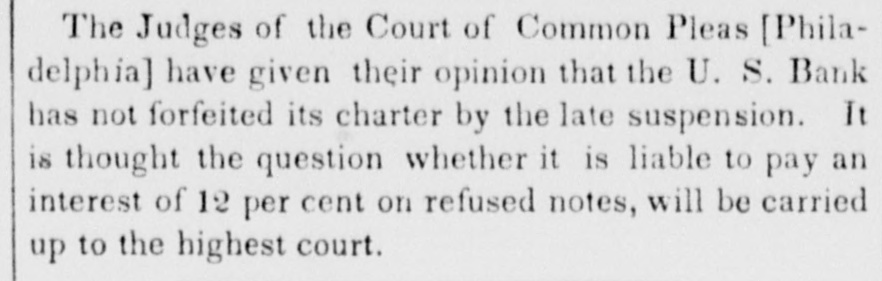
The Judges of the Court of Common Pleas [Philadelphia] have given their opinion that the U. S. Bank has not forfeited its charter by the late suspension. It is thought the question whether it is liable to pay an interest of 12 per cent on refused notes, will be carried up to the highest court.


Article from Mobile Daily Commercial Register and Patriot, August 16, 1841

Click image to open full size in new tab

Article Text

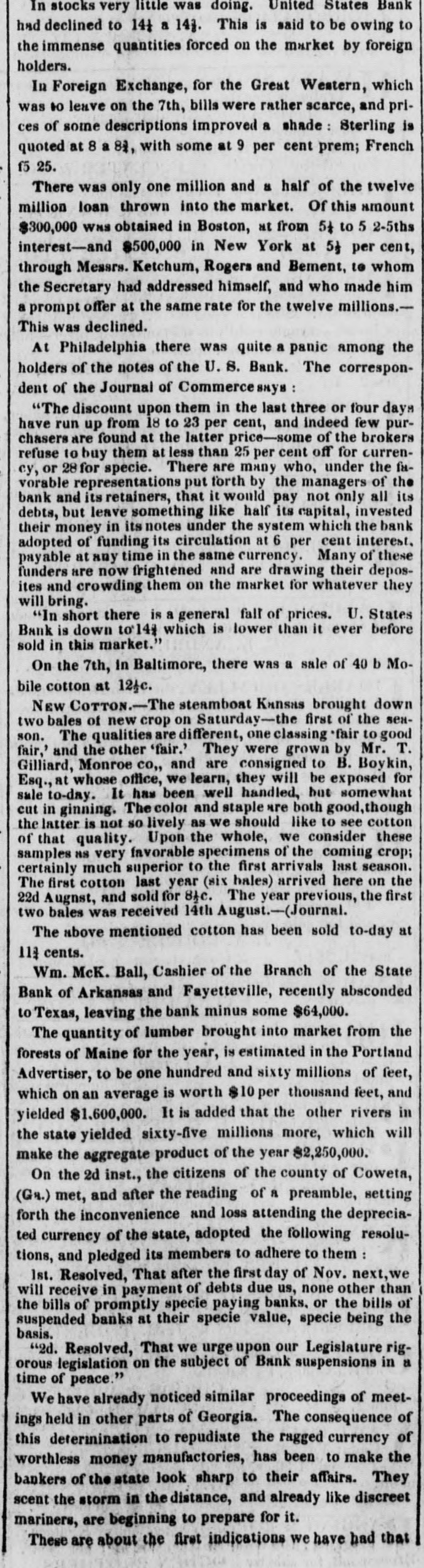
Bank In stocks very little was doing. United States had declined to 144 a 14}. This is said to be owing to the immense quantities forced on the market by foreign holders. In Foreign Exchange, for the Great Western, which was to leave on the 7th, bills were rather scarce, and prices of some descriptions improved a shade : Sterling is quoted at 8 a 82, with some at 9 per cent prem; French f5 25. There was only one million and a half of the twelve million loan thrown into the market. Of this amount $300,000 WHS obtained in Boston, at from 5 to 5 2-5ths interest-and $500,000 in New York at 5 per cent, through Messrs. Ketchum, Rogers and Bement, to whom the Secretary had addressed himself, and who made him a prompt offer at the samerate for the twelve millions.This was declined. At Philadelphia there was quite a panic among the holders of the notes of the U. .S. Bank. The correspondent of the Journal of Commerce anys "The discount upon them in the last three or four days have run up from 18 to 23 per cent, and indeed few purchasers are found at the latter price-some of the brokers refuse to buy them at less than 25 per cent off for currency, or 28 for specie. There are many who, under the favorable representations put forth by the managers of the bank and its retainers, that it would pay not only all its debts, but leave something like half its capital, invested their money in its notes under the system which the bank adopted of funding its circulation at 6 per cent interest. payable at any time in the same currency. Many of these funders are now frightened and are drawing their deposites and crowding them on the market for whatever they will bring. "In short there is a general fall of prices. U. States Bank is down to'14) which is lower than it ever before sold in this market." On the 7th, in Baltimore, there was a sale of 40 b Mobile cotton at 121c. NEW COTTON.-The steamboat Kansas brought down two bales of new crop on Saturday-the first of the sexson. The qualities are different, one classing fair to good fair,' and the other 'fair.' They were grown by Mr. T. Gilliard, Monroe co,, and are consigned to B. Boykin, Esq., at whose office, we learn, they will be exposed for sale to-day. It has been well handled, but somewhat cut in ginning. The color and staple are both good,though the latter is not so lively as we should like to see cotton of that quality. Upon the whole, we consider these samples as very favorable specimens of the coming crop; certainly much superior to the first arrivals last season. The first cotton last year (six hales) arrived here on the 22d Augnst, and sold for 84c. The year previous, the first two bales was received 14th August.-(Journal. The above mentioned cotton has been sold to-day at 114 cents. Wm. McK. Ball, Cashier of the Branch of the State Bank of Arkansas and Fayetteville, recently absconded to Texas, leaving the bank minus some $64,000. The quantity of lumber brought into market from the forests of Maine for the year, is estimated in the Portland Advertiser, to be one hundred and sixty millions of feet, which on an average is worth $10 per thousand feet, and yielded $1.600,000. It is added that the other rivers in the state yielded sixty-five millions more, which will make the aggregate product of the year $2,250,000. On the 2d inst., the citizens of the county of Coweta, (Gs.) met, and after the reading of a preamble, setting forth the inconvenience and loss attending the depreciated currency of the state, adopted the following resolutions, and pledged its members to adhere to them : 1st. Resolved, That after the first day of Nov. next, we will receive in payment of debts due us, none other than the bills of promptly specie paying banks. or the bills of suspended banks at their specie value, specie being the basis. "2d. Resolved, That we urge upon our Legislature rigorous legislation on the subject of Bank suspensions in a time of peace." We have already noticed similar proceedings of meetings held in other parts of Georgia. The consequence of this determination to repudiate the ragged currency of worthless money manufactories, has been to make the bankers of the state look sharp to their affairs. They scent the storm in the distance, and already like discreet mariners, are beginning to prepare for it. These are about the first indications we have had that


Article from Daily Richmond Whig, September 9, 1841

Click image to open full size in new tab

Article Text

From the Baltimore American

U. S. BANK ASSIGNMENT. stated yesterday that the U. S. Bank had We an assignment of its assets, for the benefit of made creditors generally. We find in the Philadel its U. S. Gazette of yesterday the following with arti phia explanatory of the particulars connected this cle, final step in the existence of the institution: of On Saturday, the Directors of the Bank the States made an assignment of most of the valuable United assets of that institution to the following J named gentlemen:-James Robertson, President, S Newbold, a Director; Richard Bayard, of DelaAssistant Cashier. ware; Thomas S Taylor, Cashier; Herman Cope, The preferences, if they can be so denominated, or two small demands; next, those indivi are duals one are to be secured who have made themselves responsible for any liabilities of the Bank, particuthose who have entered security on judgelarly recently obtained against the Bank on is ments amounting, we think, to nearly two hundred notes, thousand dollars. The proceeds of the remaining of the assets are to be appropriated for de- the benefit portion of the general creditors, the note holders, positors, With reference &c. to this assignment, we may rethat it is called a "partial assignment," not general, mark because a general assignment would not for be valid without the assignees entering security of the nominal amount assigned, and no set this or other city of the men twice in any Union would could accept find a such security, or, at any rate, none trust of such little profit upon such an onerous con- and The assignment is, therefore, PARTIAL, the dition. authorised by an act of Assembly granting Bank is power to make partial assignments without knowsecurity from the assignees. Without asking we presume the schedule of property assigned of the contains ing, nearly all the valuable property Bank not included in the two former assignments, the viz: the one for the benefit of the city banks, and o her for the benefit of the note holders. One condition of this assignment is well worthy remark, viz: the assignees may receive notes or of of U. S. Bank for any bills receivable, notes the bonds due; and they have, besides, power granted thereto sell any of the assets, taking in payments for notes of the U.S. Bank. It iF thought by some that notes of the Bank will be of more value, as they are likely to either to pay liabilities or to we would take occasion to any sets; called now be and for, purchase that of it the as is probable that the want of some provision kind in a former assignment for the exclusive benefit of the note holders, has led to the non-fulfilment the general expectation that the assignment would of tend to keep the notes nearly at par. Though in THAT partial assignment (for the benefit of the notes note holders) the assignees are allowed to receive of the bank for the payment of bills and accounts due, yet such a provision has proved unavailing, becoming inasmuch as it is probable that the best of of class of assets were assigned for the benefit that and another class of securities were to the who act for the note were not allowed to sell the while given they Lanks, assignees those assets for holders, Uni- for thing but par money, at any rate, not any ted States Bank notes. That assignment, therefore, without any fault in the assignees, fails of one great We object may here proposed, remark that this assignment does interfere with or supercede the other two spccial not assignments to which we have referred. The course now adopted by the Board of Direc. has been rendered necessary by the great numtors ber of suits instituted against the Bank, on some of which judgment had been rendered and security while others were rapidly maturing for judggiven, and the numbers constantly increasing. These ment, suits were absorbing the funds of the Bank, it may, therefore, be fairly inferred that the Directors have consulted and protected the interests of both noteholders and stockholders as well as they could under existing circumstances. We le rn that in the whole of the business connected with this assignment, the utmost harmony and entire unanimity prevailed at the Board of Directors, the old and new members heartily concurring in the general plan and in its details. e With reference to the assignees, we may add for of our readers who do not reside in this neigh I those borhood, that their character and standing are such ( as to insure confidence in whatever they under9 take. Of course the Board of Directors continue e meet, though the banking business necessarily , e closes. The assignment allows to Messra. Robinson I. Bayard and Newbold fifteen hundred dollars a year I each for their services, and to Messra Taylor and e Cope four thousands dollars a year each. This is e diminution than an increase expenses as Mr Robinson rather inasmuch a relinquishes of his salary n of five thousand dollars a year as President, and in Taylorg and Cope have received as Cashier and Ase sistant Cashier the same salary which is now given is to them. The new arrangement will, of course e cause the dismissal of most of the clerks hicherto d employed in the institution. Mr Robinson contin h ues to act as President, while he discharges the du y of trustee. 1.


Article from Sunbury American and Shamokin Journal, March 26, 1842

Click image to open full size in new tab

Article Text

Broken Banks in Philadelphia

The following list of Banks still occupy their banking houses in this city, but their business is suspended, and their capital may be considered out of market. We annex their locations with the capital of each institution : U. S. Bank, located in Chesnut street $35,000,000 above Fourth, capital Schuylkill Bank, corner Sixth and Market, 1,000,000 Girard Bank, Third below Chesnut, 5,000,000 Pennsylvania Bank, Second below Chesnut, 2,500,000 500,000 Penn Township Bank, Sixth & Viee, Mechanics' Bts, Third above Chesnut, 1,400,000 Manufacturers' and Mechanics' Bank, 600.000 Third and Vlne, 250,000 Moyamensing Bk, Second & Chesnut, $46,250,000 Total amount of capital,


Article from Indiana State Sentinel, March 5, 1846

Click image to open full size in new tab

Article Text

THE UNITED STATES BANK

Commenting upon a statement that the stock of the U. S. Bank having got into the hands of English Bankers, and that they have it in contemplation to resuscitate the defunct monster, the Philadelphia Ledger says:

"The charter of the Bank is whole and sound as ever it was. It makes its regular statements to the Auditor General, holds its annual elections of officers, and does every other thing that a bank in credit does, saving and excepting the payment of its debts. But in this last particular it is better than many other institutions of the State; for, though it does not pay what it owes, it runs no more in debt, being out of credit. When the U. S. Bank stopped payment, application was made to the Legislature, and an act, authorizing a special assignment, was obtained, and thus the charter was saved."