Article Text
VOLUME III.
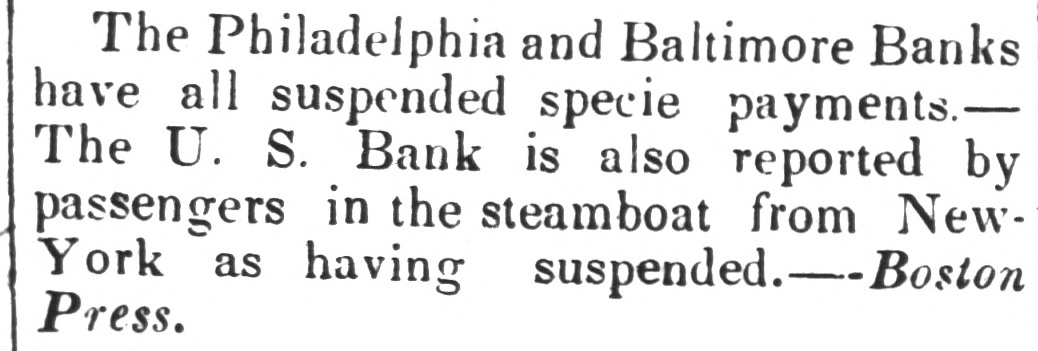
[From our Evening Edition of yesterday.] PHILADELPHIA, Aug. 23d, 1837. Things are comparatively quiet here. The under currents, however, are strong, and threaten, ere long, to disturb the tranquility that reigns on the surface.
You have in this large city, a community of 100,000 souls, taking and paying out a worthless rag currency, with as much sang froid as if it were intrinsically valuable. The chink of silver is no more heard. It is neither heard in the liquor room, the theatre offices, at the bank counter, nor even at the tables of rouge et noir. Paper, irredeemable paper, with its silky rustling where it is new, has usurped the place of real value, and you witness the inexplicable anomaly of thousands of merchants and dealers giving countenance to this villainous scheme of cheating the community.
They know, and all know who have any reflection about them, that the ultimate loss of these shin plasters will fall on the industrious poor. But on they all go, and the devil take the hindmost. Honest and dishonest, virtuous and vicious join in the race, and the city of brotherly love, once so famous for the uprightness of its dealings, is now the abode of a whole people striving to delude each other.
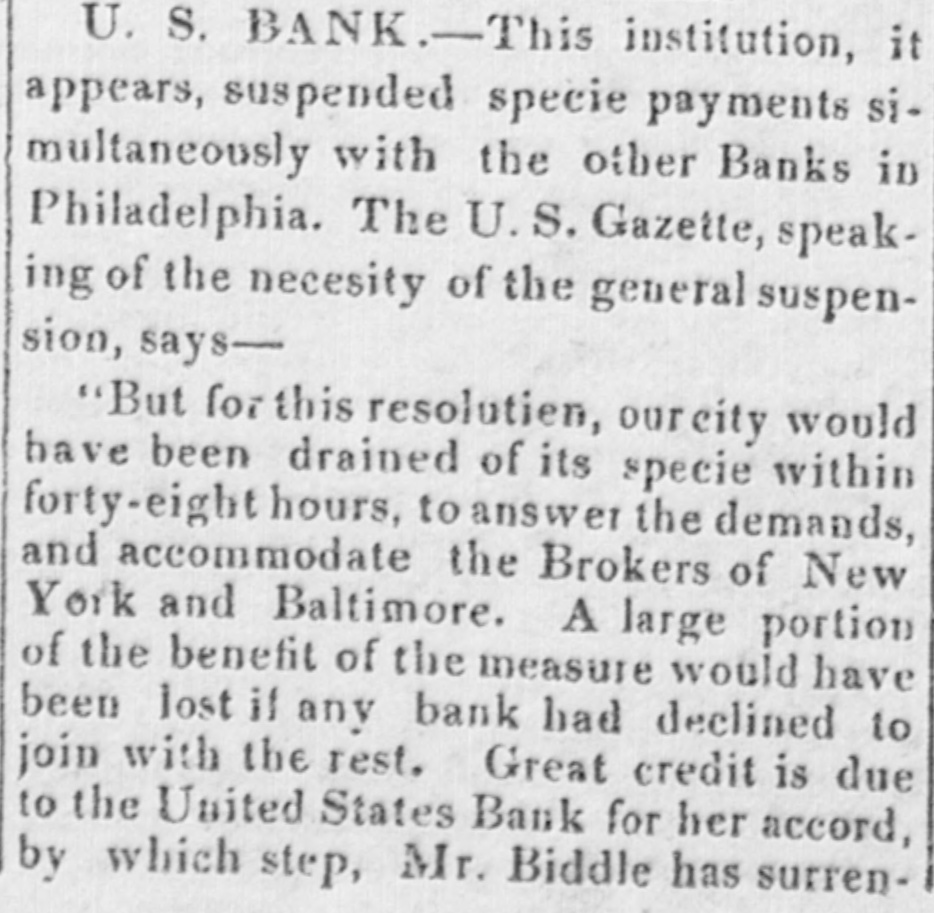
You may think New York is flooded with shin plasters. You are favored-complain not. Where you have one two shilling rag, the Philadelphians have ten thousand. It is now beginning to be understood, and felt here, that Mr. Biddle has had a heavy hand in producing the catastrophe of suspension, and in sustaining the measure after the step was taken. It is argued, and with justice, too, that there must have been a wide concert of opinion among the nabebs or menied men, prior to the suspension, or they would never have submitted so tamely and so readily to the shin plaster system. A feeling is getting abroad, that Mr. Biddle has been mixing up political feelings and objects too extensively with the great scientific and financial principles that should govern and control a bank like that of the United States.
The Philadelphia banks have been like wild young colts in a luxuriant clover field, since the suspension. They have thrown public opinion to the winds; they have discarded the laws by which they are expected to be governed. They have their affairs to themselves, like faithful stewards of one master, and for ought the world knows, they may be all, at this present moment, like the honeyless bee hive after a severe winter.
There are men here who believe the vilest and most atrocious acts have been committed-men who place as little confidence in the U. S. Bank, as they do in the ultimate responsibility of some two-penny shin plaster shop to meet its issues. They urge in support of their opinion, the general course of this bank, as well as some few scores of isolated facts, that have leaked out contrary to the wish, or even knowledge of the men concerned.
Questions of this kind are asked, and yet no answer comes. Why did Mr. Biddle suspend at all? How many millions did he loan to the Philadelphia merchants, in the shape of bonds, to keep them from all going to ruin? Where were these bonds sold? Who paid the piper? To this they confess-Wall street. What were the deposites, specie, circulation, and profits of the United States Bank on the 1st of June, July, and August, and what will they be on the 1st of September?
Has not Mr. Biddle five dollars of the old notes out to one of specie to redeem it? Did not Mr. B. and his cronies in other banks know what sort of a ninnyhammer Ritner was before they concluded to violate the right to hold their charter? Mr. Ritner had not the moral courage to proceed against the Pennsylvania bank.
Does not Mr. B. hope to carry the Pennsylvania legislature with him at the next session? The people are beginning to regard Mr. B. in his true light-that of a great financier, with an intellect clouded by the madness of political ambition.
But does not the fact that a whole trading community like that of Philadelphia should cut loose the bark of honesty, and embark in a ricketty old hulk, composed of cheatery, shin plasters and dishonesty, argue a great depravation of the high morals that should always animate the body commercial? Is not the apple rotten to the core?
Trade is exceedingly dull. Hardly enough doing to keep men alive.
The Bank of the United States is putting another flight of steps to her portico. They now run entirely across the whole front. The building is a fine specimen of architecture, but what of that, if all should be as a whitened sepulchre within?
There is very little shipping here. Philadelphia is no more calculated to be the money capital of this Union than she is to be the commercial. New York is the great centre where there should be a National Bank, and New Orleans should have the principal branch. Take these two cities, and all others are lost, in a commercial point of view.
Leading men here think that Congress will do nothing, because the question of succession will be involved in the decision. I find some who think that Gen. Jackson's letter was intended by Mr. Van Buren to drive rom his ranks the hard-money boys, as he contemplates a union with the interested and stock-jobbing Whigs to carry his National Bank.
Ball at Flushing. NEW YORK, Aug. 24. 1837.