4018. State Savings Institution (Chicago, IL)

Bank Information

Episode Type
Run → Suspension → Closure
Bank Type
savings bank
Start Date
July 18, 1877
Location
Chicago, Illinois (41.850, -87.650)

Metadata

Model
gpt-5-mini
Short Digest
e0156905fd9740ac

Response Measures

None

Description

Multiple articles document a small run in mid-July 1877 (triggered by panic from St. Louis bank troubles), enforcement of the 30-day rule, continued drain, and then final closure/assignment to a receiver (Col. Abner Taylor) at the end of August 1877. Subsequent reporting shows criminality/embezzlement by President D.D. Spencer and indictments for officers, confirming insolvency rather than mere rumor. Dates in events use the publication reports (July 18–19 run; late August suspension/assignment Aug 28–29, 1877).

Events (4)

1. July 18, 1877 Run
Cause
Local Banks
Cause Details
Run triggered by panic from recent St. Louis bank troubles; small depositors withdrew funds in mid-July.
Measures
Banks by agreement posted notices that the thirty days rule would be enforced; State Savings paid small amounts to needy depositors but generally deferred payments under the 30-day rule.
Newspaper Excerpt
There has been a small run, by light depositors, to-day, on the State Savings bank
Source
newspapers
2. July 19, 1877 Run
Cause
Local Banks
Cause Details
Augmented withdrawals continued the enforcement of the thirty-day rule; banks agreed to limit immediate payments.
Measures
Thirty days rule enforced; continued selective small payments to needy depositors.
Newspaper Excerpt
The run upon the State Savings Bank this morning was considerably increased ... by 10 o'clock all the savings banks had by agreement posted notices that the thirty days rule would be enforced.
Source
newspapers
3. August 28, 1877 Receivership
Newspaper Excerpt
The State Savings Institution made an assignment this afternoon to Abner Taylor. ... The affairs of the bank are said to be in a bad condition, and it is a difficult matter to tell what arrangements will be made with the depositors.
Source
newspapers
4. August 28, 1877 Suspension
Cause
Bank Specific Adverse Info
Cause Details
Continued drain on funds combined with poor/unsalable assets and alleged frauds/embezzlement by President D.D. Spencer forced the bank to close and assign to a receiver.
Newspaper Excerpt
The State Savings Institution of Chicago will close its doors to-morrow. ... a final meeting of the directors was held and it was decided to turn over books and other property of the institution to Colonel Abner Taylor, whom they appointed receiver.
Source
newspapers

Newspaper Articles (23)

Article from The Dallas Daily Herald, July 19, 1877

Click image to open full size in new tab

Article Text

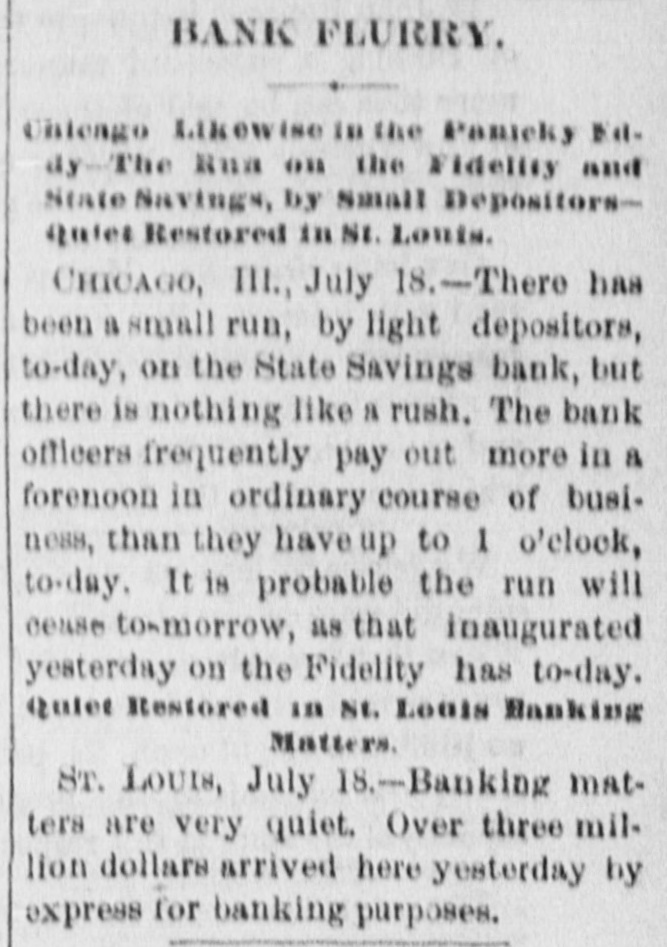
BANK FLURRY. * Chicago Likewise in the Panicky Ed. dy-The Run on the Fidelity and State Savings, by Small Depositorsquiet Restored in Nt. Louis. CHICAGO, III., July 18.-There has been a small run, by light depositors, to-day, on the State Savings bank, but there is nothing like a rush. The bank officers frequently pay out more in a forenoon in ordinary course of business, than they haveup to 1 o'clock, to-day. It is probable the run will cease to-morrow, as that inaugurated yesterday on the Fidelity has to-day. quiet Restored in Nt. Louis Banking Matters. ST. LOUIS, July 18.-Banking matters are very quiet. Over three million dollars arrived here yesterday by express for banking purposes.


Article from The Wheeling Daily Intelligencer, July 19, 1877

Click image to open full size in new tab

Article Text

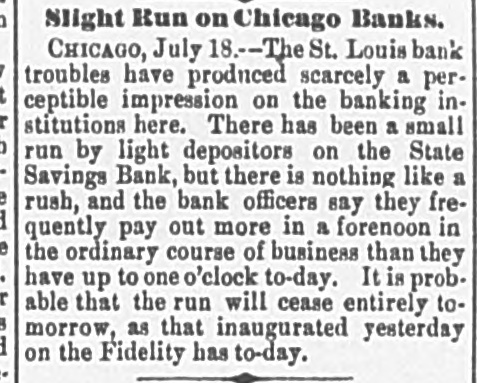
Slight Kun on Chicago Banks. CHICAGO, July 18.--The St. Louis bank troubles have produced scarcely a perceptible impression on the banking institutions here. There has been a small run by light depositors on the State Savings Bank, but there is nothing like a rush, and the bank officers say they frequently pay out more in a forenoon in the ordinary course of business than they have up to one o'clock to-day. It is prob. able that the run will cease entirely tomorrow, as that inaugurated yesterday on the Fidelity has to-day.


Article from Eureka Daily Sentinel, July 21, 1877

Click image to open full size in new tab

Article Text

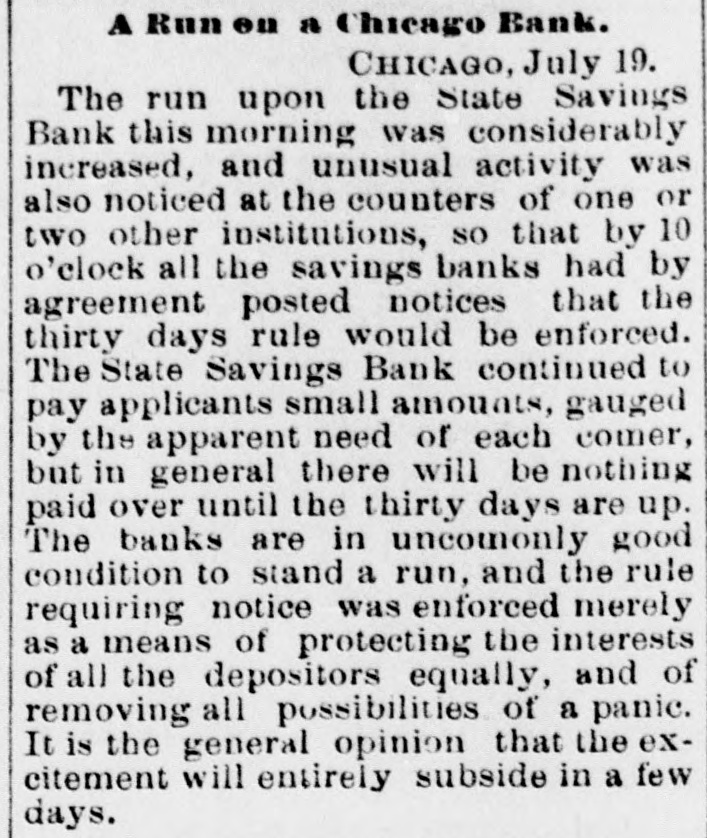
A Run on a Chicago Bank. CHICAGO, July 19. The run upon the State Savings Bank this morning was considerably increased, and unusual activity was also noticed at the counters of one or two other institutions, SO that by 10 o'clock all the savings banks had by agreement posted notices that the thirty days rule would be enforced. The State Savings Bank continued to pay applicants small amounts, gauged by the apparent need of each comer, but in general there will be nothing paid over until the thirty days are up. The banks are in uncomonly good condition to stand a run, and the rule requiring notice was enforced merely as a means of protecting the interests of all the depositors equally, and of removing all possibilities of a panic. It is the general opinion that the excitement will entirely subside in a few days.


Article from The Daily Gazette, August 29, 1877

Click image to open full size in new tab

Article Text

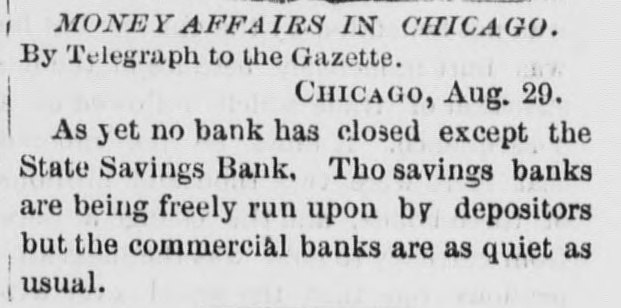
MONEY AFFAIRS IN CHICAGO. By Telegraph to the Gazette. CHICAGO, Aug. 29. As yet no bank has closed except the State Savings Bank, Tho savings banks are being freely run upon by depositors but the commercial banks are as quiet as usual.


Article from The Cincinnati Daily Star, August 29, 1877

Click image to open full size in new tab

Article Text

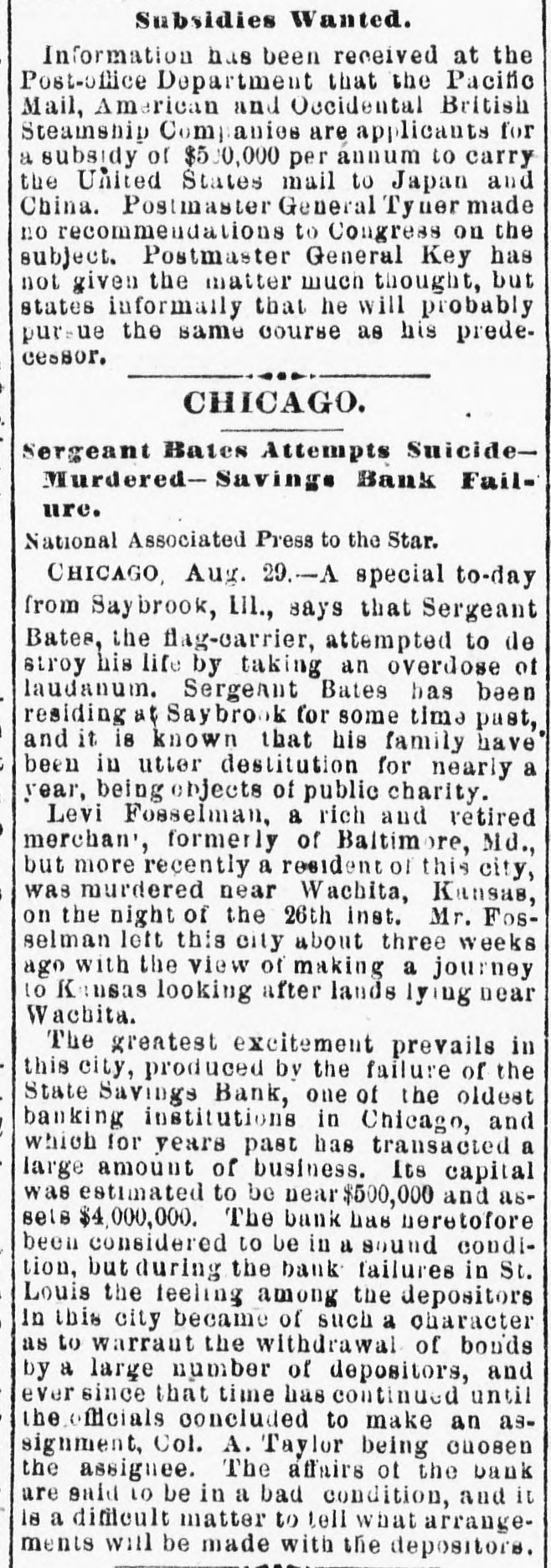
Subsidies Wanted. Information has been received at the Post-office Department that the Pacific Mail, American and Occidental British Steamship Companies are applicants for a subsidy of $530,000 per annum to carry the United States mail to Japan and China. Postmaster General Tyuer made no recommendations to Congress on the subject. Postmaster General Key has not given the matter much thought, but states informally that he will probably pure ue the same course as his predecessor. CHICAGO. Sergeant Bates Attempts SuicideMurdered-Savinge Bank Failure. National Associated Press to the Star. CHICAGO, Aug. 29.-A special to-day from Saybrook, 111., says that Sergeant Bates, the flag-carrier, attempted to de stroy his life by taking an overdose of laudanum. Sergeant Bates has been residing at Saybrook for some time past, and it is known that his family have been in utter destitution for nearly a year, being objects of public charity. Levi Fosselman, a rich and retired merchan', formerly of Baltimore, Md., but more recently a resident of this city, was murdered near Wachita, Kansas, on the night of the 26th inst. Mr. Fosselman left this city about three weeks ago with the view of making a journey to Kansas looking after lands lying near Wachita. The greatest excitement prevails in this city, produced by the failure of the State Savings Bank, one of the oldest banking institutions in Chicago, and which for years past has transacted a large amount of business. Its capital was estimated to be near $500,000 and assels $4,000,000. The bank has heretofore been considered to be in a sound condition, butduring the bank failures in St. Louis the feeling among the depositors in this city became of such a character as to warraut the withdrawal of bonds by a large number of depositors, and ever since that time has continued until the officials concluded to make an assignment, Col. A. Taylor being cuosen the assignee. The affairs ot the bank are said 10 be in a bad condition, and it is a difficult matter to tell what arrangements will be made with the depositors.


Article from The New York Herald, August 29, 1877

Click image to open full size in new tab

Article Text

HEAVY BANK FAILURE. The State Savings Institution of Chicago to Close To-Day. FLIGHT OF ITS PRESIDENT. Six Other Banks Expected To Be Involved in Its Ruin. ASSETS AND LIABILITIES. [BY TELEGRAPH TO THE HERALD.] CHICAGO, III.. August 28, 1877. The State Savings Institution of Chicago will close its doors to-morrow morning. It will be remembered that the recent bank troubles in St. Louis caused a heavy run upon the savings banks of Chicago. and that after two days of constant drain upon the available funds of the institution they were compelled to take advantage of the "thirty day rule," which requires that depositors shall give thirty days' notice of intention to draw out The president of the State Savings Institution at that time stated that the bank had in ready cash $900,000 and could within a reasonable time convert its paper into available funds, so that it would be ready for any emergency. The depositors took the advice of the newspapers and decided to give the bank a fair chance to straighten up its affairs. The run was checked and people began to think that there was no ground for uneasiness. In the meantime the bank has been going from bad to worse. It is estimated that within the last three months over $1,000,000 has been paid out. while within the past six weeks deposits have steadily fallen off. It became evident to the directors some time ago that this could not last much longer, and several efforts were made to raise money in this city and in New York, without avail. DEPOSITS RECEIVED UP TO THE LAST MOMENT. Notwithstanding the fact that the directors were satisfied the bank would collapse within a short time deposits were received up to last Saturday, when a meeting was held to decide upon the future. It was then agreed that all deposits coming in from that time until the suspension was made public should be turned over to Dr. Grant, a private citizen, and by him held for the benefit of the depositors. Deposits were received up to three o'clock this afternoon, so as not to excite suspicion, but they were turned over to Dr. Grant, as decided by the directors. This afternoon a final meeting of the directors was held and it was decided to turn over books and other property of the institution to Colonel Abner Taylor, whom they appointed receiver. DEPOSITS AND DEPOSITORS. From Colonel Taylor the HERALD corresponden procured the following information:-The number of persons depositors in the bank is upward of sixteen thousand, and the amount of deposits foot up $4,000,000. or this sum about $2,000,000 is secured by mortgages, bonds, &c.; but these If disposed of now will have to be sacrificed. Last Saturday morning President Spencer left Chicago for New York, ostensibly for the purpose of raising some money, but it is believed with a view to his personal safety. His mission if after money was a fruitless one. He had been connected with several loosely managed banking houses before he became president of the State Savings, and but little confidence was placed in his integrity by the business community. He has deceived the public as to the true condition of the bank, and the last quarterly statement made in July is a gross falsification of the assets. LIABILITIES AND ASSETS. Colonel Taylor had the following summary of the bank's condition drawn up for the HERALD correspondent:LIABILITIES.


Article from The Sun, August 30, 1877

Click image to open full size in new tab

Article Text

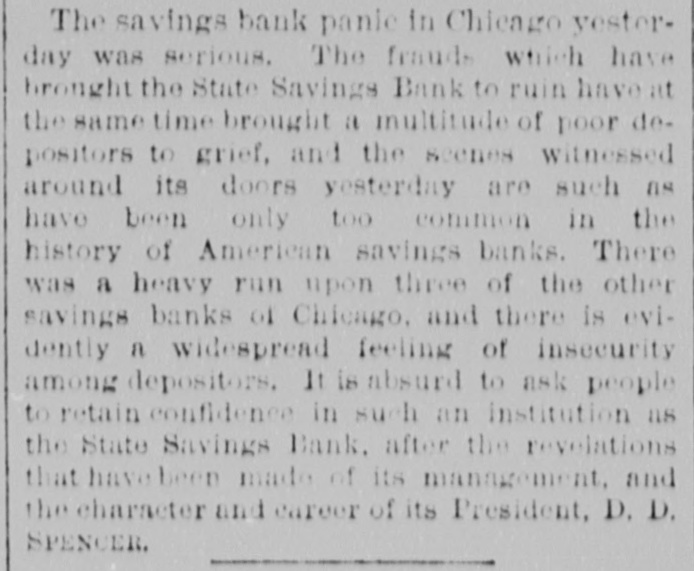
The savings bank panic in Chicago yesterday was serious. The frauds which have brought the State Savings Bank to ruin have at the same time brought a multitude of poor depositors to grief, and the scenes witnessed around its doors yesterday are such as have been only too common in the history of American savings banks. There was a heavy run upon three of the other savings banks of Chicago, and there is evidently a widespread feeling of insecurity among depositors. It is absurd to ask people to retain confidence in such an institution as the State Savings Bank. after the revolutions that have been made of its management, and the character and career of its President, D. D. SPENCER


Article from The Stark County Democrat, August 30, 1877

Click image to open full size in new tab

Article Text

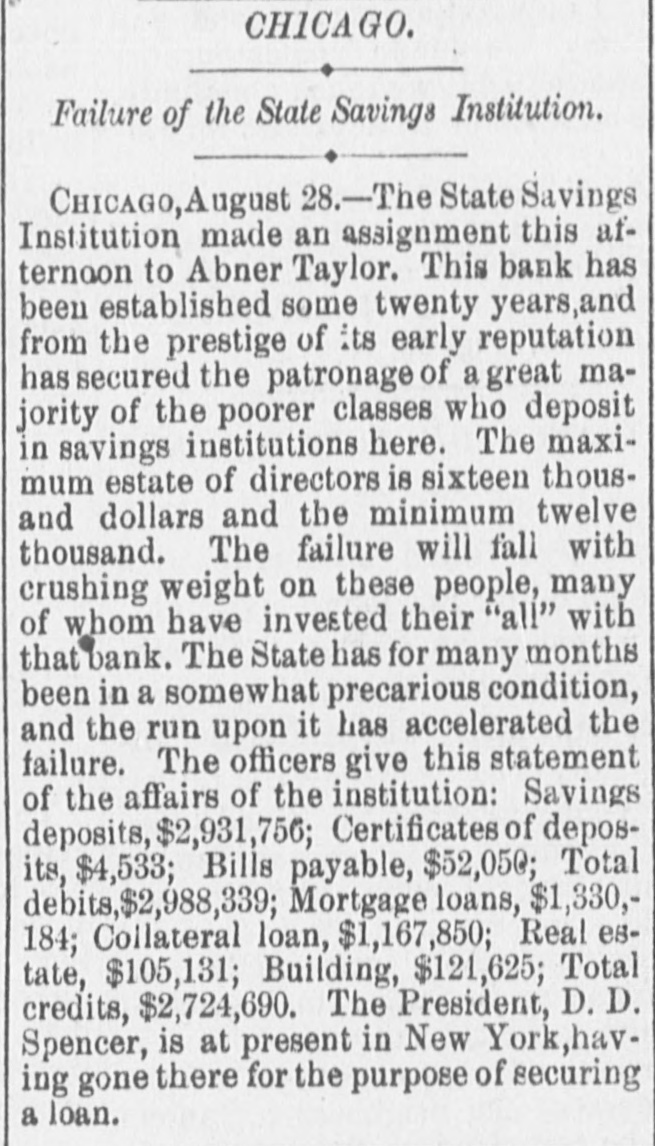
CHICA GO. Failure of the State Savings Institution. CHICAGO, August 28.-The State Savings Institution made an assignment this atternoon to Abner Taylor. This bank has been established some twenty years,and from the prestige of its early reputation has secured the patronage of a great majority of the poorer classes who deposit in savings institutions here. The maximum estate of directors is sixteen thousand dollars and the minimum twelve thousand. The failure will fall with crushing weight on these people, many of whom have invested their "all" with that bank. The State has for many months been in a somewhat precarious condition, and the run upon it has accelerated the failure. The officers give this statement of the affairs of the institution: Savings deposits, $2,931,756; Certificates of deposits, $4,533; Bills payable, $52,050; Total debits, $2,988,339; Mortgage loans, $1,330,184; Collateral loan, $1,167,850; Real estate, $105,131; Building, $121,625; Total credits, $2,724,690. The President, D.D. Spencer, is at present in New York, having gone there for the purpose of securing a loan.


Article from The New York Herald, August 30, 1877

Click image to open full size in new tab

Article Text

FINANCIAL AND COMMERCIAL. The Stock Market Active and Changeable. GOLD 104 1-8 A 104 1-4. Government Bonds Weaker, States Dull and Railroads Irregular. Money on Call 4 a 3 Per Cent, Closing at 2 Per Cent. WALL STREET, WEDNESDAY, August 29-6 P. The bulls who have been slashing about with such defiant elevation of horns and tall got a scent of the shambles this morning in the news which came of savings bank troubles in Chicago. The effect was immedate and rather startling in the sudden pressure to sell following so closely upon the heels of the former pressure to buy. and the bull party seemed for the moment stunned and tailed to come to the rescue until prices had slipped off from 1/2 to 2% per cent. The greatest decline was in Michigan Central, being closely followed by the Western and St. Paul shares, with Rock Island in close attendance, An impression prerailed that the suspension of the State Savings Bank in Chicago might lead to a run upon other institutions of that city and create a financial panic, which would force a sale of the above securities, and with this view not only the small holders but the small bears rushed in to sell. In the alternoon, when word came that the trouble was not likely to extend and that no more rotten spots were at present visible, a sharp rally ensued and the sellers of the morning realized that they had sold themselves as well as their stocks. Rock Island, however, refused to recover, it having to contend against a reported railroad accident and a German incubus. How bad the first IS we do not know, but Mr. H. Riddle, who appears to be an official, telegraphs that it has resulted in +considerable loss of life and injury to passengers. Will give fuller particulars by mail." The zealous haste to relieve the minds of anxious friends and relatives, as suggested in the last paragraph, Is highly worthy of commendation-11 leaves some opportunity for "guessing," bowever, which ought to be Mr. Riddle's strong point. The strength which the market achieved in the afternoon, after the hard blow in the morning, was due in H great degree to orders from Saraloga, the managers of the advance being compelled to keep the tone of prices up to concert pitch until the public shall have been induced to join in the chorus. Just now they have no ear for music such as is offered them. and evince no intention of relieving the buils of their répertoire of long stock. Gold advanced to 104 1/2 in the afternoon, closing at 104 Mr. Sherman will sell $1,000,000 on Saturday, and will pay out $7,114,000 on the 1st of September in the shape of interest on the ten-forty and four and a half per cent loans. THE SALES TO-DAY. New York Central, 14,700; Harlem, 200; Erie, 1,700; Lake Shore, 39,895; Wabash, 6,700; Northwestern, 8,900; do. preferred, 13,900; Rock Island, 12,700; Milwaukee and St. Paul, 6,400; do. preferred, 10,800; Pittsburg, 200; Delaware, Lackawanna and Western. 16,700; New Jersey Central, 700; Delaware and Hudson Canal, 2,700; Morris and Essex, 1,900; Michigan Central, 24,054; Illinois Central, 400; Union Pacific, 1.025; Hannibal and St. Joseph, 900; do. preferred, 500; Ohio and Missiesippi, 800; Panama, 8,000; Atlantic and Pacific Telegraph, 16,200; Pacific Mall, 5,150; Quicksilver preferred, 150; Wells, Fargo & Co., 200. OPENING, HIGHEST AND LOWEST. The following table shows the opening, highest and lowest prices of the day:-


Article from New-York Tribune, September 1, 1877

Click image to open full size in new tab

Article Text

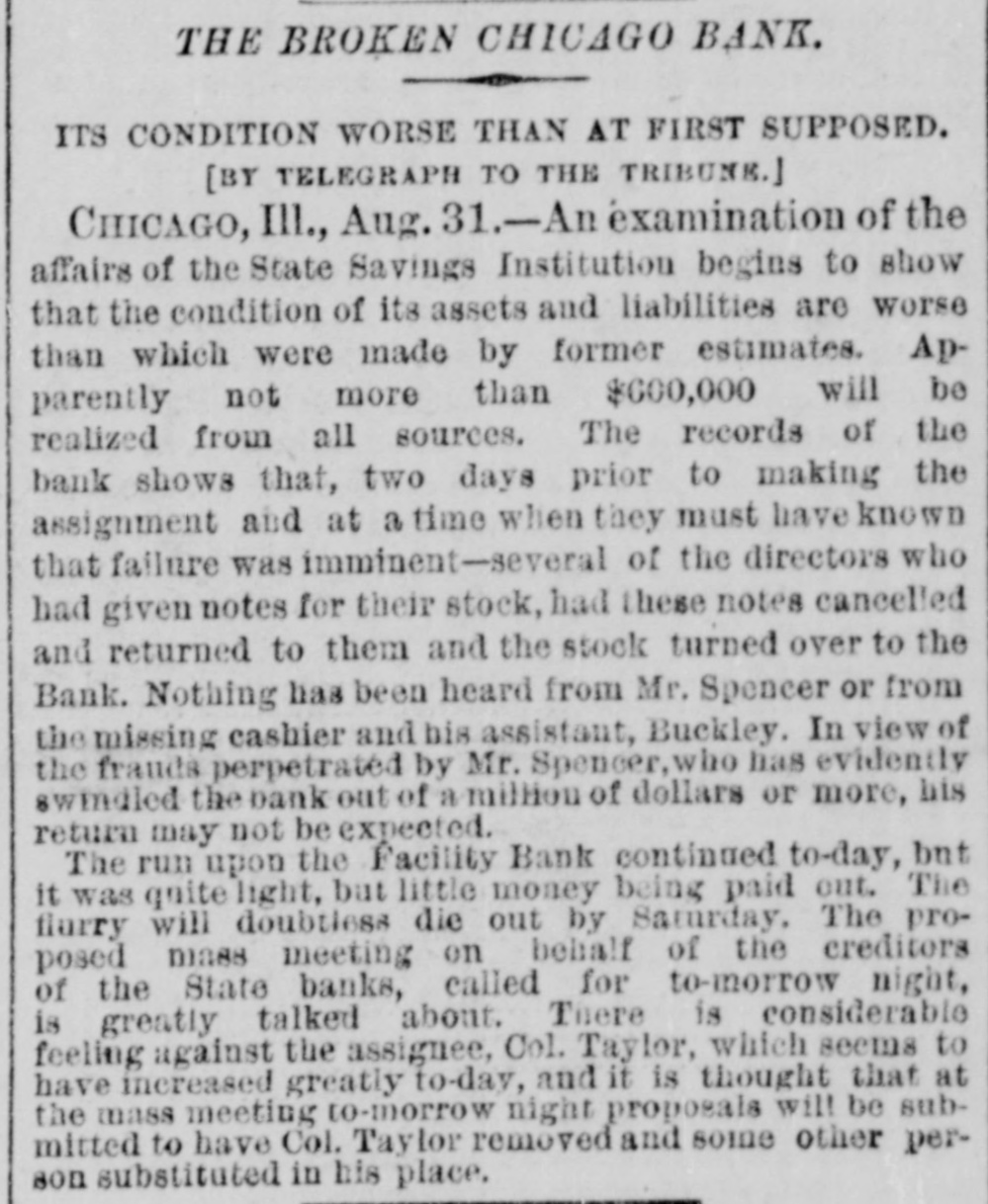
THE BROKEN CHICAGO BANK. ITS CONDITION WORSE THAN AT FIRST SUPPOSED. [BY TELEGRAPH TO THE TRIBUNE.] CHICAGO, III., Aug. 31.-An examination of the affairs of the State Savings Institution begins to show that the condition of its assets and liabilities are worse than which were made by former estimates. Apparently not more than $600,000 will be realized from all sources. The records of the bank shows that, two days prior to making the assignment and at a time when they must have known that failure was imminent-several of the directors who had given notes for their stock, had these notes cancelled and returned to them and the stock turned over to the Bank. Nothing has been heard from Mr. Spencer or from the missing cashier and his assistant, Buckley. In view of the frauds perpetrated by Mr. Spencer, who has evidently swindled the bank out of a million of dollars or more, his return may not be expected. The run upon the Facility Bank continued to-day, bnt it was quite light, but little money being paid out. The flurry will doubtless die out by Saturday. The proposed mass meeting on behalf of the creditors of the State banks, called for to-morrow night, is greatly talked about. There is considerable feeling against the assignee, Col. Taylor, which seems to have increased greatly to-day, and it is thought that at the mass meeting to-morrow night proposals will be submitted to have Col. Taylor removed and some other person substituted in his place.


Article from The Wheeling Daily Register, September 5, 1877

Click image to open full size in new tab

Article Text

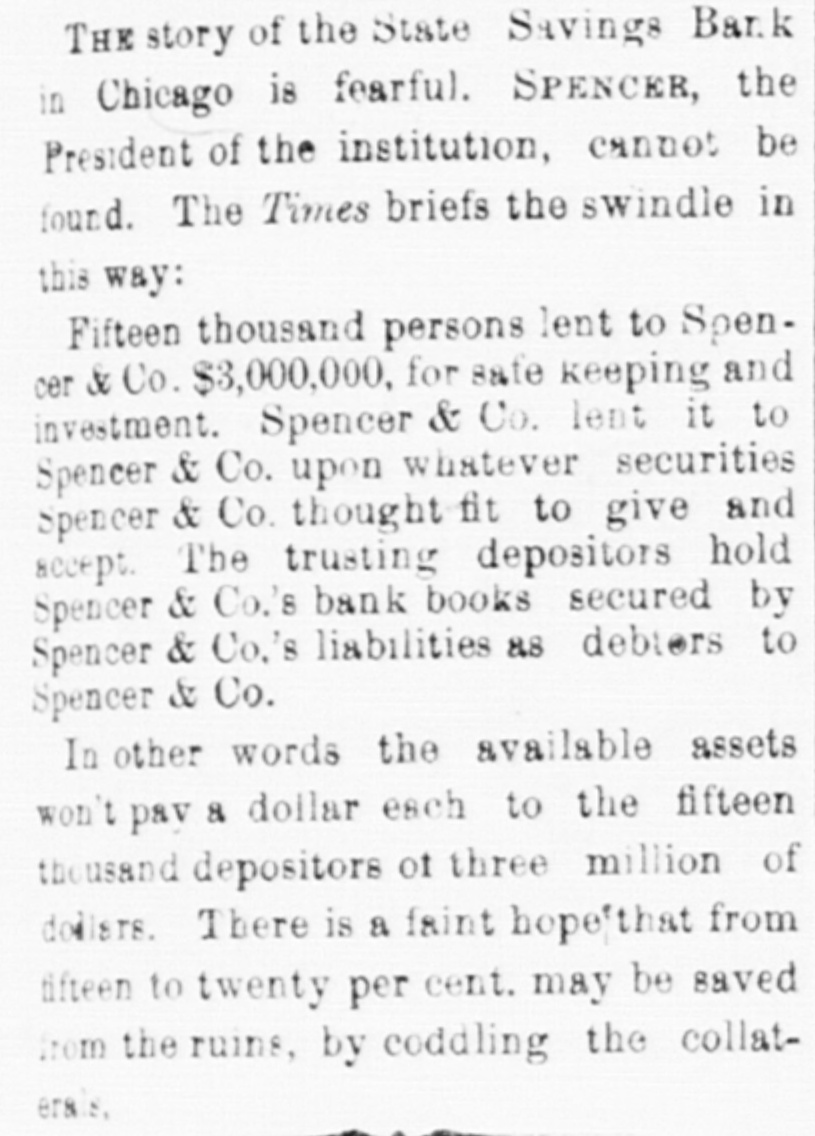
THE story of the State Savings Bank in Chicago is fearful. SPENCER, the President of the institution, cannot be found. The Times briefs the swindle in this way: Fifteen thousand persons lent to Spencer & Co. $3,000,000. for safe keeping and investment. Spencer & Co. lent it to Spencer & Co. upon whatever securities Spencer & Co. thought fit to give and accept. The trusting depositors hold Spencer & Co.'s bank books secured by Spencer & Co.'s liabilities as debtors to Spencer & Co. In other words the available assets won't pay a dollar each to the fifteen thousand depositors of three million of dollsts. There is a faint hope*that from tifteen to twenty per cent. may be saved from the ruins, by coddling the collateras.


Article from The Donaldsonville Chief, September 8, 1877

Click image to open full size in new tab

Article Text

Domestic. Ex-Governor Wilson Shannon of Kausas is dead. Village of Ashland, Ills., almost entirely burned. Decrease of the national debt in August $3,869,538. Adams, founder of Adams Express, died at Boston, aged 73. Avaring mille, litte, Illa., with 25,000 bushels of wheat, burned. Louisville business men will petition Congress to repeal the bankrupt law. The State Savings Bank of Chicago has failed and the officers have left the city. Ten blocks, composing nearly the entire business portion of Paris, Texas, burned. A.B. Haynes. grand master of the State Grange and n leading farmer of Mississippi, is dead. John King, and extensive St. Louis lard and oil dealer, has gone into voluntary bankruptcy. Hamburg distillery, Pekin, Ills., was destroyed by fire. A blacksmith perished in the flames. A convention of bankers will be held at New York ou the 12th. The attendance will be large. The Grand Encampment of Knights Templar adjourned at Cleveland to meet in Chicago next year. The State department has advices of the death of United States Vice Consul Harrison at Gnayas. Robert Leich, a Scotchman, just arrived from Florida, died in New York Hospital, of yellow fever. A locomotive ran into a group of five persons at Salem, Mass., killing three and wounding the others. The Lehigh Valley railroad refuses to transport coal for minioing companies that yielded to the strikers. Hon. A. G. Lawrence of Rhode Island has accepted the civilian's position on the Sitting Bull commission. Dr. S. M. Stein, a New York physician, committed suicide by jumping from the Niagara suspension bridge. Theopholus Gaines, recently appointed attorney for Montana, has complied with the request to resign. Gen. Wesley Merritt will command ten companies of cavalry to be sent in pursuit of the hostile Nez Perces. Mrs. Catherine Berry of New Orleans ventured beyond her deptii while bathing at Grand Isle, and was drowned. ) During a heavy shower the wall of I the building of the Woreester Wire Company was blown down, killing i two persons. e A house of ill fame at Cincinnati e fell while workmen were making an excavation under the walls. Several y persons were injured. t The sixth regiment Maryland miliS tia, Col. Peters. which took a promit nent part in quelling the strike riots r at Baltimore, has disbanded. n S. S. Burdett, a commissioner of p e the general land-office, who it was II supposed committed suicide, has turned up at Sedalia, Mo., insane. y g Simeon Garnett, a negro who comil mitted an assault on Mrs. Perry Kingrey. near Oxford, O., was taken out of jail and shot dead by the people.


Article from The Redwood Gazette, September 13, 1877

Click image to open full size in new tab

Article Text

signally defeated. Though sadly crippled since the fire, it was hoped by the management that the Institution would worry through, but the series of sudden failures in St. Louis brought a run upon the quivering bank, which, in an effort to save itself, paid out from $300,000 to $400,000 of its cash means without securing the object sought-the allayingof the excitement. It was finally forced to fall back upon the sixty-day rule, though it has constantly paid out money to needy depositors. This drain, the payment of the half-yearly interest of 3 per cent on $4,000,000 of de posits, and the slow receipts of deposits, conspired to still further weaken the Institution, which, up to July 1, had paid $800,000 over its receipts, and thus parted with the bulk of itecash means. Its assets were of an unfortunate nature. Masses of real estate, which could not be turned owing to the general depression of the market, crippled paper secured by lots whose buildings had been destroyed by the fire, and an enormous amount of unimproved property, taken for debt, and valuable only as it represented a dead loss in the taxes that must be paid, made up the list. The $500,000 capital had been wiped away and the interest of the stockholders extinguished by the hard times that had eaten sadly into the prosperity of the bank, and shrunk it from a live and healthy institution to a pitiful monument of the banking system. It is estimated that nearly one-third of its loans were to mechanics and the salaried class, who borrowed to build homes, and whom the Institution endeavored by every means to assist when the hour of payment found them unable to respond. All this time it preserved its high rate of interest on deposits, notwithstanding the fact that much of its money was idle and its expenses heavy. Perhaps this outline of its affairs will remove any doubt that may exist as to the propriety of the explosion. It is certain that Mr. Spencer did not fully enjoy the confidence of the financial community. His unfortunate experience in the Cook County National, which subsequently landed high and dry, militated against him seriously, and through him against the State Savings. But he managed to stem even this tide until the troubles in St. Louis precipitated the disaster he had hoped to avert. But little could be learned of the condition of the bank for some time before the failure, and this fact, connected with surmises that Mr. Spencer had reasons for suppressing all information, did not tend to the establishment of the confidence he coveted. When the necessity for raising money became absolute, Mr. Spencer went among bankers and said he had $1,000,000 in paper good for its face, $1,000,000 in slow paper, and $1,000,000 in miscellaneous securities. Per contra, his obligations were $3,000,000, and on this showing he wanted $300,000 on such securities as he could afford to part with, claiming that this would enable him to raise from $300,000 to $500,000 in New York, with which he could restore credit. It was readily seen that he would have no first-class securities left, and that the bank must go under by the 1st of January, and bankers concluded that there would be less disappointment if it should fall now than in the winter, when less could be realized on the securities than when the corn was waving, the crops moving, and business generally more brisk. As to the dividends for depositors, Mr. Spencer has claimed that they will reach 75 or 80 per cent., or, under first-class management, 90 per cent., if the paper were sold wisely and slowly, while bad management will reduce them to 60 or 70 per cent. How much really will be realized depends upon the manner in which the vast mass of real estate can be utilized. The question whether the affairs of the bank have been managed dishonestly, or merely imprudently, is asked, and an investigation is awaited anxiously. Mr. Spencer has always been secretive, and has kept the details of his administration to himself. In how far this has been a wise course is left for time to determine. The depositors feel desirous of understanding the matter, even if they receive no other equivalent for their money. From these facts it is manifest that the State Savings Institution was doomed. No general pressure exists upon banking interests, and none was needed to cripple the foundation of this one institution. Flush times might have saved it, but flush times were necessary, and a little pinching. which has not yet affected, and will not affect, the rest, has raised the tombstone of the bank whose vitality has been sadly impaired since the fire.-Chicago Tribune, Aug. 29.


Article from Chicago Daily Tribune, September 13, 1877

Click image to open full size in new tab

Article Text

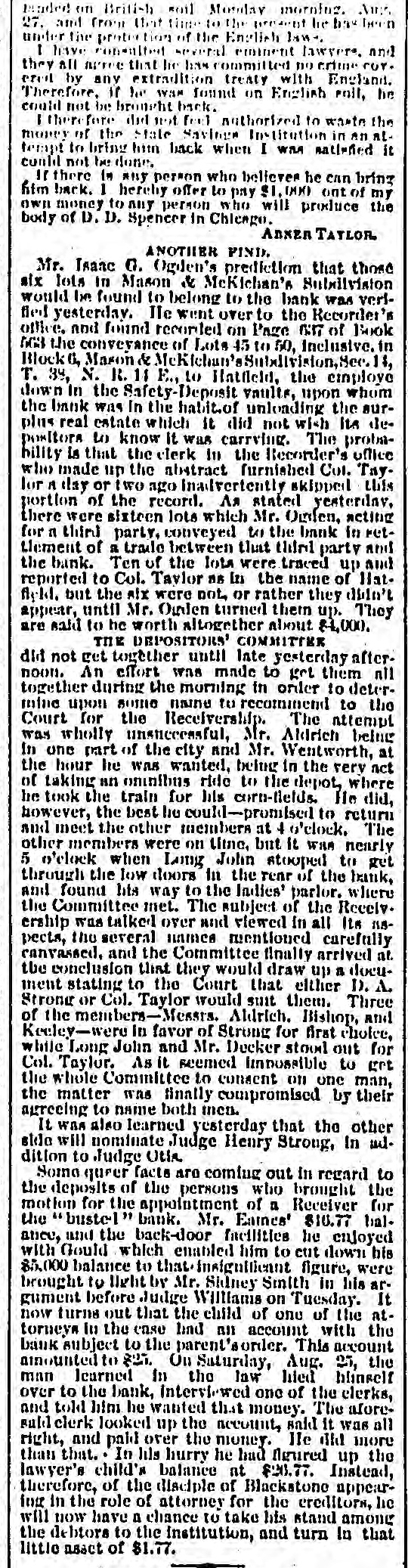
# ABNER TAYLOR maded on British oil Moralay mornfuz. Mr. 27. and from that time to the present he has been under the protection of the Englich laws. I have ron-nitrd several eminent lawyere, and they all agree that he has committed no crime cor. erol by any extradition treaty with England, Therefore, if he was found on English coil, he could not be brought back. I therefore did not food authorized to waste the money ney of the State Savinge Institution in an al- tempt to bring him back when I was satisfied it cunlil not be done, If there in any person who believes he can bring him back. I hereby offer to pay $1,188) ont of my own money to any person who will produce the body of D. D. Spencer in Chicago. # ANOTHER FIND. Mr. Isaac G. Ogden's prediction that those six lots in Mason & McKichan's Subsilviston would be found to belong to the bank was verified yesterday. IHe went over to the Recorder's office, and found recorded on Page 7 of Book 663 the conveyance of Lots 45 to 50, Inclusive, in Block 6, Mason & McKichan's Subdivision, Sec. 14, T. 39, N. R. 11 E., to Hatfield, the employe down in the Safety-Deposit vaulte, upon whom the bank was in the habit of unloading the surplus real estate which it did not wish its depositors to know it was carrving. The probability is that the clerk in the Recorder's uffice who made up the abstract furnished Cot. Taylor a day or two ago inadvertently skipped this portion of the record. As stated yesterday, there were sixteen lots which Mr. Ogden, acting for a third party, conveyed to the bank in ret- Llement of a trade between that third party and the bank. Ten of the lota were traced up and reported to Col. Tavlor as in the name of Hat- flykl, but the six were not, or rather they dilo't appear, until Mr. Ogden turned them up. They are said to he worth altogether about 1,000. # THE DEPOSITORS' COMMITTER did not get together until late yesterday afternoon. An effort was made to get them all together during the morning in order to deter- mine upon some naine to recommend to the Court for the Receivership. The attempl was wholly unsuccessful, Mr. Aldrich being In one part of the city and Mr. Wentworth, at the hour he was wanted, being in the very act of taking an oninibus ride to the depot, where he took the train for his corn-fields. He did, however, the best he could-promised to returu and meet the other members at 4 o'clock. The other members were on tiine, but it was nearly 5 o'clock when Lang John stooped to get through the low doors in the rear of the bank, and found his way to the Indies' parlor, where the Committee met. The subject of the Receiv ership was talked over and viewed in all its ns- pects, the several names mentioned carefully canvassed, and the Committee finally arrived at. the conclusion that they would draw up a docu- ment stating to the Court that either D. A. Strong or Col. Taylor would sunt them. Three of the members-Messrs. Aldrich. Bishop, and Keeley-were in favor of Strong for first cholce, while Long John and Mr. Decker stood out for Col. Taylor. As it seemed impossible to get the whole Committee to consent on one man, the matter was finally compromised by their agreeing to name both men. It was also learned yesterday that the other side will nominate Judge Henry Strong, In ad- dition to Judge Otis. Somo quser facts are coming out in regard to the deposits of the persons who brought the motion for the appointment of a Receiver for he "bustel" bank. Mr. Eaines' $10.77 hal- anee, and the back-door facilities he enjoyed with Gould which enabled him to cut down his 85.000 balance to that insigullicant figure, were brought to light by Mr. Sidney Smith in his ar- gument before Judge Williams on Tuesday. It now turns out that the child of one of the at- torneys in the case had an account with the bank subject to the parent'sorder. This account amounted to 25. On Saturday, Aug. 25, the man learned in the law hied hinself over to the bank, interviewed one of the clerks, and told him he wanted that money. The afore- sald clerk looked up the account, sald it was all right, and paid over the money. He did more than that. In his hurry he had figured up the lawyer's child's balance at $23.77. Instead, therefore, of the disciple of Blackstone appear- ing in the role of attorney for the creditors, he will now have a chance to take his stand among the debtors to the institution, and turn in that little nsact of $1.77.


Article from The Stark County Democrat, September 20, 1877

Click image to open full size in new tab

Article Text

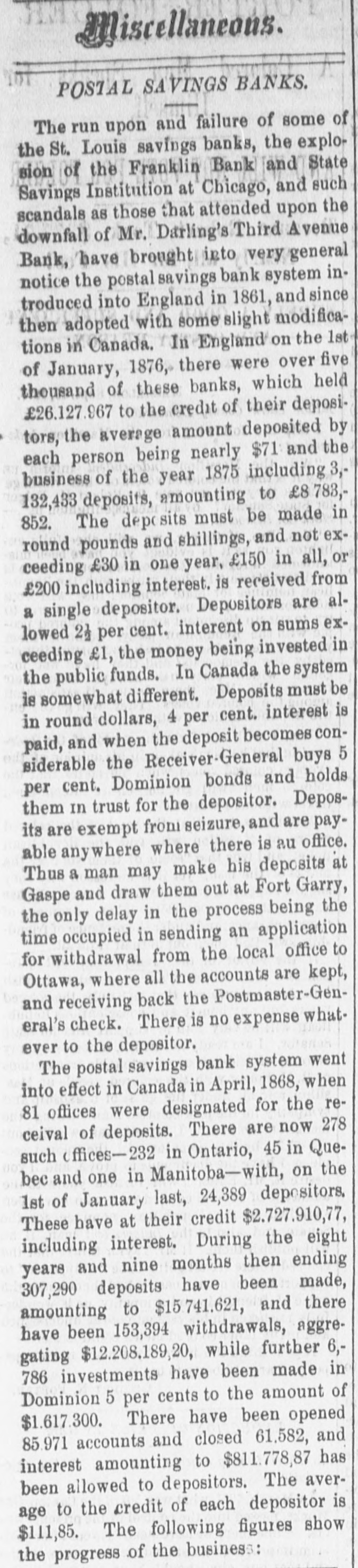
# POSTAL SAVINGS BANKS. The run upon and failure of some of the St. Louis savings banks, the explosion of the Franklin Bank and State Savings Institution at Chicago, and such scandals as those that attended upon the downfall of Mr. Darling's Third Avenue Bank, have brought into very general notice the postal savings bank system introduced into England in 1861, and since then adopted with some slight modifications in Canada. In England on the 1st of January, 1876, there were over five thousand of these banks, which held £26.127.967 to the credit of their depositors, the average amount deposited by each person being nearly $71 and the business of the year 1875 including 3,132,433 deposits, amounting to £8783,852. The deposits must be made in round pounds and shillings, and not exceeding £30 in one year, £150 in all, or £200 including interest, is received from a single depositor. Depositors are allowed 2½ per cent. interent on sums exceeding £1, the money being invested in the public funds. In Canada the system is somewhat different. Deposits must be in round dollars, 4 per cent. interest is paid, and when the deposit becomes considerable the Receiver-General buys 5 per cent. Dominion bonds and holds them in trust for the depositor. Deposits are exempt from seizure, and are payable anywhere where there is au office. Thus a man may make his deposits at Gaspe and draw them out at Fort Garry, the only delay in the process being the time occupied in sending an application for withdrawal from the local office to Ottawa, where all the accounts are kept, and receiving back the Postmaster-General's check. There is no expense whatever to the depositor. The postal savings bank system went into effect in Canada in April, 1868, when 81 offices were designated for the receival of deposits. There are now 278 such offices-232 in Ontario, 45 in Quebec and one in Manitoba-with, on the 1st of January last, 24,389 depositors. These have at their credit $2.727.910,77, including interest. During the eight years and nine months then ending 307,290 deposits have been made, amounting to $15 741.621, and there have been 153,394 withdrawals, aggregating $12.208.189,20, while further 6,786 investments have been made in Dominion 5 per cents to the amount of $1.617.300. There have been opened 85.971 accounts and closed 61,582, and interest amounting to $811.778,87 has been allowed to depositors. The average to the credit of each depositor is $111,85. The following figures show the progress of the business:


Article from The New York Herald, September 25, 1877

Click image to open full size in new tab

Article Text

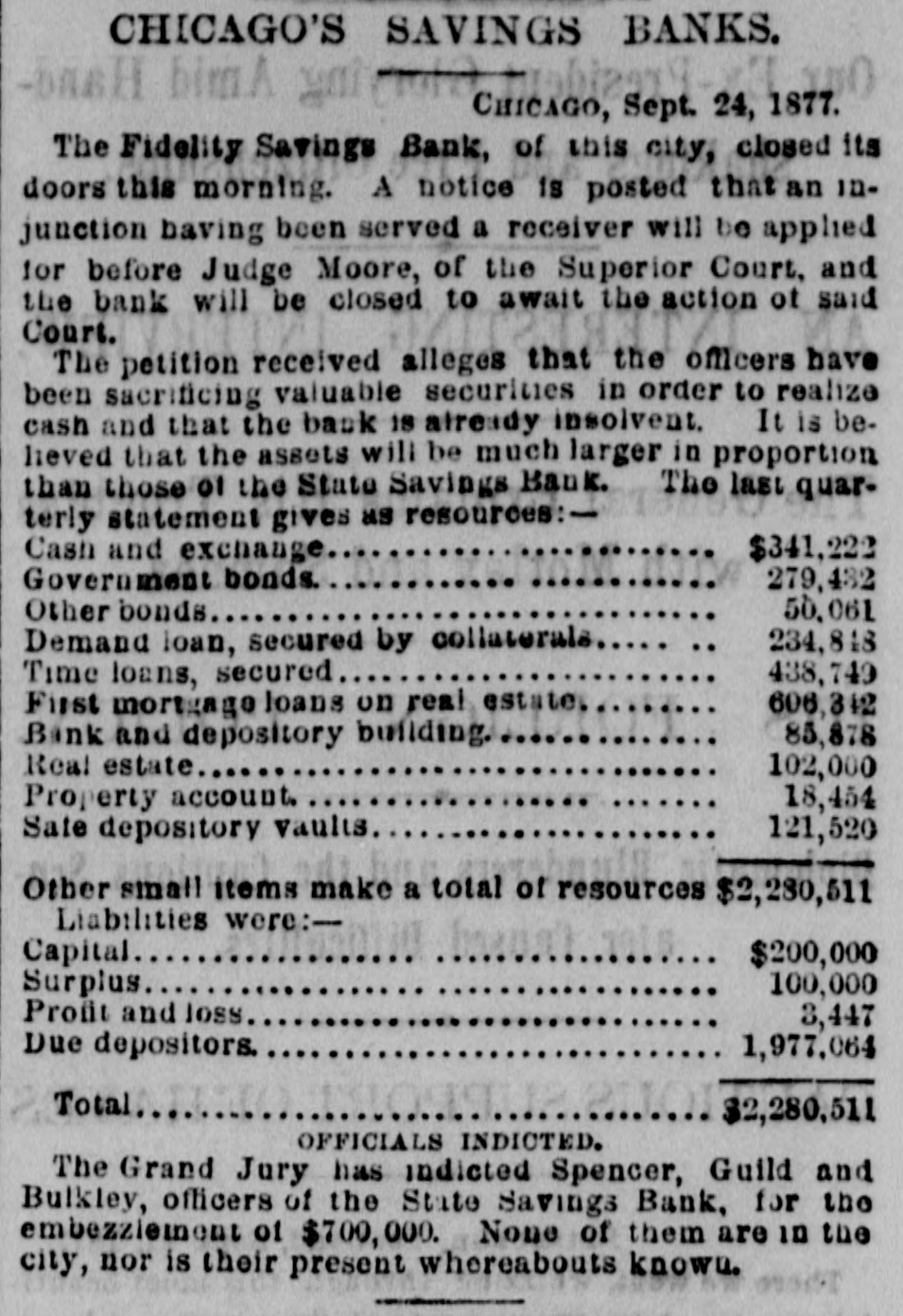
CHICAGO'S SAVINGS BANKS. moha CHICAGO, Sept. 24, 1877. The Fidelity Savings Bank, of this city, closed its doors this morning. A notice is posted that an injunction having been served a receiver will be applied for before Judge Moore, of the Superior Court, and the bank will be closed to await the action ot said Court. The petition received alleges that the officers have been sacrificing valuable securities in order to realize cash and that the back 18 already insolvent. It is believed that the assets will be much larger in proportion than those 01 the State Savings Bank. The last quarterly statement gives as resources:$341,222 Cash and exchange Government bonds. 279,432 Other bonds 50,061 234,818 Demand loan, secured by collaterals 438,749 Time loans, secured First mortgage loans on real estate. 606,342 85,878 Bank and depository building. Real estate 102,000 Property account. 18,454 Safe depository vaults 121,520 Other small items make a total of resources $2,230,511 Liabilities were:Capital $200,000 Surplus 100,000 Pront and loss 3,447 Due depositors. 1,977,064 Total $2,280,511 OFFICIALS INDICTED. The Grand Jury has indicted Spencer, Guild and Bulkley, officers of the State Savings Bank, for the embezziement of $700,000. None of them are in the city, nor is their present whereabouts known.


Article from The Cairo Bulletin, September 26, 1877

Click image to open full size in new tab

Article Text

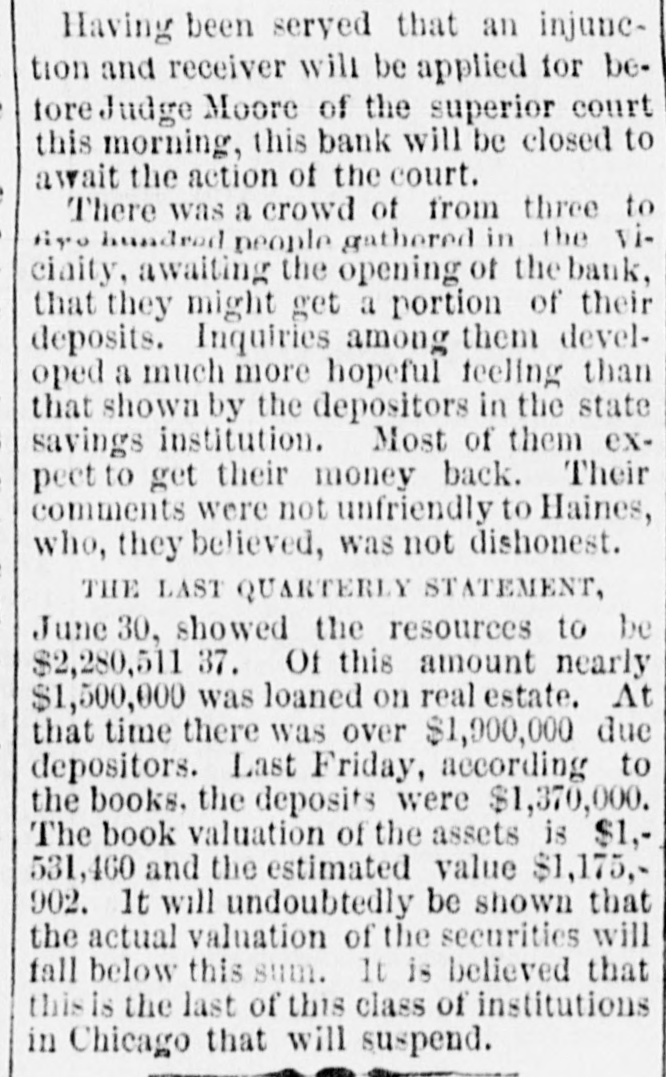
Having been seryed that an injunction and receiver will be applied for before Judge Moore of the superior court this morning, this bank will be closed to await the action of the court. There was a crowd of from three to Apo hundred people gathered in the viciaity, awaiting the opening of the bank, that they might get a portion of their deposits. Inquiries among them developed a much more hopeful feeling than that shown by the depositors in the state savings institution. Most of them expect to get their money back. Their comments were not unfriendly to Haines, who, they believed, was not dishonest. THE LAST QUARTERLY STATEMENT, June 30, showed the resources to be $2,280,511 37. Of this amount nearly $1,500,000 was loaned on real estate. At that time there was over $1,900,000 due depositors. Last Friday, according to the books. the deposits were $1,370,000. The book valuation of the assets is $1,531,460 and the estimated value $1,175,902. It will undoubtedly be shown that the actual valuation of the securities will fall below this sum. It is believed that this is the last of this class of institutions in Chicago that will suspend.


Article from The Donaldsonville Chief, September 29, 1877

Click image to open full size in new tab

Article Text

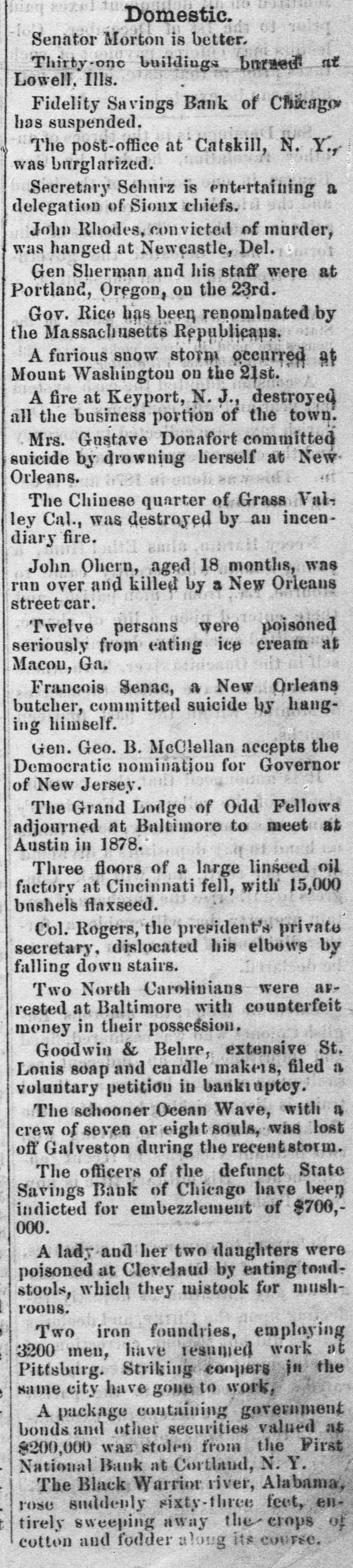
Domestic. 03 Senator Morton is better. Thirty-one buildings burned at Lowell, Ills. Fidelity Savings Bank of Chicago has suspended. The post-office at Catskill, N.Y., was burglarized. Secretary Schurz is entertaining a delegation of Sioux chiefs. John Rhodes, convicted of murder, was hanged at Newcastle, Del. Gen Sherman and his staff were at Portland, Oregon, on the 23rd. Gov. Rice has been renominated by the Massachusetts Republicans. A furious snow storm occurred at Mount Washington on the 21st. A fire at Keyport, N.J., destroyed all the business portion of the town. Mrs. Gustave Donafort committed suicide by drowning herself at New Orleans. The Chinese quarter of Grass Valley Cal., was destroyed by au incendiary fire. John Ohern, aged 18 months, was run over and killed by a New Orleans street car. Twelve persons were poisoned seriously from eating ice cream at Macon, Ga. Francois Senac, a New Orleans butcher, committed suicide by hanging himself. Gen. Geo. B. McClellan accepts the Democratic nomination for Governor of New Jersey. The Grand Lodge of Odd Fellows adjourned at Baltimore to meet at Austin in 1878. Three floors of a large linseed oil factory at Cincinnati fell, with 15,000 bnshels flaxseed. Col. Rogers, the president's private secretary, dislocated his elbows by falling down stairs. Two North Carolinians were avrested at Baltimore with counterfeit money in their possession. Goodwin & Behre, extensive St. Louis soap and candle makers, filed a voluntary petition in bankiuptcy. The schooner Ocean Wave, with a crew of seven or eight souls, was lost off Galveston during the recentstorm. The officers of the defunct State Savings Bank of Chicago have been indicted for embezzlement of $700,000. A lady and her two daughters were poisoned at Clevelaud by eating toadstools, which they mistook for mushroons. Two iron foundries, employing 3200 men, have resumed work at Pittsburg. Striking coopers in the same city have gone to work, A package containing government bonds and other securities valued at $200,000 was stolen from the First National Bank at Cortland, N.Y The Black Warrior river, Alabama, rose suddenly sixty-three feet, entirely sweeping away the crops of cotton and fodder along its course.


Article from The Redwood Gazette, November 1, 1877

Click image to open full size in new tab

Article Text

with impressive ceremonies, in the presence of a large concourse of people. John Morrissey has been nominated as the Anti-Tammany candidate for the New York State Senate, in the Seventh Districtthe home of John Kelly, the Tammany Chief The Board appointed to examine the Washington Monument have decided that the monument may safely be completed, if certain additions are made to secure the foundation. A steamer at New Haven, Conn., a few days ago, was ready to sail for Constantinople with 2,150 tons of ammunition, valued at $2,000,000, and another vessel was preparing to load. J. S. Trasker. President of the First National Bank of Wichita, Kan., has been convicted of embezzling the bank's funds, and sentenced to five years' imprisonment in the State Prison. John M. Harlan, of Kentucky, was nominated as an Associate Justice of the Supreme Court, by the President, on the 17th. The nomination was referred to the appropriate committee of the Senate. There being no export demand at present for trade-dollars, Sec'y Sherman has ordered the Director of the Mint to discontinue the receipt of deposits therefor at the several mints. and a general order to that effeet has been issued. Guild and Bulkley, the Cashier and Assistant-Cashier of the suspended Chicago State Savings Institution, have returned to that city from a brief sojourn in Canada. They express a willingness to assist the Receiver in realizing upon the assets. The total vote for Governor of Ohio, at the recent election, was: Bishop (Dem.), 261.236: West (Rep.), 239,347: Bond (Workingman). 12,480: Thompson (Pro.), 4,868; Johnson (Greenback and Workingman) 16,890: scattering, 84. Total. 534,905. In consequence of the illness of Senator Morton, the Committee to investigate the case of Senator Grover, of Oregon, had not reported up to the 22d. The report was being prepared, and it was thought the Oregon Senator would be fully exonerated. A produce commission merchant of Albany, N.Y., named Wm. S. Taylor, has been, it is said, recently detected in a series of forgeries, aggregating about $38,000. He obtained money from four banks on notes to which he had signed the names of his father and an uncle. A dispatch was received from the Commission to treat with Sitting Bull. on the 22d. the purport of which was that they had met the warrior, but had utterly failed to obtain any satisfaction or terms of settlement from him. The Commission had left for home and would reach Fort Benton, on the 24th. The rates on west-bound freight from New York have been fixed as follows, per 100 lbs: To St. Louis-First class, $1.28: second class, $1.16: third class, 97c.; fourth class, 61c. To Chicago-First class, $1.00; second, 90c.: third. 75c.; fourth, 45c. To Milwaukee -Same as Chicago. To Indianapolis-First class, 95c.: second, S5c.: third, 71c.: fourth. 43c. To Toledo-First class, Tic.; second. 69c.: third, 58c.; fourth. 35c. To DetroitFirst class, 70c.: second, 63c.: third, 53c.: fourth, 32c.


Article from Chicago Daily Tribune, December 9, 1877

Click image to open full size in new tab

Article Text

ness, in which she was engaged as his agent. She assigned the account to him, and he went down the day the bank closed to draw the money, but found the doors shut. He owes the bank $2,000 secured by collaterals, and he prays that this balance to his wife's credit, but assigned to him, may be set off as far as it will go against his note. Martha P. Sedgwick relates that in June last her husband, since deceased, had a deposit of $1,025.62 in the ill-fated bank. She employed one Stephen Sibley to close up her husband's estate, and in pursuance of his duties he called on the bank to draw this balance. The officers refused to pay it, but offered to apply it on a note for a larger sum owing by Sedgwick to it, and which was nearly due. They also offered to and did transfer this bank account to Sibley's name, in order to facilitate matters. After the failure of the institution, the Receiver declined to set this note and account off against each other, they being in different names, and Mrs. Sedgwick, under the circumstances, thinks that it should be done, and asks that the Receiver be directed to credit the deposit account on the note. Christopher McJohn, in his petition, represents that in August, 1875, he borrowed $350 of the bank, giving a note and a trust-deed executed by his father on the latter's land. Petitioner had an account of $355 in the bank when it closed, and he asks that it may be set off against the note and trust-deed, on the ground that the securities were given by his father solely on his account. Lastly, Thomas S. McClelland filed a petition stating that in December, 1876, Sydney Myers bought in at a trustee's sale Lot 1, Block 1, of E. Smith's Resubdivision of B. F. Johnson's Subdivision of part of the W. ½ of the S. W. ¼ of Sec. 34, 39, 14. This purchase was made solely in trust for petitioner who was to resell the land and out of the proceeds pay the purchase money. Subsequently, and without consideration, Myers conveyed the lot to A. D. Guild, Cashier of the State Savings Institution, and Guild turned it over to the bank for $10. McClelland claims these conveyances were fraudulent, and asks that Judge Otis may be compelled to pay him $149, that being his interest in the lot, or that in default thereof the lot may be sold. Judge Williams was engaged in hearing evidence on these claims, but no order was made beyond dismissing a petition of Jacob S. Matthews for a set-off of an account against his note. No further steps were taken toward making out the order for the sale of the bank building, though yesterday was fixed as the time when the notice of publication should be made out.


Article from Chicago Daily Tribune, December 12, 1877

Click image to open full size in new tab

Article Text

Receiver three days after. He has authority, on the order of Court, among other things, to com- pound doubtful debts, and he asks for the direc- tion of the Court as to the disposition to make of the following securities: Nov. 21 J. H. Clough deposited in the bank a check for $5,000, payable out of the Union National Bank. He received credit therefor, and the check was refused at the Union National on account of want of funds, and it was charged back to him. Similar accidents happened on all the following checks: Babcock Bros., check for $100; R. B. Cuson, Special Agent, check for $56.43; A. Knisely & Co., $225; Holly, Easton & Allen, $323; Fisher Bros., $221.25; Holly, Easton & Allen, $1,000; McDonald & Stimpson, $100; and Nation- al Cigar Company, two checks for $130 each. These checks have all been charged back to the parties making or presenting them, and they have asked to have them given back to them. All the parties also have balances at the bank to their credit, and none of them are in debt to the bank, except A. Knisely & Co., so that no damage or loss can re- sult to the bank. An order was therefore entered allowing the Receiver to surrender the checks as asked. # THE DEAD SAVINGS-BANKS yield little or nothing to the newsgatherer. Judge Otis wants to sell the State Savings Institution, but neither he nor any depositor is willing to have it sold at too great a sacrifice. The proposed sale has accordingly been abandoned for the present, and the Judge will wait for better days, when peo- ple are more settled on the money question, busi- ness improves, and real estate takes a rise. In the State Savings-Hans case Judge Williams yesterday entered an order allowing the Receiver to sell to James F. Joy, President of the Michigan Central Railroad Company, an undivided 7-24 in- terest in 60.383 acres, being parts of secs. 22 and 27, Township 37, Range 14, owned by the bank. The sale is at the rate of $312.50 an acre, one-quarter cash, and the balance in one, two, and three years, with interest at 5 per cent. The Receiver is also authorized to lease certain strips of land near the above property to the railroad to enable it to get water from Calumet Lake. The petition for the purpose was filed several days ago, and several witnesses were examined to ascertain whether the proposed sale and lease was advantageous. The Fidelity is still paying out that 10 per cent dividend. Something near $100 was doled out yesterday. The big fish have come and get their wealth, but the little ones who had deposits from $1 up to $20 do not press forward with any noticeable amount of anxiety to draw the moiety coming to them. The approach of the Christmas holidays will no doubt suggest to some of them that even a small amount will go a little towards buying presents. What is left after the paying-out falls off to noth- ing will be set apart as a first dividend fund, and kept for those who do not want their money now, but prefer to let it accumulate. The deadest of all the banks, savings or Nation- al, is the Beehive. The voice of the mourners isn't exactly heard in its midst, for "merrier men, within the limits of becoming mirth," than those same clerks and the jolly Receiver, one "never spent an hour's talk withal." But, for all that, there is no news.


Article from The Rock Island Argus, April 22, 1878

Click image to open full size in new tab

Article Text

ILLINOIS. CHICAGO, April 22. - Receiver Otis sold the State Savings bank building and vaults at auction this morning. C.B. Blair, of the Merchants' National, being the purchaser at $110.500. Chicago parties were the principal bidders, the next highest bid was $110,000, by R. S. Hinkley, Northamptou, Mass.


Article from Daily Globe, September 2, 1878

Click image to open full size in new tab

Article Text

SUCCUMBED TO SHERMAN. Chicago Sends Three Hundred and Seventyfive Bankrupts to Meet the Pirate-Other Cities Contribute Their Proportion to the Army of Bankrupts. CHICAGO, Aug. 31.-The principal petitions in bankruptcy filed to-day are the following: John C. Ottenger, secured debts, $64,000; unaccured, $34,000. Small assets. M. A. Shaffenburg, unsecured, $180,000. No assets. Jos. E. Lockwood, secured, $15,000. No assets. Hall & Wheeler. of Highland Park, liabilities, $120,000. No assets scheduled. H. S. Peck. $307. 000, all unsecured. No assets. Paul Cornell, capitalist, liabilities $1,425,000. Assets practically nothing. S.S. Hayes, debts about $1,000,000, with small asesets. Chas. Busby, secured $373,000; unsecured, $34,000; liabilities on notes, $78,000. Assets, $378,000 in unincumbered lands, and $22,000 in bills receivable. Benjamin B. Wells, secured, $142,000; unsecured, $7,500; discounted bills, $18,000. Assets, lands of unknown value. A. D. Guild, former assistant cashier of State Savings institution, unsecured, $1,073,000, including $50,000 due to Receiver Otis, for liability on stock, and $1,000.000 due Otis for alleged liabilities with other officers of the bank. Assets, stock in various companies of little real value. American A. Dewey, secured, $124,000; unsecured, $17,000; accommodation paper, $48,000; Assets $38,000. James McKinney. secured, $10,000; unsecured, $16,000. N. S. Jones, unsecured, $71,000, of which $40,000 is due the C.T. Jones estate, Cincinnati. No assets. Wm, P. Roberts, secured, $55,000, of which $35,000 is due D.R. Green, New Bedford, Mass.; unsecured, $236.000, of which $216,000 is due Jas. Taylor and John B. Race, Leith, Scotland. Assets about $147,000. John W. Hersey, secured, $122,000; unsecured, $16,000. Assets $9,000. H.E. Broughton. secured, $1,600; unsecured, $233,000. Assets, lands worth $7,500. J. E. Lockwood, secured, $173,000; accommodation paper, $16,000. No assets. Joseph R. Shelley, Freeport, secured, $60,000: unsecured, $18,000. Assets, $3 ,000 in encumbered lands. Three hundred and seventy-five petitions were filed during the day, the register's office closing at midnight. The last petition was O. J. Bell, debts $116,000, with no assets. CINCINNATI, Aug. 31.-Over a hundred petitions in bankruptcy were filed to-day. The most prominent are: McNeal & Urbane, unsecured liabilities $00,000; available assets $30,000. Geo. Newburger, Ironton, O., liabilities $50,000; assets $1,000. James Leighton, liabilities $175,000; assets nominal. CLEVELAND, Aug. 31.-The register in bankruptcy kept his office open until midnight. Near 100 petitions were filed to-day and even ing.