American State Bank (Wichita, KS)

Episode Information

Episode Type
Suspension → Closure
Start Date
June 19, 1923
Location
Wichita, Kansas (37.692, -97.338)
Bank Type
state
Routing Number
40-0004

Metadata

Notes

Bank closed after discovery of large cashier defalcation; receiver took charge.

Events (3)

1. June 19, 1923 Suspension
Cause
Bank Specific Adverse Info
Cause Details
Discovery of approximately $1,500,000–$2,000,000 shortage due to defalcations by cashier Phil(Philip) A. Drumm; bank failed to open June 19.
Newspaper Excerpt
The bank ... is closed, pending investigation.
Source
newspapers
2. June 19, 1923 Receivership
Newspaper Excerpt
Receiver Foley testified that the bank was hopelessly insolvent when he took charge June 19, 1923.
Source
newspapers
3. January 23, 1924 Other
Newspaper Excerpt
The State Reserve Bank of Wichita ... succeeding the defunct American State Bank, with a capital of $500,000.
Source
newspapers

Newspaper Articles (22)

Article from The Daily Messenger, June 19, 1923

Click image to open full size in new tab

Article Text

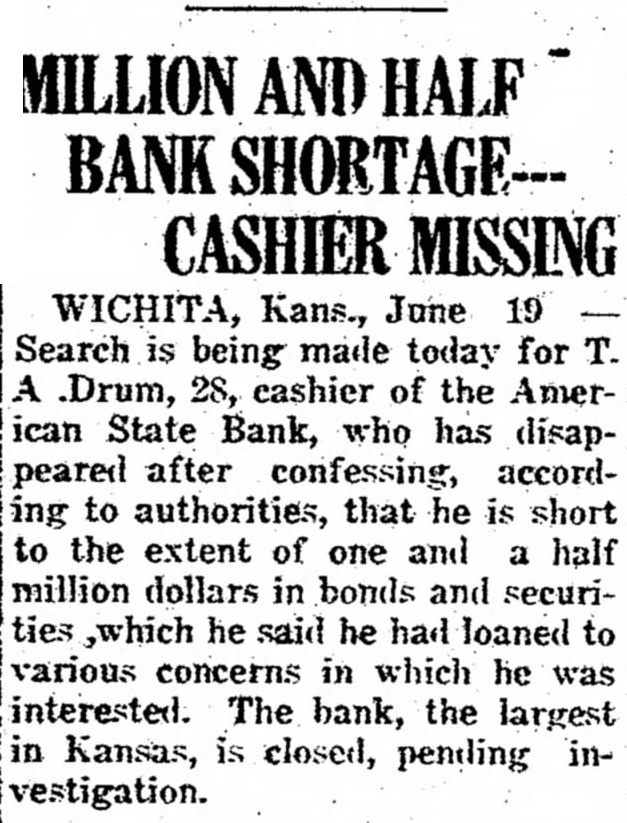
MILLION AND HALF BANK SHORTAGE---CASHIER MISSING

WICHITA, Kans., June 19 — Search is being made today for T. A. Drum, 28, cashier of the American State Bank, who has disappeared after confessing, according to authorities, that he is short to the extent of one and a half million dollars in bonds and securities, which he said he had loaned to various concerns in which he was interested. The bank, the largest in Kansas, is closed, pending investigation.


Article from Poughkeepsie Eagle-News, June 21, 1923

Click image to open full size in new tab

Article Text

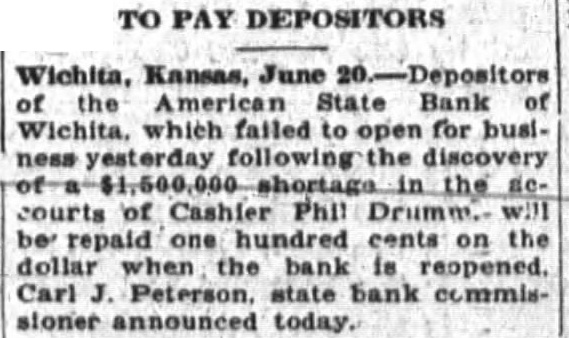
TO PAY DEPOSITORS

Wichita, Kansas, June 20.—Depositors of the American State Bank of Wichita, which failed to open for business yesterday following the discovery of a $1,500,000 shortage in the accounts of Cashier Phil Drumm, will be repaid one hundred cents on the dollar when the bank is reopened, Carl J. Peterson, state bank commissioner announced today.


Article from Poughkeepsie Eagle-News, June 21, 1923

Click image to open full size in new tab

Article Text

Wichita, Kansas, June 20.—Depositors of the American State Bank of Wichita, which failed to open for business yesterday following the discovery of a $1,500,000 shortage in the accounts of Cashier Phil Drumm, will be repaid one hundred cents on the dollar when the bank is reopened, Carl J. Peterson, state bank commissioner announced today.


Article from The Washington Times, June 21, 1923

Click image to open full size in new tab

Article Text

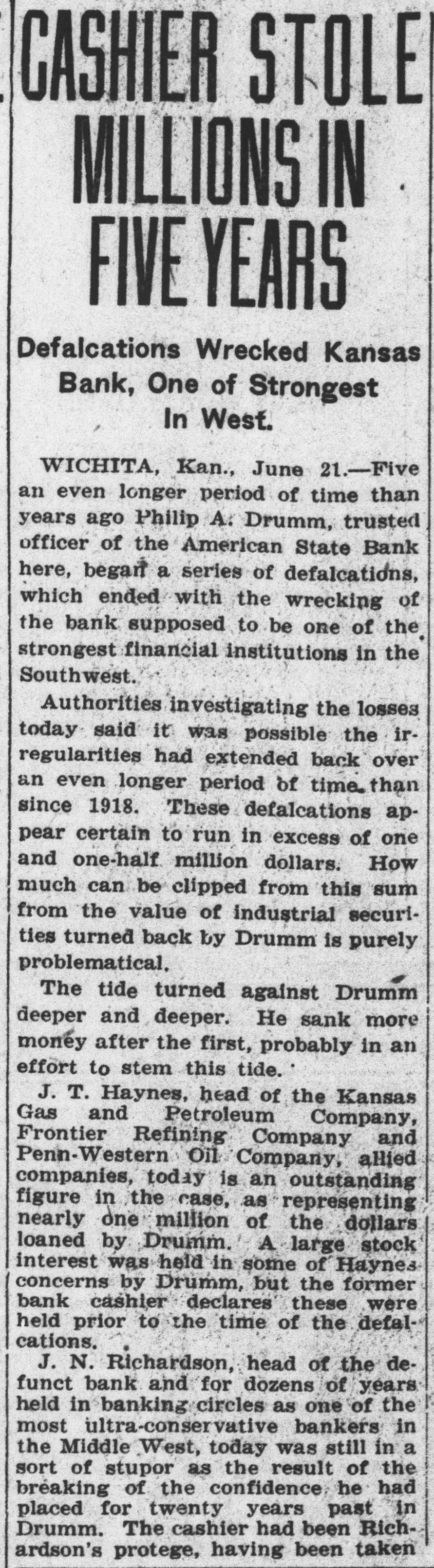
CASHIER STOLE MILLIONS IN FIVE YEARS Defalcations Wrecked Kansas Bank, One of Strongest In West. WICHITA, Kan., June 21.-Five an even longer period of time than years ago Philip A. Drumm, trusted officer of the American State Bank here, began a series of defalcations, which ended with the wrecking of the bank supposed to be one of the strongest financial institutions in the Southwest. Authorities investigating the losses today said it was possible the irregularities had extended back over an even longer period of time. than since 1918. These defalcations appear certain to run in excess of one and one-half million dollars. How much can be clipped from this sum from the value of industrial securities turned back by Drumm is purely problematical. The tide turned against Drumm deeper and deeper. He sank more money after the first, probably in an effort to stem this tide. J. T. Haynes, head of the Kansas Gas and Petroleum Company, Frontier Refining Company and Penn-Western Oil Company, allied companies, today is an outstanding figure in the case, as representing nearly one million of the dollars loaned by Drumm. A large stock interest was held in some of Haynes concerns by Drumm, but the former bank cashier declares these were held prior to the time of the defalcations. J. N. Richardson, head of the defunct bank and for dozens of years held in banking circles as one of the most ultra-conservative bankers in the Middle West, today was still in a sort of stupor as the result of the breaking of the confidence he had placed for twenty years past in Drumm. The cashier had been Richardson's protege, having been taken


Article from The Huntington Herald, June 21, 1923

Click image to open full size in new tab

Article Text

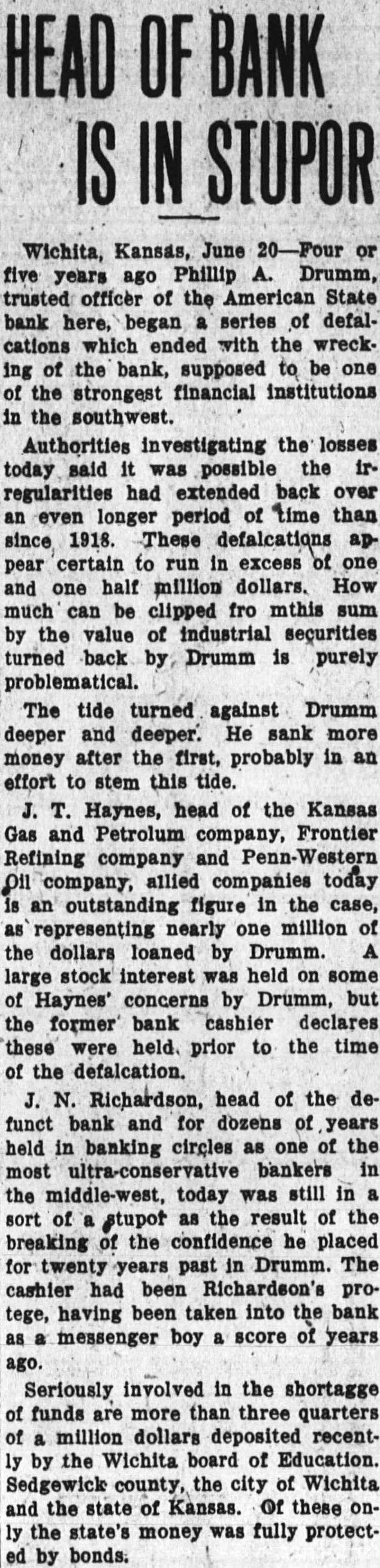
HEAD OF BANK IS IN STUPOR

Wichita, Kansas, June 20—Four or five years ago Phillip A. Drumm, trusted officer of the American State bank here, began a series of defalcations which ended with the wrecking of the bank, supposed to be one of the strongest financial institutions in the southwest.

Authorities investigating the losses today said it was possible the irregularities had extended back over an even longer period of time than since 1918. These defalcations appear certain to run in excess of one and one half million dollars. How much can be clipped from this sum by the value of industrial securities turned back by Drumm is purely problematical.

The tide turned against Drumm deeper and deeper. He sank more money after the first, probably in an effort to stem this tide.

J. T. Haynes, head of the Kansas Gas and Petroleum company, Frontier Refining company and Penn-Western Oil company, allied companies today is an outstanding figure in the case, as representing nearly one million of the dollars loaned by Drumm. A large stock interest was held on some of Haynes' concerns by Drumm, but the former bank cashier declares these were held prior to the time of the defalcation.

J. N. Richardson, head of the defunct bank and for dozens of years held in banking circles as one of the most ultra-conservative bankers in the middle-west, today was still in a sort of a stupor as the result of the breaking of the confidence he placed for twenty years past in Drumm. The cashier had been Richardson's protege, having been taken into the bank as a messenger boy a score of years ago.

Seriously involved in the shortage of funds are more than three quarters of a million dollars deposited recently by the Wichita board of Education. Sedgewick county, the city of Wichita and the state of Kansas. Of these only the state's money was fully protected by bonds.


Article from Buffalo Courier, June 21, 1923

Click image to open full size in new tab

Article Text

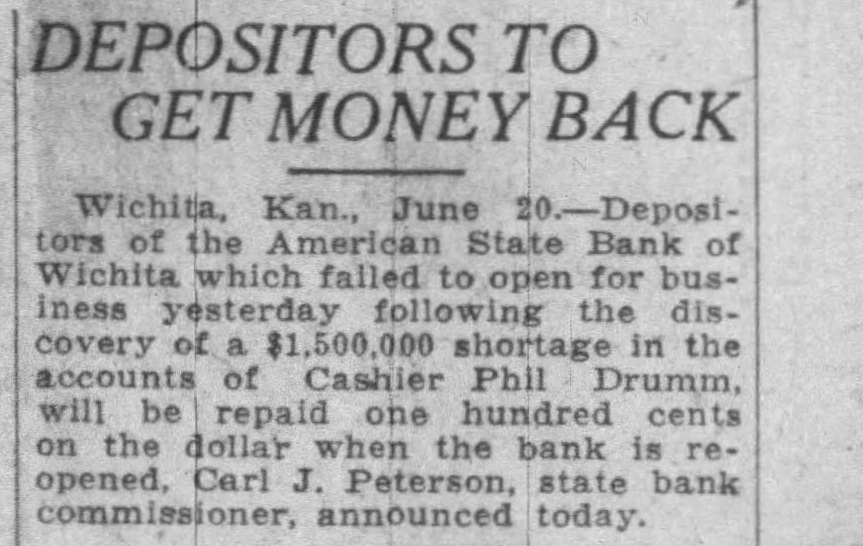
DEPOSITORS TO GET MONEY BACK

Wichita, Kan., June 20.—Depositors of the American State Bank of Wichita which failed to open for business yesterday following the discovery of a $1,500,000 shortage in the accounts of Cashier Phil Drumm, will be repaid one hundred cents on the dollar when the bank is reopened, Carl J. Peterson, state bank commissioner, announced today.


Article from Buffalo Courier, June 21, 1923

Click image to open full size in new tab

Article Text

Wichita, Kan., June 20.—Depositors of the American State Bank of Wichita which failed to open for business yesterday following the discovery of a $1,500,000 shortage in the accounts of Cashier Phil Drumm, will be repaid one hundred cents on the dollar when the bank is reopened, Carl J. Peterson, state bank commissioner, announced today.


Article from The Wichita Eagle, June 25, 1923

Click image to open full size in new tab

Article Text

KANSAS CITYANS HERE Drainage Experts Here Looking Over North End Project

For the purpose of doing the topographical and other work preliminary to the North End drainage project, Major L. B. Roberts and F. B. Barrett, both of Kansas City, have arrived in Wichita and will remain until the last of the preliminary survey has been completed. They are making headquarters at the Wichita club.

Both men are thoroughly experienced in drainage engineering, and Mr. Barrett is said to be particularly well informed on topography.

The running of levels on the land affected by flood waters probably will be the first step. Then a mapping out of ways in which to divert the flood waters of Chisholm Creek, the Little Arkansas river and the drainage canal will be worked out.

HOPES TO CLEAR UP BANK AFFAIR IN WICHITA SOON Petersons Returns to Topeka But Will Be Back in City Tuesday WARRANTS HELD UP

All depositors of the American State bank have been requested by Ray Foley, deputy bank commissioner in charge of the American State bank, to bring their pass books in at the earliest possible time to be balanced. There will be men on hand Monday to care for the depositors, he says.

Affairs of the American State bank may be settled much sooner than first expected, according to Carl J. Peterson, state bank commissioner, who left for Topeka late Sunday night in order to attend the session of the state charter board today. Mr. Peterson declared that the bank would be reopened as soon as the assets of the institution are recovered and that as the work of checking continues there is increased hope of a speedy settlement.


Article from Joplin Globe, July 1, 1923

Click image to open full size in new tab

Article Text

COUNTY OFFICIALS DESIRE BANK RECEIVER APPOINTED

Wichita, Kan., June 30.—Sedgwick county commissioners today took the first legal step to force the appointment of a receiver for the defunct American State bank of Wichita when they announced they would make application for the appointment of a receiver in district court here July 6.

Receiver for the institution, which closed its doors here ten days ago after the discovery of a $1,500,000 shortage in its accounts, is sought by the county so that assets could be sold to replace the $89,133.82 deposited in the bank by the county.


Article from The Wichita Eagle, July 2, 1923

Click image to open full size in new tab

Article Text

MAY NOT CLAIM BONDS DEPOSIT AS TRUST FUND

(Continued from page one.)

can State bank actually comes under the protection of the guaranty fund, or whether it is a trust fund and as such can be classed as a preferred claim on the defunct bank. The attorneys say they are not ready to answer either of these questions. A conference in Topeka will be held this week with Gov. Davis, Carl J. Peterson, bank commissioner, and C. B. Griffith, attorney general, to determine their views on the matter.

Oppose Second Bond Issue

Senator Hegler says it would not be necessary to submit to the people the proposition of an extra bond issue. The statute gives the board the right to authorize the additional issue, he says. Whether the board will agree on this procedure is another matter. Some members are strongly opposed to another bond issue for the high school and say they will oppose such action. They'd rather finance it some other way, preferably by the issuance of warrants to the contractor and which will be cashed by Wichita banks and held until settlement of the affairs of the American State bank.

The board believes its school fund is within the scope of the guaranty law. They say they intend to insist on such when the American State begins to pay out. But on the other hand there is an opinion of the state supreme court which has a direct bearing on the Wichita case. The Board of Education received three per cent interest direct from the American State bank on its deposits. It also received two per cent from the Brown-Crummer company, which handled the board's bond accounts.

Thus the board received five per cent interest on the money it had in the bank. Carl J. Peterson, bank commissioner, says it received six per cent. The supreme court has held that subsidiary contracts, by which a greater rate of interest than the legal limit was received by a deposit, removed the deposit from the protection of the guaranty law. The court has held that a bonus paid by a bank to obtain long time deposits constituted a subterfuge whereby a greater rate of interest than the legal limit was paid and that such deposits were without the protection of the guaranty fund.


Article from The Caney News, July 6, 1923

Click image to open full size in new tab

Article Text

NEWS ITEMS FROM ALL OVER KANSAS

Happenings of More or Less Interest Gathered From Many Sources.

WILL PROBE BANK FAILURE

Governor Davis Visits Wichita to Learn Facts About Closing of American State Institution.

Wichita.—Affairs of the defunct American State Bank of Wichita, which have been in the hands of the state banking department since the institution closed more than a week ago, following the discovery of a $1,500,000 defalcation in the accounts of Phil Drumm, cashier, were the object of an investigation recently by Gov. Jonathan M. Davis.

Carl J. Peterson, state bank commissioner, spent the greater part of the day with Governor Davis.

Asked what his plans for reorganization of the bank were, as well as the object of his trip to Wichita, the governor gave no definite answer.

Plans for reorganizing the bank were discussed freely by Governor Davis and Commissioner Peterson, and it was indicated that this would be the next step taken by the banking department.

All phases of the coal storage situation in the United States are to be investigated thoroughly this summer by a committee of the American Engineering Council, of which P. F. Walker, dean of the K. U. school of engineering, is a member, it was announced at Lawrence. Dean Walker has been named a special field worker, and will visit nearly all of the larger cities in the country to assist the seventy-five committees that are taking up local phases of the investigation. Methods of storage, cost of storing and transportation problems—the last of which is Dean Walker's special field—will be surveyed. Dean Walker will help consolidate the data gathered by the local committees, and will help draft the final report.

The Kansas industrial court has filed in the state supreme court a motion to make mandatory such portions of the industrial court order regarding the Wolff Packing Company as were not affected adversely by the recent decision of the United States supreme court. Portions of the order which still are valid, according to the motion, require the packing company to set an eight-hour day for employees, but permit a nine-hour day on not to exceed two days a week. Time and one-half is to be paid on all time exceeding forty-eight hours a week. Another portion of the order requires that equal wages be paid men and women in the same class of work.


Article from The Caney News, July 6, 1923

Click image to open full size in new tab

Article Text

Two moves, both of a startling nature, were made recently in connection with the failure of the American State Bank of Wichita. First, a suit to recover $1,639,872.79 in bonds and cash, alleged to have been withdrawn illegally from the bank, was filed in district court against the Brown-Crummer Investment Company by Carl J. Peterson, state bank commissioner. Second, the arrest of John M. Richardson, treasurer of the investment company and president of the defunct bank, and of R. E. Crummer, vice-president of the company and a director of the bank, was demanded by Peterson.


Article from The Wichita Eagle, July 25, 1923

Click image to open full size in new tab

Article Text

DEPOSITOR SUES BANK OFFICIALS TO RECOVER $550

Five Made Defendants in Action Brought Tuesday by Ida Harrover

PREDICT OTHER SUITS

The first of a series of suits depositors are expected to bring against officers and directors of the American State bank to recover money, was filed in city court Tuesday. Ida Harrover, 227 South Hillside avenue, wife of A. C. Harrover of the Chapple Investment company, sued five officers and directors to recover $550 deposited during the last month the bank was open.

The officials sued are: J. N. Richardson, president; O. A. Powell, vice president; Phil A. Drumm, cashier; M. J. Loyd and R. E. Crummer, directors. Mrs. Harrover is represented by George Gardner, Pringle and Brown, attorneys, Beacon building.

The suits are based upon sections 584 and 585 of the General Statutes of 1915, George Gardner, member of the legal firm, said. The first section referred to makes it the duty of every official to examine into the affairs of the bank and to know its condition at all times. It makes each official individually responsible for deposits received.

Section 585 is particularly specific in regard to civil suits and is practically the principal reliance of the suit. It states:

In all suits brought for the recovery of the amount of any deposit received or any debt created, all officers, agents or managers of any such banking institutions, charged with having assented to the reception of such deposit or the creation of such debts, may be joined as defendants or proceeded against severally.


Article from The Daily Law Journal-Record, October 23, 1923

Click image to open full size in new tab

Article Text

By JUDGE PHELPS

37441—Carmichael v Landers verdict for plff. 36935—Merritt v Merritt, cit dis on promise to comply with order in 30 days. 39693—Maynard v Herzog, 5 days add to file amd pet. 40172—Beck v Beck, decree for plff per J E. 40395—Bullis v Bullis, same. 39462—Tellegen v Tellegen mo to mod decree sust per J E.

Wichita, Kan., Octo. 23.—Satisfactory development in the case of the closed American State bank here appears nearer today as result of announcement by officials that Phil Drumm, cashier, who admitted extensive defalcations, has turned to the state banking department all his personal property, believed to have a potential value of more than $500,000.


Article from The Wichita Eagle, January 23, 1924

Click image to open full size in new tab

Article Text

FOURTEEN WICHITA CORPORATIONS GET CHARTERS TUESDAY

Capitalization of Nearly Million Represented in New Businesses

NEW BANK IS APPROVED

Wichita business firms, capitalized at nearly a million dollars, were granted charters Tuesday by the state charter board at a half hour session in Topeka, at which 24 Kansas corporations were created at the rate of about $55,000 a minute. Twenty-four corporations were granted charters, 14 of which are located in Wichita. The total value of the Kansas firms is approximately $1,750,000.

The State Reserve Bank of Wichita has the largest capitalization of any of the firms chartered, succeeding the defunct American State Bank, with a capital of $500,000. Granting of the charter clears all legal procedure, and opening of the new institution awaits only the agreement of depositors to purchase the stock, Carl A. Peterson, state bank commissioner, said Tuesday night. The incorporators are T. J. Sweeney, Lawrence; M. B. Light, Winfield; Mayor B. F. McLean, Wichita; L. S. Naftzger, Wichita, and A. R. Wallace, White City, president of the Kansas State Bankers' association.

To Enlarge Company

Next highest on the Wichita list is the Hockaday Auto Supply Co., capitalized at $95,000. The company expects to abandon its Douglas avenue location about May 15, to enter a new building at William street and Topeka avenue. In the new quarters the company will be materially enlarged, Will J. Beaver, manager of the store, said Tuesday night. The incorporators are F. Woody Hockaday, president; Will J. Beaver, Paul Brown, G. A. Hockaday and M. L. Sieg.

The Anawalt-Fortna Lumber Co., of which B. B. Anawalt, 1201 North Topeka avenue, is the head, was granted a charter with a capitalization of $50,000. The company, which operates several lumber yards in Kansas, recently acquired new interests which prompted the incorporation, Mr. Anawalt said Tuesday night. Associated with him in the business is F. W. Fortna, of Liberal, Kan.

Other Wichita firms incorporated for large amounts are the McClellan Hotel Co., which recently opened a new hotel at William street and Lawrence avenue, and will issue 500 no-par shares; the Cassell Transfer & Storage Co., capitalized at $30,000; the White Castle System of Eating Houses, capitalized at $25,000, with W. A. Anderson and E. W. Ingram as incorporators; the Lincoln Rug & Carpet Co., $15,000, and the J. H. John Tile & Mantel Co., $5,000.

Non-profit organizations in Wichita which were chartered Tuesday are the Disabled American Veterans of the World War, Chapter No. 4, and the Wichita Council of Boy Scouts of America. John H. Tilden, scout executive, explained Tuesday night that the Scout council was incorporated in order that it might become a property owner without the necessity of creating a board of trustees. The council expects soon to own a summer camp, he stated. The Scout incorporators are Will G. Price, Lorentz Schmidt, John H. LaGrant, Arthur Brasted and Austin Stone, members of the board of directors.

Wichitans interested in the various firms chartered Tuesday, when informed by The Eagle of the session in Topeka, were elated over the amount of business activity locally, declaring that the granting of the large number of charters is an indication of


Article from The Weekly Kansas City Star, March 26, 1924

Click image to open full size in new tab

Article Text

MUST SMALL BANKS PAY?

SCHEME TO REFINANCE LOOTED WICHITA INSTITUTION AROUSES.

State Banking Department Would Require All Banks to Aid in Project, Which May Be Against the Law.

TOPEKA BUREAU THE KANSAS CITY STAR (By a Staff Correspondent.)

Topeka—Are the small banks of Kansas to be forced to refinance a Wichita bank that was looted by its own officers?

That is the way the bankers of Kansas regard the movement to reorganize the defunct American State Bank of that city. Up to the time of its failure it was regarded as the strongest state bank in Kansas. The bank was robbed by its own officers. It was literally gutted. The loss exceeded two million dollars.

Many banks have failed in Kansas, and their failures have proved serious blows to the communities in which they were located. But other cities have faced the music, stinted themselves, pinched, economized and pulled through as best they could.

WICHITA ENTHUSIASTIC FOR IT.

Wichita is playing in better luck. It is about to see the bank that was robbed by Wichita financiers reorganized, recapitalized and reopened on money furnished by the other communities of the state. It is said that Wichita is enthusiastic over the outlook.

The banks of Kansas in general, however, are not so enthusiastic over the announcement that the American State Bank soon will be reorganized and that the Wichita losses are to be paid.

The plan for reorganizing the American State has been pushed by the state banking department, it is said, under the supervision of Carl Peterson, bank commissioner for Kansas.

THE PLAN IS UNIQUE.

The plan is unique in its way. It involves the following details:

1. Each bank in the state has been asked to buy stock in the reorganized bank on the following basis: One share of stock for each $100,000 of gross deposits; one-quarter of a share for each $25,000 or major fraction of deposits over $100,000.

2. Each share of stock to cost $400, but each share to represent only $100 of the capital stock. The remaining $300 is to go into a liquidating fund to pay the losses of the bank that was robbed.

3. In addition to the purchase of stock, each bank in the state (state banks) is asked to set aside 3 per cent of its gross deposits. This amount is to be deposited in the reorganized American State Bank at Wichita, and to remain on deposit in that institution for a period of five years.

The club that is forcing the state banks of Kansas into the plan is the state bank guarantee law. The guarantee fund is known to be in a sad predicament through the failure of so many banks in the state. Its exact condition is not known, but every state banker feels that he is carrying a big load.

Many bankers in the state believe that the plan is a good one. A majority of the bankers, however, regard it as being unjust to the Kansas banks, and particularly unjust to Kansas communities outside of Wichita that have no interest in Wichita.

Many lawyers in the state declared that the plan is a distinct violation of the Kansas banking laws and cannot stand the legal test.

The Kansas banking laws specifically provide that no state bank shall own stock in any other bank.


Article from Kansas City Journal, April 13, 1924

Click image to open full size in new tab

Article Text

CASH TO WIFE OF BANKER BEFORE CRASH, REPORT

WICHITA, April 12. — Evidence that the wife of John M. Richardson, former president of the defunct American State bank, withdrew $25,000 a few hours before the bank failed was presented at the trial of Richardson today.

Richardson is charged with accepting deposits from patrons when he knew the bank was insolvent.

Phil Drumm, former cashier, testified he tried to induce Richardson to close the bank on June 13, 1923, because it was insolvent.

Ray Foley, receiver, testified that two days after Drumm says he pleaded for the bank's closing, he loaned C. L. Brosius, Wichita oil man, $75,000 of the bank's money.

Receiver Foley testified that the bank was hopelessly insolvent when he took charge June 19, 1923. He further said that in his opinion the bank had been in an insolvent condition since the lending of $250,000 to the Federal Refining company in 1919.

Notes of the Federal Refining company totaling $248,920 were introduced in the evidence. There were fourteen, dated from November, 1918, to July, 1919. The notes, Foley said, were not in the note case when he took over the bank.

Foley said the value of the notes now would not exceed $3,000. They were secured only by a dilapidated refinery in Cushing, Ok., that has not been in operation for three or four years, he said.


Article from The Emporia Gazette, September 15, 1924

Click image to open full size in new tab

Article Text

TRY DRUMM THIS FALL.

Former Wichita Bank Cashier's Case to Come Before Pollock.

Wichita, Sept. 15. — Phil Drumm, former cashier of the defunct American State bank, will be tried before Judge John C. Pollock during the fall term of the United States district court here on a charge of using the mails with intent to defraud, it became known upon receipt of the docket for the fall term today.

The fall term of court will begin September 22.

Drumm is alleged to have confessed that he was instrumental in causing the failure of the bank on June 18, 1923, for which three other officers of the institution faced trial.


Article from The Freedom Call, January 8, 1925

Click image to open full size in new tab

Article Text

NEWS ITEMS FROM ALL OVER KANSAS

Happenings of More or Less Interest Gathered From Many Sources.

BANKS IN GOOD CONDITION

Financial Institutions of State Start New Year With Bright Outlook, Says Peterson.

Topeka,-Kansas banks as a whole are starting the new year under more favorable conditions than they have experienced in the last four years, according to Carl J. Peterson, state bank commissioner. "Conditions are better now than they have been since I became bank commissioner nearly four years ago," Peterson said. "I expect the new statement resulting from our call of December 26 to show a healthy condition and a noticeable increase in The state bank guaranty fund has paid out approximately $1,000,000 in the last year protecting depositors of insolvent banks against loss. The fund now has on hand more than $1,000,000 in securities and $250,000 in cash. "The guaranty fund has proved itself a valuable asset to the banks as well as to the depositors," Mr. Peterson said. "It not only protects legitimate depositors, but it is recog nized so generally as a stabilizer of the banking business that such a thing as a run on a bank which is a member of the guaranty fund is almost unheard of. "Those who have deposited in institutions which fail are given certificates drawing 6 per cent interest during the process of the bank's liquidation, and ultimately are paid 100 cents on the dollar on their deposits." Commissioner Peterson believes one of the outstanding accomplish ments of his department of the last year has been the successful reorganization of a score of banks which, had this process not been effected, would have caused a heavy drain on the guaranty fund and even heavier losses to the stockholders. The most extensive undertaking of this kind was the organization of the Wichita bank which succeeded the defunct American State bank. By this plan a loss of more than $2,000,000 to the guaranty fund was avoided.


Article from Westphalia Times, January 15, 1925

Click image to open full size in new tab

Article Text

BANKS IN GOOD CONDITION

Financial Institutions of State Start New Year With Bright Outlook, Says Peterson.

Topeka,—Kansas banks as a whole are starting the new year under more favorable conditions than they have experienced in the last four years, according to Carl J. Peterson, state bank commissioner.

"Conditions are better now than they have been since I became bank commissioner nearly four years ago," Peterson said. "I expect the new statement resulting from our call of December 26 to show a healthy condition and a noticeable increase in deposits."

The state bank guaranty fund has paid out approximately $1,000,000 in the last year protecting depositors of insolvent banks against loss. The fund now has on hand more than $1,000,000 in securities and $250,000 in cash.

"The guaranty fund has proved itself a valuable asset to the banks as well as to the depositors," Mr. Peterson said. "It not only protects legitimate depositors, but it is recognized so generally as a stabilizer of the banking business that such a thing as a run on a bank which is a member of the guaranty fund is almost unheard of.

"Those who have deposited in institutions which fail are given certificates drawing 6 per cent interest during the process of the bank's liquidation, and ultimately are paid 100 cents on the dollar on their deposits."

Commissioner Peterson believes one of the outstanding accomplishments of his department of the last year has been the successful reorganization of a score of banks which, had this process not been effected, would have caused a heavy drain on the guaranty fund and even heavier losses to the stockholders.

The most extensive undertaking of this kind was the organization of the Wichita bank which succeeded the defunct American State bank. By this plan a loss of more than $2,000,000 to the guaranty fund was avoided.

That old saw about the farmer "threshing his pumpkins" is not so imaginary as one unacquainted with agricultural processes in southwestern Kansas might suppose. Threshing muskmelons and canteloupes has been developed into one of the most important industries in that part of the state. It has enabled melon growers to build up a business, unique in American agriculture—that of supplying melon seed to most of the prominent seed firms of the United States. The extent of this particular enterprise may be visualized by the fact cantaloupe and muskmelon seed are shipped to the seed houses from Lakin by the car load.

Sam Amidon of Wichita, national Democratic committeeman for Kansas, admitted he virtually had been tendered the position of national party chairman. "I have been advised that the appointment is mine if I want it, but I haven't yet made up my mind whether I want it," he said. A meeting would be in Chicago the latter part of next month, he said, at which the matter of appointing a national chairman would be taken up.

William F. Mize, 15, a freshman in the Coffeyville junior high school, died at the home of his parents, Mr. and Mrs. Emery Mize, at Coffeyville of complications resulting from an attack not unlike that which caused the death of Calvin Coolidge, jr., last July. The trouble had its inception two weeks ago, when the youth chafed one of his heels while wearing his basket ball shoes for the first time this season.

Adolf Goeldner, 67, who came to Kansas 54 years ago, being one of the first settlers of Derby, is dead after a lingering illness. A half century ago Mr. Goedner filed on a homestead between Wichita and Derby, where he had made his home ever since.

Four Mexicans are in the Atchison county jail, charged with being accomplices in the shooting of Frank Mix, Mexican, in the Atchison railroad yards, following a Christmas spree in which all five are said to have participated.

"The Story of Christmas," a cantata by H. Alexander Matthews, was presented by the chorus of sixty-five members of the West Zion church, at the church auditorium twice Christmas. This was the fifth annual Christmas cantata presented by the West Zion chorus at Moundridge.
Article from The Emporia Gazette, September 25, 1925

Click image to open full size in new tab

Article Text

DRUMM JURY STILL OUT.

Can't Agree As Guilt of Back

Wichita, Sept. today the in the case Phil Drumm. charged conspiracy the funds the failed American State bank. had been for hours. stood to Jacques, foreman, said yesterday there little hope of agreeJudge Grover Pierpont indicatthat would the had not come an agreement late this afternoon.


Article from The Wichita Eagle, April 13, 1927

Click image to open full size in new tab

Article Text

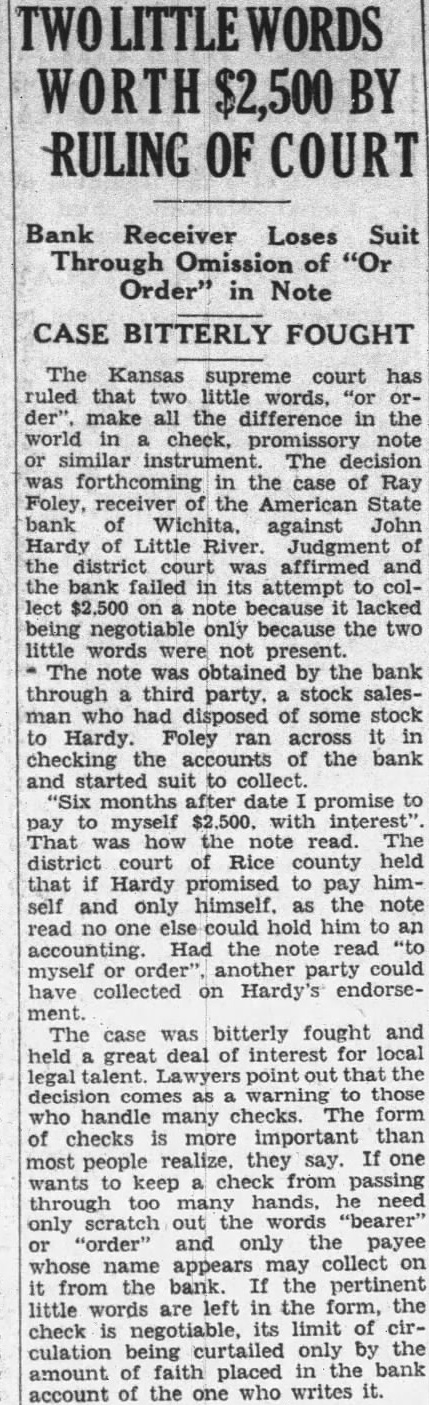
WORTH RULING OF COURT

Bank Receiver Loses Suit Through Omission of "Or Order" in Note

CASE BITTERLY FOUGHT

The Kansas supreme court has ruled that two little words. der". make all the difference in the world in check, promissory note or similar instrument. The decision was forthcoming in the case of Ray Foley, receiver the American State bank of Wichita. against John Hardy Little River. Judgment of the district was affirmed and the bank in its attempt col$2.500 on note because lacked being negotiable only because the two little words not present. The note was obtained by the bank through third party. stock salesdisposed of some stock to Hardy. Foley ran in the the bank started suit to collect. 'Six months after date promise to pay to myself with interest" That how the note read. The district court of Rice county held that Hardy promised to pay himself and only himself. as the note read no could hold him to an accounting. Had the note read "to myself or order", another party could have collected on Hardy's endorsement. The case was bitterly fought and held great deal interest for local legal talent. point those who handle checks. form of checks more important than most people realize. they say. If one wants keep passing through hands. he need only scratch out the words "bearer" "order" and only the payee whose name appears may collect on from the bank. If the pertinent little words left in the form, the check negotiable, its limit of cirbeing curtailed by the culation only of faith placed in the bank amount account of the one who writes it.