First National Bank (Superior, WI)

Episode Information

Episode UID
392601249
Episode Type
Run Only
Bank Type
national
Bank ID
39260 national
Charter Number
3926
Start Date
January 12, 1904
Location
Superior, Wisconsin (46.721, -92.104)

Metadata

Model
gpt-5-mini (chosen from majority vote of a three-model LLM ensemble)
Short Digest
e68f2d2ed9f02e52

Response Measures

Accommodated withdrawals, Borrowed from banks or large institutions, Public signal of financial health

Events (2)

1. September 25, 1888 Chartered
Source
historical_nic
2. January 12, 1904 Run
Cause Details
Cause not stated in articles; reports explicitly say cause is unknown.
Measures
Bank stayed open late/overnight, paid depositors dollar for dollar; obtained currency shipments from St. Paul and Chicago.
Newspaper Excerpt
RUN ON FIRST NATIONAL BANK OF SUPERIOR, WIS. Superior, Jan. 13-A run on the First National Bank which started yesterday ...
Source
newspapers

Newspaper Articles (11)

Article from Santa Fe New Mexican, January 13, 1904

Click image to open full size in new tab

Article Text

RUN ON FIRST NATIONAL BANK OF SUPERIOR, WIS. Superior, Jan. 13-A run on the First National Bank which started yeste day and kept up through the day ti.i past midnight, was resumed this morning. The bank kept open until 1:30 this morning. when the last of the depositors who had stood in line for many hours was paid. President William M. Banks said the bank can pay dollar for dollar. He had no reason to advance for the run.


Article from Evening Times-Republican, January 13, 1904

Click image to open full size in new tab

Article Text

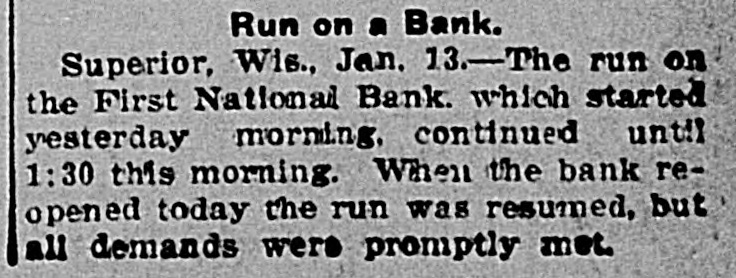
Run on a Bank. Superior, Wis., Jan. 13.-The run on the First National Bank. which started yesterday morning, continued until 1:30 this morning. When the bank reopened today the run was resumed, but all demands were promptly met.

Article from The Cairo Bulletin, January 13, 1904

Click image to open full size in new tab

Article Text

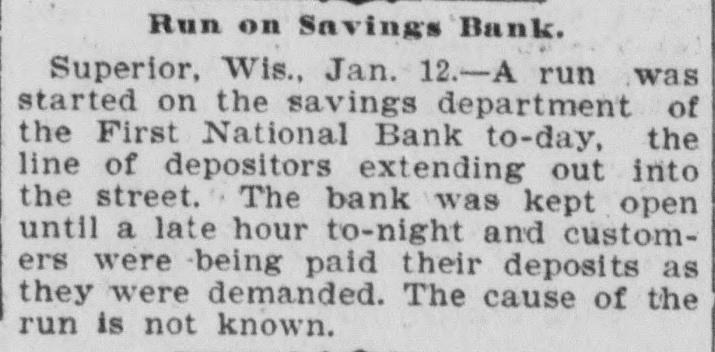
RUN ON SAVINGS BANK. Superior, Wis., Jan. 12.-The run started on the Savings Department of the First National bank this morning continued until late tonight. The president of the bank said he could keep open all night if necessary, and pay every one n gold. There is about $400,000 deposited in the savings department. The cause of the run is not known.


Article from The Indianapolis Journal, January 13, 1904

Click image to open full size in new tab

Article Text

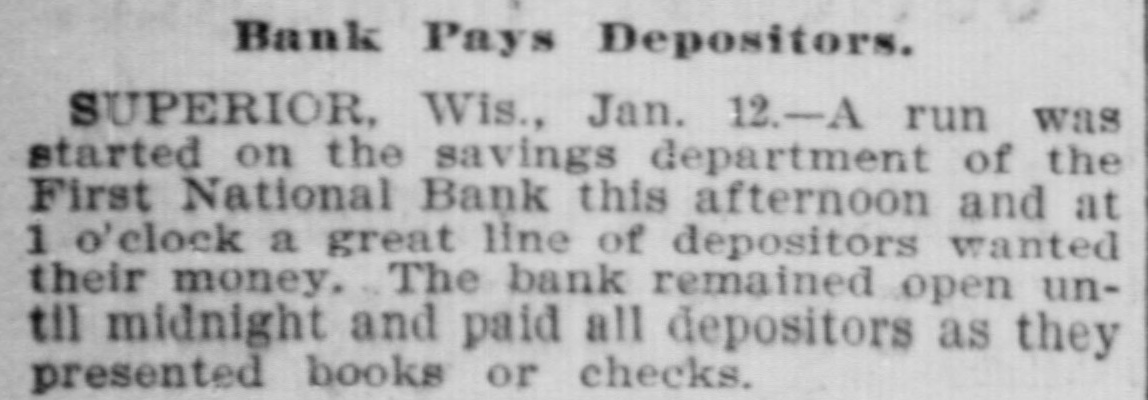
Bank Pays Depositors. SUPERIOR, Wis., Jan. 12.-A run was started on the savings department of the First National Bank this afternoon and at 1 o'clock a great line of depositors wanted their money. The bank remained open until midnight and paid all depositors as they presented books or checks.

Article from Ottumwa Tri-Weekly Courier, January 14, 1904

Click image to open full size in new tab

Article Text

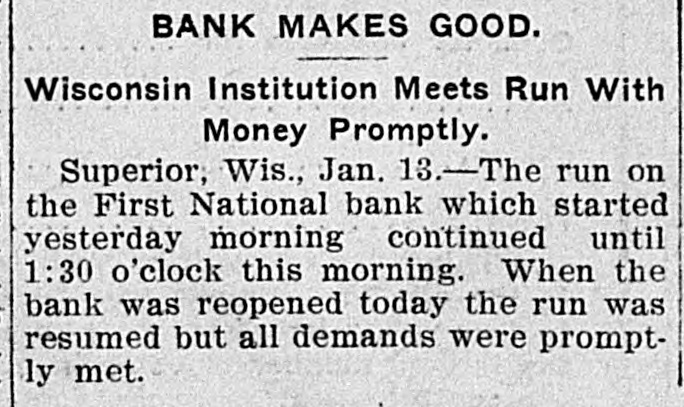
BANK MAKES GOOD. Wisconsin Institution Meets Run With Money Promptly. Superior, Wis., Jan. 13.-The run on the First National bank which started yesterday morning continued until 1:30 o'clock this morning. When the bank was reopened today the run was resumed but all demands were promptly met.

Article from The Daily Pioneer, January 14, 1904

Click image to open full size in new tab

Article Text

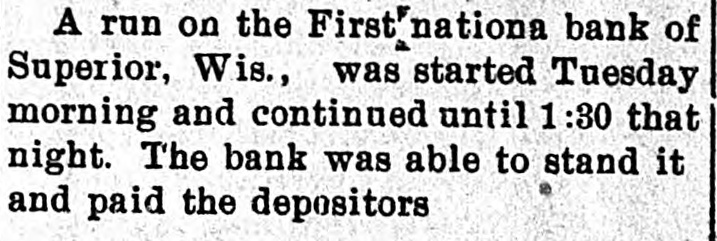
HEAVY RUN ON A BANK. Savings Withdrawn From Superior In. stitution. Superior, Wis., Jan. 14.-The run on the First National bank. which started Tuesday morning, continued until 1 30 Wednesday morning, when the last of the savings depositors who had stood in line many hours was paid and the tired bank officials locked the doors for the night and went home. Will iam B. Banks, president of the First National. said: "The First National can pay dollar for dollar en its deposits and is in a perfectly solvent condition. I have no reason to advance for the so-called run. The money which is being drawn out is on savings deposits and GUI commercial.deposits today and for the past week have been as large as usual." The crowd filled the lobby of the bank and SO increased that toward the afternoon it reached far into the street and the services of several policemen were required to keep it in line. Several business men of Superior, who are acquainted with the condition of the bank. expressed their surprise at the run on what has always been considered one of the strongest finan cial institutions of the Northwest.


Article from Waterbury Evening Democrat, January 14, 1904

Click image to open full size in new tab

Article Text

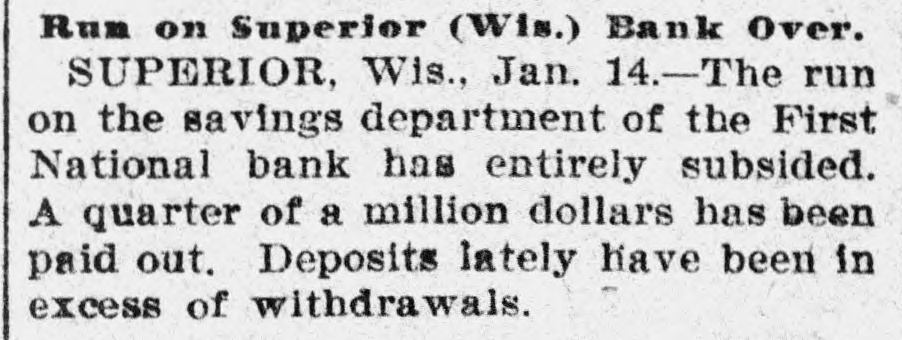
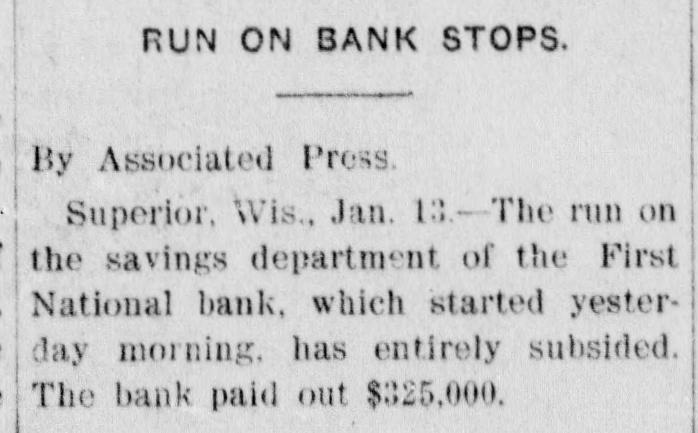
Run on Superior (Wis.) Bank Over. SUPERIOR, Wis., Jan. 14.-The run on the savings department of the First National bank has entirely subsided. A quarter of a million dollars has been paid out. Deposits lately have been in excess of withdrawals.

Article from The Montgomery Advertiser, January 14, 1904

Click image to open full size in new tab

Article Text

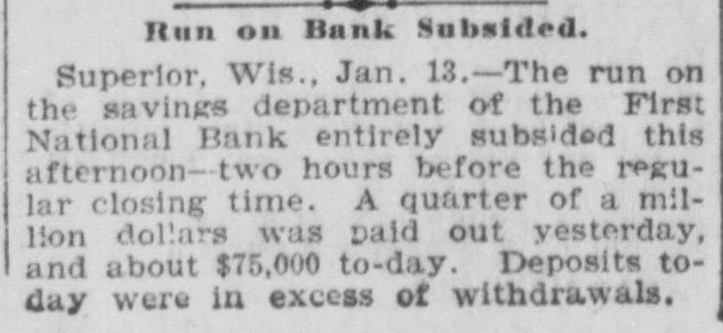
Run on Bank Stops. Superior, Wis., Jan. 13.-The run on the savit 138 department of the First National Bank which started yesterday morning had entirely subsided this afternoon two hours before the regular closing time. A quarter of a million dollars was paid out yesterday according to Cashier Benson, and about $75,000 to-day, but the deposits for to-day were in excess of the withdrawals.


Article from The Van Buren Press, January 16, 1904

Click image to open full size in new tab

Article Text

RUN ON SAVINGS DEPOSITS Savings Department of Superior, Wis., Bank Suffers a Run. The Bank Officials Declare the Instltution is Solvent and Will Meet Every Demand. Superior, Wis., Jan. 14.-The run on the First national bank was resumed Wednesday morning. At ten o'clock, the hour for opening, nearly 50 depositors in the savings department were in line. The run started Tuesday morning, and the bank kept open until 1:30 o'clock Wednesday morning, when the last of the savings depositors who had stood in line many hours, was paid and the tired bank officials locked the doors for the night and went home. William B. Banks, president of the First national bank, said: "The First national can pay dollar for dollar on its deposits, and is in a perfectly SCIvent condition. I have no reason to advance for the so-called run. The money which is being drawn out is on savings deposits, and our commercial deposits to-day and for the past week have been as large as usual." Vice-President Robert Kelly said: "There was a meeting of the stockholders of the bank to-day, and they went into the affairs of the institution, expressed their confidence in the present management and re-elected the entir old board of diretors." Cashier Benson said: "The bank received $150,000 in currency last night, from St. Paul, and $200,000 from Chicago is scheduled to reach us this morning. We are glad of this opportunity to prove our ability to meet every demand."


Article from Custer County Republican, January 21, 1904

Click image to open full size in new tab

Article Text

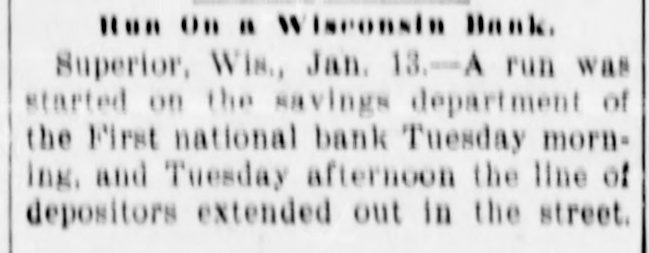
BANK STAYS OPEN AT NIGHT. Busy Paying Off Depositors Who Make a Run on It. SUPERIOR, Wis.-A run was started on the savings department of the First National bank Tuesday morning. and in the afternoon the depositors extended out in the street. A notice was issued by the bank's officers stating that the bank would remain open Tuesday night until the last person in line had been paid. The bank was still open at a late hour Tuesday night and a long line of customers were being paid their deposits as they were demanded. President Banks said he could keep open all night if necessary and pay every one in gold. The bank is the oldest in the city, and has a capital of $200,000, with deposits of about a million and a half. The bank paid out a vast sum, but business men made heavy deposits. The C. use of the run is not known.

Article from The Ely Miner, January 22, 1904

Click image to open full size in new tab

Article Text

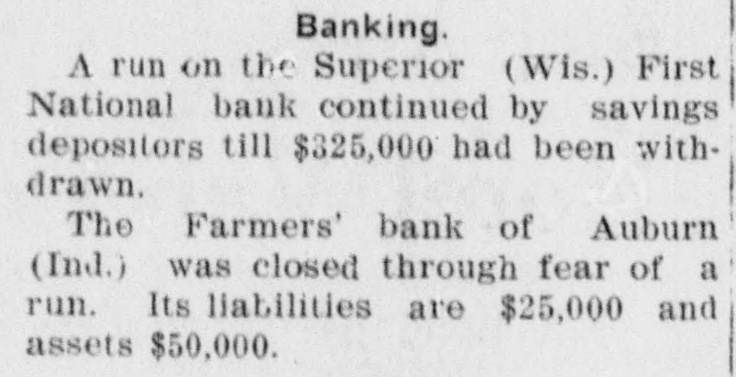
signs along railroad lines is recommended by Gov. Murphy in his message to the New Jersey legislature. A run on the Superior (Wis.) First National bank was continued by savings depositors till $325,000 had been withdrawn. An American "group," to be affiliated with the interparliamentary union for international arbitration, has been organized in congress. Mayor Harrison testified at the Iroquois inquest in Chicago, saying he feared public opinion would not sustain him in closing the theaters at the time when he first became aware they were violating the law. John S. Cooper's horse sale pavilion and mule stables were burned at Omaha, and eight horses perished. Robbers blew open the safe of the bank at Goff, Kan., secured $3,000 and escaped. Edwin Warfield was inaugurated as governor of Maryland. Fire destroyed the jail at Pratt City, Ala., and Jack Kelly (white) and four unidentified negroes were burned to death. Formal confession was made by Charles M. Schwab in a New York court that the ship-building trust was hopelessly bankrupt. An inspection of churches and schools in Chicago showed a few not properly equipped and the South Congregational church was closed. Rather than risk wrecks the Northwestern railway ordered that no train shall run at more than schedule speed, no matter how late it may be. Ten persons fell down an elevator shaft in a building in St. Louis and eight were killed. An open switch caused a collision between trains on the Southern railroad at New Baden, III., and Fireman Mixon was killed and Engineer William Knight probably fatally hurt. The Virginia legislature convened in Richmond. Mrs. James A. Carothers, of Pontiac, Ill., received by express a legacy of $380,000, being her share of the estate of an uncle who died in Paris. A new picketing method has been devised by the Chicago Federation of Labor to force nonunion men to join or leave the city; abuse of family to be tried. Tieup of navigation decided on by Lake Carriers' association at Its Detroit (Mich.) convention, to check demands of unions. The remains of Gen. John B. Gordon, the south's last great figure of the civil war, were buried in Oakland cemetery in Atlanta, Ga. Carriages for use at funerals are hard to get in Chicago owing to the revival of the strike by livery drivers. Hearses are not to be interfered with. A negro named Elmore Moseley was lynched by a mob of negroes in Sussex county, Va., after being acquitted in a trial for murder. As a result of drinking ginger ale flavored with lemon extract three men died from poisoning at Alexander, Ark. Amendments and objections led the Chicago council to postpone action on the revised building code and to deny to the theaters the privilege of reopening under restrictions. The Farmers' bank at Auburn, Ind., failed to open its doors and a notice posted on the doors promised that the bank would pay out dollar for dollar. Jumbo Clark, a negro, was lynched at High Springs, Fla., for attacking a white girl. The annual dinner of the diplomatic corps was given at the white house by President and Mrs. Roosevelt. Governor Cummins, of Iowa, in his address following his second inauguration argued for revision of the tariff and for reciprocity with Canada. Fire at Havre, Mont., caused a loss of $400,000 and left many persons homeless. Sixteen churches in Chicago have been closed for violations of the building law. "Butch" Riley, a negro who killed C. C. McMillan near Tallulah, Miss., was lynched by a mob.