Meadowcroft Brothers (Chicago, IL)

Episode Information

Episode UID
3862064091122
Episode Type
Suspension β†’ Closure
Bank Type
private
Bank ID
386206409 hash
Start Date
June 5, 1893
Location
Chicago, Illinois (41.850, -87.650)

Metadata

Model
gpt-5-mini (chosen from majority vote of a three-model LLM ensemble)
Short Digest
2342b23545d4b167

Response Measures

None

Events (1)

1. June 5, 1893 Suspension
Cause
Bank Specific Adverse Info
Cause Details
Failure/inability to reorganize the private banking firm after the death of a partner (Robert Meadowcroft); assignment and receiver appointed.
Newspaper Excerpt
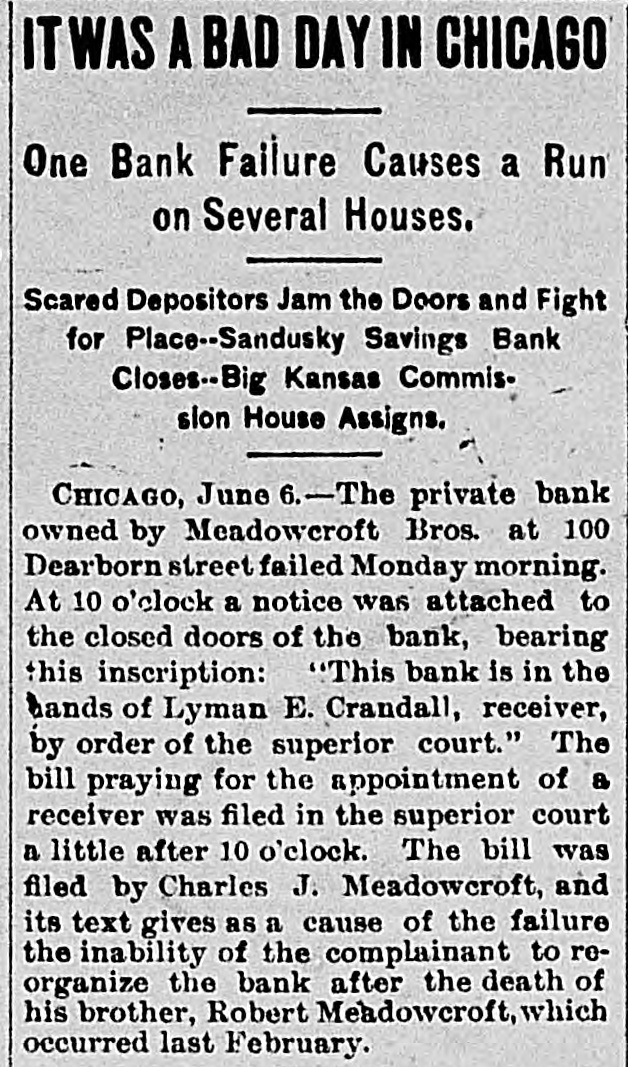
This bank is in the hands of Lyman E. Crandall, receiver, by order of the Superior Court.
Source
newspapers

Newspaper Articles (24)

Article from The Helena Independent, June 6, 1893

Click image to open full size in new tab

Article Text

Not the Slightest Uneasiness Over the Condition of the Leading Institutions. Depositors in Savings Banks Ask for Their Money and Get It. The Demonstration of Solidity Should Go n Long Way Toward Reassuring the Whole Country. CHICAGO, June 5.-The failure of Herrmann Schaffner & Co.'s bank, which occarred last week, bore fruit to-day in well defined rans which were perceptible on almost. if not every one, of the savings banks of Chicago. The first to feel the effect of the excitement was the Bank of Commerce, where a great many Jewish oitizens of the poorer class kept their accounts: The Schaffner failure had alarmed them and they bore down upon the Bank of Commerce at the opening hour. Tellers were doubled up and paid obocks ns fast as presented throughout the day, the officials of the bank expressing no ala in whatever and saying they were able to meet any demands. The Illinois Trust and Savings bank, which has a larger line of this class of deposits than any other bank in the city, amounting at times to over $12,000,000, put on an extra force of tellers and paid everyone as rapidly as possible. At three o' clock this afternoon they posted fl notice on the front door that the bank would remain open until 10 o'cleck to-night and so long as the present excitement continues. The Hibern. ian bank, which, as its name implies, was the depository for a large numbes of IrishAmericans of small means, was crowded all day, but found no difficulty in meeting all demands. The Dime Savings bank took advantage of the rule requiring, if necessary, sixty day notice of withdrawal, and paid only a small percentage of deposits to-day. The Globe Savings bank applied the thirty day rule. The Milwaukee Avenue Savings bank sustained a moderate run throughout the day and they, too, kept open house until nine o'clook to-night. Equally spirited checking was noted upon the Prairie State National and Preirio State Savings banks, as well as upon the Union Trust company and Avenue Savings bank, but in no ease WAS any alarm felt by well informed people. In fact, at many of these institutions, large ositors dame in during the afternoon, and made heavy deposits. To-day's situation was greatly aggravated by a number of board of trade brokers. who, for reasons of their own, devoted themselves to the circulation of sonsational ramors at which they involved at one time or another nearly every bank in the oity, and R large number of leading stook yards operators. Notwithstanding these malicious efforts, no fear is felt as to the safety of any of the leading banking institutions of the city. The failure of Meadowcroft Brothers. a minor institution with a total deposit of perhaps $200,000, aroused little or no interest. CHICAGO, June 6., 1:30 A. m.-The Illinois Trust and Savings bank is still open. the force of paying telle's at seven windows having been relieved by fresh men, and enough people are still waiting for money to keep the bank open two hours more. President Mitchell said there is plenty of money on hand and plenty of mon to pay it out. KANSAS CITY. June 5.-The Kansas Grain company. which claims to be the largest purchaser of grain from producers in the world, has failed. The officers here decline to make any statement of the Assets and liabilities Bill they are authorized by President Tompler, who is in charge of the office at Hutchinson. The company has elevators in over A hundred towns in Kansas, all containing grain. Tight money was the cause of the failure. SPOKANE. June 5.-The Bank of Spokane temporarily closed its doors this morning. The suspension caused no excitement. The embarrasement is due to the tightness of the money market. A. M. Cannon, president of the bank. has many large interests in this city and is reported a mniti-millionai e. CHICAGO, June 5.-F. A. Armstrong & Co., manufacturers and dealers in society and military uniforms. failed. Their liabilities are $105,000 and the assets $205,000.
Article from The Wheeling Daily Intelligencer, June 6, 1893

Click image to open full size in new tab

Article Text

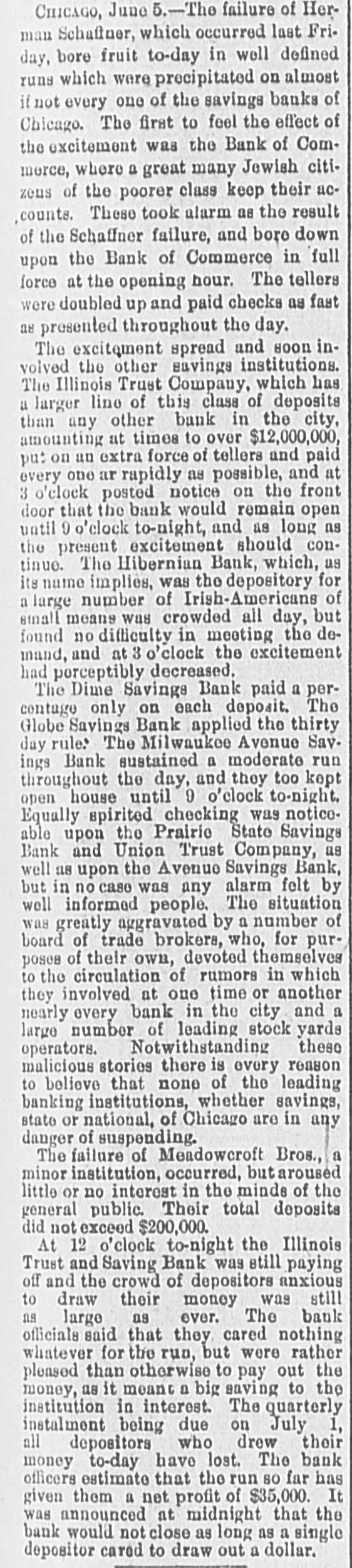
CHICAGO, June 5.-The failure of Herman Schaftner, which occurred last Friday, bore fruit to-day in well defined runs which were precipitated on almost if not every one of the savings banks of Chicago. The first to feel the effect of the excitement was the Bank of Commerce, where a great many Jewish citizens of the poorer class keep their accounts. These took alarm as the result of the Schaffner failure, and boro down upon the Bank of Commerce in full force at the opening hour. The tellers were doubled up and paid checks as fast as presented throughout the day. The excitement spread and soon involved the other savings institutions. The Illinois Trust Company. which has a larger lino of this class of deposits than any other bank in the city, amounting at times to over $12,000,000, put on an extra force of tellers and paid every one ar rapidly as possible, and at 3 o'clock posted notice on the front door that the bank would remain open until 'clock to-night, and as long as the present excitement should continue. The Hibernian Bank, which, as its name implies, was the depository for a large number of Irish-Americans of small means was crowded all day, but found no difficulty in meeting the demand, and at 3 o'clock the excitement had perceptibly decreased. The Dime Savings Bank paid a percontage only on each deposit. The Globe Savings Bank applied the thirty rule: The Milwaukee Avenue Savings Bank sustained a moderate run throughout the day, and they too kept open house until 9 o'clock to-night. Equally spirited checking was noticeable upon the Prairie State Savings Bank and Union Trust Company, as well as upon the Avenue Savings Bank, but in no case was any alarm felt by well informed people. The situation was greatly aggravated by a number of board of trade brokers, who, for purposes of their own, devoted themselves to the circulation of rumors in which they involved at one time or another nearly every bank in the city and a large number of leading stock yards operators. Notwithstanding these malicious stories there is every reason to believe that none of the leading banking institutions, whether savings, state or national, of Chicago are in any danger of suspending. The failure of Meadowcroft Bros., a minor institution, occurred, but aroused little or no interest in the minds of the general public. Their total deposits did not exceed $200,000. At 12 o'clock to-night the Illinois Trust and Saving Bank was still paying off and the crowd of depositors anxious to draw their money was still as large as ever. The bank officials said that they cared nothing whatever for the run, but were rather pleased than otherwise to pay out the money, as it meant a big saving to the institution in interest. The quarterly instalment being due on July 1, all depositors who drew their money to-day have lost. The bank officers estimate that the run SO far has given them a net profit of $35,000. It was announced at midnight that the bank would not close as long as a single depositor cared to draw out a dollar.


Article from The Anaconda Standard, June 6, 1893

Click image to open full size in new tab

Article Text

GOT THEIR MONEY BACK Chicago Depositors Become Alarmed About Their Savings. ALL WERE PAID IN FULL Scenes of Excitement In All of the Banks in the Windy Citysmall Failures-Ohio and Kansas City. CHICAGO. June 5.-The failure of Herrmann Schaffner & Co.'s bank. which occurred last wook. bore fruit to-day in well defined runs which were precipitated on almost. if not every one. of the savings banks of Chicago. The first to feel the effect of the excitement was the Bank of Commerce, where a great many Jewish citizens of the poorer class keep their accounts. The Schaffuer failure had alarmed them and they hore down upon the Bank of Commerce at the opening hour. The tellers were doubled up and paid the checks as fast as they were presented throughout the day. the officials of the bank expressing no alarm whatever and saying that they were able to meet any domands. The Illinois Trust & Savings bank. which has a larger line of this class of deposits than any other bank in the city, amounting at times to over $12,000,000. put on an extra force of tellers and paid every one as rapidly as possible. At 3 o'clock this afternoon they posted a notice on the front door that the bank would remain open until 10 o'clock to-night and so long as the present excitement continues. The Hibernian bank. which, as its name implies, was the depository for a large number of Irish-Americans of small means. was crowded all day, but found no difficulty in meeting all demands. The Dime Savings bank took advantage of a rule requiring, if necessary. 60 days notice of withdrawal. and paid only a percentage of Its deposits to-day. The Globe Savings bank applied a 30-day rule. The Milwankee Avenue Savings bank sustained a moderate run throughout the day and they, too. kept open house until 9 o'clock to-night. Equally spirited checking was noted upon the Prairie State National and the Prairie State Savings banks, as well as upon the Union Trust company, but in no case was alarm felt by well informed people. In fact. at many of these institutions, large depositors came in during the afternoon and made heavy deposits. To-day the situation was greatly aggravated by a number of board of trade brokere who. for reasons of their own. devoted themselves to the circulation of sensational rumors in which they involved at one time or another. nearly every bank in the city and a large number of leading stock yards apliators. Notwithstanding these malicious efforts, no fear is felt as to the safety of any of the leading banking institutions of the city. The failure of Meadowcroft Brothers, a minor instituwith total deposits of perhaps $200,000. aroused little or no interest.


Article from Richmond Dispatch, June 6, 1893

Click image to open full size in new tab

Article Text

Private Bankers Fail. CHICAGO. June .-The - private bank of Meadowcroft Brothers, at 100 Dearborn street. failed this morning. At 10 o'clock a notice was attached to the closed doors of the bank bearing this inscription "This bank is in the hands of Lyman E. Crandall, receiver, by order of the Su. perior Court." The bill praying for the appointment of a receiver was filed a little after 10 o'clock by Charles J. Meadowcroft, and its text gives as a cause of the failure the inabilito of the complainant to reorganize the bank after the death of his brother. Robert Meadowcroft, who died last February.


Article from The Herald, June 6, 1893

Click image to open full size in new tab

Article Text

CHICAGO FAILURES. Meadoweroft Bros. Go to the Wall-Other Embarrassed Firms. CHICAGO, June 5.-Meadowcroft Brothere, private bankers and dealers in commercial paper, doing a business similar to that of Herman Schaffner, who|failed Saturday, made an assignment today. It is one of the oldest private banking firms in the city. Assets and liabilities are not yet known. Later, on application in court, a receiver was appointed for the bank, on the application of a member of the firm. The bill gives as the cause of the failure inability to reorganize after the death of one of the brothers, last February. The bank was established in 1860 by the fathers of the members of the present firm. The attorneys for the bank place the debts at $250,000 and the assets at $470,000. The latter consist chiefly of commercial paper which is not readily convertible into cash. F. A. Armatrong & Co., manufactur= ers and dealers in society and military uniforms, have failed. Liabilities, $150,000; assets, $275,000. The firm has been in business 20 years. An attachment was brought against the firm Saturday, and the sheriff took possession. This morning the judgment was satisfied, butas others who had heard of the attachment threatened to press their claime, it was decided to assign, The firm claims that the failure is only temporary. The property of C. A. Weisenbach. a


Article from The Morning News, June 6, 1893

Click image to open full size in new tab

Article Text

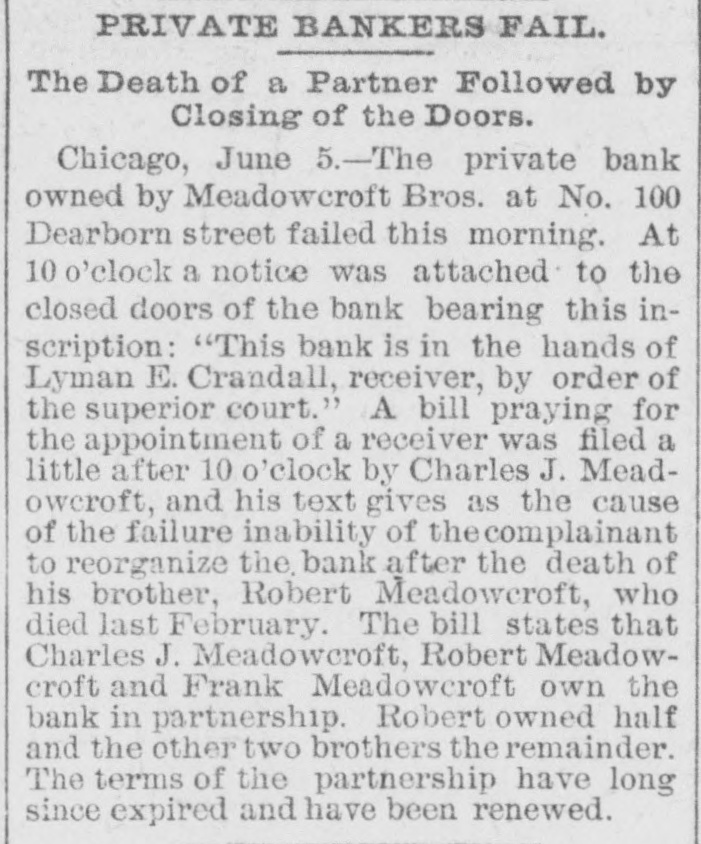
PRIVATE BANKERS FAIL. The Death of a Partner Followed by Closing of the Doors. Chicago, June 5.-The private bank owned by Meadowcroft Bros. at No. 100 Dearborn street failed this morning. At 10 o'clock a notice was attached to the closed doors of the bank bearing this inscription: "This bank is in the hands of Lyman E. Crandall, receiver, by order of the superior court." A bill praying for the appointment of a receiver was filed a little after 10 o'clock by Charles J. Meadloweroft, and his text gives as the cause of the failure inability of the complainant to reorganize the bank after the death of his brother, Robert Meadowcroft, who died last February. The bill states that Charles J. Meadowcroft, Robert Meadowcroft and Frank Meadowcroft own the bank in partnership. Robert owned half and the other two brothers the remainder. The terms of the partnership have long since expired and have been renewed.


Article from The State Chronicle, June 6, 1893

Click image to open full size in new tab

Article Text

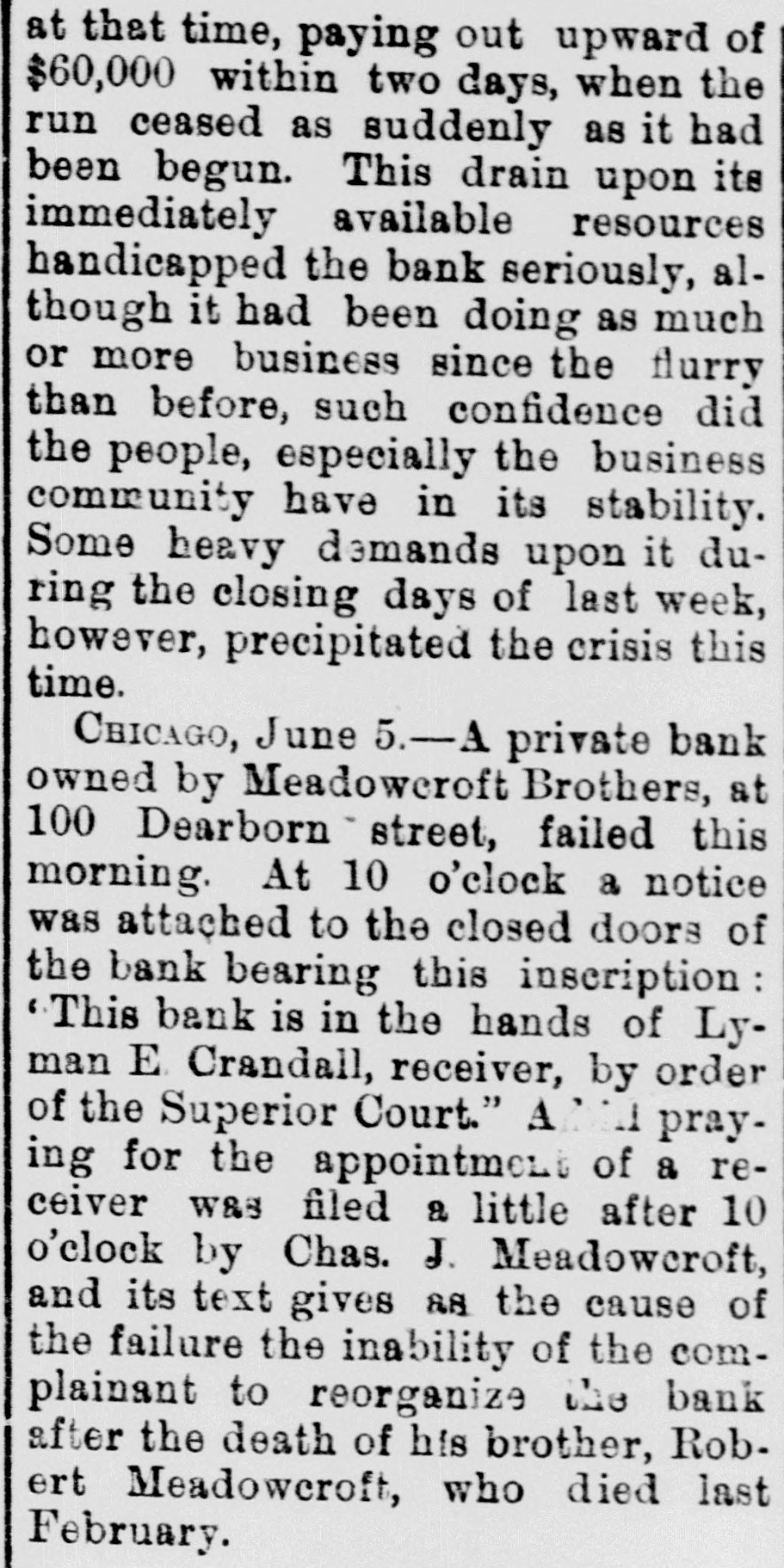
at that time, paying out upward of $60,000 within two days, when the run ceased as suddenly as it had been begun. This drain upon its immediately available resources handicapped the bank seriously, although it had been doing as much or more business since the flurry than before, such confidence did the people, especially the business community have in its stability. Some heavy demands upon it during the closing days of last week, however, precipitated the crisis this time. CHICAGO, June 5.-A private bank owned by Meadowcroft Brothers, at 100 Dearborn street, failed this morning. At 10 o'clock a notice was attached to the closed doors of the bank bearing this inscription 'This bank is in the hands of Lyman E Crandall, receiver, by order of the Superior Court." AM praying for the appointment of a receiver was filed a little after 10 o'clock by Chas. J. Meadowcroft, and its text gives 88 the cause of the failure the inability of the complainant to reorganize the bank after the death of his brother, Rob. ert Meadowcroft, who died last February.


Article from The Daily Morning Astorian, June 6, 1893

Click image to open full size in new tab

Article Text

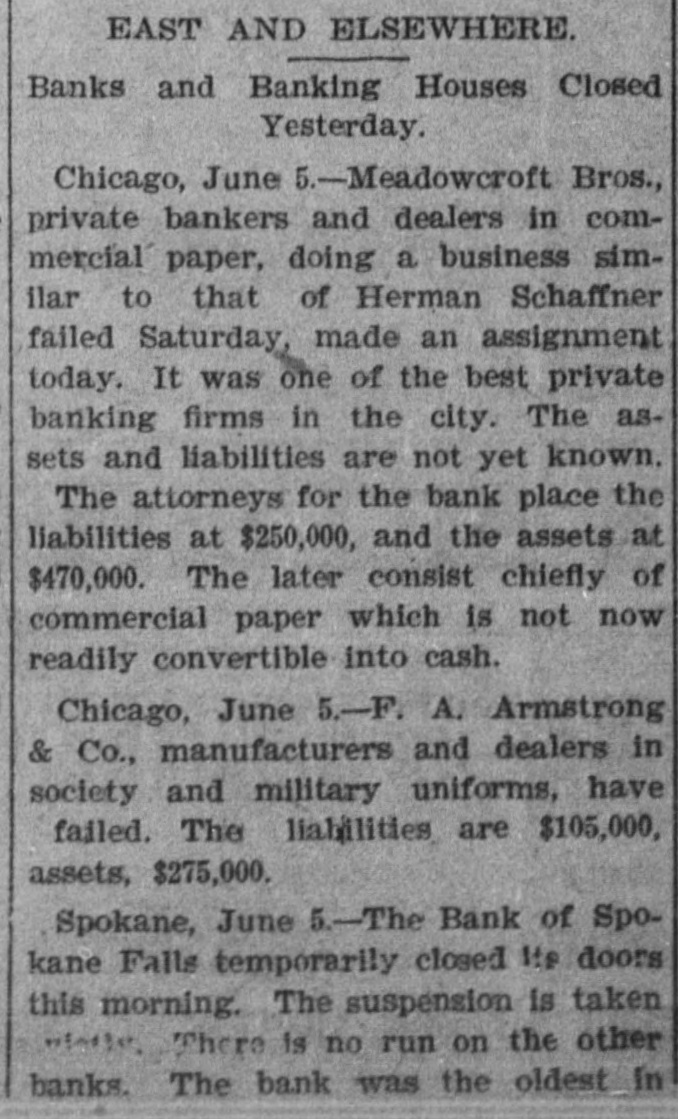
EAST AND ELSEWHERE. Banks and Banking Houses Closed Yesterday. Chicago, June 5.-Meadowcroft Bros., private bankers and dealers in commercial paper, doing a business similar to that of Herman Schaffner failed Saturday, made an assignment today. It was one of the best private banking firms in the city. The assets and liabilities are not yet known. The attorneys for the bank place the liabilities at $250,000, and the assets at $470,000. The later consist chiefly of commercial paper which is not now readily convertible into cash. Chicago, June 5.-F. A. Armstrong & Co., manufacturers and dealers in society and military uniforms, have failed. The liabilities are $105,000, assets, $275,000. Spokane, June 5.-The Bank of Spokane Falls temporarily closed Its doors this morning. The suspension is taken whete There is no run on the other banks. The bank was the oldest In


Article from The Morning Call, June 6, 1893

Click image to open full size in new tab

Article Text

AFRAID OF BANKS. Poor People Draw Out Their Savings. MONEY READY ON DEMAND. Chicago Savings Institutions May Be Shaky, but They Certainly Show No Sign of It. Special to THE MORNING CALL June 5.-The failure of HerrCHICAGO, bank, which mann, Schaffner & Co.'s OCcurred bore fruit to-day in welldefined which were ou almost if not one of last runs week, every precipitated the savings banks of The first effect excitement was of the Chicago. the to Bank feel Jewish the of Commerce, where a great many class acThe Schaffner very counts. citizens of the poorer failure keep bore had their down much alarmed them, and they Bank of Commerce at openupon hour. the The doubled the ing tellers were up and fast as presented throughout the officials of the exno alarm pressing the paid day, checks whatever, and demands. bank saying that they were able to meet any The Illinois Trust and Savings Bank, which has a larger line of this class of deposits than any other bank in the city, amounting at times to over $12,000,000, put on an extra force of tellers and paid every one as rapidly as possible. At 3 o'clock this afternoon they posted a notice on the the bank until 10 o'clock night so as the present front open door long that to-night would excitement and remain every continued. The Hibernian Bank which, as its name implies, is the depository for a large number of Irish-Americans of small means, was crowded all day, but found no difficulty in meeting all demands. The Dime Savings Bank took advantage of the rule requiring, if necessary, sixty days' notice of withdrawal, and paid only a percentage of deposits to-day, and the Globe Savings Bank applied the thirty-day rule also. The Milwaukee-avenue Savings Bank sustained a moderate run throughout the day, and it, too. kept open house until 9 o'clock to-night. Equally spirited checking was noted the Price State State as well as upon upon Savings, National and the Savings Pacific Union Trust Company and the Avenue Bank, but ia no case was any alarm felt by well-informed people. In fact, at many of these institutions large depositors came in during the afternoun and made heavy deposits. situation was greatly aggravated a number of To-day's by Board of Trade defor reasons of their own, voted to the sensational in which they brokers, themselves rumors, who, circulation involved of at or another every in and a large o erators as stockyard the one city time number nearly well. of Notwith- leading bank standing these malicious efforts no fear is felt as to the safety of any of the leading banking institutions of the city, and the failure of Meadowcroft Bros, a minor institution with total deposits of perhaps $200,000, aroused little or no interest. Attorneys for the bank place the liabilities at $250,000, assets at $470,000. The latter consist chiefly of commercial paper which is not now readily convertible into cash. in court a was for the bank, on a appointed On application receiver petition of member of the firm. The bill gives as a cause of failure inability to reorganize the bank after the death of one of the brothers last February. The bank was established in 1860 by the father of the members of the present firm. Schaffner of lief To-day's that Herman developments confirm the the failed bebank of Herman Schaffner & Co. drowned himself in the lake. The police are dragging for the body. CHICAGO, June 6.-At midnight the Illinois Trust and Savings Bank was still off, and the crowd of depositors to draw their money was as ever. The were large paying anxious as otherwise bank officials to still out rather than pay as it meanta big to money, in pleased saving the profit institution interest. So-far the net is about At this anthe bank would not so nounced $35,000. that hour cared it was to close draw long as a single depositor out a dollar. The paying of money is being continued at seven windows. "We wills stay right here for three months and not close our doors night or day if such a proceeding should become necessary. We are good for any run, no matter how long it keeps up." At 1:30 A. M. the Illinois Trust and Savings Bank was still open, the force of tellers at the seven windows having by fresh men, were still been paving people relieved waiting for hours and money enough more. to the bank open two Mitchell said there was on hand and plenty men keep President money of plenty to pay of it out.


Article from Rock Island Daily Argus, June 6, 1893

Click image to open full size in new tab

Article Text

tinued to pay. 1was after 2 o'clock this morning when the bank closed its doors with the statement that it would be ready to go on this morning at the usual hour. A run was also started on the Milwaukee Avenue bank. Along toward 11 o'clock it quieted down. Then the people learned of the Meadowcroft failure and the run be- gan again. The bank met all demands and the officers say they are ready to with- stand another run today. The uneasy feeling invaded the board of trade and casued a temporary panic among the speculators in grains and provisions. Prices tumbled headlong and the bears could not trade fast enough to keep up with the falling market. July wheat sold down to $65⅝ cents, a drop of nearly 3 cents, and 1β…› cents lower per bushel than wheat has sold in any year previous to the present. Provisions shared in the general demoralization, pork showing a decline of $1.20 at the close. Corn and oats were also extremely nervous and closed 1 cent lower than the prices current when the market closed at noon Saturday. With all the panic there was but one bank failure, that of Meadowcroft Bros., private bankers, but it is claimed there that no one will lose a dollar. They had many depositors among mar ne men, who will be put to serious inconvenience at the least, in having to wait for their money. Not the least fluer wever, was per- ceptible at any of t various national banks, and several prominent bankers, whose opinions were asked concerning the panicky feeling in the air, referred to it as simply a passing spasm, due entirely to the uneasiness prevailing among small deposi- tors identified with the savings banks un- der state jurisdiction. Every nation..l bank, it was insisted, was as sound as a dol- lar. Not one is in the slightest danger of a run, while there is not one but can meet the heaviest demand that may be made upon it.


Article from The Salt Lake Herald, June 6, 1893

Click image to open full size in new tab

Article Text

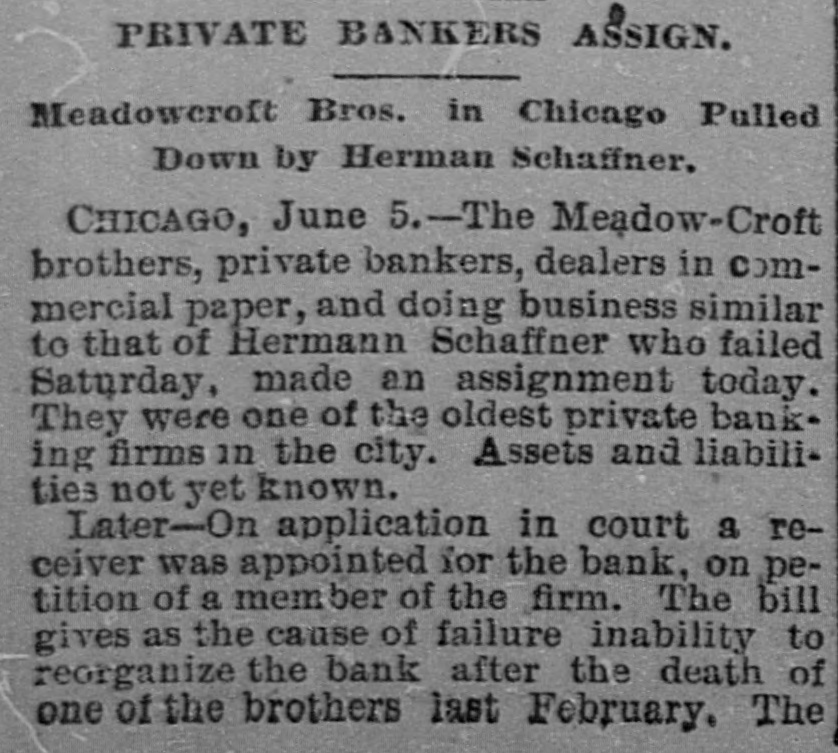
PRIVATE BANKERS ASSIGN. Meadowcroft Bros. in Chicago Pulled Down by Herman Schaffner, CHICAGO, June 5.-The Meadow-Croft brothers, private bankers, dealers in commercial paper, and doing business similar to that of Hermann Schaffner who failed Saturday, made an assignment today. They were one of the oldest private bank ing firms in the city. Assets and liabilities not yet known. Later-On application in court a receiver was appointed for the bank, on petition of a member of the firm. The bill gives as the cause of failure inability to reorganize the bank after the death of one of the brothers last February. The


Article from The Salt Lake Herald, June 6, 1893

Click image to open full size in new tab

Article Text

RUNS ON CHICAGO BANKS. Every One of the Savings Banks Crowded with Depositors. DEMANDS MET PROMPTLY. Malicious Rumors Started by Several Board of Trade Men. These Stories, Which Were Very Sensational, Aggravated the Situation Very Much as They Involved Every Bank in the City. CHICAGO, June 5.-The failure of HerMann Schafiner & Co.'s bank, which occurred last week, bore fruit today in well defined runs, which were precipitated on almost If not every one of the savings banks of Chicago. The first to feel the effect of the excitement was the Bank of Commerce, where a great many Jewish citizens of the poorer class keep their accounts. The Schaffner failure had alarmed them, and they bore down upon the Bank of Commerce. At the opening hour the tellors were doubled up and paid checks as fast as presented throughout the day, officials of the bank expressing no alarm whatever, and saying that they were able to meet any demands. The Illinois Trust and Savings bank which has a larger line of this class of deposits than any other bank in this city, amounting at times to over $12,000,000, pution an extra force of tellers and paid every one as fast as possible. At 3 o'clock this afternoon they posted a nothe front door that the bank until 10 would tice on remain open o'clock excite- tonight and so long as the present ment continues. At midnight the Illinois Trust and bank was still paying off, and the of Savings crowd depositors anxious to draw their money was still. as large as ever. The bank officials were rather pleased than otherwise to pay out money, as it means a great saving to the institution in interest. So far the net profit is 35,000. At this hour it was announced that the bank would not close as long as a single depositor cared to draw out a dollar. The paying of money is being continued at seven windows. President Mitchell said: "We will stay right here for three months and not close our doors night or day, if such proWe ceeding should become necessary, are good for any run, no matter how long it keeps up." At 1:30 this Tuesday morning, the Illinois Trust and Savings bank is still open, the force of paying tellers at the seven windows having been relieved by fresh men and enough people are still waiting for their money to keep the bank open two hours more. The Hibernian bank which its name implies, was the depositor for a large number of Irish Americans of small means was crowded all day, but found no difficulty in meeting all demands. The Dime savings bank took advantage of the rule requiring, if necessary, sixty days notice of withdrawal, and paid only a percentage of deposits today. The Globe savings bank applied the thirty day rule. The Milwaukee Avenue savings bank sustained a moderate run throughout the day and they, too, kept an open house until 9 o'clock tonight. Equally spirited checking was noted upon the Prairie State National and the Prairie State savings, as well as upon the Union Trust company and Avenue Savings bank, but in no case was any alarm at felt by well informed people. In fact, many of these institutions large depositors came in during the afternoon and made heavy deposits. Today the situation was greatly aggravated by a number of board of trade brokers, who for reasons of their own, devoted themselves to the circulation of sensational rumors in which they involved at one time or another nearly every bank in this city and a large number of stock yard operotors. Notwithstanding these malicious efforts, no fear is felt as to the safety of any of the banking institutions of the city. The failure of Meadow-Croft Brothers, a minor inwith total perhaps stitution little deposits interest. of, $200,000, aroused or no


Article from St. Paul Daily Globe, June 6, 1893

Click image to open full size in new tab

Article Text

# MADE A NEW RECORD July Wheat Goes Lower and Lower on Chicago 'Change. Failures and Bearish News From Abroad Scare Traders. All Other Futures Decline in Sympathy With the Wheat Pit. Final Quotations on New York Stock Exchange Show Gains. CHICAGO, June 5.-Another record was smashed today, and wheat has sold 1ΒΌc lower than heretofore for Juiy, and has also shown a sharp decline in the deferred fatures, but not to the same extent. The failure of Meadowcroft Bros., private bankers, this morning gave the market quite a shock. Then came the failure of the Kansas City Grain company, and prices took another dip downward. On this decline it was announced that Nelson, Van Kirk & Co., small traders in wheat, had failed, and this, in the strained condition of the market, proved sufficient to send prices off again. Still, as prices were so low before, the total decline was only about 1ΒΌc on July and considera- bly less on the longer futures. The near-by futures are feeling the results of the tightness in money more seri- ously than others, as is shown by the fact that one time 4c was paid to change July to September in the hope that be- fore that month came around financial conditions would mend. It was a great day for the rumor- mongers, the calamity-howlers and the "whisperers," who kept the trade full of feverish apprension. There was ap- parently no disposition to buy wheat, however cheap it might seem, except to cover shorts and get in profits, but with wheat below the cost of production the selling is almost entirely on exhausted margins and liquidation, few indeed be- ing nervy enough now to short the mar- ket. The general rains, followed by hot weather; the indifferent cables, the European reports of cholera cases at three important cities, the increase of 300,000 bu in wheat stocks at Liver- pool, the increase of 608,000 bu on ocean passage, the large Indian shipments, reaching 960,000 bu for the week, the receipts of 697 cars at Northwestern markets-all these were natural influences against the market. The worst break of the day in wheat came the last hour. In- stead of a decrease in the visible sup- ply, there was a 200,000 bu increase. The uneasiness was greatly intensified by the run on the La Salle street savings banks, which traders could see from the windows of the exchange. The open- ing was about the same as Saturday's closing to ΒΌc lower, and, with some fluctuations, prices declined 2ΒΌc for July and 2β…œc for September. then re- covered slightly, and the market closed easy about 2β…›c lower for July and 1β…œ c lower for September than Saturday. Corn, owing to some demand for the spot article, was comparatively steady at the start, opening trades being the same as the closing prices of Saturday, but the market later on sagged off Β½c, owing to the down turn in the surround- ing pits. The principal feature was the liquidation in July and buying the September, the premium of the latter in consequence widening to 1β…›c one time. The increase in the visible was a decided disappointment. Closing prices were about inside. Oats were affected by causes similar to those active against corn. There were a few rallies, but they were in turn followed by declines and the close was about the lowest point, with a net loss of β…›@⅝c on near futures and ⅝c on September. There was a drop of $1.40 per barrel in pork, 37Β½c in lard and 45c in ribs. in pork the decline was brought about, not through transactions at gradually receding prices, but by sellers offering it at lower and still lower prices with- out any buyers appearing to make defi- nite quotations possible until almost the entire decline had taken place. The close was at a reaction of 20c for pork from the inside, and 5c each for lard and ribs. Freights were steady, with a fair de- mand at 2c for wheat, and 1β…œe for corn to Buffalo, and 3β…œc for wheat to Kings- ton. Estimated receipts for tomorrow: Wheat, 75 cars; corn, 1,100 cars; oats, 500 cars; hogs, 13,000. The leading futures ranged as follows:


Article from St. Paul Daily Globe, June 6, 1893

Click image to open full size in new tab

Article Text

EXCITED DEPOSITORS. Groundless Rumors Start Runs on Chicago Savings Banks CHICAGO, June 5.-The failure of Herman Shaffner, which occurred last Friday, bore fruit today in well-defined almost runs which were precipitated on if not every one of the savings banks of of Chicago. The first to feel the effect the excitement was the Bank of Com- citiwhere a great many Jewish merce, of the poorer class keep their aczens These took the alarm,naturally, and counts. the result of the Shaffner failure, as bore down upon the Bank of Commerce full force at the openin hour. The tellers were doubled ing and paid checks as fast as presented throughout up the day. The excitement other and soon involved the institutions. The which has a larger savings company, spread Illinois share other Trust of class of deposits than any to this bank in the city, amounting at times force of put on an extra and paid every one as and at 11 o'clock over tellers possible, $12,000,000. posted rapidly the a bank no- as tice the front door that towould upon remain open until 10 o'clock excite= and so long as the present Hibernight, should continue. The imment bank. which, as its name for nian was the depository of a plies, number of rish-Americans day, large was crowded all no difficulty in and at 4 o'clock the demand, small but found means. meeting excitement Dime the had perceptibly decreased. The its rule bank took advantage of each Savings paid a percentage only upon the and The Globe Savings applied Avethirty-day deposit. rule. The Milwaukee run Savings sustained a moderate until throughout nue the day, and kept open checking o'clock. Equally spirited State 9 noticeable upon the Prairie as was and Union Trust company, bank, Savings well upon the Avenue Savings felt by but as in no case was any alarm well informed people. The situation was greatly aggravated number of board of trade brokers, devoted by a for purposes of their own, sensathemselves who, to the circulation of involved tional rumors, in which they time or another, nearly every of at one the and a large number stock yards operators. bank leading in city, there Not- is withstanding these efforts, reason to believe that none whether of the every banking institutions, leading state or national, of Chicago, savings, in any danger of suspending. a are failure of Meadowcroft Bros., The institution, occurred. but aroused of the minor no interest in the minds little or public. Their total deposits general not exceed $200,000. Meadowcroft did Co. did a commercial paper similar to that of & Co., the banking Schaffner business Bros. & firm Herman which The an assignment Saturday. the made was one of the oldest in concern Eddy & Walker, attorneys, assets place city. the liabilities at $250,000 and the at $460,000. o'clock tonight the Illinois Trust At 12 Savings bank was still paying off. to and the crowd of depositors anxious and their money was as large as ever. draw bank officials said that they cared The whatever for the run, but were nothing rather pleased than otherwise to pay the money. as it meant a big saving out the institution in interest. The quar- and to installment being due July 1. toall terly depositors who drew their money estihave lost. The bank officers day that the run SO far has given them an-superscript(4) mate net profit of $35,000. It was a nounced at midnight that the as would not be closed bank as a single depositor detail cared long draw out a dollar. A special to was sent for, the force of pay of police which had been constantly for several hours was on took their places. and others ing duty tellers the relieved, paying wint of money was continued at seven frighty The depositors were not dows. or worried, many of them seemed ened regard the matter as a joke, and some to them said they were only drawing of their money because others were doing the "We same will thing. stay right here for three months," said President Mitchell to not close our doors night on such a proceeding should It will take day necessary. night."and if these become seven pay at least that length of time to men the money out of our vaults. Even if out get no more deposits' we are good for we run no matter how long it keep$ any We have no intention of taking up. advantage of the time clause. Any he wants it. depositor can get his money at any time


Article from Rock Island Daily Argus, June 7, 1893

Click image to open full size in new tab

Article Text

Highest of all in Leavening Power.-Latest U. S. Gov't Report. Baking Royal CCOO Powder ABSOLUTELY PURE each or the several windows at which the paying tellers were stationed, and every SOLID AS GRANITE. preparation was made to meet the run. Millions of dollars were displayed in full view of everybody. The run was a foolish Chicago Banks Stand Against one and will only result in loss of interest the Savings Panic. to those who withdrew their money. The real cause of it was probably the sensational extras gotten out Monday morning THE FLURRY BEGINS TO SUBSIDE, when Meadowcroft Bros. suspended. The suspension was of no moment to the business world and will cost no depositor a With Only One Bank Demanding a Time cent, but those who had savings in the Limit-Heavy Capitalists Ready to Shell banks were stampeded: they didn't know Out When Necessary-The Withdrawers that their funds were in no danger and hence the run. Forfeiting Six Months' Interest and Monopolizing the Safety Deposit Vaults No Cause at Chicago, Either, They Say. -No Trouble in Commercial CirclesST. LOUIS, June .-The fact that there Cause of the Run. has been trouble in New York and that some Chicago banks have been in difficulty CHICAGO, June 7.-When the Illinois has caused some anxiety to be felt by Trust company closed its doors after 2:30 stockholders and depositors in local banks. o'clock in the morning it had paid the Inquiry among bankers developed the fact that there was not the smallest cause for last depositor who wanted his money at this. that time. But the sun was hardly out of


Article from The Indiana State Sentinel, June 7, 1893

Click image to open full size in new tab

Article Text

LOWEST NOTCH YET. July Wheat Fall Below Any Former Figure. CHICAGO, June 5.-Another record was smashed today and wheat has sold 1}c lower than heretofore for July, and has also shown a sharp decline in the deferred futures but not to the same extent. The failure of Meadowcroft brothers, private bankers, this morning, gave the market quite a shock. Then came the failure of the Kansas City grain company, and prices took another dip downward. On this decline it was announced that Nelson, Van Kirk & Co., small traders in wheat, had failed, and this, in the strained condition of the market, proved sufficient to send prices off again. Still, as prices were 80 low before, the total decline was only about 1}c on July and considerably less on the longer futures. The nearby futures are feeling the result of the tightness in money more seriously than others, as is shown by the fact that at one time 4c was paid to change July to September, in the hope that before that month came around financial conditions would mend. It was a great day for the rumor mongers, the calamity howlers and who kept the the whisperers, There trade appar- full of feverish apprehension. was ently no disposition to buy wheat, however cheap it might seem, except to cover shorts and get in profits, but with wheat below the cost of production the selling is almost entirely on exhausted marand liquidation, few indeed being now to short The rains followed by the indifferent nervy weather, gins general enough cables, hot, the market. forcing the of a European reports cholera increase cases three important cities, the of 300,000 bushels in wheat stocks at Liverpool, the increase of 600,000 bushels on ocean passage, the large India shipments reaching 960,000 bushels for the week, the receipts of 697 cars at Northwestern markets-all these were natural influences against the market. The worst break of the day in wheat came at the last hour. Instead of 2,000,000 bushels decrease in the visible, after long waiting the trade got over 200,000 increase. The uneasiness was greatly intensified by the run on LaSalle savings banks, which traders could see from the windows of the exchange. The opening was about the same as Saturday's closing to 1c lower with some fluctuations prices declined for and 2ge for and easy and recovered 2 July slightly closed September, about then 21c lower for July and 1 c for September than Saturday. Corn, owing to some demand for the spot article was comparatively steady at the start, opening trades being the same as the closing prices of but the market later on sagged to the down turn pits. The the of surrounding Saturday, off was 1@1AC liquidation owing July principal and buying in feature the in of September, the premium of the latter consequence widening to 1 c one time. in the visible W88 a closing were disappointment; The increase prices decided about at inside. Oats were affected by causes similar to those active against corn. There were a few rallies, but they were in turn followed by declines and the close was about the lowest point with a net loss of 1g@1e on near futures and to on SepThere was a decrease of $1.4 per bbl. in 371c in lard, tember. pork, and 45c in about ribs, In pork the decline was brought not through transactions at gradually receding prices, but by sellers offering it at still lower price without any to make lower buyers and appearing definite quotations possible until almost the entire decline had taken place. The close was at a reaction oi 20c for pork from the inside and 5c each for lard and ribe. Freights weresteady with a fair demand at 2c for wheat and 1 c for corn to Buffalo and 34c for wheat to Kingston. Estimated receipts for tomorrow: Wheat, 75 cars; corn, 1,100 cars; oats, 500 cars; hogs. 13,000. The leading futures ranged as follows:


Article from The Times, June 9, 1893

Click image to open full size in new tab

Article Text

LATER. THE village of Woodington, O., was almost entirely leveled by a cyclone and many persons were injured and Mrs. Mary Smith was killed beneath her building. NEARLY 400 delegates were in attendance at the opening session of the world's temperance congress in Chicago. THE office of the Hustler, a paper in Breathitt county, Ark., that advocated local liquor license, was blown up by dynamite. THE Savings bank at Sandusky, O.,' with liabilities of $205,000, closed its doors. IN a runaway at Kalamazoo, Mich., Mrs. L. A. Fagan was thrown from a wagon and killed and Mrs. T W. Murphy and Mrs. Ellison were fatally injured. CHOLERA was said to be spreading rapidly in Asiatic Turkey. THE fire loss of the United States and Canada for the month of May is estimated at $10,427,000. This is about a million greater than the aggregate for May, 1882. THE president authorizes the statement that he will call an extra session of congress early in September. THE People's bank at Bentonville, Ark., was robbed by six men of $10,000. THE Kansas Grain company at Kansas City, Mo., which claims to be the greatest buyer of grain from producers in the world, has failed. THE supreme court of Nebraska acquitted the state officials, against whom impeachment proceedings were brought. THE Merchants' national bank of Fort Worth, Tex., with a capital of $250,000, closed its doors. EPHRAIM DOMEDLAN, a Braceville (III.) miner, killed his wife and then blew out his own brains. Whisky was the cause. EIGHTEEN persons were injured in a wreck on the Iron Mountain road near Mill Spring, Mo. THE house of John Redding, a Kentucky farmer, was struck by lightning and three of its occupants instantly killed. THE president has appointed Charles W. Dayton as postmaster of New York. THE private banking house of Meadowcroft Bros. in Chicago suspended, and runs were made by frightened depositors upon the Bank of Commerce, the Prairie state national bank, the Prairie State Savings and Trust company, the Union trust bank, the Hibernian bank and the Illinois trust and savings bank, but these institutions met all demands promptly.


Article from The Weekly Tribune, June 9, 1893

Click image to open full size in new tab

Article Text

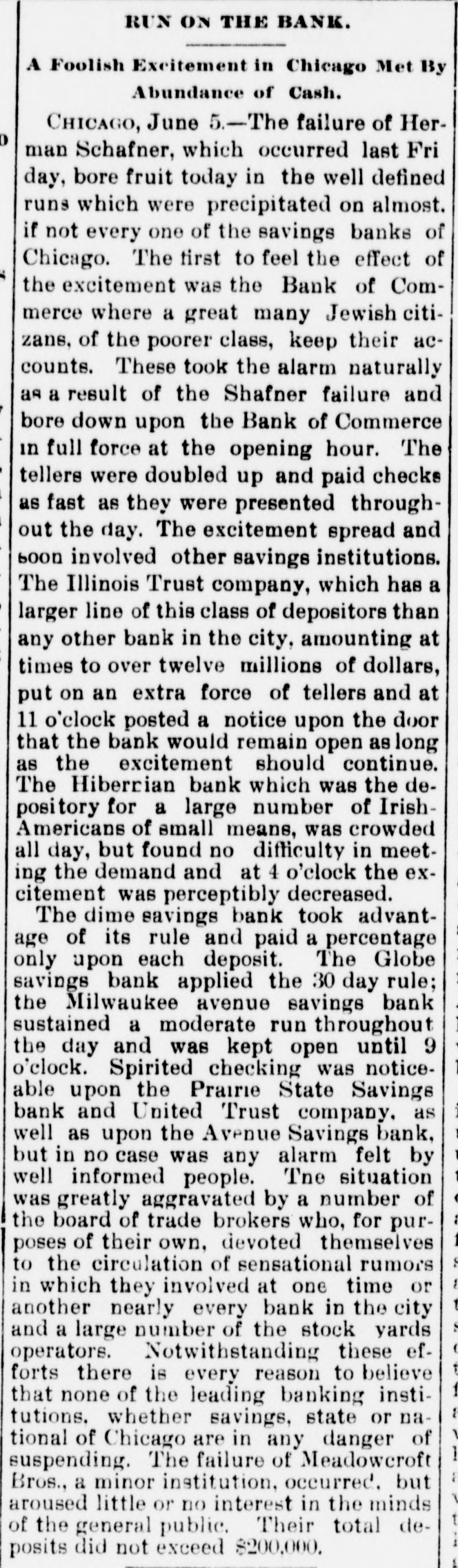
RUN ON THE BANK. A Foolish Excitement in Chicago Met By Abundance of Cash. CHICAGO, June 5.-The failure of Her0 man Schafner, which occurred last Fri day, bore fruit today in the well defined runs which were precipitated on almost. if not every one of the savings banks of Chicago. The first to feel the effect of the excitement was the Bank of Commerce where a great many Jewish citizans, of the poorer class, keep their accounts. These took the alarm naturally as a result of the Shafner failure and bore down upon the Bank of Commerce in full force at the opening hour. The tellers were doubled up and paid checks as fast as they were presented throughout the day. The excitement spread and soon involved other savings institutions. The Illinois Trust company, which has a larger line of this class of depositors than any other bank in the city, amounting at times to over twelve millions of dollars, put on an extra force of tellers and at 11 o'clock posted a notice upon the door that the bank would remain open as long as the excitement should continue. The Hiberrian bank which was the depository for a large number of IrishAmericans of small means, was crowded all day, but found no difficulty in meeting the demand and at 4 o'clock the excitement was perceptibly decreased. The dime savings bank took advantage of its rule and paid a percentage only upon each deposit. The Globe savings bank applied the 30 day rule; the Milwaukee avenue savings bank sustained a moderate run throughout the day and was kept open until 9 o'clock. Spirited checking was noticeable upon the Prairie State Savings bank and United Trust company. as well as upon the Avenue Savings bank. but in no case was any alarm felt by well informed people. The situation was greatly aggravated by a number of the board of trade brokers who, for purposes of their own, devoted themselves to the circulation of sensational rumors in which they involved at one time or another nearly every bank in the city and a large number of the stock yards operators. Notwithstanding these efforts there is every reason to believe that none of the leading banking institutions. whether savings, state or national of Chicago are in any danger of suspending. The failure of Meadowcroft Bros., a minor institution, occurred. but aroused little or no interest in the minds of the general public. Their total deposits did not exceed $200,000.


Article from Perrysburg Journal, June 10, 1893

Click image to open full size in new tab

Article Text

AFTER THEIR CASH. Uneasy Depositors Make Things Lively Runs for Several Chicago Banks Heavy Met, Experienced. But All Demands Announced. Are Only One Suspension Being the June 6. The opening of in was un symptoms of a panic. and strong banks CHICAGO, Chicago characterized Much by existed since Saturday and fears among had become so easiness the positors doubts far o'clock, aug- deeven long before 10 and including and working girls, women mented, that crowds, found men ready their to the bank doors and were way the first possible had withdraw what money to tv improve to opportuni- they the deposit. As the day wore on fullcrowds on increased. and by noon a fledged panic of no mean magnitude was Savings inaugurated. banks which experienced work a Monday kept their tellers at the run who had been in line up to of ordinary closing were were posted on busihour until and notices all the for doors paid, banks would be open at the regular hour this that ness the beyond morning the The panic did not extend but of small savings accounts, an intense strain in that there owners was financial It is to the rumor mongers phase. affairs. day is indebted for its worst the succeeded in frightening disasters many They Instead of the dozen found talked about there one suspension that people. that be were but especial would is com- in to times excite no Some or occasion serious few ment that had runs a ordinary of the banks trouble. did sixty-day in take advantage of the for cases But there was no occasion their limit. the loss of confidence displayed by patrons. June 6.-The private bank- 100 CHICAGO, house of Meadowcroft Bros., northeast ing street, at the and of has been placed in becorner streets, Washington of Washington the suspend Dearborn hands being forced to a of the prevailing cause E. Crandall gency. receiver, Lyman monetary has Walker. strin- been appointed receiver. Eddy & an attorneys for the firm. have bank's given asapproximate estimate of the the liasets and liabilities. They place at bilities at $250,000, and the assets d $460,000. The depositors began a run on in the the Trust and Savings bank Illinois building early in the morning all day and Rookery clamored for their money effort to The bank made every d long. promptly and the officials expressed for pay no fear for the result of the demand r e deposits. This bank kept its doors open until midnight in order that everyone have it. e after who wanted his money might his last depositor in the line got closed money e The at 3 a. m., then the bank t until 10 o'clock. Shortly after the doors of the Bank startwere opened a run continued for hours. Commerce which responsible was President r ed Felsenthal says rumors are conducted the bank was financial principles, was for soundest the run: there its offir on do not speculate, and all t d plenty cers of cash in its vaults to meet d demands. was a heavy run upon the the s State national bank comas Prairie Prairie There officials Trust and State Savings and apto all day. The bank met t pany to take the matter n the demands made upon pear all easily them. and e e, In the general excitement bankidid that struck not of public the Hibernian is not at the escape, but the result thus far alarming to the officials. is e Meadowcroft Brothers' failure prein a run on the Dime savings But e cipitated at 104 Washington street. the sat the Bank of debank Commerce, small ot here, was as made chiefly by the exed and there was really more inside ill on the sidewalk than in a the bank. run eitement positors Officials claim to be ts position to meet all demands. ed was made on the Union Rawson Trust to A run of which Stephen W. about noon is e bank, The run began after8. president. and was kept up during the er snoon. the Globe savings bank the run dets At all day. At 2 m. it was thirtyr kept cided up to take advantage of the acis savings this st Vice President Hayes run day counts. notice provided for said the he would not have been done had been on that bank alone. m ffThere was a slight run at the Mil- the re avenue state bank, but close crowds waukee began to diminish by the the business day. E. of a wild day on the board the The uneasy feeling erof world invaded er financial It trade. was provisions the in specin grains and a sh tumbled headlong. les and ulators Prices caused temporary The to panic. bears keep ernot trade fast enough July ers the reducing of up sold down to 65% a d. could wheat with market. declined drop se nearly 3 cents. Cash wheat lower than his and reached a figure In re cents has sold in the last thirty years. les it tense excitement prevailed. ed All deliveries of grain and provisions Septemer in a similar manner. July the suffered quite as radical as th. at 7914, reached 70 off ber It opened was'not oats and were closed he while corn and Pork vn at 701/4. cent to a cent and a half. and deut from a very sick commodity. hogs was clined a over a dollar a barrel, with off from 40 to 60 cents. igtold, the day was a disastrous care lic All and even the alarmists did not unrest. sit one exaggerate the feeling of and its tle to market has been weak only needed nerves protest to lightest The all on edge. It has pull the


Article from Fisherman & Farmer, June 16, 1893

Click image to open full size in new tab

Article Text

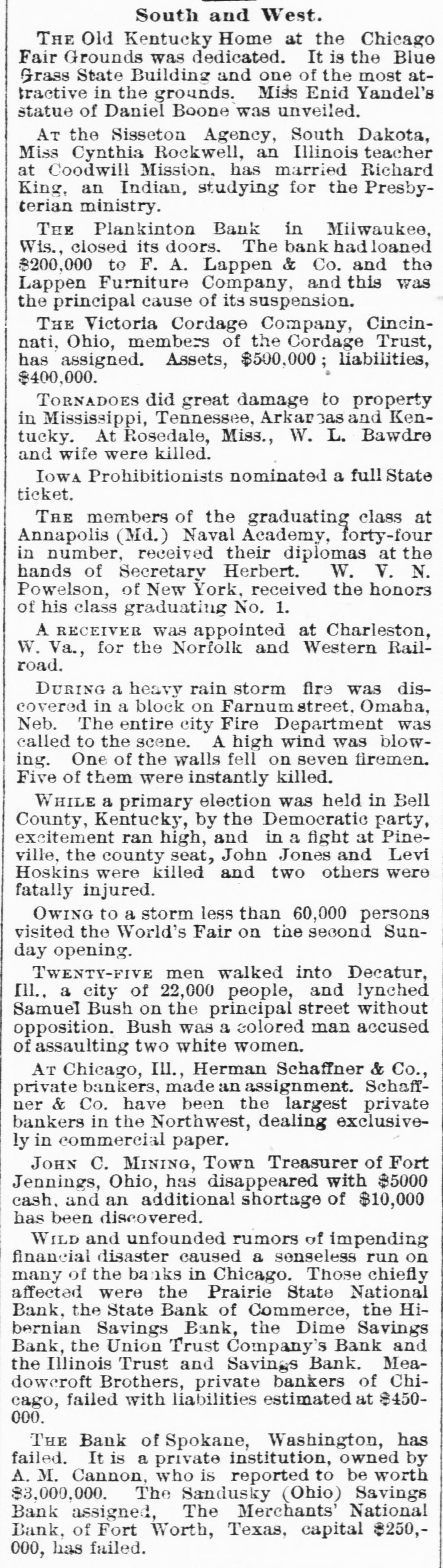
South and West. THE Old Kentucky Home at the Chicago Fair Grounds was dedicated. It is the Blue Grass State Building and one of the most attractive in the grounds. Miss Enid Yandel's statue of Daniel Boone was unveiled. AT the Sisseton Agency, South Dakota, Miss Cynthia Rockwell, an Illinois teacher at Coodwill Mission. has married Richard King, an Indian, studying for the Presbyterian ministry. THE Plankinton Bank in Milwaukee, Wis., closed its doors. The bank had loaned $200,000 to F. A. Lappen & Co. and the Lappen Furniture Company, and this was the principal cause of its suspension. THE Victoria Cordage Company, Cincinnati, Ohio, members of the Cordage Trust, has assigned. Assets, $500,000 liabilities, $400,000. TORNADOES did great damage to property in Mississippi, Tennessee, Arkarcas and Kentucky. At Rosedale, Miss., W. L. Bawdre and wife were killed. IOWA Prohibitionists nominated a full State ticket. THE members of the graduating class at Annapolis (Md.) Naval Academy, forty-four in number, received their diplomas at the hands of Secretary Herbert. W. V. N. Powelson, of New York, received the honors of his class graduating No. 1. A RECEIVER was appointed at Charleston, W. Va., for the Norfolk and Western Railroad. DURING a heavy rain storm fire was discovered in a block on Farnumstreet, Omaha, Neb. The entire city Fire Department was called to the scene. A high wind was blowing. One of the walls fell on seven firemen. Five of them were instantly killed. WHILE a primary election was held in Bell County, Kentucky, by the Democratic party, excitement ran high, and in a fight at Pineville, the county seat, John Jones and Levi Hoskins were killed and two others were fatally injured. OWING to a storm less than 60,000 persons visited the World's Fair on the second Sunday opening. TWENTY-FIVE men walked into Decatur, Ill., a city of 22,000 people, and lynched Samuel Bush on the principal street without opposition. Bush was a colored man accused of assaulting two white women. AT Chicago, Ill., Herman Schaffner & Co., private bankers, made an assignment. Schaffner & Co. have been the largest private bankers in the Northwest, dealing exclusively in commercial paper. JOHN C. MINING, Town Treasurer of Fort Jennings, Ohio, has disappeared with $5000 cash. and an additional shortage of $10,000 has been discovered. WILD and unfounded rumors of impending financial disaster caused a senseless run on many of the banks in Chicago. Those chiefly affected were the Prairie State National Bank, the State Bank of Commerce, the Hibernian Savings Bank, the Dime Savings Bank, the Union Trust Company's Bank and the Illinois Trust and Savings Bank. Meadowcroft Brothers, private bankers of Chicago, failed with liabilities estimated at $450000. THE Bank of Spokane, Washington, has failed. It is a private institution, owned by A. M. Cannon, who is reported to be worth $3,000,000. The Sandusky (Ohio) Savings Bank assigned, The Merchants' National Bank, of Fort Worth, Texas, capital $250,000, has failed.


Article from The Waco Evening News, July 29, 1893

Click image to open full size in new tab

Article Text

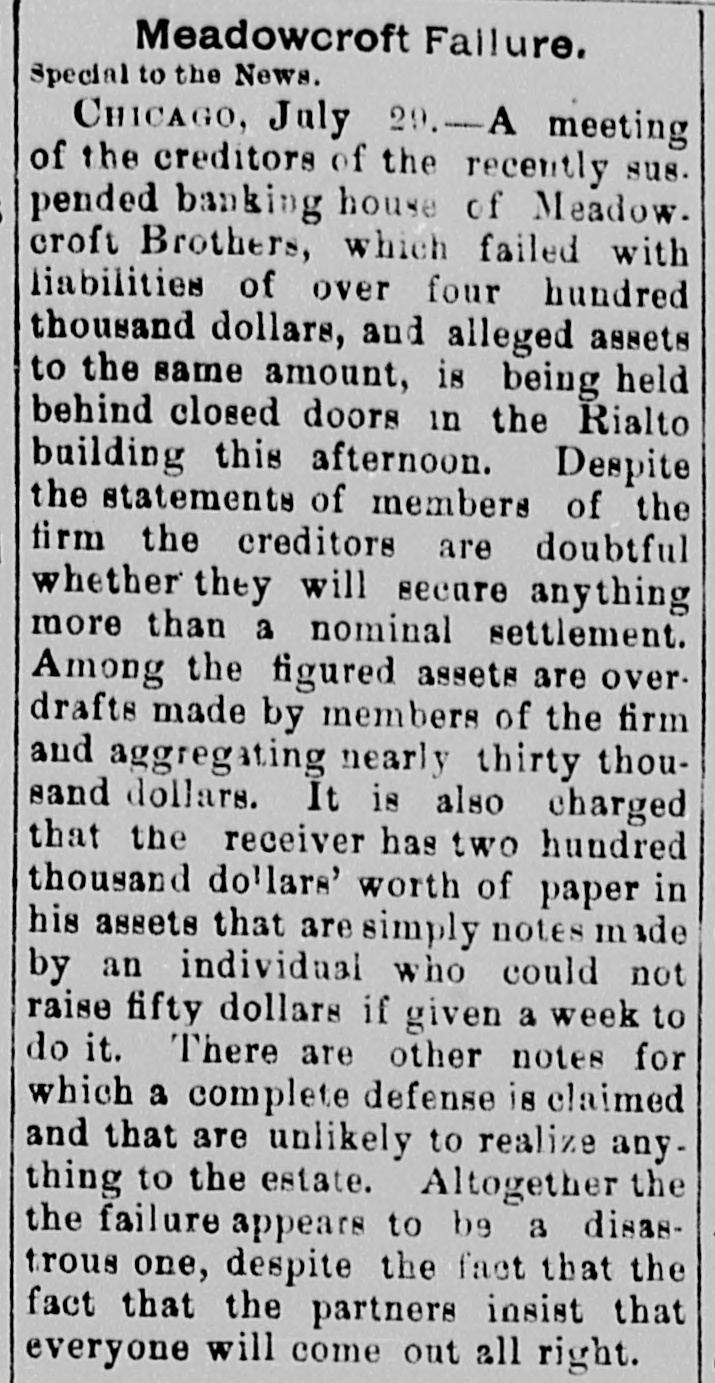
Meadowcroft Failure. Special to the News. CHICAGO, July 20.-A 29. meeting of the creditors of the recently sus. pended banking house of Meadow. croft Brothers, which failed with liabilities of over four hundred thousand dollars, and alleged assets to the same amount, is being held behind closed doors in the Rialto building this afternoon. Despite the statements of members of the firm the creditors are doubtful whether they will secure anything more than a nominal settlement. Among the figured assets are overdrafts made by members of the firm and aggregating nearly thirty thousand dollars. It is also charged that the receiver has two hundred thousand dollars' worth of paper in his assets that are simply notes ade by an individual who could not raise fifty dollars if given a week to do it. There are other notes for which a complete defense is claimed and that are unlikely to realize anything to the estate. Altogether the the failure appears to be a disastrous one, despite the fact that the fact that the partners insist that everyone will come out all right.


Article from The Topeka State Journal, March 15, 1894

Click image to open full size in new tab

Article Text

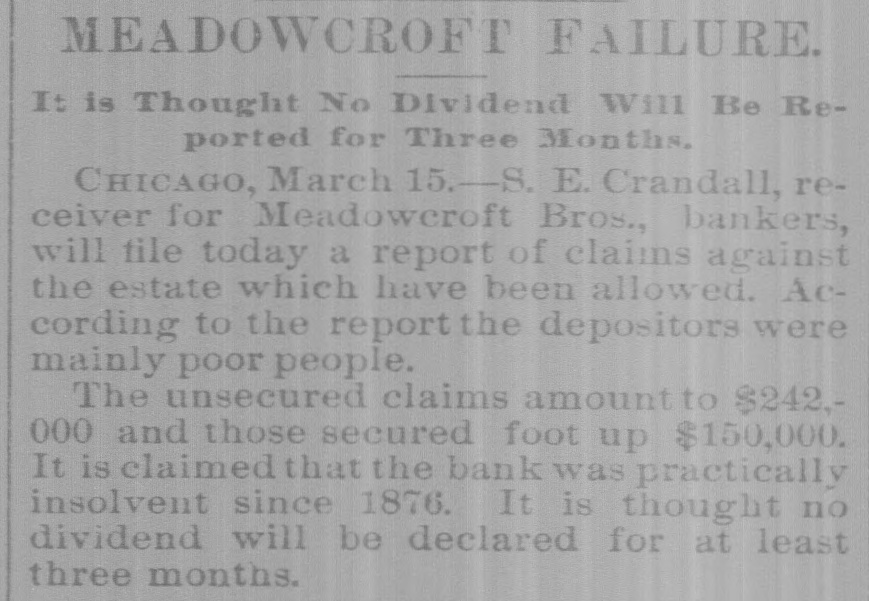
MEADOWCROFT FAILURE. It is Thought No Dividend Will Be Reported for Three Months. CHICAGO, March 15.-S. E. Crandall, receiver for Meadowcroft Bros., bankers, will file today a report of claims against the estate which have been allowed. According to the reportthe depositors were mainly poor people. The unsecured claims amountto $242,000 and those secured foot up $150,000. It is claimed that the bank was practically insolvent since 1876. It is thought no dividend will be declared for at least three months.


Article from The Copper Country Evening News, March 31, 1896

Click image to open full size in new tab

Article Text

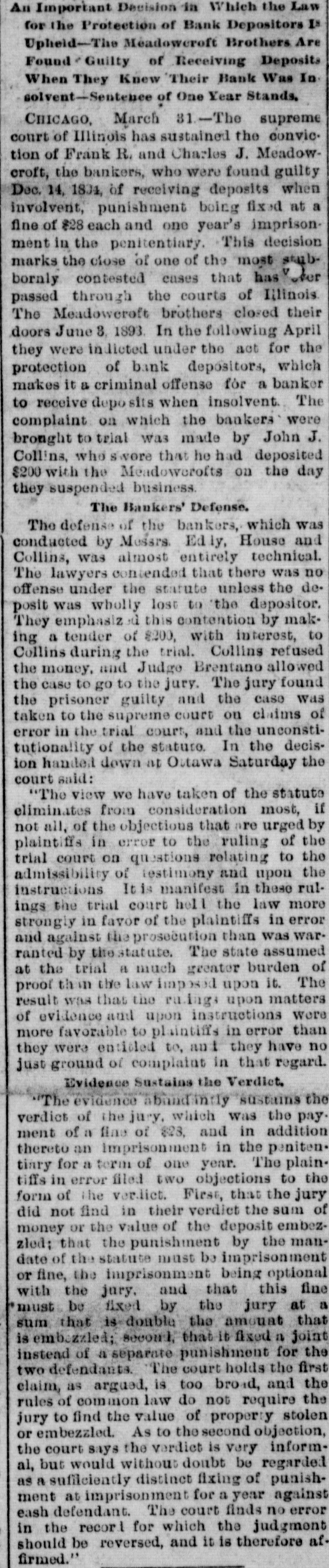
An Important Decision in Which the Law for the Protection of Bank Depositors Is Upheld-The Meadowcroft Brothers Are Found / Guilty of Receiving Deposits When They Knew Their Bank Was In solvent-Sentence of One Year Stands. CHICAGO, March 31-The supreme court of Illinois has sustained the conviction of Frank R. and Charles J. Meadowcroft, the bankers, who were found guilty Dec. 14, 1834, of receiving deposits when involvent, punishment being fixed at a fine of $28 each and one year's imprisonment in the penitentiary. This decision marks the close of one of the most stubbornly contested cases that has ever passed through the courts of Illinois The Meadoweroft brothers closed their doors June 8. 1893. In the following April they were in dicted under the act for the protection of bank depositors, which makes it a criminal offense for a banker to receive deposits when insolvent. The complaint on which the bankers were brought to trial was made by John J. Collins, who swore that he had deposited $200 with the Meadowcrofts on the day they suspended business. The Bankers' Defense. The defense of the bankers, which was conducted by Mesars Edly, House and Collins, was almost entirely technical. The lawyers contended that there was no offense under the statute unless the deposit was wholly lost to the depositor. They emphasiz el this contention by making a tender of $200, with interest, to Collins during the trial. Collins refused the money. and Judge Brentano allowed the case to go to the jury. The jury found the prisoner guilty and the caso was taken to the supreme court on claims of error in the trial court, and the unconstitutionality of the stature. In the decision handed down at Ostawa Saturday the court said: "The view we have taken of the statute eliminates from consideration most, if not all, of the objections that are urged by plaintiffs in error to the ruling of the trial court on questions relating to the admissibility of testimony and upon the instructions It is manifest in those rulings the trial court hell the law more strongly in favor of the plaintiffs in error and against the prosecution than was warranted by thestatute. The state assumed at the trial a much genter burden of proof th in the law imposΓ©d upon it. The result was that the raings upon matters of evidence and upon instructions were more favorable to plaintiffs in error than they were entitled to, ani they have no just ground of complaint in that regard. Evidence Sustains the Verdict. The evidence aband in th sustains the verdict of the jury, which was the pay ment of a fine of 823, and in addition thereto an imprisonment in the penitentinry for a term of one year. The plaintiffs in error filed two objections to the form of the verlict. First, that the jury did not find in their verdict the sum of money or the value of the deposit embezzled; that the punishment by the mandate of the statute must be imprisonment or fine, the imprisonment being optional with the jury, and that this fine 'must be fixed by the jury at a sum that is double the amount that is embezzled; second, that it fixed a joint instead of a separate punishment for the two defendants. The court holds the first claim, as argued, is too broad, and the rules of common law do not require the jury to find the value of property stolen or embezzled. As to the second objection, the court says the vardict is very informal, but would without doubt be regarded as a sufficiently distinct fixing of punishment at imprisonment for a year against eash defendant. The court finds no error in the record for which the judgment should be reversed, and it is therefore af firmed."


Article from The Salt Lake Herald, March 31, 1896

Click image to open full size in new tab

Article Text

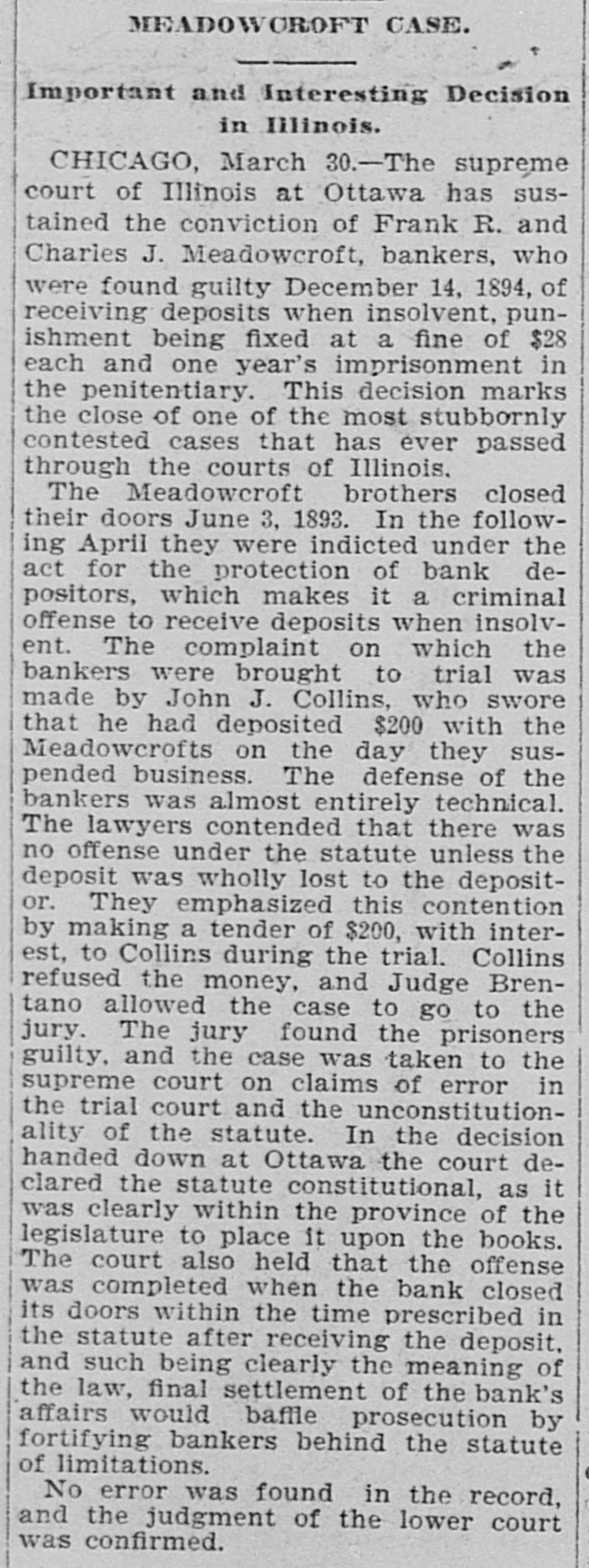
# MEADOWCROFT CASE. Important and Interesting Decision in Illinois. CHICAGO, March 30.-The supreme court of Illinois at Ottawa has sustained the conviction of Frank R. and Charles J. Meadowcroft, bankers, who were found guilty December 14, 1894, of receiving deposits when insolvent, punishment being fixed at a fine of $28 each and one year's imprisonment in the penitentiary. This decision marks the close of one of the most stubbornly contested cases that has ever passed through the courts of Illinois. The Meadowcroft brothers closed their doors June 3, 1893. In the following April they were indicted under the act for the protection of bank depositors, which makes it a criminal offense to receive deposits when insolvent. The complaint on which the bankers were brought to trial was made by John J. Collins, who swore that he had deposited $200 with the Meadowcrofts on the day they suspended business. The defense of the bankers was almost entirely technical. The lawyers contended that there was no offense under the statute unless the deposit was wholly lost to the depositor. They emphasized this contention by making a tender of $200, with interest, to Collins during the trial. Collins refused the money, and Judge Brentano allowed the case to go to the jury. The jury found the prisoners guilty, and the case was taken to the supreme court on claims of error in the trial court and the unconstitutionality of the statute. In the decision handed down at Ottawa the court declared the statute constitutional, as it was clearly within the province of the legislature to place it upon the books. The court also held that the offense was completed when the bank closed its doors within the time prescribed in the statute after receiving the deposit, and such being clearly the meaning of the law, final settlement of the bank's affairs would baffle prosecution by fortifying bankers behind the statute of limitations. No error was found in the record, and the judgment of the lower court was confirmed.