3847. Garden City Banking & Trust Company (Chicago, IL)

Bank Information

Episode Type
Run Only
Bank Type
trust
Start Date
December 21, 1896
Location
Chicago, Illinois (41.850, -87.650)

Metadata

Model
gpt-5-mini
Short Digest
86ab4b932cfcf1f5

Response Measures

None

Description

Multiple contemporaneous newspaper accounts (Dec 21โ€“23, 1896) describe a short-lived run on the Garden City Banking & Trust Company triggered by the collapse of the National Bank of Illinois, but no suspension or closure of Garden City is reported; officers met withdrawals and the bank remained open.

Events (1)

1. December 21, 1896 Run
Cause
Correspondent
Cause Details
Depositors learned the Garden City bank cleared through the failed National Bank of Illinois, prompting withdrawals.
Measures
Opened doors an hour early; paid out deposits as requested; officers reported having ~50% of deposits on hand and later said receipts that day tripled payouts.
Newspaper Excerpt
A run was in progress on the Garden City bank ... There were 100 people in line waiting to withdraw deposits ... the bank officials say that they have fully fifty per cent. of the amounts deposited on hand and are paying out to all depositors as fast as possible.
Source
newspapers

Newspaper Articles (10)

Article from The Portland Daily Press, December 22, 1896

Click image to open full size in new tab

Article Text

LIKE ROW OF BLOCKS. Chicago Banking Institutions Tumbling Down Over Each Other. Chicago, December 21.-S. S. Dreyer & Co., one of the oldest banking establishments of this city, failed at 10 o'clock this morning. The banking firm of Wasmannsdoff & Heimann, 145 and 147 East Randolph street, is announced to be in the hands of the Security Title and Trust Company. The National Bank of Illinois, Incated at 115 Dearborn street, and one of the oldest and best known banking institutions in the city, with assets amounting to nearly $15,000,000, diรก not open its doors this morning. The causes of the suspension as given in the resolutions adopted by the clearing house committee, 'unwarrantable and injudicious loans, through which "the capital and surplus of said bank is seriously imperilled, if not absolutely lost. At the last statement of the bank its capital was shown to be $1,000,000 with a surplus of $1,000,000 and undivided assets of over $300 000. Both the first named failures were a direct outcome of the National bank of Illinois closing its doors. A run on the Garden City Banking and Trust company bank was caused by the fact becoming generally known among the depositors that the institution cleared through the failed national bank of Illinois. The withdrawals were promptly met until the regular hour for closing the bank. At the Illinois Trust and Savings and American Trust and Savings banks, there were small lines of mon and women who were anxious to get their money. The bank officers were glad to pay it out as the withdrawals in the savings department meant a gain of interest money. Both these banks are regarded financially impregnable. President Schneider of the National bank of Illinois is treasurer of the Chicago Associated Press. In regard to the failure of the National Bank of Illinois, Comptroller Eckles said: "The failure of the bank is due to injudicious, reckless and imprudent methods, followed by the officers. and not checked by the directors though their attention individually was called to the same, and over their individual signatures they promised to remedy the weak points in the bank's condition." a The Roseland bank, situated in the suburbs of Roseland, peopled largely by Hollanders, did not open its doors this morning. The bank is owned by Fred Weirsman. The depositors, who are mostly poor people, were assured that they would get their money as soon as the money was received from the National Bank of Illinois. Linseed Oil Company Fails. Chicago, December 21.-A bill was filed in the circuit court by the National Linseed Oil Company, and the Grove Linseed Oil Company, asking for the appointment of a receiver for the Firemen's Insurance Company, an application based upon the judgments recovered and upon the ground that an effort is being made to throw the company into the hands of a friendly receiver. The insurance company has a capital stock of $500,000, one half of this is said to be have been paid in. The statement is made that the company is totally insolvent.

Article from Marietta Daily Leader, December 22, 1896

Click image to open full size in new tab

Article Text

Run on a Chicago Bank. CHICAGO, Dec. 21.-A run was in progress on the Garden City bank, situated in the chamber of commerce building on Washington and LaSalle streets, Monday afternoon. There were 100 people in line waiting to withdraw deposits and on the sidewalk a large crowd, which was increasing rapidly, have gathered waiting an opportunity to enter the bank. The bank officials say that they have fully fifty per cent. of the amounts deposited on hand and are paying out to all depositors as fast as possible.


Article from Deseret Evening News, December 23, 1896

Click image to open full size in new tab

Article Text

As a Result of the Fallure, CHICAGO, Dec. 22.-The Jailure of Augus & Gindele, general contractors; the American Brewing, Malting and Elevator company; the George A. Weiss Malting and Elevator company, and George A. Welss individually, all of these belug due to the collapse of the National bank of Illinois, and small runs on three banks, were the echoos today of the bank failures of yesterday. Runs were made on the Garden City Banking and Trust company, the Hisernian Savings bank and the Illinois Trust and Savings bank, but none of the runs were of much importance.


Article from The Wichita Daily Eagle, December 23, 1896

Click image to open full size in new tab

Article Text

soon after receiving the notice. The Bank of Minnesita was the oldest in the city and one of the best known throughout the west. It had many correspondents, among them the National Bank of Illinois, but it was stated tonight that the failure of the Chicago bank had nothing to do with the closing of this concern. The small bank at the stock yards that closed as a result of the other failure was a branch of the Bank of Minnesota, but no other local banks are at all affected by the failure. CHICAGO'S FAILURES. Washington, Dec. 22.-Comptroller Eckels received a telegram early in the afternoon stating that everything was quiet in Chicago but containing no other news. He said he did not care to talk concerning the situation and that he did not know yet whether or not there would be any criminal proceedings brought on account of the revelations concerning the failure. The first duty of examiners placed in chargeof failed national banks, he said, was to ascertain whether there had been any criminal violations of the law. He had received no report of any as yet but if the examiner did find and report such violations, measures would be taken, of course, to prosecute the parties reported. EXCITEMENT SUBSIDES. Chicago, Dec. 22.-The excitement attendent upon the collapse of the National Bank of Illinois and its three dependent banks, appeared to have died out today. Runs of more or less magnitude were made yesterday on several banking institutions. notably the Garden City Banking and Trust company. The doors of that institution were opened an hour before banking hours today, but by 10:30 a. m. withdrawals had ceased and deposits had trebled the amount taken out. Withdrawals at other banks were few and far between. It is generally expected that Bank Examiner McKeown will be appointed receiver permanently for the National Bank of Illnois. LOANED TO SONS-IN-LAW. Chicago, Ill. Dec, 22.-The assets of the National Bank of Illinois, which closed its doors yesterday, are said to include in addition to the $2,475,000 loaned to Robert Berger, a son-in-law of President George Schneider, $500,000 advanced to G. A. Weiss, another son-in-law, and over $800,000 of doubtful debts. Berger is a partner in the firm of E. S. Dryer & Co., which also went into the hands of a receiver yesterday, and Weiss is a brewer The losses by the failure will fall upon 1,971 individual depositors and 350 private state and national banks. Included among the depositors are the treasurers of the city of Chicago, and of the state of Illinois. The deposits of the treasurers of Chicago and Cook county will aggregate almost $1,000,000. The amount at the present time on deposit by the state treasurer is comparatiely small. Among the depositors were many large corporations and receiers. They include the receivers of the Northern Pacific rail road and the receiver of the whisky trust. The deposits of E. S. Dryer & Co., include the funds of the West Park board. The amount at the time the bank closed was about $310,000. Robert E. Jenkins, one of the directors of the National Bank of Illinois, says: "The directors did not know the size of the loan on the Calumet Electric. The discovery of the condition of the loan was as much of a surprise to me as to the public. The same is true of the loan of Dryer & Co. The directors were unaware of the loans, which appear to have carried the bank down, or were, until the latter part of last week. I do not care to say who I believe was to blame for the directors being kept in the dark as to the mangnitude of these loans." CITY OF CHICAGO'S FUNDS. Washington D. C. Dec. 22.-Mr. Eckles, the comptroller of the currency. received a telegram today from Mr. McKeon. the receiver of the National Bank of Illinois, stating that the books of the bank show that quite large sums of public funds belonging to the city of Chicago were on deposit. In reply the comptroller sent Mr. McKeon the following telegram. "Your telegram relative to public funds received. You may make arrangements with depositors thereof to issue to them at once certificates for such amounts of their deposits as an examination of the books of the bank makes clear is due them. This will enable them to avail themselves of the offer of the clearing house to advance 75 per cent and SO prevent embarrassment in meeting public expenditures." BANK STATEMENT. Chicago. III., Dec. 22.-Under the general call issued by the comptroller of the currency, the national banks of this city have prepared a statement showing their condition at the close of business Dec. 17. The last previous statement was made Oct. 6. The fourteen banks show total loans of $63,639,323, as compared with $63,665,693 Oct. 6. a loss in loans of $25,470. The total deposits are $94,341,352. as compared with $37,361,503, a gain of $10,354,186. The legal requirements in reserve is 25 per cent. or for the fourteen banks. $23,597,863, while there is held $47,896,089 in excess of the legal requirement of $24,-


Article from The Wichita Daily Eagle, December 23, 1896

Click image to open full size in new tab

Article Text

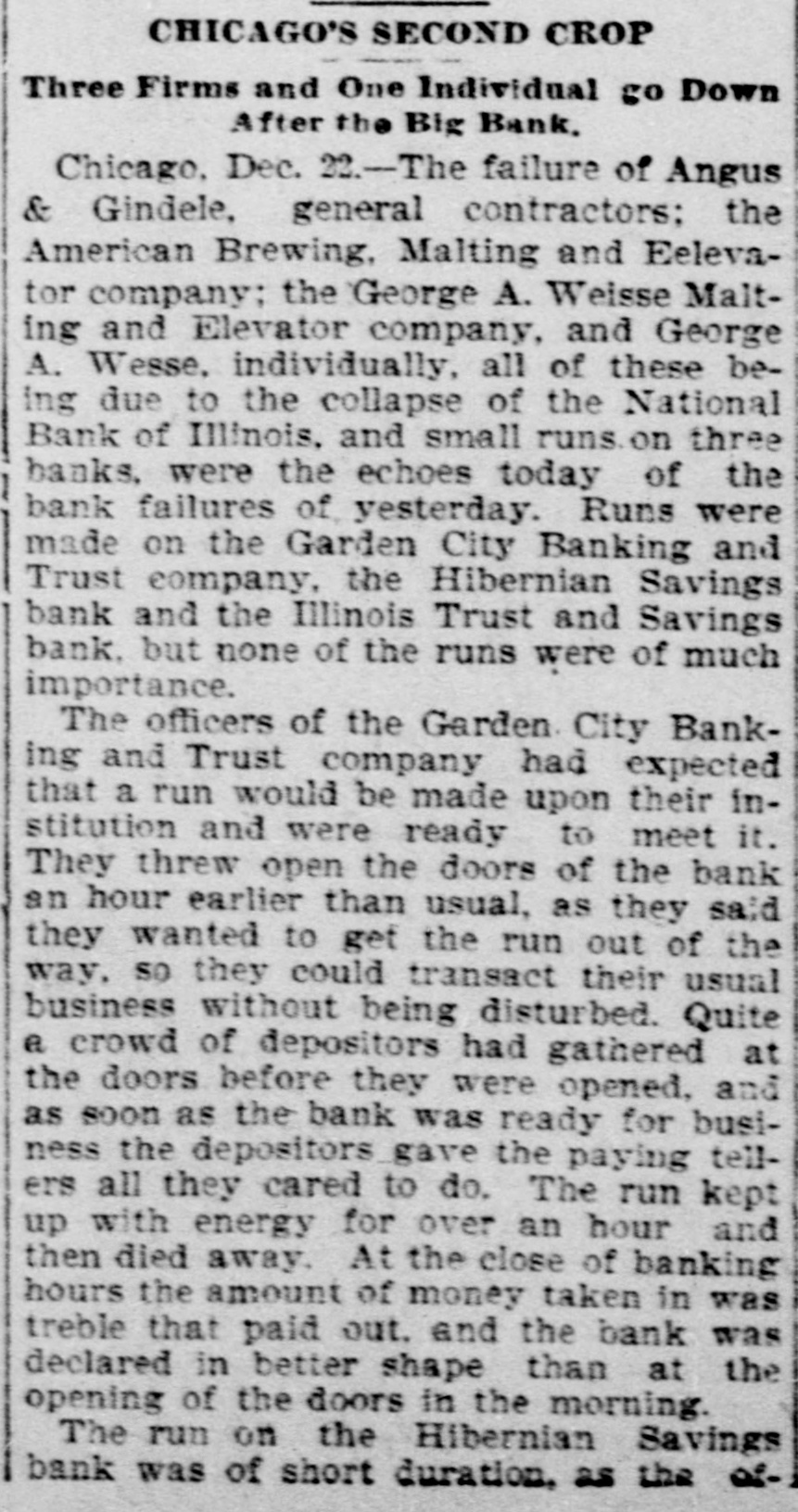
CHICAGO'S SECOND CROP Three Firms and One Individual go Down After the Big Bank, Chicago, Dec. 22.-The failure of Angus & Gindele, general contractors; the American Brewing, Malting and Eelevator company; the George A. Weisse Malting and Elevator company, and George A. Wesse. individually, all of these being due to the collapse of the National Bank of Illinois, and small runs. on three banks, were the echoes today of the bank failures of yesterday. Runs were made on the Garden City Banking and Trust company, the Hibernian Savings bank and the Illinois Trust and Savings bank. but none of the runs were of much importance. The officers of the Garden City Banking and Trust company had expected that a run would be made upon their institution and were ready to meet it. They threw open the doors of the bank an hour earlier than usual, as they said they wanted to get the run out of the way, S0 they could transact their usual business without being disturbed. Quite a crowd of depositors had gathered at the doors before they were opened, and as soon as the bank was ready for business the depositors gave the paying tellers all they cared to do. The run kept up with energy for over an hour and then died away. At the close of banking hours the amount of money taken in was treble that paid out. and the bank was declared in better shape than at the opening of the doors in the morning. The run on the Hibernian Savings bank was of short duration, as the of-


Article from The Anaconda Standard, December 23, 1896

Click image to open full size in new tab

Article Text

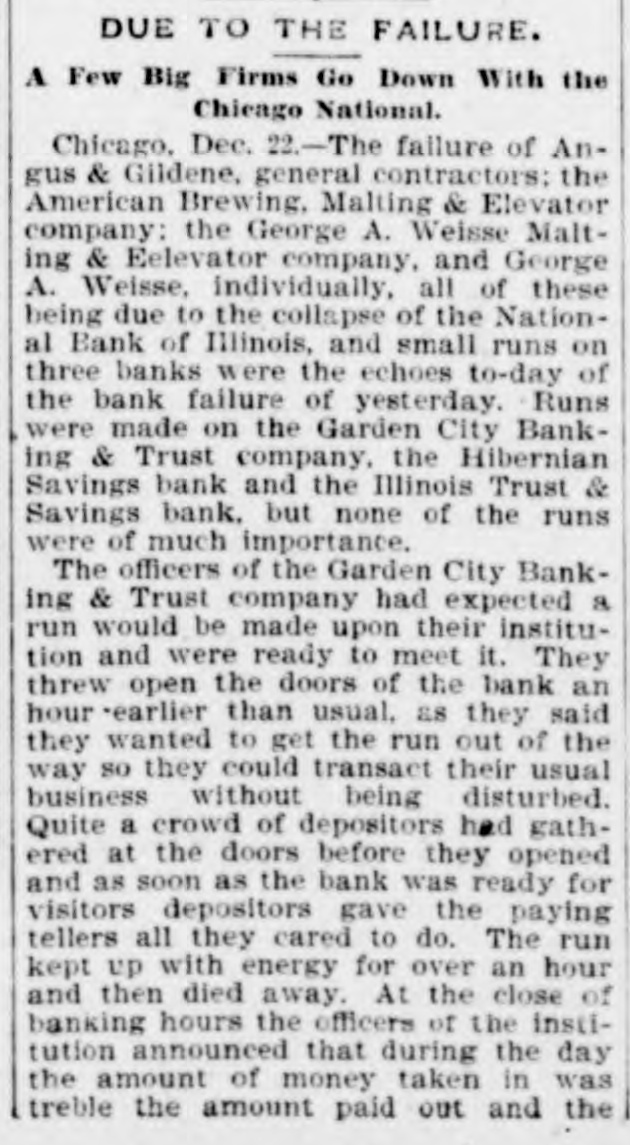
DUE TO THE FAILURE. A Few Big Firms Go Down With the Chicago National. Chicago, Dec. 22.-The failure of Angus & Gildene, general contractors: the American Brewing, Malting & Elevator company: the George A. Weisse Malting & Eelevator company, and George A. Weisse, individually, all of these being due to the collapse of the National Bank of Illinois, and small runs on three banks were the echoes to-day of the bank failure of yesterday. Runs were made on the Garden City Banking & Trust company. the Hibernian Savings bank and the Illinois Trust & Savings bank. but none of the runs were of much importance. The officers of the Garden City Banking & Trust company had expected a run would be made upon their institution and were ready to meet it. They threw open the doors of the bank an hour earlier than usual, as they said they wanted to get the run out of the way so they could transact their usual business without being disturbed. Quite a crowd of depositors had gathered at the doors before they opened and as soon as the bank was ready for visitors depositors gave the paying tellers all they cared to do. The run kept up with energy for over an hour and then died away. At the close of banking hours the officers of the institution announced that during the day the amount of money taken in was treble the amount paid out and the


Article from The Bryan Daily Eagle, December 23, 1896

Click image to open full size in new tab

Article Text

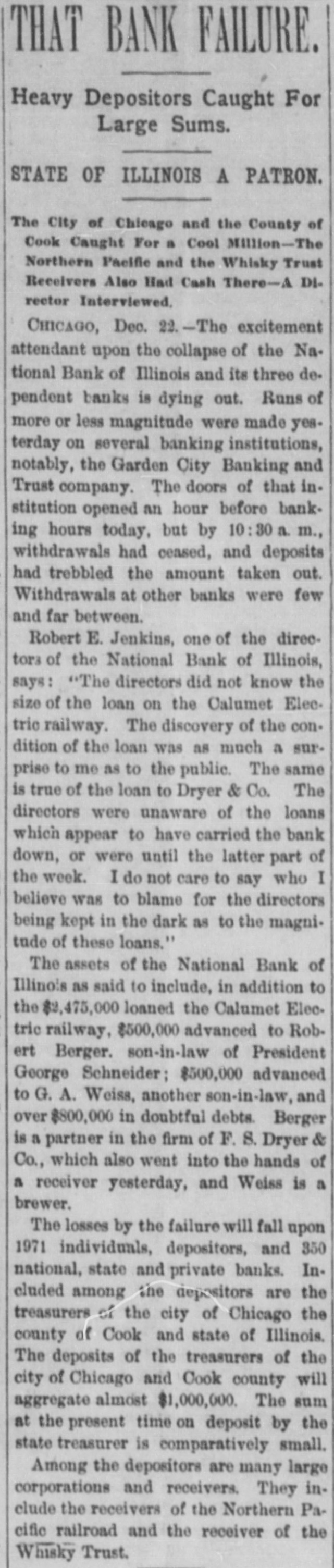
THAT BANK FAILURE. Heavy Depositors Caught For Large Sums. STATE OF ILLINOIS A PATRON. The City of Chicago and the County of Cook Caught For a Cool Million-The Northern Pacific and the Whisky Trust Receivers Also Had Cash There-A DIrector Interviewed. CHICAGO, Dec. 22.-The excitement attendant upon the collapse of the National Bank of Illinois and its three dependent banks is dying out. Runs of more or less magnitude were made yesterday on several banking institutions, notably, the Garden City Banking and Trust company. The doors of that institution opened an hour before banking hours today, but by 10:30 a. m., withdrawals had ceased, and deposits had trebbled the amount taken out. Withdrawals at other banks were few and far between. Robert E. Jenkins, one of the directors of the National Bank of Illinois, says: "The directors did not know the size of the loan on the Calumet Electric railway. The discovery of the condition of the loan was as much a surprise to me as to the public. The same is true of the loan to Dryer & Co. The directors were unaware of the loans which appear to have carried the bank down, or were until the latter part of the week. I do not care to say who I believe was to blame for the directors being kept in the dark as to the magnitude of these loans." The assets of the National Bank of Illinois as said to include, in addition to the $2,475,000 loaned the Calumet Electric railway, $500,000 advanced to Robert Berger. son-in-law of President George Schneider ; $500,000 advanced to G. A. Weiss, another son-in-law, and over $800,000 in doubtful debts. Berger is a partner in the firm of F. S. Dryer & Co., which also went into the hands of a receiver yesterday, and Weiss is a brewer. The losses by the failure will fall upon 1971 individuals, depositors, and 350 national, state and private banks. Included among the depositors are the treasurers of the city of Chicago the county of Cook and state of Illinois. The deposits of the treasurers of the city of Chicago and Cook county will aggregate almost $1,000,000. The sum at the present time on deposit by the state treasurer is comparatively small. Among the depositors are many large corporations and receivers. They include the receivers of the Northern Pacific railroad and the receiver of the Whisky Trust.


Article from The Saint Paul Globe, December 23, 1896

Click image to open full size in new tab

Article Text

THREE FIRMS CARRIED DOWN. TWO CONTROLLED BY SON-IN-LAW OF ILLINOIS NATIONAL'S PRESIDENT. BANK DOORS OPEN BEFORE HOURS. Fear of Depositors as to Savings Satisfied Without Difficulty-Increase in Receipts. CHICAGO, Dec. 22.-The failures of Angus & Gindele, general contractors; the American Brewing, Malting and Elevator company, the George A. Weisse Malting and Elevator company and George A. Welsse individually, all of these being due to the collapse of the National Bank of Illinois, and small runs on three banks were the echoes today of the bank failures of yesterday. Runs were made on the Garden City Banking & Trust company, the Hibernian Savings bank and the Illinois Trust and Savings bank, but none of the runs was of much importance. The officers of the Garden City Banking and Trust company had expected that a run would be made upon their institution and were ready to meet it. They threw open the doors of the bank an hour earlier than usual, as they said they wanted to get the run out of the way, SO that they could transact their usual business without being disturbed. Quite a crowd of depositors had gathered at the doors before they were opened, and as soon as the bank was ready for business the depositors gave the paying tellers all they cared to do. The run kept up with energy for over an hour and then died away. At the close of banking hours the officers of the instiution announced that during the day the amount of money taken in was treble that paid out, and the bank was declared to be in better shape than at the opening of the doors in the morning. The run on the Hibernian Savings bank was of short duration, as the officers declined to make any payment on time deposits unless given the legal sixty-day notice. They said that this was not because they were not prepared to pay all depositors in full, but because they wished to avoid embarrassment to smaller banks who might not be prepared to pay all their depositors at once, and who might be placed in an embarrassing position if the stronger banks were paying all demands for time deposits. There was a slight run on the Illinois Trust and Savings bank shortly after it opened this morning, the similarity of its name and that of the National Bank of Illinois having led some depositors to believe that the former was embarrassed. During the run in 1895 President John J. Mitchell. of the minois Trust, gave orders to pay all depositors who called for their money, and was criticized by other bankers for doing so. This morning, as soon as it became evident that there was likely to be a crowd in the bank, instructions were given the tellers to serve the customary sixty-day notice, but to pay all depositors who could show that they wanted $100 of their money for a legitimate purpose. The result was that the score or more of people who had lined up at the paying tellers' windows soon dispersed. Before the close of banking hours the excitement had completely died out. The giving of the notice was sanctioned by the clearing house committee, and the object was (the Illinois Trust being the strongest savings bank in the city) to give the smaller ones the opportunity to point to its action as an excuse for giving the notice themselves, which they did, and thus effectually stopped a run at any of the savings banks. The Illinois Trust and Savings bank is said to have $9,000,000 in cash on hand, and was today loaning money instead of, as in 1893, calling loans to meet the demands of the savings depositors. The American Brewing, Malting and Elevator company, the George A. Weisse Malting and Elevator company. and George A. Welsse assigned this evening in the county court. The assignments of the two companies, which are intimately connected in business, and that of Weisse were brought into court together at 6 o'clock. The assignee of the American Brewing, Malting and Elevator company is the Chicago Title and Trust company. The George A. Weisse Malting and Elevator company assigned to the Security Title and Trust company, and that company is the assignee of Weisse also. No statement was filed as to the assets or liabilities. The two companies carried on business at the same place, 922 North Ashland avenue. The failure of the two corporations was the result of the failure of the National Bank of Illinois. The two companies were borrowers from the bank and were indebted to the bank when it failed to the amount of over $500,000. As soon as the failure of the bank was announced, preparations were begun for the closing up of the busi-


Article from Rock Island Argus, December 23, 1896

Click image to open full size in new tab

Article Text

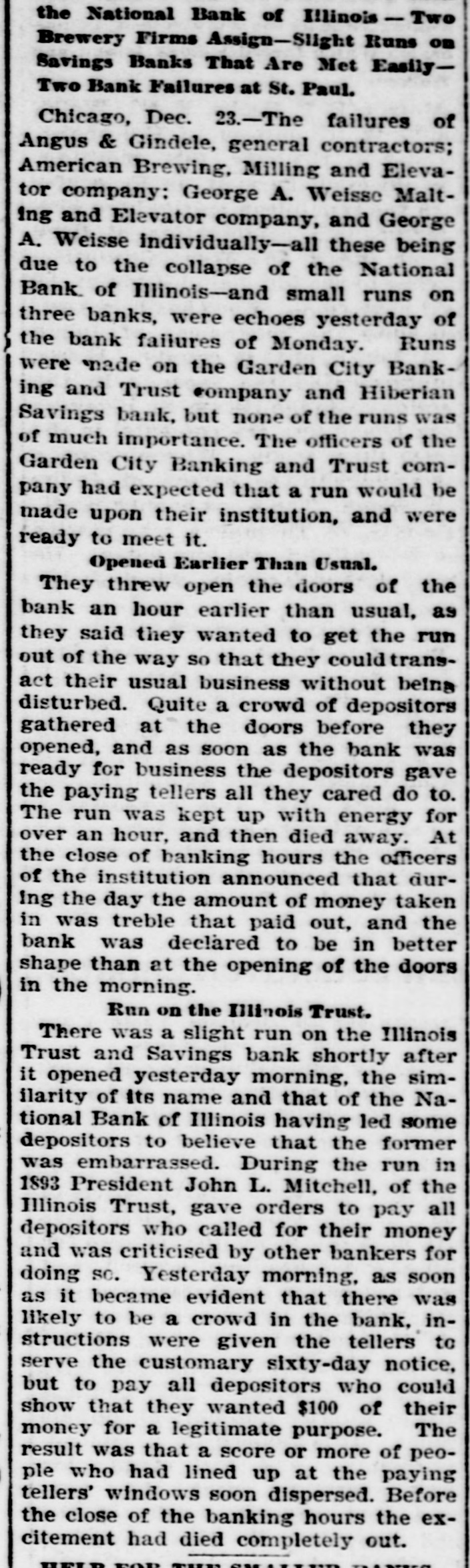
the National Bank of Illinois - Two Brewery Firms Assign-Slight Runs on Savings Banks That Are Met EasilyTwo Bank Failures at St. Paul. Chicago, Dec. 23.-The failures of Angus & Gindele, general contractors; American Brewing. Milling and Elevator company: George A. Weisse Malting and Elevator company, and George A. Weisse individually-all these being due to the collapse of the National Bank of Illinois-and small runs on three banks, were echoes yesterday of the bank failures of Monday. Runs were made on the Garden City Banking and Trust company and Hiberian Savings bank, but none of the runs was of much importance. The officers of the Garden City Banking and Trust company had expected that a run would be made upon their institution, and were ready to meet it. Opened Earlier Than Usual. They threw open the doors of the bank an hour earlier than usual, as they said they wanted to get the run out of the way so that they could transact their usual business without being disturbed. Quite a crowd of depositors gathered at the doors before they opened, and as soon as the bank was ready for business the depositors gave the paying tellers all they cared do to. The run was kept up with energy for over an hour, and then died away. At the close of banking hours the officers of the institution announced that during the day the amount of money taken in was treble that paid out, and the bank was declared to be in better shape than at the opening of the doors in the morning. Run on the Illinois Trust. There was a slight run on the Illinois Trust and Savings bank shortly after it opened yesterday morning, the similarity of its name and that of the National Bank of Illinois having led some depositors to believe that the former was embarrassed. During the run in 1893 President John L. Mitchell, of the Illinois Trust, gave orders to pay all depositors who called for their money and was criticised by other bankers for doing so. Yesterday morning, as soon as it became evident that there was likely to be a crowd in the bank. instructions were given the tellers to serve the customary sixty-day notice, but to pay all depositors who could show that they wanted $100 of their money for a legitimate purpose. The result was that a score or more of people who had lined up at the paying tellers' windows soon dispersed. Before the close of the banking hours the excitement had died completely out.


Article from The Cambria Freeman, December 25, 1896

Click image to open full size in new tab

Article Text

MORE FAILURES IN CHICAGO. Runs on Three Banks Owing to Monday's Banks Collapse. CHICAGO, Dec. 23.-The failures of Angus & Gindele, general contractors, the American Brewing, Malting and Elevator company, the George A. Weisse Malting and Elevator company and George A. Weisse, individually, all of these being due to the collapse of the National Bank of Illinoise, and small runs on three banks were the echoes of the big bank failures. Runs were made on the Garden City Banking and Trust company, the Hibernian Savings bank and the Illinois Trust and Savings bank, but none were of much importance.