California National Bank (San Diego, CA)

Episode Information

Episode Type
Run → Suspension → Closure
Start Date
November 12, 1891
Location
San Diego, California (32.715, -117.157)
Bank Type
national
Charter Number
3828

Metadata

Response Measures

Accommodated withdrawals, Public signal of financial health, Capital injected, Full suspension, Books examined

Receivership Details

Depositor recovery rate
41.8%
Date receivership started
1891-12-18
Date receivership terminated
1900-06-12
OCC cause of failure
Fraud
Share of assets assessed as good
37.7%
Share of assets assessed as doubtful
37.2%
Share of assets assessed as worthless
25.1%

Notes

President Collins later arrested on embezzlement charges; comptroller denied resumption.

Events (5)

1. December 29, 1887 Chartered
Source
historical_nic
2. November 12, 1891 Run
Cause
Bank Specific Adverse Info
Cause Details
Heavy withdrawals/run triggered by suspected mismanagement, high‑interest deposit practices, risky loans and later revelations of embezzlement by the president.
Newspaper Excerpt
The California National bank closed its doors November 12
Source
newspapers
3. November 14, 1891 Suspension
Cause
Bank Specific Adverse Info
Cause Details
Bank suspended after the run and concerns about its loans, deposits and internal management.
Newspaper Excerpt
Bank Examiner W. H. Chamberlain arrived here last evening and began his investigation into the affairs of the suspended California National Bank.
Source
newspapers
4. December 18, 1891 Receivership
Newspaper Excerpt
The comptroller of the currency has appointed Fredrick Pauly ... receiver of the California National bank.
Source
newspapers
5. December 18, 1891 Receivership
Source
historical_nic

Newspaper Articles (22)

Article from New-York Tribune, November 15, 1891

Click image to open full size in new tab

Article Text

THE SUSPENDED CALIFORNIA BANK

San Diego, Cal., Nov. 14.-Bank Examiner W. H. Chamberlain arrived here last evening and began his investigation into the affairs of the suspended Callfornia National Bank. George V. Sims, of the Lombard Trust Company, of London, who came to this city


Article from Los Angeles Herald, November 15, 1891

Click image to open full size in new tab

Article Text

California National bank has failed

By the failing of this San Diego bank a probability arose of a run being made on their banks through that bank, and so as to shield themselves and help a brother in distress a special is taken through loaded with enough coin to make any train robber happy for his lifetime if able to get the better of the bankers and their weapons.


Article from Los Angeles Herald, November 19, 1891

Click image to open full size in new tab

Article Text

Anaheimers Bitten.

ANAHEIM, Cal., Nov. 18.—J. W. J. Culton, of this place, had $50,000 in the suspended California National bank of San Diego; E. P. Fowler, of this place, had $5000 there.


Article from The Cecil Whig, November 28, 1891

Click image to open full size in new tab

Article Text

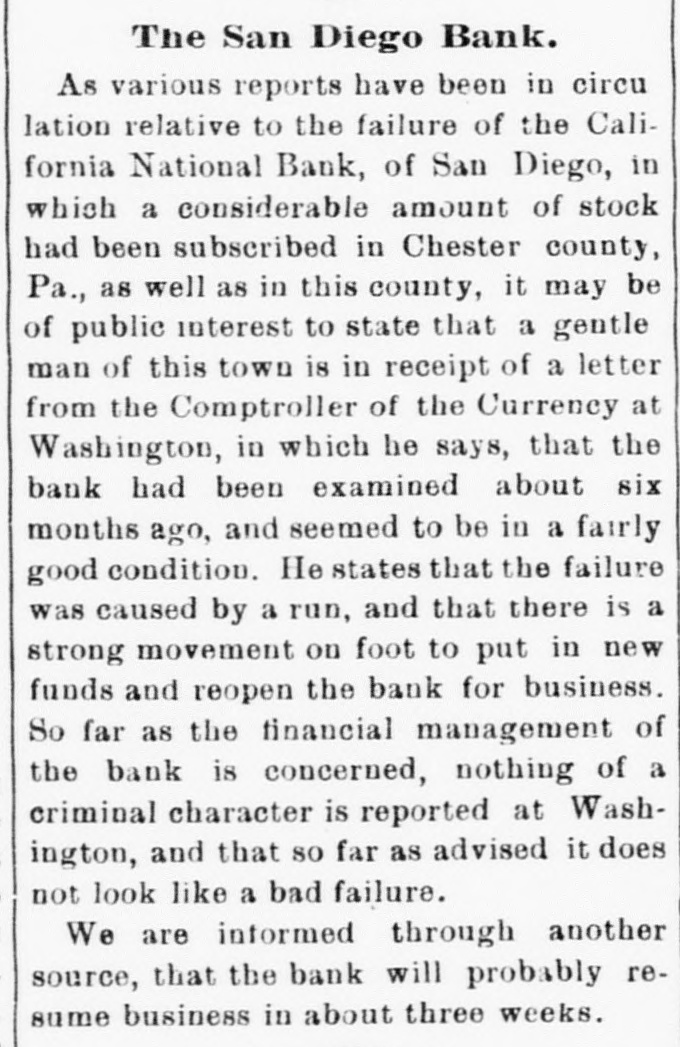
The San Diego Bank

As various reports have been in circu lation relative to the failure of the California National Bank, of San Diego, in which a considerable amount of stock had been subscribed in Chester county, Pa., as well as in this county, it may be of public interest to state that a gentle man of this town is in receipt of a letter from the Comptroller of the Currency at Washington, in which he says, that the bank had been examined about six months ago, and seemed to be in a fairly good condition. He states that the failure was caused by a run, and that there is a strong movement on foot to put in new funds and reopen the bank for business. So far as the financial management of the bank is concerned, nothing of a criminal character is reported at Washington, and that so far as advised it does not look like a bad failure. We are informed through another source, that the bank will probably resume business in about three weeks.


Article from The Salt Lake Herald, December 17, 1891

Click image to open full size in new tab

Article Text

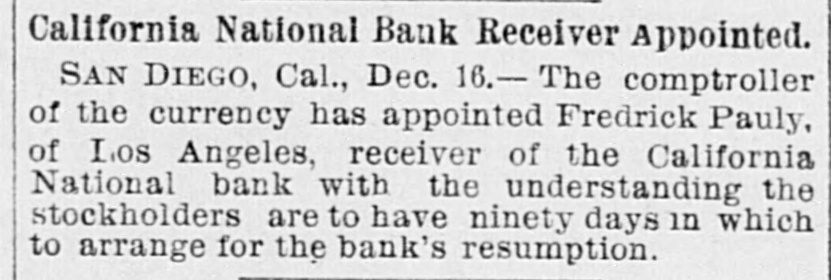
California National Bank Receiver Appointed

SAN DIEGO, Cal., Dec. 16.- The comptroller of the currency has appointed Fredrick Pauly, of Los Angeles, receiver of the California National bank with the understanding the stockholders are to have ninety days in which to arrange for the bank's resumption.


Article from St. Paul Daily Globe, February 15, 1892

Click image to open full size in new tab

Article Text

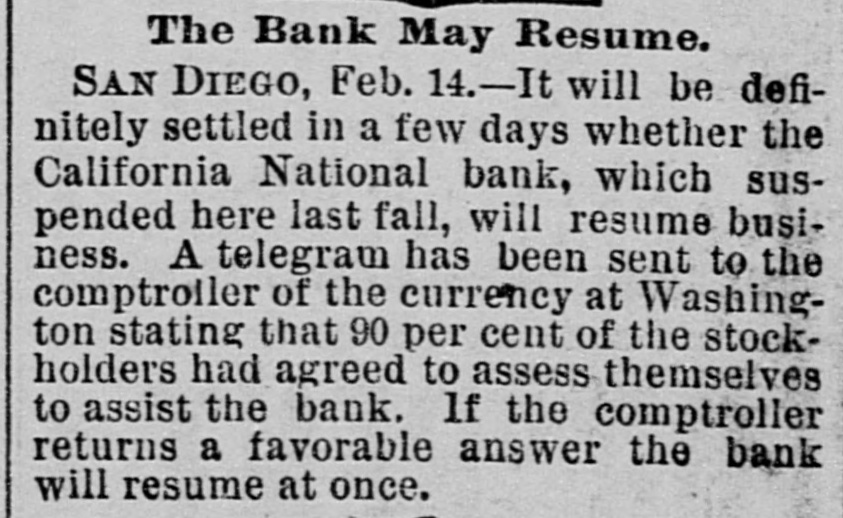
The Bank May Resume

SAN DIEGO, Feb. 14.-It will be definitely settled in a few days whether the California National bank, which suspended here last fall, will resume business. A telegram has been sent to the comptroiler of the currency at Washington stating that 90 per cent of the stockholders had agreed to assess themselves to assist the bank. If the comptroller returns a favorable answer the bank will resume at once.


Article from Wood County Reporter, February 18, 1892

Click image to open full size in new tab

Article Text

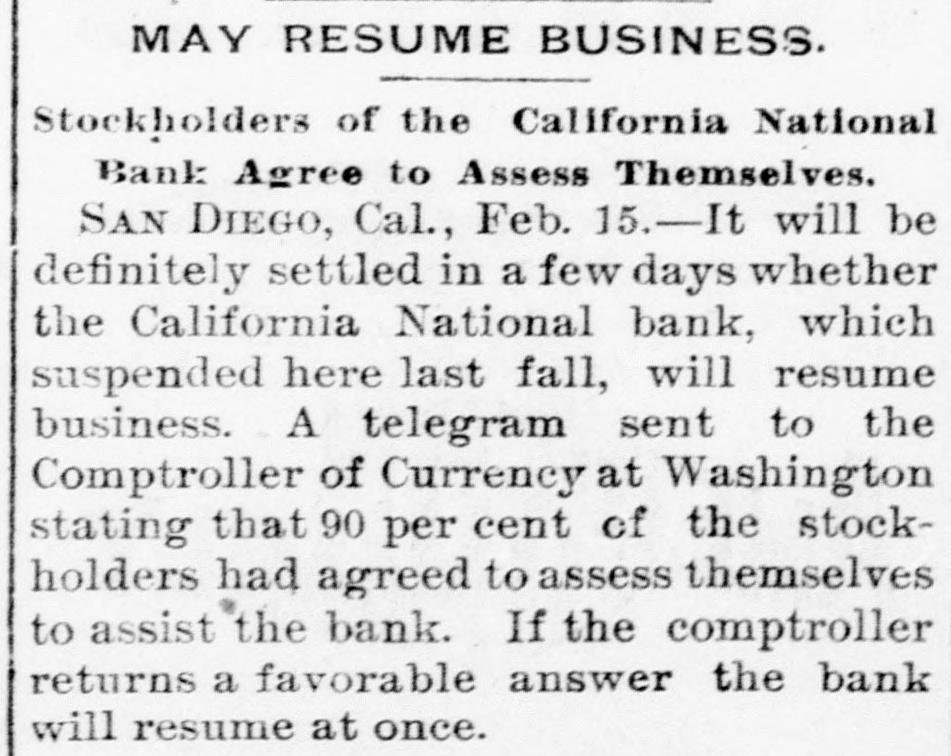
MAY RESUME BUSINESS

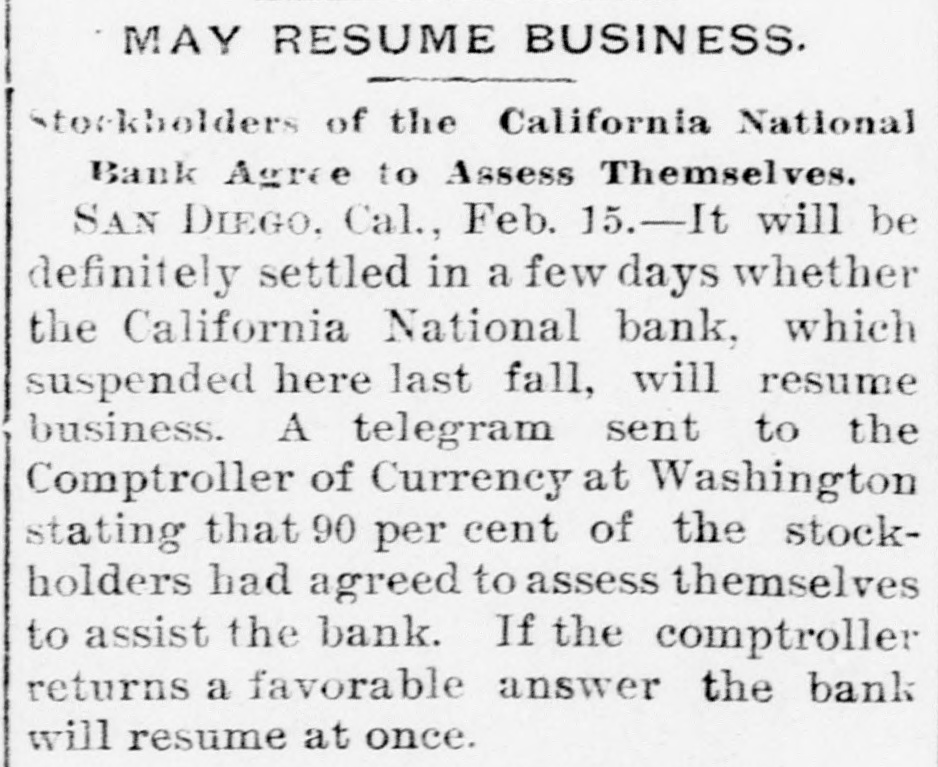
Stockholders of the California National Bank Agree to Assess Themselves. SAN DIEGO. Cal., Feb. 15.-It will be definitely settled in a few days whether the California National bank, which suspended here last fall, will resume business. A telegram sent to the Comptroller of Currency at Washington stating that 90 per cent of the stockholders had agreed to assess themselves to assist the bank. If the comptroller returns a favorable answer the bank will resume at once.


Article from Iowa County Democrat, February 19, 1892

Click image to open full size in new tab

Article Text

MAY RESUME BUSINESS

Stockholders of the California National Bank Agree to Assess Themselves. SAN DIEGO, Cal., Feb. 15.-It will be definitely settled in a few days whether the California National bank, which suspended here last fall, will resume business. A telegram sent to the Comptroller of Currency at Washington stating that 90 per cent of the stockholders had agreed to assess themselves to assist the bank. If the comptroller returns a favorable answer the bank will resume at once.


Article from The Sun, February 25, 1892

Click image to open full size in new tab

Article Text

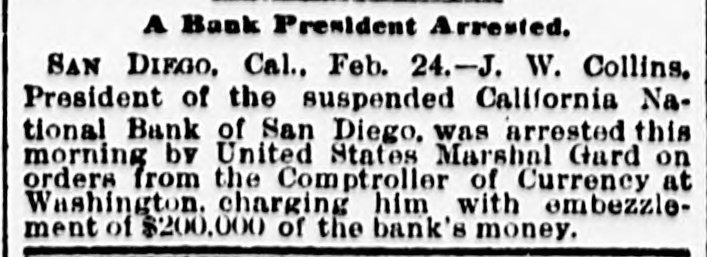
A Bank President Arrested

SAN DIFGO, Cal., Feb. 24.-J. W. Collins. President of the suspended California National Bank of San Diego. was arrested this morning by United States Marshal Gard on orders from the Comptroller of Currency at Washington. charging him with embezzlement of $200,000 of the bank's money.


Article from Los Angeles Herald, February 26, 1892

Click image to open full size in new tab

Article Text

FOLLY AND A MELANCHOLY STORY GUILT

OF FINANCIAL visit of Bank Examiner action Cham- of The to San Diego, and the arrest of President berlain Receiver Pauly Collins, in causing of the defunct the city, Cali- has fornia National bank of that loose syscalled attention anew to the possible financiering which made Quite tem of to this catastrophe. came and led up of years ago Mr. Collins number Cheyenne to the city of had on from He appears to have to climate. and desired a with him, Bay'n' in $40,- our go 000 banking business southern into the neighbor. Everything He had was inpropitious for manners; his project. and was quite fanning, cagratiating pable of participating in, and the enthusiasm of San Diegans. seems to have been invited recommended His plan by its simplicity. He them, by paying interest conservative upon deposits a procedure which the more a result, he failed to imitate. As banks succeeded in hornswoggling $700,000 classes of had surplus earnings of all those of the of the ranging from those of servant San Diegans, girl and newsboy up that to after 3 the merchant. day It on is said which the failure of o'clock of the was announced a deposit of the of $2500 the was bank received from the chief It is even 5 department of San Diego. taken up to fire that deposits were closed. In added on the day the bank individual deo'clock to the losses of had addition the city of San moribund Diego instipositors, deposited in the $30,000 and the county $60,000. tution, of the $700,000 due other depositors, liabilOutside that there were When it is alleged the amount of $300,000. there were ities to closed it is said that circumthe bank in its vaults. Under the showing $15,000 this was a pretty good into the stances, all the facts were taken since inwhen Receiver Pauly has and count. creased this sum to between $50,000 $60,000. investigation. as far as peculiar it has The has ehown some very to be gone, There is paid which a things. of about $300,000 Collins is deficit referable to Messrs. Owing to the faulty system segand of bookkeeping Dare. it is impossible whole system to this account. The unforregate conducting the affairs of this on the of bank seems to have run tunate of Danton's,celebrated apostrophe, Dare." lines "To to Dare, always to Dare, our system of bank examiners to is What commissioners amounts bank. and bank by the career of this of the well shown the disclosures in It supplements bank of Philadelphia, holy, Keystone Postmaster Wanamaker, officiated. of which and immortal memory, find out pious rule, these able gentlemen been done. As a mischief after it has for the supposed to be invented public, They are of protecting the they are the purpose keeping the banks, which plane of appointed and to supervise, on the matter of and stable finance. As a till the fact, safe they are never done. heard from mischief has been collapse of the California reminds Naone The bank of San Diego the tional of the celebrated bank failure of of this Temple & 1875. Workman In that disastrous city, in cataclysm about $1,200,000 was the financial up. The failure in swallowed & Workman was California precipitated in of Temple of the Bank of propby that 1875. If it had been & September, handled, the Messre. Temple to have Workman erly had :ample property of their liatwice over every cent financially paid But the times were every bilities. joint. Dietrust existed on spreadout of the black financial cloud the hand, from San Francisco all over dissiing and a princely estate was much as coast, pated without the return of so a dollar to the depositors. a then Los Angeles which they bankers have never learned since experi- forlesson As a result of our past larger gotten. our banks today contain a than, ences of coin to the deposits States. proportion any other in the United for almost, ordeal was enough for a One such of a century. Fortunately quarter of our financial institutions, anticipated the stability banks of Los Angeles ehortenthe "bursting of the boom" by have the and what would otherwise safety. ing been sail, a storm, was ridden out in


Article from The Morning Call, February 28, 1892

Click image to open full size in new tab

Article Text

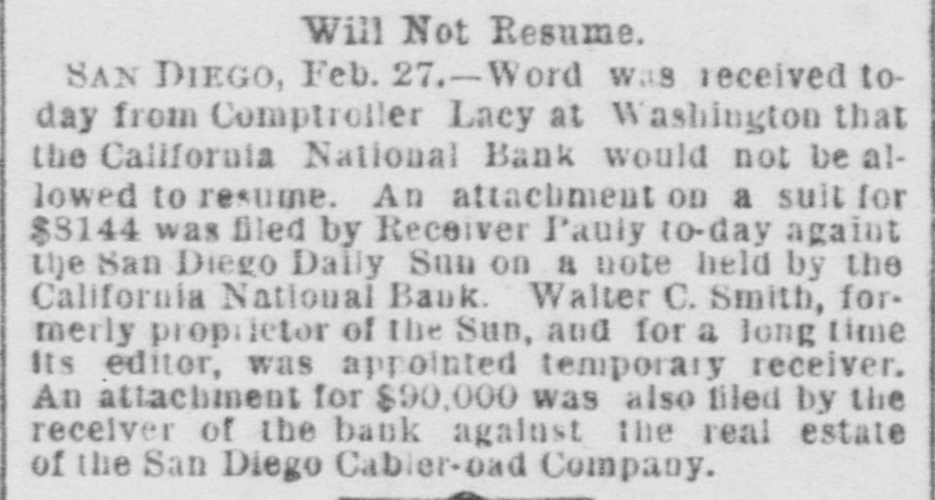
Will Not Resume

SAN DIEGO, Feb. 27.-Word Was received today from Comptroller Lacy at Washington that the California National Bank would not be allowed to resume. An attachment on a suit for $8144 was filed by Receiver Pauly to-day againt tije San Diego Daily Sun on a note held by the California National Bank. Walter C. Smith, formerly proprietor of the Sun, and for a long time Its editor, was appointed temporary receiver. An attachment for $90,000 was also filed by the receiver of the bank against the real estate of the San Diego Cabler-oad Company.


Article from Los Angeles Herald, March 2, 1892

Click image to open full size in new tab

Article Text

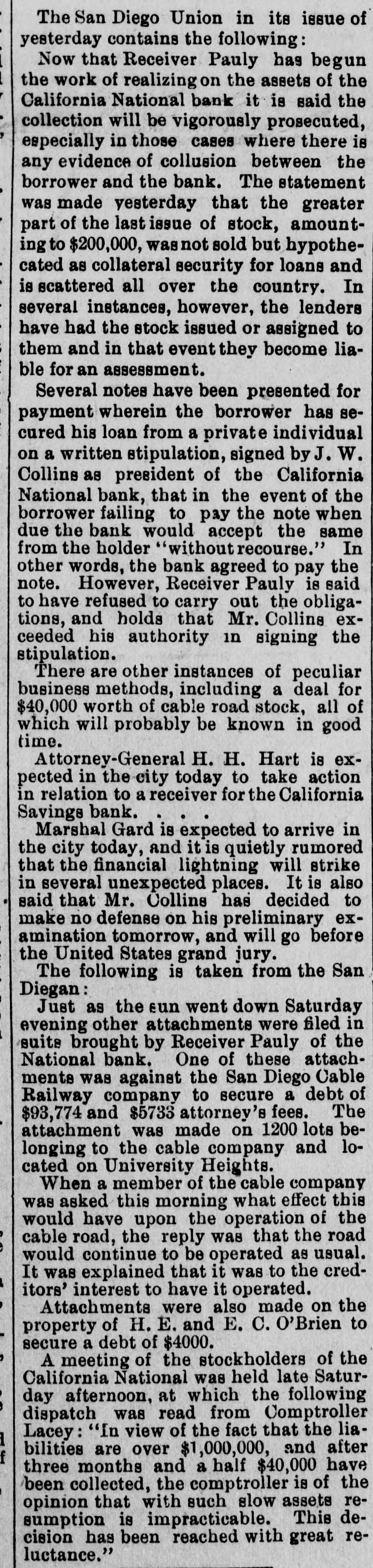
The San Diego Union in its issue of yesterday contains the following: Now that Receiver Pauly has begun the work of realizing on the assets of the California National bank it is said the collection will be vigorously prosecuted, especially in those cases where there is any evidence of collusion between the borrower and the bank. The statement was made yesterday that the greater part of the last issue of stock, amounting to $200,000, was not sold but hypothecated as collateral security for loans and is scattered all over the country. In several instances, however, the lenders have had the stock issued or assigned to them and in that event they become liable for an assessment. Several notes have been presented for payment wherein the borrower has secured his loan from a private individual on a written stipulation, signed by J. W. Collins as president of the California National bank, that in the event of the borrower failing to pay the note when due the bank would accept the same from the holder "withoutrecourse." In other words, the bank agreed to pay the note. However, Receiver Pauly is said to have refused to carry out the obligations, and holds that Mr. Collins exceeded his authority in signing the stipulation. There are other instances of peculiar business methods, including a deal for $40,000 worth of cable road stock, all of which will probably be known in good time. Attorney-General H. H. Hart is expected in the city today to take action in relation to a receiver for the California Savings bank. Marshal Gard is expected to arrive in the city today, and it is quietly rumored that the financial lightning will strike in several unexpected places. It is also said that Mr. Collins has decided to make no defense on his preliminary examination tomorrow, and will go before the United States grand jury. The following is taken from the San Diegan: Just as the eun went down Saturday evening other attachments were filed in suite brought by Receiver Pauly of the National bank. One of these attachments was against the San Diego Cable Railway company to secure a debt of $93,774 and $5733 attorney's fees. The attachment was made on 1200 lots belonging to the cable company and located on University Heights. When a member of the cable company was asked this morning what effect this would have upon the operation of the cable road, the reply was that the road would continue to be operated as usual. It was explained that it was to the creditors' interest to have it operated. Attachments were also made on the property of H. E. and E. C. O'Brien to secure a debt of $4000. A meeting of the stockholders of the California National was held late Saturday afternoon, at which the following dispatch was read from Comptroller Lacey: "In view of the fact that the liabilities are over $1,000,000, and after three months and a half $40,000 have been collected, the comptroller is of the opinion that with such slow assets resumption is impracticable. This decision has been reached with great reluctance."


Article from The Cheyenne Daily Leader, March 4, 1892

Click image to open full size in new tab

Article Text

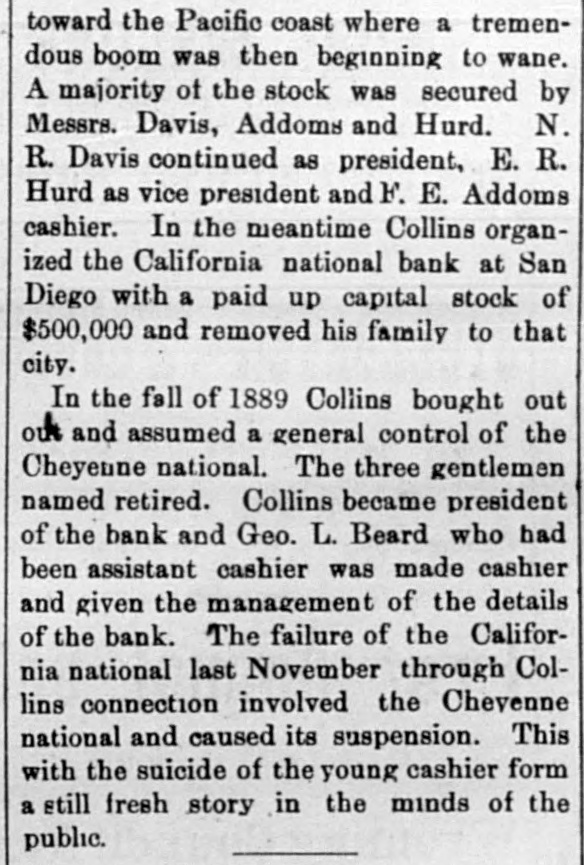
toward the Pacific coast where a tremendous boom was then beginning to wane. A majority of the stock was secured by Messrs. Davis, Addoms and Hurd. N. R. Davis continued as president, E. R. Hurd as vice president and F. E. Addoms cashier. In the meantime Collins organized the California national bank at San Diego with a paid up capital stock of $500,000 and removed his family to that city. In the fall of 1889 Collins bought out out and assumed a general control of the Cheyenne national. The three gentlemen named retired. Collins became president of the bank and Geo. L. Beard who had been assistant cashier was made cashier and given the management of the details of the bank. The failure of the California national last November through Collins connection involved the Chevenne national and caused its suspension. This with the suicide of the young cashier form a still fresh story in the minds of the public.


Article from Barton County Democrat, March 10, 1892

Click image to open full size in new tab

Article Text

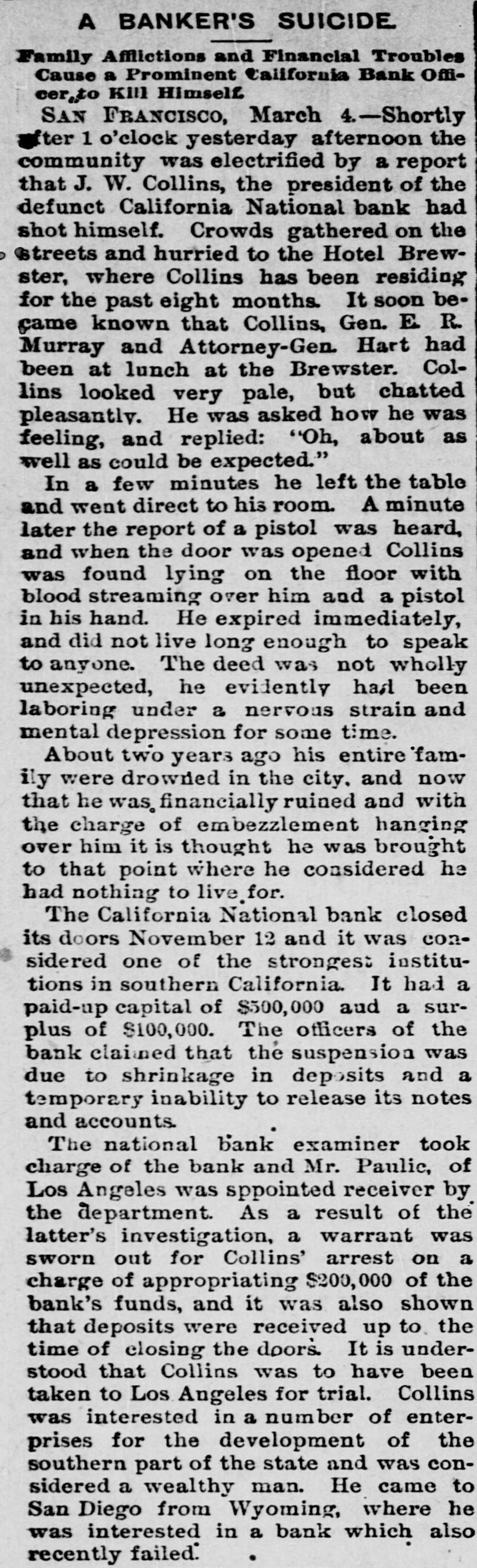
A BANKER'S SUICIDE

Family Afflictions and Financial Troubles Cause a Prominent California Bank Officer, to Kill Himself

SAN FRANCISCO, March 4.-Shortly after 1 o'clock yesterday afternoon the community was electrified by a report that J. W. Collins, the president of the defunct California National bank had shot himself. Crowds gathered on the streets and hurried to the Hotel Brewster, where Collins has been residing for the past eight months. It soon became known that Collins, Gen. E R. Murray and Attorney-Gen. Hart had been at lunch at the Brewster. Collins looked very pale, but chatted pleasantly. He was asked how he was feeling, and replied: "Oh, about as well as could be expected."

In a few minutes he left the table and went direct to his room. A minute later the report of a pistol was heard, and when the door was opened Collins was found lying on the floor with blood streaming over him and a pistol in his hand. He expired immediately, and did not live long enough to speak to anyone. The deed was not wholly unexpected, he evidently had been laboring under a nervous strain and mental depression for some time.

About two years ago his entire family were drowned in the city, and now that he was, financially ruined and with the charge of embezzlement hanging over him it is thought he was brought to that point where he considered he had nothing to live for.

The California National bank closed its doors November 12 and it was considered one of the strongest institutions in southern California. It had a paid-up capital of $500,000 and a surplus of $100,000. The officers of the bank claimed that the suspension was due to shrinkage in deposits and a temporary inability to release its notes and accounts.

The national bank examiner took charge of the bank and Mr. Paulic, of Los Angeles was appointed receiver by the department. As a result of the latter's investigation, a warrant was sworn out for Collins' arrest on a charge of appropriating $200,000 of the bank's funds, and it was also shown that deposits were received up to the time of closing the doors. It is understood that Collins was to have been taken to Los Angeles for trial. Collins was interested in a number of enterprises for the development of the southern part of the state and was considered a wealthy man. He came to San Diego from Wyoming, where he was interested in a bank which also recently failed.


Article from Arizona Weekly Citizen, March 12, 1892

Click image to open full size in new tab

Article Text

near Manoney City this morning Tatally burned five men. ORLEANS, March 4.-Philip NEW and Bud Renaud have signed ticles Dwyer for a fight between Choyinski Corbett, for a 32,500 purse. SANTA ANA, March 4. A man was dead near bridge 65 on the Santa all found San Jaan Capistrano, with he his Fe near limbs gone. No clew as to how was killed. NEW HAVEN, March 4. Noah Porter, and president of Yale college, formerly of moral philosophy and 80 years met. old. professor aphysics, died this morning, WASHINGTON, March 1. The been steamer ornow at Callao has with Yorkton, dered to proceed to San Francisco stopping en at the route as little delay principal as possible, ports of Central America and Mexico. WASHINGTON. March 4. Springer night. rest and passed a good improved ed His quietly condition is somewhat morning. this !which has been afThe erysipelas his brain is rapidly subsiding fecting menace to the patient's lif which and the lies only in the great prostration malady. resulted now from ravages of the March 4. Since the disturb- the unof last week in this city, have employed ances BERLIN, workmen been in 8 throughout state of cause foment, Ger- an many will require but little to Dantworkthat the open which states outbreak. A despatch unemployed from them ZIC usable to get work promised pillaged men, government today, bread and a by baker the shop and seized the meal. WASHINGTON, March 4 House committee on appropriations and it reported was referred the invalid pension bill, of the whole. The of to a committee went into a committee laid the whole on honse then the private calendar. president In the senate senate the communi vice inication from to before the of the interior, relating referred Yosemite the secretary park, in California; lands. committee on public N. M., March 3. Boyle of ALBUQUERQUE, Pitisburg, for left his here home. yesterday His on safety bicycle will take him to Los Utah; Anperiginations Lake City and Ogden, Cliff, Colo.; geles, Salt and Red Leadville. Grand Junction Tennessee pass to river across will the go down the Arkansas Buena Vista, He leaving Leadville, to to Colorado after and down by thence Pike's north Peak to Denver. He Springs, crose and the Missouri at to St. Burling- Joseph, to thence the by will Mo., and will go Chicago. northeast At Columbus, Keystone Ohio ton, he club will of be Pittsburg met and of they the way will Bicycle him the remainder be travaccompany Pittsburg. The distance miles. to eled to is a little over 5000 Hamp the TAMPICO, Mex., March who 3.-J. has charge H. of has son, the contractor work of the harbor by the this city, Mex line the ican jetty been government given the railroad. for contract the completion The proposed Coat- of Pacific oceans. ZO the Coal Tehuate runs Co., from connecting the Atlantic to and minutes SAN 1 DIEGO, o'clock March this afternoon 3.-A by few the the report com deafter electrified of the was Collins, president the munity funct that J. California W gathered national on bank, Brewster street shot where himself. Crowds Hotel the and hurried Collins to had the been residing past eight months. DIEGO, March 4 The president coroner's of verdict SAN in the case National of Collins,.. bank discovered returned his jury the California suicide. It is insurance, that Collins for the assigned benefit of the last creditors of dollar's $85,000 was the over. his bank. of property This be had to turn -The worth CITY, Mo., March Kansas, KANSAS from Topeka, entered John J. and from now says: the arena, in the of his voice made his actively Journal's will special be Ingalls heard has again really councils first on In a public his for party. appearance nearly He a year league tonight of after republican speech seclu- tosion republican. for he said he not a but United at States clubs night before present the was was still senate. a candidate Agent the LONDON, March 4. company -Special which Reuner telegraphe distress the in Vienna and houses, inquiring points out into a terrible the in picture that city. of destitu splen- There which prevails whose did are tion many exteriors give be no says, suspicions Cellars in of such their crowded miserable interiors. affirms are found work and houses starving he persons out pittance. of unwith earning only a mere and exist fear is a total others dreds daily are unable of eviction. to pay rent But in absence spite of all this among the secretary of 10 evidence misery of March vice there 4. The presence sufferers. of the in LONDON, Foster, acting at London of treasury, is and social States journalistic accep United tention from He steadily the refuses groun to of poor all health. reception social worlde. inv itations on ready access in to the He gives rooms who here, to the the people enhotel, comers customed and amazes to seeing officialism, Foster wall of inspect the bank the vironed by a visit to and see has arranged and the mint financial house. unconof England of the great of being he has working of assurances question unofficial probably cerned In spite in met the currency Goschen in an interview. 4.-A Washington to CHICAGO, March the senators have opposed to decided special says of Harrison Secretary Blaine, his choice to use the for selected health renomination.co. permitting, says of they second Iowa delega- J. S The papers and asserts the the state conven- vote -Clarkecn selected at instructed to for choice. tion will tion, tion Blaine March be first 29, will with be Clarkson as second
Article from Los Angeles Herald, March 18, 1892

Click image to open full size in new tab

Article Text

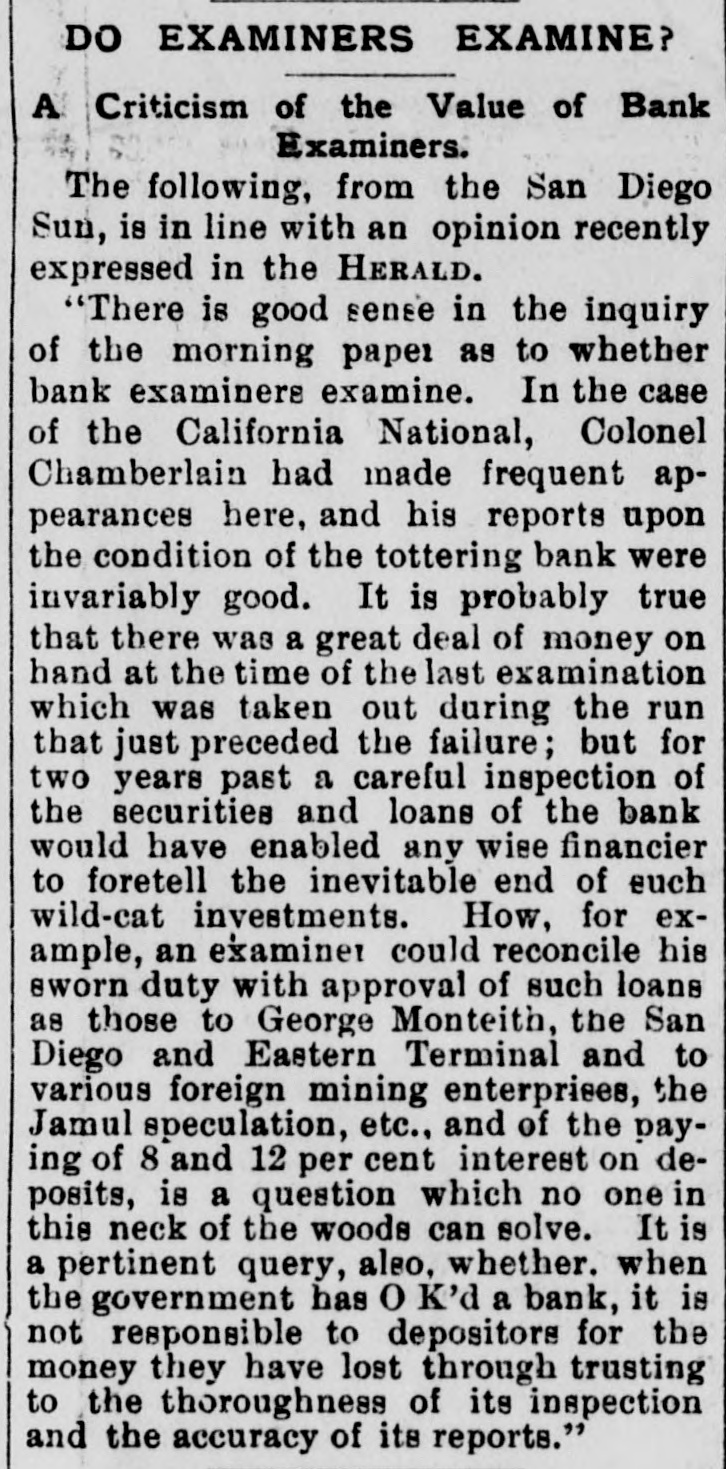
DO EXAMINERS EXAMINE? A Criticism of the Value of Bank Examiners. The following, from the San Diego Sun, is in line with an opinion recently expressed in the HERALD. "There is good sense in the inquiry of the morning paper as to whether bank examiners examine. In the case of the California National, Colonel Chamberlain had made frequent appearances here, and his reports upon the condition of the tottering bank were invariably good. It is probably true that there was a great deal of money on hand at the time of the last examination which was taken out during the run that just preceded the failure; but for two years past a careful inspection of the securities and loans of the bank would have enabled any wise financier to foretell the inevitable end of euch wild-cat investments. How, for example, an examiner could reconcile his sworn duty with approval of such loans as those to George Monteith, the San Diego and Eastern Terminal and to various foreign mining enterpriees, the Jamul speculation, etc., and of the paying of 8 and 12 per cent interest on deposits, is a question which no one in this neck of the woods can solve. It is a pertinent query, aleo, whether. when the government has o K'd a bank, it is not responsible to depositors for the money they have lost through trusting to the thoroughness of its inspection and the accuracy of its reports."


Article from Los Angeles Herald, October 19, 1892

Click image to open full size in new tab

Article Text

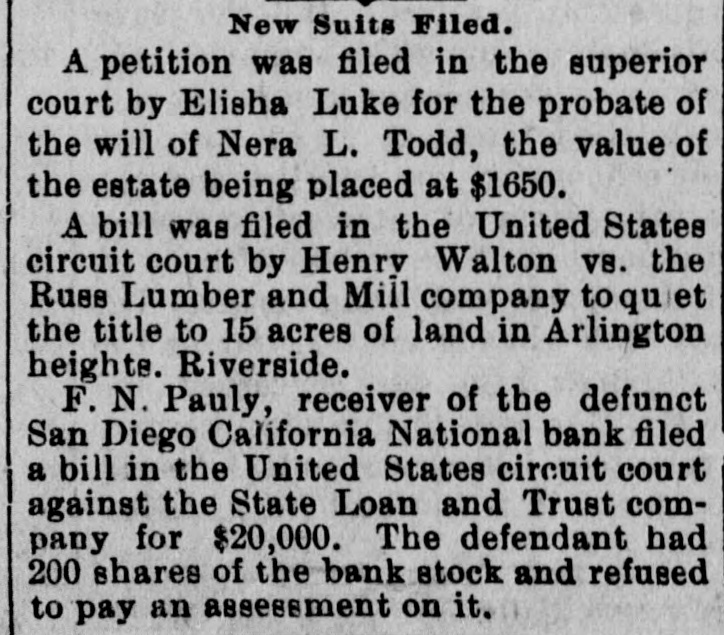
New Suits Filed

A petition was filed in the superior court by Elisha Luke for the probate of the will of Nera L. Todd, the value of the estate being placed at $1650. A bill was filed in the United States circuit court by Henry Walton VS. the Russ Lumber and Mill company to quiet the title to 15 acres of land in Arlington heights. Riverside. F. N. Pauly, receiver of the defunct San Diego California National bank filed a bill in the United States circuit court against the State Loan and Trust company for $20,000. The defendant had 200 shares of the bank stock and refused to pay an assessment on it.


Article from Los Angeles Herald, November 4, 1892

Click image to open full size in new tab

Article Text

Court Notes

The sentence of Robert Black, convicted of burglary, was yesterday continued by Judge Smith to November 5th. Judge Van Dyke granted Mrs. Fannie Killebrow of San Pedro a divorce from her husband, J. J. Killebrow, on the ground of desertion. In the foreclosure suit of C. D. Seamans VS. F. H. Barclay et al. Judge Van Dyke granted judgment for plaintiff for $1469 91, and that any surplus from sale of property should be paid into court to apply on a judgment heretofore entered in favor of J. M. Elliott for $18,706 20. In the case of Van Sciever VS. A. K. Moropolus, Judge Van Dyke, acting for Judge Shaw, upon a proper showing directed $100 in the possession of the court to be paid to C. C. Stephens, attorney for Moropolus. In the case of Merril vs. Merrill, Judge Wade granted the defendant leave to amend his cross complaint, upon the terms that he pay the costs of the hearing and of the continuance of filing the amended cross complaint. The cause was then continued to November 9th. In Judge McKinley's court the case of Peter Allen vs. the Royal Exchange Assurance company, to compel the payment of $4500 insurance, was up for argument, but the plaintiff moved for a voluntary nonsuit, which was argued and granted, the case having been amicably arranged between the parties. Wong Ark, charged with the murder of Guet Gue, was before Judge McKinley yesterday morning without an attorney. The court offered to appoint one to conduct his defense on his new trial, but granted him until next Monday to secure counsel. The case of the people VS. Ah Fook et al. was tried before Judge Shaw yesterday and taken under advisement by him. Ah Fook was one of Ah Tet's bondsmen, who was tried/for perjury. The jury disagreed and the court allowed him to be released on the old bond. Ah Tet ran away and the county is now suing to recover from the bondsmen the amount of the forfeited bond, $1500. The bondsmen claim that when Ah Tet was tried his first bond was exonerated and that they are not liable. The euit of the First National bank vs. E. D. Rice et al, was on trial before Judge Clark yesterday afternoon. It is an action unon a promissory note, The Case of J. N. Pauly, receiver of the California National bank of San Diego, vs. The Coronado Beach company, upon bank stock, was tried and submitted before Judge Ross in the United States circuit court. Six jurore were obtained, in the sec ond trial of William Murphy, yesterday afternoon in the United States district court, and the trial will be resumed this morning. The defendant 18 accused of passing counterfeit eilver dollars.


Article from Los Angeles Herald, November 30, 1892

Click image to open full size in new tab

Article Text

Judgment for Defendant

The case of the California Mortgage, Loan and Trust company VS. the California National Bank of San Diego was tried before Judge Ross yesterday in the United States circuit court. It was a suit brought to recover judgment for a certificate of deposit of $19,000 against the defunct bank. August 11, 1891, E. J. Swayne, manager of the plaintiff company claims he deposited the $19,000 in the California National, taking therefor a certificate of deposit signed by Cashier G. N. O'Brien. Receiver Pauly claimed that no money was deposited at all ; that President Collins and Mr. Dare had given the plaintiff company two notes, and in payment gave the certificate in question, He claimed that it was not the act of the bank, and that it was not responsible. The plaintiff was represented by A. Haines and A. E. Mitt of San Diego, and Receiver Pauly by M. T. Allen. The case was submitted late in the afternoon, and Judge Ross rendered judgment in favor of the defendant.


Article from Los Angeles Herald, January 4, 1893

Click image to open full size in new tab

Article Text

United States Courts.

Two new complaints were filed in the United States circuit court yesterday, both suits brought by Receiver Frederick K. Pauly of the California National bank of San Diego. The first one was against R. A. and Miriam Graham, upon a promisory note for $1040, and the second against R. A. Graham upon eleven notes for various sums, aggregating $35,590 26.

In the United States district court, Jose Sylvas pleaded not guilty to the charge of selling liquor to Indians.


Article from The State Herald, May 12, 1893

Click image to open full size in new tab

Article Text

Wyoming

Theft of a novel nature has landed Ed Dolan, n tramp, In the county jall at Rawlins. Dolan stole the telephone from the office of Judge Homer Merrell. Dolan says he did t not know the nature or value of the instrument, but thought It would sell for something. Governor Osborne hits Issued a proclamation offering a reward of $250 for the apprehension of Charles T. Gale, the defaulting city treasurer at Laramie. This is in addition to the 8500 posted by his bondsmen. Gale handled $80,000 while In office a year and was short $12,000. Pictures and descriptions have been scattered broadcast. A third dividend has been declared by the receiver of the Cheyenne National Bank. It brings the total of payment up to 50 cents on the dollar. and the creditors confidently expect to get 25 cents more. The bank failed for $300,000 eighteen months ago.going down with the California National Bank of San Diego. J. W. Collins was president of both. Sandobal and Martinez, the Mexicans who killed Jim Calboun, the foreman of one of Governor Osborne's sheep outfits, have been discharged by the coroner's jury. The AmerIcan and the Mexicans had quarreled over cards. Calhoun had threatened to kill the foreigners. They armed themselves, but meeting Calhoun, announced that they were merely on the defensive. They warned him to keep peace. Calhoun drew his six-shooter slowly. When the weapon was within an inch of being out of Its scabbard the Mexicans opened fire. All three pistols were emptied. The men continued shooting after they were down. There were nine wounds in Calhoun's body. One of the Mexicans received three bullets and the other four. but their hurts were not dangerous. All of Calhoun's wounds were above the walst.


Article from The Herald, February 1, 1896

Click image to open full size in new tab

Article Text

SAN DIEGO CABLE RAILWAY Something of the Sale Which Will Take Place March 11 The San Diego cable railway will be sold at the power house of the company in the city of San Diego at 2 p. m. on Wednesday, March 11, to the highest bidder. The property consists of the franchise, roadway and all the real and personal property of the company. The roadway is single track with ten turnouts and two squares of double track. It is cable construction, laid in concrete to a depth of thirty inches; the yokes are heavy cast iron, and nothing but iron, steel and concrete has been used in constructing it. The conduit is two feet deep and can be utilized for conveying the electric current, although the right is reserved in the franchise to use either the overhead or underground system; the track between the rails is paved with asphalt. The cost of the roadway as constructed was over $200.000. The power and car house is located midway on the line of the road and is a large, substantial two-story brick building 100x 200 feet, and has more than sufficient capacity for the machinery and rolling stock of the company. The large frame building adjoining the power house and located 100 feet south of it is the four-story dwelling, containing thirty-two rooms. The lot on which the power house and dwelling house are located is 300 feet front by 200 feet deep, covering a full block. The machinery consists of two Corliss four each: pump, ers. engines, 100 horse-power 400 horse-power; complete flue heater, and boil- in piping and shafting, all perfect condition. The equipment consists of ten large combination cars, twentyfive feet in length, and four large open cars. There is a surplus of 200 horse-power which can be utilized for light and power, and there is a good demand for both. The company was organized in 1889 by the officers of the California National bank and was built and equipped at a cost of $350,000. It began operating in June, 1890. The bank failed in October, 1891. when the road went into the hands of a receiver and was operated until October, 1892. During the time it was in operation the earnings were sufficient to have paid 3 per cent on its investment. provided the perating expenses could have been kept to as low a figure as the road can be operated at this time with an electrical equipment. It was an error to construct a cable road in a city the size of San Diego. Coal was then selling at $8 per ton. This was the great cost of the cable, its wear and tear and the wear and tear of the pulleys, and the cost of maintaining same, made the expense of the motive power nearly equal to the gross receipts of the road. The franchise has yet seventeen years to run. The present owner of the San Diego Cable railway is George B. Kerper, who purchased the property a little less than a year ago. Mr. Kerper came to Southern California from Cincinnati to negotiate the purchase of the Main Street and Agricultural Park railway in this city and to look into the feasibility of purchasing and consolidating the interests of the Redondo railroad with the Main street system and electricising the whole, but which ambitious plan fell through.