3822. Fidelity Savings Bank (Chicago, IL)

Bank Information

Episode Type
Run β†’ Suspension β†’ Closure
Bank Type
savings bank
Start Date
August 31, 1877
Location
Chicago, Illinois (41.850, -87.650)

Metadata

Model
gpt-5-mini
Short Digest
e76ada3eaed8acdb

Response Measures

None

Description

Newspaper accounts show a depositor run Aug 31–Sep 2, 1877, followed weeks later by the bank closing Sept 24, 1877 with a petition for a receiver and appointment of a receiver Sept 25, 1877. Cause of the run is linked to loss of confidence after the failure of the State Savings Bank; the suspension/closure was by court action (receiver) for insolvency. OCR spelling quirks corrected (e.g., Haines for Haines/Mr. Haines).

Events (4)

1. August 31, 1877 Run
Cause
Local Banks
Cause Details
Run began after failure/panic at the State Savings Bank and depositors lost confidence; spillover panic produced heavy withdrawals.
Measures
Paid out deposits to those who came; officers 'doled out small sums' and applied the 10%/time rules; President Haines pledged private property and directors sought liquidity measures.
Newspaper Excerpt
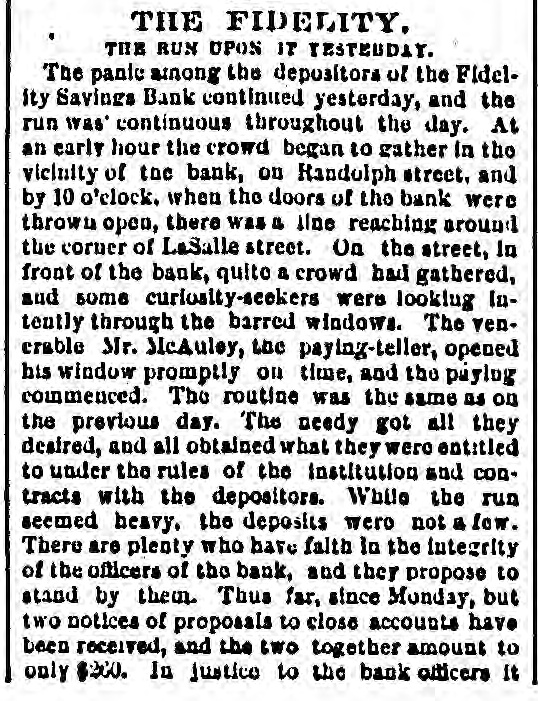
THE FIDELITY, THE RUN UPON IT YESTERDAY. The panic among the depositors of the Fidelity Savings Bank continued yesterday, and the run was continuous throughout the day.
Source
newspapers
2. September 1, 1877 Run
Cause
Local Banks
Cause Details
Continued depositor withdrawals driven by prior bank failures and diminished confidence; management attempted assurances and pledged private assets.
Measures
Reduced payouts to scheduled amounts; directors pledged private property; encouraged committee inspection and sought convertible securities.
Newspaper Excerpt
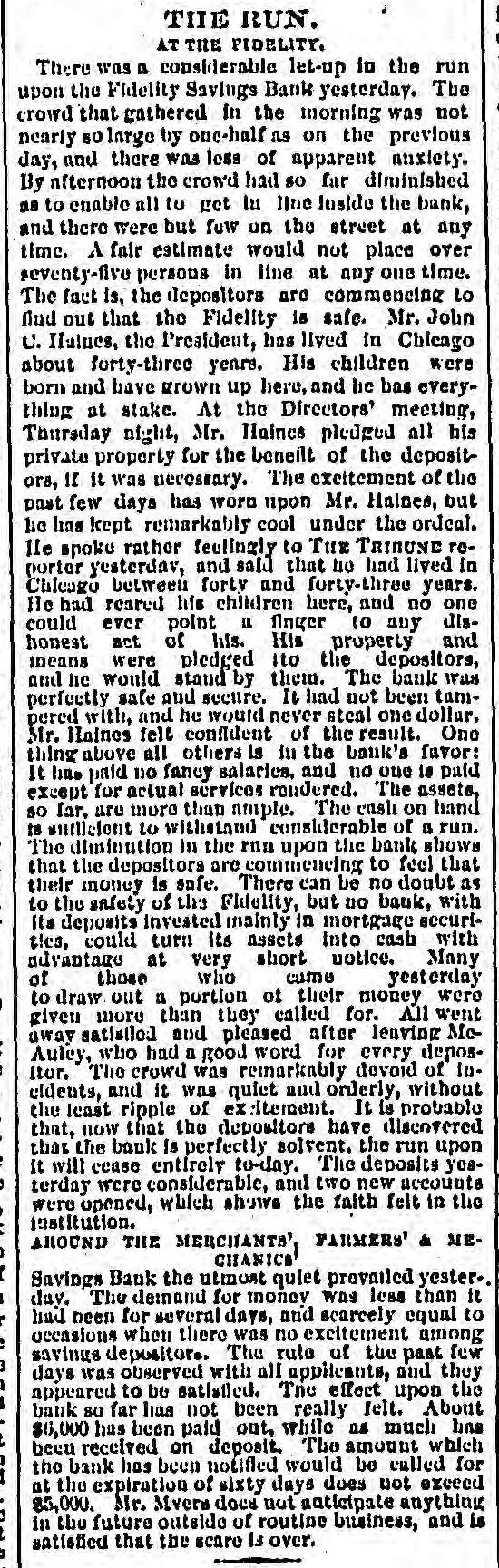
There was a considerable let-up in the run upon the Fidelity Savings Bank yesterday... Mr. Haines pledged all his private property for the benefit of the depositors, if it was necessary.
Source
newspapers
3. September 24, 1877 Suspension
Cause
Government Action
Cause Details
Bank closed after notice that a petition for a receiver would be filed; petition alleges officers sacrificed securities to obtain cash and that bank was insolvent.
Newspaper Excerpt
Early callers at the Fidelity Savings bank this morning found its doors closed and a hastily penned card thereon informing depositors that a petition for a receiver would be filed in the Superior court to-day, and that the bank would remain closed pending the decision of that question.
Source
newspapers
4. September 25, 1877 Receivership
Newspaper Excerpt
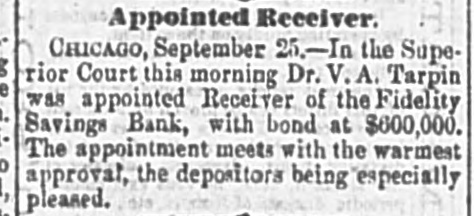
In the Superior Court this morning Dr. V.A. Turpin was appointed Receiver of the Fidelity Savings Bank, with bond at $600,000. The appointment meets with the warmest approval, the depositors being especially pleased. -
Source
newspapers

Newspaper Articles (20)

Article from Chicago Daily Tribune, August 31, 1877

Click image to open full size in new tab

Article Text

THE FIDELITY, THE RUN UPOS IT TESTEUDAY. The panic among the depositors of the Fidelity Savings Bank continued yesterday, and the run was' continuous throughout the day. At an early hour the crowd began to gather In the viciulty of the bank, on Randolph street, and by 10 o'clock. when the doors of the bank were thrown open, there was a line reaching around the corner of LaSalle street. On the street, In front of the bank, quite a crowd had gathered, and some curiosity-seekers were looking Intently through the barred windows. The venerable Mr. McAuley, the paying-teller, opened his window promptly on time, and the paying commenced. The routine was the same as on the previous day. The needy got all they desired, and all obtained what they were entitled to under the rules of the institution and contracts with the depositors. While the run seemed heavy. the deposits were not a few. There are plenty who have faith In the integrity of the officers of the bank, and they propose to stand by them. Thus far, since Monday, but two notices of proposals to close accounts have been received, and the two together amount to only $200. In justice to the bank officers it


Article from Chicago Daily Tribune, September 1, 1877

Click image to open full size in new tab

Article Text

THE RUN. AT THE FIDELITY. There was a considerable let-up in the run upon the Fidelity Savings Bank yesterday. The crowd that gathered in the morning was not nearly so large by one-half as on the previous day, and there was less of apparent anxiety. By afternoon the crowd had so far diminished as to enable all to get lu line Juside the bank, and there were but few on the street at any time. A fair estimate would not place over seventy-five persons in line at any one time. The fact is, the depositors are commencing to find out that the Fidelity is safe. Mr. John C. Halues, the President, has lived in Chicago about forty-three years. His children were born and have grown up here, and lie has everything at stake. At the Directors' meeting, Thursday night, Mr. Haines pledged all his private property for the benefit of the depositors, If it was necessary. The excitement of the past few days has worn upon Mr. Haines, but be has kept remarkably cool under the ordeal. lle spoke rather feelingly to THE TRINUND reporter yesterday, and sald that he had lived In Chicago between fortv and furty-three years. lle had reared his children here, and no one could ever point a finger to any dishonest act of his. His property and means were pledged ito the depositors, and he would stand by them. The bank was perfectly safe and secure. It had not been tampered with, and he would never steal one dollar. Mr. Haines felt confident of the result. One thing above all others is in the bank's favor: It has paid no fancy salaries, and no one is paid except for actual services rendered. The assets, so far, are more than ample. The cash on hand is sufficient to withstand considerable of a run. The diminution in the run upon the bank shows that the depositors are commencing to feel that their money is safe. There can be no doubt as to the safety of the Fldelity, but no bank, with Its deposits invested mainly in mortgage accurities, could turn its assets into cash with advantage at very short notice. Many of those who came yesterday to draw out a portion of their money were given more than they called for. All went away satisfied and pleased after leaving McAuley, who had a good word for every depositor, The crowd was remarkably devoid of lucidents, and it was quiet and orderly, without the least ripple of x itement. It is probable that, now that the depositors have discovered that the bank is perfectly solvent. the run upon it will cease entirely to-day. The deposits yesterday were considerable, and two new accounts were opened, which shows the faith felt in the institution. AROUND THE MERCHANTS', FARMERS' & MECHANICS Savings Bank the utmost quiet provailed yesterday. The demand for money was less than it had been for several days, and scarcely equal to occasions when there was no excitement among savings depositor. The rule of the past few days was observed with all applicants, and they appeared to be satisfied. The effect upon the bank so far has not been really felt. About $0,000 has been paid out, while as much line been received on deposit. The amount which the bank has been notified would be called for at the expiration of sixty days does not exceed $5,000. Mr. Mvers does uot anticipate anything in the future outside of routine business, and is satisfied that the scare is over.


Article from Chicago Daily Tribune, September 2, 1877

Click image to open full size in new tab

Article Text

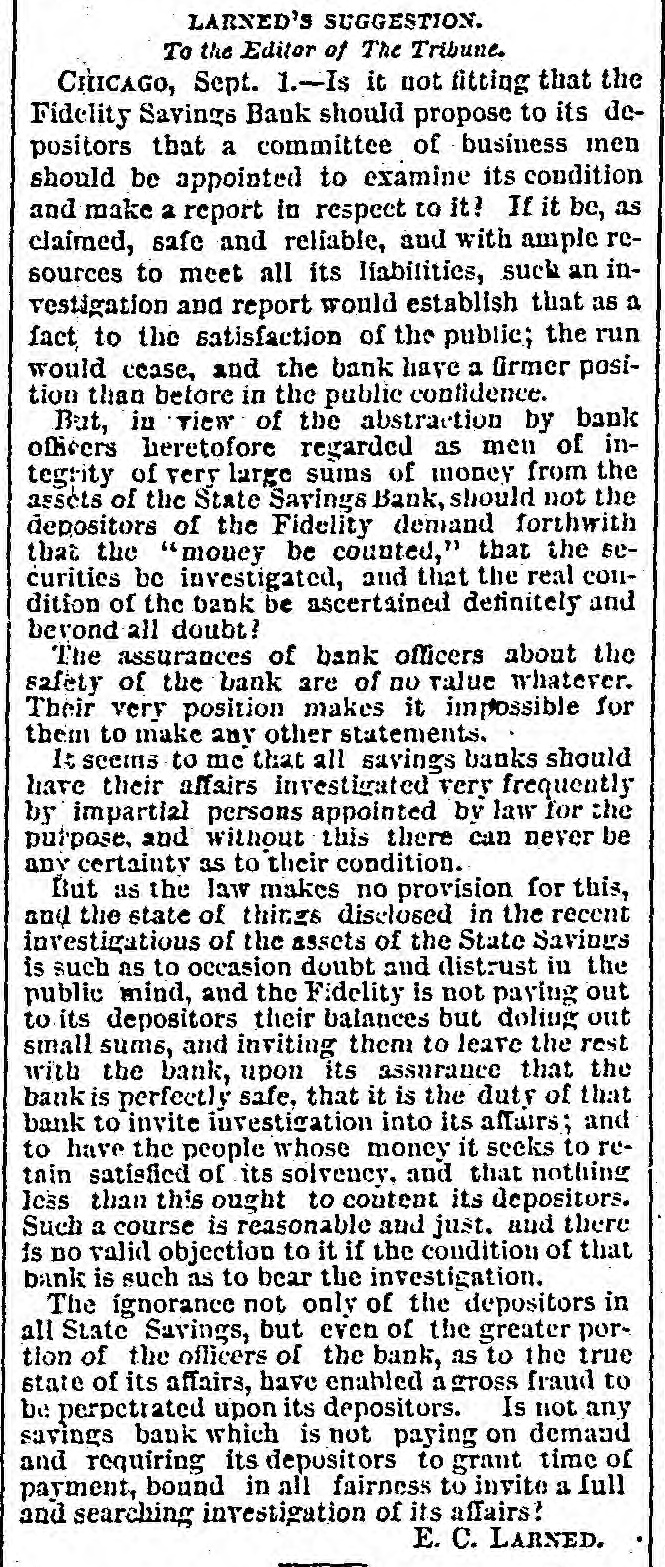
LARNED'S SUGGESTION. To the Editor of The Tribune. CHICAGO, Sept. 1.-Is it not fitting that the Fidelity Savings Bank should propose to its depositors that a committee of business men should be appointed to examine its condition and make 2 report in respect to it? If it be, as claimed, safe and reliable, and with ample resources to meet all its liabilities, such an investigation and report would establish that as a fact to the satisfaction of the public; the run would cease, and the bank have a firmer position than before in the public confidence. But, in view of the abstraction by bank officers heretofore regarded as men of integrity of very large sums of money from the assets of the State Savings Bank, should not the depositors of the Fidelity demand forthwith that the "mouey be counted," that the securities be investigated, and that the real condition of the bank be ascertained definitely and bevond all doubt? The assurances of bank officers about the safety of the bank are of no value whatever. Their very position makes it impossible for them to make any other statements. 1t seems to me that all savings banks should have their affairs investigated very frequently by impartial persons appointed by law for the purpose, and without this there can never be any certainty as to their condition. But as the law makes no provision for this, and the state of things disclosed in the recent investigations of the assets of the State Savings is such as to occasion doubt and distrust iu the public mind, and the Fidelity is not paying out to its depositors their balances but doling out small sums, and inviting them to leave the rest with the bank, upon its assurance that the bank is perfectly safe, that it is the duty of that bank to invite investigation into its affairs; and to have the people whose money it seeks to retain satisfied of its solvency, and that nothing less than this ought to content its depositors. Such a course is reasonable and just. and there is no valid objection to it if the condition of that bank is such as to bear the investigation. The Γ­gnorance not only of the depositors in all State Savings, but even of the greater portion of the officers of the bank, as to the true state of its affairs, have enabled a gross fraud to be perpetrated upon its depositors. Is not any savings bank which is not paying on demand and requiring its depositors to grant time of payment, bound in all fairness to invito a full and searching investigation of its affairs? E. C. LARNED.


Article from Chicago Daily Tribune, September 2, 1877

Click image to open full size in new tab

Article Text

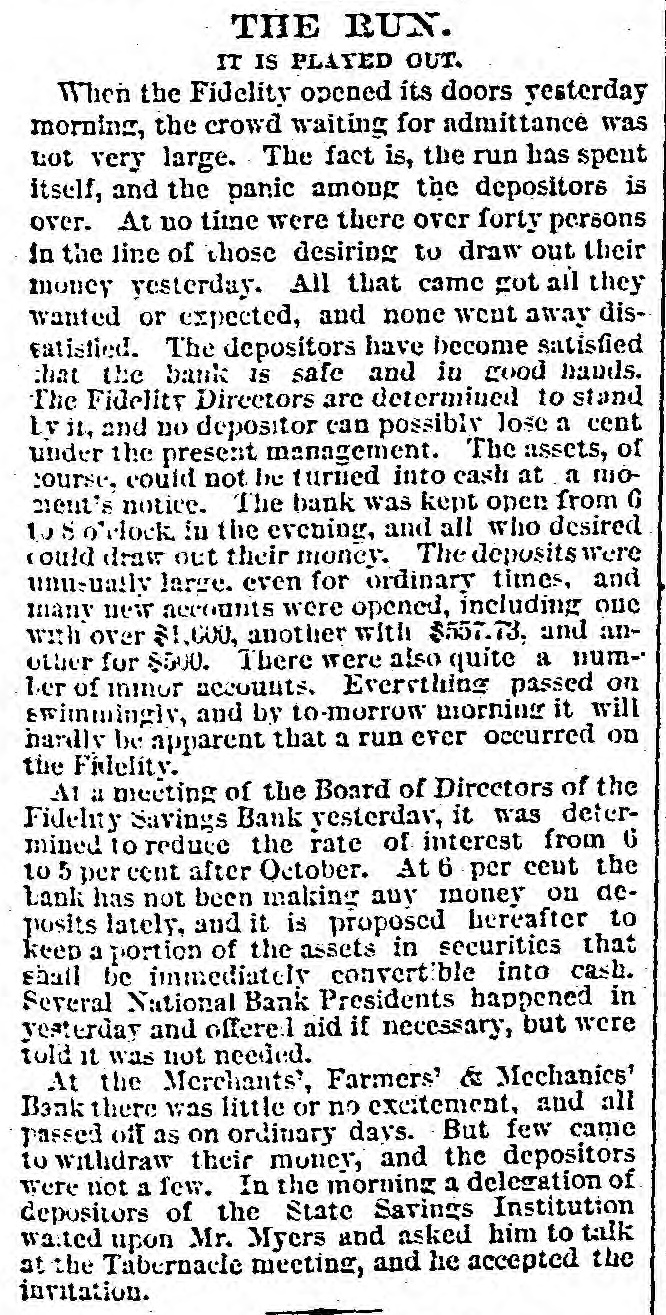
THE RUN. IT IS PLAYED OUT. When the Fidelity opened its doors yesterday morning, the crowd waiting for admittance was not very large. The fact is, the run has speut itself, and the panic among the depositors is over. At no time were there over forty persons in the line of those desiring to draw out their money yesterday. All that came got all they wanted or expected, and none went away dissatisfied. The depositors have become satisfied :hat the bank IS safe and in good hands. The Fidelity Directors are determined to stand Lv it, and no depositor can possibly Jose a cent under the present management. The assets, of course, could not be turned into cash at a moment's notice. The bank was kept open from 6 10 S o' lock in the evening, and all who desired could draw out their money. The deposits unu-ually large. even for ordinary times, and many new accounts were opened, including one with over $1,000, another with $557.73. and another for $500. There were also quite a numher of immor accounts. Everything passed on swimmingly, and by to-morrow morning it will hardly be apparent that a run ever occurred on the Fidelitv. At a meeting of the Board of Directors of the Fidelity Savings Bank yesterdav, it was determined to reduce the rate of interest from 6 to per cent after October. At 6 per cent the Lank has not been making any money on deposits lately, and it is proposed hereafter to keep a portion of the assets in securities that shall be immediately convertible into cash. Several National Bank Presidents happened in yesterday and offere.1 aid if necessary, but were told it was not needed. At the Merchants', Farmers' & Mechanics' Bank there was little or no excitement, and all passed off as on ordinary days. But few came to withdraw their money, and the depositors were not a few. In the morning a delegation of depositors of the State Savings Institution wasted upon Mr. Myers and asked him to talk at the Tabernacle meeting, and he accepted the invitation.


Article from The Cheyenne Daily Leader, September 25, 1877

Click image to open full size in new tab

Article Text

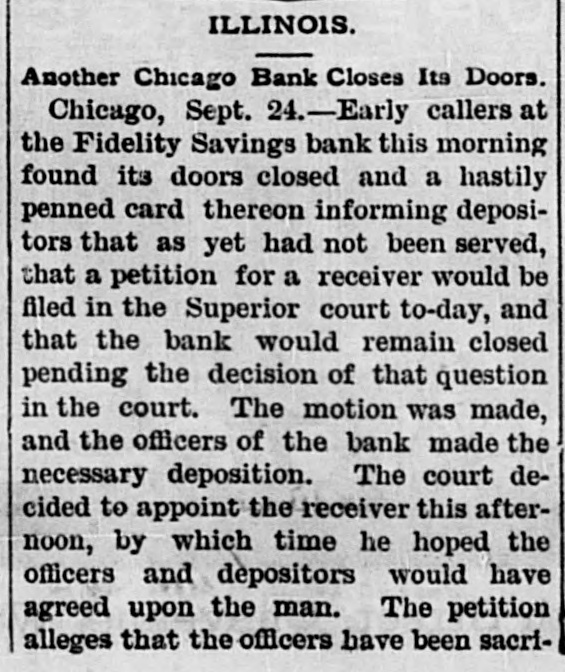
ILLINOIS. Another Chicago Bank Closes Its Doors. Chicago, Sept. 24. Early callers at the Fidelity Savings bank this morning found its doors closed and a hastily penned card thereon informing depositors that as yet had not been served, that a petition for a receiver would be filed in the Superior court to-day, and that the bank would remain closed pending the decision of that question in the court. The motion was made, and the officers of the bank made the necessary deposition. The court decided to appoint the receiver this afternoon, by which time he hoped the officers and depositors would have agreed upon the man. The petition alleges that the officers have been sacri-


Article from The Wheeling Daily Intelligencer, September 25, 1877

Click image to open full size in new tab

Article Text

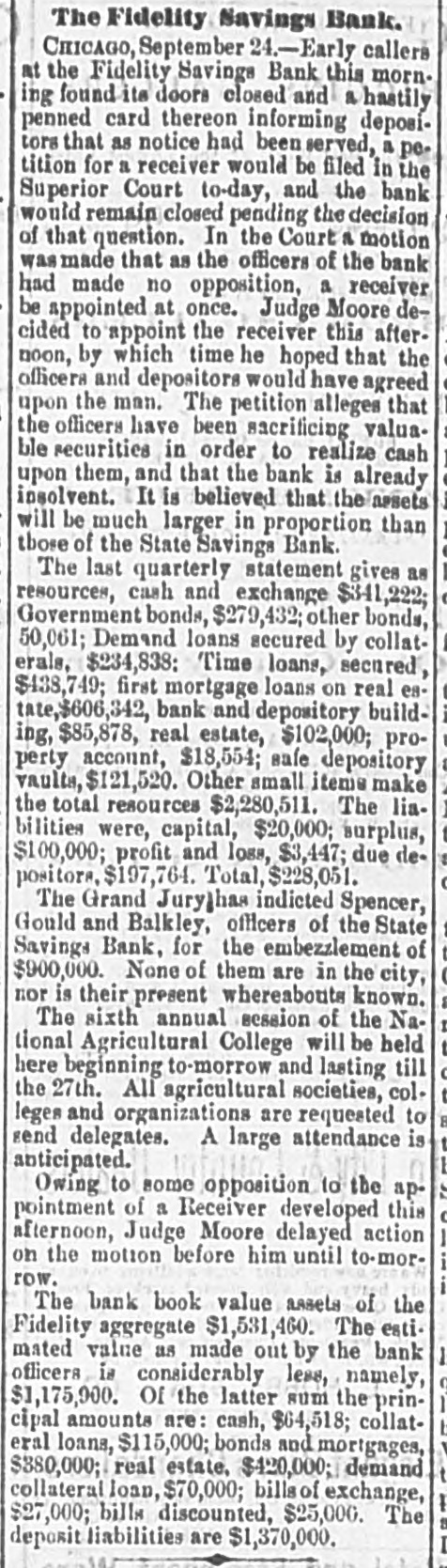
The Fidelity Savings Bank. CHICAGO, September 24.-Early callera at the Fidelity Savings Bank this morning found its doors closed and a hastily as a tors penned that card notice thereon had informing been served, deposi- petition for a receiver would be filed in the Superior Court to-day, and the bank would remain closed pending the decision of that question. In the Court a motion wasmade that as the officers of the bank had made no opposition, a receiver be appointed at once. Judge Moore decided to appoint the receiver this afternoon, by which time he hoped that the officers and depositors would have agreed upon the man. The petition alleges that the officers have been sacrificing valua. ble securities in order to realize cash upon them, and that the bank is already insolvent. It is believed that the assets will be much larger in proportion than tbose of the State Savings Bank. The last quarterly statement gives as resources, cash and exchange $341,222; Government bonds, $279,432; other bonds, 50,061; Demand loans secured by collaterals, $234,838: Time loans, secured, $438,749; first mortgage loans on real estate,$606,342, bank and depository building, $85,878, real estate, $102,000; property account, $18,554; safe depository vaults, $121,520. Other small items make the total resources $2,280,511. The liabilities were, capital, $20,000; surplus, $100,000; profit and loss, $3,447; due depositore, $197,764. Total, $228,051. The Grand Juryjhas indicted Spencer, Gould and Balkley, officers of the State Savings Bank, for the embezzlement of $900,000. None of them are in the city, nor is their present whereabouts known. The sixth annual session of the National Agricultural College will be held here beginning to-morrow and lasting till the 27th. All agricultural societies, col. leges and organizations are requested to send delegates. A large attendance is anticipated. Owing to some opposition to the appointment of a Receiver developed this afternoon, Judge Moore delayed action on the motion before him until to-morrow. The bank book value assets of the Fidelity aggregate $1,531,460. The estimated value as made out by the bank officers is considerably less, namely, $1,175,900. Of the latter sum the principal amounts are: cash, $64,518; collateral loans, $115,000; bonds and mortgages, $380,000; real estate, $420,000; demand collateral loan, $70,000; bills of exchange, $27,000; bills discounted, $25,000. The deposit liabilities are $1,370,000.


Article from The Sun, September 25, 1877

Click image to open full size in new tab

Article Text

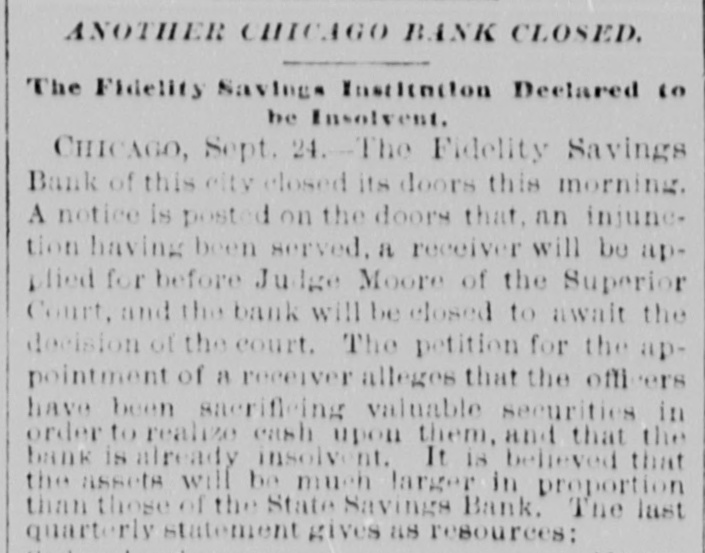
ANOTHER CHICAGO BANK CLOSED. The Fidelity Savings Institution Declared to be Insolvent. CHICAGO, Sept. 24.-The Fidelity Savings Bank of this city closed its doors this morning. A notice is posted on the doors that, an injunetion having been served. a receiver will be applied for before Judge Moore of the Superior Court, and the bank will be closed to await the decision of the court. The petition for the appointment of a receiver alleges that the officers have been sacrificing valuable securities in order to realize cash upon them, and that the bank is already insolvent. It is believed that the assets will be much larger in proportion than those of the State Savings Bank. The last quarterly statement gives as resources:


Article from New-York Tribune, September 25, 1877

Click image to open full size in new tab

Article Text

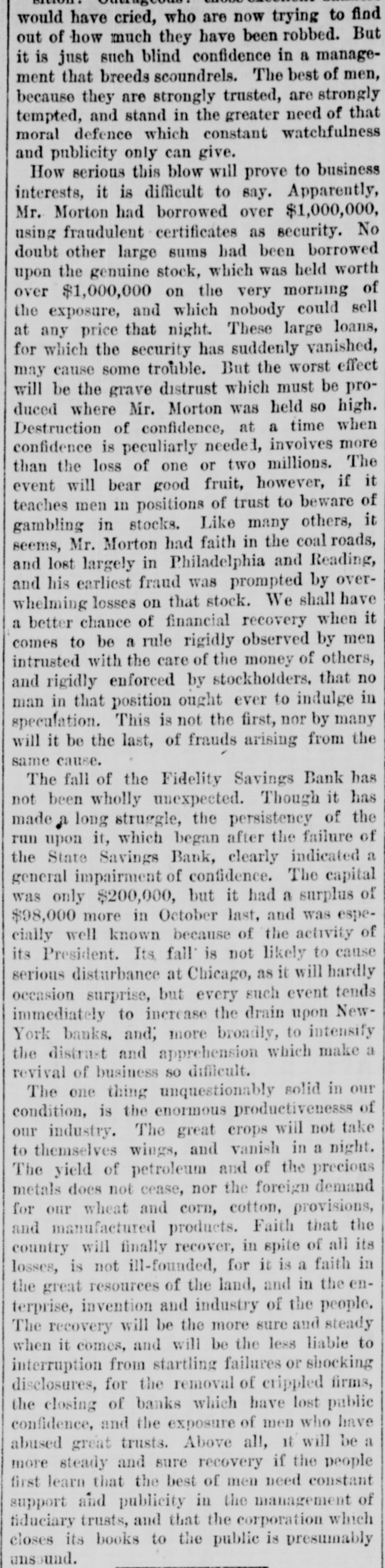
# THE FIDELITY SAVINGS BANK would have cried, who are now trying to find out of how much they have been robbed. But it is just such blind confidence in a manage- ment that breeds scoundrels. The best of men, because they are strongly trusted, are strongly tempted, and stand in the greater need of that moral defence which constant watchfulness and publicity only can give. How serious this blow will prove to business interests, it is difficult to say. Apparently, Mr. Morton had borrowed over $1,000,000, using fraudulent certificates as security. No doubt other large sums had been borrowed upon the genuine stock, which was held worth over $1,000,000 on the very morning of the exposure, and which nobody could sell at any price that night. These large loans, for which the security has suddenly vanished, may cause some trouble. But the worst effect will be the grave distrust which must be pro- duced where Mr. Morton was held so high. Destruction of confidence, at a time when confidence is peculiarly needed, involves more than the loss of one or two millions. The event will bear good fruit, however, if it teaches men in positions of trust to beware of gambling in stocks. Like many others, it seems, Mr. Morton had faith in the coal roads, and lost largely in Philadelphia and Reading, and his earliest fraud was prompted by over- whelming losses on that stock. We shall have a better chance of financial recovery when it comes to be a rule rigidly observed by men intrusted with the care of the money of others, and rigidly enforced by stockholders, that no man in that position ought ever to indulge in speculation. This is not the first, nor by many will it be the last, of frauds arising from the same cause. The fall of the Fidelity Savings Bank has not been wholly unexpected. Though it has made a long struggle, the persistency of the run upon it, which began after the failure of the State Savings Bank, clearly indicated a general impairment of confidence. The capital was only $200,000, but it had a surplus of $98,000 more in October last, and was espe- cially well known because of the activity of its President. Its fall is not likely to cause serious disturbance at Chicago, as it will hardly occasion surprise, but every such event tends immediately to increase the drain upon New- York banks, and; more broadly, to intensify the distrust and apprehension which make a revival of business so difficult. The one thing unquestionably solid in our condition, is the enormous productivenesss of our industry. The great crops will not take to themselves wings, and vanish in a night. The yield of petroleum and of the precious metals does not cease, nor the foreign demand for our wheat and corn, cotton, provisions, and manufactured products. Faith that the country will finally recover, in spite of all its losses, is not ill-founded, for it is a faith in the great resources of the land, and in the en- terprise, invention and industry of the people. The recovery will be the more sure and steady when it comes, and will be the less liable to interruption from startling failures or shocking disclosures, for the removal of crippled firms, the closing of banks which have lost public confidence, and the exposure of men who have abused great trusts. Above all, it will be a more steady and sure recovery if the people first learn that the best of men need constant support and publicity in the management of fiduciary trusts, and that the corporation which closes its books to the public is presumably unsound.


Article from The Wheeling Daily Intelligencer, September 26, 1877

Click image to open full size in new tab

Article Text

Appointed Receiver. CHICAGO, September 25.-In the Superior Court this morning Dr. V.A. Tarpin was appointed Receiver of the Fidelity Savings Bank, with bond at $600,000. The appointment meets with the warmest approval, the depositors being especially pleased. -


Article from Ottumwa Weekly Courier, September 26, 1877

Click image to open full size in new tab

Article Text

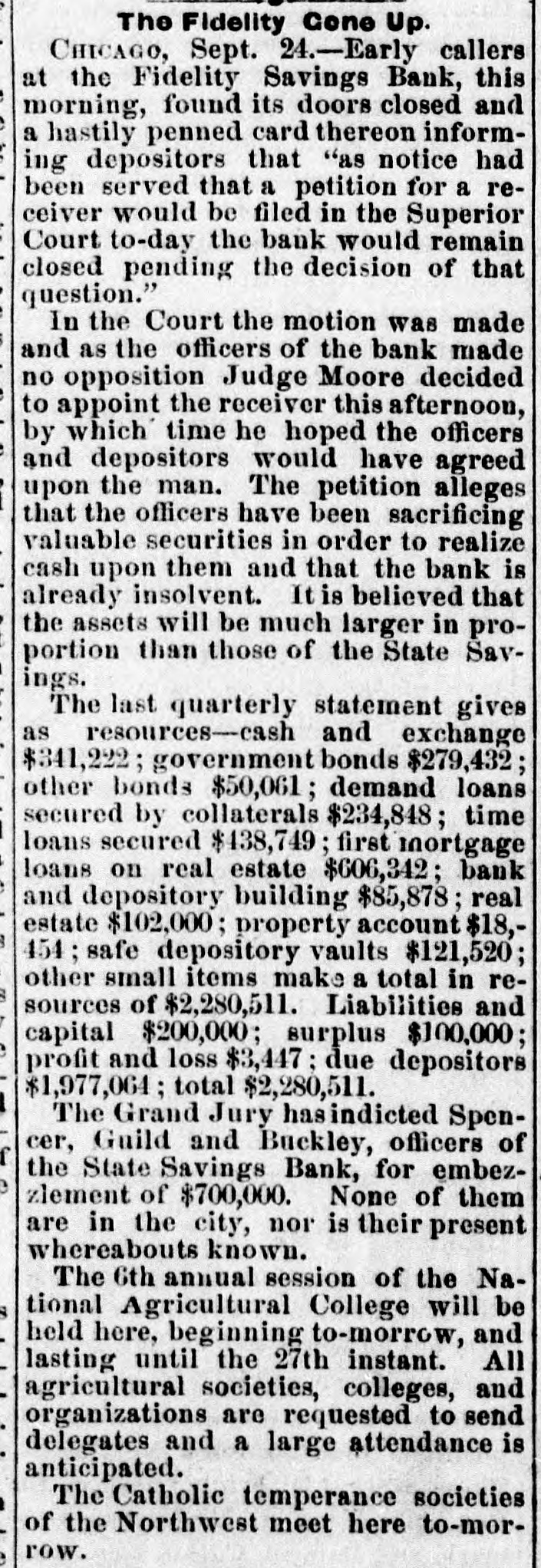
The Fidelity Cone Up. Chicago, Sept. 24.-Early callers at the Fidelity Savings Bank, this morning, found its doors closed and a hastily penned card thereon informing depositors that "as notice had been served that a petition for a receiver would be filed in the Superior Court to-day the bank would remain closed pending the decision of that question." In the Court the motion was made and as the officers of the bank made no opposition Judge Moore decided to appoint the receiver this afternoon, by which time he hoped the officers and depositors would have agreed upon the man. The petition alleges that the officers have been sacrificing valuable securities in order to realize cash upon them and that the bank is already insolvent. It is believed that the assets will be much larger in proportion than those of the State Savings. The last quarterly statement gives as resources-cash and exchange $341,222 government bonds $279,432; other bonds $50,061; demand loans secured by collaterals $234,848; time loans secured $438,749 first mortgage loans on real estate $606,342; bank and depository building $85,878 real estate $102,000; property account $18,454 ; safe depository vaults $121,520; other small items make a total in resources of $2,280,511. Liabilities and capital $200,000; surplus $100,000; profit and loss $3,447 : due depositors $1,977,064; total $2,280,511. The Grand Jury hasindicted Spencer, Guild and Buckley, officers of the State Savings Bank, for embezzlement of $700,000. None of them are in the city, nor is their present whereabouts known. The 6th annual session of the National Agricultural College will be held here, beginning to-morrow, and lasting until the 27th instant. All agricultural societies, colleges, and organizations are requested to send delegates and a large attendance is anticipated. The Catholic temperance societies of the Northwest meet here to-morrow.


Article from The Sun, September 26, 1877

Click image to open full size in new tab

Article Text

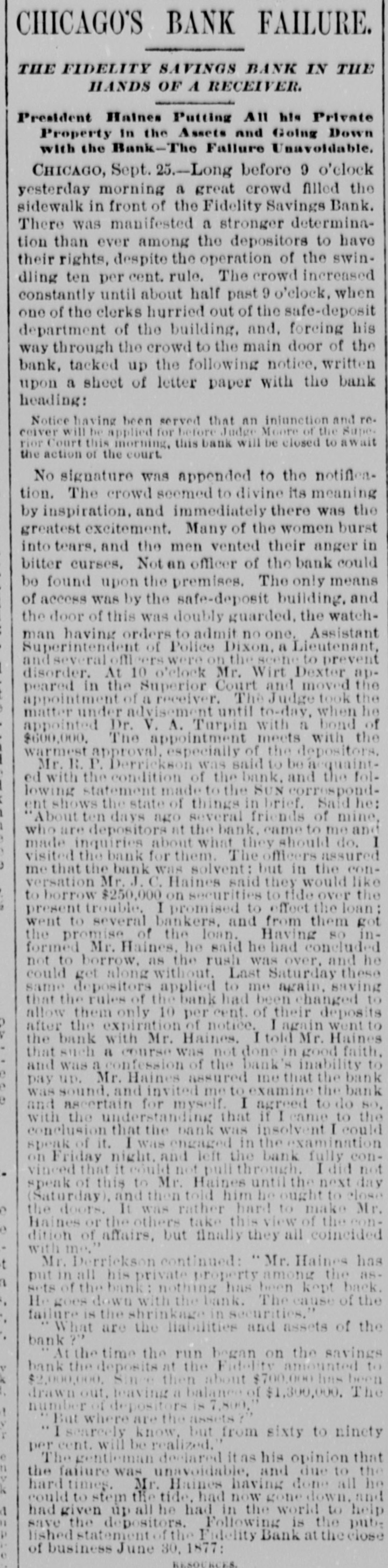
CHICAGO'S BANK FAILURE. THE FIDELITY SAVINGS BANK IN THE HANDS OF 4 RECEIVER. President Haines Putting All his Private Property In the Assets and Going Down with the Bank-The Fallure Unavoidable. CHICAGO, Sept. 25.-Long before 9 o'clock yesterday morning a great crowd filled the sidewalk in front of the Fidelity Savings Bank. There was manifested a stronger determination than ever among the depositors to have their rights, despite the operation of the swindling ten per cent. rule. The crowd increased constantly until about half past 9 o'clock, when one of the clerks hurried out of the safe-deposit department of the building. and, foreing his way through the crowd to the main door of the bank, tacked up the following notice, written upon a sheet of letter paper with the bank heading: Notice having been served that an injunction and receiver will be applied for before Judge Moore of the Supe. rior Court this morning, this bank will be closed to await the action of the court. No signature was appended to the notification. The crowd seemed to divine its meaning by inspiration, and immediately there was the greatest excitement. Many of the women burst into tears, and the men vented their anger in bitter curses. Not an officer of the bank could be found upon the premises. The only means of access was by the safe-deposit building. and the door of this was doubly guarded, the watchman having orders to admit no one, Assistant Superintendent of Police Dixon, a Lieutenant, and several offi ers were on the scene to prevent disorder. At 10 o'clock Mr. Wirt Dexter appeared in the Superior Court and moved the appointment of a receiver. The Judge took the matter under advisement until to-day, when he appointed Dr. V. A. Turpin with a bond of $600,000. The appointment meets with the warmest approval. especially of the depositors. Mr. R. P. Derrickson was said to be acquainted with the condition of the bank, and the following statement made to the SUN correspondent shows the state of things in brief. Said he: "About ten days ago several friends of mine, who are depositors at the bank. came to me and made inquiries about what they should do. I visited the bank for them. The officers assured me that the bank was solvent: but in the conversation Mr. J. C. Haines said they would like to borrow $250,000 on securities to tide over the present trouble. I promised to effect the loan went to several bankers, and from them got the promise of the loan. Having so informed Mr. Haines, he said he had concluded not to borrow. as the rush was over, and he could get along without. Last Saturday these same depositors applied to me again, saving that the rules of the bank had been changed to allow them only 10 per cent. of their deposits after the expiration of notice. I again went to the bank with Mr. Haines. I told Mr. Haines that such a course was not done in good faith. and was a confession of the bank's inability to pay up. Mr. Haines assured me that the bank was sound, and invited me to examine the bank and ascertain for myself. I agreed to do so, with the understanding that if I came to the conclusion that the bank was insolvent I could speak of it. I was engaged in the examination on Friday night. and left the bank fully convinced that it could not pull through. adid not speak of this to Mr. Haines until the next day (Saturday), and then told him he ought to close the doors. It was rather hard to make Mr. Haines or the others take this view of the condition of affairs. but finally they all coincided with me." Mr. Derrickson continued: Mr. Haines has put in all his private property among the assets of the bank nothing has been kept back. He goes down with the bank. The cause of the failure IS the shrinkage in securities." What are the liabilities and assets of the bank ?" At the time the run began on the savings bank the deposits at the Fidelity amounted to $2,000,000. Since then about $700,000 been drawn out, leaving a balance of $1,300,000. The number of depositors is 7,8002 But where are the assets "I scareely know, but from sixty to ninety per cent. will be realized. The gentleman declared itas his opinion that


Article from The News and Herald, September 29, 1877

Click image to open full size in new tab

Article Text

RATES OF ADVERTISING. One square one insertion $1.00. For each subsequent insertion 50Γ¨. Obituaries and Tributes of Respect charged for as advertisements. Liberal discount made for contract dvertisements. 0 JOB WORK. Bill Heads, Letter Heads, Envelopes Posters, Cards, Invitations, Tickets, &c. neatly executed at this office,CHEAP FOR CASH. NEWS OF THE DAY. Another Ohio treasurer has defaulted. A pocket-book containing $200,000 in bonds, stocks, &c., is missing from the bank safe at Cortland, New York. The yellow fever is raging at Fernandina, Florida. Aid has been sent from Savannah, Charleston, New York and other cities. The New Jersey Republicans have nominated a dark horse, Williams for governor. He has been put up for McClellan to knock down. - Fifty thousand workingmen of Northumberland and Durham, England, gave General Grant 11 res ception at Newcastle on the 22d inst. The Chicago grand jury has indicted certain officers of the State Savings Bank for embezzlement of $700,000. None of them are in the city, nor are their whereabouts known. The Fidelity Savings Bank of the same place has also closed its doors. Gambetta, the French Republican leader, has been sentenced to 2000 francs fine and three months imprisonment, for assailing President MacMahon in a public speech. A number of Republican papers have been suspended. Very heavy frauds are reported in the management of the Philadelphia City Passenger Railway Company. Stock representing over three million dollars has been fraudulently issued, of course with the connivance of the officers, one of whom is the president of the Philadelphia Permanent Exhibition. Strenuous efforts are now making to consolidate the friends of the Texas Pacific Railroad in asking aid from Congress for its construction. A systematic plan of operation is matured, into which enters the subject of the election of a Speaker of the House favorable to the project. The New York Herald reports that there is a formidable movement on foot to defeat Gen. James A. Walker; the Democratic candidate for licutenant-governor, because he openly opposes a readjustment of the State debt. An Independent candidate is proposed. Leverrier, the great French astronomer is dead. It was he who first suggested the existence of a planet nearer the sun than Mercury, which planet was subsequently discovered and named Vulcan, and which is only 13,000,000 miles from the sun, and revolves once around it every twenty days. A telegram from General Sturgis represents that he has been reinforced. He followed the hostiles thirty-eight miles Sunday, killed five, and regained six hundred head of horses. The Crows are fighting the Nez Perces and have brought into the agency seven hundred horses. Sitting Bull, with 1,000 warriors, is in the heart of the Canadian buffalo country, near Wood Mountains. Joseph's band is heading straight north. Nearly all the northern tribos are believed to be ready for the revolt, and all can cross the Canadian border in three days, and would number over 4,000 warriors, exclusive of Sitting Bull's 1,000, and all will join the latter if it is thought politic. Sitting Bull is amply supplied with ammunition, and other tribes are rapidly pro-


Article from The Portland Daily Press, October 2, 1877

Click image to open full size in new tab

Article Text

TUESDAY MORNING, OCT. 2. ington printer, are associate d with ex-Congressman Lynch in the publication of his new paper. Gen. Grant received an address at Stratfordon-Avon enclosed in a box made from the wood of Shakespeare's famous mulberry tree. Mark Twain's "ocean tramp," the schoon Jonas Smith, about which SO much has been said, was recently picked up at sea and towed into a Southern port. Capt. Vogle, of the Dictator, who rescued the miserable craft, has already savel over 100 lives. Information has been received from Senator Morton that he expects to be in Washington Dy the first of December, and resume his seat in the Senate. His colleague, Senator McDonald, has generously offered to pair with him on all questions as soon as he arrives in Washington, so that will not be compelled to attend the sessions of the Senate unless he desires to do so. One of the new and curious objects of the Japanese capital is a gigantic image of a wo_ man, made of wood and plaster, and dedicated to Hachiman, the god of war. In height it measures fifty-four feet, the head alone, which is reached by a winding staircase in the interior of the figure, being capable of holding about twenty persons with comfort, A sword is held in the right hand and a huge ball in the left. Internally the hovelty consists of an extraordinary anatomical model. A fine view of the surrounding district is obtained by looking through one of the eyes, and the price of admission is only two cents. A new way of scaling down liabilities was urged upon Mr. Haines, of the exploded Fidelity Savings Bank of Chicago. Depositors were clamorous, the funds wouldn't hold out. A proposition was made[to him by a man to quietly take $100,000 of the bank's funds and use it to the purchase of bank books for the benefit of the institution. This would do good in two ways: The bank would be relieved to the extent of the discount on each book, and the value of the books would be gradually appreciated, S0 that perhaps the run might stop; that is, they would start in by offering, say, sixty cents on the dollar. Then there would be a little quiet competition, and the price would go up to seventy, eighty, ninety, and SO on until the depositors would refuse to sell, thinking that the institution was perfectly sound, and that they were simply being shaved by speculators.


Article from Chicago Daily Tribune, October 18, 1877

Click image to open full size in new tab

Article Text

THE BROKEN BANKS. Formal Transfer of the Assets of the State to Judge Otis. Thr Other Receivers Pegging Away at Their Reports. Matters and things In relation to the triumvirate of broken banks have 50 long been dull that anything like a more on the part of any one of the Assigners or Receivers will appear ns real news. The public have come to the conclusion that somewhere In the dim vista of the future there existed a possibility of progress, but in what way no man could tell. Yesterday, however, & few Items of interest did develop, and It appears probable that before the close of this week the actual standing of all the defunct concerns will be made manifest by means of the Receivers' reports as presented to the Courts. At the State Savings Institution yesterday forenoon there was a meeting of the old Board of Trustees, the outcome of which cagnot fall to result profitably for the depositors. Dr. D. S. Smith, D. Goodwin, Jr., and the returned fugifive Guild and Bulkley. were on hand, forming a majority of the Board. Judge L. B. Otis and his attorneys conferred with the Board, and the result was that a voluminous deed, conveying to Lucien B. Otis, as Receiver, over 300 pieces of real estate, was executed. The deed was at once placed on record, and the depositors may be congratulated on the amicable settlement of the question. Judge Otis, in reply to the question of a TRIBUNE reporter. said that he considered the action taken OR being of considerable Interest to the depositors. They held, or claimed, a title to the property In question under the Spencer assignment to Abner Taylor, which was transferred to him on Mr. Taylor's retirement. But it was of great importance to obtain a DIRECT DEED FROM THE TRUSTEES, as It simplified matters generally. and tended to the avoidance of litigation. The original deed was general In its character; this one is specific, and contains a description of all the property. As to the probable value of the assets thus brought under his control Judge Qtis was, in the absence of statistics, utterly unable to furnish all opinion. The reporter asked what came next on the programme. Judge Otis answered that lie expected within a few days to ask the Court for leave to solicit proposals for the purchase of the bank building, vaults. safes, furniture, and effects. There had been a good many stories circulated as to the return of Guild and Bulkley, but the plain fact was that they had come back without, BO far as he knew, any promise of Immunity or safe conduct. lle had no power to grant Immunity, anyhow; that was a matter within the control of the State's Attorney. He had signtfled to certain friends of the Canadian excursionists that their presence was destred and they had come back accordingly. In order to obtain the signature of a majority of the Board to the deed of transfer they had to be called upon. And as to anything else of Interest to the American public, Judge Otis' mind Wus a dreary blank. THE BEE-HIVE. Then as to the M., F. & M., the hive where the greenback bee no longer stores up honey, the ex-king bee did not show up yesterday. It is reported that he caught cold while attemptIng to smoke In bed with one of the windows open, and that he has been ordered to diet himself for the time being. But Mr. Ward was on hand. He didn't know anything. Model of Receivers: whose duty it is to receive everything and part with nothing. In a casual wav Mr. Ward mentioned that his report was very nearly ready, and would be presented to the Court this week, probably on Friday. But he had no news. and ne didn't know anything about what the report would show. At the Fidelity Mr. McAuley, the whilom paying-teller, was discovered reading the papers. Curiously enough his report was nearly ready also, and would be presented about Friday. Dr. Turpin had gone round the block on business, but, as he didn't know anything, this fact was a matter of indifference. The only obstacle in the wayof concluding his report was that the appraisers had not yet set a valuation upon certain outside property. Owing to the bad weather they had been unable to visit it, and being extremely conscientious they could not bring themselves to place A valuation on neres and lots on which they had never gazed. But by Saturday at Intest the report would probably be filed. As to news, there wasn't any. In the case of V.A. Turpin, Receiver of the Fidelity Savings Bank, vs. J. C. Haines and the other stockholders, a bill to prevent suite against the stockholders, the Receiver yesterday, by permission of the Court, amended his bill so as to charge that suits had been also begun in Justices' Courts against the stock-


Article from Chicago Daily Tribune, November 4, 1877

Click image to open full size in new tab

Article Text

WANTS TO KNOW. To the Editor of The Tribune. CHICAGO, Nov. 2.-Please inform the depositors of the Fidelity Savings Bank, through your paper, which is it.-the Receiver or Mr. Haines, -is going to rob the poor depositors now. Mr. Haines said that he signed over all his private property to the bank, even his homestead, and that his property would make $150,000 more than he owed the bank; but now the report in your paper is quite different. There is not a word about Mr. Haines' property. I suppose the Receiver wants to favor Mr. Haines and rob the poor widows and orphans. Is it not a nice way for a man to rob, to set up a bank for three or four years, and take all the poor people's money in, and then close up the doors and leave


Article from Chicago Daily Tribune, November 21, 1877

Click image to open full size in new tab

Article Text

Total $ 47,108 The assets comprise, besides the above, office furniture and listures, the value of will 1 isnot given, also the ground lease above mentioned, the bank building. Lot 1, Block 8. of Beck's subdivision of the S. W. 14 of the S. W. 11 of Ser. 21. 33, 11, in Englewood, with house, taken on n debt for 81,500 against one Hyatt, and 2011/2 feet on Walnut street. with house. Besides the 890.47 cash in the bank. the itevelver has collected 8:00 rent and $30.00 from other sources. He has expended $11.93 for stationery, etc.: has also employed one clerk at 81.30 a day, and a bookker at the same rate. His own services the Receiver rutes at $300. In conclusion. Mr. Hinkley says that the bank ever since the expenditure of $20,851.00 for its building In 1STM has been insolvent, and at no time since been able to pay its depositors. A grave and important question arlses whether any personal Hability exists against any one on benatt of the depositors to reimburse them for their losses. Among the list of bills receivable are the following: John G. Brown, balance due, $1,225, secured by tru-t-deed: J. C. Patterson, $355.10: A. 11. Burley, na Receiver of the Cook County National Bank, $703.00 E. J. Adams, 811251: B. W. Phillips. $1,142.41; 1.. L. Greenicaf, 8742.85; Chicago Society for the New Jerusalem. $651.25: Jacob Well & Co., SUNSO: Mary Lawrence, 401. The Receiver also asks for advice as to whethor ne shall proceed to sell the furniture. lixtures, leasehold Interests, etc., at public or prirate sale, and whether be shall progeed to collert the outstanding accounts by suit. Ile also asks to have his expenses and fees allowed, and proposes heneeforth to charge 85 a day for his services. THE FIDELITY. Judge Moore gesterday entered nn order consolidating the two suits of Johnson and AnderBon against the Fidelity Savings Bank. and granting a perpetual Injunction ugainst the prosecution of suits against the stockholders of the bank. It Is expected a demurrer will be Interposed and a formal decree entered 60 that the case can nt once go to the Appellate Court. No testimony Was taken before Collector Harvey yesterday on the Habitity of the bank to pay Government taxes. be having been absent all day. The argument will be heard today. The paying-out at the Fulelity went on vesterday just about the same as on the previous day, and about noo depositors were given money. On balancing the books for Monday It was found that the payments were about 813.0.0. Yesterday would show about the same results. Mr. MeAuley noted, as n matter of interest. that the smallest sum paid to any one depositor during the day was two cents, the same being an equal and exact 10 per cent of the sum which the bank had of the depositor's. JUDGE oris, Receiver of the State Savings Institution, was not the best pleased yesterday at a statement made by one Evarts at the meeting of the Fldebty Bank depositors Monday evening. The assertion of Evarts Was that at the State " the lawvers had already eaten up half the cash deposits." Judge Otls resents this as unealledfor and false. He adds that he has paid but one lawyer's bill, and that was $30. Further, be had to offer that collections were being made better than he expected, and, In fact, matters Were getting on well.


Article from Chicago Daily Tribune, November 28, 1877

Click image to open full size in new tab

Article Text

THE BANKS. ALL quier. A reporter visited all the suspended banks, National as well as savings, yesterday, but was hardly compensated In Information for the wear and tear of his constitution and shoo-leather. At the Third National, Mr. Watson was seen. He knew of nothing. No Receiver had yet been appointed. It seems, however, that telegrama have been received from Washington, stating that Huntington A. Jackson will be the successful one. Ills papers have not been made out, but they are expected here by Thursday. Regarding the Receiver of the Central, rumor bath It that Mr. Burley is the man. But he has no advices to that effect, nor could the roport be verified. As is known, he is now in charge of the bank. He has enough cash on hand to pay a dividend of 20 per cent at once. The creditors of both the Central and Third will, in time, certainly get 100 cents on the dollar. Absolutely nothing was obtainable at the savIngs banks,-that is, as to collections, dividends, etc. A female depositor dropped into the State about 1 o'clock and asked for "tho clerks." This a pretty bank." said the woman. " It is a smashed bank," rejoined the reporter. " Yes, remarked she, and I would like to get hold of some of them, wouldn't 1 smash 'em." "Them" was indefinite, 80 the reporter, not wishing to be mistaken for a bank employe, pointed out Judge Otis and Mr. Chamberlain, and withdrew. Both the gentlemen named were whole last night. There is a noticeable falling-off in the crowd at the Fidelity, though the drawing of the 10 per cent was pretty steady all day. Only a third of the depositors have thus far received what is due to them. Many, perhaps, do not yet know that the institution is in liquidation. Dr. Ward, of the Beehive, Was notified in the afternoon that the Committee appointed by the depositors will come to see him again this morning. These centlemen say they are after the fellows who hold their beads high, though they are deeply in debt, and they purpose exposing them to the community. One of the Committee, whom a reporter saw yesterday, said he didn't think any harm would be done by publishing the names of the bank's debtorsthat the money was due, and would have to be paid. W. S. Hinckley, Receiver of the Chicago SavIngra Institution & Trust Company, filed a petition yesterday setting out that among the assets of the bank are some office furniture, collectable debts, and Incumbered real estate. The debts ought to be collected and the other property sold, in his opinion, and Judge Moore gave him leave to do as he wished in the matter. John C. Winterbotham, one of the stockholders of the Fidelity Savings Bank, who has been sued by the Receiver of the bank to recover ou his statutory liability, filed his separate answer yesterday. No deals in glittering generalities, denying vaguely that he la under any moral or legal obligation to pay any of the debts of the corporation, and claiming that he was not one of the original stockholders, but purchased bis stock at the Instance of some parties connected with the management of the bank


Article from Chicago Daily Tribune, December 4, 1877

Click image to open full size in new tab

Article Text

be declared, representing that they were In urgent need of moner. A dividend ought to be paid at once if possible, but the trouble and expense of declaring one and paying so many depositors are so grent that there ought to be money enough scraped together to pav 10 per cent at least before any is declared. Except by a sale of the bullding, enough money cannot be obtained this winter to nay such a dividend. and though with the depressed price of real estato the building could only be sold at A considerable sacrifice, less would be lost on it than on any other property betonging to the bank. IL is advisable at least that the sale should be made before next May, when banks will make their arrangements for the Following year. The Receiver has asked a number of persons competent to Judge on the subject, and they agree that n comparatively early scle should be made. The argument on the question was set for Thursday at 2 p. m. Judge Otis also filed another petition setting out that among the other property held by him as Receiver is an undivided seven twenty-fourths Interest in the S. E. fractional 1/4 of Sec. 22, (36) north of the Indian boundery line, and the N. E. fractional is of Sec. 27, north of the Indian boundary line, and the S. Β½ of Sec. 23. south of the Indian boundary line, the N. W. fractional 1/ of See. 27 south of the Indian boundary line, the W. Β½ of the S. W. 1/ of Sec. 27. and the E. 1/2 of the N. W. 14 and the N. W. 4 of the N. W. 14 of Sec. BI. all in Township 87, Range 14, except the S. E. fractional 4 of Sec. 33, north of the Indian boundary line. The remaining interest In the land is held by E. K. Beach, George M. Pullman, and C. B. Hosmer. The Michigan Central Railway Company owns about twenty neres near this tract, on which are n round-bouse and n number of side-tracks and switches. This Company is destrous of buying parts of Sec. 23 and 27. above mentioned, containing in all 60.383 acres. near Kensington. An arrangement was made a long time ago for the sale of this tract to the Company for $18,860.68, and for a lease to it of certain other land. so ns to enable It. to get water from Calmet Lake, for the term of 999 years, at a nominal rent of $5 n year. The Receiver thinks this proposed lenee and sale is fair, and will be advantageous to the estate. The prayer of the potition was granted. THE FIDELITY. Dr. Turpin, Receiver of the Fidelity Savings Bank, filed his second monthly report vesterday, which gives an account of his doings for November. It is as follows: RECEIPTS


Article from Chicago Daily Tribune, March 18, 1879

Click image to open full size in new tab

Article Text

statement of facts to show a cause of action. The Government could not proceed In rem, the vessel being in a Canadian port, but there was no doubt of the right of the Government to Buo the parties at common law. The Judge held the form of action proper, and overruled the exceptions, requiring the defendants to answer In ten days. GENERAL The objections to the batch of exchanges of real estate for bank-books recently made by the Receiver of the Fidelity Savings Bank were argued yesterday morning at some length before Judge Moore. The chief objections have all been published heretofore, and the gist of them is that the exchanges are not equitable. but benefit some depositors nt the expense of the others. At the conclusion of the arguments the Judge took the matter under advisement. DIVORCES. Stephen S. Davis began a sult yesterday toget a divorce from his wife Harriet, because she saw fit to leave him just two years and seven days ngo. Judge Farwell granted n divorce yesterday to Juliania C. Tyson from John R. Tyson on the ground of desertion. ITEMS. The Stewart-Patterson case was up before Judge Farwell yesterday morning on some motions to settle the pleadings. After Indulging in a general discussion for half an hour without making the least headway, the attorneys agreed to postpone the matter for a week. In the case of the German National Bank, the Receiver, J. M. Flower, filed n petition setting out that among the assets of the bank were two judgments for $0,040.46 against the J. F. Warren Company, J. F. Warren, and Henry J. Caswell, on which, however, $500 had been paid on execution. The defendants offer to compromise by paring $1,750, and the Receiver thinks the offer the best that can be gotten. Judge Rogers is hearing the case of Brandt vs. Gullup & Peabody, which was tried some time ago before Judge McAllister, and resulted in favor of the plaintiff, and is now up a second time, a new trial having been granted. Judge McAllister will not be in court until tomorrow, belog confined at home by a severe cold. BANKRUPTCY. In the case of W. W. Everts, the Assignee filed a report setting out that last Thursday he sold a large amount of real estate In Chicago, Hyde Park, and also in Iown, Wisconsin, and Tennessee, owned by the bankrupt, but only realized about S110 from the whole. All of It had been mortgaged or forcelosed, 80 that only a bare equity of redemption was remaining. The case of Hadtoy Bros. & Co. was referred to the Register for final report. SUPERIOR COURT IN BRIEF. Nickolaus Maurer sued John and Maria E. Schnelder for $1,000. John Moore, John Hay, and J. II. Smith began a suit for $5,000 against Rudolph Wolfson and Theodore Wollstein. CIRCUIT COURT. Gustav Blatz and William Locb filed a bill against Joseph Pollak, conservator of the cstate of Oliver C. Henson, insaue, Elizabeth E. Vaughn, administratrix, Mathilde Kochler, D. a. Hamilton, and the unknown heirs of (). C. Henson, to foreclose a mortgage for $1,000 on Lot 3, Block 2, of McGrath's Addition to Chi: caro. Robert Mannhelmer and Williom Losb filed a will against Elizabeth Dett, Mary Von Horn, Virgiulus Seyer, and others to foreclose a trust deed for $1,500on Lots 3 and 4, Block 43, In the Canal Trustees' Subdivision of Sec. 7, 89, 11. THE CALL. JUDGE BLODGETT-No court the remainder of the week. THE APPELLATE Count-Opinions nt 2 p. m.43, Bandle vs. Robinson; 44, City VM. Palmer; 45, Same Ys. Goudy: 40, Same ye. Jamicson: 47, Far. well ve. Hardy and passed case No. 7, Loowenthal vs. McCormick. No case on trial. JUDGE GARY-181 and 487 to 520, Inclusive, ex. cept 492, 403, 404, and 408. No. 483, German American Bank Ys. Probating. on trial. JUDGE JAMESON-Assists Judge Gary. Interna. tional Bank VS. Anthony, on hearing on motion to strike pleas from the files. Junus Moone-17, 20, 21, 22. No. 15, Wilson VS. Wilson, on trial. JUDGE Honrns-Sct case 2,330, Brandt VH. Gallup, on trial. No further caso until further notice. Juner BOOTH-70, 81, 87 to 105, inclusive. No case on trial. Jupor MCALLISTER-No court to-day. JUDUE FARWELL-1,700, Ityan vs. Ryan. JUDGE Loomis-Calendar Nos. 2, 4, B, 8, 10, 11, 12, 13, 14, 15, 111. 17, 18, 10, and 20. JUDGE WILLIAMS-Nos. 150, 150. 157. 102, 160, 103, 100, 1, 102, 1, 100, 1,110, and 1, ,111. JUDGMENTS. UNITED STATES CIRCUIT COURT-JUDGE BLODexrr-Jerome I. Care vs. Francis E. Illinckley, $1,803.29. SUPERIOR COUNT-CONPENSIONS-Frank Bruman vs. Lester N. Swezey. 355. 40. M. Pholps at al. vs. Margaret King. $977.00 JUDGE GARY-Hannah Goodman TE. The Guar. anty Fire-Insurance Company, $257.33,-W. II. Goodrich vs. A. K. Norris, $140. 15.-Fred Wherburgh YS. Bernard Witter and HenryZimmermann, $15. CIRCUIT COURT-JUNCE Ronens-South Park Commissioners vs. Walker: condemnation verdict for $11, 000 in favor of the owners of the N. 1/1 of the premises condemned, and for $0,000 in favor of the owners of the S. 16 of the entine premises. Same Henry H. Gage; verdict in favor of Gage
Article from New Ulm Weekly Review, April 16, 1879

Click image to open full size in new tab

Article Text

State, etc., etc. THE United States Senate, on the 10th, decided, by a vote of 85 to 28, that Charles H. Bell was entitled to a seat in that body by virtue of appointment of the Governor of New Hampshire. Mr. Bell was consequently sworn in to fill the vacancy from that State. THE Massachusetts House of Reprecentatives, on the 10th, rejected a bill to secure women the right to vote on municipal affairs in cities and towns. A bill to give women the right to vote for members of School Committees was passed. JOHN TAYLOR has been re-elected President of the Twelve Apostles and Trustee of the Mormon Church. No successor to Brigham Young, as President of the Church, has been elected. THE Fidelity Bank building, the Fidelity Safe Deposit Vaults and Hooley's Theater, property belonging to the defunct Fidelity Savings Bank of Chicago, were sold at auction, on the 10th, for the sum of $192,400. JOHN P. PHAIR, the Vermont murderer, who had been three times reprieved, was hanged, on the 10th, at the State Peniten tiary in Windsor. THE New Orleans authorities have determined to quarantine for twenty days all vessels arriving from ports in the West Indies, the Gulf of Mexico south of Texas, and South America, after the 1st of May, with the object of preventing the introduction of yellow fever. AT the rolling-mill in Cleveland, Ohio, on the 10th, a bar of iron being run through the rollers encircled a boy in its fantastic folds, and literally burned his body in two. SEVEN Indians attacked Serg't