3782. Sioux City Savings Bank (Sioux City, IA)

Bank Information

Episode Type
Run → Suspension → Closure
Bank Type
savings bank
Start Date
November 19, 1896
Location
Sioux City, Iowa (42.500, -96.400)

Metadata

Model
gpt-5-mini
Short Digest
51530802

Response Measures

Partial suspension, Books examined

Other: Receiver appointed; criminal investigations and embezzlement discovered later.

Description

The failure of the First National (Nov 19, 1896) triggered heavy withdrawals at the Sioux City Savings Bank; officers invoked the sixty-day rule and a receiver (F. B. Ross / later Goss/Moss mentioned) was appointed. Subsequent investigations found forged and worthless assets and criminal charges against the cashier, indicating the savings bank did not resume normal independent operations and remained in receivership/failed.

Events (3)

1. November 19, 1896 Run
Cause
Local Banks
Cause Details
News of the failure/closing of the First National Bank of Sioux City led depositors to withdraw from the Sioux City Savings Bank (same president T. J. Stone).
Measures
Officers took advantage of the sixty-day law (invoked the 60-day rule to suspend immediate payments).
Newspaper Excerpt
The failure of the First National bank caused a run on the Sioux City Savings bank
Source
newspapers
2. November 19, 1896 Suspension
Cause
Local Banks
Cause Details
Heavy withdrawals following the First National's failure forced the savings bank to invoke the sixty-day law and cease normal payments; a receiver was appointed for protection of stockholders and creditors.
Newspaper Excerpt
The officers took advantage of the sixty-day law. ... F. B. Ross was appointed receiver
Source
newspapers
3. November 20, 1896 Receivership
Newspaper Excerpt
Late in the day F. B. Ross was appointed receiver for the protection of the stockholders and creditors. ... Receiver Goss today reported ... forged paper ... $20,000 forged by ex-Cashier Stone (June 1897/1898 reporting). F. B. Ross was appointed receiver for the protection of the stockholders and creditors.
Source
newspapers

Newspaper Articles (20)

Article from The Seattle Post-Intelligencer, November 20, 1896

Click image to open full size in new tab

Article Text

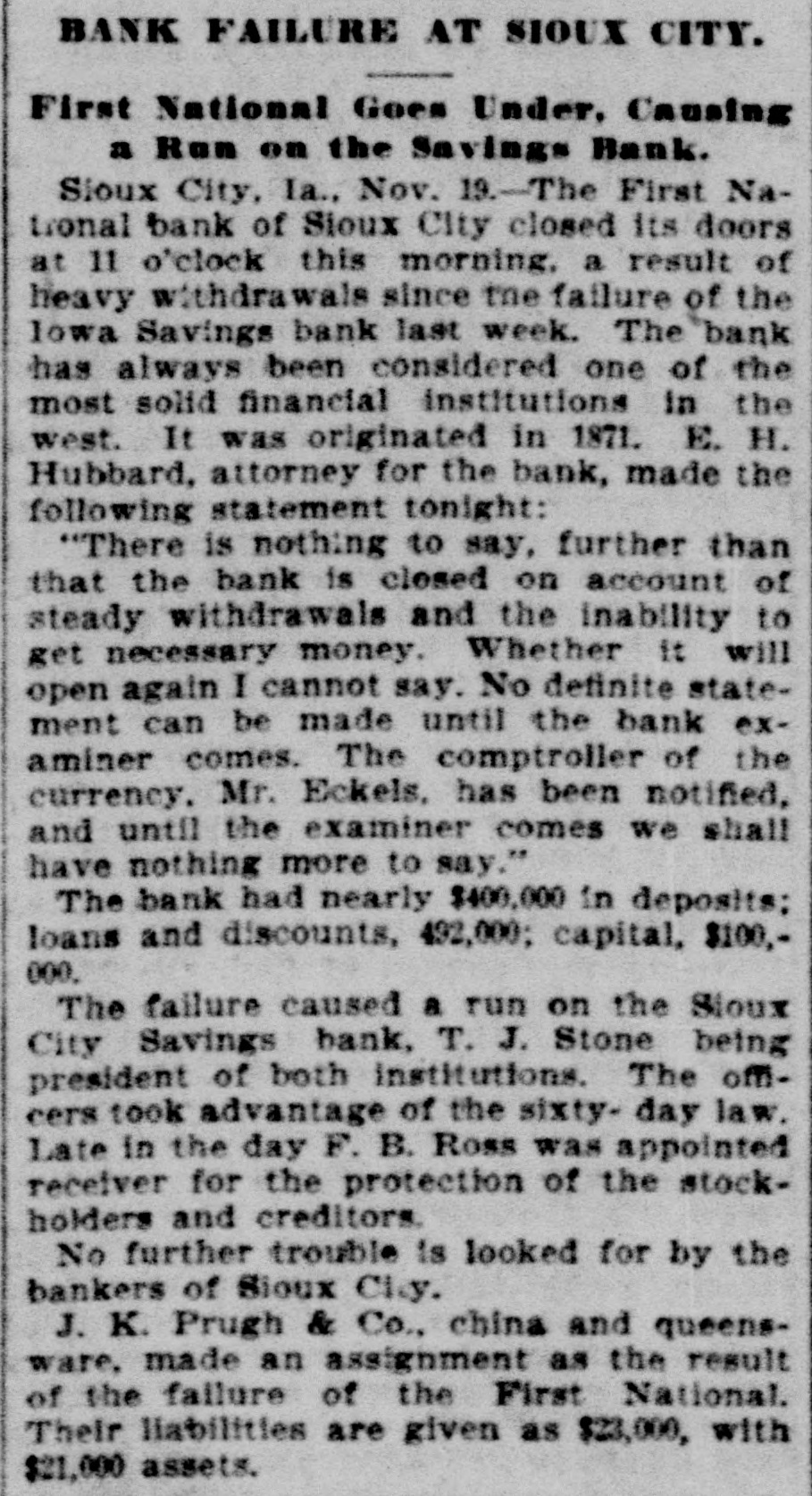
BANK FAILURE AT SIOUX CITY. First National Goes Under, Causing a Run on the Savings Bank. Sioux City, Ia., Nov. 19.-The First Natronal bank of Sioux City closed its doors at 11 o'clock this morning, a result of heavy withdrawals since the failure of the Iowa Savings bank last week. The bank has always been considered one of the most solid financial institutions in the west. It was originated in 1871. E. H. Hubbard, attorney for the bank, made the following statement tonight: "There is nothing to say, further than that the bank is closed on account of steady withdrawals and the inability to get necessary money. Whether it will open again I cannot say. No detinite statement can be made until the bank examiner comes. The comptroller of the currency. Mr. Eckels, has been notified, and unt!! the examiner comes we shall have nothing more to say." The bank had nearly $400,000 in deposits: loans and discounts, 492,000; capital, $100,000. The failure caused a run on the Sioux City Savings bank, T. J. Stone being president of both institutions. The officers took advantage of the sixty- day law. Late in the day F. B. Ross was appointed receiver for the protection of the stockholders and creditors. No further trouble is looked for by the bankers of Sioux City. J. K. Prugh & Co., china and queensware, made an assignment as the result of the failure of the First National. Their liabilities are given as $23,000, with $21,000 assets.


Article from Arizona Republican, November 20, 1896

Click image to open full size in new tab

Article Text

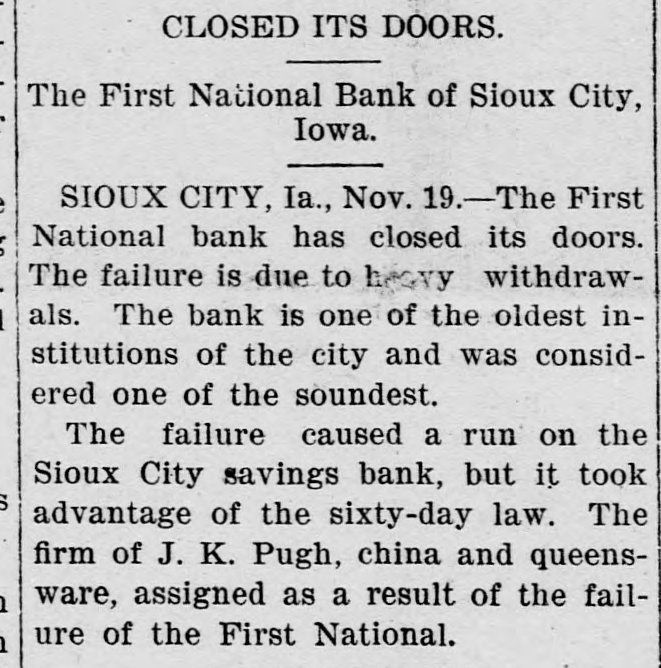
CLOSED ITS DOORS. The First National Bank of Sioux City, Iowa. SIOUX CITY, Ia., Nov. 19.-The First National bank has closed its doors. The failure is due to heavy withdrawals. The bank is one of the oldest institutions of the city and was considered one of the soundest. The failure caused a run on the Sioux City savings bank, but it took advantage of the sixty-day law. The firm of J. K. Pugh, china and queensware, assigned as a result of the failure of the First National.


Article from The News & Observer, November 20, 1896

Click image to open full size in new tab

Article Text

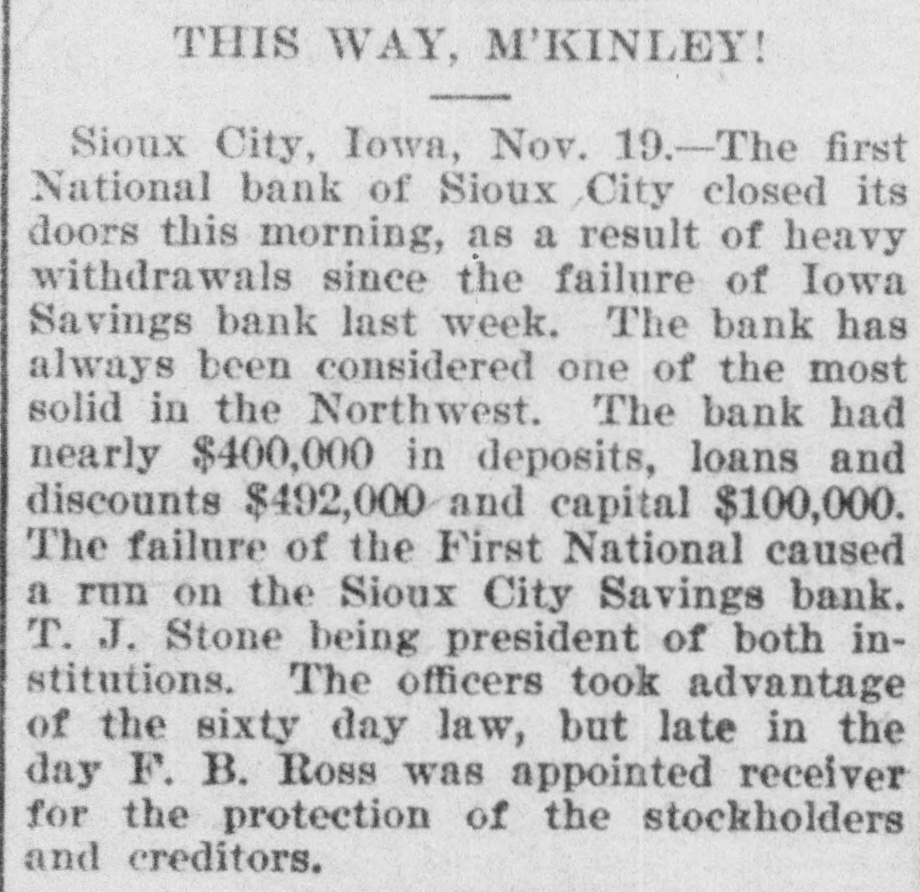
THIS WAY, M'KINLEY! Sioux City, Iowa, Nov. 19.-The first National bank of Sioux City closed its doors this morning, as a result of heavy withdrawals since the failure of Iowa Savings bank last week. The bank has always been considered one of the most solid in the Northwest. The bank had nearly $400,000 in deposits, loans and discounts $492,000 and capital $100,000. The failure of the First National caused a run on the Sioux City Savings bank. T. J. Stone being president of both institutions. The officers took advantage of the sixty day law, but late in the day F. B. Ross was appointed receiver for the protection of the stockholders and creditors.


Article from Kansas City Daily Journal, November 20, 1896

Click image to open full size in new tab

Article Text

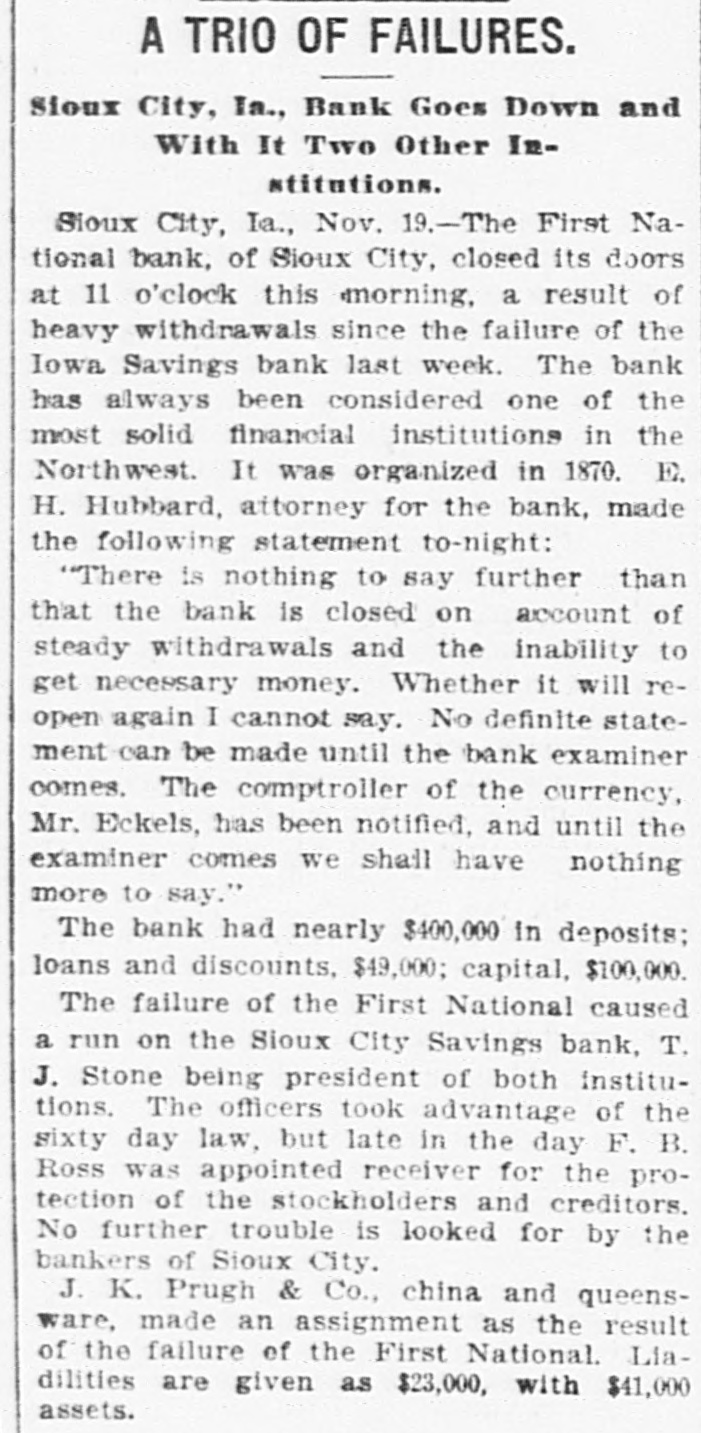
A TRIO OF FAILURES. Sioux City, Ia., Bank Goes Down and With It Two Other Institutions. Sioux City, Ia., Nov. 19.-The First National bank, of Sioux City, closed its doors at 11 o'clock this morning, a result of heavy withdrawals since the failure of the Iowa Savings bank last week. The bank has always been considered one of the most solid financial institutions in the Northwest. It was organized in 1870. E. H. Hubbard, attorney for the bank, made the following statement to-night: "There is nothing to say further than that the bank is closed on account of steady withdrawals and the inability to get necessary money. Whether it will reopen again I cannot say. No definite statement can be made until the bank examiner comes. The comptroller of the currency, Mr. Eckels, has been notified, and until the examiner comes we shall have nothing more to say." The bank had nearly $400,000 in deposits; loans and discounts, $49,000; capital, $100,000. The failure of the First National caused a run on the Sioux City Savings bank, T. J. Stone being president of both institutions. The officers took advantage of the sixty day law. but late in the day F. B. Ross was appointed receiver for the protection of the stockholders and creditors. No further trouble is looked for by the bankers of Sioux City. J. K. Prugh & Co., china and queensware, made an assignment as the result of the failure of the First National. Liadilities are given as $23,000, with $41,000 assets.


Article from Rock Island Argus, November 20, 1896

Click image to open full size in new tab

Article Text

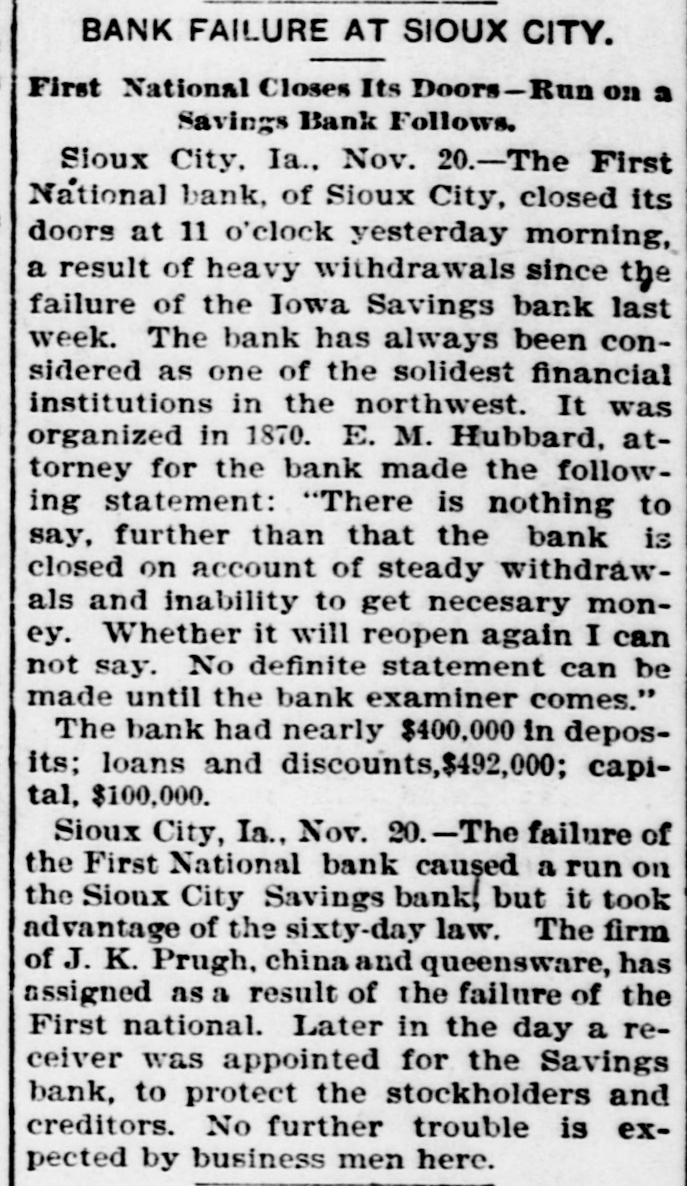
BANK FAILURE AT SIOUX CITY. First National Closes Its Doors-Run on a Savings Bank Follows. Sioux City, Ia., Nov. 20.-The First National bank, of Sioux City, closed its doors at 11 o'clock yesterday morning, a result of heavy withdrawals since the failure of the Iowa Savings bank last week. The bank has always been considered as one of the solidest financial institutions in the northwest. It was organized in 1870. E. M. Hubbard, attorney for the bank made the following statement: "There is nothing to say, further than that the bank is closed on account of steady withdrawals and inability to get necesary money. Whether it will reopen again I can not say. No definite statement can be made until the bank examiner comes." The bank had nearly $400,000 in deposits; loans and discounts, $492,000; capital, $100,000. Sioux City, Ia., Nov. 20. -The failure of the First National bank caused a run on the Sioux City Savings bank, but it took advantage of the sixty-day law. The firm of J. K. Prugh, china and queensware, has assigned as a result of the failure of the First national. Later in the day a receiver was appointed for the Savings bank, to protect the stockholders and creditors. No further trouble is expected by business men here.


Article from The Herald, November 20, 1896

Click image to open full size in new tab

Article Text

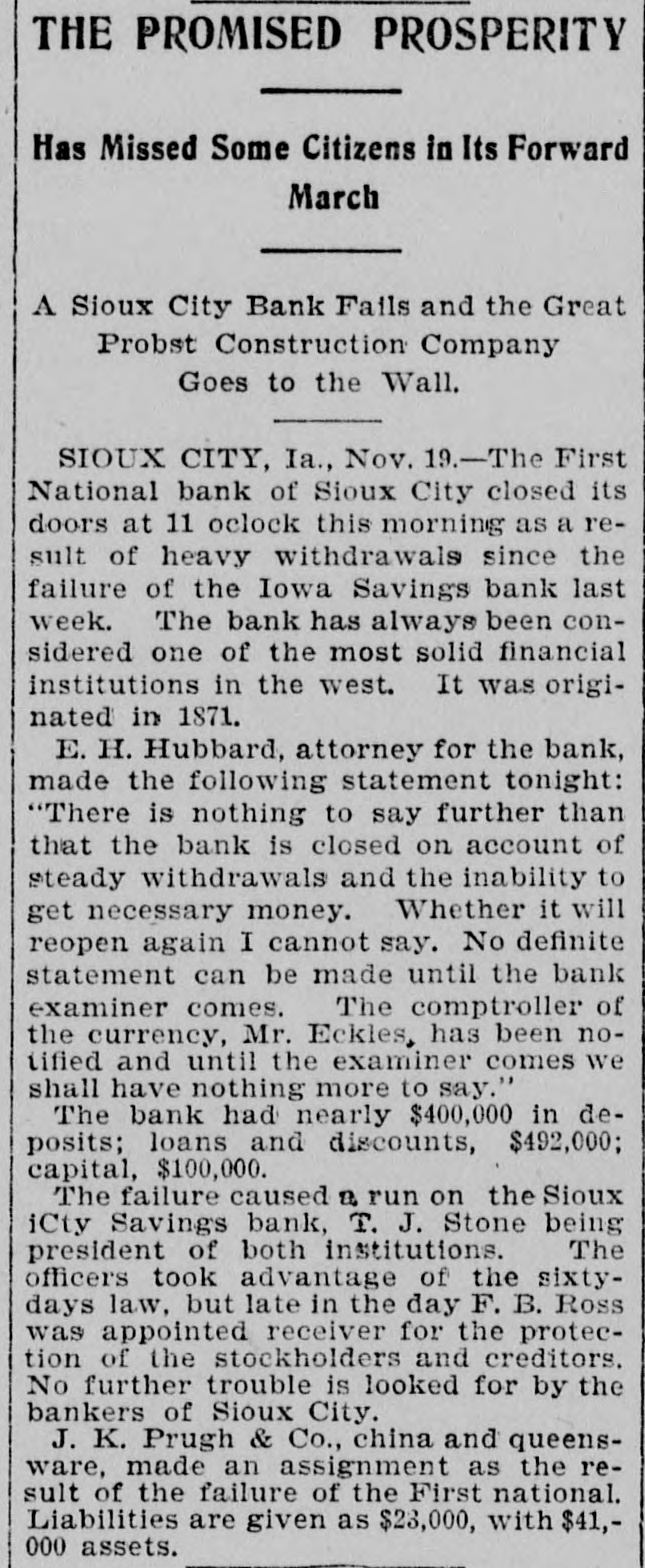
THE PROMISED PROSPERITY Has Missed Some Citizens in Its Forward March A Sioux City Bank Fails and the Great Probst Construction Company Goes to the Wall. SIOUX CITY, Ia., Nov. 19.-The First National bank of Sioux City closed its doors at 11 oclock this morning as a result of heavy withdrawals since the failure of the Iowa Savings bank last week. The bank has always been considered one of the most solid financial institutions in the west. It was originated in 1871. E. H. Hubbard, attorney for the bank, made the following statement tonight: "There is nothing to say further than that the bank is closed on account of steady withdrawals and the inability to get necessary money. Whether it will reopen again I cannot say. No definite statement can be made until the bank examiner comes. The comptroller of the currency, Mr. Eckles, has been notified and until the examiner comes we shall have nothing more to say." The bank had nearly $400,000 in deposits; loans and discounts, $492,000; capital, $100,000. The failure caused a run on the Sioux iCty Savings bank, T. J. Stone being The president of both institutions. officers took advantage of the sixtydays law, but late in the day F. B. Ross was appointed receiver for the protection of the stockholders and creditors. No further trouble is looked for by the bankers of Sioux City. J. K. Prugh & Co., china and queensware, made an assignment as the result of the failure of the First national. Liabilities are given as $23,000, with $41,000 assets.


Article from The Wichita Daily Eagle, November 20, 1896

Click image to open full size in new tab

Article Text

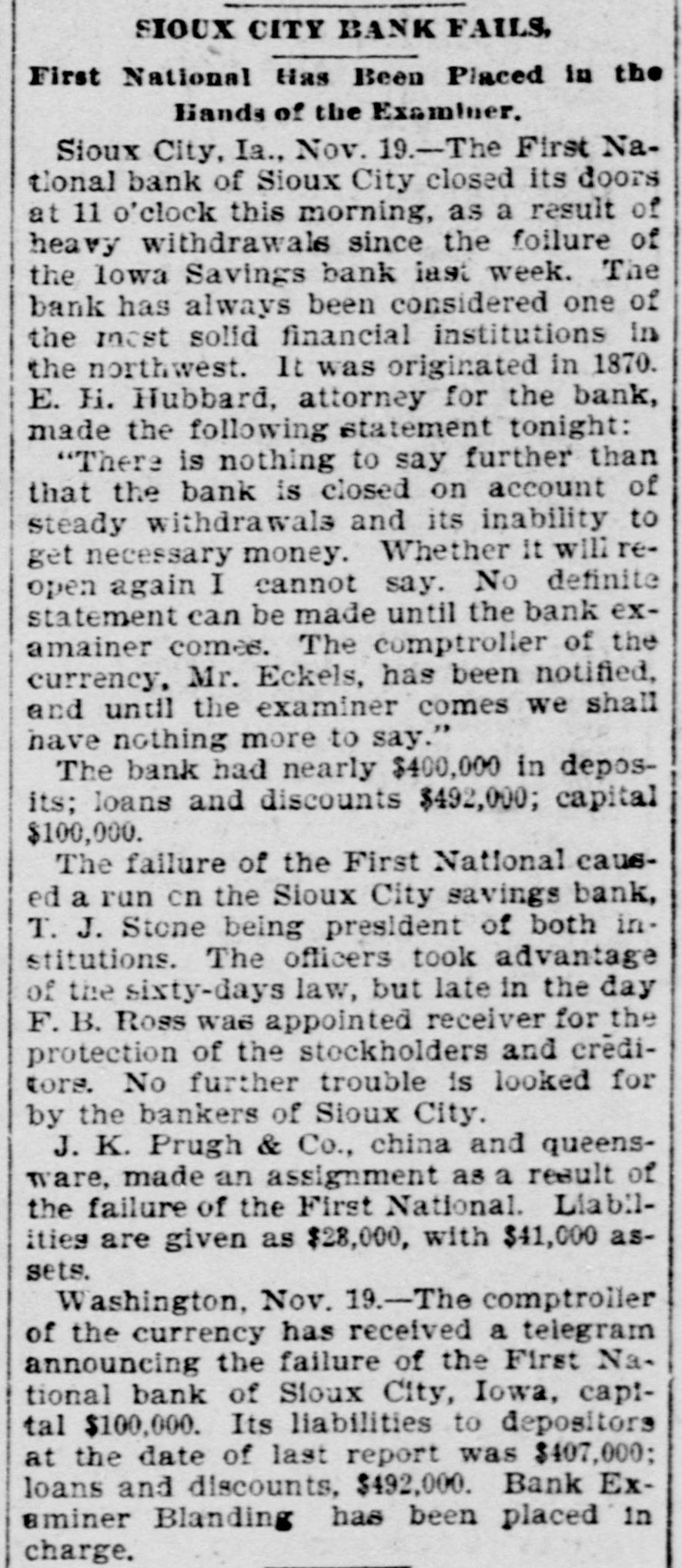
SIOUX CITY BANK FAILS, First National Has Been Placed in the Hands of the Examiner. Sioux City, Ia., Nov. 19.-The First National bank of Sioux City closed its doors at 11 o'clock this morning, as a result of heavy withdrawals since the foilure of the lowa Savings bank last week. The bank has always been considered one of the most solid financial institutions in the northwest. It was originated in 1870. E. H. Hubbard, attorney for the bank, made the following statement tonight: "There is nothing to say further than that the bank is closed on account of steady withdrawals and its inability to get necessary money. Whether It will reopen again I cannot say. No definite statement can be made until the bank examainer comes. The comptroller of the currency, Mr. Eckels, has been notified, and until the examiner comes we shall have nothing more to say." The bank had nearly $400,000 in deposits; loans and discounts $492,000; capital $100,000. The failure of the First National caused a run on the Sloux City savings bank, T. J. Stone being president of both institutions. The officers took advantage of the sixty-days law, but late in the day F. B. Ross was appointed receiver for the protection of the stockholders and creditors. No further trouble is looked for by the bankers of Sioux City. J. K. Prugh & Co., china and queensware, made an assignment as a result of the failure of the First National. Liabilities are given as $28,000, with $41,000 assets. Washington, Nov. 19.-The comptroller of the currency has received a telegram announcing the failure of the First National bank of Sloux City, Iowa, capital $100,000. Its liabilities to depositors at the date of last report was $407,000; loans and discounts, $492,000. Bank Examiner Blanding has been placed in charge.


Article from The Saint Paul Globe, November 20, 1896

Click image to open full size in new tab

Article Text

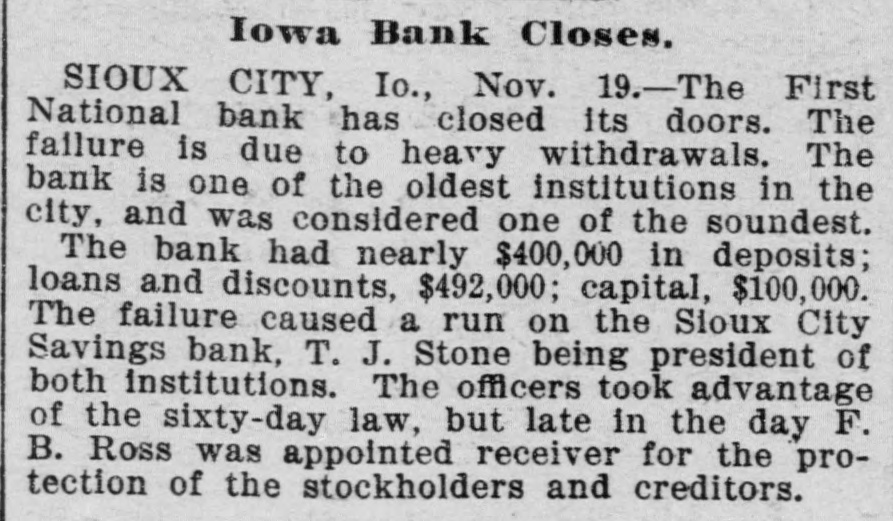
Iowa Bank Closes. SIOUX CITY, Io., Nov. 19.-The First National bank has closed its doors. The failure is due to heavy withdrawals. The bank is one of the oldest institutions in the city, and was considered one of the soundest. The bank had nearly $400,000 in deposits; loans and discounts, $492,000; capital, $100,000. The failure caused a run on the Sioux City Savings bank, T. J. Stone being president of both institutions. The officers took advantage of the sixty-day law, but late in the day F. B. Ross was appointed receiver for the protection of the stockholders and creditors.


Article from Omaha Daily Bee, November 20, 1896

Click image to open full size in new tab

Article Text

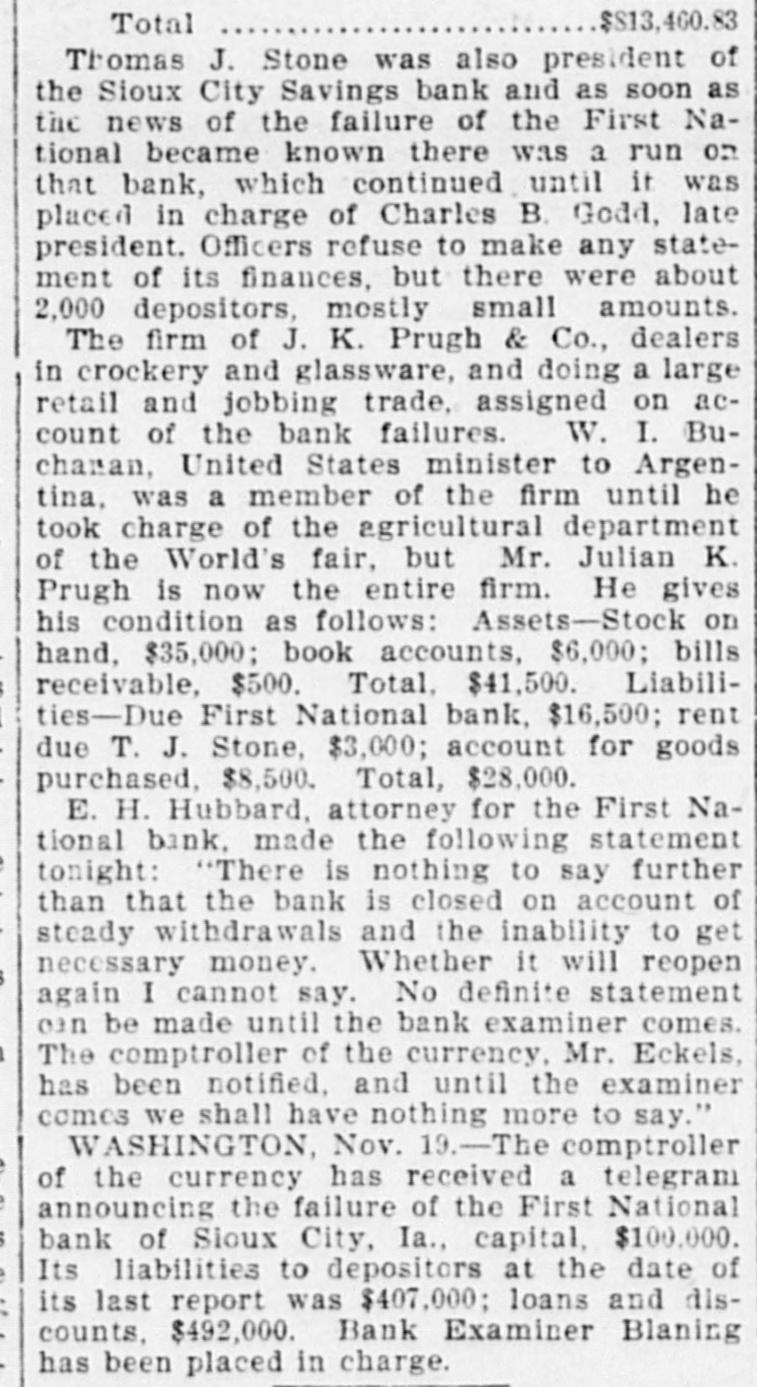
$813,400.83 Total Thomas J. Stone was also president of the Sioux City Savings bank and as soon as the news of the failure of the First National became known there was a run on that bank, which continued until it was placed in charge of Charles B. Godd, late president. Officers refuse to make any statement of its finances, but there were about 2,000 depositors, mostly small amounts. The firm of J. K. Prugh & Co., dealers in crockery and glassware, and doing a large retail and jobbing trade, assigned on account of the bank failures. W. I. Buchanan, United States minister to Argentina, was a member of the firm until he took charge of the agricultural department of the World's fair, but Mr. Julian K. Prugh is now the entire firm. He gives his condition as follows: Assets-Stock on hand, $35,000; book accounts, $6,000; bills receivable, $500. Total, $41,500. Liabilities-Due First National bank, $16,500; rent due T. J. Stone, $3,000; account for goods purchased, $8,500. Total, $28,000. E. H. Hubbard, attorney for the First National bank, made the following statement tonight: "There is nothing to say further than that the bank is closed on account of steady withdrawals and the inability to get necessary money. Whether it will reopen again I cannot say. No definite statement on be made until the bank examiner comes. The comptroller of the currency, Mr. Eckels, has been notified, and until the examiner comes we shall have nothing more to say." WASHINGTON, Nov. 19.-The comptroller of the currency has received a telegram announcing the failure of the First National bank of Sioux City, Ia., capital, $100,000. Its liabilities to depositors at the date of its last report was $407,000; loans and discounts, $492,000. Bank Examiner Blaning has been placed in charge.


Article from Omaha Daily Bee, November 21, 1896

Click image to open full size in new tab

Article Text

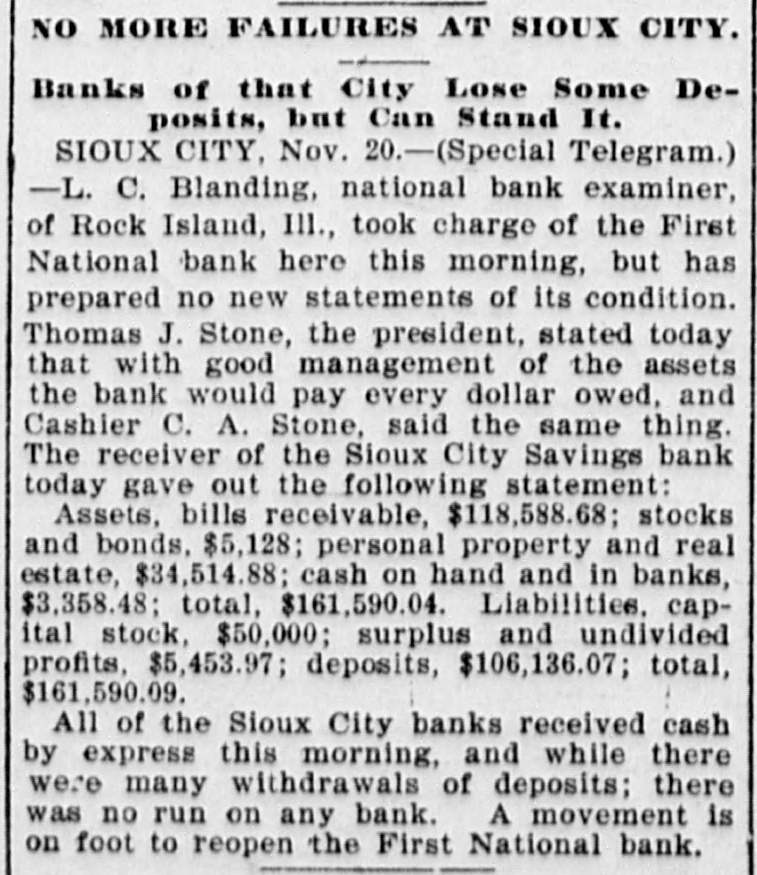
NO MORE FAILURES AT SIOUX CITY. Banks of that City Lose Some Deposits, but Can Stand It. SIOUX CITY, Nov. 20.-(Special Telegram.) -L. C. Blanding, national bank examiner, of Rock Island, Ill., took charge of the First National bank here this morning, but has prepared no new statements of its condition. Thomas J. Stone, the president, stated today that with good management of the assets the bank would pay every dollar owed, and Cashier C. A. Stone, said the same thing. The receiver of the Sioux City Savings bank today gave out the following statement: Assets, bills receivable, $118,588.68; stocks and bonds, $5,128; personal property and real estate, $34,514.88; cash on hand and in banks, $3,358.48; total, $161,590.04. Liabilities, capital stock, $50,000; surplus and undivided profits, $5,453.97; deposits, $106,136.07; total, $161,590.09. All of the Sioux City banks received cash by express this morning, and while there were many withdrawals of deposits; there was no run on any bank. A movement is on foot to reopen the First National bank.


Article from The Salt Lake Herald, November 21, 1896

Click image to open full size in new tab

Article Text

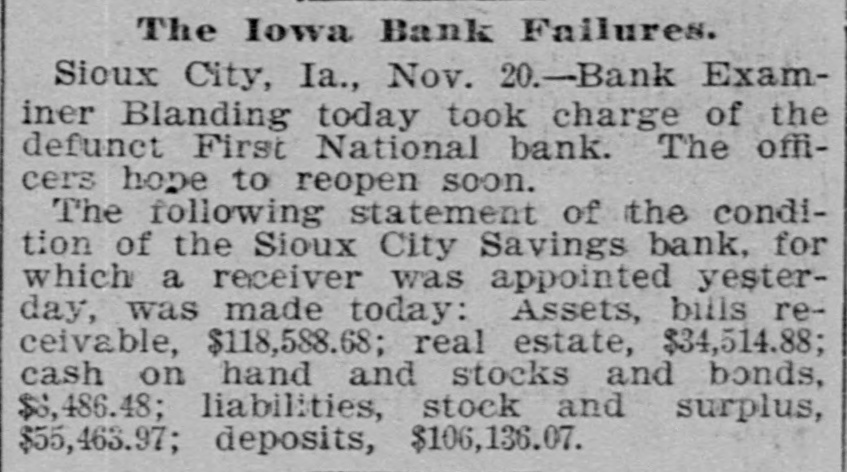
The Iowa Bank Failures. Sioux City, Ia., Nov. 20.-Bank Examiner Blanding today took charge of the defunct First National bank. The officers hope to reopen soon. The following statement of the condition of the Sioux City Savings bank, for which a receiver was appointed yesterday, was made today: Assets, bills receivable, $118,588.68; real estate, $34,514.88; cash on hand and stocks and bonds, $6,486.48; liabilities, stock and surplus, $55,463.97; deposits, $106,136.07.


Article from Iowa State Bystander, November 27, 1896

Click image to open full size in new tab

Article Text

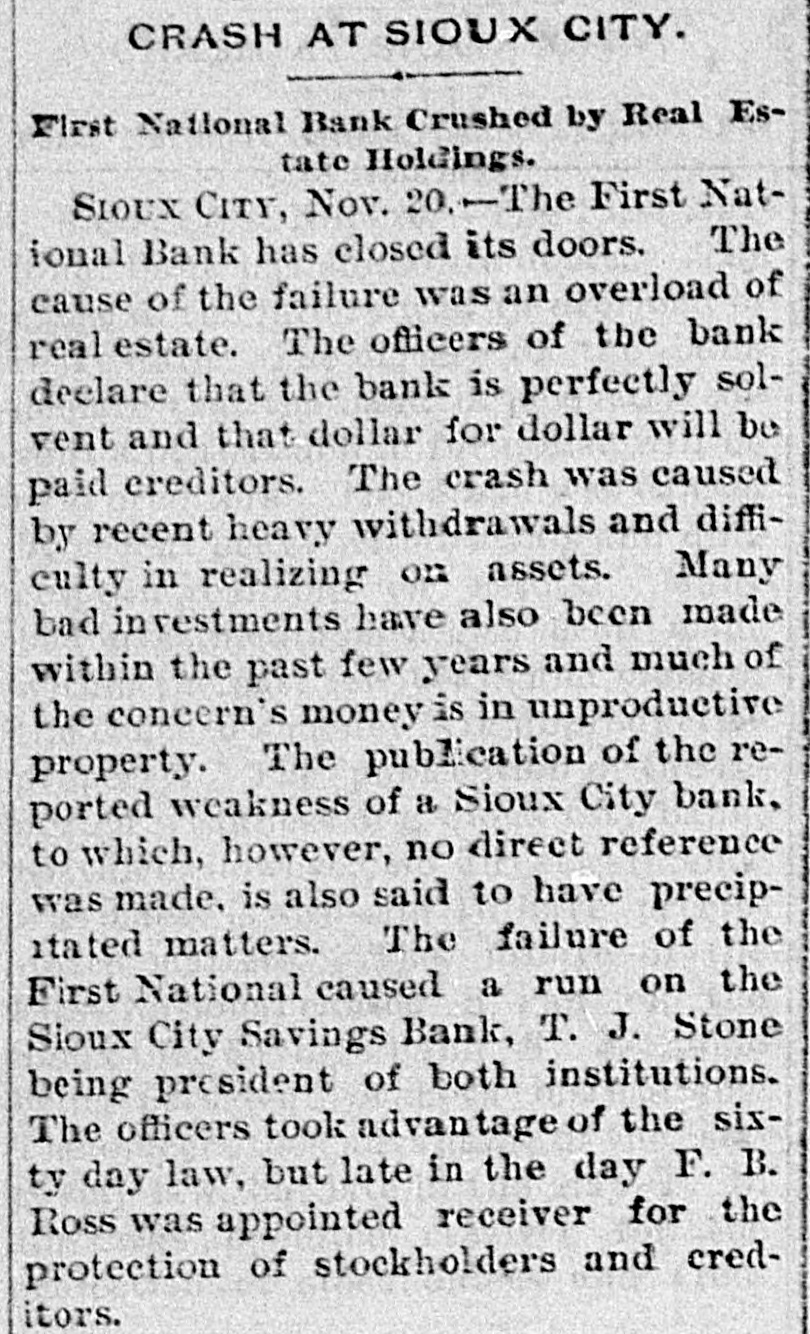
CRASH AT SIOUX CITY. First National Bank Crushed by Real Estate Holdings. SIOUX CITY, Nov. 20.-The First National Bank has closed its doors. The cause of the failure was an overload of real estate. The officers of the bank declare that the bank is perfectly solvent and that dollar for dollar will be paid creditors. The crash was caused by recent heavy withdrawals and difficulty in realizing on assets. Many bad investments have also been made within the past few years and much of the concern's money is in unproductive property. The publication of the reported weakness of a Sioux City bank, to which, however, no direct reference was made, is also said to have precipitated matters. The failure of the First National caused a run on the Sioux City Savings Bank, T. J. Stone being president of both institutions. The officers took advantage of the sixty day law, but late in the day F. B. Ross was appointed receiver for the protection of stockholders and creditors.


Article from The Van Buren Press, November 28, 1896

Click image to open full size in new tab

Article Text

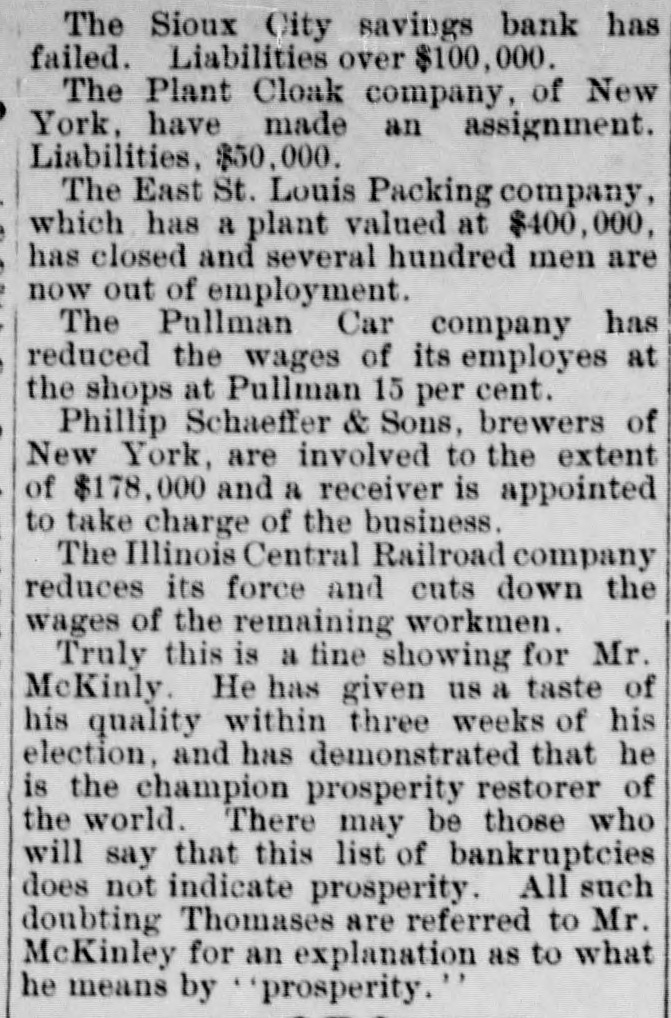
The Sioux City savings bank has failed. Liabilities over $100,000. The Plant Cloak company, of New York, have made an assignment. Liabilities, $50,000. The East St. Louis Packing company, which has a plant valued at $400,000, has closed and several hundred men are now out of employment. The Pullman Car company has reduced the wages of its employes at the shops at Pullman 15 per cent. Phillip Schaeffer & Sons, brewers of New York, are involved to the extent of $178,000 and a receiver is appointed to take charge of the business. The Illinois Central Railroad company reduces its force and cuts down the wages of the remaining workmen. Truly this is a fine showing for Mr. McKinly. He has given us a taste of his quality within three weeks of his election, and has demonstrated that he is the champion prosperity restorer of the world. There may be those who will say that this list of bankruptcies does not indicate prosperity. All such doubting Thomases are referred to Mr. McKinley for an explanation as to what he means by ''prosperity.''


Article from Decorah Public Opinion, December 1, 1896

Click image to open full size in new tab

Article Text

One of the buildings of the Fowler Company, wholesale grocers, at Waterloo, was badly scorched by fire at an early hour in the morning. The building contained stock valued at $50,000, which is believed to be a total loss. The damage to the building is estimated at $5,000. Insurance on building, $11,800; on stock, $33,000. A fire started in the engine house at Belmond a few days ago and burned up all the water works hose so that it was hard to handle the flames. A livery barn belonging to H. J. Klemme was burned also. The engine house with all its contents were burned. The contents of the livery barn were saved. Loss, $2.000. A tramp in the engine house was burned badly, but may live. The fire is supposed to.have caught from a hot stove. A coal shaft belonging to the Consolidation Coal company of Muchakinock, a mining town near Oskaloosa, took fire and the company sustained a loss of about $10,000. M. C. White, the fireman at the shaft, was the only man at the scene. He was inside of the boiler cleaning it when he first discovered the fire. In making his escape he was obliged to crawl out through the flames, and he was literally burned to a crisp from head to foot. He died a few hours later. A $5,000 slander suit will come up in the next session of the Appanoose county court as a result of the election. R. F. Rinker, has sued a neighbor, Elvin Owens, for this amount, alleging that Owens made remarks derogatory to his character by stating that "Rinker intended to vote for Bryan, but he got $25 for voting and working for McKinley." The case excites much ...interest. The plaintiff's friends are much wrought up over the matter. The defendant's friends claim that the use of corruption funds in the campaign will be shown in proving what Owens said is true. The jury in the Krekel murder case, on trial at Burlington, has been secured. County Attorney Tracy addressed them, and stated that the prosecution would endeavor to prove that Henry Tenscher was guilty of the murder of Louis Krekel, some time in the month of November, 1895; that on two different occasions he had admitted his guilt ata private conference before Chief Grenier and also before Jndge Wohlwend; that testimony would be introduced to prove these facts. Attorney Smythe, for the defense, claimed Teuscher was an imbecile, and could not be charged with murder. The case of the H. C. Clock & Son VS. the Hartford Fire Insurance company of Hartford, Conn., which was to come up in the next term of the district court of Franklin county has just been settled. The case grew out of a failure of the company to adjust a loss on two policies, amounting to $5,000, covering a stock of goods and store building. One of the peculiar features of the case was the fact that H. C. Clock, the senior member of |the firm, was agent for the company and this was the first loss during a period of 25 years. The loss was nearly twice the amount of the insurance but the company claimed the insurance on both stock and building was excessive. The insurance company did not pay the full amount of the policies. The First National Bank of Sioux City has closed its doors. The cause of the failure was an overload of real estate. The officers of the bank say that the bank is perfectly solvent and that dollar for dollar will be paid creditors. The crash was caused by recent·heavy withdrawals and difficulty in realizing on assets. Many bad investments have also been made within the past few years and much of the concern's money is in unproductive property. The publication of the reported weakness of a Sioux City bank, to which, however, no direct reference have 04 pies also sp 'epear SEM itated matters. The failure of the First National caused a run on the Sioux City Savings Bank, T. J. Stone being president of both institutions. F. B. Ross was appointed receiver. Several weeks ago a man named Hogan began canvassing among the farmers near Central City. He claimed that a house in Cedar Rapids had failed with a large number of safes belonging to the Alpine Safe company. Rather than ship them back he said he
Article from Omaha Daily Bee, January 23, 1897

Click image to open full size in new tab

Article Text

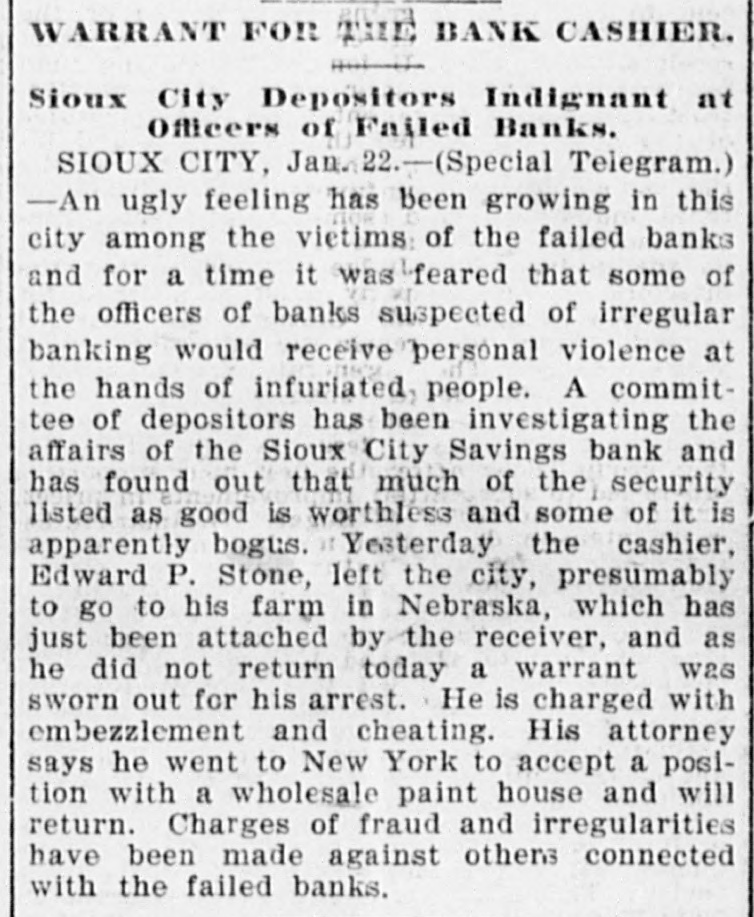
WARRANT FOR THE BANK CASHIER. Sioux City Depositors Indignant at Officers of Failed Banks. SIOUX CITY, Jan 22.-(Special Telegram.) -An ugly feeling has been growing in this city among the vietims of the failed banks and for a time it was feared that some of the officers of banks suspected of irregular banking would receive personal violence at the hands of infuriated people. A committee of depositors has been investigating the affairs of the Sioux City Savings bank and has found out that much of the security listed as good is worthless and some of it is apparently bogus. Yesterday the cashier, Edward P. Stone, left the city, presumably to go to his farm in Nebraska, which has just been attached by the receiver, and as he did not return today a warrant was sworn out for his arrest. He is charged with embezzlement and cheating. His attorney says he went to New York to accept a position with a wholesale paint house and will return. Charges of fraud and irregularities have been made against others connected with the failed banks.


Article from San Antonio Daily Light, January 23, 1897

Click image to open full size in new tab

Article Text

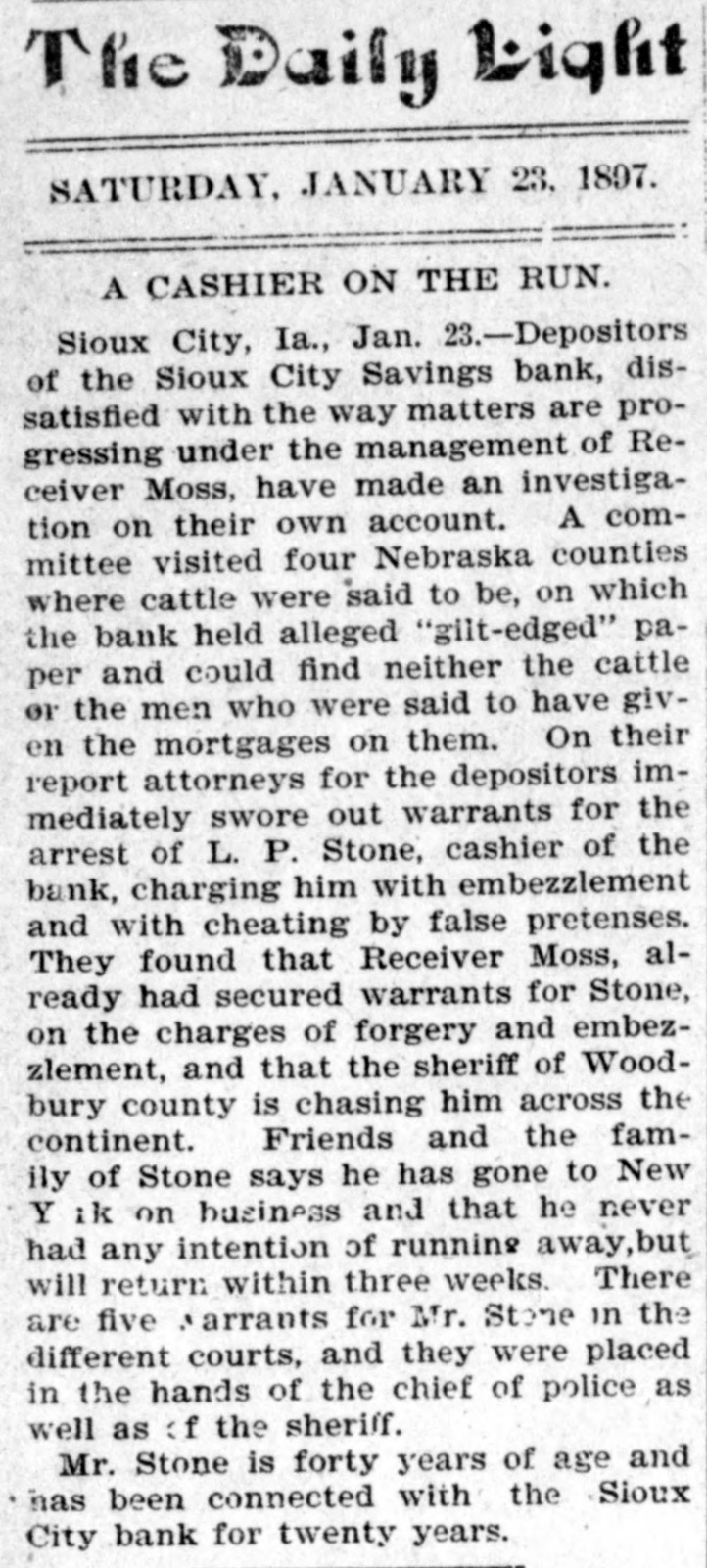
The Daily Light SATURDAY, JANUARY 23. 1897. A CASHIER ON THE RUN. Sioux City, Ia., Jan. 23.-Depositors of the Sioux City Savings bank, dissatisfied with the way matters are progressing under the management of Receiver Moss, have made an investigation on their own account. A committee visited four Nebraska counties where cattle were said to be, on which the bank held alleged "gilt-edged" paper and could find neither the cattle or the men who were said to have given the mortgages on them. On their report attorneys for the depositors immediately swore out warrants for the arrest of L. P. Stone, cashier of the bank, charging him with embezzlement and with cheating by false pretenses. They found that Receiver Moss, already had secured warrants for Stone, on the charges of forgery and embezzlement, and that the sheriff of Woodbury county is chasing him across the continent. Friends and the family of Stone says he has gone to New Y ik on business and that he never had any intention of running away, but will return within three weeks. There are five arrants for Mr. Stone in the different courts, and they were placed in the hands of the chief of police as well as of the sheriff. Mr. Stone is forty years of age and has been connected with the Sioux City bank for twenty years.


Article from Kansas City Daily Journal, January 23, 1897

Click image to open full size in new tab

Article Text

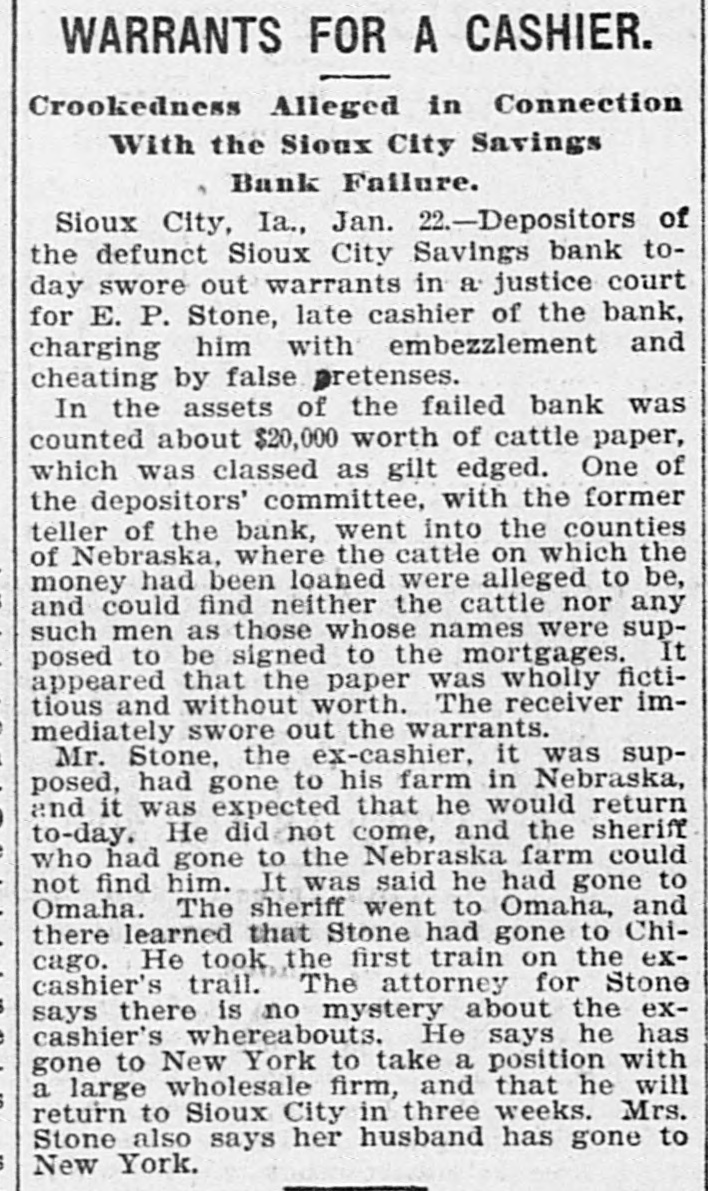
WARRANTS FOR A CASHIER. Crookedness Alleged in Connection With the Sioux City Savings Bank Failure. Sioux City, Ia., Jan. 22.-Depositors of the defunct Sioux City Savings bank today swore out warrants in a justice court for E. P. Stone, late cashier of the bank, charging him with embezzlement and cheating by false pretenses. In the assets of the failed bank was counted about $20,000 worth of cattle paper, which was classed as gilt edged. One of the depositors' committee, with the former teller of the bank, went into the counties of Nebraska, where the cattle on which the money had been loaned were alleged to be, and could find neither the cattle nor any such men as those whose names were supposed to be signed to the mortgages. It appeared that the paper was wholly fictitious and without worth. The receiver immediately swore out the warrants. Mr. Stone, the ex-cashier, it was supposed, had gone to his farm in Nebraska, and it was expected that he would return to-day. He did not come, and the sheriff who had gone to the Nebraska farm could not find him. It was said he had gone to Omaha. The sheriff went to Omaha, and there learned that Stone had gone to Chicago. He took the first train on the excashier's trail. The attorney for Stone says there is no mystery about the excashier's whereabouts. He says he has gone to New York to take a position with a large wholesale firm, and that he will return to Sioux City in three weeks. Mrs. Stone also says her husband has gone to New York.


Article from Abilene Weekly Reflector, January 28, 1897

Click image to open full size in new tab

Article Text

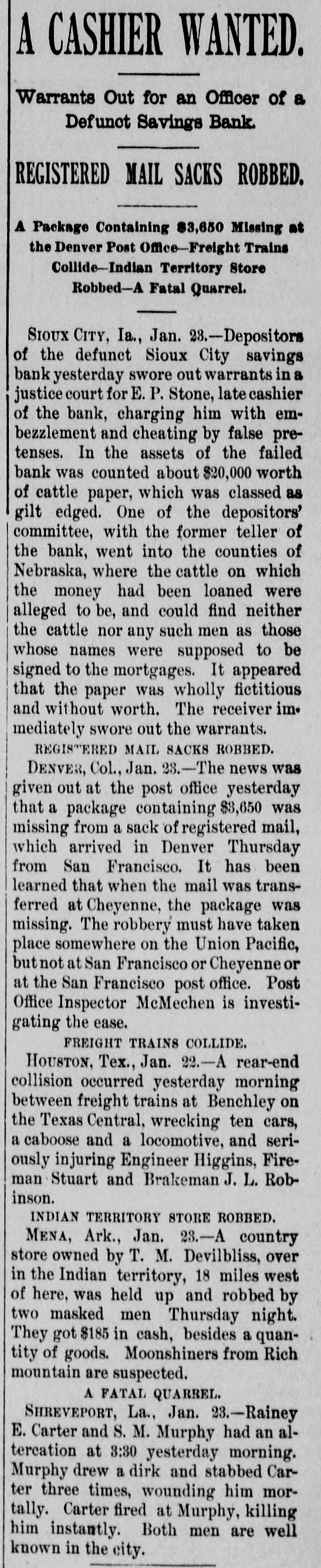
A CASHIER WANTED. Warrants Out for an Officer of a Defunct Savings Bank. REGISTERED MAIL SACKS ROBBED. A Package Containing $3,650 Missing at the Denver Post Office-Freight Trains Collide-Indian Territory Store Robbed-A Fatal Quarrel. SIOUX CITY, Ia., Jan. 28.-Depositors of the defunct Sioux City savings bank yesterday swore out warrants in a justice court for E. P. Stone, late cashier of the bank, charging him with embezzlement and cheating by false pretenses. In the assets of the failed bank was counted about $20,000 worth of cattle paper, which was classed as gilt edged. One of the depositors' committee, with the former teller of the bank, went into the counties of Nebraska, where the cattle on which the money had been loaned were alleged to be, and could find neither the cattle nor any such men as those whose names were supposed to be signed to the mortgages. It appeared that the paper was wholly fictitious and without worth. The receiver im. mediately swore out the warrants. REGISTERED MAIL SACKS ROBBED. DENVER, Col., Jan. 23.-The news was given out at the post office yesterday that a package containing $3,650 was missing from a sack of registered mail, which arrived in Denver Thursday from San Francisco. It has been learned that when the mail was transferred at Cheyenne, the package was missing. The robbery must have taken place somewhere on the Union Pacific, but not at San Francisco or Cheyenne or at the San Francisco post office. Post Office Inspector McMechen is investigating the ease. FREIGHT TRAINS COLLIDE. HOUSTON, Tex., Jan. 22.-A rear-end collision occurred yesterday morning between freight trains at Benchley on the Texas Central, wrecking ten cars, a caboose and a locomotive, and seriously injuring Engineer Higgins, Fireman Stuart and Brakeman J. L. Robinson. INDIAN TERRITORY STORE ROBBED. MENA, Ark., Jan. 23.-A country store owned by T. M. Devilbliss, over in the Indian territory, 18 miles west of here, was held up and robbed by two masked men Thursday night. They got $185 in cash, besides a quantity of goods. Moonshiners from Rich mountain are suspected. A FATAL QUARREL. SHREVEPORT, La., Jan. 23.-Rainey E. Carter and S. M. Murphy had an altercation at 3:30 yesterday morning. Murphy drew a dirk and stabbed Carter three times, wounding him mortally. Carter fired at Murphy, killing him instantly. Both men are well known in the city.


Article from Omaha Daily Bee, June 5, 1897

Click image to open full size in new tab

Article Text

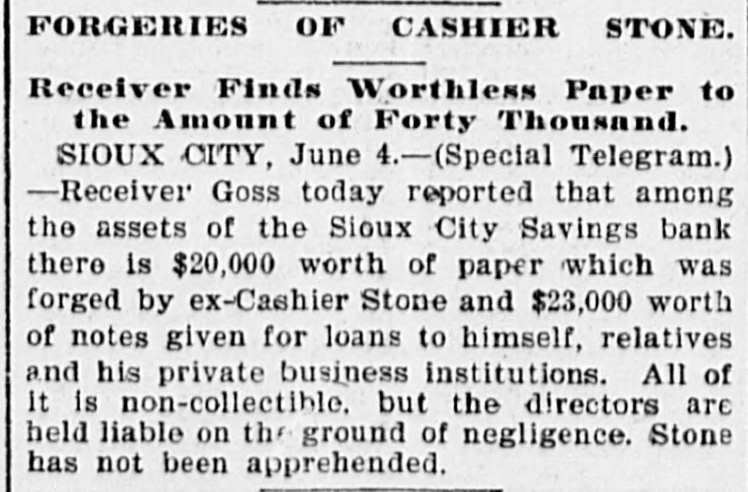
FORGERIES OF CASHIER STONE. Receiver Finds Worthless Paper to the Amount of Forty Thousand. SIOUX CITY, June 4.-(Special Telegram.) -Receiver Goss today reported that among the assets of the Sioux City Savings bank there is $20,000 worth of paper which was forged by ex-Cashier Stone and $23,000 worth of notes given for loans to himself, relatives and his private business institutions. All of It is non-collectible. but the directors are held liable on th ground of negligence. Stone has not been apprehended.


Article from Omaha Daily Bee, March 24, 1898

Click image to open full size in new tab

Article Text

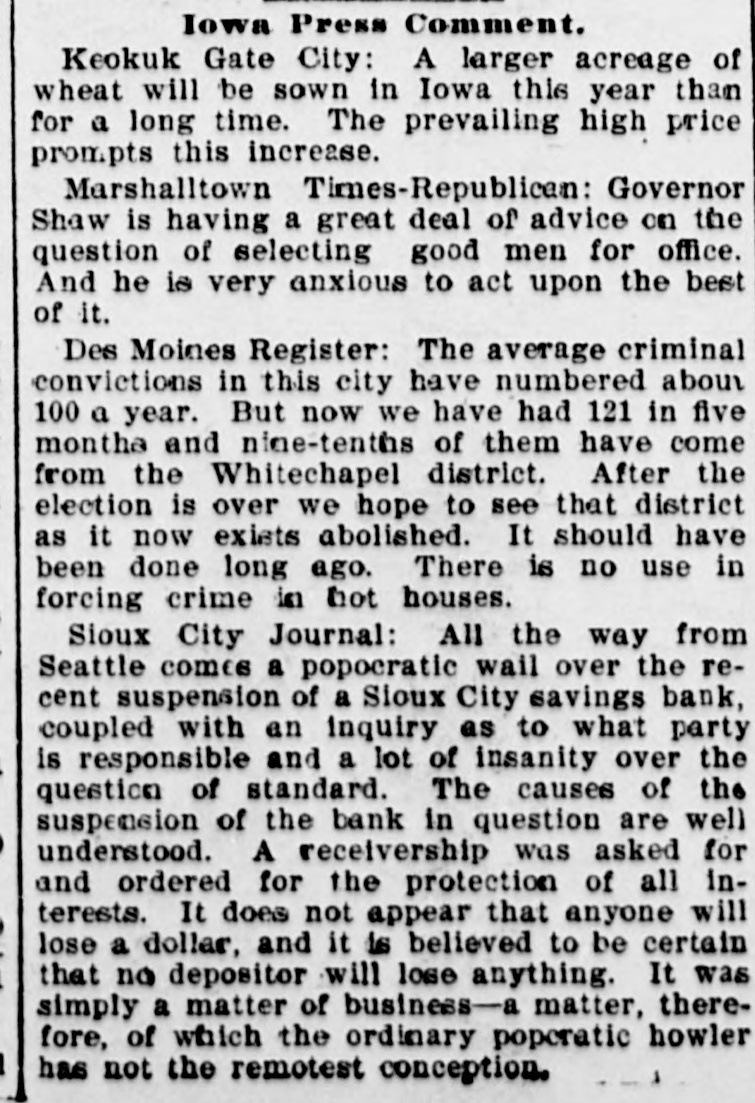
Iowa Press Comment. Keokuk Gate City: A larger acreage of wheat will be sown in Iowa this year than for a long time. The prevailing high price prompts this increase. Marshalltown Times-Republican: Governor Shaw is having a great deal of advice on the question of selecting good men for office. And he is very anxious to act upon the best of it. Des Moines Register: The average criminal convictions in this city have numbered about 100 a year. But now we have had 121 in five montha and nine-tenths of them have come from the Whitechapel district. After the election is over we hope to see that district as it now exiets abolished. It should have been done long ago. There is no use in forcing crime in hot houses. Sioux City Journal: All the way from Seattle comes a popoeratic wail over the recent suspension of a Sloux City savings bank, coupled with an inquiry as to what party is responsible and a lot of insanity over the question of standard. The causes of the suspension of the bank in question are well understood. A receivership was asked for and ordered for the protection of all interests. It does not appear that anyone will lose a dollar, and it is believed to be certain that no depositor will lose anything. It was simply a matter of business-a matter, therefore, of which the ordinary poperatic howler 1 has not the remotest conception.