3736. Sheldon State Bank (Sheldon, IA)

Bank Information

Episode Type
Suspension → Closure
Bank Type
state
Start Date
November 4, 1903
Location
Sheldon, Iowa (43.181, -95.856)

Metadata

Model
gpt-5-mini
Short Digest
0053a472

Response Measures

None

Description

The bank closed its doors in early November 1903 and a receiver (R. W. Ady/Aday) was appointed. Coverage describes insolvency due to heavy farmer/range cattle paper and poor crops; no articles describe depositor runs prior to suspension. Ultimately the bank remained closed and receivership proceedings and criminal indictments followed.

Events (2)

1. November 4, 1903 Suspension
Cause
Local Shock
Cause Details
Bank closed because of inability to realize cash on large volumes of farmer/range cattle paper coming due amid poor local crops; acceptance of too large amount of farm paper left bank illiquid/insolvent.
Newspaper Excerpt
SHELDON STATE BANK OF IOWA TO CLOSE DOORS SHELDON, Iowa, Nov. 5.-A sensation was caused yesterday by the failure of the Sheldon State Bank ... to open its doors.
Source
newspapers
2. November 5, 1903 Receivership
Newspaper Excerpt
R. W. Aday, of Sheldon, was named as receiver. ... The officers say depositors will be paid in full. W. R. Ady has appointed receiver. Assets, $225,000; liabilities, $175,000.
Source
newspapers

Newspaper Articles (21)

Article from The Washington Times, November 5, 1903

Click image to open full size in new tab

Article Text

SHELDON STATE BANK OF IOWA TO CLOSE DOORS SHELDON, Iowa, Nov. 5.-A sensation was caused yesterday by the failure of the Sheldon State Bank, of which Ed C. Brown, State railroad commissioner, is president. to open its doors. The bank. capitalized at $50,000 and carrying $190,000 in deposits, was supposed to be flourishing. R. W. Aday, of Sheldon, was named as receiver. W. D. Boles said the failure was due to acceptance of too large an amount of paper from farmers. Crops locally were poor, and while the securities are good, cash cannot be realized immediately.


Article from Rock Island Argus, November 5, 1903

Click image to open full size in new tab

Article Text

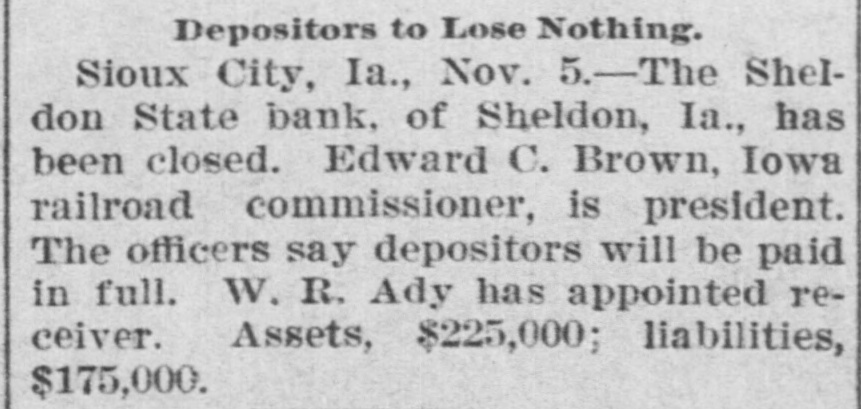
Depositors to Lose Nothing. Sioux City, Ia., Nov. 5.-The Sheldon State bank, of Sheldon, Ia., has been closed. Edward C. Brown, Iowa railroad commissioner, is president. The officers say depositors will be paid in full. W. R. Ady has appointed receiver. Assets, $225,000; liabilities, $175,000.


Article from Iowa State Bystander, November 6, 1903

Click image to open full size in new tab

Article Text

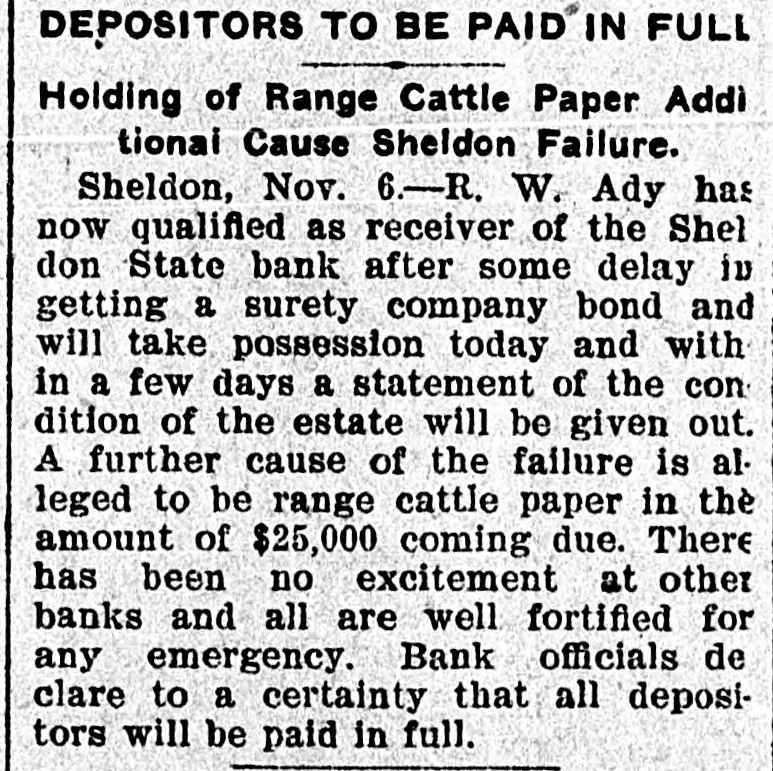
DEPOSITORS TO BE PAID IN FULL Holding of Range Cattle Paper Addi tionai Cause Sheldon Failure. Sheldon, Nov. 6.-R. W. Ady has now qualified as receiver of the Shel don State bank after some delay in getting a surety company bond and will take possession today and with in a few days a statement of the con dition of the estate will be given out. A further cause of the failure is alleged to be range cattle paper in the amount of $25,000 coming due. There has been no excitement at other banks and all are well fortified for any emergency. Bank officials de clare to a certainty that all depositors will be paid in full.


Article from Iron County Register, November 12, 1903

Click image to open full size in new tab

Article Text

Tron County Register. By ELI D. AKE. IRONTON. : : 1 MISSOURI On the 6th, the United States recog nized the new republic of Panama a a de facto government. The Sheldon State bank, of Sheldor Ia., closed on the 4th. The officers sai depositors would be paid in full. Without the firing of a shot and ami scenes of great enthusiasm, the inde pendence of the isthmus and the de partment of Panama was declared, O the 4th. President Roosevelt, on the 6th, re ceived the members of the executiv board of the Women's Foreign Societ of the Methodist Episcopal church which had just concluded its annus convention in Baltimore, Md. Minister Powell cabled the state de partment at Washington, D. C., on th 6th, that the insurgent army wa marching on the city of San Doming He asked that an American man-o war be sent there. The Baltimore wa sent. King Edward, in the presence of sev eral thousand people, on the 3d, lai the foundation stone of the King E ward VII. consumption sanitarium, a Midhurst, Sussex, for the erection ( which Sir Ernest Cassel gave the kin $1,000,000. The cadets of the Western militar academy, at Alton, III., constituted part of the reception committee which met Gov. Richard Yates, on the 3 The governor addressed a mass mee ing of the citizens in the Spauldir auditorium. The first trainload of returnir Dowie "restorationists" arrived at Zie City, Chicago, on the 3d. Later, intervals of an hour or two, train aft train deposited its travel-stained cr saders. The day was devoted to pray and thanksgiving. The First national bank of Victo Col., was closed, on the 4th, by dire tion of the acting comptroller of t currency, the examiner having repor ed the bank to be insolvent. James Lazear, national bank examiner, w appointed receiver. As showing the depth of the reser ment over the success of the Unit States in the Alaskan boundary ma ter, during the performance of a mi strel troupe at Vancouver, B. C., on t 6th, the music of the American anthe was vigorously hissed. Final burial services were held 01 the remains of Emma-Booth Tuck on the 4th, in New York city, and 1 body was placed in a vault at Wo lawn cemetery. Later it will be i terred in the army plot, where two the commander's children are burie Congressman Slemp, in Bristol, V on the 5th, confirmed the rumor the Edward L. Wentz, the young Philad phia millionaire who disappeared, V in the hands of abductors in the moi tains of southwest Virginia, and t.] a ransom of $100,000 was demanded his release. President Roosevelt was asked, the 5th, to forbid the United Sta Marine band to accent encagome


Article from Northern Wisconsin Advertiser, November 12, 1903

Click image to open full size in new tab

Article Text

FISCAL AFFAIRS. The Victor (Colo.) First National bank, with $300,000 deposits, closed. The Sheldon (la.) State bank, with $175,000 liabilities and $225,000 assets. is insolvent. In Chicago A. J. Stone, real estate dealer, petitioned the United States court to relieve him from indebtedness of $61,231. The Bimetallic bank of Cripple Creek, Colo., with $50,000 deposits, closed its doors. The Pueblo (Colo.) Title and Trust company, with $250,000 deposits, assigned. Paul Jones was appointed receiver of the Young Repeating Arms company of Columbus, O., a company. organized under the laws of New Jersey. The company is capitalized at $60,000. Pressing claims amount to $25,000.


Article from Courier Democrat, November 12, 1903

Click image to open full size in new tab

Article Text

Thursday, Nov. 5. About 150 houses were destroyed by fire at Jeremie, Hayti, Monday. The London Daily Mail's Tien Tsin correspondent cables that 10,000 Russian troops have occupied Mukden. In a head-on collision between freight trains on the Cleveland and Pittsburg road at Reeds Run. O., two men were killed and a third badly injured. A Big Four yard engine and a cut of freight cars were wrecked east of Caledonia, O., and Engineer Lee Smith and Henry Meischler. brakeman, were killed. Stephen D. Winner, said to have been the oldest locomotive engineer in active service in the United States, is dead at Newark, N. J., aged eightyone years. The Sheldon State bank of Sheldon, Ia., has closed its doors. Ed C. Brown, Iowa railroad commissioner, is president. The officers say depositors will be paid in full.


Article from Morgan County Democrat, November 13, 1903

Click image to open full size in new tab

Article Text

Happenings of the Past Sever Days in Brief. ROUND ABOUT THE WORLD Casualties and Fires, Personal and Po litical Notes, Business Failures and Resumptions, Weather Record. INTELLIGENCE FROM ALL PARTS DOMESTIC. Railway postal clerks last year handied 15,999,803,630 pieces of mail mat ter. A new counterfeit five dollar silver certificate, series of 1899, check letter A. plate No. 161; Lyons, regis trar; Roberts, treasurer, has been dis covered. Grover Goss, Harry Eitzarach and Ray Ward were burned to death in a livery barn fire at Montpelier, Ind. The Sheldon (Ia.) State bank went into a receiver's hands, with liabilities of $175,000; assets, $225,000. Washington officials believe the rev. olutionists will be successful in Panama and think the supremacy of the United States is complete. Six men were killed and ten injured by the explosion of a United States naval magazine at Iona Island, N. Y. The property loss was $500,000. Chicago banks report an increase of nearly 23 per cent. in savings deposits during the year ended October 15, the total being $104,600,000. President Roosevelt has accepted the resignation of Judge Oliver Shiras, of the northern Iowa district court, to take effect at once. George H. Maxwell, chairman of the national irrigation commission. says the present land laws are an invitation to fraud. President Compers, of the American Federation of Labor, at the Boston convention will oppose sympathetic strikes as a menace to the industrial life of the nation. Employes of the Chicago City Railway company voted in favor of a strike. A general strike of coal miners in district 15, which includes Colorado New Mexico, Utah and Wyoming, is said to be Inevitable. President Roosevelt has been asked to forbid the United States marine band to accept engagements to play for pay. The Bimetallic bank of Cripple Creek, Col., with $50,000 oposits, closed its doors, and the Pueblo (Col.) Title and Trust company, with $250,000 deposits, assigned. The president has appointed Daniel Thew Wright, of Cincinnati, to be justice of the supreme court of the District of Columbia. Edward L. Wentz Philadelphia milHonaire, missing since Oct. 14, is held in the Cumberland (Va.) mountains for $100,000 ransom Hollister Brothers' lumber yard near Thorpe. Wis., containing about 700.000 feet of lumber, was destroyed by forest fires Samuel Adams a negro, was lynched by a mob at Pass Christian, Miss. for assaulting the wife of one of the most prominent residents of the place. Harry J. Hoover, former cashier of the Licking county bank at Newark D., confessed to be short in his ac counts $36,000. There were 246business failures in the United States during the seven days ended on the 6th, against 253 the same wek in 1902. Judge Cleveland, in New Haven Conn. decided that the letter giving $50,000 to William J. Bryan could not be admitted to probate with the will of Philo S. Bennett. Iron workers were ordered on strike which will involve the whole country in a bitter struggle. One hundred nonunion miners near Knoxville, Tenn., were attacked by union men, placed on a train and force to leave town. The exchanges at the leading clearing


Article from Little Falls Herald, November 13, 1903

Click image to open full size in new tab

Article Text

Thursday, Nov. 5. About 150 houses were destroyed by fire at Jeremie, Hayti, Monday. The London Daily Mail's Tien Tsin correspondent cables that 10,000 Rub sian troops have occupied Mukden. In a head-on collision between freight trains on the Cleveland and Pittsburg road at Reeds Run, O., two men were killed and a third badly injured. A Big Four yard engine and a cut of freight cars were wrecked east of Caledonia, O., and Engineer Lee Smith and Henry Meischler, brakeman, were killed. Stephen D. Winner, said to have been the oldest locomotive engineer in active service in the United States, is dead at Newark, N. J., aged eightyone years. The Sheldon State bank of Sheldon, la., has closed its doors. Ed C. Brown, Iowa railroad commissioner, is president. The, officers say depositors will be paid in full.


Article from Manchester Democrat, December 2, 1903

Click image to open full size in new tab

Article Text

The town of Fenton has Incorporated Davenport is to have an automobile club. A new bank is to be launched at Mel bourne. Art Vinall, a Davenport bowler, rolled a perfect score, 300. The town of Thor is undergoing an epidemic of robberies. It is estimated the recent election cost Woodbury County about $3,000 a The Burlington road is building $40,000 coal chute at Hastings The Wilson House, recently destroyed by fire at Denison, will be rebuilt. The Updike elevator, recently burned at Missouri Valley, will be rebuilt. P. C. Rich of Lora was robbed of $5, 200 by two footpads in Kansas City The burned district of Albia will be rebuilt in a more substantial manner. Henry Steffen, sent to prison from Le Mars for manslaughter, is seeking a pardon. The management of the Burlington street railway have provided club rooms for their employes. F. L. Bennett is under arrest at Des Moines charged with stealing a horse and buggy at St. Paul. Capt. and Mrs. J.T. Parker of Sigour ney have just celebrated their fiftieth wedding anniversary A new national bank is being organized at Sheldon to take the place of the one recently suspended. William Nevins of Bloomington, Minn., the is under arrest at Loveland on charge of passing forged checks. A movement is on foot, fathered by the State anti-saloon league, to raise the mulet tax assessed against saloons. The Postmaster General has allowed the postmaster at Des Moines three additional letter carriers on Dec 1. The Waterloo health department is getting after the doctors who disregard the law regarding contagious diseases. Conductor R. S. Hibbard, one of the ploneer employes of the Dubuque division of the Milwaukee, is dead at Savanna, III. The average attendance in the Iowa City schools the past year was 1,350, and the average cost per pupil per month $17.00. A large portion of the C., B. & Q doubie ack between Creston and Council Bluns is now ready for regular train service. The Council Bluffs library trustees are planning trips to a number of cities to secure ideas before beginning their new building. The postmaster at Fort Dodge has made application for the appointment of a mounted mail carrier for the suburbs of that city. While P. W. Hutchinson was-cutting wood near Muscatine the ax glanced from a log and struck his foot, cutting off two toes. Great numbers of carp are being taken from the 'Coon river at Auburn, and many of them weigh from ten to twelve pounds apiece. Henry Ohsann of Lyons fell from a roof and is suffering a number of fractured bones and severe bruises as a result of the fall. There are a number of cases of diphtheria in Muscatine, and a strict quarantine is being enforced to prevent the disease spreading. The supervisors of Woodbury County have voted to issue 5 per cent bonds to the amount of $37,000 to take up outstanding 6 per cent bonds. A Le Mars woman, Jennie Schaarts, has broken the matrimonial record. Her husband was killed last month, and she has just married a feeble minded man. Rev. Howard Cramblet, who has been pastor or the Christian Church at Hampton for the past two years, has tendered his resignation in order to accept a larger pastorate at Mansfield, Ohio. The gasoline launch, Helen Louise, belonging to J. B. Morrison, burned to the water's edge at Fort Madison. Three employes, Clyde Mills, William Schulte and George Whittington, were badly burned, narrowly escaping with their lives. The Bank of Ireton, a private institution, with H. F. McKeever as cashier, has closed Its doors. A notice reading, "Closed for Liquidation" was posted on the doors and no further statement was given out. The failure of the Sheldon State Bank is said to have been respon sible for the closing. T. A. Redden, a retired Clinton farm er, was swindled out of $3,000 by a man giving his name as William Lunger. Lunger borrowed the money from Redden, and gave as security a forged deed for another man's farm, near Maquoketa which he declared he had bought. Lunger's present whereabouts are unknown. The body of a woman found in the woods near Belle Plaine has been identi fied as that of Mrs. William Myers of Keister, Minn. William Myers identified the body as that of his wife, who disappeared from her home several weeks ago. Myers is a wealthy German farmer. A woman answering his wife's de scription passed through Belle Plaine in a light covered wagon, accompanied by an unknown man. The coroner's jury returned a verdict of murder. Officers are endeavoring to find the woman's companion. John Booth of Colorado, now attending Drake University in Des Moines, who won the State college oratorical contest. has been charged with plagiarism and has admitted the charge. Booth advances the novel defense that thought is a common product and he therefore had the right to it. Booth's oration was entitled "The Sublimity of Great Convictions," and was largely a reproduction from a chapter in "Patriots and Principles,' called "The Value of Decision.' The plagiarism was discovered by a girl in the sophomore class. Leonard W. Haley, editor of the Ana mosa Prison Press, now serving a life sentence for the murder of Officers Talcott and Frith of Dubuque in 1893, will be among those who will petition the Legislature for a pardon at the approaching session. Fire broke out in the business section of Pocahontas and the buildings occu pied by the Mutual Telephone Exchange, the the Quinn Hardware Company Morse Clothing Company and the Whitney pool room and bowling alley were consumed. The loss is estimated at $50, 000. James Casey set a new example in Fort Dodge the other day, by walking into court to make personal application to be sent to the dipsomaniac ward of the Cherokee hospital for the insane. Mrs. Mary Boyer of Oskaloosa, aged 82 years, is suffering from a bad fracture of the left femur near the hip joint. A heavy door was blown against her, throwing her to the ground and inflicting the injury.
Article from The Minneapolis Journal, December 11, 1903

Click image to open full size in new tab

Article Text

SHELDON, IOWA-Th report of the receiver of the Sheldon State bank has been filed with the court. It is believed the bank will pay depositors about 70 cents on the dollar.


Article from Evening Times-Republican, December 14, 1903

Click image to open full size in new tab

Article Text

WILL PAY ALMOST NOTHING. Failed Sheldon Bank Will Realize But Little for Depositors. Special to Times-Republican. in Primghar, Dec. 14.-People O'Brien county are interested in the reports which are being printed in the newspapers about the condition of th failed Sheldon State bank. Men who have familiarized themselves with the report of the receiver and the character of the assets declare that statements which have recently been sent to the Tribune and other papers that the institution will pay about 60 cents on the dollar to depositors are entirely at fault. It Is stated on the other hand. on the testimony of men who are well acquainted with the people whose notes are listed, that it will not pay over 30 cents on the dollar. One of these IS authority for this statement: Says Assets Are Bad. "Of the $195,000 of assets scheduled. at least $75,000 is not worth the paper it is written on, and is in fact the rottenest of stuff ever set up by any concern as assets of a banking institution. All or nearly all of the really good notes given the bank are in soak in Chicago, Des Moines and Sioux City, and of course these creditors will be paid in full while the local creditors will suffer." It is further declared by representatives of depositors that the people of O'Brien county will never stop short of rigid and thorough probing of the affairs of the bank, and prosecutions are hinted at in strong terms. One of the charges is that the bank has been insolvent for a year and a half and that the fact should have been patent to bankers. On the other hand the friends of Ed C. Brown insist that he employed the best of judgment, and closed the bank at a time when It was yet possible that it might have been tided over, because he did not propose. to take chances of violating the banking laws.


Article from Ottumwa Tri-Weekly Courier, March 10, 1904

Click image to open full size in new tab

Article Text

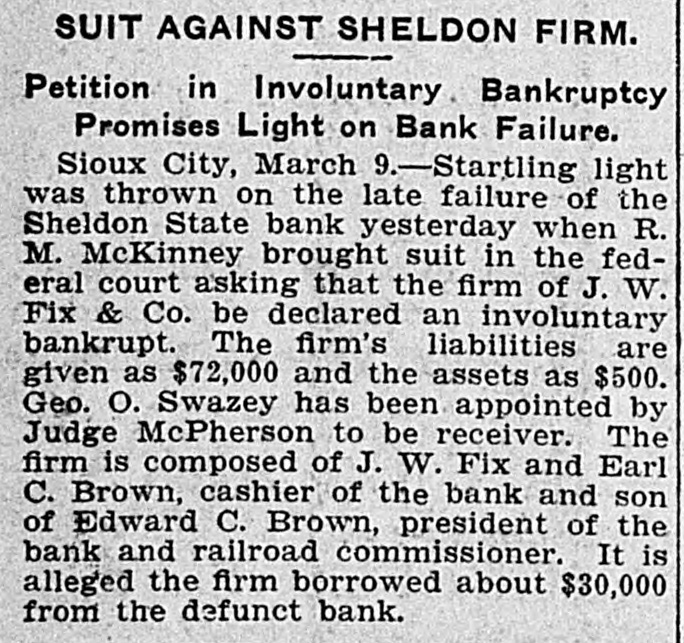
SUIT AGAINST SHELDON FIRM. Petition in Involuntary. Bankruptcy Promises Light on Bank Failure. Sioux City, March 9.-Startling light was thrown on the late failure of the Sheldon State bank yesterday when R. M. McKinney brought suit in the federal court asking that the firm of J. W. Fix & Co. be declared an involuntary bankrupt. The firm's liabilities are given as $72,000 and the assets as $500. Geo. O. Swazey has been appointed by Judge McPherson to be receiver. The firm is composed of J. W. Fix and Earl C. Brown, cashier of the bank and son of Edward C. Brown, president of the bank and railroad commissioner. It is alleged the firm borrowed about $30,000 from the defunct bank.


Article from Evening Times-Republican, April 2, 1904

Click image to open full size in new tab

Article Text

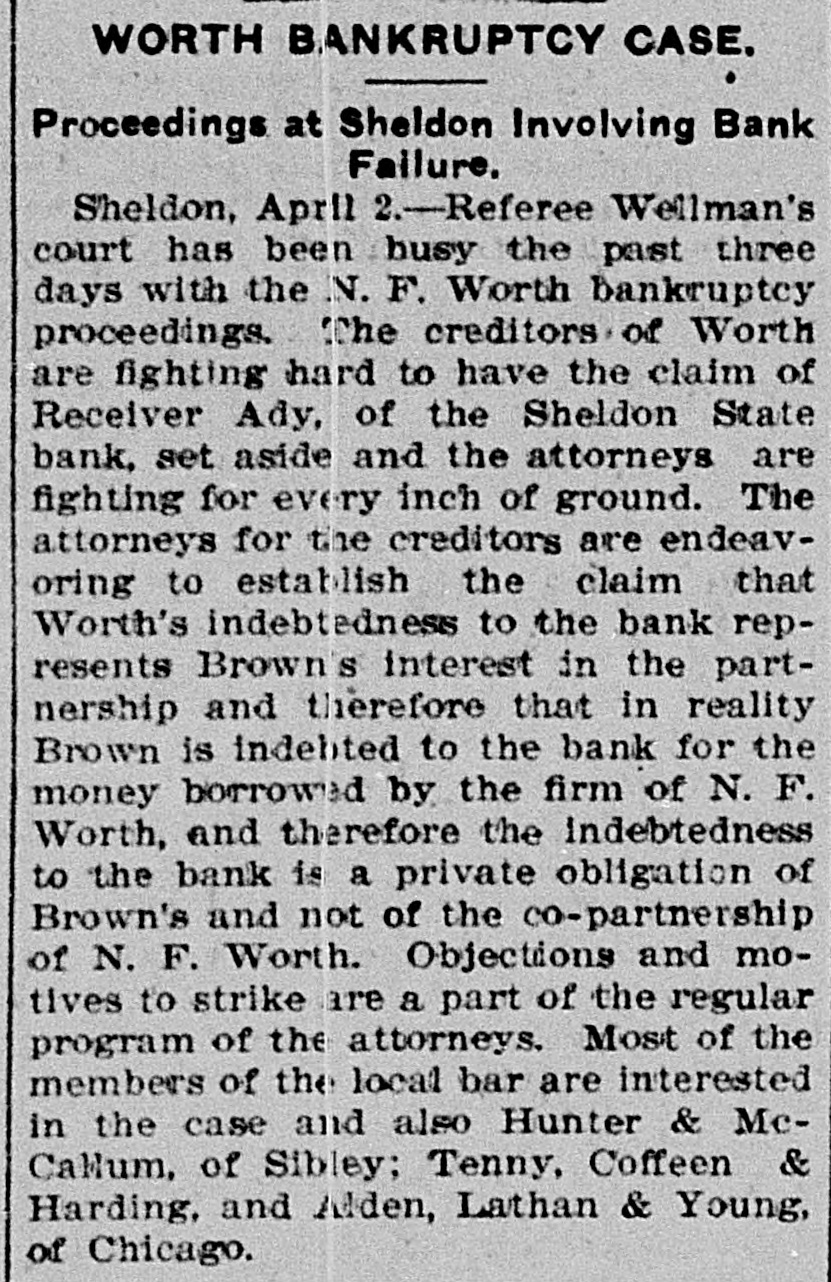
WORTH BANKRUPTCY CASE. Proceedings at Sheldon Involving Bank Failure. Sheldon, April 2.-Referee Wellman's court has been busy the past three days with the N. F. Worth bankruptcy proceedings. The creditors of Worth are fighting hard to have the claim of Receiver Ady, of the Sheldon State bank, set aside and the attorneys are fighting for every inch of ground. The attorneys for the creditors are endeavoring to establish the claim that Worth's indebtedness to the bank represents Brown's interest in the partnership and therefore that in reality Brown is indebted to the bank for the money borrowed by the firm of N. F. Worth, and therefore the Indebtedness to the bank is a private obligation of Brown's and not of the co-partnership of N. F. Worth. Objections and motives to strike are a part of the regular program of the attorneys. Most of the members of the local bar are interested in the case and also Hunter & McCalum, of Sibley; Tenny, Coffeen & Harding, and Adden, Lathan & Young, of Chicago.


Article from The Mitchell Capital, May 6, 1904

Click image to open full size in new tab

Article Text

ED. C. BROWN AND SONS ARE INDICTED Sheldon Banker and Railroad Commissioner Charged on Four Counts. PULLS OUT OF THE RACE Mr. Brown Announced That He Would No Longer Attempt to Press His Candidacy for Renomination This Year. Sheldon, Ia., May 5.-The O'Erien county grand jury Tuesday afternoon voted five indictments against Ed C. Brown, chairman of the lowa board of ailroad commissioners and president of he failed Sheldon State bank of this place, for irregularities in connection with the bank's affairs, leading to its ailure. They are understood to inlude one and possibly two for emezzlement, one for declaring a divilend when the bank was insolvent, and least one for receiving deposits after he bank was known to be insolvent. Earl W. Brown, cashier of the bank, and Ed C. Brown, jr., a director, both of President Brown, are also inlicted on five counts each, the same acusations being made against all hree. The indictments were returned the jury sitting at Primghar, the county seat. The Indictments have not yet been reported to the court, but Mr. Brown vas waiting to be called before the jury it is understood was not called, he indictments being based on records. The largest embezzlement charged is based on a loan of $72,000 to J. W. Fix Co., a firm of which Earl Brown, ashier and son of President Brown, vas a member. Earl Brown signed the irm name of Fix & Co. to the notes, he loan being made without authorizaof the directors, which is contrary statute in case of an officer of the bank. Paid Dividend When Insolvent. It is charged in another indictment hat on April 13, 1903, the band declared dividend of nearly $4,000, being then nsolvent. In another, Brown is charged with having borrowed $6,000 from a Chicago ank on his personal note and later writing the bank to charge it against he bank, which is alleged to constitute mbezzlement. There are several specharges of receiving deposits after he bank was insolvent. The bank originally had $100,000 capbut in 1892 was reorganized, the apital being cut to $50,000. It is harged with carrying over $78,000 of ractically worthless paper to the new rganization, and therefore being inolvent from the beginning of the new rganization. Ed C. Brown left Sheldon after it was iven out that the indictments had been


Article from The Washington Times, December 28, 1904

Click image to open full size in new tab

Article Text

TEN BANKERS IN IOWA SELF-SLAIN Record Year of Disaster in That State. CATTLE BROUGHT DOWNFALL Faced by Ruin, Half a Score of Hawkeye Officials Committed Suicide. DES MOINES, Dec. 28.-An unprecedented record of disaster among Iowa banks will be disclosed by a report now being prepared at the State auditor's office for 1904. Culminating last week with the closing of the savings bank at Dedham, this is the year's startling record: Ten bank cashiers dead by suicide. Forty banks wrecked and their surplus squandered. Twelve millions of dollars lost to depositors. In two instances bank officers have absconded with funds, thus accounting for the failure, but the remarkable number of failures due to similar circumstances has aroused the curiosity of the whole State to ascertain the cause. These are the suicides of the year due to bank failures, so far as the State officials know: H. C. Spencer and his son, cashier and assistant cashier of the Grinnell National Bank. George D. Wood, cashier of the Bank of Colfax, Colfax, Iowa. Charles Wood, cashier of the Citizens' Bank of St. Charles. F. L. La Rue, cashier of the Corning State Bank. G. D. Utterback, cashier of the Sigourney Savings Bank. H. W. Main, cashier of the Linn Grove Bank. Cashier of the Lone Tree Bank. Two other suicides early in the year, whose names are not recalled by the attaches of the State auditor's office. Tragedy Follows Tragedy. It is only within the past few days that the State has become aware of the magnitude of the disasters and the tragedies attending them, many of the failures having been kept quiet. Not until the two suicides in quick succession at Lone Tree and Linn Grove, and the failure of the Sheldon State Bank, with losses amounting to many thousands, created a State-wide sensation was general attention attracted to the serious condition of affairs. The failure of the bank at Collfax, the National Bank at Storm Lake, and the bank at Sigourney, with the suicide of the cashier, added to the sensation. The suicide of Cashier Utterback, of the Sigourney Bank, was followed by the discovery of extensive forgeries which he had perpetrated to cover up a shortage which had been running for some time. His shortage, like those of the eight other cashier suicides, was apparently due to one of two causesspeculation on the Chicago board of trade and the juggling of prices by the meat trust. Meat Trust Blamed. The meat trust is blamed by thousands throughout Iowa for the year's tragedies. In almost every bank that failed large quantities of paper, based on higher prices for five stock, were found, the makers being unable to meet their loans owing to the cut in prices of live stock. In almost every case the cashier had trusted to the prices of cattle remaining high, and this, coupled with speculative plunges on the board of trade, accomplished their ruin. Back of this recklessness. State Bank Examiner Cox declares, is the lax banking law of the State, and as a result of the year's melancholy record efforts are already making to amend this law. The epidemic of banking suicides started with that of Cashier George D. Wood, of the Bank of Colfax He was regarded as one of the shrewdest and most trustworthy bankers of the State, and his suicks caused a great sensation. Investigation developed that he personally had been a large investor in live stock and had loaned extensively for cattle purchases. The drop in eattle prices brought him face to face with ruin, if not dishonor, and he took his life. Wood had been accounted the wealthiest and most public-spirited man in his county, and imputation of dishonesty is hotly resented by every man in his home city. The cause of his downfall is illustrated by the sale, after his suicide, of paper representing a par value of $175,000 for $640. State Bank Examiner Cox declares that such worthless paper would never have been admitted to the bank if the institution had been subject to State inspection. A Six-Figure Failure. The death of E. H. McCutchon, one of the best-known politicians in the State, precipitated the wreck of the bank at Holstein. Directly after his death it was discovered that the loss at this bank would run into the six


Article from Omaha Daily Bee, October 18, 1905

Click image to open full size in new tab

Article Text

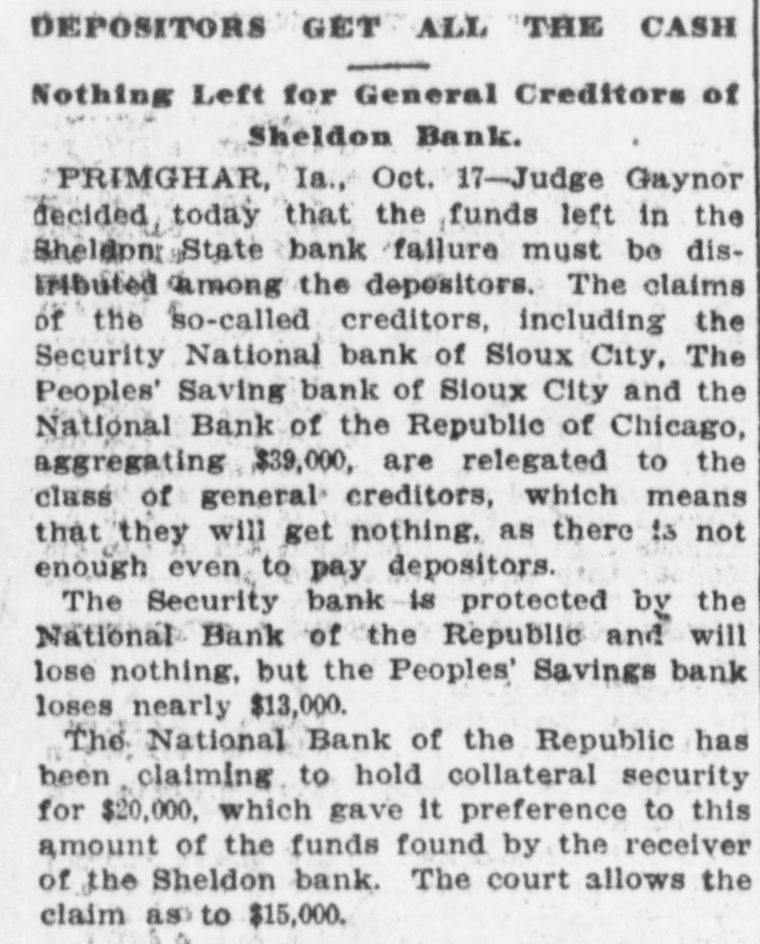
DEPOSITORS GET ALL THE CASH | Nothing Left for General Creditors of Sheldon Bank. PRIMGHAR, Ia., Oct. 17-Judge Gaynor decided today that the funds left in the Sheldon: State bank failure must be disiributed among the depositors. The claims of the so-called creditors, including the Security National bank of Sioux City, The Peoples' Saving bank of Sioux City and the National Bank of the Republic of Chicago, aggregating $39,000, are relegated to the class of general creditors, which means that they will get nothing, as there is not enough even to pay depositors. The Security bank is protected by the National Bank of the Republic and will lose nothing, but the Peoples' Savings bank loses nearly $13,000. The National Bank of the Republic has been claiming to hold collateral security for $20,000, which gave it preference to this amount of the funds found by the receiver of the Sheldon bank. The court allows the claim as to $15,000.


Article from Omaha Daily Bee, October 21, 1905

Click image to open full size in new tab

Article Text

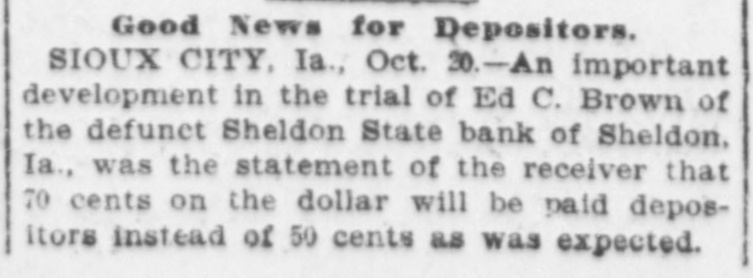
Good News for Depositors. SIOUX CITY, Ia., Oct. 20.-An important development in the trial of Ed C. Brown of the defunct Sheldon State bank of Sheldon, Ia., was the statement of the receiver that 70 cents on the dollar will be paid depositors instead of 50 cents as was expected.


Article from Evening Times-Republican, October 23, 1905

Click image to open full size in new tab

Article Text

Evidence In the Trial of Sheldon Banker Shows Loans Were Made to Many SECURITY WAS INSUFFICIENT Brown Seemed to Have Been Unable to Deny Favors to His Friends and Was More of a "Good Fellow" Than a Rogue in His Dealings With the Bank-News of Interest. Special to Times-hepublican. Primghar, Oct. 23.-In the mass of evidence of the loose banking methods of E. C. Brown, on trial on criminal charges for wrecking the Sheldon State bank, there is more to prove him a "good fellow," in the general acceptation of the phrase than a "bad fellow" in the sense of using other person's money to enhance his own fortune. Receiver R. W. Ady, just before court adjourned Saturday, stated that notes in the bills receivable, which are absolutely worthless, will total over $100,000. The makers of these notes form a list of more than 200 persons, beneficiaries of the charitable spirit of Brown. Farmers, school teachers, impecunious artisans and business acquaintances borrowed this money and if they had no chattels they gave no security. The loaning of $35,000 to the fictitious firm of J. W. Fix & Co., appears to have been Brown's only overt act in an effort to benefit himself. It was this that broke the institution. Court adjourned till today. The state will probably rest its case tonight and the defense finish Wednesday. Some of the Evidence. The two principal witnesses for the state so far were Fred F. Frisbee. cashier of the First National bank of Sheldon, and R. W. Ady, receiver of the Sheldon State bank. It was sought by the state to prove by Mr. Frisbee that a large number of notes carried and listed as assets by the Sheldon State bank were worthless, and the further fact that Mr. Frisbee was one of a committee agreed upon by the Browns and the depositors to examine into the affairs of the bank next day after the failure; and that the real estate assets of the bank were far below in value from the estimates placed upon them by the Browns, and as carried on the bank's books as bills receivable. The other two members of that committee were Hon. Tim Donohue and Joseph Shinski, the latter a capitalist of Sheldon. The board of appraisers were also placed on the stand who had appraised the bank's assets, they being Frank Frisbee, president of the First National bank of Sheldon; H. W. Conant, a justice of the peace of Sheldon, and W. H. Sleeper, cashier of the Union bank of Sheldon. Following these witness1 es R. W. Ady, receiver, was placed on the stand for an entire day, going into 1 all the notes and other assets of the bank, showing that many of them were worthless. 1 Carroll's Letter Damaging. The most damaging evidence to the defense so far offered by the state was I a letter from State Auditor B. F. CarTO roll, bearing date of some time in Aua gust, 1903, in which the auditor informed Mr. Brown that according to t the state bank examiner's report the to Sheldon State bank was carrying too 1 large an overdraft, and advises Mr. Brown to reduce this overdraft at o once. The auditor also informed him o that the law prohibited the bank from " loaning more than $10,000 to any one person, while the report shows that


Article from The Minneapolis Journal, October 24, 1905

Click image to open full size in new tab

Article Text

# FRUIT GROWERS TO SUE RAILROADS COURTS WILL BE ASKED TO DECIDE QUESTION OF RATES. Attorney J. H. Call Arrives at Sioux City and Says an Attempt Will Be Made to Recover $5,000,000, Paid to Roads in Excess of Commission's Rates. Special to The Journal. Sioux City, Iowa, Oct. 24.—Joseph H. Call of California, the well-known attorney who conducted the recent litigation for California fruit growers against the railroads, said yesterday that suit will be brought by the fruit-growers to recover $5,000,000 paid the railroads in over charges. "There is no power under the present law whereby a court of the United States, or any state, can put into effect a railroad rate as a substitute for one found by the interstate commerce commission to be unjust," he said. Acting for the fruit-growers, he secured a ruling from the commission that the rate on oranges was unjust and should be $1.10 instead of $1.25 from California to Missouri river points. The railroads refused to lower the rate, and Call says the only relief the growers can have is to sue for the over-charge. This, he estimates, would amount to $5,000,000 before such a suit could be brought to judgment. Mr. Call has been mentioned as a possible candidate for the interstate commission, but he candidate for the interstate commerce commission, but he declares he would not take such a position. He is on his way to the interstate commerce law convention at Chicago, in which he will take a prominent part. He visited his two brothers here yesterday. The defense scored yesterday in the trial at Primghar of Ed C. Brown, president of the failed Sheldon State bank, when Receiver R. W. Ady admitted, in reply to questions by W. D. Boies, attorney for Brown, that the bank had been compelled to sell much of its real property at a figure much below the actual value. It was shown a big mill at Sheldon was sold at $5,000, when the insurance companies valued it at $15,000. It was also shown a big ranch at Ipswich, S. D., was sold at about 50 cents on the dollar. Ady said, in explaining the two transactions, that it was necessary to close up the bank's affairs, and therefore he was compelled to sell at a sacrifice. He stated he had already collected $120,500 for the creditors, and he might collect more, but insisted he could not obtain enough to pay out. This is very material to the case, for Brown is charged with receiving money when he knew the bank was insolvent. If he can show the bank was not insolvent, he of course will have a good defense.


Article from The Brookings Register, October 26, 1905

Click image to open full size in new tab

Article Text

JOY FOR DEPOSITORS. Sheldon, lowa, Bank Liabilities Reduced by Court's Ruling. Sioux City, Iowa, Oct. 24.-The depositors in the defunct Sheldon State bank at Sheldon, Iowa, will get 70 cents on the dollar instead of 50, which was all they had been counting on. The recent decision of Judge Gaynor in ruling out preferred claims reduced the liabilities of the bank to $4,000. The announcement has caused joy among the hundreds of smaller creditors of the bank. The revised report of the receiver will be part of the evidence in the criminal case against Ed C. Brown, who was president of the bank.


Article from Evening Times-Republican, October 26, 1905

Click image to open full size in new tab

Article Text

# MAKING STRONG DEFENSE. Sheldon Banker's Son Testifies In His Father's Behalf. Primghar, Ia., Oct.26.-The state rested its case against Ed C. Brown after continuing the examination of R. W. Ady, receiver, and putting J. M. Shrenk on the stand, who made the deposit on the day the bank failed. The state proved by Shrenk that Ed C. Brown and his two sons were all in the bank when this deposit was made, but the defense will prove by at least two or three witnesses that Ed. C. Brown was not in the banking room of the building when the deposit was made, and knew nothing of it until after the failure. Shrenk admitted that his firm, the Sheldon marble works, for whom the deposit was made, at that time owed the bank on a note not then due. The case so far looks bright for Brown and his acquittal is predicted by some. W. D. Boies, one of Brown's attorneys, said yesterday that the state had not made a case agaist Brown, either under the law or the facts. State Bank Examiner Bennett was here but did not testify as the court ruled that the solvency of the old Sheldon bank, which was merged into the Sheldon State bank in April, 1902, was not involved and as evidence along that line was excluded, Mr. Bennett did not testify. Son & Strong Witness. The afternoon was taken up with the examination of Earl W. Brown, son of Ed C. Brown, and cashier of the bank. Mr. Brown made a strong witness for the defense and untangled many of the bank's nets and snares the state had set by trying to show the worthlessness of many of the bank's assets in the form of notes and mortgages. He made clear many trans-actions which the state claimed were shady. Ed C. Brown, the father, will be the next witness for the defense, and as he is thoroughly familiar with the books of the Sheldon State bank, and with the old Sheldon bank as well, for the past thirty years, he will probably be kept on the stand for many hours.