Chestnut Street National Bank (Philadelphia, PA)

Episode Information

Episode UID
372301176
Episode Type
Run β†’ Suspension β†’ Closure
Bank Type
national
Bank ID
37230 national
Charter Number
3723
Start Date
December 23, 1897
Location
Philadelphia, Pennsylvania (39.952, -75.164)

Metadata

Model
gpt-5-mini (chosen from majority vote of a three-model LLM ensemble)
Short Digest
d6b07b294d95b4c5

Response Measures

Borrowed from banks or large institutions, Capital injected, Full suspension, Books examined

Receivership Details

Depositor recovery rate
100.0%
Date receivership started
1898-01-29
Date receivership terminated
1916-09-30
OCC cause of failure
Fraud
Share of assets assessed as good
43.2%
Share of assets assessed as doubtful
12.1%
Share of assets assessed as worthless
44.7%

Description

Suspension followed by attempted voluntary liquidation; receiver later involved and indictments/hearings followed.

Events (5)

1. June 14, 1887 Chartered
Source
historical_nic
2. December 23, 1897 Run
Cause
Bank Specific Adverse Info
Cause Details
Withdrawals driven by revelations of large losses and heavy indebtedness of bank president William M. Singerly (paper mill losses, large personal loans).
Measures
No special public measures reported beyond attempts by bankers and committees to raise funds to relieve the banks.
Newspaper Excerpt
it is said there have been quiet but steady runs on both banks for several days past.
Source
newspapers
3. December 23, 1897 Suspension
Cause
Bank Specific Adverse Info
Cause Details
Suspension due to shrinkage in value of Singerly Pulp and Paper Mills and Singerly's heavy indebtedness to the bank, rendering it insolvent.
Newspaper Excerpt
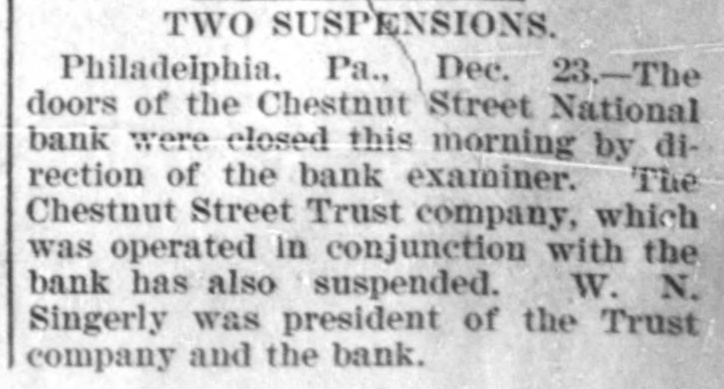
the Chestnut Street National bank and the Chestnut Street Trust and Savings Fund company were obliged to suspend business yesterday.
Source
newspapers
4. January 29, 1898 Receivership
Source
historical_nic
5. April 1, 1898 Receivership
Newspaper Excerpt
George H. Earle, receiver of the bank, and all of the directors of the institution gave testimony.
Source
newspapers

Newspaper Articles (22)

Article from The Morning News, December 24, 1897

Click image to open full size in new tab

Article Text

circles that Mr. Singerly's banks were in trouble, and the national bank examiner, it is said, was aware of the condition of affairs. Last night it is said, a number of leading bankers of the city nad a conference which lasted until nearly 3 o'clock, considering the matter of raising a sufficient amount of money to relieve Mr. Singerly's banks of their distress. It is understood a proposition to float $2,000,000 preferred stock of the Philadelphia Record had been practically agreed to when the discovery was made that owing to the in. volved condition of the trust company's finances, this sum would not be within several hundred thousand dollars of the amount required. The negotiations were therefore declared off, and the banks were forced to the wall. Now it is hoped that the committee which began to-night where the former committee left off will succeed in satisfactorily adjusting the finances, and thus permit the banks to pay depositors dollar for dollar. The statements of the cause of the failure current here agree with that made by Controller Eckels at Washington to-day, that it was primarily due to the loss of much money by Mr. Singerly in his unproductive paper mill at Elkton, Md., one of the largest in the country. One statement placed the sum thus involved at near_ ly $1,000,000. Mr. Singerly also has much money invested in other enterprises in this and other cities. Rumors were current to the effect that the ownership of the Record would pass from Mr. Singerly, but this he denied, stating positively that he is in absolute control of the paper and will continue at its head. It is said there have been quiet but steady runs on both banks for several days past. Much sympathy is expressed on all sides for Mr. Singerly. He has occupied such a prominent place in the affairs of the city and the state for years past that the news of his financial difficulties naturally created a sensation. Crowds were gathered in front of the big granite banking building all day, but all was quiet. A great number of small amounts were carried by the trust company, and apprehension was expressed that some distress might follow the failure. If the hopes of a quick settlement are realized, however, all depositors will be paid in full within a short time. The last report of the condition of the Chestnut Street National Bank, made on Oct. 5, 1897, was: Resources-Loans and discounts, $2,790.508.65; overdrafts, secured and unsecured, $3,552.34; United States bonds to secure. circulation, $250,000; United States bonds to secure United States deposits, $100,000; premiums on United States bonds, $10,500; due from the national banks, $226,631.70; due from the state banks and bankers, $8,851.46; due from approved reserve agents, $300,732.78; checks and other cash items, $54,387.74; exchange for clearing house, $174,595.47; notes of other national banks, $3,184; fractional paper currency, nickels and cents, $2,835.94; lawful money reserve in bank, $149,040.50; redemption fund with United States treasurer, $2,250; total, $3,868,070.58. Liabilities-Capital stock, paid in, $500,000; rplus fund, $150,000; undivided profits, less expenses and taxes paid, $24,924.86; national bank notes outstanding, $43,600; due to other national banks. $506,110.41; due to state banks and bankers, $134,771.70; individual deposits subject to check, $2,035,856; demand certificates of deposit, $11,070; cashier's checks outstanding, $126,572.51; United States deposits, $94,715.10; bills payable, $250,000; total, $3,868,077.58.


Article from The Wilmington Daily Republican, December 24, 1897

Click image to open full size in new tab

Article Text

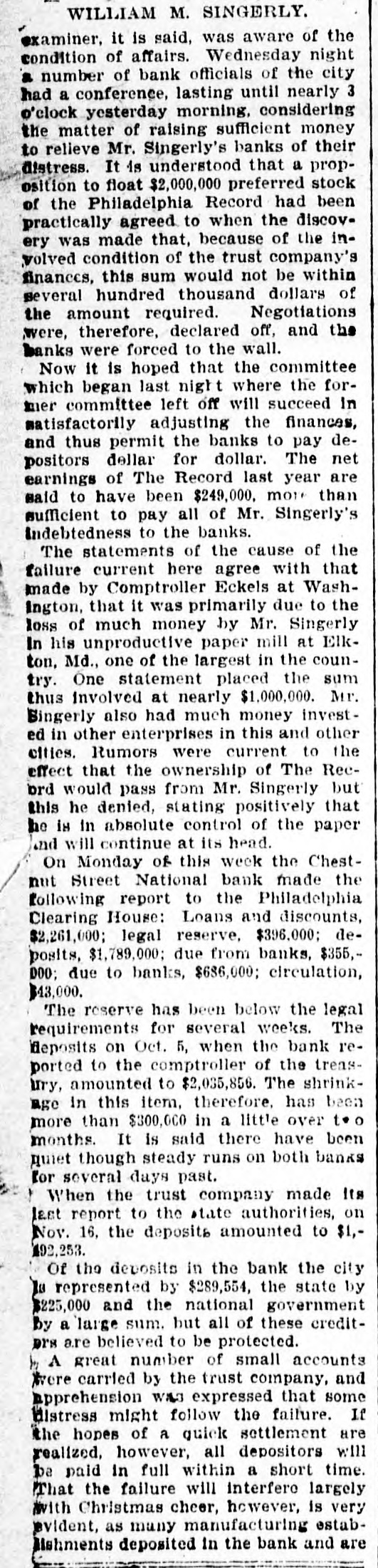
WILLIAM M. SINGERLY. examiner, it is said, was aware of the condition of affairs. Wednesday night number of bank officials of the city had a conference, lasting until nearly 3 o'clock yesterday morning, considering the matter of raising sufficient money to relieve Mr. Singerly's banks of their distress. It is understood that a proposition to float $2,000,000 preferred stock of the Philadelphia Record had been practically agreed to when the discovery was made that, because of the involved condition of the trust company's finances, this sum would not be within several hundred thousand dollars of the amount required. Negotiations were, therefore, declared off, and the banks were forced to the wall. Now it is hoped that the committee which began last night where the foriner committee left off will succeed in satisfactorily adjusting the finances, and thus permit the banks to pay depositors dellar for dollar. The net earnings of The Record last year are said to have been $249,000. more than sufficient to pay all of Mr. Singerly's Indebtedness to the banks. The statements of the cause of the failure current here agree with that made by Comptroller Eckels at WashIngton, that it was primarily due to the loss of much money by Mr. Singerly In his unproductive paper mill at Elkton, Md., one of the largest in the country. One statement placed the sum thus involved at nearly $1,000,000. Mr. Bingerly also had much money invested in other enterprises in this and other cities. Rumors were current to the effect that the ownership of The Recbrd would pass from Mr. Singerly but this he denied, stating positively that he is in absolute control of the paper and will continue at its head. On Monday of this week the Chestnut Street National bank made the following report to the Philadelphia Clearing House: Loans and discounts, $2,261,000; legal reserve, $396.000; deposits, $1,789,000; due from banks, $355,000; due to banks, $686,000; circulation, $43,000. The reserve has been below the legal requirements for several weeks. The deposits on Oct. 5, when the bank reported to the comptroller of the treasury, amounted to $2,035,856. The shrinkage in this item, therefore, has been more than $300,000 in a little over to months. It is said there have been quiet though steady runs on both banks for several days past. When the trust company made Its last report to the state authorities, on Nov. 16, the deposits amounted to $1,493.253. Of the deposits in the bank the city la represented by $289,554, the state by $225,000 and the national government by a large sum. but all of these creditDrs are believed to be protected. to A great number of small accounts Xvere carried by the trust company, and apprehension WAS expressed that some distress might follow the failure. If the hopes of a quick settlement are realized, however, all depositors will be paid in full within a short time. That the failure will interfere largely with Christmas cheer, however, is very evident, as many manufacturing estabMishments deposited in the bank and are


Article from The Providence News, December 24, 1897

Click image to open full size in new tab

Article Text

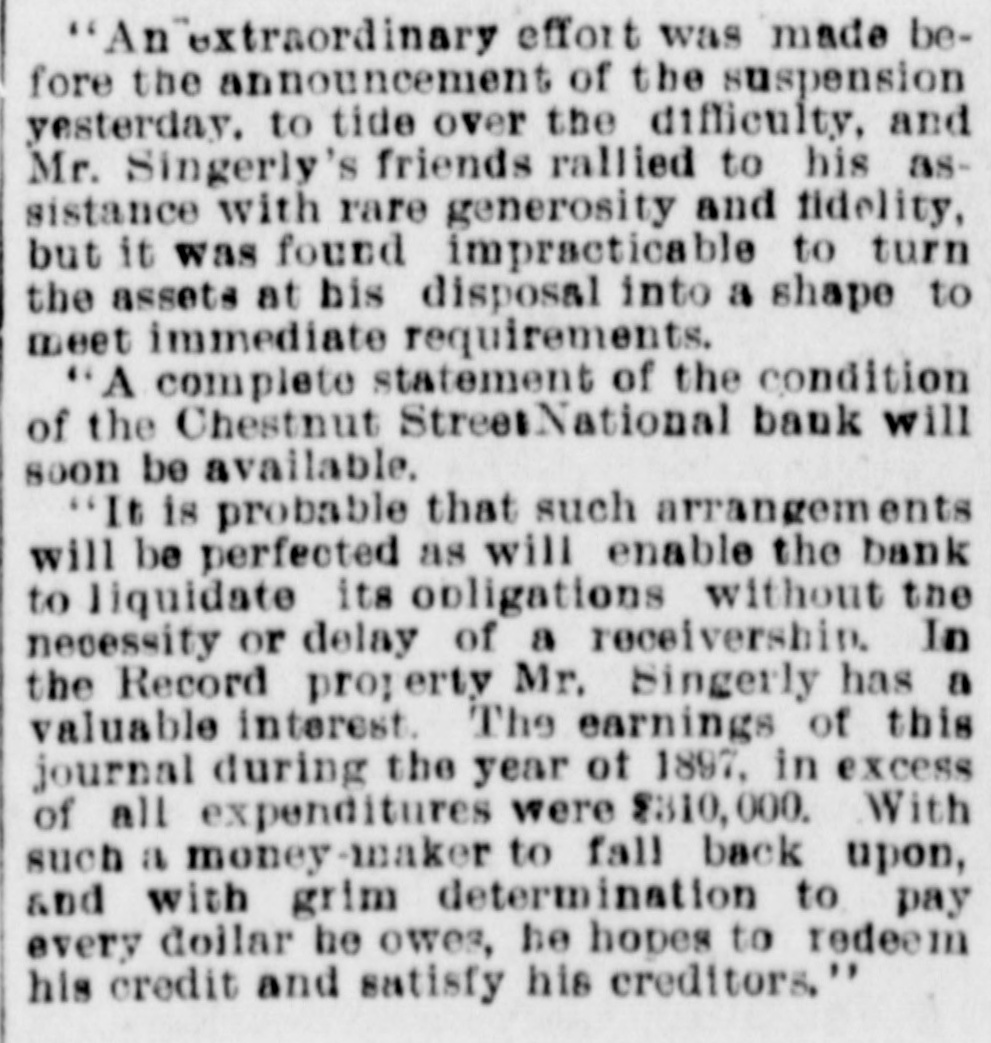
"An extraordinary effort was made before the announcement of the suspension yesterday, to tide over the difficulty, and Mr. Singerly's friends rallied to his assistance with rare generosity and fidelity, but it was found impracticable to turn the assets at his disposal into a shape to meet immediate requirements. "A complete statement of the condition of the Chestnut Street National bank will soon be available. "It is probable that such arrangements will be perfected as will enable the bank to liquidate its obligations without the necessity or delay of a receivership. In the Record property Mr. Singerly has a valuable interest. The earnings of this journal during the year of 1897, in excess of all expenditures were $310,000. With such a money-maker to fall back upon, and with grim determination to pay every dollar he owes, he hopes to redeem his credit and satisfy his creditors."


Article from The Seattle Post-Intelligencer, December 24, 1897

Click image to open full size in new tab

Article Text

Total Voluntary Liquidation Probable. WASHINGTON Dec. 23.-Comptroller of the Currency Eckels said today. In regard to the failure of the Chestnut Street National bank, of Philadelphia, that the suspension was primarily due to a shrinkage in the value of the bonds and notes of the Singerly Pulp and Paper Mills. located at Elkton, Md. The capital of the bank le $500,000; the deposits aggregate about $1,750,000. and Its surplus is about $150,000. Mr. Eckels said there was not the least suspicion of wrong-doing on the part of the bank, and he still had strong hopes of arranging for a voluntary liquidation of the bank affairs without the expense incident to the appointment of a receiver. Mr. Eckels said this afternoon that no other banks were involved, and that in his judgment none would be affected by the failure. Mr. Eckels and Mr. Hart, the bank examiner in charge, had a conversation late this afternoon over the longdistance telephone. Mr. Hart said that a joint meeting of the directors of the two failed concerns, with Mr. John S. Bullitt, who is acting as counsel for the department: Mr. Goffin, the deputy comptroller. and himself. was then in progress, and that they were working on a plan to bring about voluntary liquidation with reasonable hope of success. Among the directors present were several men of large means, and It was hoped that a final settlement on this basis ultimately would be secured. Boston Banks Will Lose Nothing. BOSTON, Dec. 23.-At the Third National bank the correspondent of the Chestnut Street National bank. of Philadelphia, which failed today. it was said that the Philadelphia institution has sufficient balances here to cover any outstanding liabilities, and that none of the Boston banks would lose anything on account of the fallure. Depositors to Be Paid in Full. A great number of small accounts were carried by the trust company and apprehension was expressed that some distress might follow the failure. If the hopes of a quick settlement are realized, however, all depositors will be paid in full within a short time. It is said that there have been quiet, but steady, runs on both banks for several days past. Of the deposits in the bank the city is represented by $289,554; the state by $225,0000, and the national government by a large sum, but all of these creditors are believed to be protected. When the trust company made its last report to the state authorities on November 16, the deposits amounted to $1,492,353. A meeting of the directors of the trust company will be held tomorrow to decide upon a course of procedure. It is believed the state bank examiner will then take formal possession of the institution. State Bank Commissioner Gilkeson was in the office of the company a short while today, and said that he had the books of the institution under inspection for some time past. Much sympathy is expressed on all sides for Mr. Singerly. He has occupied such a prominent place in the affairs of the state and city for years past that the news of his financial difficulties naturally created a sensation. Mr. Singerly stated tonight that he received hundreds of telegrams from all over the country expressing the sympathy of his friends. He has borne the strain very well, though he naturally shows In his face and manner the deep concern his troubles are causing him. The Chestnut Street National bank was established in June, 1877. but was not incorporated until July 5, of the same year. Hon. Robert E. Pattison was Its first president, assuming the office when he retired from the governorship. When he again became governor. in 1891. Mr. Singerly succeeded him. The present officers and directors of the bank are: President, Willfam M. Singerly: vice president. Isaac Cooper: directors, Benjamin P. Obdyke, Benjamin A. Vanschaack, John Simmons, Charles A. Porter, Walter T. Bradley and George J. Zeigler, jr.: paying teller, W. W. Price: cashier, William Steele: notary pubItc. J. F. Reardon. The officers and directors of the Chestnut Street Trust and Savings Fund Company are: President. William M. Singerly: vice president. Isaac Cooper: secretary and treasurer, Irvin C. Carverick: title officer, H. C. Hart: directors. William M. Singerly, Issac Cooper. Benjamin Obdyke, BenJamin A. Vanschaack, John Simmons, A1-


Article from The Daily Morning Journal and Courier, December 25, 1897

Click image to open full size in new tab

Article Text

MR. SINGERLY'S TROUBLES. A Personal Statement in the RecordThe Closed Chestnut Street Institutions. Philadelphia, Dec. 24.-The Record to-day publishes the following editorial: 'To the Public-The Record is compelled to make a painful personal announcement this morning. Owing to the financial embarrassment of Mr. William M. Singerly, president of the Record Publishing company, the Chestnut Street National bank and the Chestnut Street Trust and Savings Fund company were obliged to suspend business yesterday. The weight which proved too heavy for Mr. Singlerly to carry was his large investment in the Singerly Pulp and Paper Mills at Elkton, Maryland. The extreme shrinkage in the price of paper and the resulting depreciation in the value of that property was the primary cause of his embarrassment and of the suspension of the bank and trust company with which he has been so closely identified. "An extraordinary effort was made before the announcement of the suspension yesterday to tide over the difficulty, and Mr. Singerly's friends rallied to his assistance with rare generosity and fidelity; but it was found impracticable to turn the assets at his disposal into a shape to meet immediate requirement. A complete statement of the condition of the Chestnut Street National bank will soon be available. It is probable that such arrangements will be perfected as will enable the bank to liquidate its obligations without the necessity of the delay of a receivership. In the Record property Mr. Singerly has a valuable asset. The earnings of this journal during the year 1896, in excess of all expenditures, were $310.000. With such a money maker to fall back upon, and with grim determination to pay every dollar he owes, he hopes to redeem his credit and satisfy his creditors." The Chestnut Street Trust and Savings Fund company made an assignment to-day for the benefit of creditors to George E. Earl, jr., president of the Tradesmen's National bank, and Richard Y. Cook, president of the Guarantee Trust and Safe Deposit company. The bank examiner and his assistants were busily engaged to-day in going over the books and accounts of the Chestnut Street National bank. The examiner declines to make any statement regarding the assets and liabilities of the institution, but says he will 3 furnish a complete statement when his investigation shall have been completed. Every effort is being made by President Singerly and the directors of r the bank to adjust the accounts of the 3 bank in such a manner that the credf itors will receive every dollar which is due them. Following the meeting of the directors of the trust company, which terminate ed in an assignment of the company, there was a conference of the officials 1 of the bank with representatives of a number of financial institutions of the e city, at which was discussed a plan to raise sufficient funds to liquidate all . the claims against the bank. President Singerly says that he is confident that some plan can be consummated by : which all creditors of the bank will be d paid in full and the bank be permited e to go into voluntary bankruptcy. The is trust company has about thirty-two r hundred different deposit accounts and the bank about eighteen hundred deS posit accounts.


Article from The Times, December 28, 1897

Click image to open full size in new tab

Article Text

PLANS OF COL. SINGERLY Aiming to Reorganize the Suspended Philadelphia Bank. Creditors to Be Divided Into Three Classes-Points of the Arrangement Decided Upon. Philadelphia, Dec. 27.-A plan of reorganization and adjustment of the affairs of the Chestnut Street Trust and Savings Fund Company, of the Chestnut Street National Bank. and of the affiliated busi ness interests of William M. Singerly, was made public tonight. and will be submitted to the creditors of those institutions and of Mr. Singerly, by George N. Earle, jr., and Richard Y. Cook, the assignees of the trust company. The assignees werein conference with Mr. Singerly, Assistant Comptroller Coffin, of 'the Treasurv Department, and counsel this afternoon. When they adjourned late this evening they had adopted a formal plan of reorganization, to be submitted to the creditors. The plan aims to place all the assets of Mr. Singerly and of the Bank and Trust Company in the bands of reorganiza tion managers. It divides the creditorsinto three classes: first. those who assent to the plan to the extent to which they may hold lieus against the Record Publishing Company, orpreferredor city claimsagainst the bank of trust company, or persons, or corporations willing to advance money in furtherance of the plan. Second. Holders of claims against the Record, or claims secured by its stock, the managers reserving to themselves the right to determine without liability the amount or existence of such claims. Third. All creditors other than those specified who may have an interest in the success of the reorganization. The plan then provides for the issue of capital stock of the Record Publishing Compan to an amount sufficient to pay the creditors of the first-class par for their claims, in a 6 per cent cumulative pieferred stock. The Creditors of the second class, par in a 6 per cent cumulative second preferred stock, and the creditors of the third class, par in common stock. No incumbrance against the property of the Record Publishing Company is to be created without the assent of the tolders of two-thirds of the preferred stock of both classes. The plan says: "There now exists $1,000,000 of common stock of the Record Publishing Company, to the prior lien of $700,000 of mortgages. After a full examination of the property, it was recommended to a syndicate recently formed that this stock issue be increased by the issuance of


Article from Barbour County Index, December 29, 1897

Click image to open full size in new tab

Article Text

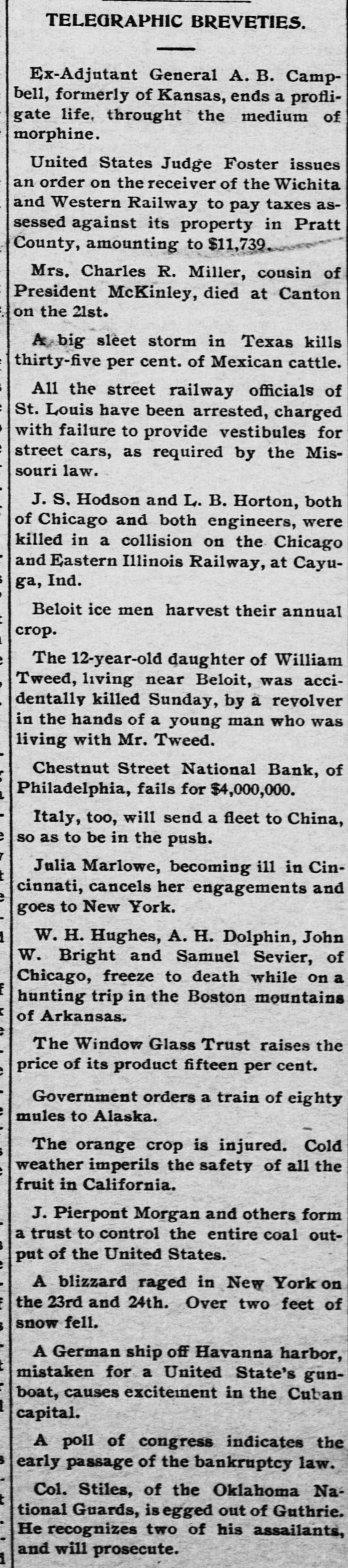
TELEGRAPHIC BREVETIES. Ex-Adjutant General A.B. Campbell, formerly of Kansas, ends a profligate life, throught the medium of morphine. United States Judge Foster issues an order on the receiver of the Wichita and Western Railway to pay taxes assessed against its property in Pratt County, amounting to $11,739. Mrs. Charles R. Miller, cousin of President McKinley, died at Canton on the 21st. A big sleet storm in Texas kills thirty-five per cent. of Mexican cattle. All the street railway officials of St. Louis have been arrested, charged with failure to provide vestibules for street cars, as required by the Missouri law. J.S. Hodson and L. B. Horton, both of Chicago and both engineers, were killed in a collision on the Chicago and Eastern Illinois Railway, at Cayuga, Ind. Beloit ice men harvest their annual crop. The 12-year-old daughter of William Tweed, living near Beloit, was accidentally killed Sunday, by a revolver in the hands of a young man who was living with Mr. Tweed. Chestnut Street National Bank, of Philadelphia, fails for $4,000,000. Italy, too, will send a fleet to China, so as to be in the push. Julia Marlowe, becoming ill in Cincinnati, cancels her engagements and goes to New York. 1 W. H. Hughes, A. H. Dolphin, John W. Bright and Samuel Sevier, of Chicago, freeze to death while on a hunting trip in the Boston mountains of Arkansas. The Window Glass Trust raises the price of its product fifteen per cent. Government orders a train of eighty mules to Alaska. The orange crop is injured. Cold weather imperils the safety of all the fruit in California. J. Pierpont Morgan and others form a trust to control the entire coal output of the United States. A blizzard raged in New York on the 23rd and 24th. Over two feet of snow fell. A German ship off Havanna harbor, mistaken for a United State's gunboat, causes excitement in the Cuban capital. A poll of congress indicates the early passage of the bankruptcy law. Col. Stiles, of the Oklahoma National Guards, isegged out of Guthrie. He recognizes two of his assailants, and will prosecute.


Article from Elmore Bulletin, December 29, 1897

Click image to open full size in new tab

Article Text

BIG BANK FAILURE. Greatest Banks in the City of Philadelphia Suspend Payment. Philadelphia, Dec. 27. A sensation was created in this city by the an nouncement of the suspension of the Chestnut Street, National bank, reas one of the finangarded strongest The cial institutions in the city. suspension carried with it the closing of the Chestnut Trust and Savings Fund company. doing business under the state banking laws. William M. Singerly, publisher of the Philadelphia Record, is president of both companies and the saine men, with one exception act as officers and directors. The first information the public received that the banks were in trouble was in the form of a notice posted on the door of the building occupied jointly by the concerns, signed by National Bank Examiner William M. Hart, to the effect that the Chestnut Street National bank had closed its doors pending an investigation of its affairs. No statement of assets and liabilities is available, but it is stated that the deposits of the Chestnut Street bank amounted to $1,700,000, and of the trust company $1,300,000. President Singerly gave out a brief statement tonight in which he said: "We are working to secure the indebtedness of the two banks so that they can go into voluntary liquidation, and thus avoid a receivership. The net earnings of the Record last year are said to have been $249,000, more than sufficient to pay dividends on a sum sufficient to pay all of Mr. Singerly's indebtedness to the banks. The statements of the cause of the failure current here agree with those made by Comptroller Eckels at Washington, that it was primarily due to the loss of much money by Mr. Singerly in his unproductive paper mill at Elkton, Md., one of the largest in the country. One statement placed the sum thus involved at nearly a million dollars. Mr. Singerly also has much money invested in other enterprises in this and other cities. Rumors were current that the ownership of the Record would pass from Mr. Singerly, but this he denied, his friends stating positively that he is in absolute control of the paper, and will continue at its head. On Monday of this week the Chestnut Street National bank made the following report to the clearing house: Loans and discounts, $2,261,000; legal reserve, $396,000; deposits, $1,789,000; due from banks, $355,000; due to banks, 9686,000; circulation, $43,000. The reserve has been below the legal requirements for several weeks. The deposits on October 5, when the bank reported to the comptroller of the treasury, amounted to $2,239,955. The shrinkage in this sum, therefore, has been more than $300,000 in a little over two months. It is said that there have been quiet but steady runs on both banks for several days past Of the deposits in the bank, the city is represented by $289,554; the state by $225,000, and the national government by a large sum, but all of these creditors are believed to be protected. Much sympathy is expressed on all s sides for Mr. Singerly. He has occupied such a prominent place in the affairs of the state and city for years past that the news of his financial difficulties naturally created a sensation.


Article from The Brunswick Times, December 29, 1897

Click image to open full size in new tab

Article Text

Philadelphia's Bank Failure. Washington, Dec. 28.-Mr. Eckles, today, stated that, in order that there may be DO delay in placing the Chestout Street National bank in voluntary liquidation, in case the creditors of the bank accepted the plan proposed by the committee having it in charge: "I have instructed Deputy Comp. troller George M. Coffin to at once call a meeting of the directors of the Chestnut Street National bank, to pass the necessary resolutions and issue notices to the shareholders for a meeting to vote to go into voluntary liquidation. In addition, I requested him to have the directors obtain at once the signatures of representatives holding two-thirds of the bank's stock, agree to vote for liquidation, which matter will be presented at the meeting to be called. Having done this, I have stated that the comptroller would then permit the bank to go into voluntary liquidation, after the vote is had, on evidence being furnished that the creditors of the bank have accepted the plan proposed by the committee in place of evidences of indebtedness from the bank. By having this arranged before voting, it will enable the public to understand, 1mmediately upon consent of the credi. tors being obtained, that the bank will avoid the appointment of a receiver and the expenses and delay attendant upon a receivership avoided,"


Article from Connecticut Western News, December 30, 1897

Click image to open full size in new tab

Article Text

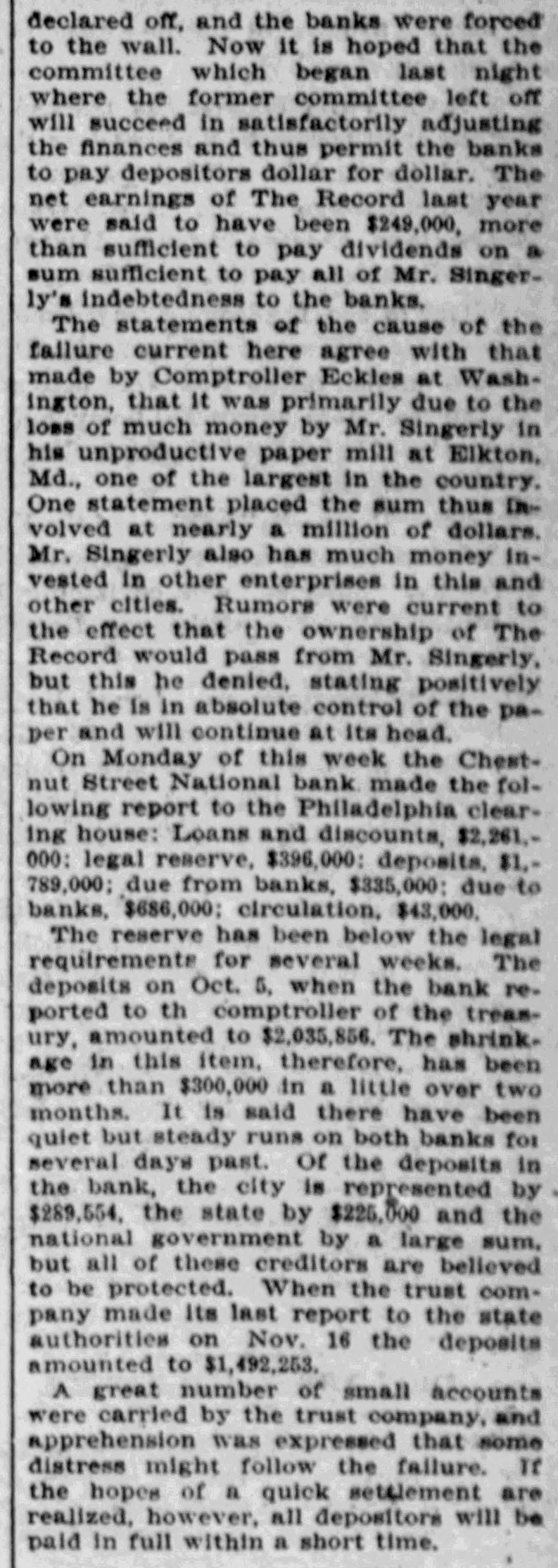
declared off, and the banks were forced to the wall. Now it is hoped that the committee which began last night where the former committee left off will succeed in satisfactorily adjusting the finances and thus permit the banks to pay depositors dollar for dollar. The net earnings of The Record last year were said to have been $249,000, more than sufficient to pay dividends on a sum sufficient to pay all of Mr. Singerly's indebtedness to the banks. The statements of the cause of the failure current here agree with that made by Comptroller Eckles at Washington, that It was primarily due to the loss of much money by Mr. Singerly in his unproductive paper mill at Elkton, Md., one of the largest in the country. One statement placed the sum thus involved at nearly a million of dollars. Mr. Singerly also has much money Invested in other enterprises in this and other cities. Rumors were current to the effect that the ownership of The Record would pass from Mr. Singerly, but this he denied, stating positively that he Is in absolute control of the paper and will continue at its head. On Monday of this week the Chestnut Street National bank made the following report to the Philadelphia clearing house: Loans and discounts, $2,261.000: legal reserve, $396,000: deposits, $1.789,000; due from banks, $335,000; due to banks, $686,000; circulation, $43,000. The reserve has been below the legal requirements for several weeks. The deposits on Oct. 5. when the bank reported to th comptroller of the treasury, amounted to $2,035,856. The shrink. age in this item, therefore, has been more than $300,000 in a little over two months. It is said there have been quiet but steady runs on both banks for several days past. Of the deposits in the bank, the city is represented by $289,554. the state by $225,000 and the national government by a large sum, but all of these creditors are believed to be protected. When the trust company made Its last report to the state authorities on Nov. 16 the deposits amounted to $1,492,253. A great number of small accounts were carried by the trust company, and apprehension was expressed that some distress might follow the failure. If the hopes of a quick settlement are realized, however, all depositors will be paid In full within a short time.


Article from Pike County Press, December 31, 1897

Click image to open full size in new tab

Article Text

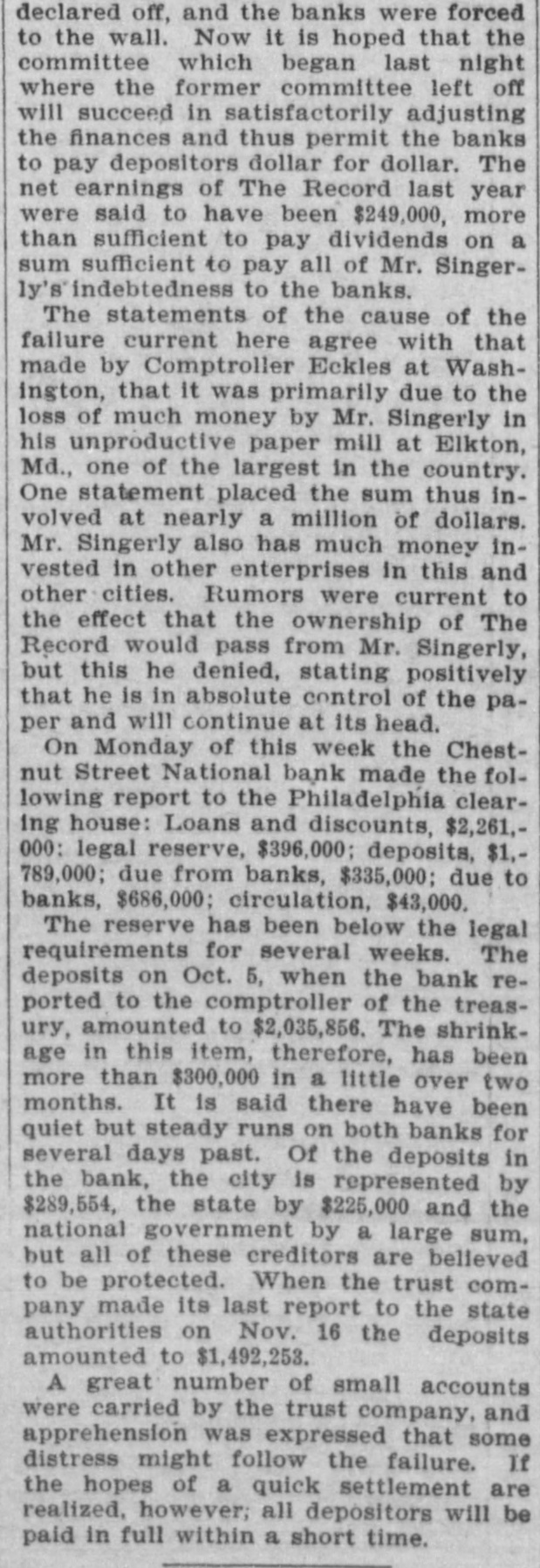
declared off, and the banks were forced to the wall. Now it is hoped that the committee which began last night where the former committee left off will succeed in satisfactorily adjusting the finances and thus permit the banks to pay depositors dollar for dollar. The net earnings of The Record last year were said to have been $249,000, more than sufficient to pay dividends on a sum sufficient to pay all of Mr. Singerly's' indebtedness to the banks. The statements of the cause of the failure current here agree with that made by Comptroller Eckles at Washington, that it was primarily due to the loss of much money by Mr. Singerly in his unproductive paper mill at Elkton, Md., one of the largest in the country. One statement placed the sum thus involved at nearly a million of dollars. Mr. Singerly also has much money invested in other enterprises in this and other cities. Rumors were current to the effect that the ownership of The Record would pass from Mr. Singerly, but this he denied, stating positively that he is in absolute control of the paper and will continue at its head. On Monday of this week the Chestnut Street National bank made the following report to the Philadelphia clearing house: Loans and discounts, $2,261,000: legal reserve, $396,000; deposits, $1,789,000; due from banks, $335,000; due to banks, $686,000; circulation, $43,000. The reserve has been below the legal requirements for several weeks. The deposits on Oct. 5, when the bank reported to the comptroller of the treasury, amounted to $2,035,856. The shrinkage in this item, therefore, has been more than $300,000 in a little over two months. It is said there have been quiet but steady runs on both banks for several days past. Of the deposits in the bank, the city is represented by $289,554, the state by $225,000 and the national government by a large sum, but all of these creditors are believed to be protected. When the trust company made its last report to the state authorities on Nov. 16 the deposits amounted to $1,492,253. A great number of small accounts were carried by the trust company, and apprehension was expressed that some distress might follow the failure. If the hopes of a quick settlement are realized, however; all depositors will be paid in full within a short time.


Article from The Wilmington Daily Republican, January 22, 1898

Click image to open full size in new tab

Article Text

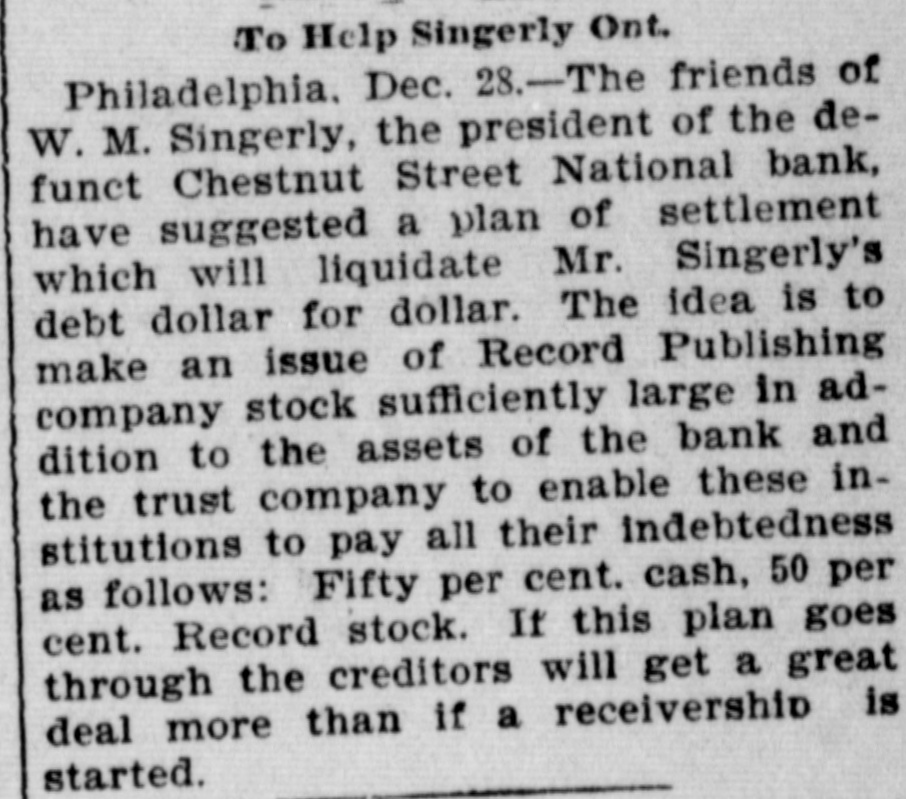
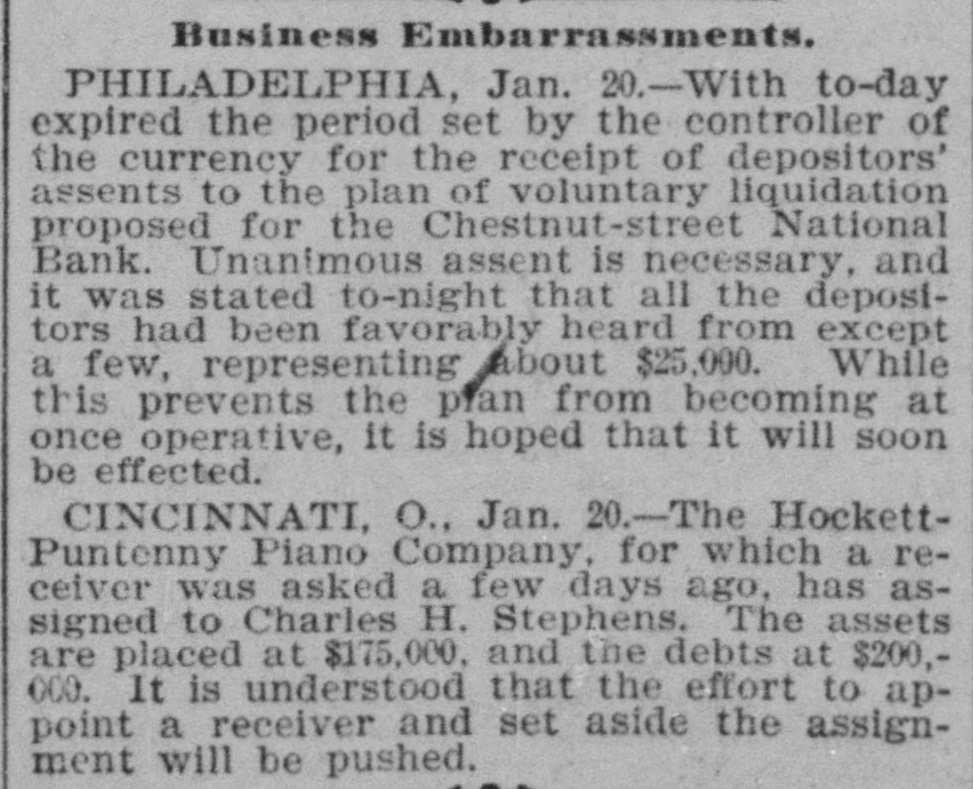
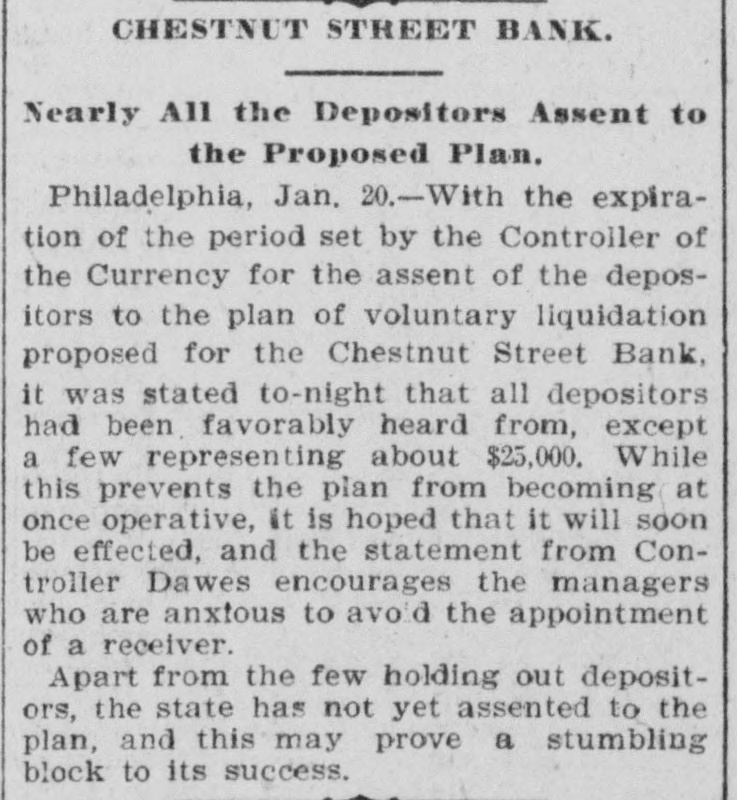
PHILADELPHIA'S FAILED BANK. Some Depositors Oppose Further Time For Voluntary Liquidation Plan. Phuadelphia, Jan. 22.-The Chestnut Street National bank, which closed its doors on Dec. 23, 1897, was yesterday granted further time in which to receive assents to its proposed plan of voluntary liquidation, the comptroller of the currency having originally fixed Jan. 20 as the last day that he would permit the bank to continue without a receiver. Owing to encouraging reports from the managers of Mr. Singerly's I ffairs the comptroller has been induced to extend further time. It developed today that a number of the non-assenting creditors are displeased with the action of the comptroller. They point to the fact that the former comptroller, Mr. Eckles, made a public statement that he was aware that the bank had been in a bad condition more than a year before Its doors wereclosed, and many of the depositors believe that no further time should be granted. The state of Pennsylvania has deposits amounting to $250,000, and the managers of the bank's affairs have anhounced that it is the withholding of the state's assent that has caused the delay in the acceptance of the plan of voluntary liquidation.


Article from New-York Tribune, January 28, 1898

Click image to open full size in new tab

Article Text

AFFAIRS OF MR. SINGERLY'S BANK. THE STOCKHOLDERS VOTE FOR VOLUNTARY LIQUIDATION. Philadelphia, Jan. 27.-There is still no change in the affairs of the Chestnut Street National Bank and the Chestnut Trust and Savinga Fund Com. pany, and it is said that all depends on the result of the coming conference between Controller Dawes and Messrs. Earle and Cook, managers of the proposed plan for settling the affairs of the two institutions. Controller Dawes is expected here tomorrow, when the conference will take place. The stockholders of the bank met to-day and voted in favor of voluntary liquidation. The banking laws require, before the Government can consent to this step, that the stockholders by at least a two-thirds vote shall formally declare themselves in favor of the proposition Out of a total of 5,000 shares, 3,948 were present at the meeting The plan proposed by Messrs. Earle and Cook was fully discussed. A vote was then taken in favor of voluntary liquidation. There were no negative votes. Messrs. Earle and Cook to-day declined to discuss the situation further than to say that they did not see how the plan could be put in operation if the Controller insists on his conditions. The hope of the managers of the plan is that when the Controller arrives here to-morrow and the situation is carefully gone over some compromise may be effected that will insure the success of the plan and prevent the appointment of a receiver.


Article from The News & Observer, February 9, 1898

Click image to open full size in new tab

Article Text

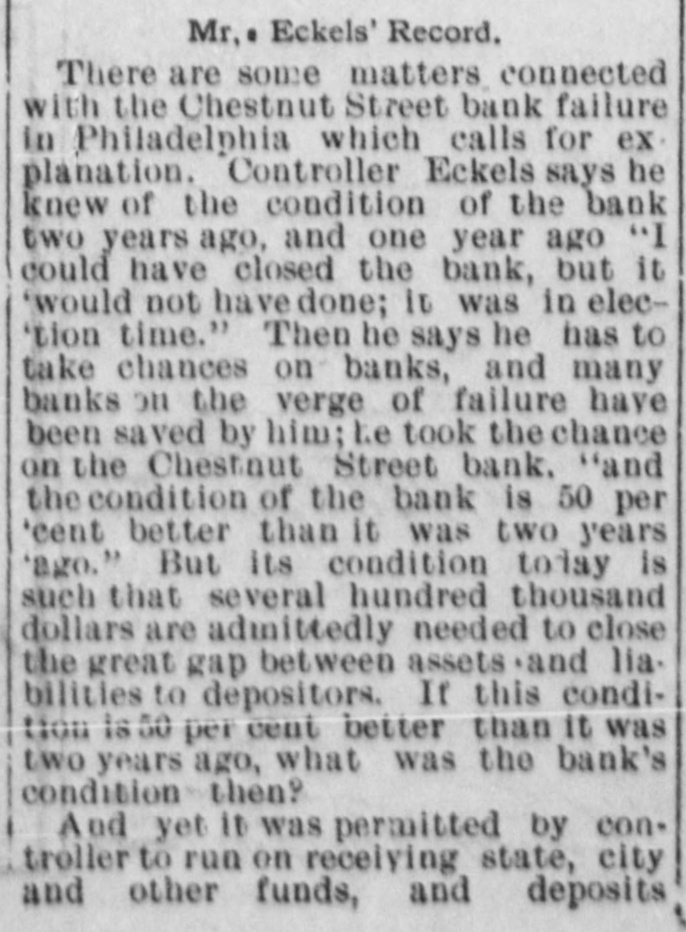
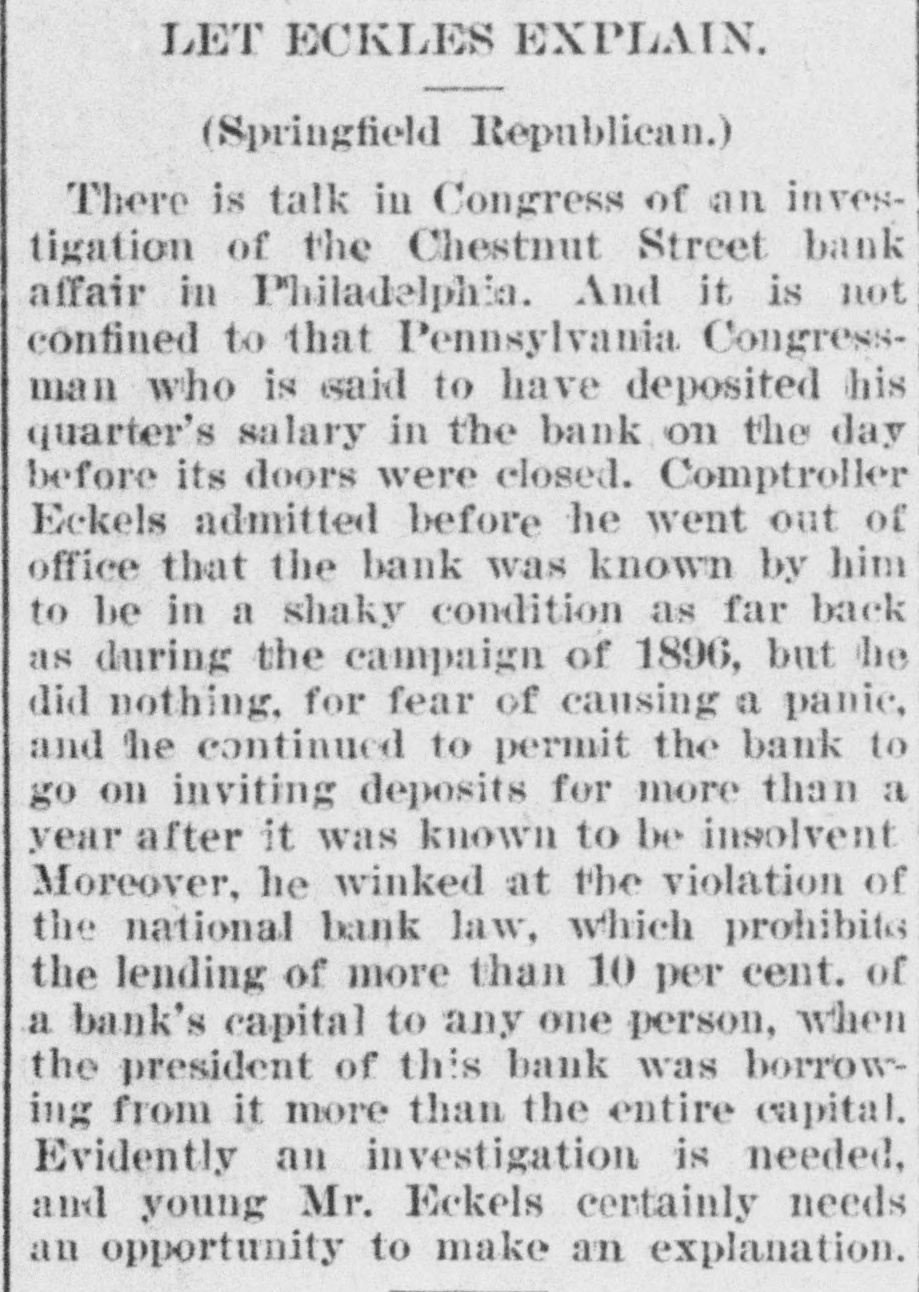
# LET ECKLES EXPLAIN. (Springfield Republican.) There is talk in Congress of an inves- tigation of the Chestnut Street bank affair in Philadelphia. And it is not confined to that Pennsylvania Congress- man who is said to have deposited his quarter's salary in the bank on the day before its doors were closed. Comptroller Eckels admitted before he went out of office that the bank was known by him to be in a shaky condition as far back as during the campaign of 1896, but he did nothing, for fear of causing a panic, and he continued to permit the bank to go on inviting deposits for more than a year after it was known to be insolvent. Moreover, he winked at the violation of the national bank law, which prohibits the lending of more than 10 per cent. of a bank's capital to any one person, when the president of this bank was borrow- ing from it more than the entire capital. Evidently an investigation is needed, and young Mr. Eckels certainly needs an opportunity to make an explanation.


Article from Evening Journal, February 18, 1898

Click image to open full size in new tab

Article Text

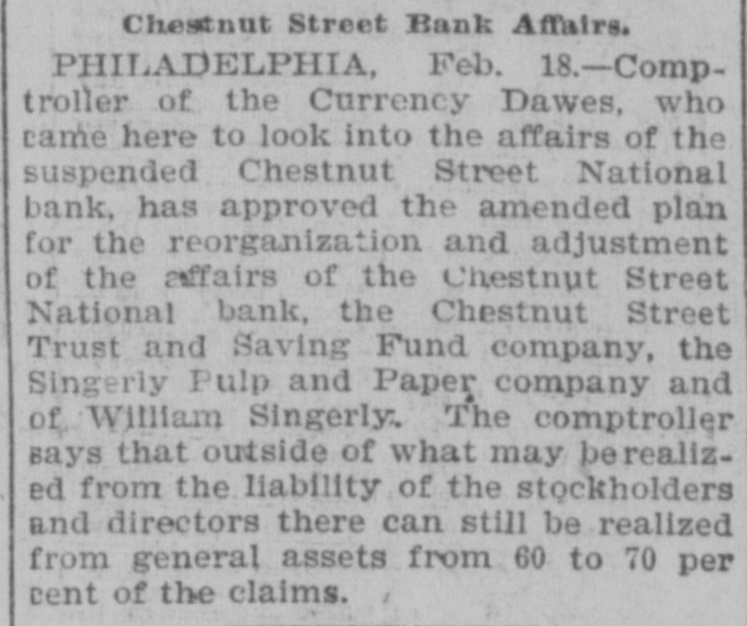
Chestnut Street Bank Affairs. PHILADELPHIA, Feb. 18.-Comptroller of the Currency Dawes, who came here to look into the affairs of the suspended Chestnut Street National bank, has approved the amended plan for the reorganization and adjustment of the affairs of the Chestnut Street National bank, the Chestnut Street Trust and Saving Fund company, the Singerly Pulp and Paper company and of William Singerly: The comptroller says that outside of what may berealized from the liability of the stockholders and directors there can still be realized from general assets from 60 to 70 per cent of the claims.


Article from The Wilmington Daily Republican, April 1, 1898

Click image to open full size in new tab

Article Text

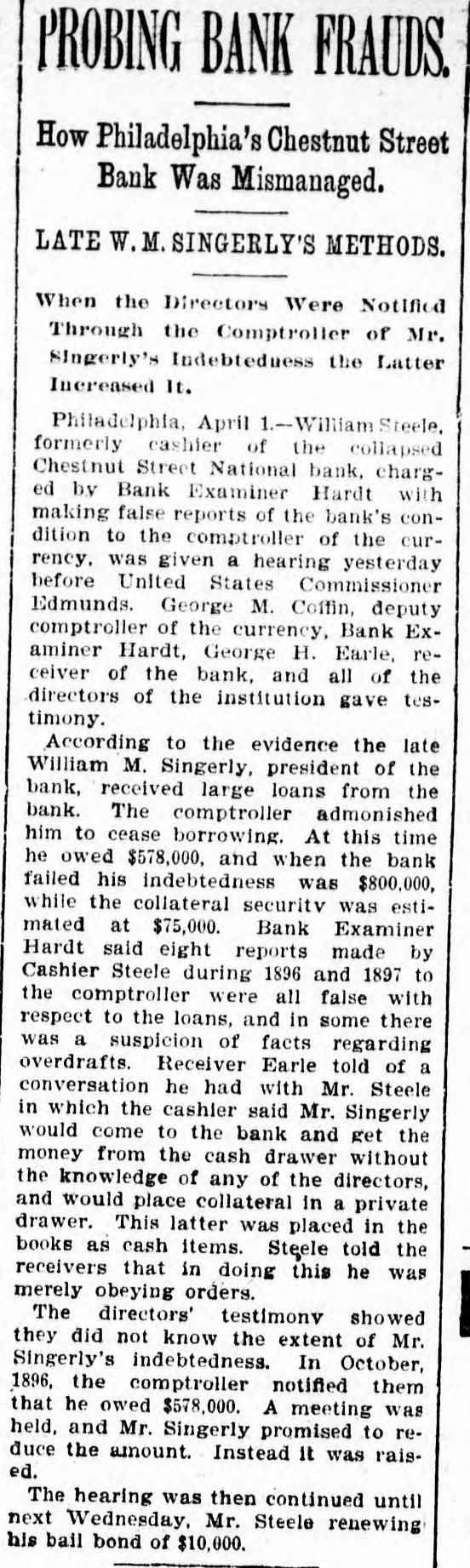
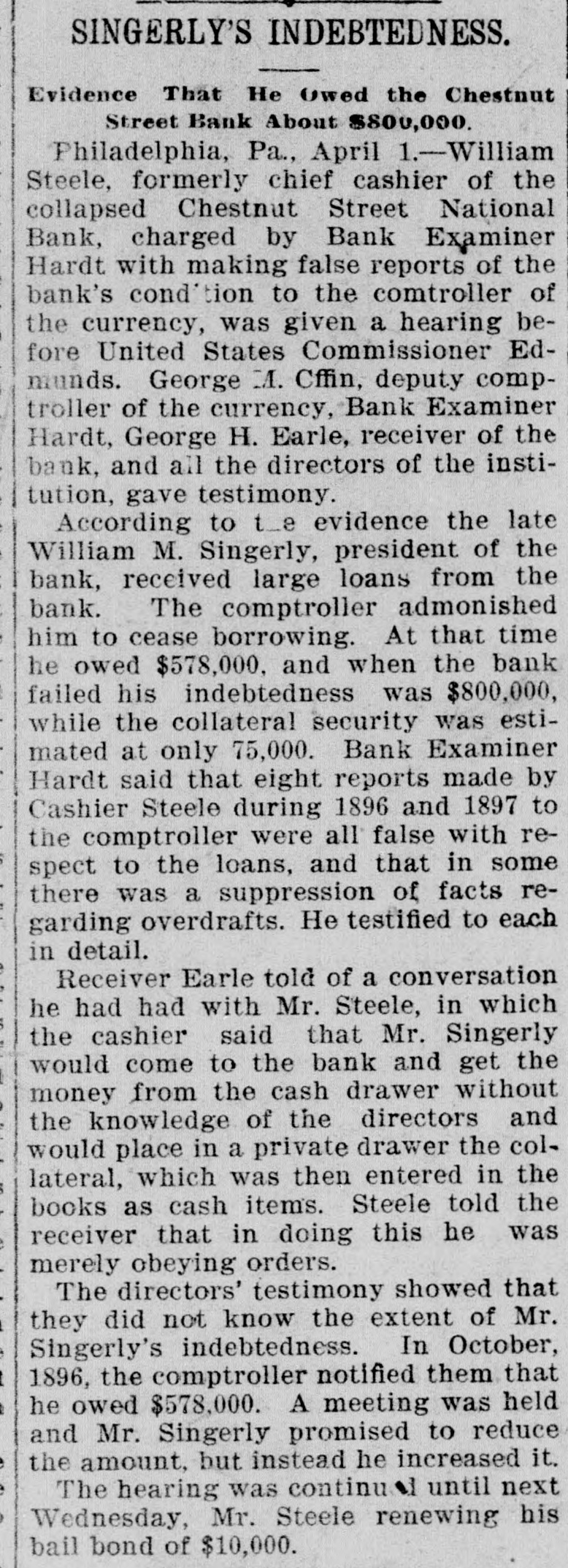
# PROBING BANK FRAUDS. How Philadelphia's Chestnut Street Bank Was Mismanaged. # LATE W. M. SINGERLY'S METHODS. When the Directors Were Notified Through the Comptroller of Mr. Singerly's Indebtedness the Latter Increased It. Philadelphia, April 1.-William Steele, formerly cashier of the collapsed Chestnut Street National bank, charged by Bank Examiner Hardt with making false reports of the bank's condition to the comptroller of the currency, was given a hearing yesterday before United States Commissioner Edmunds. George M. Coffin, deputy comptroller of the currency, Bank Examiner Hardt, George H. Earle, receiver of the bank, and all of the directors of the institution gave testimony. According to the evidence the late William M. Singerly, president of the bank, received large loans from the bank. The comptroller admonished him to cease borrowing. At this time he owed $578,000, and when the bank failed his indebtedness was $800,000, while the collateral security was estimated at $75,000. Bank Examiner Hardt said eight reports made by Cashier Steele during 1896 and 1897 to the comptroller were all false with respect to the loans, and in some there was a suspicion of facts regarding overdrafts. Receiver Earle told of a conversation he had with Mr. Steele in which the cashier said Mr. Singerly would come to the bank and get the money from the cash drawer without the knowledge of any of the directors, and would place collateral in a private drawer. This latter was placed in the books as cash items. Steele told the receivers that in doing this he was merely obeying orders. The directors' testimony showed they did not know the extent of Mr. Singerly's indebtedness. In October, 1896, the comptroller notified them that he owed $578,000. A meeting was held, and Mr. Singerly promised to reduce the amount. Instead it was raised. The hearing was then continued until next Wednesday, Mr. Steele renewing his bail bond of $10,000.


Article from The Scranton Tribune, April 1, 1898

Click image to open full size in new tab

Article Text

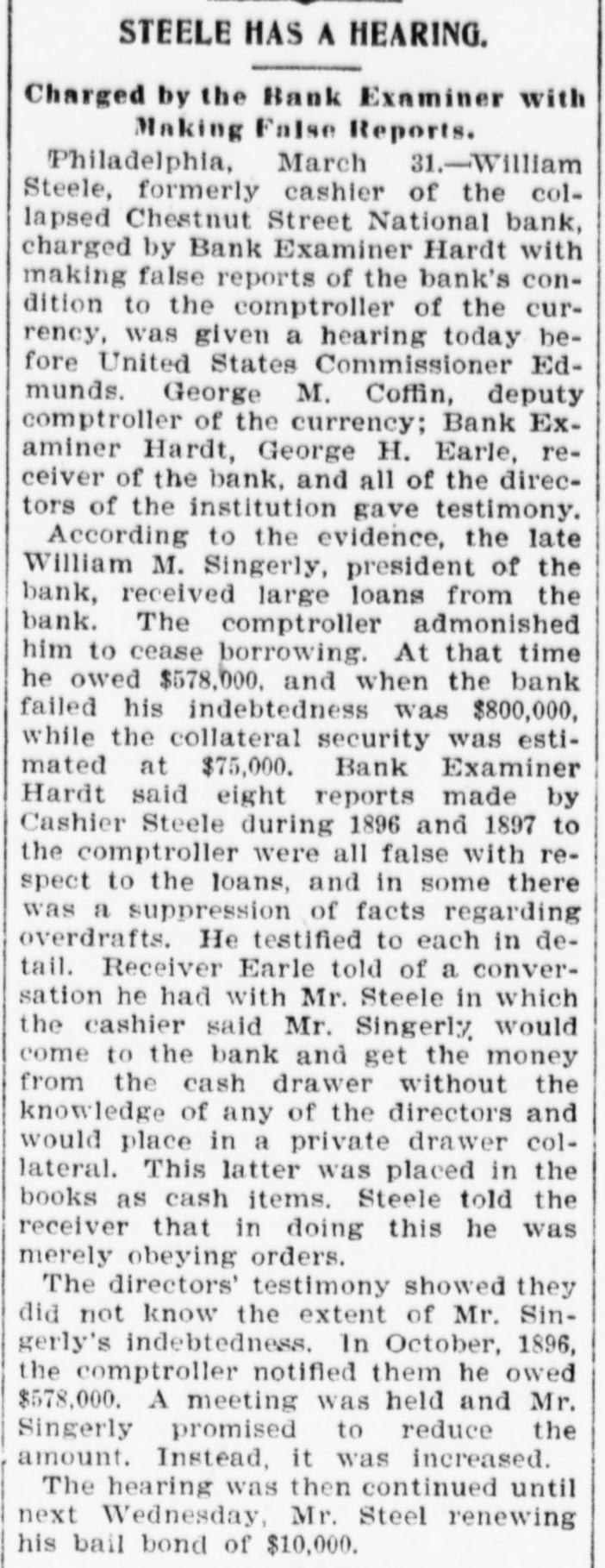
# STEELE HAS A HEARING. Charged by the Bank Examiner with Making False Reports. Philadelphia, March 31.-William Steele, formerly cashier of the collapsed Chestnut Street National bank, charged by Bank Examiner Hardt with making false reports of the bank's condition to the comptroller of the currency, was given a hearing today before United States Commissioner Edmunds. George M. Coffin, deputy comptroller of the currency; Bank Examiner Hardt, George H. Earle, receiver of the bank, and all of the directors of the institution gave testimony. According to the evidence, the late William M. Singerly, president of the bank, received large loans from the bank. The comptroller admonished him to cease borrowing. At that time he owed $578,000, and when the bank failed his indebtedness was $800,000, while the collateral security was estimated at $75,000. Bank Examiner Hardt said eight reports made by Cashier Steele during 1896 and 1897 to the comptroller were all false with respect to the loans, and in some there was a suppression of facts regarding overdrafts. He testified to each in detail. Receiver Earle told of a conversation he had with Mr. Steele in which the cashier said Mr. Singerly would come to the bank and get the money from the cash drawer without the knowledge of any of the directors and would place in a private drawer collateral. This latter was placed in the books as cash items. Steele told the receiver that in doing this he was merely obeying orders. The directors' testimony showed they did not know the extent of Mr. Singerly's indebtedness. In October, 1896, the comptroller notified them he owed $578,000. A meeting was held and Mr. Singerly promised to reduce the amount. Instead, it was increased. The hearing was then continued until next Wednesday, Mr. Steel renewing his bail bond of $10,000.


Article from Wheeling Register, April 2, 1898

Click image to open full size in new tab

Article Text

# SINGERLY'S INDEBTEDNESS. Evidence That He Owed the Chestnut Street Bank About $800,000. Philadelphia, Pa., April 1.β€”William Steele, formerly chief cashier of the collapsed Chestnut Street National Bank, charged by Bank Examiner Hardt with making false reports of the bank's condition to the comtroller of the currency, was given a hearing before United States Commissioner Edmunds. George M. Cffin, deputy comptroller of the currency, Bank Examiner Hardt, George H. Earle, receiver of the bank, and all the directors of the institution, gave testimony. According to the evidence the late William M. Singerly, president of the bank, received large loans from the bank. The comptroller admonished him to cease borrowing. At that time he owed $578,000, and when the bank failed his indebtedness was $800,000, while the collateral security was estimated at only 75,000. Bank Examiner Hardt said that eight reports made by Cashier Steele during 1896 and 1897 to the comptroller were all false with respect to the loans, and that in some there was a suppression of facts regarding overdrafts. He testified to each in detail. Receiver Earle told of a conversation he had had with Mr. Steele, in which the cashier said that Mr. Singerly would come to the bank and get the money from the cash drawer without the knowledge of the directors and would place in a private drawer the collateral, which was then entered in the books as cash items. Steele told the receiver that in doing this he was merely obeying orders. The directors' testimony showed that they did not know the extent of Mr. Singerly's indebtedness. In October, 1896, the comptroller notified them that he owed $578,000. A meeting was held and Mr. Singerly promised to reduce the amount, but instead he increased it. The hearing was continued until next Wednesday, Mr. Steele renewing his bail bond of $10,000.


Article from The Semi-Weekly Messenger, April 12, 1898

Click image to open full size in new tab

Article Text

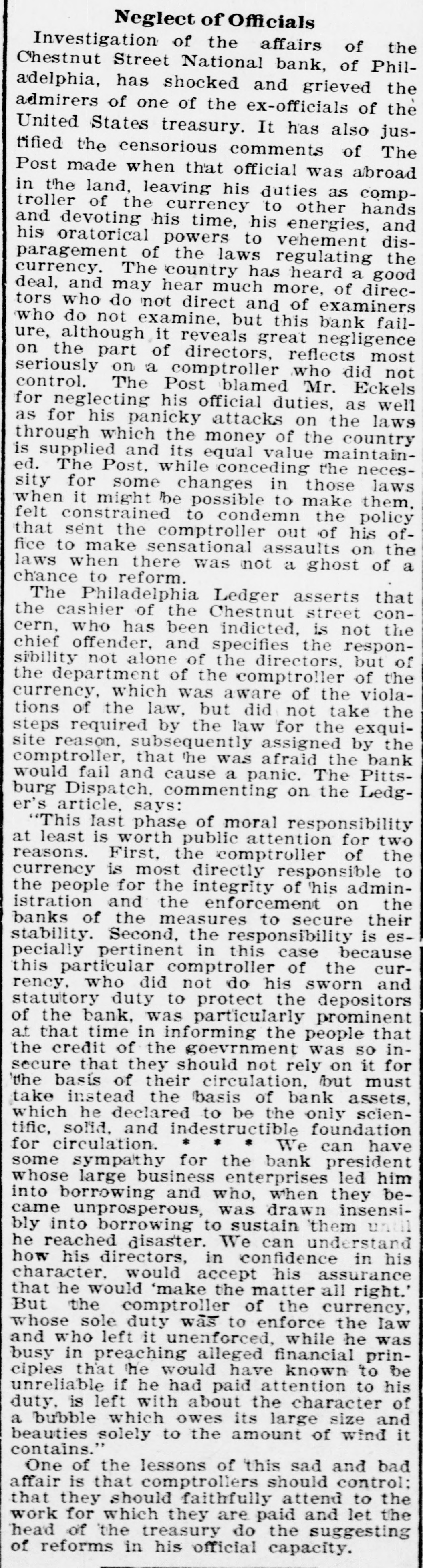
# Neglect of Officials Investigation of the affairs of the Chestnut Street National bank, of Philadelphia, has shocked and grieved the admirers of one of the ex-officials of the United States treasury. It has also justified the censorious comments of The Post made when that official was abroad in the land, leaving his duties as comptroller of the currency to other hands and devoting his time, his energies, and his oratorical powers to vehement disparagement of the laws regulating the currency. The country has heard a good deal, and may hear much more, of directors who do not direct and of examiners who do not examine, but this bank failure, although it reveals great negligence on the part of directors, reflects most seriously on a comptroller who did not control. The Post blamed Mr. Eckels for neglecting his official duties, as well as for his panicky attacks on the laws through which the money of the country is supplied and its equal value maintained. The Post, while conceding the necessity for some changes in those laws when it might be possible to make them, felt constrained to condemn the policy that sent the comptroller out of his office to make sensational assaults on the laws when there was not a ghost of a chance to reform. The Philadelphia Ledger asserts that the cashier of the Chestnut street concern, who has been indicted, is not the chief offender, and specifies the responsibility not alone of the directors, but of the department of the comptroller of the currency, which was aware of the violations of the law, but did not take the steps required by the law for the exquisite reason, subsequently assigned by the comptroller, that he was afraid the bank would fail and cause a panic. The Pittsburg Dispatch, commenting on the Ledger's article, says: "This last phase of moral responsibility at least is worth public attention for two reasons. First, the comptroller of the currency is most directly responsible to the people for the integrity of his administration and the enforcement on the banks of the measures to secure their stability. Second, the responsibility is especially pertinent in this case because this particular comptroller of the currency, who did not do his sworn and statutory duty to protect the depositors of the bank, was particularly prominent at that time in informing the people that the credit of the goevrnment was so insecure that they should not rely on it for the basis of their circulation, but must take instead the basis of bank assets, which he declared to be the only scientific, solid, and indestructible foundation for circulation. We can have some sympathy for the bank president whose large business enterprises led him into borrowing and who, when they became unprosperous, was drawn insensibly into borrowing to sustain them until he reached disaster. We can understand how his directors, in confidence in his character, would accept his assurance that he would 'make the matter all right.' But the comptroller of the currency, whose sole duty was to enforce the law and who left it unenforced, while he was busy in preaching alleged financial principles that the would have known to be unreliable if he had paid attention to his duty, is left with about the character of a bubble which owes its large size and beauties solely to the amount of wind it contains." One of the lessons of this sad and bad affair is that comptrollers should control: that they should faithfully attend to the work for which they are paid and let the head of the treasury do the suggesting of reforms in his official capacity.


Article from Evening Journal, May 6, 1899

Click image to open full size in new tab

Article Text

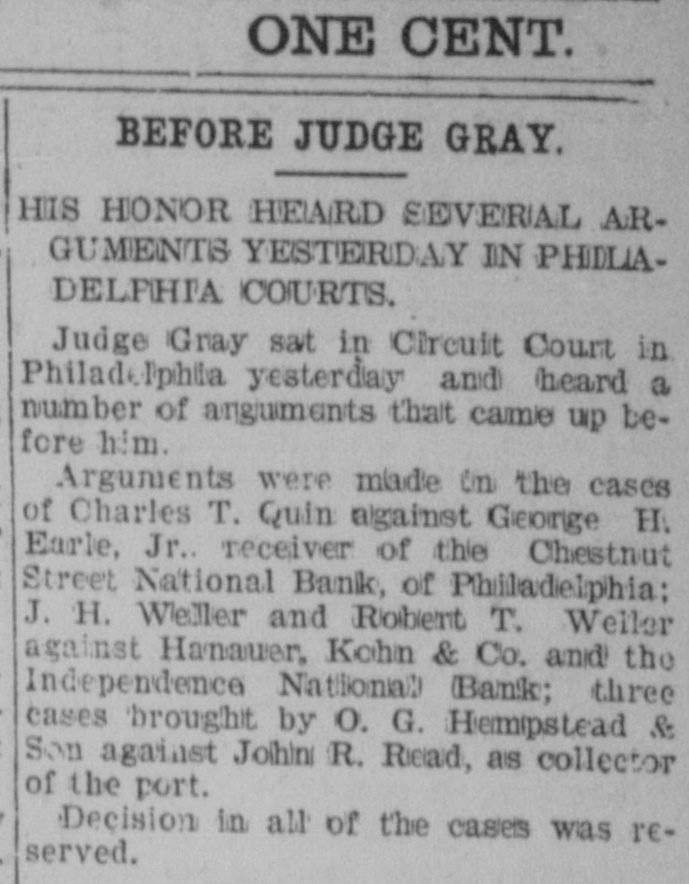
ONE CENT. BEFORE JUDGE GRAY. HIS HONOR HEARD SEVERAL ARGUMENTS YESTERDAY IN PHILLADELFHIA COURTS. Judge Gray sat in Circuit Court in Philadelphila yesterday and heard a number of arguments that came up before him. Arguments were made in the cases of Charles T. Quin algainst George H. Earle, Jr.. receiver of the Chestnut Street National Bank, of Philadelphia; J. H. Weller and Robert T. Weller against Hanauer, Kohn & Co. and the Independence National Bank; three cases brought by O. G. Hempstead & Son against John R. Read, as collector of the port. Decision in all of the cases was I'Eserved.


Article from Arizona Republican, October 19, 1899

Click image to open full size in new tab

Article Text

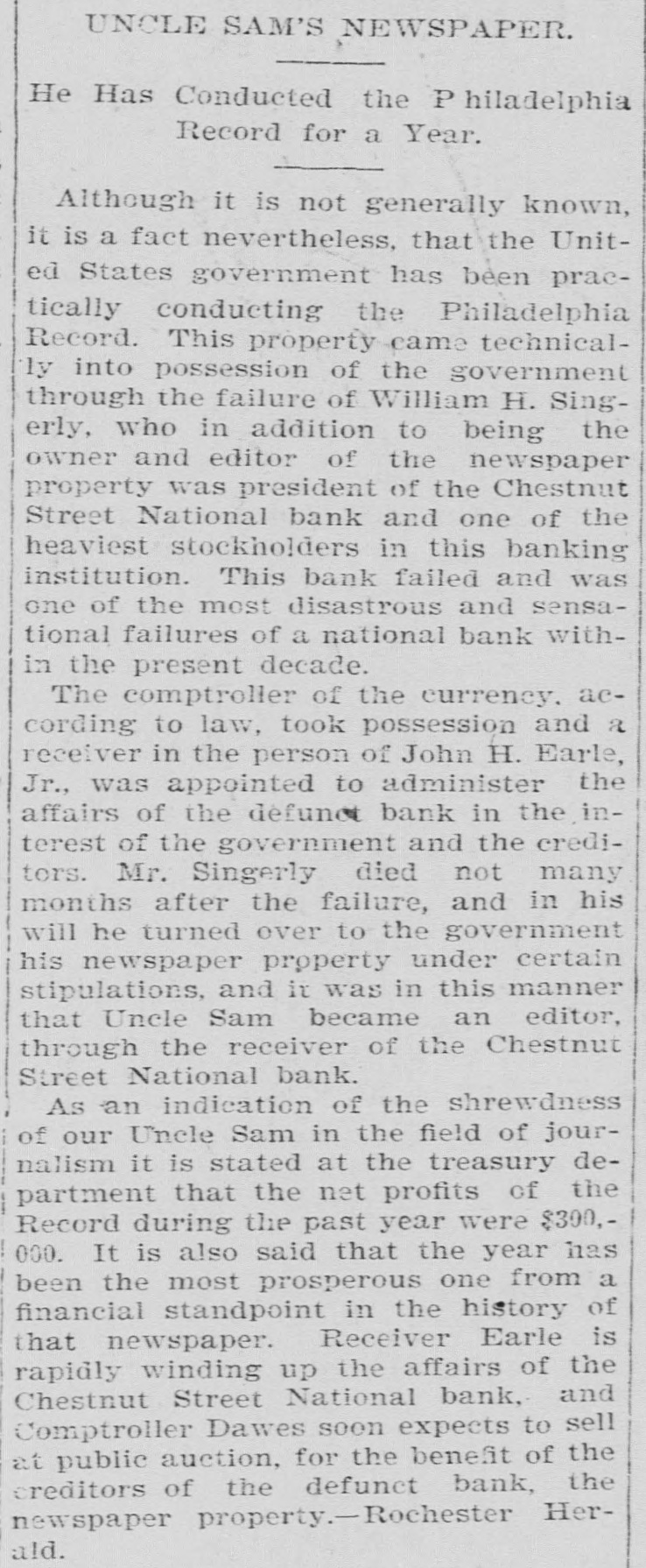
UNCLE SAM'S NEWSPAPER. He Has Conducted the Philadelphia Record for a Year. Although it is not generally known, it is a fact nevertheless, that the United States government has been practically conducting the Philadelphia Record. This property came technically into possession of the government through the failure of William H. Singerly, who in addition to being the owner and editor of the newspaper property was president of the Chestnut Street National bank and one of the heaviest stockholders in this banking institution. This bank failed and was one of the most disastrous and sensational failures of a national bank within the present decade. The comptroller of the currency, according to law, took possession and a receiver in the person of John H. Earle, Jr., was appointed to administer the affairs of the defunct bank in the interest of the government and the creditors. Mr. Singerly died not many months after the failure, and in his will he turned over to the government his newspaper property under certain stipulations, and it was in this manner that Uncle Sam became an editor, through the receiver of the Chestnut Street National bank. As an indication of the shrewdness of our Uncle Sam in the field of journalism it is stated at the treasury department that the net profits of the Record during the past year were $300,000. It is also said that the year has been the most prosperous one from a financial standpoint in the history of that newspaper. Receiver Earle is rapidly winding up the affairs of the Chestnut Street National bank, and Comptroller Dawes soon expects to sell at public auction, for the benefit of the creditors of the defunct bank, the newspaper property.-Rochester Herald.


Article from The Emmett Index, August 5, 1909

Click image to open full size in new tab

Article Text

ence the conduct of an honorable man or the suspicions of one of like character. # H. W. Taft Appears In New York. Lawyers and financial men in New York who have followed the sugar trust matter are recalling this corre- spondence with not a little interest. The firm of attorneys "with Washing- ton connections" was Strong & Cad- walader, of which, at the time Mr. Earle wrote, both Henry W. Tart, a leading counsel for the sugar trust in all the litigation growing out of the Segal loan, and George W. Wicker- sham, the present attorney general, were members. The fact that Henry W. Taft is an attorney of the sugar trust in this identical Segal case, thus involving the law firm of which Attorney General Wickersham was a member, raises an interesting question as to what the present administration will do toward prosecuting the trust. Judging by the vigor with which Collector Loeb pro- ceeded against the same trust in the matter of the short weight frauds, the law business of Henry W. Taft and of the firm of Strong & Cadwalader will have little or no influence on President Taft, and the prosecution will go for- ward with the same vim that marked a Receiver Earle's case. If a private in- dividual could accomplish what he did, what could not the United States gov- ernment accomplish if it proceeded against the trust with all its great power? One of the most remarkable interviews that have appeared in years grew out of this identical suit. It was from no less a man than Sam- uel Untermyer, the famous corporation lawyer of New York, who was re- tained by Segal. Mr. Untermyer stated in effect that the government, if it were in earnest, could not only suc- cessfully prosecute the sugar trust, but many other gigantic corporations that pursue the same methods. That inter- view took the lid off. Whatever the government does, how- ever, George H. Earle has given the sugar trust a staggering blow. He has not alone wrested from it many mil- lions of dollars, but has shown the country what can be done in curbing criminal combinations by any man who means business. That perhaps is the greatest service of all. Moreover, he has put the Real Estate Trust Com- pany of Philadelphia on its feet, thus saving the money of thousands of in- nocent depositors, and has made it possible for the Pennsylvania Sugar Refining company to open its Camden plant and resume business. For his services to the trust company he was unanimously elected Its president. # Other Concerns Saved by Earle. This is but one of a long series of tottering or wrecked institutions that George H. Earle, Jr., has successfully reorganized. Among the others are the Pennsylvania Warehousing and Safe Deposit company, which he took when its stock was down to $5 per share and by cutting out the dead wood, ju- dicious buying of wharfs and busi- ness principles brought it up until its stock is in the neighborhood of $100 per share; the Finance Company as of Pennsylvania, which needed a strong bracing and in Earle's hands got it; the Tradesman's National bank, which got into deep water with its stock down to 50, called on Earle, was set on its feet and now is above par; the Market Street National bank, which was floundering, sent out a hail for Earle and is now selling at a pre- mium of 60: the Reading railroad, which the last time it failed was put back on its feet by Earle and Freder- ick P. Olcott of New York; the Choc- taw, Oklahoma and Gulf railroad, which struck a slump and went under, but with Earle as chairman of its com- mittee of reorganization has been made a paying property, and the Chestnut Street National Bank and Trust company, involving the owner- ship of the great newspaper, the Phila- lelphia Record, all three of which Mr. Earle, with the help of one other re- ceiver, put back into flourishing con- dition, although the bank and trust company had actually falled and the paper was heavily involved. This noteworthy triple success was perhaps Earle's greatest achievement up to the time that he reinstated the Real Estate Trust company and the Pennsylvania Sugar Refining company and forced the sugar trust to disgorge several millions of money, credits, stocks and bonds. And now, after the famous street car strike in Philadel- phia, Mr. Earle has been asked by the mayor and councils to take charge of this situation and in a letter that boldly outlines his views and cuts to the heart of the question has consent- ed to do so. The regard with which he is held in Philadelphia is shown by the fact that since his appointment public confidence that the traction question is at last in the hands of a man who will solve it has been gener- lly expressed. The same trust in his ability and integrity was displayed several years ago when he took charge of a failed trust company. The man- ner in which this particular failure had been brought about had enraged the depositors, large numbers of whom entered suit. On Mr. Earle's mere ap- peal these suits were all withdrawn. He was given complete voting power for the depositors, and he finally paid them every cent with interest.