
First Columbia National Bank (Columbia, PA)

Episode Information

Episode UID
37101112
Episode Type
Suspension β†’ Reopening
Bank Type
national
Bank ID
3710 national
Charter Number
371
Start Date
August 17, 1892
Location
Columbia, Pennsylvania

Metadata

Model
gpt-5-mini (chosen from majority vote of a three-model LLM ensemble)
Short Digest
59e7adec8b1b3718

Response Measures

None

Description

One article (1892) names a 'First National Bank' in Columbia which may be a different institution; 1933 statewide bank holiday clearly applies.

Events (3)

1. April 8, 1864 Chartered
Source
historical_nic
2. August 17, 1892 Other
Newspaper Excerpt
J. F. Miller, of the First National bank, of Columbia, Pa., has absconded and is a defaulter in a large amount.
Source
newspapers
3. March 5, 1933 Suspension
Cause
Government Action
Cause Details
Governor Pinchot proclaimed a mandatory two-day bank holiday for all Pennsylvania banks in response to interstate banking moratoria.
Newspaper Excerpt
I hereby declare a bank holiday throughout Pennsylvania on Saturday, March 4, and Monday, March 6.
Source
newspapers

Newspaper Articles (4)

Article from The Prison Mirror, August 25, 1892

Click image to open full size in new tab

Article Text

NEWS OF A WEEK. August 17. Senator Spooner is nominated for governor of Wisconsin. Walter Mann, one of St. Paul's most public spirited eitizens, dies. Judge Morse receives the democratic nomination for governor in Michigan. Nancy Hanks trots a mile in 2:07Β½ at Chicago, being the fastest mile ever trotted. A number of men are killed on both sides in a fight between state troops and miners at Coal Creek, Tenn. August 18. Hal Pointer paces a mile in 2:05Β½. The British parliament is prorogued until February. The Master Painters' Association is founded in Minneapolis. The Lick observatory confirms the discovery of double canals in Mars. Another fight takes place between miners and militia in Tennessee and several are killed. Eight thousand troops are called to Buffalo, N. Y., to protect railway property from striking switchmen. August 19. The militia gain the upperhand of the miners in Tennessee. The business portion of Geneva, Ohio, is destroyed by fire. Three tramps and six horses are killed in a railway wreck at Prairie Junction, Minn. Eighteen hundred men, it is claimed, are now working in the Carnegie mills at Homestead. The Brotherhood of Locomotive Engineers are holding their annual convention at Toronto, Canada. The treasurer of Pennsylvania has paid out $152,000 on account of the service of troops at Homestead. J. F. Miller, of the First National bank, of Columbia, Pa., has absconded and is a defaulter in a large amount. The house of Dr. Bartlett, and American missionary at Bourdour, province of Konia, Asia Minor, has been burned by the natives. McDonnell and Hill, accomplices of the Bidwells in the great Bank of England forgeries, have been released on condition that they leave the country. August 20. Nancy Hanks tries to lower her record at Chicago, but fails. The president issues a retaliatory proclamation against Canada. A crank meets Queen Victoria on the highway and threatens her life. President Harrison celebrates the fifty-ninth anniversary of his birth. The bodies of fifteen miners killed in the battle at Coal Creek, Tenn., are found. A number of buildings on the East Seventh street embankment, St. Paul, slide down the bluff into what is known as "Swede Hollow." No one is injured, but fire breaks out in the wreck and much property is destroyed. August 21. A retired American army officer commits suicide in London. It seems to-day that the Buffalo switchmen are losing their strike. Minnie Seligman, the actress, and Millionaire Cutting's son are married in New York. A man supposed to have been murdered by strikers at West Superior, Wis., is found alive, but terribly mangled. Mary Lundenberg and Andrew Holenberg are run down by a St. Paul electric car and are terribly injured, the former fatally. Four farmers in Kansas rob an express train of a large amount of money in the neighborhood of their homes, but are captured. August 22. The encampment of Knights of Pythias begins. in Kansas City. One thousand saw mill men at Eau Claire strike for a ten-hour day. Frank Gieffer is arrested at Mankato for the murder of Leonard Roway. Everything remains quiet at Homestead, and the Amalgamated workmen remain out. Wm. L. Sullivan, a brakeman of St. Paul, has a leg cut off by a freight train at Carlisle on the Great Northern. The British bark, Rome, from Bombay for Hull, is wrecked at Groot Valley, South Africa, and it is believed the entire crew are drowned. The large Wagner block on the south side of East Seventh street, St. Paul, is destroyed by fire. This building is opposite that one which was destroyed by a landslide Saturday. August 23. The cholera plague reaches Germany and France. Gov. Merriam has changed the date of the Columbus celebration from:Oct. 12 to Oct. 21. All is quiet now at the scene of the recent conflict between miners and militia in the mining region of Tennessee. Great excitement is caused in Rome by the

Article from The Sun, August 17, 1893

Click image to open full size in new tab

Article Text

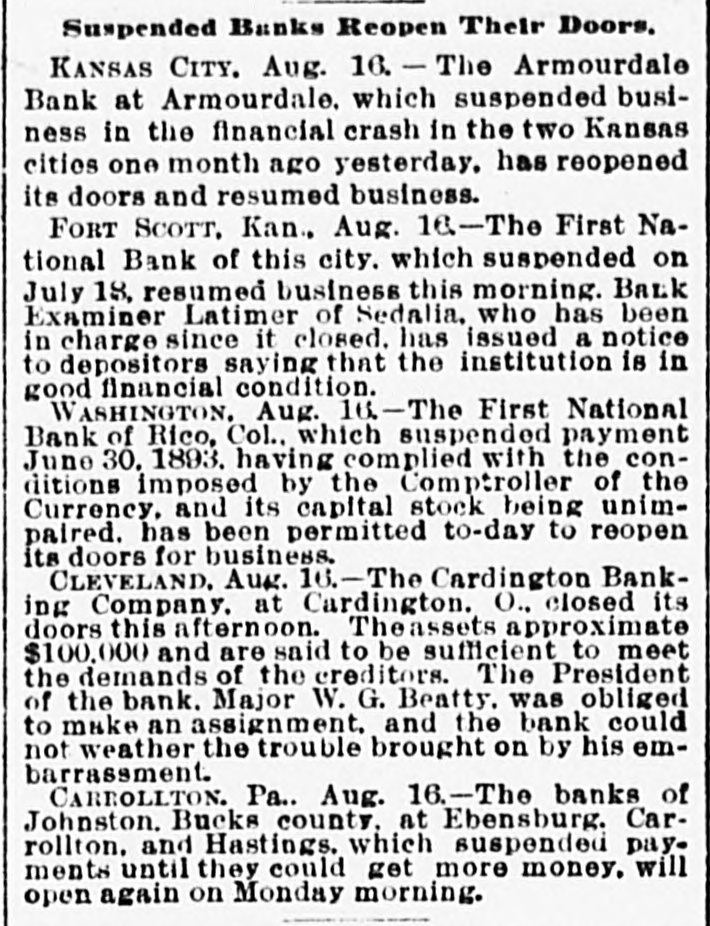
Suspended Banks Reopen Their Doors. KANSAS CITY. Aug. 16. - The Armourdale Bank at Armourdale. which suspended business in the financial crash in the two Kansas cities one month ago yesterday. has reopened its doors and resumed business. FORT SCOTT, Kan., Aug. 16-The First National Bank of this city. which suspended on July 18, resumed business this morning. Bank Examiner Latimer of Sedalia. who has been in charge since it closed. has issued a notice to depositors saying that the institution is in good financial condition. WASHINGTON. Aug. 16.-The First National Bank of Rico, Col., which suspended payment June 30. 1893. having complied with the conditions imposed by the Comptroller of the Currency. and its capital stock being unimpaired. has been permitted to-day to reopen its doors for business. CLEVELAND. Aug. 16.-The Cardington Banking Company. at Cardington. O., closed its doors this afternoon. Theassets approximate $100. 000 and are said to be sufficient to meet the demands of the creditors. The President of the bank. Major W. G. Beatty. was obliged to make an assignment. and the bank could not weather the trouble brought on by his embarrassment. CARROLLTON. Pa.. Aug. 16.-The banks of Johnston. Bucks county. at Ebensburg. Carrollton. and Hastings. which suspended payments until they could get more money. will open again on Monday morning.


Article from Evening Star, March 4, 1933

Click image to open full size in new tab

Article Text

# EARLY U. S. ACTION # PLANNED ON BANKS New York and Illinois Declare Holidays-Only Four States Unrestricted. (Continued From First Page.) Connecticut took similar action, bring- ing to 43 the list of States in which restrictions on withdrawals are opera- tive in some form or another. Only Montana, Colorado, North Da- kota and South Carolina remained without restrictions at noon today. Delaware's banks were open, but the State Legislature has already taken emergency action. These developments had brought from Representative Rainey, the next Speaker of the House, the prediction that "an extra session of Congress will be called at the earliest possible time." He said he felt that early next week, possibly Tuesday, would not be too soon. Pre- viously Rainey had told House mem- bers-elect to remain in Washington. Others at the Capitol said the session probably would begin Wednesday. The Federal Reserve Bank of New York was closed with all other bank- ing institutions of that State. The Federal Reserve Bank at Philadelphia also closed, under a holiday declared throughout Pennsylvania by Gov. Pin- chot. Later in the day the Minne- apolis Federal Reserve Bank suspended business. The closing of the New York Federal Reserve Bank meant the tying up of its huge gold reserve for the period of the holiday against withdrawal by either domestic or foreign agencies. In discussing the banking relief pro- gram, Senator Robinson said: "We do not know just when it will be completed, but it will be expedited all possible. The details can not be announced right now but you may be assured there will be no delay." Wagner Plans Action, Previously Senator Wagner, Demo- crat, of New York, had told newspaper men he would carry immediately to Democratic leaders an appeal for imme- diate emergency banking moves. In- formed at his hotel here of banking moratoria in New York and Illinois. Wagner said he would appeal this morn- ing to Democratic leaders to begin working out a program and some time this afternoon would call on Mr. Roose- velt with the same objective. A bank holiday, he said, "is the only thing to do" to meet the emergency of the banks themselves, but he added quick steps are necessary to enable them to reopen and continue opera- tions. Harvey Couch, Democratic member of the Reconstruction Finance CorpoΠ³Π°- tion, was the first White House caller this morning. He said after a brief conference with President Hoover he had discussed "matters incident to the banking situation," but declined to give details. Couch conferred last night with President-elect Roosevelt. Officials in Conferences. High officials both of the outgoing Republican and incoming Democratic administrations were in conference most of the night. Secretary of the Treasury Mills said afterward the Hoover administration would have no statement, but that governors of the Federal Reserve banks in Chicago and New York would have announcements. Demands Impossible. The hours between midnight and dawn saw banking officials in many States struggling with the problem, made acute by the flurrying of nervous- ness on the part of depositors. As a statement by the New York Clearing House Committee put it: "The unthinking attempt of the pub- lic to convert over $40,000,000,000 of deposits into currency at one time is, on its face, impossible." The statement added that the condi- tion clearing house banks is such that "they could, through the facilities of the Federal Reserve Bank, pay on de- mand every dollar of their deposits," but that withdrawals throughout the country as a whole have increased so that a "halt" is necessary "to enable the proper authorities to consider and adopt remedies to meet this situation, not for New York primarily, but for the Nation as a whole." Only a few States remained today in which restrictions on withdrawals had not been invoked. No Holiday in Virginla. In Virginia, Gov. Pollard said no general banking holidays would be de- clared because the State's laws already protect the banks and their depositors. In Maryland, the General Assembly early today approved the emergency banking legislation without a dissenting vote in either House. Gov. Ritchie signed it this morning, but said that the banking institutions of the State will not reopen Monday. The resources of the Reconstruction Finance Corporation earlier had been made available to hard-pressed, but solvent banks in States that have imposed moratoria on withdrawals. This was one of a number of de- velopments yesterday that included introduction of legislation to allow postal savings checking accounts and to confer upon the incoming admin- istration sweeping authority to main- tain the security of deposits. Reconstruction Corporation officials said their policy called for lending in- stitutions if the loans were well secured enough money to pay the percentage of deposits that could be withdrawn, provided the banks did not have the funds immediately available. It was emphasized this was not a new departure, but was simply the ap- plication of regulations decided upon for individual instances in the past to a situation spread into a number of States. Pinchot's Statement. Gov. Pinchot of Pennsylvania here for the inauguration issued the follow- ing statement: "Because of the declaration of a bank holiday in New York, Illinois and most of the other States, similar action in Pennsylvania has become unavoidable. "Were our banks to remain open, the demands upon them would impose an impossible burden. "Therefore, upon specific recom- mendation of Gov. Norris of the Phila- delphia Federal Reserve Bank, I hereby declare a bank holiday throughout Pennsylvania on Saturady, March 4, 1933, and Monday, March 6, 1933." Exchange Statement. A statement issued by the Govern- ing Committee of the New York Stock Exchange said: "The Governing Committee at a meeting held this morning in order to give full effect to the banking holiday declared by the Governor of the State of New York directed: "First, that the exchange be closed during such holiday: "Second, that members and firms registered on the exchange be pro- hibited from making any contracts for the purchase or sale or the borrowing or lending of any securities, and also from permitting their offices or facili- ties to be used for the purpose of mak- ing or carrying out any such contracts; "Third, that all deliveries be suspend- ed on all member contracts, except on such contracts as may be cleared by or settled through the Stock Clearing Corporation, and that in such cases deliveries shall be made as the Stock Clearing Corporation shall direct


Article from The Daily Courier, March 4, 1933

Click image to open full size in new tab

Article Text

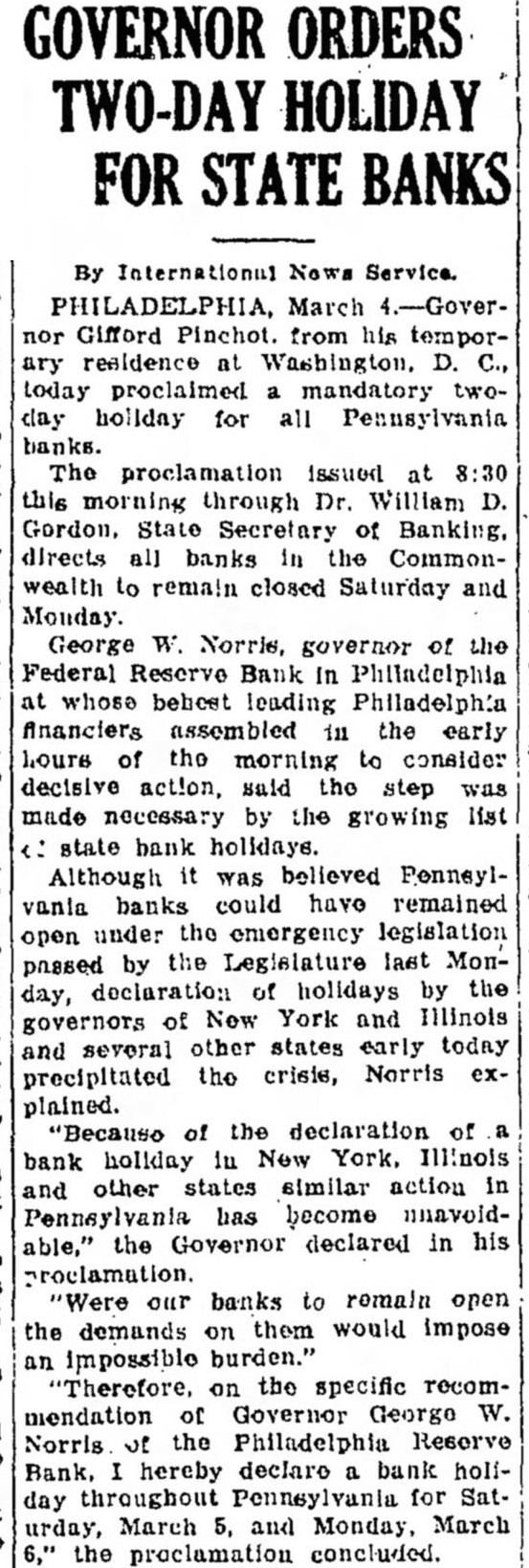
GOVERNOR ORDERS TWO-DAY HOLIDAY FOR STATE BANKS By International Nows Service. PHILADELPHIA, March 4.-Governor Gifford Pinchot. from his temporary residence at Washington, D. C., today proclaimed mandatory twoday hollday for all Pennsylvania banks. The proclamation issued at 8:30 this morning through Dr. William D. Gordon, State Secretary of Banking, directs all banks in the Commonwealth to remain closed Saturday and Monday. George W. Norris, governor of the Federal Reserve Bank in Philadelphia at whose behest leading Philadelphia financiers assembled in the early Lours the morning to consider decisive action, said the step was made necessary by the growing list state bank holidays. Although it was believed Penneylvania banks could have remained open under the emergency legislation passed by the Legislature last Monday, of holidays by the governors of New York and Illinois and several other states early today precipitated the crisis, Norris explained. "Because of the declaration of bank holiday in New York, Illinois and other states similar action in Pennsylvania has become unavoidable," the Governor declared in his "Were our banks to remain open the demands on them would impose an impossible burden." "Therefore, on the specific recommendation of Governor George W. Norris of the Philadelphia Reserve Bank, hereby declare bank hollday throughout for Saturday, March 5, and Monday, March 6," the proclamation concluded.